
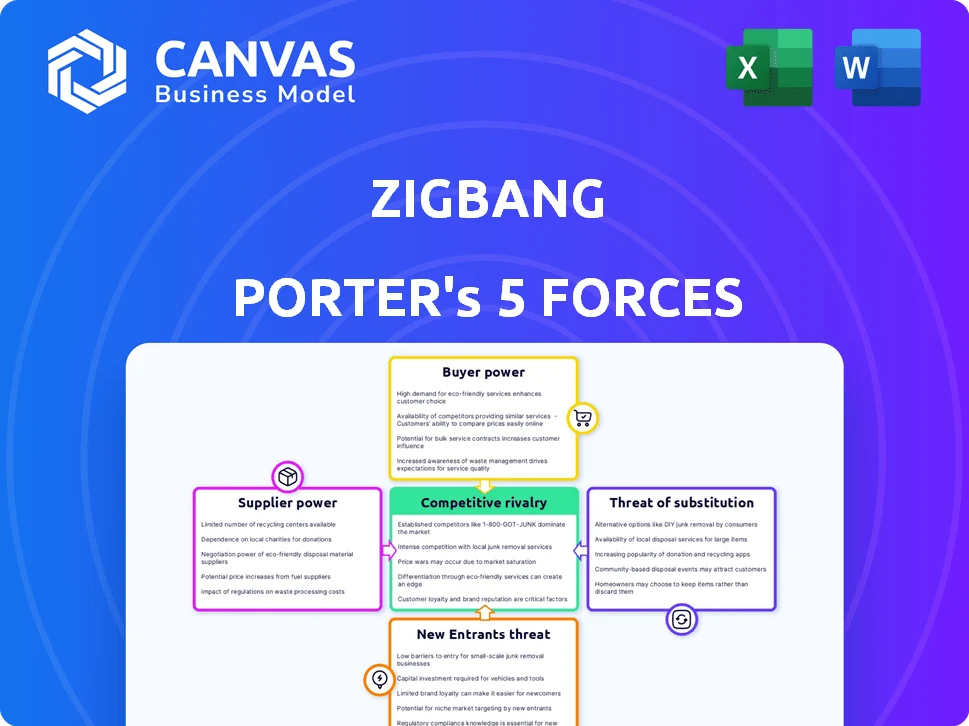
ZIGBANG PORTER'S FIVE FORCES TEMPLATE RESEARCH
What is included in the product
 Detailed Word Document
Analyzes ZigBang's competitive forces: rivalry, suppliers, buyers, entrants, and substitutes, assessing its market position.

 Customizable Excel Spreadsheet
Quickly identify critical threats and opportunities with a color-coded visualization for each of the five forces.
What You See Is What You Get
ZigBang Porter's Five Forces Analysis
This preview provides the full ZigBang Porter's Five Forces analysis you'll receive. It comprehensively assesses industry competition, including suppliers, buyers, threats of substitutes and new entrants. Expect the same detailed analysis immediately after your purchase. This ready-to-use document is professionally formatted.

Porter's Five Forces Analysis Template

Elevate Your Analysis with the Complete Porter's Five Forces Analysis
ZigBang's market faces moderate competition. Bargaining power of buyers is significant due to available alternatives. Supplier power is moderate, influenced by specific tech needs. The threat of new entrants is low given the established market. Substitute products pose a moderate challenge.
The complete report reveals the real forces shaping ZigBang’s industry—from supplier influence to threat of new entrants. Gain actionable insights to drive smarter decision-making.
Suppliers Bargaining Power

Property Owners and Real Estate Agents
ZigBang's suppliers are property owners and real estate agents. Their power hinges on listing concentration and platform importance. If key suppliers control desirable listings, they can seek better terms. In 2024, the real estate market saw about 4.5 million existing homes sold, which can influence supplier dynamics. The platform aims to connect users directly, potentially reducing reliance on intermediaries.
Data Providers
ZigBang's operational success heavily leans on data providers for crucial property and market insights. The influence of these providers hinges on data uniqueness and breadth. If comparable data is easily sourced, ZigBang's dependence decreases. In 2024, the real estate tech sector saw significant data-driven competition, intensifying provider bargaining.

Technology Infrastructure Providers
ZigBang relies on tech infrastructure, including hosting and databases. Supplier power hinges on switching costs and alternatives. Cloud services offer flexibility, potentially lessening dependence. For example, the global cloud computing market was valued at $670.6 billion in 2024. This indicates a wide array of potential suppliers.

Providers of Premium Services
ZigBang's premium services, such as professional photography and virtual tours, involve suppliers with significant bargaining power. These suppliers, providing specialized services, can command higher prices if their offerings are unique or high-quality. The bargaining power depends on the demand for these services and their availability. For example, according to a 2024 report, the average cost for professional real estate photography ranged from $150 to $500 per listing, reflecting the service's value.
- High-quality services increase supplier power.
- Demand and availability affect pricing.
- Specialized services command higher prices.
- Costs vary based on service scope.
Financial Institutions and Investors
Financial institutions and investors wield significant influence over ZigBang's trajectory. Their bargaining power stems from their role in providing essential funding, which directly impacts the company's strategic choices and market valuation. For instance, in 2024, the real estate tech sector saw approximately $1.5 billion in venture capital investments. This funding landscape enables investors to shape ZigBang's direction.
- Funding Availability: Influences ZigBang's ability to scale and innovate.
- Strategic Direction: Investors can steer the company's focus through capital allocation.
- Valuation Impact: Investment decisions directly affect ZigBang's market worth.
- Market Trends: Economic conditions and investor sentiment in 2024 are key.
Real Estate Supplier Power Dynamics
Suppliers' influence varies. Property owners and agents' power depends on listing control. Data providers' strength hinges on uniqueness. Tech infrastructure suppliers' power is tied to alternatives. Premium service providers can command higher prices.
| Supplier Type | Bargaining Power Factor | 2024 Market Context |
|---|---|---|
| Property Owners/Agents | Listing Concentration | 4.5M existing homes sold |
| Data Providers | Data Uniqueness | Data-driven competition |
| Tech Infrastructure | Switching Costs | Cloud computing market: $670.6B |
| Premium Service | Service Uniqueness | Photo cost: $150-$500/listing |
Customers Bargaining Power

Property Seekers (Buyers and Renters)
ZigBang's property seekers, buyers and renters, wield significant bargaining power. This stems from the multitude of competing platforms and readily available online real estate information. A user-friendly interface with comprehensive listings and search tools is crucial to maintain user engagement and reduce their ability to switch. As of late 2024, the Korean real estate market shows a 10% year-over-year increase in online property searches, highlighting the importance of platform competitiveness.
Property Owners and Real Estate Agents (as customers paying for listings)
Property owners and real estate agents are customers when they pay for listings on ZigBang. Their bargaining power fluctuates with the platform's value. In 2024, ZigBang's revenue from listings and related services was approximately $300 million. The more effective the platform is at generating leads, the less bargaining power customers have. If competitors offer better reach, customers may seek alternatives.

Developers and Businesses (for advertising and data)
ZigBang's advertising revenue stream faces customer bargaining power influenced by ad effectiveness. In 2024, digital ad spending hit $225 billion in the U.S., indicating a competitive market. Businesses can negotiate based on ad performance metrics. Data solution bargaining power relies on ZigBang's data uniqueness versus competitors.

Users of Smart Home Services
ZigBang's move into smart home services brings in a new customer base. The bargaining power of these users is shaped by the alternatives available. This includes other smart home systems and the appeal of ZigBang's features.
- Market share of smart home devices reached $123.6 billion in 2023.
- The global smart home market is expected to grow to $793.7 billion by 2030.
- Consumers can choose from various providers, increasing their leverage.
Users of B2B Real Estate Data Solutions
For ZigBang's B2B real estate data solution, the bargaining power of customers (real estate professionals) is a key consideration. This power stems from the availability of competing data and analytics platforms. The value customers place on ZigBang's data, in terms of quality and relevance, also plays a significant role.
- Competition in the real estate tech market is intense, with platforms like Zillow and Redfin also offering data solutions.
- The success of ZigBang depends on how well its AI-driven big data meets the specific needs of professionals, such as predictive analytics or property valuation.
- Customer loyalty can be influenced by pricing, data accuracy, and the user experience of the platform.
ZigBang's Customer Power: Navigating a Competitive Market
ZigBang's customers, including property seekers and advertisers, hold significant bargaining power. This is fueled by competitive online platforms and readily available information. The effectiveness of ZigBang's services, like lead generation and ad performance, directly impacts this power. As of late 2024, digital ad spending hit $225 billion in the U.S., indicating a competitive market.
| Customer Type | Bargaining Power Drivers | 2024 Impact |
|---|---|---|
| Property Seekers | Platform competition, info availability | Searches up 10% YoY in Korea |
| Advertisers | Ad performance, market competition | Digital ad spend: $225B in U.S. |
| Data Solution Customers | Data quality, competing platforms | Intense competition with Zillow |
Rivalry Among Competitors

Other Online Real Estate Platforms
The South Korean online real estate market sees intense rivalry. ZigBang competes directly with platforms like DaBang and 직방. In 2024, these platforms battled for user engagement and listings. The market share distribution and service differentiation significantly affect the intensity of this competition.
Traditional Real Estate Agencies
Traditional real estate agencies present strong competition for ZigBang. In 2024, these agencies still handled a significant portion of property transactions. Their established networks and in-person service appeal to many clients. However, ZigBang's digital focus offers a convenient alternative for tech-savvy users.

New Entrants and Startups
The proptech sector sees new entrants constantly. Startups with fresh tech, like AI-driven property analysis, challenge existing players. In 2024, venture capital poured over $10 billion into proptech globally. These newcomers intensify rivalry, forcing incumbents to innovate.

Horizontal and Vertical Expansion by Competitors
Competitors in the real estate tech sector, like ZigBang, constantly evolve. Horizontal expansion involves adding services; for instance, offering moving assistance alongside property listings. Vertical integration means controlling more of the value chain, such as providing in-house brokerage services. Both strategies intensify competition, as rivals seek to capture more of the customer's spending.
- In 2024, the proptech market is valued at over $15 billion, showing strong growth.
- Companies offering expanded services have seen a 15-20% increase in customer retention rates.
- Vertical integration can lead to cost savings, potentially reducing prices by 5-10%.
- The number of mergers and acquisitions in the proptech industry has increased by 10% in the past year.
Differentiation and Innovation
Competitive rivalry in real estate platforms is significantly shaped by innovation and differentiation. Platforms compete by offering unique features to attract users and gain market share. In 2024, platforms like Zillow and Redfin invested heavily in AI-driven tools and virtual tours, enhancing user experience. These innovations are vital for staying ahead in a competitive market.
- Zillow's revenue in Q3 2024 was $489 million, demonstrating the impact of innovation.
- Redfin's market share in 2024 was approximately 0.7%, with continuous innovation as a key goal.
- Virtual tours increased user engagement by 40% on average across major platforms in 2024.
South Korea's Proptech: A $15B+ Battleground!
Competitive rivalry in South Korea’s proptech market is fierce. Platforms like ZigBang, DaBang, and traditional agencies compete for users. Innovation, such as AI-driven tools, is crucial for market share. The market's value in 2024 exceeded $15 billion, showing rapid growth.
| Feature | Impact | Data (2024) |
|---|---|---|
| Market Value | Overall Growth | >$15B |
| User Engagement (Virtual Tours) | Increased Engagement | 40% avg. |
| Zillow Revenue (Q3) | Revenue Indicator | $489M |
Original: $10.00
-65%$10.00
$3.50ZIGBANG PORTER'S FIVE FORCES TEMPLATE RESEARCH
What is included in the product
Detailed Word Document
Analyzes ZigBang's competitive forces: rivalry, suppliers, buyers, entrants, and substitutes, assessing its market position.
Customizable Excel Spreadsheet
Quickly identify critical threats and opportunities with a color-coded visualization for each of the five forces.
What You See Is What You Get
ZigBang Porter's Five Forces Analysis
This preview provides the full ZigBang Porter's Five Forces analysis you'll receive. It comprehensively assesses industry competition, including suppliers, buyers, threats of substitutes and new entrants. Expect the same detailed analysis immediately after your purchase. This ready-to-use document is professionally formatted.
Porter's Five Forces Analysis Template
Elevate Your Analysis with the Complete Porter's Five Forces Analysis
ZigBang's market faces moderate competition. Bargaining power of buyers is significant due to available alternatives. Supplier power is moderate, influenced by specific tech needs. The threat of new entrants is low given the established market. Substitute products pose a moderate challenge.
The complete report reveals the real forces shaping ZigBang’s industry—from supplier influence to threat of new entrants. Gain actionable insights to drive smarter decision-making.
Suppliers Bargaining Power
Property Owners and Real Estate Agents
ZigBang's suppliers are property owners and real estate agents. Their power hinges on listing concentration and platform importance. If key suppliers control desirable listings, they can seek better terms. In 2024, the real estate market saw about 4.5 million existing homes sold, which can influence supplier dynamics. The platform aims to connect users directly, potentially reducing reliance on intermediaries.
Data Providers
ZigBang's operational success heavily leans on data providers for crucial property and market insights. The influence of these providers hinges on data uniqueness and breadth. If comparable data is easily sourced, ZigBang's dependence decreases. In 2024, the real estate tech sector saw significant data-driven competition, intensifying provider bargaining.
Technology Infrastructure Providers
ZigBang relies on tech infrastructure, including hosting and databases. Supplier power hinges on switching costs and alternatives. Cloud services offer flexibility, potentially lessening dependence. For example, the global cloud computing market was valued at $670.6 billion in 2024. This indicates a wide array of potential suppliers.
Providers of Premium Services
ZigBang's premium services, such as professional photography and virtual tours, involve suppliers with significant bargaining power. These suppliers, providing specialized services, can command higher prices if their offerings are unique or high-quality. The bargaining power depends on the demand for these services and their availability. For example, according to a 2024 report, the average cost for professional real estate photography ranged from $150 to $500 per listing, reflecting the service's value.
- High-quality services increase supplier power.
- Demand and availability affect pricing.
- Specialized services command higher prices.
- Costs vary based on service scope.
Financial Institutions and Investors
Financial institutions and investors wield significant influence over ZigBang's trajectory. Their bargaining power stems from their role in providing essential funding, which directly impacts the company's strategic choices and market valuation. For instance, in 2024, the real estate tech sector saw approximately $1.5 billion in venture capital investments. This funding landscape enables investors to shape ZigBang's direction.
- Funding Availability: Influences ZigBang's ability to scale and innovate.
- Strategic Direction: Investors can steer the company's focus through capital allocation.
- Valuation Impact: Investment decisions directly affect ZigBang's market worth.
- Market Trends: Economic conditions and investor sentiment in 2024 are key.
Real Estate Supplier Power Dynamics
Suppliers' influence varies. Property owners and agents' power depends on listing control. Data providers' strength hinges on uniqueness. Tech infrastructure suppliers' power is tied to alternatives. Premium service providers can command higher prices.
| Supplier Type | Bargaining Power Factor | 2024 Market Context |
|---|---|---|
| Property Owners/Agents | Listing Concentration | 4.5M existing homes sold |
| Data Providers | Data Uniqueness | Data-driven competition |
| Tech Infrastructure | Switching Costs | Cloud computing market: $670.6B |
| Premium Service | Service Uniqueness | Photo cost: $150-$500/listing |
Customers Bargaining Power
Property Seekers (Buyers and Renters)
ZigBang's property seekers, buyers and renters, wield significant bargaining power. This stems from the multitude of competing platforms and readily available online real estate information. A user-friendly interface with comprehensive listings and search tools is crucial to maintain user engagement and reduce their ability to switch. As of late 2024, the Korean real estate market shows a 10% year-over-year increase in online property searches, highlighting the importance of platform competitiveness.
Property Owners and Real Estate Agents (as customers paying for listings)
Property owners and real estate agents are customers when they pay for listings on ZigBang. Their bargaining power fluctuates with the platform's value. In 2024, ZigBang's revenue from listings and related services was approximately $300 million. The more effective the platform is at generating leads, the less bargaining power customers have. If competitors offer better reach, customers may seek alternatives.
Developers and Businesses (for advertising and data)
ZigBang's advertising revenue stream faces customer bargaining power influenced by ad effectiveness. In 2024, digital ad spending hit $225 billion in the U.S., indicating a competitive market. Businesses can negotiate based on ad performance metrics. Data solution bargaining power relies on ZigBang's data uniqueness versus competitors.
Users of Smart Home Services
ZigBang's move into smart home services brings in a new customer base. The bargaining power of these users is shaped by the alternatives available. This includes other smart home systems and the appeal of ZigBang's features.
- Market share of smart home devices reached $123.6 billion in 2023.
- The global smart home market is expected to grow to $793.7 billion by 2030.
- Consumers can choose from various providers, increasing their leverage.
Users of B2B Real Estate Data Solutions
For ZigBang's B2B real estate data solution, the bargaining power of customers (real estate professionals) is a key consideration. This power stems from the availability of competing data and analytics platforms. The value customers place on ZigBang's data, in terms of quality and relevance, also plays a significant role.
- Competition in the real estate tech market is intense, with platforms like Zillow and Redfin also offering data solutions.
- The success of ZigBang depends on how well its AI-driven big data meets the specific needs of professionals, such as predictive analytics or property valuation.
- Customer loyalty can be influenced by pricing, data accuracy, and the user experience of the platform.
ZigBang's Customer Power: Navigating a Competitive Market
ZigBang's customers, including property seekers and advertisers, hold significant bargaining power. This is fueled by competitive online platforms and readily available information. The effectiveness of ZigBang's services, like lead generation and ad performance, directly impacts this power. As of late 2024, digital ad spending hit $225 billion in the U.S., indicating a competitive market.
| Customer Type | Bargaining Power Drivers | 2024 Impact |
|---|---|---|
| Property Seekers | Platform competition, info availability | Searches up 10% YoY in Korea |
| Advertisers | Ad performance, market competition | Digital ad spend: $225B in U.S. |
| Data Solution Customers | Data quality, competing platforms | Intense competition with Zillow |
Rivalry Among Competitors
Other Online Real Estate Platforms
The South Korean online real estate market sees intense rivalry. ZigBang competes directly with platforms like DaBang and 직방. In 2024, these platforms battled for user engagement and listings. The market share distribution and service differentiation significantly affect the intensity of this competition.
Traditional Real Estate Agencies
Traditional real estate agencies present strong competition for ZigBang. In 2024, these agencies still handled a significant portion of property transactions. Their established networks and in-person service appeal to many clients. However, ZigBang's digital focus offers a convenient alternative for tech-savvy users.
New Entrants and Startups
The proptech sector sees new entrants constantly. Startups with fresh tech, like AI-driven property analysis, challenge existing players. In 2024, venture capital poured over $10 billion into proptech globally. These newcomers intensify rivalry, forcing incumbents to innovate.
Horizontal and Vertical Expansion by Competitors
Competitors in the real estate tech sector, like ZigBang, constantly evolve. Horizontal expansion involves adding services; for instance, offering moving assistance alongside property listings. Vertical integration means controlling more of the value chain, such as providing in-house brokerage services. Both strategies intensify competition, as rivals seek to capture more of the customer's spending.
- In 2024, the proptech market is valued at over $15 billion, showing strong growth.
- Companies offering expanded services have seen a 15-20% increase in customer retention rates.
- Vertical integration can lead to cost savings, potentially reducing prices by 5-10%.
- The number of mergers and acquisitions in the proptech industry has increased by 10% in the past year.
Differentiation and Innovation
Competitive rivalry in real estate platforms is significantly shaped by innovation and differentiation. Platforms compete by offering unique features to attract users and gain market share. In 2024, platforms like Zillow and Redfin invested heavily in AI-driven tools and virtual tours, enhancing user experience. These innovations are vital for staying ahead in a competitive market.
- Zillow's revenue in Q3 2024 was $489 million, demonstrating the impact of innovation.
- Redfin's market share in 2024 was approximately 0.7%, with continuous innovation as a key goal.
- Virtual tours increased user engagement by 40% on average across major platforms in 2024.
South Korea's Proptech: A $15B+ Battleground!
Competitive rivalry in South Korea’s proptech market is fierce. Platforms like ZigBang, DaBang, and traditional agencies compete for users. Innovation, such as AI-driven tools, is crucial for market share. The market's value in 2024 exceeded $15 billion, showing rapid growth.
| Feature | Impact | Data (2024) |
|---|---|---|
| Market Value | Overall Growth | >$15B |
| User Engagement (Virtual Tours) | Increased Engagement | 40% avg. |
| Zillow Revenue (Q3) | Revenue Indicator | $489M |
Product Information
Product Information
Shipping & Returns
Shipping & Returns
Description
What is included in the product
Detailed Word Document
Analyzes ZigBang's competitive forces: rivalry, suppliers, buyers, entrants, and substitutes, assessing its market position.
Customizable Excel Spreadsheet
Quickly identify critical threats and opportunities with a color-coded visualization for each of the five forces.
What You See Is What You Get
ZigBang Porter's Five Forces Analysis
This preview provides the full ZigBang Porter's Five Forces analysis you'll receive. It comprehensively assesses industry competition, including suppliers, buyers, threats of substitutes and new entrants. Expect the same detailed analysis immediately after your purchase. This ready-to-use document is professionally formatted.
Porter's Five Forces Analysis Template
Elevate Your Analysis with the Complete Porter's Five Forces Analysis
ZigBang's market faces moderate competition. Bargaining power of buyers is significant due to available alternatives. Supplier power is moderate, influenced by specific tech needs. The threat of new entrants is low given the established market. Substitute products pose a moderate challenge.
The complete report reveals the real forces shaping ZigBang’s industry—from supplier influence to threat of new entrants. Gain actionable insights to drive smarter decision-making.
Suppliers Bargaining Power
Property Owners and Real Estate Agents
ZigBang's suppliers are property owners and real estate agents. Their power hinges on listing concentration and platform importance. If key suppliers control desirable listings, they can seek better terms. In 2024, the real estate market saw about 4.5 million existing homes sold, which can influence supplier dynamics. The platform aims to connect users directly, potentially reducing reliance on intermediaries.
Data Providers
ZigBang's operational success heavily leans on data providers for crucial property and market insights. The influence of these providers hinges on data uniqueness and breadth. If comparable data is easily sourced, ZigBang's dependence decreases. In 2024, the real estate tech sector saw significant data-driven competition, intensifying provider bargaining.
Technology Infrastructure Providers
ZigBang relies on tech infrastructure, including hosting and databases. Supplier power hinges on switching costs and alternatives. Cloud services offer flexibility, potentially lessening dependence. For example, the global cloud computing market was valued at $670.6 billion in 2024. This indicates a wide array of potential suppliers.
Providers of Premium Services
ZigBang's premium services, such as professional photography and virtual tours, involve suppliers with significant bargaining power. These suppliers, providing specialized services, can command higher prices if their offerings are unique or high-quality. The bargaining power depends on the demand for these services and their availability. For example, according to a 2024 report, the average cost for professional real estate photography ranged from $150 to $500 per listing, reflecting the service's value.
- High-quality services increase supplier power.
- Demand and availability affect pricing.
- Specialized services command higher prices.
- Costs vary based on service scope.
Financial Institutions and Investors
Financial institutions and investors wield significant influence over ZigBang's trajectory. Their bargaining power stems from their role in providing essential funding, which directly impacts the company's strategic choices and market valuation. For instance, in 2024, the real estate tech sector saw approximately $1.5 billion in venture capital investments. This funding landscape enables investors to shape ZigBang's direction.
- Funding Availability: Influences ZigBang's ability to scale and innovate.
- Strategic Direction: Investors can steer the company's focus through capital allocation.
- Valuation Impact: Investment decisions directly affect ZigBang's market worth.
- Market Trends: Economic conditions and investor sentiment in 2024 are key.
Real Estate Supplier Power Dynamics
Suppliers' influence varies. Property owners and agents' power depends on listing control. Data providers' strength hinges on uniqueness. Tech infrastructure suppliers' power is tied to alternatives. Premium service providers can command higher prices.
| Supplier Type | Bargaining Power Factor | 2024 Market Context |
|---|---|---|
| Property Owners/Agents | Listing Concentration | 4.5M existing homes sold |
| Data Providers | Data Uniqueness | Data-driven competition |
| Tech Infrastructure | Switching Costs | Cloud computing market: $670.6B |
| Premium Service | Service Uniqueness | Photo cost: $150-$500/listing |
Customers Bargaining Power
Property Seekers (Buyers and Renters)
ZigBang's property seekers, buyers and renters, wield significant bargaining power. This stems from the multitude of competing platforms and readily available online real estate information. A user-friendly interface with comprehensive listings and search tools is crucial to maintain user engagement and reduce their ability to switch. As of late 2024, the Korean real estate market shows a 10% year-over-year increase in online property searches, highlighting the importance of platform competitiveness.
Property Owners and Real Estate Agents (as customers paying for listings)
Property owners and real estate agents are customers when they pay for listings on ZigBang. Their bargaining power fluctuates with the platform's value. In 2024, ZigBang's revenue from listings and related services was approximately $300 million. The more effective the platform is at generating leads, the less bargaining power customers have. If competitors offer better reach, customers may seek alternatives.
Developers and Businesses (for advertising and data)
ZigBang's advertising revenue stream faces customer bargaining power influenced by ad effectiveness. In 2024, digital ad spending hit $225 billion in the U.S., indicating a competitive market. Businesses can negotiate based on ad performance metrics. Data solution bargaining power relies on ZigBang's data uniqueness versus competitors.
Users of Smart Home Services
ZigBang's move into smart home services brings in a new customer base. The bargaining power of these users is shaped by the alternatives available. This includes other smart home systems and the appeal of ZigBang's features.
- Market share of smart home devices reached $123.6 billion in 2023.
- The global smart home market is expected to grow to $793.7 billion by 2030.
- Consumers can choose from various providers, increasing their leverage.
Users of B2B Real Estate Data Solutions
For ZigBang's B2B real estate data solution, the bargaining power of customers (real estate professionals) is a key consideration. This power stems from the availability of competing data and analytics platforms. The value customers place on ZigBang's data, in terms of quality and relevance, also plays a significant role.
- Competition in the real estate tech market is intense, with platforms like Zillow and Redfin also offering data solutions.
- The success of ZigBang depends on how well its AI-driven big data meets the specific needs of professionals, such as predictive analytics or property valuation.
- Customer loyalty can be influenced by pricing, data accuracy, and the user experience of the platform.
ZigBang's Customer Power: Navigating a Competitive Market
ZigBang's customers, including property seekers and advertisers, hold significant bargaining power. This is fueled by competitive online platforms and readily available information. The effectiveness of ZigBang's services, like lead generation and ad performance, directly impacts this power. As of late 2024, digital ad spending hit $225 billion in the U.S., indicating a competitive market.
| Customer Type | Bargaining Power Drivers | 2024 Impact |
|---|---|---|
| Property Seekers | Platform competition, info availability | Searches up 10% YoY in Korea |
| Advertisers | Ad performance, market competition | Digital ad spend: $225B in U.S. |
| Data Solution Customers | Data quality, competing platforms | Intense competition with Zillow |
Rivalry Among Competitors
Other Online Real Estate Platforms
The South Korean online real estate market sees intense rivalry. ZigBang competes directly with platforms like DaBang and 직방. In 2024, these platforms battled for user engagement and listings. The market share distribution and service differentiation significantly affect the intensity of this competition.
Traditional Real Estate Agencies
Traditional real estate agencies present strong competition for ZigBang. In 2024, these agencies still handled a significant portion of property transactions. Their established networks and in-person service appeal to many clients. However, ZigBang's digital focus offers a convenient alternative for tech-savvy users.
New Entrants and Startups
The proptech sector sees new entrants constantly. Startups with fresh tech, like AI-driven property analysis, challenge existing players. In 2024, venture capital poured over $10 billion into proptech globally. These newcomers intensify rivalry, forcing incumbents to innovate.
Horizontal and Vertical Expansion by Competitors
Competitors in the real estate tech sector, like ZigBang, constantly evolve. Horizontal expansion involves adding services; for instance, offering moving assistance alongside property listings. Vertical integration means controlling more of the value chain, such as providing in-house brokerage services. Both strategies intensify competition, as rivals seek to capture more of the customer's spending.
- In 2024, the proptech market is valued at over $15 billion, showing strong growth.
- Companies offering expanded services have seen a 15-20% increase in customer retention rates.
- Vertical integration can lead to cost savings, potentially reducing prices by 5-10%.
- The number of mergers and acquisitions in the proptech industry has increased by 10% in the past year.
Differentiation and Innovation
Competitive rivalry in real estate platforms is significantly shaped by innovation and differentiation. Platforms compete by offering unique features to attract users and gain market share. In 2024, platforms like Zillow and Redfin invested heavily in AI-driven tools and virtual tours, enhancing user experience. These innovations are vital for staying ahead in a competitive market.
- Zillow's revenue in Q3 2024 was $489 million, demonstrating the impact of innovation.
- Redfin's market share in 2024 was approximately 0.7%, with continuous innovation as a key goal.
- Virtual tours increased user engagement by 40% on average across major platforms in 2024.
South Korea's Proptech: A $15B+ Battleground!
Competitive rivalry in South Korea’s proptech market is fierce. Platforms like ZigBang, DaBang, and traditional agencies compete for users. Innovation, such as AI-driven tools, is crucial for market share. The market's value in 2024 exceeded $15 billion, showing rapid growth.
| Feature | Impact | Data (2024) |
|---|---|---|
| Market Value | Overall Growth | >$15B |
| User Engagement (Virtual Tours) | Increased Engagement | 40% avg. |
| Zillow Revenue (Q3) | Revenue Indicator | $489M |


