
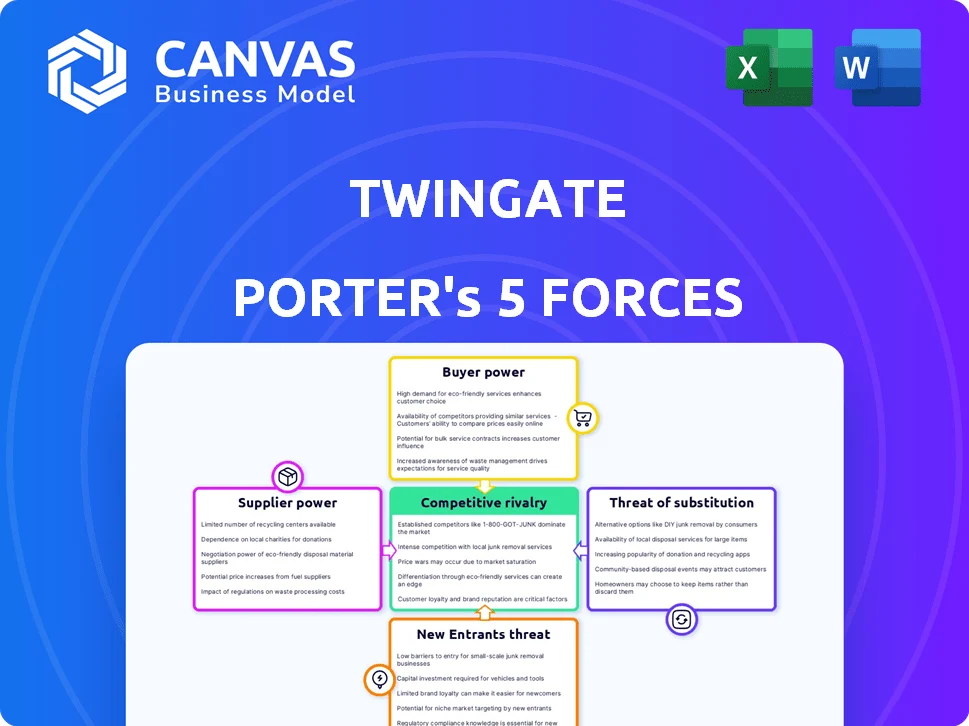
TWINGATE PORTER'S FIVE FORCES TEMPLATE RESEARCH
What is included in the product
 Detailed Word Document
Evaluates control held by suppliers and buyers, and their influence on pricing and profitability.

 Customizable Excel Spreadsheet
Twingate Porter's Five Forces analysis reveals competitive forces, providing strategic insights.
Full Version Awaits
Twingate Porter's Five Forces Analysis
This preview showcases the comprehensive Twingate Porter's Five Forces analysis you'll receive immediately upon purchase. It is the exact, fully-formatted document, professionally crafted for your use. You won't find any differences between this preview and your downloadable file. The analysis is ready for immediate application, providing you with valuable insights. No hidden content; what you see is precisely what you get.

Porter's Five Forces Analysis Template

Go Beyond the Preview—Access the Full Strategic Report
Twingate operates in a dynamic cybersecurity market, facing diverse competitive pressures. Existing rivalry is intense, with established players vying for market share. The threat of new entrants is moderate, balanced by high barriers to entry. Buyer power is relatively low, while supplier power is also moderate. Finally, the threat of substitutes is present, as alternative security solutions evolve.
Ready to move beyond the basics? Get a full strategic breakdown of Twingate’s market position, competitive intensity, and external threats—all in one powerful analysis.
Suppliers Bargaining Power

Limited number of key technology providers
Twingate depends on key tech and infrastructure. Cloud providers like AWS, Azure, and Google Cloud hold significant power. The cloud market's consolidation gives these suppliers leverage. In 2024, AWS controlled about 32% of the cloud market, showing provider concentration. This concentration can affect Twingate's costs and flexibility.
High reliance on cloud service providers
Twingate's architecture heavily leans on cloud service providers, increasing supplier power. The company's dependence on these providers for hosting and infrastructure can be substantial. Switching costs are high, giving suppliers leverage. For example, in 2024, cloud spending reached $670 billion globally, highlighting the market power of these providers.

Specialized software and tools
Twingate's reliance on unique software and security tech impacts supplier power. A limited number of vendors offering essential tools gives them leverage. In 2024, the cybersecurity market was valued at $223.8 billion, showing the high stakes. This concentration can lead to higher costs and potential supply disruptions. This is something Twingate must manage carefully for stable operations.

Potential for increased costs
Twingate's profitability can be significantly affected by the bargaining power of its suppliers. Powerful suppliers can hike prices for essential services and tools, directly affecting Twingate's operational costs. These increased costs could squeeze Twingate's profit margins, potentially impacting its financial health. This is a crucial factor for Twingate's strategic planning and financial forecasting.
- Cost of cloud services, which increased by 15% in 2024.
- Cybersecurity software expenses, which account for 20% of operating costs.
- Data center services that have a 10% price increase.
- The overall supplier power that has increased by 5% due to market consolidation.
Importance of partnerships
To lessen supplier power, Twingate strategically partners with tech and cybersecurity companies. These alliances ensure smooth integration and bolster Twingate's bargaining strength. Such collaborations can lead to better pricing and more favorable terms. The goal is to create a resilient supply chain. In 2024, strategic partnerships in the cybersecurity sector increased by 15%.
- Strategic partnerships reduce supplier dependency.
- Partnerships enhance negotiation leverage.
- Collaborations enable better pricing.
- Improved supply chain resilience.
Navigating Supplier Power Dynamics for Twingate's Success
Twingate faces supplier power challenges, particularly from cloud providers and cybersecurity vendors. Cloud service costs rose by 15% in 2024, impacting operational expenses. Strategic partnerships are vital to mitigate supplier influence and secure favorable terms.
| Factor | Impact | 2024 Data |
|---|---|---|
| Cloud Services | Cost Increase | 15% rise |
| Cybersecurity Costs | Operational Expense | 20% of costs |
| Supplier Power | Market Consolidation | Increased by 5% |
Customers Bargaining Power

Availability of alternatives
Customers can choose from many secure remote access options, like traditional VPNs and ZTNA solutions. With more ZTNA competitors, customers gain more power. The ZTNA market is growing, with companies like Cloudflare and Cisco. In 2024, the ZTNA market was valued at approximately $4 billion, showing strong customer choice.
Switching costs for customers
Switching costs for customers of Twingate involve migrating from existing solutions. While Twingate emphasizes ease of deployment, changes still require effort. Consider the 2024 average cost of $5,000 for a small business network security overhaul. This is a factor in customer decisions. However, Twingate's potential for simplified setup could offset these costs.

Customer size and concentration
Customer size and concentration significantly influence bargaining power. Twingate, serving diverse clients, could face varied negotiation strengths. If a few large enterprise customers constitute a major portion of Twingate's revenue, their ability to dictate terms increases substantially. Conversely, a fragmented customer base reduces individual customer leverage, as seen in 2024 where enterprise software pricing strategies often consider customer volume discounts.

Demand for robust security and ease of use
Customers in the ZTNA market are becoming more discerning, prioritizing robust security and user-friendly interfaces. Twingate's ability to deliver on these expectations is vital for retaining customers and minimizing their likelihood of switching to competitors. This focus helps Twingate maintain a competitive edge by meeting evolving customer needs. The ZTNA market is projected to reach $5.5 billion by 2024.
- Demand for seamless integration with existing IT infrastructure.
- Emphasis on ease of use to ensure efficient deployment and management.
- Expectation of comprehensive security features.
- Focus on cost-effectiveness and value for money.
Access to information and reviews
Customers' access to information and reviews significantly impacts their bargaining power in the ZTNA market. This easy access to data lets them compare providers, understand pricing, and evaluate service quality. According to a 2024 report, the average customer now consults at least three different review sources before making a purchase decision. This heightened awareness of options allows customers to negotiate better terms and demand more competitive pricing. The availability of detailed product comparisons online further strengthens their position.
- Increased price sensitivity due to readily available pricing data.
- Higher expectations for service quality and support.
- Ability to switch providers more easily, increasing competition.
- Greater influence on product development and features.
ZTNA Market: Customer Power & Choices
Customer bargaining power in the ZTNA market is high due to many choices. This is amplified by access to information, like reviews. Customers can negotiate better terms because of this. The ZTNA market was worth roughly $4 billion in 2024.
| Factor | Impact | 2024 Data |
|---|---|---|
| Market Competition | High | Many ZTNA providers |
| Information Access | High | Reviews and pricing readily available |
| Customer Size | Varied | Enterprise software pricing considers volume |
Rivalry Among Competitors

Numerous competitors in the ZTNA market
The ZTNA market is crowded, with many players vying for market share. This intense competition includes giants like Cisco and smaller firms such as Twingate. In 2024, the cybersecurity market saw over $200 billion in spending. This rivalry often results in price wars and aggressive feature rollouts.
Presence of large, established players
Twingate faces fierce competition from giants like Cisco, Microsoft, and Palo Alto Networks. These established players boast vast resources and customer bases. Cisco's 2023 revenue reached $57 billion, showing their market dominance. Microsoft's security revenue alone was over $20 billion in 2023. This makes it challenging for Twingate to gain market share.

Continuous innovation
The cybersecurity market demands constant innovation to counter emerging threats and meet customer demands. Competitors, like Twingate, heavily invest in R&D. This investment is crucial for maintaining a competitive edge. Twingate differentiates itself by leveraging cutting-edge technologies like ZTNA. According to a 2024 report, cybersecurity spending is projected to reach $202.5 billion.

Differentiation through features and usability
Competitive rivalry in the network security market sees companies vying for market share by enhancing their offerings. Twingate stands out by focusing on ease of use and a zero-trust security model. This approach aims to attract users looking for simpler, more secure alternatives to conventional VPNs.
- In 2024, the zero-trust security market was valued at approximately $45 billion.
- Ease of use is a significant factor; 70% of IT professionals prioritize it in security solutions.
- Twingate's focus aligns with the growing demand for user-friendly cybersecurity tools.
Pricing strategies
Competitive pricing significantly influences the market, with providers like Twingate employing various tiered plans to capture diverse customer segments. Pricing models often vary, affecting the overall competitiveness. For instance, in 2024, cybersecurity firms saw about a 7% shift in pricing strategies. This dynamic pricing landscape forces companies to continually evaluate their offerings.
- Tiered pricing models are common.
- Competition pushes for value.
- Pricing impacts market share.
ZTNA Market Heats Up: Cisco's $57B vs. $45B Opportunity
Competitive rivalry in the ZTNA market is intense, marked by aggressive feature rollouts and price wars. Giants like Cisco and Microsoft compete fiercely, leveraging their vast resources; Cisco's 2023 revenue was $57B. Twingate differentiates itself through ease of use, targeting the $45B zero-trust market.
| Metric | Details |
|---|---|
| Market Size (ZTNA) | $45 Billion (2024) |
| Cisco Revenue (2023) | $57 Billion |
| Security Market Spending (2024) | $202.5 Billion |
Original: $10.00
-65%$10.00
$3.50TWINGATE PORTER'S FIVE FORCES TEMPLATE RESEARCH
What is included in the product
Detailed Word Document
Evaluates control held by suppliers and buyers, and their influence on pricing and profitability.
Customizable Excel Spreadsheet
Twingate Porter's Five Forces analysis reveals competitive forces, providing strategic insights.
Full Version Awaits
Twingate Porter's Five Forces Analysis
This preview showcases the comprehensive Twingate Porter's Five Forces analysis you'll receive immediately upon purchase. It is the exact, fully-formatted document, professionally crafted for your use. You won't find any differences between this preview and your downloadable file. The analysis is ready for immediate application, providing you with valuable insights. No hidden content; what you see is precisely what you get.
Porter's Five Forces Analysis Template
Go Beyond the Preview—Access the Full Strategic Report
Twingate operates in a dynamic cybersecurity market, facing diverse competitive pressures. Existing rivalry is intense, with established players vying for market share. The threat of new entrants is moderate, balanced by high barriers to entry. Buyer power is relatively low, while supplier power is also moderate. Finally, the threat of substitutes is present, as alternative security solutions evolve.
Ready to move beyond the basics? Get a full strategic breakdown of Twingate’s market position, competitive intensity, and external threats—all in one powerful analysis.
Suppliers Bargaining Power
Limited number of key technology providers
Twingate depends on key tech and infrastructure. Cloud providers like AWS, Azure, and Google Cloud hold significant power. The cloud market's consolidation gives these suppliers leverage. In 2024, AWS controlled about 32% of the cloud market, showing provider concentration. This concentration can affect Twingate's costs and flexibility.
High reliance on cloud service providers
Twingate's architecture heavily leans on cloud service providers, increasing supplier power. The company's dependence on these providers for hosting and infrastructure can be substantial. Switching costs are high, giving suppliers leverage. For example, in 2024, cloud spending reached $670 billion globally, highlighting the market power of these providers.
Specialized software and tools
Twingate's reliance on unique software and security tech impacts supplier power. A limited number of vendors offering essential tools gives them leverage. In 2024, the cybersecurity market was valued at $223.8 billion, showing the high stakes. This concentration can lead to higher costs and potential supply disruptions. This is something Twingate must manage carefully for stable operations.
Potential for increased costs
Twingate's profitability can be significantly affected by the bargaining power of its suppliers. Powerful suppliers can hike prices for essential services and tools, directly affecting Twingate's operational costs. These increased costs could squeeze Twingate's profit margins, potentially impacting its financial health. This is a crucial factor for Twingate's strategic planning and financial forecasting.
- Cost of cloud services, which increased by 15% in 2024.
- Cybersecurity software expenses, which account for 20% of operating costs.
- Data center services that have a 10% price increase.
- The overall supplier power that has increased by 5% due to market consolidation.
Importance of partnerships
To lessen supplier power, Twingate strategically partners with tech and cybersecurity companies. These alliances ensure smooth integration and bolster Twingate's bargaining strength. Such collaborations can lead to better pricing and more favorable terms. The goal is to create a resilient supply chain. In 2024, strategic partnerships in the cybersecurity sector increased by 15%.
- Strategic partnerships reduce supplier dependency.
- Partnerships enhance negotiation leverage.
- Collaborations enable better pricing.
- Improved supply chain resilience.
Navigating Supplier Power Dynamics for Twingate's Success
Twingate faces supplier power challenges, particularly from cloud providers and cybersecurity vendors. Cloud service costs rose by 15% in 2024, impacting operational expenses. Strategic partnerships are vital to mitigate supplier influence and secure favorable terms.
| Factor | Impact | 2024 Data |
|---|---|---|
| Cloud Services | Cost Increase | 15% rise |
| Cybersecurity Costs | Operational Expense | 20% of costs |
| Supplier Power | Market Consolidation | Increased by 5% |
Customers Bargaining Power
Availability of alternatives
Customers can choose from many secure remote access options, like traditional VPNs and ZTNA solutions. With more ZTNA competitors, customers gain more power. The ZTNA market is growing, with companies like Cloudflare and Cisco. In 2024, the ZTNA market was valued at approximately $4 billion, showing strong customer choice.
Switching costs for customers
Switching costs for customers of Twingate involve migrating from existing solutions. While Twingate emphasizes ease of deployment, changes still require effort. Consider the 2024 average cost of $5,000 for a small business network security overhaul. This is a factor in customer decisions. However, Twingate's potential for simplified setup could offset these costs.
Customer size and concentration
Customer size and concentration significantly influence bargaining power. Twingate, serving diverse clients, could face varied negotiation strengths. If a few large enterprise customers constitute a major portion of Twingate's revenue, their ability to dictate terms increases substantially. Conversely, a fragmented customer base reduces individual customer leverage, as seen in 2024 where enterprise software pricing strategies often consider customer volume discounts.
Demand for robust security and ease of use
Customers in the ZTNA market are becoming more discerning, prioritizing robust security and user-friendly interfaces. Twingate's ability to deliver on these expectations is vital for retaining customers and minimizing their likelihood of switching to competitors. This focus helps Twingate maintain a competitive edge by meeting evolving customer needs. The ZTNA market is projected to reach $5.5 billion by 2024.
- Demand for seamless integration with existing IT infrastructure.
- Emphasis on ease of use to ensure efficient deployment and management.
- Expectation of comprehensive security features.
- Focus on cost-effectiveness and value for money.
Access to information and reviews
Customers' access to information and reviews significantly impacts their bargaining power in the ZTNA market. This easy access to data lets them compare providers, understand pricing, and evaluate service quality. According to a 2024 report, the average customer now consults at least three different review sources before making a purchase decision. This heightened awareness of options allows customers to negotiate better terms and demand more competitive pricing. The availability of detailed product comparisons online further strengthens their position.
- Increased price sensitivity due to readily available pricing data.
- Higher expectations for service quality and support.
- Ability to switch providers more easily, increasing competition.
- Greater influence on product development and features.
ZTNA Market: Customer Power & Choices
Customer bargaining power in the ZTNA market is high due to many choices. This is amplified by access to information, like reviews. Customers can negotiate better terms because of this. The ZTNA market was worth roughly $4 billion in 2024.
| Factor | Impact | 2024 Data |
|---|---|---|
| Market Competition | High | Many ZTNA providers |
| Information Access | High | Reviews and pricing readily available |
| Customer Size | Varied | Enterprise software pricing considers volume |
Rivalry Among Competitors
Numerous competitors in the ZTNA market
The ZTNA market is crowded, with many players vying for market share. This intense competition includes giants like Cisco and smaller firms such as Twingate. In 2024, the cybersecurity market saw over $200 billion in spending. This rivalry often results in price wars and aggressive feature rollouts.
Presence of large, established players
Twingate faces fierce competition from giants like Cisco, Microsoft, and Palo Alto Networks. These established players boast vast resources and customer bases. Cisco's 2023 revenue reached $57 billion, showing their market dominance. Microsoft's security revenue alone was over $20 billion in 2023. This makes it challenging for Twingate to gain market share.
Continuous innovation
The cybersecurity market demands constant innovation to counter emerging threats and meet customer demands. Competitors, like Twingate, heavily invest in R&D. This investment is crucial for maintaining a competitive edge. Twingate differentiates itself by leveraging cutting-edge technologies like ZTNA. According to a 2024 report, cybersecurity spending is projected to reach $202.5 billion.
Differentiation through features and usability
Competitive rivalry in the network security market sees companies vying for market share by enhancing their offerings. Twingate stands out by focusing on ease of use and a zero-trust security model. This approach aims to attract users looking for simpler, more secure alternatives to conventional VPNs.
- In 2024, the zero-trust security market was valued at approximately $45 billion.
- Ease of use is a significant factor; 70% of IT professionals prioritize it in security solutions.
- Twingate's focus aligns with the growing demand for user-friendly cybersecurity tools.
Pricing strategies
Competitive pricing significantly influences the market, with providers like Twingate employing various tiered plans to capture diverse customer segments. Pricing models often vary, affecting the overall competitiveness. For instance, in 2024, cybersecurity firms saw about a 7% shift in pricing strategies. This dynamic pricing landscape forces companies to continually evaluate their offerings.
- Tiered pricing models are common.
- Competition pushes for value.
- Pricing impacts market share.
ZTNA Market Heats Up: Cisco's $57B vs. $45B Opportunity
Competitive rivalry in the ZTNA market is intense, marked by aggressive feature rollouts and price wars. Giants like Cisco and Microsoft compete fiercely, leveraging their vast resources; Cisco's 2023 revenue was $57B. Twingate differentiates itself through ease of use, targeting the $45B zero-trust market.
| Metric | Details |
|---|---|
| Market Size (ZTNA) | $45 Billion (2024) |
| Cisco Revenue (2023) | $57 Billion |
| Security Market Spending (2024) | $202.5 Billion |
Product Information
Product Information
Shipping & Returns
Shipping & Returns
Description
What is included in the product
Detailed Word Document
Evaluates control held by suppliers and buyers, and their influence on pricing and profitability.
Customizable Excel Spreadsheet
Twingate Porter's Five Forces analysis reveals competitive forces, providing strategic insights.
Full Version Awaits
Twingate Porter's Five Forces Analysis
This preview showcases the comprehensive Twingate Porter's Five Forces analysis you'll receive immediately upon purchase. It is the exact, fully-formatted document, professionally crafted for your use. You won't find any differences between this preview and your downloadable file. The analysis is ready for immediate application, providing you with valuable insights. No hidden content; what you see is precisely what you get.
Porter's Five Forces Analysis Template
Go Beyond the Preview—Access the Full Strategic Report
Twingate operates in a dynamic cybersecurity market, facing diverse competitive pressures. Existing rivalry is intense, with established players vying for market share. The threat of new entrants is moderate, balanced by high barriers to entry. Buyer power is relatively low, while supplier power is also moderate. Finally, the threat of substitutes is present, as alternative security solutions evolve.
Ready to move beyond the basics? Get a full strategic breakdown of Twingate’s market position, competitive intensity, and external threats—all in one powerful analysis.
Suppliers Bargaining Power
Limited number of key technology providers
Twingate depends on key tech and infrastructure. Cloud providers like AWS, Azure, and Google Cloud hold significant power. The cloud market's consolidation gives these suppliers leverage. In 2024, AWS controlled about 32% of the cloud market, showing provider concentration. This concentration can affect Twingate's costs and flexibility.
High reliance on cloud service providers
Twingate's architecture heavily leans on cloud service providers, increasing supplier power. The company's dependence on these providers for hosting and infrastructure can be substantial. Switching costs are high, giving suppliers leverage. For example, in 2024, cloud spending reached $670 billion globally, highlighting the market power of these providers.
Specialized software and tools
Twingate's reliance on unique software and security tech impacts supplier power. A limited number of vendors offering essential tools gives them leverage. In 2024, the cybersecurity market was valued at $223.8 billion, showing the high stakes. This concentration can lead to higher costs and potential supply disruptions. This is something Twingate must manage carefully for stable operations.
Potential for increased costs
Twingate's profitability can be significantly affected by the bargaining power of its suppliers. Powerful suppliers can hike prices for essential services and tools, directly affecting Twingate's operational costs. These increased costs could squeeze Twingate's profit margins, potentially impacting its financial health. This is a crucial factor for Twingate's strategic planning and financial forecasting.
- Cost of cloud services, which increased by 15% in 2024.
- Cybersecurity software expenses, which account for 20% of operating costs.
- Data center services that have a 10% price increase.
- The overall supplier power that has increased by 5% due to market consolidation.
Importance of partnerships
To lessen supplier power, Twingate strategically partners with tech and cybersecurity companies. These alliances ensure smooth integration and bolster Twingate's bargaining strength. Such collaborations can lead to better pricing and more favorable terms. The goal is to create a resilient supply chain. In 2024, strategic partnerships in the cybersecurity sector increased by 15%.
- Strategic partnerships reduce supplier dependency.
- Partnerships enhance negotiation leverage.
- Collaborations enable better pricing.
- Improved supply chain resilience.
Navigating Supplier Power Dynamics for Twingate's Success
Twingate faces supplier power challenges, particularly from cloud providers and cybersecurity vendors. Cloud service costs rose by 15% in 2024, impacting operational expenses. Strategic partnerships are vital to mitigate supplier influence and secure favorable terms.
| Factor | Impact | 2024 Data |
|---|---|---|
| Cloud Services | Cost Increase | 15% rise |
| Cybersecurity Costs | Operational Expense | 20% of costs |
| Supplier Power | Market Consolidation | Increased by 5% |
Customers Bargaining Power
Availability of alternatives
Customers can choose from many secure remote access options, like traditional VPNs and ZTNA solutions. With more ZTNA competitors, customers gain more power. The ZTNA market is growing, with companies like Cloudflare and Cisco. In 2024, the ZTNA market was valued at approximately $4 billion, showing strong customer choice.
Switching costs for customers
Switching costs for customers of Twingate involve migrating from existing solutions. While Twingate emphasizes ease of deployment, changes still require effort. Consider the 2024 average cost of $5,000 for a small business network security overhaul. This is a factor in customer decisions. However, Twingate's potential for simplified setup could offset these costs.
Customer size and concentration
Customer size and concentration significantly influence bargaining power. Twingate, serving diverse clients, could face varied negotiation strengths. If a few large enterprise customers constitute a major portion of Twingate's revenue, their ability to dictate terms increases substantially. Conversely, a fragmented customer base reduces individual customer leverage, as seen in 2024 where enterprise software pricing strategies often consider customer volume discounts.
Demand for robust security and ease of use
Customers in the ZTNA market are becoming more discerning, prioritizing robust security and user-friendly interfaces. Twingate's ability to deliver on these expectations is vital for retaining customers and minimizing their likelihood of switching to competitors. This focus helps Twingate maintain a competitive edge by meeting evolving customer needs. The ZTNA market is projected to reach $5.5 billion by 2024.
- Demand for seamless integration with existing IT infrastructure.
- Emphasis on ease of use to ensure efficient deployment and management.
- Expectation of comprehensive security features.
- Focus on cost-effectiveness and value for money.
Access to information and reviews
Customers' access to information and reviews significantly impacts their bargaining power in the ZTNA market. This easy access to data lets them compare providers, understand pricing, and evaluate service quality. According to a 2024 report, the average customer now consults at least three different review sources before making a purchase decision. This heightened awareness of options allows customers to negotiate better terms and demand more competitive pricing. The availability of detailed product comparisons online further strengthens their position.
- Increased price sensitivity due to readily available pricing data.
- Higher expectations for service quality and support.
- Ability to switch providers more easily, increasing competition.
- Greater influence on product development and features.
ZTNA Market: Customer Power & Choices
Customer bargaining power in the ZTNA market is high due to many choices. This is amplified by access to information, like reviews. Customers can negotiate better terms because of this. The ZTNA market was worth roughly $4 billion in 2024.
| Factor | Impact | 2024 Data |
|---|---|---|
| Market Competition | High | Many ZTNA providers |
| Information Access | High | Reviews and pricing readily available |
| Customer Size | Varied | Enterprise software pricing considers volume |
Rivalry Among Competitors
Numerous competitors in the ZTNA market
The ZTNA market is crowded, with many players vying for market share. This intense competition includes giants like Cisco and smaller firms such as Twingate. In 2024, the cybersecurity market saw over $200 billion in spending. This rivalry often results in price wars and aggressive feature rollouts.
Presence of large, established players
Twingate faces fierce competition from giants like Cisco, Microsoft, and Palo Alto Networks. These established players boast vast resources and customer bases. Cisco's 2023 revenue reached $57 billion, showing their market dominance. Microsoft's security revenue alone was over $20 billion in 2023. This makes it challenging for Twingate to gain market share.
Continuous innovation
The cybersecurity market demands constant innovation to counter emerging threats and meet customer demands. Competitors, like Twingate, heavily invest in R&D. This investment is crucial for maintaining a competitive edge. Twingate differentiates itself by leveraging cutting-edge technologies like ZTNA. According to a 2024 report, cybersecurity spending is projected to reach $202.5 billion.
Differentiation through features and usability
Competitive rivalry in the network security market sees companies vying for market share by enhancing their offerings. Twingate stands out by focusing on ease of use and a zero-trust security model. This approach aims to attract users looking for simpler, more secure alternatives to conventional VPNs.
- In 2024, the zero-trust security market was valued at approximately $45 billion.
- Ease of use is a significant factor; 70% of IT professionals prioritize it in security solutions.
- Twingate's focus aligns with the growing demand for user-friendly cybersecurity tools.
Pricing strategies
Competitive pricing significantly influences the market, with providers like Twingate employing various tiered plans to capture diverse customer segments. Pricing models often vary, affecting the overall competitiveness. For instance, in 2024, cybersecurity firms saw about a 7% shift in pricing strategies. This dynamic pricing landscape forces companies to continually evaluate their offerings.
- Tiered pricing models are common.
- Competition pushes for value.
- Pricing impacts market share.
ZTNA Market Heats Up: Cisco's $57B vs. $45B Opportunity
Competitive rivalry in the ZTNA market is intense, marked by aggressive feature rollouts and price wars. Giants like Cisco and Microsoft compete fiercely, leveraging their vast resources; Cisco's 2023 revenue was $57B. Twingate differentiates itself through ease of use, targeting the $45B zero-trust market.
| Metric | Details |
|---|---|
| Market Size (ZTNA) | $45 Billion (2024) |
| Cisco Revenue (2023) | $57 Billion |
| Security Market Spending (2024) | $202.5 Billion |


