
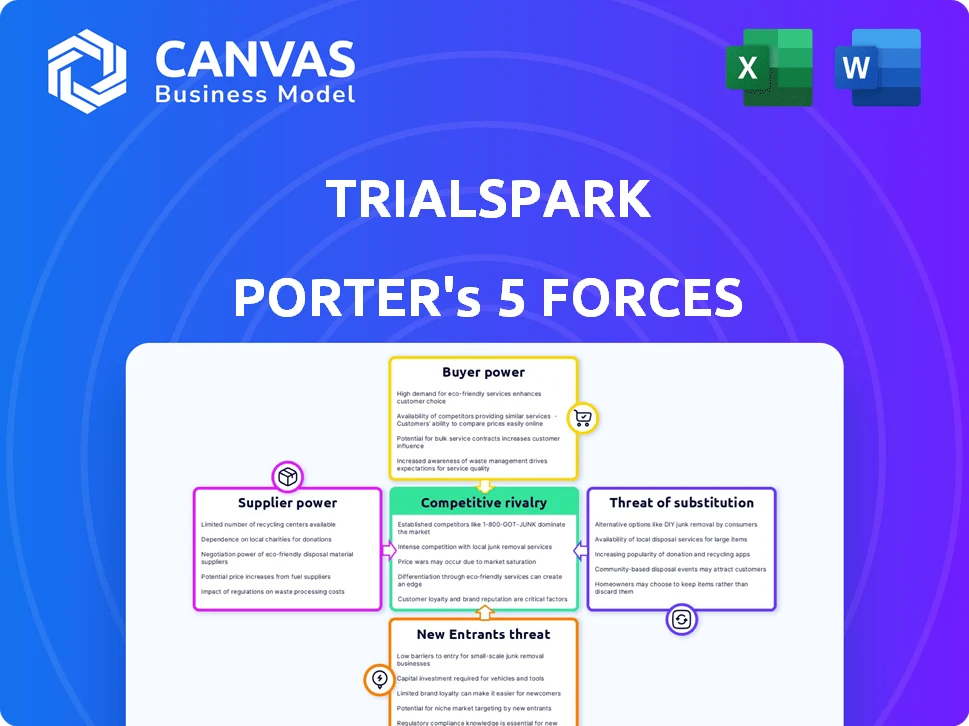
TRIALSPARK PORTER'S FIVE FORCES TEMPLATE RESEARCH
What is included in the product
 Detailed Word Document
Tailored exclusively for TrialSpark, analyzing its position within its competitive landscape.

 Customizable Excel Spreadsheet
Analyze the competitive landscape by comparing threats to find the best market fit.
Same Document Delivered
TrialSpark Porter's Five Forces Analysis
This preview showcases the comprehensive TrialSpark Porter's Five Forces analysis. The document displayed is the same professionally written report you'll receive after purchase. It's a fully formatted and ready-to-use analysis. You get immediate access to this exact file. There are no surprises; this is your deliverable.

Porter's Five Forces Analysis Template

Don't Miss the Bigger Picture
TrialSpark navigates a complex pharmaceutical landscape. The threat of new entrants is moderate, fueled by high R&D costs. Buyer power from healthcare providers is a key factor. Intense competition from established pharma giants also exists. Supplier bargaining power and substitute product threats present further challenges.
Ready to move beyond the basics? Get a full strategic breakdown of TrialSpark’s market position, competitive intensity, and external threats—all in one powerful analysis.
Suppliers Bargaining Power

Limited number of specialized providers
The clinical trial sector leans on specialized suppliers, including CTMS and EDC providers. A concentrated supplier base boosts their leverage, particularly with unique tech. In 2024, the global CTMS market was valued at $1.5 billion. This concentration affects costs and timelines. The bargaining power impacts project budgets and drug development efficiency.
High reliance on technology vendors
TrialSpark, now Formation Bio, leans heavily on tech for its clinical trials. This reliance on vendors for software and data tools gives these suppliers leverage. Specialized tech integration boosts vendor power, potentially increasing costs. For example, in 2024, tech spending on clinical trials rose by 8%, impacting budgets.

Suppliers with proprietary technology
Suppliers with proprietary technology, like those offering unique clinical trial software, hold considerable power. Their control over essential technologies can dictate pricing and contract terms for TrialSpark. For example, in 2024, the market for clinical trial software reached $2.3 billion, highlighting the value of specialized tech.

Potential for vertical integration by suppliers
Some suppliers in the clinical trial ecosystem might consider vertical integration to offer more services, potentially competing with TrialSpark. This forward integration could boost their bargaining power. For example, data analytics firms could expand into trial design, challenging TrialSpark's role. The trend of consolidation among suppliers, such as CROs, is a notable dynamic. This could lead to larger entities with more leverage.
- The global CRO market was valued at $76.2 billion in 2023.
- The market is projected to reach $112.4 billion by 2028.
- Major CROs like IQVIA and Labcorp continue to grow through acquisitions.
- Vertical integration is a key strategy for these players.
Ability to influence pricing and service terms
The bargaining power of suppliers significantly impacts TrialSpark's operational costs and flexibility. Suppliers with unique offerings or high switching costs can dictate pricing and service terms. This power is amplified if the supplier is crucial to the trial's success. For example, specialized lab services might have significant leverage.
- Unique suppliers can command higher prices.
- Switching costs impact TrialSpark's options.
- Critical suppliers increase supplier power.
- High supplier power raises operational costs.
CTMS Suppliers: Power & Market Dynamics
Suppliers, especially those with unique tech like CTMS providers, hold significant bargaining power. The global CTMS market was $1.5B in 2024, showing their leverage. Vertical integration and consolidation among suppliers, such as CROs, further amplify this power. This impacts TrialSpark's costs and flexibility.
| Factor | Impact | Data Point (2024) |
|---|---|---|
| CTMS Market | Supplier Leverage | $1.5 Billion |
| Tech Spending | Rising Costs | Up 8% |
| Clinical Trial Software Market | Specialized Tech Value | $2.3 Billion |
Customers Bargaining Power

Pharmaceutical and biotech companies
TrialSpark's clients, mainly pharma and biotech firms, hold considerable bargaining power. These companies, often managing numerous clinical trials simultaneously, can leverage their size to negotiate favorable terms. For instance, in 2024, the top 10 pharmaceutical companies invested billions in R&D, indicating their financial clout in negotiations. They can influence pricing and demand tailored services.
Increasing demand for faster and more efficient trials
Pharmaceutical companies are under pressure to speed up drug development and cut costs. This drives their need for efficient clinical trial solutions. Companies seek providers like TrialSpark that offer significant time and cost savings.

Availability of alternative solutions
Customers of TrialSpark have various choices for clinical trials, such as CROs, internal teams, and tech firms. The presence of these alternatives boosts customer bargaining power because they can readily switch if TrialSpark's offerings aren't appealing. In 2024, the CRO market was valued at $58.1 billion, showing considerable competition. This means customers have multiple options, raising their leverage.

Customer focus on data quality and regulatory compliance
Pharmaceutical and biotech companies prioritize data quality and regulatory compliance. They lean toward providers who consistently deliver high-quality data and ensure adherence to strict regulatory standards. This focus grants customers significant leverage in choosing and negotiating with providers.
- In 2024, the FDA issued over 500 warning letters related to data integrity in clinical trials.
- Companies face potential fines up to $1 million for non-compliance.
- Approximately 70% of clinical trial data is outsourced.
Shift towards patient-centric trials
The bargaining power of customers is evolving with the shift toward patient-centric trials. Customers, including pharmaceutical companies and research institutions, increasingly prioritize patient recruitment and retention. They will favor providers adept at decentralized and patient-friendly approaches. For instance, in 2024, the adoption of decentralized clinical trials (DCTs) grew, with a 20% increase in trials using remote monitoring. TrialSpark, specializing in this area, could attract more customers. However, customer demands for patient engagement and diversity still exert pressure.
- Patient-centric trials aim to improve patient recruitment and retention.
- Customers seek providers with decentralized and patient-friendly approaches.
- TrialSpark's expertise may attract customers.
- Customer needs for engagement and diversity exert pressure.
Pharma's Power: $58.1B Market & Data Integrity
TrialSpark's clients, mainly pharma and biotech firms, have strong bargaining power, particularly given the $58.1 billion CRO market in 2024. These firms leverage their size and numerous clinical trials to negotiate favorable terms. The FDA's over 500 warning letters in 2024 highlight the importance of data quality, further empowering customers.
| Aspect | Details | 2024 Data |
|---|---|---|
| Market Size | CRO Market | $58.1 billion |
| FDA Warnings | Data Integrity Issues | Over 500 letters |
| DCT Growth | Trials using remote monitoring | 20% increase |
Rivalry Among Competitors

Presence of traditional CROs
TrialSpark faces intense competition from traditional CROs like IQVIA and Syneos Health, which hold significant market share. In 2024, IQVIA's revenue reached approximately $15 billion, indicating the scale of established rivals. These CROs are also integrating technology, intensifying the competitive landscape. This convergence challenges TrialSpark's differentiation strategy, as traditional players adapt.
Emergence of other technology-focused trial providers
The decentralized clinical trial sector is intensifying with tech-focused entrants. Companies and startups provide innovative solutions for trials. These include patient recruitment, remote monitoring, and data management tools. Increased competition is observed in specific market segments. The global clinical trials market was valued at $53.8 billion in 2023, per Grand View Research.

In-house clinical trial capabilities of large pharma
Large pharma's in-house clinical trial prowess intensifies competition. In 2024, companies like Roche invested billions in internal R&D, including trials. This reduces reliance on external entities such as TrialSpark. Pfizer allocated approximately $14.2 billion to research and development. This approach allows greater control and potentially lower costs.

Differentiation through technology and efficiency
Competition in clinical trials hinges on tech and efficiency. TrialSpark's rivalry depends on its tech advantages and results. Faster, cheaper trials are key. 2024 saw a rise in tech-driven trial solutions. The goal is superior outcomes.
- Tech adoption increased by 15% in 2024, boosting trial efficiency.
- Cost reduction targets are set at 10-12% for 2024-2025 by competitors.
- TrialSpark's tech is predicted to improve patient recruitment by 20% in 2024.
- Faster trial completion times are a key differentiator.
Globalization of clinical trials
The globalization of clinical trials intensifies competition for TrialSpark, as it contends with international providers. This expands the competitive arena, compelling TrialSpark to operate globally, navigating diverse regulations and market conditions. The need to manage varied regulatory landscapes adds complexity to its operations. TrialSpark must adapt to these changes to remain competitive.
- In 2024, the global clinical trials market was valued at approximately $50 billion.
- The Asia-Pacific region is experiencing rapid growth in clinical trials, with a projected CAGR of over 6% through 2028.
- Approximately 40% of all clinical trials now involve sites outside of North America and Europe.
- The average cost of conducting a clinical trial has increased by 10-15% in the past five years due to globalization and regulatory complexities.
Clinical Trial Landscape: Fierce Competition
TrialSpark faces stiff competition, especially from major CROs like IQVIA, which had around $15B revenue in 2024. The rise of tech-focused entrants and large pharma’s in-house trial capabilities further intensify the landscape. Efficiency and tech advantages are crucial, with tech adoption increasing by 15% in 2024.
| Factor | Impact | Data (2024) |
|---|---|---|
| Market Size | Competition Intensity | Global market ≈ $50B |
| Tech Adoption | Efficiency Gains | Increased by 15% |
| Cost Reduction | Competitive Pressure | Targets 10-12% |
TRIALSPARK PORTER'S FIVE FORCES TEMPLATE RESEARCH
What is included in the product
Detailed Word Document
Tailored exclusively for TrialSpark, analyzing its position within its competitive landscape.
Customizable Excel Spreadsheet
Analyze the competitive landscape by comparing threats to find the best market fit.
Same Document Delivered
TrialSpark Porter's Five Forces Analysis
This preview showcases the comprehensive TrialSpark Porter's Five Forces analysis. The document displayed is the same professionally written report you'll receive after purchase. It's a fully formatted and ready-to-use analysis. You get immediate access to this exact file. There are no surprises; this is your deliverable.
Porter's Five Forces Analysis Template
Don't Miss the Bigger Picture
TrialSpark navigates a complex pharmaceutical landscape. The threat of new entrants is moderate, fueled by high R&D costs. Buyer power from healthcare providers is a key factor. Intense competition from established pharma giants also exists. Supplier bargaining power and substitute product threats present further challenges.
Ready to move beyond the basics? Get a full strategic breakdown of TrialSpark’s market position, competitive intensity, and external threats—all in one powerful analysis.
Suppliers Bargaining Power
Limited number of specialized providers
The clinical trial sector leans on specialized suppliers, including CTMS and EDC providers. A concentrated supplier base boosts their leverage, particularly with unique tech. In 2024, the global CTMS market was valued at $1.5 billion. This concentration affects costs and timelines. The bargaining power impacts project budgets and drug development efficiency.
High reliance on technology vendors
TrialSpark, now Formation Bio, leans heavily on tech for its clinical trials. This reliance on vendors for software and data tools gives these suppliers leverage. Specialized tech integration boosts vendor power, potentially increasing costs. For example, in 2024, tech spending on clinical trials rose by 8%, impacting budgets.
Suppliers with proprietary technology
Suppliers with proprietary technology, like those offering unique clinical trial software, hold considerable power. Their control over essential technologies can dictate pricing and contract terms for TrialSpark. For example, in 2024, the market for clinical trial software reached $2.3 billion, highlighting the value of specialized tech.
Potential for vertical integration by suppliers
Some suppliers in the clinical trial ecosystem might consider vertical integration to offer more services, potentially competing with TrialSpark. This forward integration could boost their bargaining power. For example, data analytics firms could expand into trial design, challenging TrialSpark's role. The trend of consolidation among suppliers, such as CROs, is a notable dynamic. This could lead to larger entities with more leverage.
- The global CRO market was valued at $76.2 billion in 2023.
- The market is projected to reach $112.4 billion by 2028.
- Major CROs like IQVIA and Labcorp continue to grow through acquisitions.
- Vertical integration is a key strategy for these players.
Ability to influence pricing and service terms
The bargaining power of suppliers significantly impacts TrialSpark's operational costs and flexibility. Suppliers with unique offerings or high switching costs can dictate pricing and service terms. This power is amplified if the supplier is crucial to the trial's success. For example, specialized lab services might have significant leverage.
- Unique suppliers can command higher prices.
- Switching costs impact TrialSpark's options.
- Critical suppliers increase supplier power.
- High supplier power raises operational costs.
CTMS Suppliers: Power & Market Dynamics
Suppliers, especially those with unique tech like CTMS providers, hold significant bargaining power. The global CTMS market was $1.5B in 2024, showing their leverage. Vertical integration and consolidation among suppliers, such as CROs, further amplify this power. This impacts TrialSpark's costs and flexibility.
| Factor | Impact | Data Point (2024) |
|---|---|---|
| CTMS Market | Supplier Leverage | $1.5 Billion |
| Tech Spending | Rising Costs | Up 8% |
| Clinical Trial Software Market | Specialized Tech Value | $2.3 Billion |
Customers Bargaining Power
Pharmaceutical and biotech companies
TrialSpark's clients, mainly pharma and biotech firms, hold considerable bargaining power. These companies, often managing numerous clinical trials simultaneously, can leverage their size to negotiate favorable terms. For instance, in 2024, the top 10 pharmaceutical companies invested billions in R&D, indicating their financial clout in negotiations. They can influence pricing and demand tailored services.
Increasing demand for faster and more efficient trials
Pharmaceutical companies are under pressure to speed up drug development and cut costs. This drives their need for efficient clinical trial solutions. Companies seek providers like TrialSpark that offer significant time and cost savings.
Availability of alternative solutions
Customers of TrialSpark have various choices for clinical trials, such as CROs, internal teams, and tech firms. The presence of these alternatives boosts customer bargaining power because they can readily switch if TrialSpark's offerings aren't appealing. In 2024, the CRO market was valued at $58.1 billion, showing considerable competition. This means customers have multiple options, raising their leverage.
Customer focus on data quality and regulatory compliance
Pharmaceutical and biotech companies prioritize data quality and regulatory compliance. They lean toward providers who consistently deliver high-quality data and ensure adherence to strict regulatory standards. This focus grants customers significant leverage in choosing and negotiating with providers.
- In 2024, the FDA issued over 500 warning letters related to data integrity in clinical trials.
- Companies face potential fines up to $1 million for non-compliance.
- Approximately 70% of clinical trial data is outsourced.
Shift towards patient-centric trials
The bargaining power of customers is evolving with the shift toward patient-centric trials. Customers, including pharmaceutical companies and research institutions, increasingly prioritize patient recruitment and retention. They will favor providers adept at decentralized and patient-friendly approaches. For instance, in 2024, the adoption of decentralized clinical trials (DCTs) grew, with a 20% increase in trials using remote monitoring. TrialSpark, specializing in this area, could attract more customers. However, customer demands for patient engagement and diversity still exert pressure.
- Patient-centric trials aim to improve patient recruitment and retention.
- Customers seek providers with decentralized and patient-friendly approaches.
- TrialSpark's expertise may attract customers.
- Customer needs for engagement and diversity exert pressure.
Pharma's Power: $58.1B Market & Data Integrity
TrialSpark's clients, mainly pharma and biotech firms, have strong bargaining power, particularly given the $58.1 billion CRO market in 2024. These firms leverage their size and numerous clinical trials to negotiate favorable terms. The FDA's over 500 warning letters in 2024 highlight the importance of data quality, further empowering customers.
| Aspect | Details | 2024 Data |
|---|---|---|
| Market Size | CRO Market | $58.1 billion |
| FDA Warnings | Data Integrity Issues | Over 500 letters |
| DCT Growth | Trials using remote monitoring | 20% increase |
Rivalry Among Competitors
Presence of traditional CROs
TrialSpark faces intense competition from traditional CROs like IQVIA and Syneos Health, which hold significant market share. In 2024, IQVIA's revenue reached approximately $15 billion, indicating the scale of established rivals. These CROs are also integrating technology, intensifying the competitive landscape. This convergence challenges TrialSpark's differentiation strategy, as traditional players adapt.
Emergence of other technology-focused trial providers
The decentralized clinical trial sector is intensifying with tech-focused entrants. Companies and startups provide innovative solutions for trials. These include patient recruitment, remote monitoring, and data management tools. Increased competition is observed in specific market segments. The global clinical trials market was valued at $53.8 billion in 2023, per Grand View Research.
In-house clinical trial capabilities of large pharma
Large pharma's in-house clinical trial prowess intensifies competition. In 2024, companies like Roche invested billions in internal R&D, including trials. This reduces reliance on external entities such as TrialSpark. Pfizer allocated approximately $14.2 billion to research and development. This approach allows greater control and potentially lower costs.
Differentiation through technology and efficiency
Competition in clinical trials hinges on tech and efficiency. TrialSpark's rivalry depends on its tech advantages and results. Faster, cheaper trials are key. 2024 saw a rise in tech-driven trial solutions. The goal is superior outcomes.
- Tech adoption increased by 15% in 2024, boosting trial efficiency.
- Cost reduction targets are set at 10-12% for 2024-2025 by competitors.
- TrialSpark's tech is predicted to improve patient recruitment by 20% in 2024.
- Faster trial completion times are a key differentiator.
Globalization of clinical trials
The globalization of clinical trials intensifies competition for TrialSpark, as it contends with international providers. This expands the competitive arena, compelling TrialSpark to operate globally, navigating diverse regulations and market conditions. The need to manage varied regulatory landscapes adds complexity to its operations. TrialSpark must adapt to these changes to remain competitive.
- In 2024, the global clinical trials market was valued at approximately $50 billion.
- The Asia-Pacific region is experiencing rapid growth in clinical trials, with a projected CAGR of over 6% through 2028.
- Approximately 40% of all clinical trials now involve sites outside of North America and Europe.
- The average cost of conducting a clinical trial has increased by 10-15% in the past five years due to globalization and regulatory complexities.
Clinical Trial Landscape: Fierce Competition
TrialSpark faces stiff competition, especially from major CROs like IQVIA, which had around $15B revenue in 2024. The rise of tech-focused entrants and large pharma’s in-house trial capabilities further intensify the landscape. Efficiency and tech advantages are crucial, with tech adoption increasing by 15% in 2024.
| Factor | Impact | Data (2024) |
|---|---|---|
| Market Size | Competition Intensity | Global market ≈ $50B |
| Tech Adoption | Efficiency Gains | Increased by 15% |
| Cost Reduction | Competitive Pressure | Targets 10-12% |
Product Information
Product Information
Shipping & Returns
Shipping & Returns
Description
What is included in the product
Detailed Word Document
Tailored exclusively for TrialSpark, analyzing its position within its competitive landscape.
Customizable Excel Spreadsheet
Analyze the competitive landscape by comparing threats to find the best market fit.
Same Document Delivered
TrialSpark Porter's Five Forces Analysis
This preview showcases the comprehensive TrialSpark Porter's Five Forces analysis. The document displayed is the same professionally written report you'll receive after purchase. It's a fully formatted and ready-to-use analysis. You get immediate access to this exact file. There are no surprises; this is your deliverable.
Porter's Five Forces Analysis Template
Don't Miss the Bigger Picture
TrialSpark navigates a complex pharmaceutical landscape. The threat of new entrants is moderate, fueled by high R&D costs. Buyer power from healthcare providers is a key factor. Intense competition from established pharma giants also exists. Supplier bargaining power and substitute product threats present further challenges.
Ready to move beyond the basics? Get a full strategic breakdown of TrialSpark’s market position, competitive intensity, and external threats—all in one powerful analysis.
Suppliers Bargaining Power
Limited number of specialized providers
The clinical trial sector leans on specialized suppliers, including CTMS and EDC providers. A concentrated supplier base boosts their leverage, particularly with unique tech. In 2024, the global CTMS market was valued at $1.5 billion. This concentration affects costs and timelines. The bargaining power impacts project budgets and drug development efficiency.
High reliance on technology vendors
TrialSpark, now Formation Bio, leans heavily on tech for its clinical trials. This reliance on vendors for software and data tools gives these suppliers leverage. Specialized tech integration boosts vendor power, potentially increasing costs. For example, in 2024, tech spending on clinical trials rose by 8%, impacting budgets.
Suppliers with proprietary technology
Suppliers with proprietary technology, like those offering unique clinical trial software, hold considerable power. Their control over essential technologies can dictate pricing and contract terms for TrialSpark. For example, in 2024, the market for clinical trial software reached $2.3 billion, highlighting the value of specialized tech.
Potential for vertical integration by suppliers
Some suppliers in the clinical trial ecosystem might consider vertical integration to offer more services, potentially competing with TrialSpark. This forward integration could boost their bargaining power. For example, data analytics firms could expand into trial design, challenging TrialSpark's role. The trend of consolidation among suppliers, such as CROs, is a notable dynamic. This could lead to larger entities with more leverage.
- The global CRO market was valued at $76.2 billion in 2023.
- The market is projected to reach $112.4 billion by 2028.
- Major CROs like IQVIA and Labcorp continue to grow through acquisitions.
- Vertical integration is a key strategy for these players.
Ability to influence pricing and service terms
The bargaining power of suppliers significantly impacts TrialSpark's operational costs and flexibility. Suppliers with unique offerings or high switching costs can dictate pricing and service terms. This power is amplified if the supplier is crucial to the trial's success. For example, specialized lab services might have significant leverage.
- Unique suppliers can command higher prices.
- Switching costs impact TrialSpark's options.
- Critical suppliers increase supplier power.
- High supplier power raises operational costs.
CTMS Suppliers: Power & Market Dynamics
Suppliers, especially those with unique tech like CTMS providers, hold significant bargaining power. The global CTMS market was $1.5B in 2024, showing their leverage. Vertical integration and consolidation among suppliers, such as CROs, further amplify this power. This impacts TrialSpark's costs and flexibility.
| Factor | Impact | Data Point (2024) |
|---|---|---|
| CTMS Market | Supplier Leverage | $1.5 Billion |
| Tech Spending | Rising Costs | Up 8% |
| Clinical Trial Software Market | Specialized Tech Value | $2.3 Billion |
Customers Bargaining Power
Pharmaceutical and biotech companies
TrialSpark's clients, mainly pharma and biotech firms, hold considerable bargaining power. These companies, often managing numerous clinical trials simultaneously, can leverage their size to negotiate favorable terms. For instance, in 2024, the top 10 pharmaceutical companies invested billions in R&D, indicating their financial clout in negotiations. They can influence pricing and demand tailored services.
Increasing demand for faster and more efficient trials
Pharmaceutical companies are under pressure to speed up drug development and cut costs. This drives their need for efficient clinical trial solutions. Companies seek providers like TrialSpark that offer significant time and cost savings.
Availability of alternative solutions
Customers of TrialSpark have various choices for clinical trials, such as CROs, internal teams, and tech firms. The presence of these alternatives boosts customer bargaining power because they can readily switch if TrialSpark's offerings aren't appealing. In 2024, the CRO market was valued at $58.1 billion, showing considerable competition. This means customers have multiple options, raising their leverage.
Customer focus on data quality and regulatory compliance
Pharmaceutical and biotech companies prioritize data quality and regulatory compliance. They lean toward providers who consistently deliver high-quality data and ensure adherence to strict regulatory standards. This focus grants customers significant leverage in choosing and negotiating with providers.
- In 2024, the FDA issued over 500 warning letters related to data integrity in clinical trials.
- Companies face potential fines up to $1 million for non-compliance.
- Approximately 70% of clinical trial data is outsourced.
Shift towards patient-centric trials
The bargaining power of customers is evolving with the shift toward patient-centric trials. Customers, including pharmaceutical companies and research institutions, increasingly prioritize patient recruitment and retention. They will favor providers adept at decentralized and patient-friendly approaches. For instance, in 2024, the adoption of decentralized clinical trials (DCTs) grew, with a 20% increase in trials using remote monitoring. TrialSpark, specializing in this area, could attract more customers. However, customer demands for patient engagement and diversity still exert pressure.
- Patient-centric trials aim to improve patient recruitment and retention.
- Customers seek providers with decentralized and patient-friendly approaches.
- TrialSpark's expertise may attract customers.
- Customer needs for engagement and diversity exert pressure.
Pharma's Power: $58.1B Market & Data Integrity
TrialSpark's clients, mainly pharma and biotech firms, have strong bargaining power, particularly given the $58.1 billion CRO market in 2024. These firms leverage their size and numerous clinical trials to negotiate favorable terms. The FDA's over 500 warning letters in 2024 highlight the importance of data quality, further empowering customers.
| Aspect | Details | 2024 Data |
|---|---|---|
| Market Size | CRO Market | $58.1 billion |
| FDA Warnings | Data Integrity Issues | Over 500 letters |
| DCT Growth | Trials using remote monitoring | 20% increase |
Rivalry Among Competitors
Presence of traditional CROs
TrialSpark faces intense competition from traditional CROs like IQVIA and Syneos Health, which hold significant market share. In 2024, IQVIA's revenue reached approximately $15 billion, indicating the scale of established rivals. These CROs are also integrating technology, intensifying the competitive landscape. This convergence challenges TrialSpark's differentiation strategy, as traditional players adapt.
Emergence of other technology-focused trial providers
The decentralized clinical trial sector is intensifying with tech-focused entrants. Companies and startups provide innovative solutions for trials. These include patient recruitment, remote monitoring, and data management tools. Increased competition is observed in specific market segments. The global clinical trials market was valued at $53.8 billion in 2023, per Grand View Research.
In-house clinical trial capabilities of large pharma
Large pharma's in-house clinical trial prowess intensifies competition. In 2024, companies like Roche invested billions in internal R&D, including trials. This reduces reliance on external entities such as TrialSpark. Pfizer allocated approximately $14.2 billion to research and development. This approach allows greater control and potentially lower costs.
Differentiation through technology and efficiency
Competition in clinical trials hinges on tech and efficiency. TrialSpark's rivalry depends on its tech advantages and results. Faster, cheaper trials are key. 2024 saw a rise in tech-driven trial solutions. The goal is superior outcomes.
- Tech adoption increased by 15% in 2024, boosting trial efficiency.
- Cost reduction targets are set at 10-12% for 2024-2025 by competitors.
- TrialSpark's tech is predicted to improve patient recruitment by 20% in 2024.
- Faster trial completion times are a key differentiator.
Globalization of clinical trials
The globalization of clinical trials intensifies competition for TrialSpark, as it contends with international providers. This expands the competitive arena, compelling TrialSpark to operate globally, navigating diverse regulations and market conditions. The need to manage varied regulatory landscapes adds complexity to its operations. TrialSpark must adapt to these changes to remain competitive.
- In 2024, the global clinical trials market was valued at approximately $50 billion.
- The Asia-Pacific region is experiencing rapid growth in clinical trials, with a projected CAGR of over 6% through 2028.
- Approximately 40% of all clinical trials now involve sites outside of North America and Europe.
- The average cost of conducting a clinical trial has increased by 10-15% in the past five years due to globalization and regulatory complexities.
Clinical Trial Landscape: Fierce Competition
TrialSpark faces stiff competition, especially from major CROs like IQVIA, which had around $15B revenue in 2024. The rise of tech-focused entrants and large pharma’s in-house trial capabilities further intensify the landscape. Efficiency and tech advantages are crucial, with tech adoption increasing by 15% in 2024.
| Factor | Impact | Data (2024) |
|---|---|---|
| Market Size | Competition Intensity | Global market ≈ $50B |
| Tech Adoption | Efficiency Gains | Increased by 15% |
| Cost Reduction | Competitive Pressure | Targets 10-12% |


