
STAR ATLAS BUSINESS MODEL CANVAS TEMPLATE RESEARCH
What is included in the product
 Detailed Word Document
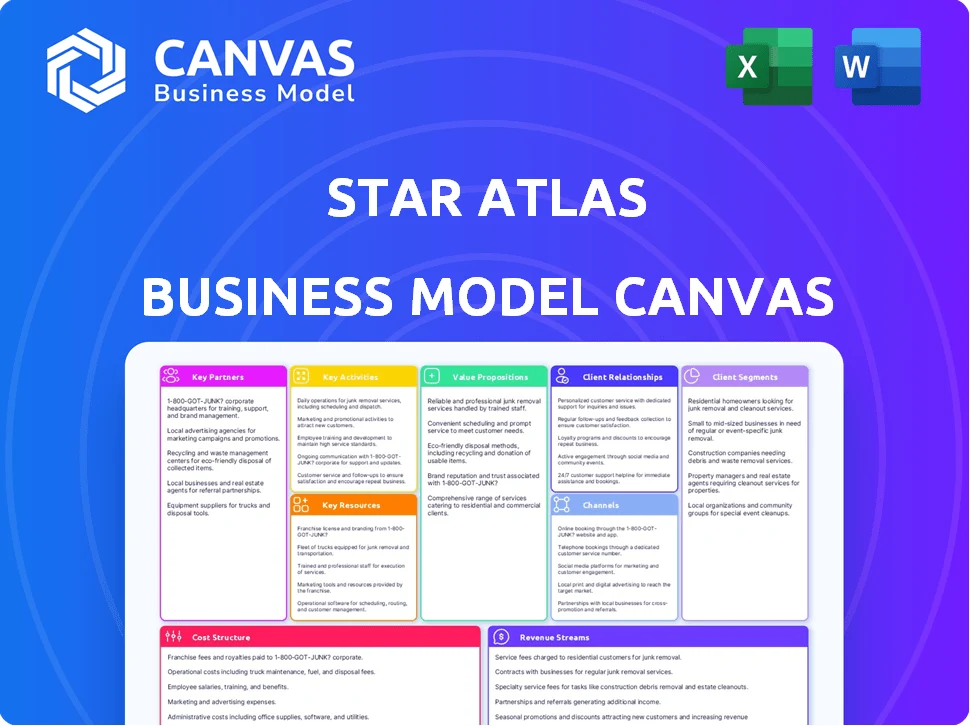
A comprehensive business model canvas for Star Atlas, covering key aspects like customer segments and value propositions.

 Customizable Excel Spreadsheet
Quickly identify core components with a one-page business snapshot.
Full Version Awaits
Business Model Canvas
The Star Atlas Business Model Canvas you see now is what you'll receive. This isn't a sample: it's the actual document. Purchase grants full access to this same ready-to-use file. Expect no differences; it's ready to go!

Business Model Canvas Template

Star Atlas: Business Model Unveiled!
Explore the Star Atlas business model with the Business Model Canvas. This framework unveils their customer segments, value propositions, and revenue streams. It highlights crucial activities, partnerships, and cost structures.
The canvas offers a clear, strategic snapshot of Star Atlas's operations. Perfect for understanding their competitive advantages and growth strategies. Download the full version for in-depth analysis and actionable insights.
Partnerships

Blockchain Platform Providers
Star Atlas relies on Solana for its blockchain foundation. This partnership is key to the game's infrastructure, ensuring fast transactions. Solana's low costs support the game's in-game economy. In 2024, Solana saw significant growth, with transaction fees remaining low.
Game Development Studios
Collaborations with game development studios are essential for Star Atlas's success. Partnerships, such as with Sperasoft, are key to developing the metaverse using Unreal Engine 5. These collaborations ensure high-quality graphics and advanced game mechanics. In 2024, the global metaverse market was valued at $50 billion, highlighting the importance of these partnerships.

Decentralized Cloud Gaming Platforms
Star Atlas leverages partnerships with decentralized cloud gaming platforms to broaden its reach. Platforms such as Shaga facilitate cloud gaming, eliminating the need for expensive hardware for players. This strategic move significantly increases the accessible player base. In 2024, the cloud gaming market is projected to reach $7.4 billion. This is up from $2.6 billion in 2020, according to Statista.

AI Technology Providers
Star Atlas could forge crucial alliances with AI technology providers. Partnering with entities like SingularityNET might allow for the integration of sophisticated AI agents. These agents could optimize in-game economies and significantly improve player experiences.
- SingularityNET's market cap as of early 2024 was approximately $100 million.
- AI in gaming is projected to reach $2.8 billion by 2024.
Crypto Exchanges and Wallets
Key partnerships with crypto exchanges and wallet providers are crucial for Star Atlas's success. Collaborations with platforms like Uphold, which offers features like Topper, and Phantom Wallet, enable players to easily acquire ATLAS and POLIS tokens. These partnerships are vital for a functioning in-game economy, allowing players to trade and manage their assets. As of late 2024, the crypto market cap is around $2.5 trillion, highlighting the significance of these integrations.
- Facilitates access to in-game tokens (ATLAS and POLIS).
- Enhances player participation in the game's economy.
- Partnerships with exchanges like Uphold and wallet providers like Phantom Wallet.
- Supports trading and management of in-game assets.
Key Alliances Fueling Economic Growth
Star Atlas's success depends on key partnerships for its economic functionality. Crypto exchange collaborations, such as Uphold and wallet providers like Phantom, enhance in-game participation. These partnerships facilitate trading, token management, and the overall economic health. The crypto market cap neared $2.5 trillion late in 2024, underscoring these alliances.
| Partnership Type | Partner Examples | Impact |
|---|---|---|
| Crypto Exchanges | Uphold | Enables easy acquisition of tokens |
| Wallet Providers | Phantom Wallet | Supports asset trading & management |
| Market Influence | Crypto market | Late 2024 cap around $2.5T |
Activities

Game Development and Updates
Game development and updates are pivotal for Star Atlas. The team uses Unreal Engine 5 for creating new modules and features. Continuous updates and content releases are vital for player engagement. In 2024, investment in game development reached $5 million. Responding to community feedback shapes the game's evolution.
Blockchain and Smart Contract Management
Blockchain and smart contract management are fundamental. This ensures the game's functionality, security, and player-driven economy integrity. Handling in-game transactions and asset ownership is a key part of this. In 2024, Solana's TPS averaged around 2,500, crucial for Star Atlas.

NFT and Tokenomics Design and Management
NFT and Tokenomics Design and Management is central to Star Atlas's play-to-earn model. This involves designing and managing the dual-token economy (ATLAS and POLIS) and NFT ecosystem. The goal is to balance token emissions and create utility for in-game assets. In 2024, the NFT market saw approximately $14.5 billion in trading volume, highlighting the significance of this activity.

Community Building and Engagement
Community building and engagement are crucial for Star Atlas's success. Active participation on platforms like Discord and social media is essential for gathering player feedback and creating a strong community. This approach fosters a sense of belonging among players, helping to promote the game organically. Engaging with players and supporting community-led initiatives are key strategies.
- Discord: 100,000+ active members.
- Social Media: 50,000+ followers across platforms.
- Community Events: Monthly in-game events.
- Feedback: Over 5,000 feedback submissions in 2024.
Marketing and User Acquisition
Marketing and user acquisition are vital for Star Atlas's growth. Ongoing marketing strategies attract new players and retain existing ones. This includes creator campaigns and highlighting the game's unique features. In 2024, the blockchain gaming market saw over $4.8 billion in investments.
- Creator campaigns boost visibility.
- Showcasing unique game features is key.
- User retention strategies are essential.
- Market investments fuel growth.
$5M Boosts Game, NFTs Thrive!
Ongoing game updates using Unreal Engine 5, with 2024 investments of $5 million, are crucial. Smart contracts and Solana's average of 2,500 TPS support the economy. The NFT market's $14.5 billion volume shows this activity’s relevance.
| Key Activities | Description | 2024 Data |
|---|---|---|
| Game Development | Creating new modules and features. | $5M Investment |
| Blockchain Management | Handling in-game transactions, security. | Solana TPS 2,500 |
| NFT Management | Designing dual-token system (ATLAS, POLIS). | NFT market $14.5B |
Resources

The Star Atlas Metaverse and Game Assets
The Star Atlas metaverse, encompassing planets and star systems, is a core resource. In-game assets like ships, land, and equipment, represented as NFTs, drive the economy. These digital assets, with values fluctuating based on player activity and market demand, are crucial. The Star Atlas marketplace saw over $1 million in NFT trading volume in 2024, reflecting their importance.
The Solana Blockchain Infrastructure
The Solana blockchain is a key resource for Star Atlas, offering fast transactions and security. Solana's infrastructure supports the game's complex needs. It's designed to handle high transaction volumes. In 2024, Solana's total value locked (TVL) hit $1.5 billion, showing its growing adoption.

Game Development Team and Talent
A strong game development team is crucial for Star Atlas. This includes developers, designers, blockchain experts, and economists. The team's expertise ensures the metaverse's complexity is managed effectively. In 2024, the global gaming market was valued at roughly $282 billion, highlighting the financial stakes involved.

ATLAS and POLIS Tokens
ATLAS and POLIS tokens are central to Star Atlas's ecosystem. ATLAS serves as the in-game currency for transactions, while POLIS grants governance rights to players. These tokens drive the play-to-earn model, enabling players to earn rewards and influence the game's development. The value of both tokens fluctuates based on in-game activities and market dynamics.
- ATLAS facilitates in-game purchases and rewards.
- POLIS enables voting on game proposals.
- Token values are influenced by player activity.
- Both tokens are vital for economic participation.
Community and Player Base
The Star Atlas community and player base are vital resources. They actively participate in the game's ecosystem, driving its growth. This participation includes gameplay, content creation, and valuable feedback. A strong community enhances the overall metaverse experience, increasing engagement and value. In 2024, active player engagement in similar blockchain games has shown a correlation with project success.
- Active players contribute to the game's economy.
- Content creators boost engagement.
- Feedback improves game development.
- Community strengthens the metaverse.
Star Atlas's Key Assets: Metaverse, Blockchain, and Community
Key Resources of Star Atlas's Business Model Canvas: core assets include metaverse, blockchain tech and token, and community.
Digital assets like ships and land represented as NFTs with fluctuating values that fuel the Star Atlas market.
Solana provides speed, security and supports complex in-game activity while tokens power in-game economy and player engagement.
| Resource | Description | 2024 Data |
|---|---|---|
| In-game Assets | NFTs: ships, land, equipment | $1M+ NFT trading volume |
| Blockchain | Solana blockchain | $1.5B TVL |
| Tokens | ATLAS and POLIS tokens | Influenced by in-game activity and market dynamics. |
Value Propositions

Immersive Metaverse Experience
Star Atlas's value lies in its Unreal Engine 5-powered immersive metaverse. It offers a visually rich space exploration experience. Players can explore a vast universe. This appeals to gamers seeking engaging gameplay. The metaverse market was valued at $47.69 billion in 2023 and is projected to reach $678.8 billion by 2030.
Real Ownership of Digital Assets
Star Atlas offers real ownership of digital assets via NFTs on the Solana blockchain. Players gain true ownership of in-game assets, enabling trading and potential real-world value. The NFT market saw a trading volume of $14.5 billion in 2024, showing the potential of this model. This creates an innovative value proposition, as the NFT market capitalization reached $17.9 billion by the end of 2024.

Play-to-Earn Opportunities
Star Atlas offers "Play-to-Earn" mechanics, letting players earn crypto and assets. This model attracts players seeking financial rewards. In 2024, play-to-earn games saw an increase in user engagement. For example, Axie Infinity's daily active users rose by 15% in Q3 2024.

Player Governance and Influence
Star Atlas's player governance is centered around the POLIS token, granting holders significant influence over the game's evolution. Through the DAO, these token holders can directly impact decisions about the game's development and strategic direction. This model fosters a strong sense of community ownership and engagement, crucial for long-term success. This approach reflects the growing trend of decentralized governance in gaming, enhancing player involvement.
- POLIS token holders vote on proposals.
- DAO manages game's treasury.
- Community shapes future game updates.
- Empowers players in decision-making.
Combination of Traditional and Blockchain Gaming
Star Atlas’s value proposition centers on merging traditional gaming with blockchain. This hybrid model attracts a broad audience, including gamers and crypto fans. By integrating blockchain, it introduces features like in-game asset ownership and trading. This approach leverages the established gaming market while tapping into the growing crypto community. In 2024, the blockchain gaming sector saw investments exceeding $4.8 billion, highlighting its potential.
- Hybrid appeal: Attracts both traditional gamers and crypto enthusiasts.
- Innovative features: Integrates blockchain for asset ownership and trading.
- Market opportunity: Leverages the growing blockchain gaming market.
- Financial backing: Blockchain gaming investments exceeded $4.8B in 2024.
Metaverse & NFTs: A $14.5B Boost!
Star Atlas’s value is boosted by an immersive metaverse, offering visual richness and vast exploration. Real ownership of in-game assets is granted via NFTs, driving asset trading. The "Play-to-Earn" model lets players earn crypto, and the governance model gives POLIS holders power. In 2024, the NFT market hit $14.5B.
| Value Proposition Element | Description | 2024 Impact |
|---|---|---|
| Immersive Metaverse | Rich visual space exploration. | Metaverse market valued at $678.8B projected by 2030. |
| NFT Ownership | Real asset ownership, enabling trading. | NFT market saw $14.5B in trading volume. |
| Play-to-Earn | Players earn crypto and assets. | Play-to-earn games saw rising engagement. |
| Player Governance | POLIS token holders influence. | DAO drives community-led game evolution. |
STAR ATLAS BUSINESS MODEL CANVAS TEMPLATE RESEARCH
What is included in the product
Detailed Word Document
A comprehensive business model canvas for Star Atlas, covering key aspects like customer segments and value propositions.
Customizable Excel Spreadsheet
Quickly identify core components with a one-page business snapshot.
Full Version Awaits
Business Model Canvas
The Star Atlas Business Model Canvas you see now is what you'll receive. This isn't a sample: it's the actual document. Purchase grants full access to this same ready-to-use file. Expect no differences; it's ready to go!
Business Model Canvas Template
Star Atlas: Business Model Unveiled!
Explore the Star Atlas business model with the Business Model Canvas. This framework unveils their customer segments, value propositions, and revenue streams. It highlights crucial activities, partnerships, and cost structures.
The canvas offers a clear, strategic snapshot of Star Atlas's operations. Perfect for understanding their competitive advantages and growth strategies. Download the full version for in-depth analysis and actionable insights.
Partnerships
Blockchain Platform Providers
Star Atlas relies on Solana for its blockchain foundation. This partnership is key to the game's infrastructure, ensuring fast transactions. Solana's low costs support the game's in-game economy. In 2024, Solana saw significant growth, with transaction fees remaining low.
Game Development Studios
Collaborations with game development studios are essential for Star Atlas's success. Partnerships, such as with Sperasoft, are key to developing the metaverse using Unreal Engine 5. These collaborations ensure high-quality graphics and advanced game mechanics. In 2024, the global metaverse market was valued at $50 billion, highlighting the importance of these partnerships.
Decentralized Cloud Gaming Platforms
Star Atlas leverages partnerships with decentralized cloud gaming platforms to broaden its reach. Platforms such as Shaga facilitate cloud gaming, eliminating the need for expensive hardware for players. This strategic move significantly increases the accessible player base. In 2024, the cloud gaming market is projected to reach $7.4 billion. This is up from $2.6 billion in 2020, according to Statista.
AI Technology Providers
Star Atlas could forge crucial alliances with AI technology providers. Partnering with entities like SingularityNET might allow for the integration of sophisticated AI agents. These agents could optimize in-game economies and significantly improve player experiences.
- SingularityNET's market cap as of early 2024 was approximately $100 million.
- AI in gaming is projected to reach $2.8 billion by 2024.
Crypto Exchanges and Wallets
Key partnerships with crypto exchanges and wallet providers are crucial for Star Atlas's success. Collaborations with platforms like Uphold, which offers features like Topper, and Phantom Wallet, enable players to easily acquire ATLAS and POLIS tokens. These partnerships are vital for a functioning in-game economy, allowing players to trade and manage their assets. As of late 2024, the crypto market cap is around $2.5 trillion, highlighting the significance of these integrations.
- Facilitates access to in-game tokens (ATLAS and POLIS).
- Enhances player participation in the game's economy.
- Partnerships with exchanges like Uphold and wallet providers like Phantom Wallet.
- Supports trading and management of in-game assets.
Key Alliances Fueling Economic Growth
Star Atlas's success depends on key partnerships for its economic functionality. Crypto exchange collaborations, such as Uphold and wallet providers like Phantom, enhance in-game participation. These partnerships facilitate trading, token management, and the overall economic health. The crypto market cap neared $2.5 trillion late in 2024, underscoring these alliances.
| Partnership Type | Partner Examples | Impact |
|---|---|---|
| Crypto Exchanges | Uphold | Enables easy acquisition of tokens |
| Wallet Providers | Phantom Wallet | Supports asset trading & management |
| Market Influence | Crypto market | Late 2024 cap around $2.5T |
Activities
Game Development and Updates
Game development and updates are pivotal for Star Atlas. The team uses Unreal Engine 5 for creating new modules and features. Continuous updates and content releases are vital for player engagement. In 2024, investment in game development reached $5 million. Responding to community feedback shapes the game's evolution.
Blockchain and Smart Contract Management
Blockchain and smart contract management are fundamental. This ensures the game's functionality, security, and player-driven economy integrity. Handling in-game transactions and asset ownership is a key part of this. In 2024, Solana's TPS averaged around 2,500, crucial for Star Atlas.
NFT and Tokenomics Design and Management
NFT and Tokenomics Design and Management is central to Star Atlas's play-to-earn model. This involves designing and managing the dual-token economy (ATLAS and POLIS) and NFT ecosystem. The goal is to balance token emissions and create utility for in-game assets. In 2024, the NFT market saw approximately $14.5 billion in trading volume, highlighting the significance of this activity.
Community Building and Engagement
Community building and engagement are crucial for Star Atlas's success. Active participation on platforms like Discord and social media is essential for gathering player feedback and creating a strong community. This approach fosters a sense of belonging among players, helping to promote the game organically. Engaging with players and supporting community-led initiatives are key strategies.
- Discord: 100,000+ active members.
- Social Media: 50,000+ followers across platforms.
- Community Events: Monthly in-game events.
- Feedback: Over 5,000 feedback submissions in 2024.
Marketing and User Acquisition
Marketing and user acquisition are vital for Star Atlas's growth. Ongoing marketing strategies attract new players and retain existing ones. This includes creator campaigns and highlighting the game's unique features. In 2024, the blockchain gaming market saw over $4.8 billion in investments.
- Creator campaigns boost visibility.
- Showcasing unique game features is key.
- User retention strategies are essential.
- Market investments fuel growth.
$5M Boosts Game, NFTs Thrive!
Ongoing game updates using Unreal Engine 5, with 2024 investments of $5 million, are crucial. Smart contracts and Solana's average of 2,500 TPS support the economy. The NFT market's $14.5 billion volume shows this activity’s relevance.
| Key Activities | Description | 2024 Data |
|---|---|---|
| Game Development | Creating new modules and features. | $5M Investment |
| Blockchain Management | Handling in-game transactions, security. | Solana TPS 2,500 |
| NFT Management | Designing dual-token system (ATLAS, POLIS). | NFT market $14.5B |
Resources
The Star Atlas Metaverse and Game Assets
The Star Atlas metaverse, encompassing planets and star systems, is a core resource. In-game assets like ships, land, and equipment, represented as NFTs, drive the economy. These digital assets, with values fluctuating based on player activity and market demand, are crucial. The Star Atlas marketplace saw over $1 million in NFT trading volume in 2024, reflecting their importance.
The Solana Blockchain Infrastructure
The Solana blockchain is a key resource for Star Atlas, offering fast transactions and security. Solana's infrastructure supports the game's complex needs. It's designed to handle high transaction volumes. In 2024, Solana's total value locked (TVL) hit $1.5 billion, showing its growing adoption.
Game Development Team and Talent
A strong game development team is crucial for Star Atlas. This includes developers, designers, blockchain experts, and economists. The team's expertise ensures the metaverse's complexity is managed effectively. In 2024, the global gaming market was valued at roughly $282 billion, highlighting the financial stakes involved.
ATLAS and POLIS Tokens
ATLAS and POLIS tokens are central to Star Atlas's ecosystem. ATLAS serves as the in-game currency for transactions, while POLIS grants governance rights to players. These tokens drive the play-to-earn model, enabling players to earn rewards and influence the game's development. The value of both tokens fluctuates based on in-game activities and market dynamics.
- ATLAS facilitates in-game purchases and rewards.
- POLIS enables voting on game proposals.
- Token values are influenced by player activity.
- Both tokens are vital for economic participation.
Community and Player Base
The Star Atlas community and player base are vital resources. They actively participate in the game's ecosystem, driving its growth. This participation includes gameplay, content creation, and valuable feedback. A strong community enhances the overall metaverse experience, increasing engagement and value. In 2024, active player engagement in similar blockchain games has shown a correlation with project success.
- Active players contribute to the game's economy.
- Content creators boost engagement.
- Feedback improves game development.
- Community strengthens the metaverse.
Star Atlas's Key Assets: Metaverse, Blockchain, and Community
Key Resources of Star Atlas's Business Model Canvas: core assets include metaverse, blockchain tech and token, and community.
Digital assets like ships and land represented as NFTs with fluctuating values that fuel the Star Atlas market.
Solana provides speed, security and supports complex in-game activity while tokens power in-game economy and player engagement.
| Resource | Description | 2024 Data |
|---|---|---|
| In-game Assets | NFTs: ships, land, equipment | $1M+ NFT trading volume |
| Blockchain | Solana blockchain | $1.5B TVL |
| Tokens | ATLAS and POLIS tokens | Influenced by in-game activity and market dynamics. |
Value Propositions
Immersive Metaverse Experience
Star Atlas's value lies in its Unreal Engine 5-powered immersive metaverse. It offers a visually rich space exploration experience. Players can explore a vast universe. This appeals to gamers seeking engaging gameplay. The metaverse market was valued at $47.69 billion in 2023 and is projected to reach $678.8 billion by 2030.
Real Ownership of Digital Assets
Star Atlas offers real ownership of digital assets via NFTs on the Solana blockchain. Players gain true ownership of in-game assets, enabling trading and potential real-world value. The NFT market saw a trading volume of $14.5 billion in 2024, showing the potential of this model. This creates an innovative value proposition, as the NFT market capitalization reached $17.9 billion by the end of 2024.
Play-to-Earn Opportunities
Star Atlas offers "Play-to-Earn" mechanics, letting players earn crypto and assets. This model attracts players seeking financial rewards. In 2024, play-to-earn games saw an increase in user engagement. For example, Axie Infinity's daily active users rose by 15% in Q3 2024.
Player Governance and Influence
Star Atlas's player governance is centered around the POLIS token, granting holders significant influence over the game's evolution. Through the DAO, these token holders can directly impact decisions about the game's development and strategic direction. This model fosters a strong sense of community ownership and engagement, crucial for long-term success. This approach reflects the growing trend of decentralized governance in gaming, enhancing player involvement.
- POLIS token holders vote on proposals.
- DAO manages game's treasury.
- Community shapes future game updates.
- Empowers players in decision-making.
Combination of Traditional and Blockchain Gaming
Star Atlas’s value proposition centers on merging traditional gaming with blockchain. This hybrid model attracts a broad audience, including gamers and crypto fans. By integrating blockchain, it introduces features like in-game asset ownership and trading. This approach leverages the established gaming market while tapping into the growing crypto community. In 2024, the blockchain gaming sector saw investments exceeding $4.8 billion, highlighting its potential.
- Hybrid appeal: Attracts both traditional gamers and crypto enthusiasts.
- Innovative features: Integrates blockchain for asset ownership and trading.
- Market opportunity: Leverages the growing blockchain gaming market.
- Financial backing: Blockchain gaming investments exceeded $4.8B in 2024.
Metaverse & NFTs: A $14.5B Boost!
Star Atlas’s value is boosted by an immersive metaverse, offering visual richness and vast exploration. Real ownership of in-game assets is granted via NFTs, driving asset trading. The "Play-to-Earn" model lets players earn crypto, and the governance model gives POLIS holders power. In 2024, the NFT market hit $14.5B.
| Value Proposition Element | Description | 2024 Impact |
|---|---|---|
| Immersive Metaverse | Rich visual space exploration. | Metaverse market valued at $678.8B projected by 2030. |
| NFT Ownership | Real asset ownership, enabling trading. | NFT market saw $14.5B in trading volume. |
| Play-to-Earn | Players earn crypto and assets. | Play-to-earn games saw rising engagement. |
| Player Governance | POLIS token holders influence. | DAO drives community-led game evolution. |
Product Information
Product Information
Shipping & Returns
Shipping & Returns
Description
What is included in the product
Detailed Word Document
A comprehensive business model canvas for Star Atlas, covering key aspects like customer segments and value propositions.
Customizable Excel Spreadsheet
Quickly identify core components with a one-page business snapshot.
Full Version Awaits
Business Model Canvas
The Star Atlas Business Model Canvas you see now is what you'll receive. This isn't a sample: it's the actual document. Purchase grants full access to this same ready-to-use file. Expect no differences; it's ready to go!
Business Model Canvas Template
Star Atlas: Business Model Unveiled!
Explore the Star Atlas business model with the Business Model Canvas. This framework unveils their customer segments, value propositions, and revenue streams. It highlights crucial activities, partnerships, and cost structures.
The canvas offers a clear, strategic snapshot of Star Atlas's operations. Perfect for understanding their competitive advantages and growth strategies. Download the full version for in-depth analysis and actionable insights.
Partnerships
Blockchain Platform Providers
Star Atlas relies on Solana for its blockchain foundation. This partnership is key to the game's infrastructure, ensuring fast transactions. Solana's low costs support the game's in-game economy. In 2024, Solana saw significant growth, with transaction fees remaining low.
Game Development Studios
Collaborations with game development studios are essential for Star Atlas's success. Partnerships, such as with Sperasoft, are key to developing the metaverse using Unreal Engine 5. These collaborations ensure high-quality graphics and advanced game mechanics. In 2024, the global metaverse market was valued at $50 billion, highlighting the importance of these partnerships.
Decentralized Cloud Gaming Platforms
Star Atlas leverages partnerships with decentralized cloud gaming platforms to broaden its reach. Platforms such as Shaga facilitate cloud gaming, eliminating the need for expensive hardware for players. This strategic move significantly increases the accessible player base. In 2024, the cloud gaming market is projected to reach $7.4 billion. This is up from $2.6 billion in 2020, according to Statista.
AI Technology Providers
Star Atlas could forge crucial alliances with AI technology providers. Partnering with entities like SingularityNET might allow for the integration of sophisticated AI agents. These agents could optimize in-game economies and significantly improve player experiences.
- SingularityNET's market cap as of early 2024 was approximately $100 million.
- AI in gaming is projected to reach $2.8 billion by 2024.
Crypto Exchanges and Wallets
Key partnerships with crypto exchanges and wallet providers are crucial for Star Atlas's success. Collaborations with platforms like Uphold, which offers features like Topper, and Phantom Wallet, enable players to easily acquire ATLAS and POLIS tokens. These partnerships are vital for a functioning in-game economy, allowing players to trade and manage their assets. As of late 2024, the crypto market cap is around $2.5 trillion, highlighting the significance of these integrations.
- Facilitates access to in-game tokens (ATLAS and POLIS).
- Enhances player participation in the game's economy.
- Partnerships with exchanges like Uphold and wallet providers like Phantom Wallet.
- Supports trading and management of in-game assets.
Key Alliances Fueling Economic Growth
Star Atlas's success depends on key partnerships for its economic functionality. Crypto exchange collaborations, such as Uphold and wallet providers like Phantom, enhance in-game participation. These partnerships facilitate trading, token management, and the overall economic health. The crypto market cap neared $2.5 trillion late in 2024, underscoring these alliances.
| Partnership Type | Partner Examples | Impact |
|---|---|---|
| Crypto Exchanges | Uphold | Enables easy acquisition of tokens |
| Wallet Providers | Phantom Wallet | Supports asset trading & management |
| Market Influence | Crypto market | Late 2024 cap around $2.5T |
Activities
Game Development and Updates
Game development and updates are pivotal for Star Atlas. The team uses Unreal Engine 5 for creating new modules and features. Continuous updates and content releases are vital for player engagement. In 2024, investment in game development reached $5 million. Responding to community feedback shapes the game's evolution.
Blockchain and Smart Contract Management
Blockchain and smart contract management are fundamental. This ensures the game's functionality, security, and player-driven economy integrity. Handling in-game transactions and asset ownership is a key part of this. In 2024, Solana's TPS averaged around 2,500, crucial for Star Atlas.
NFT and Tokenomics Design and Management
NFT and Tokenomics Design and Management is central to Star Atlas's play-to-earn model. This involves designing and managing the dual-token economy (ATLAS and POLIS) and NFT ecosystem. The goal is to balance token emissions and create utility for in-game assets. In 2024, the NFT market saw approximately $14.5 billion in trading volume, highlighting the significance of this activity.
Community Building and Engagement
Community building and engagement are crucial for Star Atlas's success. Active participation on platforms like Discord and social media is essential for gathering player feedback and creating a strong community. This approach fosters a sense of belonging among players, helping to promote the game organically. Engaging with players and supporting community-led initiatives are key strategies.
- Discord: 100,000+ active members.
- Social Media: 50,000+ followers across platforms.
- Community Events: Monthly in-game events.
- Feedback: Over 5,000 feedback submissions in 2024.
Marketing and User Acquisition
Marketing and user acquisition are vital for Star Atlas's growth. Ongoing marketing strategies attract new players and retain existing ones. This includes creator campaigns and highlighting the game's unique features. In 2024, the blockchain gaming market saw over $4.8 billion in investments.
- Creator campaigns boost visibility.
- Showcasing unique game features is key.
- User retention strategies are essential.
- Market investments fuel growth.
$5M Boosts Game, NFTs Thrive!
Ongoing game updates using Unreal Engine 5, with 2024 investments of $5 million, are crucial. Smart contracts and Solana's average of 2,500 TPS support the economy. The NFT market's $14.5 billion volume shows this activity’s relevance.
| Key Activities | Description | 2024 Data |
|---|---|---|
| Game Development | Creating new modules and features. | $5M Investment |
| Blockchain Management | Handling in-game transactions, security. | Solana TPS 2,500 |
| NFT Management | Designing dual-token system (ATLAS, POLIS). | NFT market $14.5B |
Resources
The Star Atlas Metaverse and Game Assets
The Star Atlas metaverse, encompassing planets and star systems, is a core resource. In-game assets like ships, land, and equipment, represented as NFTs, drive the economy. These digital assets, with values fluctuating based on player activity and market demand, are crucial. The Star Atlas marketplace saw over $1 million in NFT trading volume in 2024, reflecting their importance.
The Solana Blockchain Infrastructure
The Solana blockchain is a key resource for Star Atlas, offering fast transactions and security. Solana's infrastructure supports the game's complex needs. It's designed to handle high transaction volumes. In 2024, Solana's total value locked (TVL) hit $1.5 billion, showing its growing adoption.
Game Development Team and Talent
A strong game development team is crucial for Star Atlas. This includes developers, designers, blockchain experts, and economists. The team's expertise ensures the metaverse's complexity is managed effectively. In 2024, the global gaming market was valued at roughly $282 billion, highlighting the financial stakes involved.
ATLAS and POLIS Tokens
ATLAS and POLIS tokens are central to Star Atlas's ecosystem. ATLAS serves as the in-game currency for transactions, while POLIS grants governance rights to players. These tokens drive the play-to-earn model, enabling players to earn rewards and influence the game's development. The value of both tokens fluctuates based on in-game activities and market dynamics.
- ATLAS facilitates in-game purchases and rewards.
- POLIS enables voting on game proposals.
- Token values are influenced by player activity.
- Both tokens are vital for economic participation.
Community and Player Base
The Star Atlas community and player base are vital resources. They actively participate in the game's ecosystem, driving its growth. This participation includes gameplay, content creation, and valuable feedback. A strong community enhances the overall metaverse experience, increasing engagement and value. In 2024, active player engagement in similar blockchain games has shown a correlation with project success.
- Active players contribute to the game's economy.
- Content creators boost engagement.
- Feedback improves game development.
- Community strengthens the metaverse.
Star Atlas's Key Assets: Metaverse, Blockchain, and Community
Key Resources of Star Atlas's Business Model Canvas: core assets include metaverse, blockchain tech and token, and community.
Digital assets like ships and land represented as NFTs with fluctuating values that fuel the Star Atlas market.
Solana provides speed, security and supports complex in-game activity while tokens power in-game economy and player engagement.
| Resource | Description | 2024 Data |
|---|---|---|
| In-game Assets | NFTs: ships, land, equipment | $1M+ NFT trading volume |
| Blockchain | Solana blockchain | $1.5B TVL |
| Tokens | ATLAS and POLIS tokens | Influenced by in-game activity and market dynamics. |
Value Propositions
Immersive Metaverse Experience
Star Atlas's value lies in its Unreal Engine 5-powered immersive metaverse. It offers a visually rich space exploration experience. Players can explore a vast universe. This appeals to gamers seeking engaging gameplay. The metaverse market was valued at $47.69 billion in 2023 and is projected to reach $678.8 billion by 2030.
Real Ownership of Digital Assets
Star Atlas offers real ownership of digital assets via NFTs on the Solana blockchain. Players gain true ownership of in-game assets, enabling trading and potential real-world value. The NFT market saw a trading volume of $14.5 billion in 2024, showing the potential of this model. This creates an innovative value proposition, as the NFT market capitalization reached $17.9 billion by the end of 2024.
Play-to-Earn Opportunities
Star Atlas offers "Play-to-Earn" mechanics, letting players earn crypto and assets. This model attracts players seeking financial rewards. In 2024, play-to-earn games saw an increase in user engagement. For example, Axie Infinity's daily active users rose by 15% in Q3 2024.
Player Governance and Influence
Star Atlas's player governance is centered around the POLIS token, granting holders significant influence over the game's evolution. Through the DAO, these token holders can directly impact decisions about the game's development and strategic direction. This model fosters a strong sense of community ownership and engagement, crucial for long-term success. This approach reflects the growing trend of decentralized governance in gaming, enhancing player involvement.
- POLIS token holders vote on proposals.
- DAO manages game's treasury.
- Community shapes future game updates.
- Empowers players in decision-making.
Combination of Traditional and Blockchain Gaming
Star Atlas’s value proposition centers on merging traditional gaming with blockchain. This hybrid model attracts a broad audience, including gamers and crypto fans. By integrating blockchain, it introduces features like in-game asset ownership and trading. This approach leverages the established gaming market while tapping into the growing crypto community. In 2024, the blockchain gaming sector saw investments exceeding $4.8 billion, highlighting its potential.
- Hybrid appeal: Attracts both traditional gamers and crypto enthusiasts.
- Innovative features: Integrates blockchain for asset ownership and trading.
- Market opportunity: Leverages the growing blockchain gaming market.
- Financial backing: Blockchain gaming investments exceeded $4.8B in 2024.
Metaverse & NFTs: A $14.5B Boost!
Star Atlas’s value is boosted by an immersive metaverse, offering visual richness and vast exploration. Real ownership of in-game assets is granted via NFTs, driving asset trading. The "Play-to-Earn" model lets players earn crypto, and the governance model gives POLIS holders power. In 2024, the NFT market hit $14.5B.
| Value Proposition Element | Description | 2024 Impact |
|---|---|---|
| Immersive Metaverse | Rich visual space exploration. | Metaverse market valued at $678.8B projected by 2030. |
| NFT Ownership | Real asset ownership, enabling trading. | NFT market saw $14.5B in trading volume. |
| Play-to-Earn | Players earn crypto and assets. | Play-to-earn games saw rising engagement. |
| Player Governance | POLIS token holders influence. | DAO drives community-led game evolution. |


