
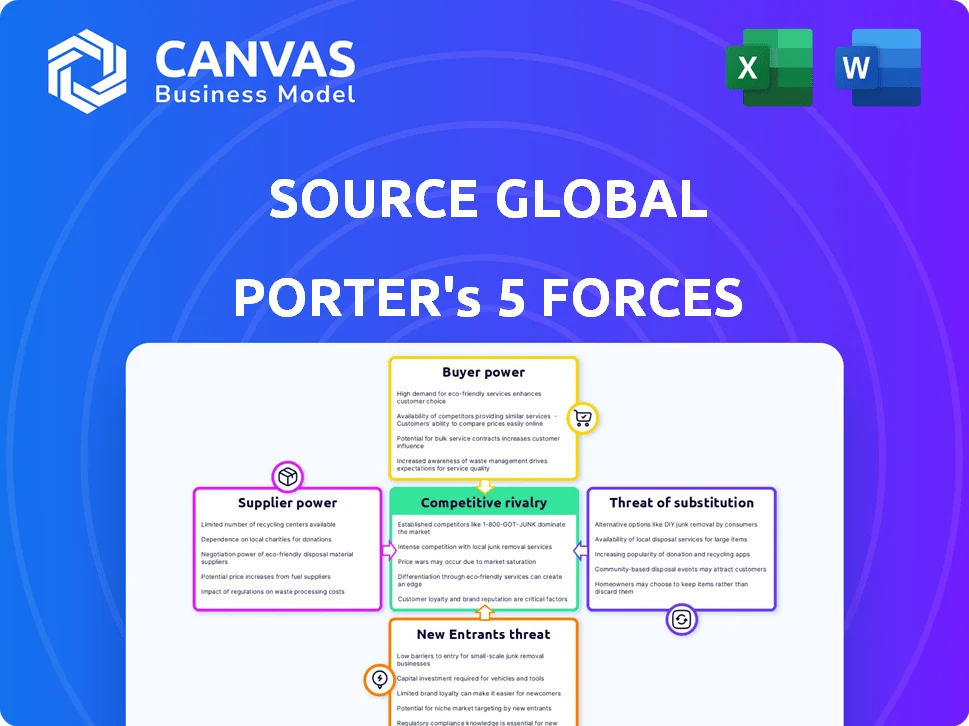
SOURCE GLOBAL PORTER'S FIVE FORCES TEMPLATE RESEARCH
What is included in the product
 Detailed Word Document
Tailored exclusively for SOURCE Global, analyzing its position within its competitive landscape.

 Customizable Excel Spreadsheet
Swap in your own data, labels, and notes to reflect current business conditions.
Same Document Delivered
SOURCE Global Porter's Five Forces Analysis
This preview showcases the comprehensive SOURCE Global Porter's Five Forces analysis you'll receive. The document you see here is the complete, ready-to-use file. It provides a detailed examination of industry competition. You will get instant access to this same high-quality analysis post-purchase.

Porter's Five Forces Analysis Template

From Overview to Strategy Blueprint
SOURCE Global operates within a dynamic industry, shaped by competitive forces. Supplier power, a key factor, impacts profitability and supply chain resilience. The threat of new entrants, customer bargaining power, and the intensity of rivalry also play significant roles. These forces shape the industry landscape and impact SOURCE Global. Understanding them is crucial for strategic planning.
This brief snapshot only scratches the surface. Unlock the full Porter's Five Forces Analysis to explore SOURCE Global’s competitive dynamics, market pressures, and strategic advantages in detail.
Suppliers Bargaining Power

Key Material Inputs
SOURCE Global's supplier power centers around critical inputs. They depend on electrical components, sheet metal, plastics, building materials, and packaging. Fluctuations in these raw material costs directly impact profitability. For example, 2024 saw a 7% increase in global steel prices.
Supplier Concentration
Supplier concentration significantly affects SOURCE Global. The company relies on suppliers in China, the U.S., and Mexico. In 2024, these regions accounted for a significant portion of global manufacturing. For example, China's manufacturing output was approximately $4 trillion, influencing supplier dynamics and cost structures.

Switching Costs
Switching costs can be significant, especially when SOURCE Global assesses new suppliers. These costs include time, investment in new equipment and training, and potential disruptions. For example, changing suppliers might involve reconfiguring production lines, which could take weeks and cost millions. The costs can vary, but the impact on a company's profitability is substantial.

Availability of Substitutes for Inputs
The Hydropanel technology's dependence on unique components could create a supplier advantage. Limited alternatives for specialized parts may give suppliers pricing leverage. This situation could affect SOURCE Global's cost structure and profitability.
- In 2024, the cost of specialized electronic components increased by 15% due to supply chain constraints.
- The company's gross profit margin decreased by 5% due to increased input costs.
- A shift in supplier bargaining power impacted the company's ability to negotiate favorable terms.
- The company's revenue grew by 10% despite rising input costs, indicating strong demand.
Potential for Forward Integration
A supplier's bargaining power can increase if they consider forward integration, which means they might enter the market themselves. This is particularly true if they offer a crucial component that is essential for the final product, such as SOURCE Global's technology. If a supplier controls a unique or scarce resource, they could potentially build their own water generation systems. This move could dramatically shift the balance of power in the industry.
- Forward integration could lead to increased market share for the supplier.
- This strategy could potentially disrupt existing market dynamics.
- Such moves are influenced by factors like profitability and market opportunity.
- The supplier's financial strength is important.
Supplier Dynamics: Costs, Concentration, and Switching
Supplier power for SOURCE Global hinges on vital inputs and supplier concentration. Fluctuating raw material costs, like a 7% rise in steel prices in 2024, impact profitability. Switching costs and unique component dependencies further shape this dynamic.
| Factor | Impact | 2024 Data |
|---|---|---|
| Input Costs | Profit Margin | Specialized electronics up 15% |
| Supplier Concentration | Negotiating Power | China's manufacturing output at $4T |
| Switching Costs | Operational Disruptions | Reconfiguring production lines cost millions |
Customers Bargaining Power

Customer Diversity
SOURCE Global faces varied customer bargaining power due to its diverse customer base. This includes bottled water brands, hotels, and homeowners. For example, in 2024, the hospitality sector's water demand was about 15% of the total market. This customer diversity impacts pricing strategies.
Customer Concentration
Customer concentration significantly shapes bargaining power. For instance, in 2024, large construction projects often see customers wielding more influence due to their substantial purchasing power, potentially impacting pricing and project terms.

Availability of Alternatives for Customers
Customers can choose from various water sources like tap, bottled, or purification systems. This gives them leverage, especially where options are plentiful. For example, the bottled water market in the United States reached $46.4 billion in 2024, showing consumer choice. This competition limits a company's pricing power.

Switching Costs for Customers
Switching costs vary with SOURCE Global's Hydropanels. For individual users, the initial investment could be a barrier to switching from existing water sources. However, for communities lacking infrastructure, Hydropanels offer a primary solution.
- Residential customers might face initial costs for installation.
- Communities without existing infrastructure see Hydropanels as a primary option.
- Switching costs are lower where water infrastructure is lacking.
Customer Price Sensitivity
Customer price sensitivity is highly variable. For example, those in remote areas might be more price-conscious. Conversely, commercial clients could value SOURCE Global's sustainability more. In 2024, the global solar water market was valued at approximately $1.2 billion. This highlights the varying willingness to pay.
- Remote customers often face higher energy costs, increasing price sensitivity.
- Commercial clients may see SOURCE Global as a long-term investment, reducing immediate price concerns.
- Luxury segments might prioritize the unique features and sustainable benefits.
- Data from 2024 suggests a wide price range, reflecting diverse customer needs.
Customer Bargaining Power Dynamics
SOURCE Global's customer bargaining power varies, affecting pricing and project terms. Customer concentration, like large projects, increases influence. The bottled water market, valued at $46.4 billion in 2024, offers alternatives, limiting pricing power.
| Factor | Impact | Example (2024) |
|---|---|---|
| Customer Base Diversity | Influences pricing strategies | Hospitality water demand: ~15% of market |
| Customer Concentration | Increases bargaining power | Large construction projects |
| Availability of Alternatives | Limits pricing power | U.S. bottled water market: $46.4B |
Rivalry Among Competitors

Number of Competitors
The AWG market features many players, with dozens actively selling products. SOURCE Global faces competition from numerous companies. This competitive landscape indicates high rivalry. In 2024, the global AWG market size was valued at approximately $2.5 billion, reflecting intense competition among providers.
Industry Growth
The sustainable water solutions market is expanding due to global water challenges. This growth attracts more competitors, increasing rivalry. In 2024, the global water treatment market was valued at approximately $330 billion. The need for innovative solutions amplifies the competition for market share. This dynamic environment pushes companies to innovate and differentiate to succeed.

Product Differentiation
SOURCE Global's Hydropanel technology stands out due to its unique, off-grid, solar-powered design, functioning across varied climates. This differentiation provides a competitive edge. In 2024, SOURCE Global secured $150 million in funding, boosting its market presence. This uniqueness helps reduce direct price competition, as the product offers distinct value. Its focus on sustainability and off-grid capabilities further sets it apart.

Exit Barriers
Exit barriers can significantly affect competitive rivalry. High initial investments in technology and manufacturing facilities, like those seen in the AWG market, can make it difficult for companies to leave. For example, building an AWG facility can cost tens of millions of dollars. The inability to recover these costs if exiting the market increases competition. This intensifies rivalry among existing firms.
- High capital investments hinder exits.
- Exit barriers can intensify competition.
- AWG facility costs can be substantial.
- Companies struggle to recover investments.
Brand Identity and Switching Costs
SOURCE Global's strategy to establish brand identity and reduce competitive rivalry centers on fostering customer loyalty. Their approach involves creating switching costs, making it less appealing for customers to choose alternatives. By offering a complete, independent water source, SOURCE Global aims to build strong customer relationships. This strategy is designed to create a competitive advantage in the market.
- SOURCE Global's systems can cost $6,000 to $10,000, which might be a switching cost.
- In 2024, the global water purifier market was valued at approximately $50 billion.
- Brand loyalty reduces price sensitivity, which is a competitive advantage.
- Switching costs make it harder for competitors to gain market share.
AWG Market Dynamics: Competition & Size
Competitive rivalry in the AWG market is fierce, with numerous firms vying for market share. High initial investments, like the tens of millions for an AWG facility, create exit barriers, intensifying competition. SOURCE Global's strategy of building brand loyalty and creating switching costs aims to reduce this rivalry.
| Metric | Details | 2024 Value |
|---|---|---|
| AWG Market Size | Global Market | $2.5 billion |
| Water Treatment Market | Global Market | $330 billion |
| Water Purifier Market | Global Market | $50 billion |
SOURCE GLOBAL PORTER'S FIVE FORCES TEMPLATE RESEARCH
What is included in the product
Detailed Word Document
Tailored exclusively for SOURCE Global, analyzing its position within its competitive landscape.
Customizable Excel Spreadsheet
Swap in your own data, labels, and notes to reflect current business conditions.
Same Document Delivered
SOURCE Global Porter's Five Forces Analysis
This preview showcases the comprehensive SOURCE Global Porter's Five Forces analysis you'll receive. The document you see here is the complete, ready-to-use file. It provides a detailed examination of industry competition. You will get instant access to this same high-quality analysis post-purchase.
Porter's Five Forces Analysis Template
From Overview to Strategy Blueprint
SOURCE Global operates within a dynamic industry, shaped by competitive forces. Supplier power, a key factor, impacts profitability and supply chain resilience. The threat of new entrants, customer bargaining power, and the intensity of rivalry also play significant roles. These forces shape the industry landscape and impact SOURCE Global. Understanding them is crucial for strategic planning.
This brief snapshot only scratches the surface. Unlock the full Porter's Five Forces Analysis to explore SOURCE Global’s competitive dynamics, market pressures, and strategic advantages in detail.
Suppliers Bargaining Power
Key Material Inputs
SOURCE Global's supplier power centers around critical inputs. They depend on electrical components, sheet metal, plastics, building materials, and packaging. Fluctuations in these raw material costs directly impact profitability. For example, 2024 saw a 7% increase in global steel prices.
Supplier Concentration
Supplier concentration significantly affects SOURCE Global. The company relies on suppliers in China, the U.S., and Mexico. In 2024, these regions accounted for a significant portion of global manufacturing. For example, China's manufacturing output was approximately $4 trillion, influencing supplier dynamics and cost structures.
Switching Costs
Switching costs can be significant, especially when SOURCE Global assesses new suppliers. These costs include time, investment in new equipment and training, and potential disruptions. For example, changing suppliers might involve reconfiguring production lines, which could take weeks and cost millions. The costs can vary, but the impact on a company's profitability is substantial.
Availability of Substitutes for Inputs
The Hydropanel technology's dependence on unique components could create a supplier advantage. Limited alternatives for specialized parts may give suppliers pricing leverage. This situation could affect SOURCE Global's cost structure and profitability.
- In 2024, the cost of specialized electronic components increased by 15% due to supply chain constraints.
- The company's gross profit margin decreased by 5% due to increased input costs.
- A shift in supplier bargaining power impacted the company's ability to negotiate favorable terms.
- The company's revenue grew by 10% despite rising input costs, indicating strong demand.
Potential for Forward Integration
A supplier's bargaining power can increase if they consider forward integration, which means they might enter the market themselves. This is particularly true if they offer a crucial component that is essential for the final product, such as SOURCE Global's technology. If a supplier controls a unique or scarce resource, they could potentially build their own water generation systems. This move could dramatically shift the balance of power in the industry.
- Forward integration could lead to increased market share for the supplier.
- This strategy could potentially disrupt existing market dynamics.
- Such moves are influenced by factors like profitability and market opportunity.
- The supplier's financial strength is important.
Supplier Dynamics: Costs, Concentration, and Switching
Supplier power for SOURCE Global hinges on vital inputs and supplier concentration. Fluctuating raw material costs, like a 7% rise in steel prices in 2024, impact profitability. Switching costs and unique component dependencies further shape this dynamic.
| Factor | Impact | 2024 Data |
|---|---|---|
| Input Costs | Profit Margin | Specialized electronics up 15% |
| Supplier Concentration | Negotiating Power | China's manufacturing output at $4T |
| Switching Costs | Operational Disruptions | Reconfiguring production lines cost millions |
Customers Bargaining Power
Customer Diversity
SOURCE Global faces varied customer bargaining power due to its diverse customer base. This includes bottled water brands, hotels, and homeowners. For example, in 2024, the hospitality sector's water demand was about 15% of the total market. This customer diversity impacts pricing strategies.
Customer Concentration
Customer concentration significantly shapes bargaining power. For instance, in 2024, large construction projects often see customers wielding more influence due to their substantial purchasing power, potentially impacting pricing and project terms.
Availability of Alternatives for Customers
Customers can choose from various water sources like tap, bottled, or purification systems. This gives them leverage, especially where options are plentiful. For example, the bottled water market in the United States reached $46.4 billion in 2024, showing consumer choice. This competition limits a company's pricing power.
Switching Costs for Customers
Switching costs vary with SOURCE Global's Hydropanels. For individual users, the initial investment could be a barrier to switching from existing water sources. However, for communities lacking infrastructure, Hydropanels offer a primary solution.
- Residential customers might face initial costs for installation.
- Communities without existing infrastructure see Hydropanels as a primary option.
- Switching costs are lower where water infrastructure is lacking.
Customer Price Sensitivity
Customer price sensitivity is highly variable. For example, those in remote areas might be more price-conscious. Conversely, commercial clients could value SOURCE Global's sustainability more. In 2024, the global solar water market was valued at approximately $1.2 billion. This highlights the varying willingness to pay.
- Remote customers often face higher energy costs, increasing price sensitivity.
- Commercial clients may see SOURCE Global as a long-term investment, reducing immediate price concerns.
- Luxury segments might prioritize the unique features and sustainable benefits.
- Data from 2024 suggests a wide price range, reflecting diverse customer needs.
Customer Bargaining Power Dynamics
SOURCE Global's customer bargaining power varies, affecting pricing and project terms. Customer concentration, like large projects, increases influence. The bottled water market, valued at $46.4 billion in 2024, offers alternatives, limiting pricing power.
| Factor | Impact | Example (2024) |
|---|---|---|
| Customer Base Diversity | Influences pricing strategies | Hospitality water demand: ~15% of market |
| Customer Concentration | Increases bargaining power | Large construction projects |
| Availability of Alternatives | Limits pricing power | U.S. bottled water market: $46.4B |
Rivalry Among Competitors
Number of Competitors
The AWG market features many players, with dozens actively selling products. SOURCE Global faces competition from numerous companies. This competitive landscape indicates high rivalry. In 2024, the global AWG market size was valued at approximately $2.5 billion, reflecting intense competition among providers.
Industry Growth
The sustainable water solutions market is expanding due to global water challenges. This growth attracts more competitors, increasing rivalry. In 2024, the global water treatment market was valued at approximately $330 billion. The need for innovative solutions amplifies the competition for market share. This dynamic environment pushes companies to innovate and differentiate to succeed.
Product Differentiation
SOURCE Global's Hydropanel technology stands out due to its unique, off-grid, solar-powered design, functioning across varied climates. This differentiation provides a competitive edge. In 2024, SOURCE Global secured $150 million in funding, boosting its market presence. This uniqueness helps reduce direct price competition, as the product offers distinct value. Its focus on sustainability and off-grid capabilities further sets it apart.
Exit Barriers
Exit barriers can significantly affect competitive rivalry. High initial investments in technology and manufacturing facilities, like those seen in the AWG market, can make it difficult for companies to leave. For example, building an AWG facility can cost tens of millions of dollars. The inability to recover these costs if exiting the market increases competition. This intensifies rivalry among existing firms.
- High capital investments hinder exits.
- Exit barriers can intensify competition.
- AWG facility costs can be substantial.
- Companies struggle to recover investments.
Brand Identity and Switching Costs
SOURCE Global's strategy to establish brand identity and reduce competitive rivalry centers on fostering customer loyalty. Their approach involves creating switching costs, making it less appealing for customers to choose alternatives. By offering a complete, independent water source, SOURCE Global aims to build strong customer relationships. This strategy is designed to create a competitive advantage in the market.
- SOURCE Global's systems can cost $6,000 to $10,000, which might be a switching cost.
- In 2024, the global water purifier market was valued at approximately $50 billion.
- Brand loyalty reduces price sensitivity, which is a competitive advantage.
- Switching costs make it harder for competitors to gain market share.
AWG Market Dynamics: Competition & Size
Competitive rivalry in the AWG market is fierce, with numerous firms vying for market share. High initial investments, like the tens of millions for an AWG facility, create exit barriers, intensifying competition. SOURCE Global's strategy of building brand loyalty and creating switching costs aims to reduce this rivalry.
| Metric | Details | 2024 Value |
|---|---|---|
| AWG Market Size | Global Market | $2.5 billion |
| Water Treatment Market | Global Market | $330 billion |
| Water Purifier Market | Global Market | $50 billion |
Product Information
Product Information
Shipping & Returns
Shipping & Returns
Description
What is included in the product
Detailed Word Document
Tailored exclusively for SOURCE Global, analyzing its position within its competitive landscape.
Customizable Excel Spreadsheet
Swap in your own data, labels, and notes to reflect current business conditions.
Same Document Delivered
SOURCE Global Porter's Five Forces Analysis
This preview showcases the comprehensive SOURCE Global Porter's Five Forces analysis you'll receive. The document you see here is the complete, ready-to-use file. It provides a detailed examination of industry competition. You will get instant access to this same high-quality analysis post-purchase.
Porter's Five Forces Analysis Template
From Overview to Strategy Blueprint
SOURCE Global operates within a dynamic industry, shaped by competitive forces. Supplier power, a key factor, impacts profitability and supply chain resilience. The threat of new entrants, customer bargaining power, and the intensity of rivalry also play significant roles. These forces shape the industry landscape and impact SOURCE Global. Understanding them is crucial for strategic planning.
This brief snapshot only scratches the surface. Unlock the full Porter's Five Forces Analysis to explore SOURCE Global’s competitive dynamics, market pressures, and strategic advantages in detail.
Suppliers Bargaining Power
Key Material Inputs
SOURCE Global's supplier power centers around critical inputs. They depend on electrical components, sheet metal, plastics, building materials, and packaging. Fluctuations in these raw material costs directly impact profitability. For example, 2024 saw a 7% increase in global steel prices.
Supplier Concentration
Supplier concentration significantly affects SOURCE Global. The company relies on suppliers in China, the U.S., and Mexico. In 2024, these regions accounted for a significant portion of global manufacturing. For example, China's manufacturing output was approximately $4 trillion, influencing supplier dynamics and cost structures.
Switching Costs
Switching costs can be significant, especially when SOURCE Global assesses new suppliers. These costs include time, investment in new equipment and training, and potential disruptions. For example, changing suppliers might involve reconfiguring production lines, which could take weeks and cost millions. The costs can vary, but the impact on a company's profitability is substantial.
Availability of Substitutes for Inputs
The Hydropanel technology's dependence on unique components could create a supplier advantage. Limited alternatives for specialized parts may give suppliers pricing leverage. This situation could affect SOURCE Global's cost structure and profitability.
- In 2024, the cost of specialized electronic components increased by 15% due to supply chain constraints.
- The company's gross profit margin decreased by 5% due to increased input costs.
- A shift in supplier bargaining power impacted the company's ability to negotiate favorable terms.
- The company's revenue grew by 10% despite rising input costs, indicating strong demand.
Potential for Forward Integration
A supplier's bargaining power can increase if they consider forward integration, which means they might enter the market themselves. This is particularly true if they offer a crucial component that is essential for the final product, such as SOURCE Global's technology. If a supplier controls a unique or scarce resource, they could potentially build their own water generation systems. This move could dramatically shift the balance of power in the industry.
- Forward integration could lead to increased market share for the supplier.
- This strategy could potentially disrupt existing market dynamics.
- Such moves are influenced by factors like profitability and market opportunity.
- The supplier's financial strength is important.
Supplier Dynamics: Costs, Concentration, and Switching
Supplier power for SOURCE Global hinges on vital inputs and supplier concentration. Fluctuating raw material costs, like a 7% rise in steel prices in 2024, impact profitability. Switching costs and unique component dependencies further shape this dynamic.
| Factor | Impact | 2024 Data |
|---|---|---|
| Input Costs | Profit Margin | Specialized electronics up 15% |
| Supplier Concentration | Negotiating Power | China's manufacturing output at $4T |
| Switching Costs | Operational Disruptions | Reconfiguring production lines cost millions |
Customers Bargaining Power
Customer Diversity
SOURCE Global faces varied customer bargaining power due to its diverse customer base. This includes bottled water brands, hotels, and homeowners. For example, in 2024, the hospitality sector's water demand was about 15% of the total market. This customer diversity impacts pricing strategies.
Customer Concentration
Customer concentration significantly shapes bargaining power. For instance, in 2024, large construction projects often see customers wielding more influence due to their substantial purchasing power, potentially impacting pricing and project terms.
Availability of Alternatives for Customers
Customers can choose from various water sources like tap, bottled, or purification systems. This gives them leverage, especially where options are plentiful. For example, the bottled water market in the United States reached $46.4 billion in 2024, showing consumer choice. This competition limits a company's pricing power.
Switching Costs for Customers
Switching costs vary with SOURCE Global's Hydropanels. For individual users, the initial investment could be a barrier to switching from existing water sources. However, for communities lacking infrastructure, Hydropanels offer a primary solution.
- Residential customers might face initial costs for installation.
- Communities without existing infrastructure see Hydropanels as a primary option.
- Switching costs are lower where water infrastructure is lacking.
Customer Price Sensitivity
Customer price sensitivity is highly variable. For example, those in remote areas might be more price-conscious. Conversely, commercial clients could value SOURCE Global's sustainability more. In 2024, the global solar water market was valued at approximately $1.2 billion. This highlights the varying willingness to pay.
- Remote customers often face higher energy costs, increasing price sensitivity.
- Commercial clients may see SOURCE Global as a long-term investment, reducing immediate price concerns.
- Luxury segments might prioritize the unique features and sustainable benefits.
- Data from 2024 suggests a wide price range, reflecting diverse customer needs.
Customer Bargaining Power Dynamics
SOURCE Global's customer bargaining power varies, affecting pricing and project terms. Customer concentration, like large projects, increases influence. The bottled water market, valued at $46.4 billion in 2024, offers alternatives, limiting pricing power.
| Factor | Impact | Example (2024) |
|---|---|---|
| Customer Base Diversity | Influences pricing strategies | Hospitality water demand: ~15% of market |
| Customer Concentration | Increases bargaining power | Large construction projects |
| Availability of Alternatives | Limits pricing power | U.S. bottled water market: $46.4B |
Rivalry Among Competitors
Number of Competitors
The AWG market features many players, with dozens actively selling products. SOURCE Global faces competition from numerous companies. This competitive landscape indicates high rivalry. In 2024, the global AWG market size was valued at approximately $2.5 billion, reflecting intense competition among providers.
Industry Growth
The sustainable water solutions market is expanding due to global water challenges. This growth attracts more competitors, increasing rivalry. In 2024, the global water treatment market was valued at approximately $330 billion. The need for innovative solutions amplifies the competition for market share. This dynamic environment pushes companies to innovate and differentiate to succeed.
Product Differentiation
SOURCE Global's Hydropanel technology stands out due to its unique, off-grid, solar-powered design, functioning across varied climates. This differentiation provides a competitive edge. In 2024, SOURCE Global secured $150 million in funding, boosting its market presence. This uniqueness helps reduce direct price competition, as the product offers distinct value. Its focus on sustainability and off-grid capabilities further sets it apart.
Exit Barriers
Exit barriers can significantly affect competitive rivalry. High initial investments in technology and manufacturing facilities, like those seen in the AWG market, can make it difficult for companies to leave. For example, building an AWG facility can cost tens of millions of dollars. The inability to recover these costs if exiting the market increases competition. This intensifies rivalry among existing firms.
- High capital investments hinder exits.
- Exit barriers can intensify competition.
- AWG facility costs can be substantial.
- Companies struggle to recover investments.
Brand Identity and Switching Costs
SOURCE Global's strategy to establish brand identity and reduce competitive rivalry centers on fostering customer loyalty. Their approach involves creating switching costs, making it less appealing for customers to choose alternatives. By offering a complete, independent water source, SOURCE Global aims to build strong customer relationships. This strategy is designed to create a competitive advantage in the market.
- SOURCE Global's systems can cost $6,000 to $10,000, which might be a switching cost.
- In 2024, the global water purifier market was valued at approximately $50 billion.
- Brand loyalty reduces price sensitivity, which is a competitive advantage.
- Switching costs make it harder for competitors to gain market share.
AWG Market Dynamics: Competition & Size
Competitive rivalry in the AWG market is fierce, with numerous firms vying for market share. High initial investments, like the tens of millions for an AWG facility, create exit barriers, intensifying competition. SOURCE Global's strategy of building brand loyalty and creating switching costs aims to reduce this rivalry.
| Metric | Details | 2024 Value |
|---|---|---|
| AWG Market Size | Global Market | $2.5 billion |
| Water Treatment Market | Global Market | $330 billion |
| Water Purifier Market | Global Market | $50 billion |


