
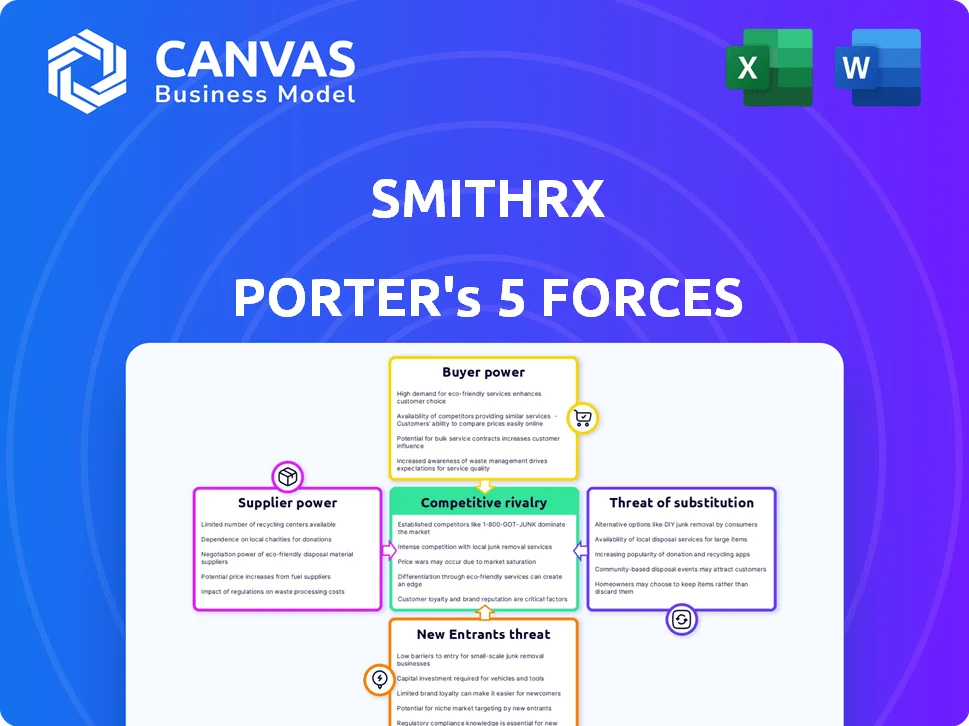
SMITHRX PORTER'S FIVE FORCES TEMPLATE RESEARCH
What is included in the product
 Detailed Word Document
Evaluates control held by suppliers and buyers, and their influence on pricing and profitability.

 Customizable Excel Spreadsheet
Customize competitive pressure levels based on new data or evolving market trends.
Same Document Delivered
SmithRx Porter's Five Forces Analysis
This preview details the SmithRx Porter's Five Forces analysis; it's the complete document.
You’ll get the same, fully formatted analysis instantly after purchase.
It includes sections on competitive rivalry, supplier power, and more.
No need for adjustments: download and use the analysis immediately.
The file is ready for your insights—what you see is what you download.

Porter's Five Forces Analysis Template

Don't Miss the Bigger Picture
SmithRx operates within a dynamic pharmaceutical benefits management (PBM) landscape, facing a complex interplay of competitive forces.
The threat of new entrants is moderate, given the high barriers to entry, including regulatory hurdles and established market players.
Supplier power from pharmaceutical companies is significant, impacting SmithRx's cost structures and negotiating leverage.
Buyer power, concentrated among large employers and health plans, exerts pressure on pricing and service offerings.
The threat of substitutes, such as alternative pharmacy models, remains a continuous consideration.
Competitive rivalry among PBMs is intense, driving innovation and margin pressure.
Our full Porter's Five Forces report goes deeper—offering a data-driven framework to understand SmithRx's real business risks and market opportunities.
Suppliers Bargaining Power

Limited number of pharmaceutical manufacturers
The pharmaceutical industry has a limited number of manufacturers, especially for specialty drugs, granting them substantial bargaining power. This concentration allows them to dictate prices and terms. For instance, in 2024, the top 10 pharmaceutical companies controlled a significant portion of the global market. This dynamic impacts PBMs like SmithRx, as they face higher drug costs.
High switching costs for certain drugs
The bargaining power of suppliers is amplified when switching costs are high. For specialty drugs, limited alternatives and complexity make it hard for PBMs to switch. In 2024, specialty drugs accounted for over 50% of U.S. prescription drug spending. High switching costs increase supplier power.

Supplier consolidation
Supplier consolidation, driven by mergers and acquisitions, increases supplier power. This concentration, especially among pharmaceutical giants, reduces SmithRx's negotiating leverage. In 2024, the pharmaceutical industry saw significant M&A activity, with deals like the $30 billion acquisition of Seagen by Pfizer. This trend directly impacts SmithRx's ability to secure favorable pricing and supply terms. The fewer suppliers, the stronger their position.

Influence of brand recognition
Brand recognition significantly shapes supplier power, particularly in pharmaceuticals. Manufacturers with well-known brands often command greater influence over pricing and formulary decisions. This is because patient and provider preferences can favor established brands, even when alternatives are available.
- In 2024, the top 10 pharmaceutical companies by revenue, such as Johnson & Johnson and Pfizer, collectively generated hundreds of billions of dollars, highlighting their significant market power.
- Patient loyalty to branded drugs, especially for chronic conditions, can drive demand and reduce price sensitivity.
- Strong brand recognition allows companies to negotiate favorable terms with payers and pharmacy benefit managers (PBMs).
- The success of biologics, like Humira, demonstrates how brand strength sustains market share and pricing power.
Regulatory landscape impacting drug pricing
Government regulations significantly shape the pharmaceutical industry's dynamics. Policies on drug pricing and negotiation directly influence the bargaining power between pharmacy benefit managers (PBMs) and pharmaceutical suppliers. For example, the Inflation Reduction Act of 2022 allows Medicare to negotiate drug prices, potentially reducing supplier power. These changes can either empower or limit suppliers based on the specifics of the regulatory environment.
- The Inflation Reduction Act of 2022: This has a potential $25 billion impact on pharmaceutical companies.
- Medicare negotiations: The Centers for Medicare & Medicaid Services (CMS) initiated the first round of price negotiations in 2023.
- PBMs: They manage approximately 75% of U.S. prescriptions.
- Drug pricing regulations: These are subject to continuous change, impacting supplier strategies.
Pharma Power Dynamics: A Shifting Landscape
Pharmaceutical suppliers, especially for specialty drugs, wield considerable power due to market concentration. High switching costs and limited alternatives further amplify their influence, particularly affecting PBMs like SmithRx. Supplier consolidation through M&A, like Pfizer's Seagen acquisition in 2024, reduces SmithRx's negotiating leverage.
Brand recognition strengthens supplier power, as established brands command influence over pricing. Government regulations, such as the Inflation Reduction Act of 2022, can reshape this dynamic by enabling Medicare to negotiate drug prices. This impacts the bargaining balance.
| Factor | Impact on Supplier Power | 2024 Data/Example |
|---|---|---|
| Market Concentration | High | Top 10 pharma companies control substantial market share |
| Switching Costs | High | Specialty drugs account for over 50% of US drug spending |
| Brand Recognition | High | Humira's success sustains market share and pricing power |
| Government Regulation | Variable | Inflation Reduction Act of 2022: Potential $25B impact |
Customers Bargaining Power

Employers seeking cost savings
SmithRx faces substantial pressure from its primary customers, employers, and plan sponsors, all intensely focused on reducing healthcare expenditures. This customer focus compels SmithRx to showcase significant cost savings. The National Health Expenditure data from CMS projected total U.S. healthcare spending to reach $4.8 trillion in 2023, highlighting the financial strain. SmithRx must offer competitive pricing and demonstrate value to retain these cost-conscious customers.
Demand for transparency
Employers are pushing for more transparency in pharmacy benefit manager (PBM) pricing and rebates. SmithRx's transparent model directly tackles this issue. This transparency enhances customer bargaining power. For instance, in 2024, approximately 70% of employers sought greater PBM pricing clarity. Customers can now compare PBMs more effectively.

Availability of alternative PBM models
The rise of transparent and pass-through Pharmacy Benefit Managers (PBMs) like SmithRx offers customers, such as employers and health plans, more options. This increased competition from alternative PBM models empowers customers. Customers can now negotiate better terms and pricing. This shift challenges the dominance of traditional PBMs. Data from 2024 shows this trend accelerating.

Customer size and purchasing volume
Large customers, like major employers, wield more clout due to their substantial purchasing volume. SmithRx's ability to secure and keep these larger clients directly impacts its bargaining power within the pharmaceutical market. In 2024, the average prescription drug cost per person in the U.S. reached $1,400, highlighting the financial stakes. SmithRx must navigate this dynamic to remain competitive. The company's success hinges on its capacity to offer favorable terms to these high-volume purchasers.
- Large employers and plan sponsors negotiate better pricing.
- SmithRx's client base size impacts its bargaining position.
- The high cost of prescriptions in 2024 emphasizes customer influence.
Access to data and analytics
SmithRx's clients gain significant bargaining power through data and analytics. Clients receive data and reports, enabling them to assess their pharmacy benefits' value and effectiveness. This information allows them to negotiate based on outcomes and costs, increasing their leverage. In 2024, about 80% of healthcare payers used data analytics for cost control and negotiation.
- Data access supports informed negotiations.
- Clients can demand value for pharmacy benefits.
- Outcome-based contracts become feasible.
- Cost control strategies are data-driven.
Healthcare Costs Drive Customer Influence
Customers, mainly employers, strongly influence SmithRx due to the high cost of healthcare, projected at $4.9 trillion in 2024. They demand cost savings and transparency, as around 72% of employers sought PBM pricing clarity in 2024. Large clients wield significant bargaining power.
| Aspect | Impact | 2024 Data |
|---|---|---|
| Customer Focus | Cost reduction pressure | Healthcare spending: $4.9T |
| Transparency Demand | Enhanced bargaining | 72% employers sought PBM clarity |
| Client Size | Negotiating power | Avg. Rx cost: $1,450/person |
Rivalry Among Competitors

Presence of large, established PBMs
The PBM market is highly concentrated, with CVS Caremark, Express Scripts, and OptumRx controlling a large portion of the market. This dominance intensifies competition, creating challenges for smaller companies like SmithRx. In 2024, these three giants managed over 75% of the prescription drug market. SmithRx faces significant pressure to compete with these established entities.
Differentiation through transparency and technology
SmithRx sets itself apart by being transparent, using a 100% pass-through model, and leveraging its tech platform. This approach targets clients unhappy with standard Pharmacy Benefit Manager (PBM) practices. In 2024, the PBM market was highly competitive, with major players like CVS Health and Express Scripts. SmithRx's focus on tech and transparency is a direct response to rising concerns about drug pricing and rebates. This strategy aims to disrupt the established PBM landscape.

Pricing pressure
The PBM market's intense competition, fueled by employer demand for cost savings, significantly impacts SmithRx. This environment forces SmithRx to offer competitive pricing. In 2024, the PBM industry saw a continued focus on reducing drug costs. This pressure necessitates demonstrating clear value to clients.

Innovation in services and technology
Competition among Pharmacy Benefit Managers (PBMs) is intensifying as they innovate with technology and service offerings. SmithRx's emphasis on technology and data analytics is critical for staying competitive. The PBM market is dynamic, with companies constantly striving to provide better solutions. This focus helps in improving operational efficiency and client satisfaction.
- In 2024, the PBM market saw a 7% increase in tech-driven solutions.
- SmithRx has invested over $50 million in its technology platform.
- Data analytics are used by 85% of PBMs to personalize services.
- The market share of innovative PBMs grew by 10% in the last year.
Vertical integration of competitors
Some major players in the pharmacy benefit management (PBM) space, like CVS Health and UnitedHealth Group, have vertically integrated their operations. This means they control various aspects of the healthcare supply chain, including pharmacies and insurance plans, which creates complex market dynamics. Vertical integration can lead to significant advantages, such as improved efficiency and better control over costs. However, it also presents potential disadvantages, including increased regulatory scrutiny and conflicts of interest.
- CVS Health's revenue in 2023 was approximately $357 billion, demonstrating its substantial market presence.
- UnitedHealth Group's revenue in 2023 was about $372 billion, highlighting its strong position in the healthcare market.
- These companies' vertical integration strategies allow them to manage a large portion of the healthcare ecosystem.
- Smaller, non-integrated PBMs face challenges competing with these giants due to scale and scope.
PBM Market: Giants vs. SmithRx's Tech Edge
Competitive rivalry in the PBM market is fierce, dominated by giants like CVS Caremark, Express Scripts, and OptumRx. These companies control over 75% of the market, intensifying competition for smaller players such as SmithRx. SmithRx differentiates itself through transparency and technology to compete in this environment.
| Aspect | Details | 2024 Data |
|---|---|---|
| Market Concentration | Top 3 PBMs share | >75% |
| Tech Investment | SmithRx's investment | >$50M |
| Industry Trend | Tech-driven solutions increase | 7% |
SMITHRX PORTER'S FIVE FORCES TEMPLATE RESEARCH
What is included in the product
Detailed Word Document
Evaluates control held by suppliers and buyers, and their influence on pricing and profitability.
Customizable Excel Spreadsheet
Customize competitive pressure levels based on new data or evolving market trends.
Same Document Delivered
SmithRx Porter's Five Forces Analysis
This preview details the SmithRx Porter's Five Forces analysis; it's the complete document.
You’ll get the same, fully formatted analysis instantly after purchase.
It includes sections on competitive rivalry, supplier power, and more.
No need for adjustments: download and use the analysis immediately.
The file is ready for your insights—what you see is what you download.
Porter's Five Forces Analysis Template
Don't Miss the Bigger Picture
SmithRx operates within a dynamic pharmaceutical benefits management (PBM) landscape, facing a complex interplay of competitive forces.
The threat of new entrants is moderate, given the high barriers to entry, including regulatory hurdles and established market players.
Supplier power from pharmaceutical companies is significant, impacting SmithRx's cost structures and negotiating leverage.
Buyer power, concentrated among large employers and health plans, exerts pressure on pricing and service offerings.
The threat of substitutes, such as alternative pharmacy models, remains a continuous consideration.
Competitive rivalry among PBMs is intense, driving innovation and margin pressure.
Our full Porter's Five Forces report goes deeper—offering a data-driven framework to understand SmithRx's real business risks and market opportunities.
Suppliers Bargaining Power
Limited number of pharmaceutical manufacturers
The pharmaceutical industry has a limited number of manufacturers, especially for specialty drugs, granting them substantial bargaining power. This concentration allows them to dictate prices and terms. For instance, in 2024, the top 10 pharmaceutical companies controlled a significant portion of the global market. This dynamic impacts PBMs like SmithRx, as they face higher drug costs.
High switching costs for certain drugs
The bargaining power of suppliers is amplified when switching costs are high. For specialty drugs, limited alternatives and complexity make it hard for PBMs to switch. In 2024, specialty drugs accounted for over 50% of U.S. prescription drug spending. High switching costs increase supplier power.
Supplier consolidation
Supplier consolidation, driven by mergers and acquisitions, increases supplier power. This concentration, especially among pharmaceutical giants, reduces SmithRx's negotiating leverage. In 2024, the pharmaceutical industry saw significant M&A activity, with deals like the $30 billion acquisition of Seagen by Pfizer. This trend directly impacts SmithRx's ability to secure favorable pricing and supply terms. The fewer suppliers, the stronger their position.
Influence of brand recognition
Brand recognition significantly shapes supplier power, particularly in pharmaceuticals. Manufacturers with well-known brands often command greater influence over pricing and formulary decisions. This is because patient and provider preferences can favor established brands, even when alternatives are available.
- In 2024, the top 10 pharmaceutical companies by revenue, such as Johnson & Johnson and Pfizer, collectively generated hundreds of billions of dollars, highlighting their significant market power.
- Patient loyalty to branded drugs, especially for chronic conditions, can drive demand and reduce price sensitivity.
- Strong brand recognition allows companies to negotiate favorable terms with payers and pharmacy benefit managers (PBMs).
- The success of biologics, like Humira, demonstrates how brand strength sustains market share and pricing power.
Regulatory landscape impacting drug pricing
Government regulations significantly shape the pharmaceutical industry's dynamics. Policies on drug pricing and negotiation directly influence the bargaining power between pharmacy benefit managers (PBMs) and pharmaceutical suppliers. For example, the Inflation Reduction Act of 2022 allows Medicare to negotiate drug prices, potentially reducing supplier power. These changes can either empower or limit suppliers based on the specifics of the regulatory environment.
- The Inflation Reduction Act of 2022: This has a potential $25 billion impact on pharmaceutical companies.
- Medicare negotiations: The Centers for Medicare & Medicaid Services (CMS) initiated the first round of price negotiations in 2023.
- PBMs: They manage approximately 75% of U.S. prescriptions.
- Drug pricing regulations: These are subject to continuous change, impacting supplier strategies.
Pharma Power Dynamics: A Shifting Landscape
Pharmaceutical suppliers, especially for specialty drugs, wield considerable power due to market concentration. High switching costs and limited alternatives further amplify their influence, particularly affecting PBMs like SmithRx. Supplier consolidation through M&A, like Pfizer's Seagen acquisition in 2024, reduces SmithRx's negotiating leverage.
Brand recognition strengthens supplier power, as established brands command influence over pricing. Government regulations, such as the Inflation Reduction Act of 2022, can reshape this dynamic by enabling Medicare to negotiate drug prices. This impacts the bargaining balance.
| Factor | Impact on Supplier Power | 2024 Data/Example |
|---|---|---|
| Market Concentration | High | Top 10 pharma companies control substantial market share |
| Switching Costs | High | Specialty drugs account for over 50% of US drug spending |
| Brand Recognition | High | Humira's success sustains market share and pricing power |
| Government Regulation | Variable | Inflation Reduction Act of 2022: Potential $25B impact |
Customers Bargaining Power
Employers seeking cost savings
SmithRx faces substantial pressure from its primary customers, employers, and plan sponsors, all intensely focused on reducing healthcare expenditures. This customer focus compels SmithRx to showcase significant cost savings. The National Health Expenditure data from CMS projected total U.S. healthcare spending to reach $4.8 trillion in 2023, highlighting the financial strain. SmithRx must offer competitive pricing and demonstrate value to retain these cost-conscious customers.
Demand for transparency
Employers are pushing for more transparency in pharmacy benefit manager (PBM) pricing and rebates. SmithRx's transparent model directly tackles this issue. This transparency enhances customer bargaining power. For instance, in 2024, approximately 70% of employers sought greater PBM pricing clarity. Customers can now compare PBMs more effectively.
Availability of alternative PBM models
The rise of transparent and pass-through Pharmacy Benefit Managers (PBMs) like SmithRx offers customers, such as employers and health plans, more options. This increased competition from alternative PBM models empowers customers. Customers can now negotiate better terms and pricing. This shift challenges the dominance of traditional PBMs. Data from 2024 shows this trend accelerating.
Customer size and purchasing volume
Large customers, like major employers, wield more clout due to their substantial purchasing volume. SmithRx's ability to secure and keep these larger clients directly impacts its bargaining power within the pharmaceutical market. In 2024, the average prescription drug cost per person in the U.S. reached $1,400, highlighting the financial stakes. SmithRx must navigate this dynamic to remain competitive. The company's success hinges on its capacity to offer favorable terms to these high-volume purchasers.
- Large employers and plan sponsors negotiate better pricing.
- SmithRx's client base size impacts its bargaining position.
- The high cost of prescriptions in 2024 emphasizes customer influence.
Access to data and analytics
SmithRx's clients gain significant bargaining power through data and analytics. Clients receive data and reports, enabling them to assess their pharmacy benefits' value and effectiveness. This information allows them to negotiate based on outcomes and costs, increasing their leverage. In 2024, about 80% of healthcare payers used data analytics for cost control and negotiation.
- Data access supports informed negotiations.
- Clients can demand value for pharmacy benefits.
- Outcome-based contracts become feasible.
- Cost control strategies are data-driven.
Healthcare Costs Drive Customer Influence
Customers, mainly employers, strongly influence SmithRx due to the high cost of healthcare, projected at $4.9 trillion in 2024. They demand cost savings and transparency, as around 72% of employers sought PBM pricing clarity in 2024. Large clients wield significant bargaining power.
| Aspect | Impact | 2024 Data |
|---|---|---|
| Customer Focus | Cost reduction pressure | Healthcare spending: $4.9T |
| Transparency Demand | Enhanced bargaining | 72% employers sought PBM clarity |
| Client Size | Negotiating power | Avg. Rx cost: $1,450/person |
Rivalry Among Competitors
Presence of large, established PBMs
The PBM market is highly concentrated, with CVS Caremark, Express Scripts, and OptumRx controlling a large portion of the market. This dominance intensifies competition, creating challenges for smaller companies like SmithRx. In 2024, these three giants managed over 75% of the prescription drug market. SmithRx faces significant pressure to compete with these established entities.
Differentiation through transparency and technology
SmithRx sets itself apart by being transparent, using a 100% pass-through model, and leveraging its tech platform. This approach targets clients unhappy with standard Pharmacy Benefit Manager (PBM) practices. In 2024, the PBM market was highly competitive, with major players like CVS Health and Express Scripts. SmithRx's focus on tech and transparency is a direct response to rising concerns about drug pricing and rebates. This strategy aims to disrupt the established PBM landscape.
Pricing pressure
The PBM market's intense competition, fueled by employer demand for cost savings, significantly impacts SmithRx. This environment forces SmithRx to offer competitive pricing. In 2024, the PBM industry saw a continued focus on reducing drug costs. This pressure necessitates demonstrating clear value to clients.
Innovation in services and technology
Competition among Pharmacy Benefit Managers (PBMs) is intensifying as they innovate with technology and service offerings. SmithRx's emphasis on technology and data analytics is critical for staying competitive. The PBM market is dynamic, with companies constantly striving to provide better solutions. This focus helps in improving operational efficiency and client satisfaction.
- In 2024, the PBM market saw a 7% increase in tech-driven solutions.
- SmithRx has invested over $50 million in its technology platform.
- Data analytics are used by 85% of PBMs to personalize services.
- The market share of innovative PBMs grew by 10% in the last year.
Vertical integration of competitors
Some major players in the pharmacy benefit management (PBM) space, like CVS Health and UnitedHealth Group, have vertically integrated their operations. This means they control various aspects of the healthcare supply chain, including pharmacies and insurance plans, which creates complex market dynamics. Vertical integration can lead to significant advantages, such as improved efficiency and better control over costs. However, it also presents potential disadvantages, including increased regulatory scrutiny and conflicts of interest.
- CVS Health's revenue in 2023 was approximately $357 billion, demonstrating its substantial market presence.
- UnitedHealth Group's revenue in 2023 was about $372 billion, highlighting its strong position in the healthcare market.
- These companies' vertical integration strategies allow them to manage a large portion of the healthcare ecosystem.
- Smaller, non-integrated PBMs face challenges competing with these giants due to scale and scope.
PBM Market: Giants vs. SmithRx's Tech Edge
Competitive rivalry in the PBM market is fierce, dominated by giants like CVS Caremark, Express Scripts, and OptumRx. These companies control over 75% of the market, intensifying competition for smaller players such as SmithRx. SmithRx differentiates itself through transparency and technology to compete in this environment.
| Aspect | Details | 2024 Data |
|---|---|---|
| Market Concentration | Top 3 PBMs share | >75% |
| Tech Investment | SmithRx's investment | >$50M |
| Industry Trend | Tech-driven solutions increase | 7% |
Product Information
Product Information
Shipping & Returns
Shipping & Returns
Description
What is included in the product
Detailed Word Document
Evaluates control held by suppliers and buyers, and their influence on pricing and profitability.
Customizable Excel Spreadsheet
Customize competitive pressure levels based on new data or evolving market trends.
Same Document Delivered
SmithRx Porter's Five Forces Analysis
This preview details the SmithRx Porter's Five Forces analysis; it's the complete document.
You’ll get the same, fully formatted analysis instantly after purchase.
It includes sections on competitive rivalry, supplier power, and more.
No need for adjustments: download and use the analysis immediately.
The file is ready for your insights—what you see is what you download.
Porter's Five Forces Analysis Template
Don't Miss the Bigger Picture
SmithRx operates within a dynamic pharmaceutical benefits management (PBM) landscape, facing a complex interplay of competitive forces.
The threat of new entrants is moderate, given the high barriers to entry, including regulatory hurdles and established market players.
Supplier power from pharmaceutical companies is significant, impacting SmithRx's cost structures and negotiating leverage.
Buyer power, concentrated among large employers and health plans, exerts pressure on pricing and service offerings.
The threat of substitutes, such as alternative pharmacy models, remains a continuous consideration.
Competitive rivalry among PBMs is intense, driving innovation and margin pressure.
Our full Porter's Five Forces report goes deeper—offering a data-driven framework to understand SmithRx's real business risks and market opportunities.
Suppliers Bargaining Power
Limited number of pharmaceutical manufacturers
The pharmaceutical industry has a limited number of manufacturers, especially for specialty drugs, granting them substantial bargaining power. This concentration allows them to dictate prices and terms. For instance, in 2024, the top 10 pharmaceutical companies controlled a significant portion of the global market. This dynamic impacts PBMs like SmithRx, as they face higher drug costs.
High switching costs for certain drugs
The bargaining power of suppliers is amplified when switching costs are high. For specialty drugs, limited alternatives and complexity make it hard for PBMs to switch. In 2024, specialty drugs accounted for over 50% of U.S. prescription drug spending. High switching costs increase supplier power.
Supplier consolidation
Supplier consolidation, driven by mergers and acquisitions, increases supplier power. This concentration, especially among pharmaceutical giants, reduces SmithRx's negotiating leverage. In 2024, the pharmaceutical industry saw significant M&A activity, with deals like the $30 billion acquisition of Seagen by Pfizer. This trend directly impacts SmithRx's ability to secure favorable pricing and supply terms. The fewer suppliers, the stronger their position.
Influence of brand recognition
Brand recognition significantly shapes supplier power, particularly in pharmaceuticals. Manufacturers with well-known brands often command greater influence over pricing and formulary decisions. This is because patient and provider preferences can favor established brands, even when alternatives are available.
- In 2024, the top 10 pharmaceutical companies by revenue, such as Johnson & Johnson and Pfizer, collectively generated hundreds of billions of dollars, highlighting their significant market power.
- Patient loyalty to branded drugs, especially for chronic conditions, can drive demand and reduce price sensitivity.
- Strong brand recognition allows companies to negotiate favorable terms with payers and pharmacy benefit managers (PBMs).
- The success of biologics, like Humira, demonstrates how brand strength sustains market share and pricing power.
Regulatory landscape impacting drug pricing
Government regulations significantly shape the pharmaceutical industry's dynamics. Policies on drug pricing and negotiation directly influence the bargaining power between pharmacy benefit managers (PBMs) and pharmaceutical suppliers. For example, the Inflation Reduction Act of 2022 allows Medicare to negotiate drug prices, potentially reducing supplier power. These changes can either empower or limit suppliers based on the specifics of the regulatory environment.
- The Inflation Reduction Act of 2022: This has a potential $25 billion impact on pharmaceutical companies.
- Medicare negotiations: The Centers for Medicare & Medicaid Services (CMS) initiated the first round of price negotiations in 2023.
- PBMs: They manage approximately 75% of U.S. prescriptions.
- Drug pricing regulations: These are subject to continuous change, impacting supplier strategies.
Pharma Power Dynamics: A Shifting Landscape
Pharmaceutical suppliers, especially for specialty drugs, wield considerable power due to market concentration. High switching costs and limited alternatives further amplify their influence, particularly affecting PBMs like SmithRx. Supplier consolidation through M&A, like Pfizer's Seagen acquisition in 2024, reduces SmithRx's negotiating leverage.
Brand recognition strengthens supplier power, as established brands command influence over pricing. Government regulations, such as the Inflation Reduction Act of 2022, can reshape this dynamic by enabling Medicare to negotiate drug prices. This impacts the bargaining balance.
| Factor | Impact on Supplier Power | 2024 Data/Example |
|---|---|---|
| Market Concentration | High | Top 10 pharma companies control substantial market share |
| Switching Costs | High | Specialty drugs account for over 50% of US drug spending |
| Brand Recognition | High | Humira's success sustains market share and pricing power |
| Government Regulation | Variable | Inflation Reduction Act of 2022: Potential $25B impact |
Customers Bargaining Power
Employers seeking cost savings
SmithRx faces substantial pressure from its primary customers, employers, and plan sponsors, all intensely focused on reducing healthcare expenditures. This customer focus compels SmithRx to showcase significant cost savings. The National Health Expenditure data from CMS projected total U.S. healthcare spending to reach $4.8 trillion in 2023, highlighting the financial strain. SmithRx must offer competitive pricing and demonstrate value to retain these cost-conscious customers.
Demand for transparency
Employers are pushing for more transparency in pharmacy benefit manager (PBM) pricing and rebates. SmithRx's transparent model directly tackles this issue. This transparency enhances customer bargaining power. For instance, in 2024, approximately 70% of employers sought greater PBM pricing clarity. Customers can now compare PBMs more effectively.
Availability of alternative PBM models
The rise of transparent and pass-through Pharmacy Benefit Managers (PBMs) like SmithRx offers customers, such as employers and health plans, more options. This increased competition from alternative PBM models empowers customers. Customers can now negotiate better terms and pricing. This shift challenges the dominance of traditional PBMs. Data from 2024 shows this trend accelerating.
Customer size and purchasing volume
Large customers, like major employers, wield more clout due to their substantial purchasing volume. SmithRx's ability to secure and keep these larger clients directly impacts its bargaining power within the pharmaceutical market. In 2024, the average prescription drug cost per person in the U.S. reached $1,400, highlighting the financial stakes. SmithRx must navigate this dynamic to remain competitive. The company's success hinges on its capacity to offer favorable terms to these high-volume purchasers.
- Large employers and plan sponsors negotiate better pricing.
- SmithRx's client base size impacts its bargaining position.
- The high cost of prescriptions in 2024 emphasizes customer influence.
Access to data and analytics
SmithRx's clients gain significant bargaining power through data and analytics. Clients receive data and reports, enabling them to assess their pharmacy benefits' value and effectiveness. This information allows them to negotiate based on outcomes and costs, increasing their leverage. In 2024, about 80% of healthcare payers used data analytics for cost control and negotiation.
- Data access supports informed negotiations.
- Clients can demand value for pharmacy benefits.
- Outcome-based contracts become feasible.
- Cost control strategies are data-driven.
Healthcare Costs Drive Customer Influence
Customers, mainly employers, strongly influence SmithRx due to the high cost of healthcare, projected at $4.9 trillion in 2024. They demand cost savings and transparency, as around 72% of employers sought PBM pricing clarity in 2024. Large clients wield significant bargaining power.
| Aspect | Impact | 2024 Data |
|---|---|---|
| Customer Focus | Cost reduction pressure | Healthcare spending: $4.9T |
| Transparency Demand | Enhanced bargaining | 72% employers sought PBM clarity |
| Client Size | Negotiating power | Avg. Rx cost: $1,450/person |
Rivalry Among Competitors
Presence of large, established PBMs
The PBM market is highly concentrated, with CVS Caremark, Express Scripts, and OptumRx controlling a large portion of the market. This dominance intensifies competition, creating challenges for smaller companies like SmithRx. In 2024, these three giants managed over 75% of the prescription drug market. SmithRx faces significant pressure to compete with these established entities.
Differentiation through transparency and technology
SmithRx sets itself apart by being transparent, using a 100% pass-through model, and leveraging its tech platform. This approach targets clients unhappy with standard Pharmacy Benefit Manager (PBM) practices. In 2024, the PBM market was highly competitive, with major players like CVS Health and Express Scripts. SmithRx's focus on tech and transparency is a direct response to rising concerns about drug pricing and rebates. This strategy aims to disrupt the established PBM landscape.
Pricing pressure
The PBM market's intense competition, fueled by employer demand for cost savings, significantly impacts SmithRx. This environment forces SmithRx to offer competitive pricing. In 2024, the PBM industry saw a continued focus on reducing drug costs. This pressure necessitates demonstrating clear value to clients.
Innovation in services and technology
Competition among Pharmacy Benefit Managers (PBMs) is intensifying as they innovate with technology and service offerings. SmithRx's emphasis on technology and data analytics is critical for staying competitive. The PBM market is dynamic, with companies constantly striving to provide better solutions. This focus helps in improving operational efficiency and client satisfaction.
- In 2024, the PBM market saw a 7% increase in tech-driven solutions.
- SmithRx has invested over $50 million in its technology platform.
- Data analytics are used by 85% of PBMs to personalize services.
- The market share of innovative PBMs grew by 10% in the last year.
Vertical integration of competitors
Some major players in the pharmacy benefit management (PBM) space, like CVS Health and UnitedHealth Group, have vertically integrated their operations. This means they control various aspects of the healthcare supply chain, including pharmacies and insurance plans, which creates complex market dynamics. Vertical integration can lead to significant advantages, such as improved efficiency and better control over costs. However, it also presents potential disadvantages, including increased regulatory scrutiny and conflicts of interest.
- CVS Health's revenue in 2023 was approximately $357 billion, demonstrating its substantial market presence.
- UnitedHealth Group's revenue in 2023 was about $372 billion, highlighting its strong position in the healthcare market.
- These companies' vertical integration strategies allow them to manage a large portion of the healthcare ecosystem.
- Smaller, non-integrated PBMs face challenges competing with these giants due to scale and scope.
PBM Market: Giants vs. SmithRx's Tech Edge
Competitive rivalry in the PBM market is fierce, dominated by giants like CVS Caremark, Express Scripts, and OptumRx. These companies control over 75% of the market, intensifying competition for smaller players such as SmithRx. SmithRx differentiates itself through transparency and technology to compete in this environment.
| Aspect | Details | 2024 Data |
|---|---|---|
| Market Concentration | Top 3 PBMs share | >75% |
| Tech Investment | SmithRx's investment | >$50M |
| Industry Trend | Tech-driven solutions increase | 7% |


