
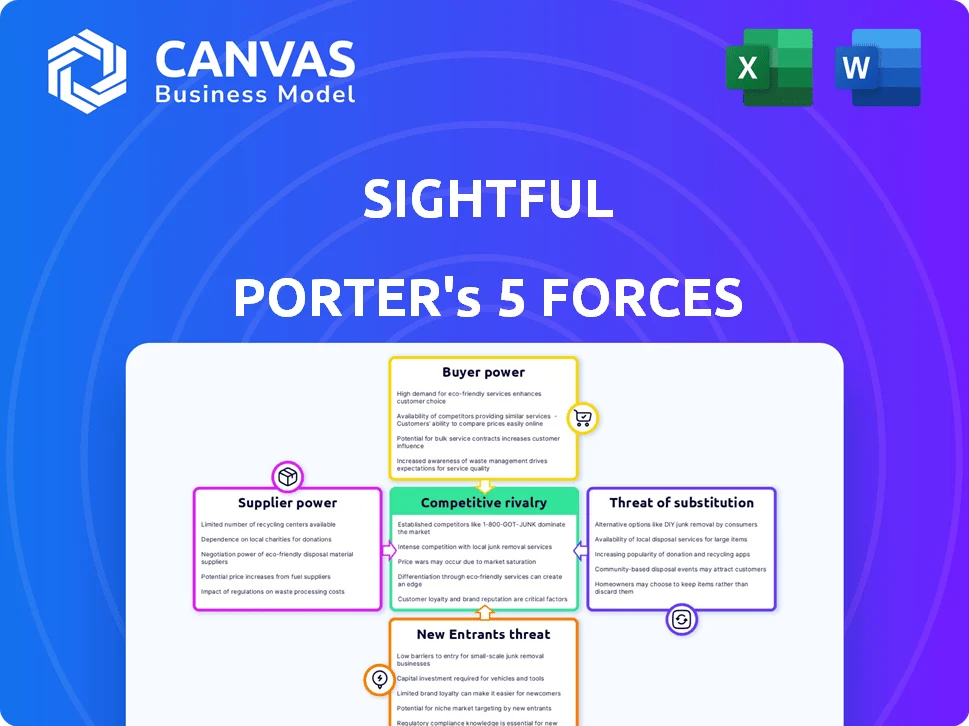
SIGHTFUL PORTER'S FIVE FORCES TEMPLATE RESEARCH
What is included in the product
 Detailed Word Document
Analyzes Sightful's competitive forces, including rivals, customers, suppliers, and potential new entrants.

 Customizable Excel Spreadsheet
Customize pressure levels based on new data or evolving market trends.
Preview the Actual Deliverable
Sightful Porter's Five Forces Analysis
This preview showcases the complete Porter's Five Forces analysis you'll get. It's the final, ready-to-use document, fully formatted. Purchase it, and this is the very file you'll instantly download. There are no hidden surprises or altered content. This is the same analysis.

Porter's Five Forces Analysis Template

A Must-Have Tool for Decision-Makers
Sightful faces complex market dynamics, from the intensity of existing rivals to the potential impact of new competitors. Understanding these forces is key to strategic success. Buyer power, supplier leverage, and the threat of substitutes also significantly impact their business model. This glimpse only touches the surface. Unlock key insights into Sightful’s industry forces—from buyer power to substitute threats—and use this knowledge to inform strategy or investment decisions.
Suppliers Bargaining Power

Reliance on Key Component Manufacturers
Sightful's Spacetop's reliance on key component manufacturers, such as Qualcomm for processors and XREAL for AR glasses, is significant. These suppliers hold considerable bargaining power due to the specialized nature of the AR components. The AR/VR headset market was valued at $28.30 billion in 2024 and is projected to reach $101.11 billion by 2030, indicating the suppliers' importance. Limited alternatives for specific technologies further amplify their influence.
Technological Expertise of Suppliers
Suppliers with unique tech, like Qualcomm for chips, boost their leverage. Sightful depends on their innovation for Spacetop's features. This dependence lets suppliers negotiate better terms. In 2024, Qualcomm's revenue was about $44.2 billion. Their tech is key to AR glasses.

Limited Number of Suppliers for Niche Components
For the Spacetop, a limited supplier pool for AR-specific tech like displays or processors gives suppliers pricing power. This is especially true in 2024, with the AR market still developing. Companies like Apple and Meta are investing heavily, but the supply chain is still maturing. This can lead to higher component costs, affecting Sightful's margins.

Supplier's Brand Reputation and Quality
The bargaining power of suppliers like Qualcomm and Wistron significantly impacts Sightful's Spacetop. These suppliers' brand reputation and component quality directly affect the Spacetop's performance and reliability. High-quality suppliers, like those with strong brand recognition, wield more power. This is because their components are crucial for product differentiation and customer satisfaction.
- Qualcomm's 2024 revenue was approximately $44.2 billion.
- Wistron reported a 2024 revenue of around $26.5 billion.
- Reliable components increase customer satisfaction.
Potential for Vertical Integration by Suppliers
Some key suppliers in the AR and computing space, like Qualcomm, are developing their own AR technologies. If these suppliers create competing products or prioritize other platforms, it could boost their bargaining power. This shift could disrupt Sightful's supply chain. The global AR/VR market was valued at $43.8 billion in 2023.
- Qualcomm's XR business reported $539 million in revenue for fiscal year 2023.
- AR/VR hardware sales grew by 10.1% in 2023.
- Meta's Reality Labs, a competitor, invested $13.7 billion in 2023.
Spacetop's Supplier Challenges: Qualcomm's Leverage
Sightful's Spacetop faces supplier power from firms like Qualcomm. These suppliers have leverage due to tech expertise. Limited alternatives and component quality impact Sightful's costs and product.
| Supplier | 2024 Revenue (approx.) | Impact on Sightful |
|---|---|---|
| Qualcomm | $44.2B | Key components, pricing |
| Wistron | $26.5B | Manufacturing, reliability |
| AR/VR Market | $28.3B (2024) | Component cost pressures |
Customers Bargaining Power

Availability of Alternative Computing Devices
Customers can choose from laptops, tablets, and AR/VR headsets. This wide choice limits Sightful's pricing power. In 2024, laptop sales reached $200 billion globally. This gives customers alternatives if Spacetop isn't ideal.
Price Sensitivity of the Target Market
The Spacetop G1's $1,900 price tag places it in a premium segment. Customers might be price-sensitive, especially when considering alternatives like laptops, which, in 2024, average around $800-$1,500. For instance, in Q4 2023, the average selling price for laptops saw a slight decrease. This could pressure Sightful to justify its higher price.

Customer's Ability to Influence Product Development
Sightful's early access programs highlight customer influence. Gathering feedback allows for product refinement, suggesting customer power over future Spacetop iterations. For example, user feedback led to a 15% improvement in battery life in the latest software update. This iterative approach, common in tech, shows responsiveness to user needs. Customer reviews on platforms like Amazon, where similar products are sold, can dramatically impact sales, with a 4.5-star rating often boosting sales by 20%.

Lack of Vendor Lock-in in the Long Term
Sightful's move to a software-focused approach weakens vendor lock-in. Customers now have more hardware options. This change boosts their bargaining power. For instance, the AR/VR market is projected to reach $86 billion by 2024, offering many compatible devices.
- Software compatibility broadens hardware choices.
- This shift increases customer leverage.
- The market's growth supports diverse options.
- Customers are less tied to one provider.
Importance of the Spacetop for Customer Productivity
Sightful's Spacetop aims to boost productivity via a large virtual workspace, directly impacting customer bargaining power. The perceived value of this productivity enhancement is crucial; if it's truly unique and substantial, customer power decreases. Conversely, if alternatives exist or gains are minimal, customers hold more sway in negotiations. This dynamic influences pricing and the overall success of the Spacetop.
- Market data from 2024 shows a rising demand for productivity tools, with a 15% increase in the use of virtual workspace solutions.
- Early adopter feedback on similar AR devices indicates a mixed response, with some users reporting significant productivity gains while others find the technology cumbersome.
- Pricing strategies will be critical; competitors offer similar features at varied price points.
- Sightful's success hinges on demonstrating a clear ROI for its customers, which will influence their bargaining power.
Tech Choices Shape Customer Power
Customers wield significant power due to diverse tech options, like laptops, tablets, and AR/VR headsets. Sightful's premium pricing, with the Spacetop G1 at $1,900, faces price sensitivity, especially against cheaper alternatives. Early access programs and software compatibility further empower customers by enabling feedback and hardware choices.
| Factor | Impact | Data (2024) |
|---|---|---|
| Product Alternatives | High | Laptop sales: $200B, AR/VR market: $86B |
| Price Sensitivity | Moderate | Avg. laptop price: $800-$1,500 |
| Customer Feedback | High | Productivity tools: 15% usage increase |
Rivalry Among Competitors

Presence of Major Tech Companies in AR/VR
The AR/VR market is fiercely competitive, with tech giants like Apple, Meta, Google, and Microsoft vying for dominance. Meta invested $13.7 billion in Reality Labs in 2023. These companies' substantial investments drive rapid innovation, setting high standards for user experience and features. This intense competition can squeeze out smaller players.
Competition from Traditional Laptop Manufacturers
Sightful faces intense competition from established laptop makers like Lenovo, HP, Dell, and Apple. These companies control a significant market share; for instance, in 2024, Lenovo and HP held about 40% of the global PC market. Although the Spacetop is unique, it competes for the same consumer dollars. The competitive landscape is fierce, with companies constantly innovating and cutting prices.

Differentiated Product Offering
Sightful's Spacetop stands out with its AR-first laptop, offering a large virtual display for productivity and privacy, a unique approach. This differentiation may lessen direct competition with standard laptops. However, it opens the door to rivalry from other AR/VR productivity tools. The global AR/VR market was valued at $30.7 billion in 2024, indicating a growing competitive landscape. This highlights the need for Sightful to continually innovate to maintain its edge.

Pivoting Business Model to Software
Sightful's move to a software-focused model intensifies competition. They now face rivals in AR software, including those developing platforms for varied devices. This shift could pit them against tech giants and specialized AR firms. The AR market is projected to reach $100 billion by 2024.
- AR software competition includes companies like Microsoft and Meta.
- Sightful's success depends on software quality and partnerships.
- Market size is a significant factor in competitive dynamics.
- The ability to adapt is crucial in this evolving space.
Pace of Innovation in AR and Computing
The AR and computing sectors are highly competitive, with relentless innovation. Sightful must accelerate its R&D to keep pace with rivals, like Apple and Meta, who are heavily investing. The need for rapid upgrades is crucial to avoid obsolescence, given the short product cycles in this industry. This constant evolution demands substantial investment in technology and talent to stay competitive.
- Apple's R&D spending in 2024 reached approximately $30 billion.
- Meta's Reality Labs division, focused on AR/VR, reported a $13.7 billion operating loss in 2023.
- The global AR/VR market is projected to reach $60 billion by 2025.
- The average product lifecycle in AR hardware is about 18-24 months.
AR/VR Market: Billions at Stake!
Competitive rivalry in the AR/VR market is intense, with giants like Apple and Meta heavily investing. Meta's Reality Labs lost $13.7 billion in 2023, reflecting the high stakes. Rapid innovation and short product cycles demand constant R&D to stay ahead.
| Company | 2024 R&D Spending (Approx.) | Focus |
|---|---|---|
| Apple | $30 billion | AR/VR, Hardware, Software |
| Meta (Reality Labs) | $13.7 billion (Operating Loss in 2023) | AR/VR Hardware and Software |
| Global AR/VR Market | $30.7 billion (2024), $60 billion (2025 Proj.) | Overall Market Growth |
SIGHTFUL PORTER'S FIVE FORCES TEMPLATE RESEARCH
What is included in the product
Detailed Word Document
Analyzes Sightful's competitive forces, including rivals, customers, suppliers, and potential new entrants.
Customizable Excel Spreadsheet
Customize pressure levels based on new data or evolving market trends.
Preview the Actual Deliverable
Sightful Porter's Five Forces Analysis
This preview showcases the complete Porter's Five Forces analysis you'll get. It's the final, ready-to-use document, fully formatted. Purchase it, and this is the very file you'll instantly download. There are no hidden surprises or altered content. This is the same analysis.
Porter's Five Forces Analysis Template
A Must-Have Tool for Decision-Makers
Sightful faces complex market dynamics, from the intensity of existing rivals to the potential impact of new competitors. Understanding these forces is key to strategic success. Buyer power, supplier leverage, and the threat of substitutes also significantly impact their business model. This glimpse only touches the surface. Unlock key insights into Sightful’s industry forces—from buyer power to substitute threats—and use this knowledge to inform strategy or investment decisions.
Suppliers Bargaining Power
Reliance on Key Component Manufacturers
Sightful's Spacetop's reliance on key component manufacturers, such as Qualcomm for processors and XREAL for AR glasses, is significant. These suppliers hold considerable bargaining power due to the specialized nature of the AR components. The AR/VR headset market was valued at $28.30 billion in 2024 and is projected to reach $101.11 billion by 2030, indicating the suppliers' importance. Limited alternatives for specific technologies further amplify their influence.
Technological Expertise of Suppliers
Suppliers with unique tech, like Qualcomm for chips, boost their leverage. Sightful depends on their innovation for Spacetop's features. This dependence lets suppliers negotiate better terms. In 2024, Qualcomm's revenue was about $44.2 billion. Their tech is key to AR glasses.
Limited Number of Suppliers for Niche Components
For the Spacetop, a limited supplier pool for AR-specific tech like displays or processors gives suppliers pricing power. This is especially true in 2024, with the AR market still developing. Companies like Apple and Meta are investing heavily, but the supply chain is still maturing. This can lead to higher component costs, affecting Sightful's margins.
Supplier's Brand Reputation and Quality
The bargaining power of suppliers like Qualcomm and Wistron significantly impacts Sightful's Spacetop. These suppliers' brand reputation and component quality directly affect the Spacetop's performance and reliability. High-quality suppliers, like those with strong brand recognition, wield more power. This is because their components are crucial for product differentiation and customer satisfaction.
- Qualcomm's 2024 revenue was approximately $44.2 billion.
- Wistron reported a 2024 revenue of around $26.5 billion.
- Reliable components increase customer satisfaction.
Potential for Vertical Integration by Suppliers
Some key suppliers in the AR and computing space, like Qualcomm, are developing their own AR technologies. If these suppliers create competing products or prioritize other platforms, it could boost their bargaining power. This shift could disrupt Sightful's supply chain. The global AR/VR market was valued at $43.8 billion in 2023.
- Qualcomm's XR business reported $539 million in revenue for fiscal year 2023.
- AR/VR hardware sales grew by 10.1% in 2023.
- Meta's Reality Labs, a competitor, invested $13.7 billion in 2023.
Spacetop's Supplier Challenges: Qualcomm's Leverage
Sightful's Spacetop faces supplier power from firms like Qualcomm. These suppliers have leverage due to tech expertise. Limited alternatives and component quality impact Sightful's costs and product.
| Supplier | 2024 Revenue (approx.) | Impact on Sightful |
|---|---|---|
| Qualcomm | $44.2B | Key components, pricing |
| Wistron | $26.5B | Manufacturing, reliability |
| AR/VR Market | $28.3B (2024) | Component cost pressures |
Customers Bargaining Power
Availability of Alternative Computing Devices
Customers can choose from laptops, tablets, and AR/VR headsets. This wide choice limits Sightful's pricing power. In 2024, laptop sales reached $200 billion globally. This gives customers alternatives if Spacetop isn't ideal.
Price Sensitivity of the Target Market
The Spacetop G1's $1,900 price tag places it in a premium segment. Customers might be price-sensitive, especially when considering alternatives like laptops, which, in 2024, average around $800-$1,500. For instance, in Q4 2023, the average selling price for laptops saw a slight decrease. This could pressure Sightful to justify its higher price.
Customer's Ability to Influence Product Development
Sightful's early access programs highlight customer influence. Gathering feedback allows for product refinement, suggesting customer power over future Spacetop iterations. For example, user feedback led to a 15% improvement in battery life in the latest software update. This iterative approach, common in tech, shows responsiveness to user needs. Customer reviews on platforms like Amazon, where similar products are sold, can dramatically impact sales, with a 4.5-star rating often boosting sales by 20%.
Lack of Vendor Lock-in in the Long Term
Sightful's move to a software-focused approach weakens vendor lock-in. Customers now have more hardware options. This change boosts their bargaining power. For instance, the AR/VR market is projected to reach $86 billion by 2024, offering many compatible devices.
- Software compatibility broadens hardware choices.
- This shift increases customer leverage.
- The market's growth supports diverse options.
- Customers are less tied to one provider.
Importance of the Spacetop for Customer Productivity
Sightful's Spacetop aims to boost productivity via a large virtual workspace, directly impacting customer bargaining power. The perceived value of this productivity enhancement is crucial; if it's truly unique and substantial, customer power decreases. Conversely, if alternatives exist or gains are minimal, customers hold more sway in negotiations. This dynamic influences pricing and the overall success of the Spacetop.
- Market data from 2024 shows a rising demand for productivity tools, with a 15% increase in the use of virtual workspace solutions.
- Early adopter feedback on similar AR devices indicates a mixed response, with some users reporting significant productivity gains while others find the technology cumbersome.
- Pricing strategies will be critical; competitors offer similar features at varied price points.
- Sightful's success hinges on demonstrating a clear ROI for its customers, which will influence their bargaining power.
Tech Choices Shape Customer Power
Customers wield significant power due to diverse tech options, like laptops, tablets, and AR/VR headsets. Sightful's premium pricing, with the Spacetop G1 at $1,900, faces price sensitivity, especially against cheaper alternatives. Early access programs and software compatibility further empower customers by enabling feedback and hardware choices.
| Factor | Impact | Data (2024) |
|---|---|---|
| Product Alternatives | High | Laptop sales: $200B, AR/VR market: $86B |
| Price Sensitivity | Moderate | Avg. laptop price: $800-$1,500 |
| Customer Feedback | High | Productivity tools: 15% usage increase |
Rivalry Among Competitors
Presence of Major Tech Companies in AR/VR
The AR/VR market is fiercely competitive, with tech giants like Apple, Meta, Google, and Microsoft vying for dominance. Meta invested $13.7 billion in Reality Labs in 2023. These companies' substantial investments drive rapid innovation, setting high standards for user experience and features. This intense competition can squeeze out smaller players.
Competition from Traditional Laptop Manufacturers
Sightful faces intense competition from established laptop makers like Lenovo, HP, Dell, and Apple. These companies control a significant market share; for instance, in 2024, Lenovo and HP held about 40% of the global PC market. Although the Spacetop is unique, it competes for the same consumer dollars. The competitive landscape is fierce, with companies constantly innovating and cutting prices.
Differentiated Product Offering
Sightful's Spacetop stands out with its AR-first laptop, offering a large virtual display for productivity and privacy, a unique approach. This differentiation may lessen direct competition with standard laptops. However, it opens the door to rivalry from other AR/VR productivity tools. The global AR/VR market was valued at $30.7 billion in 2024, indicating a growing competitive landscape. This highlights the need for Sightful to continually innovate to maintain its edge.
Pivoting Business Model to Software
Sightful's move to a software-focused model intensifies competition. They now face rivals in AR software, including those developing platforms for varied devices. This shift could pit them against tech giants and specialized AR firms. The AR market is projected to reach $100 billion by 2024.
- AR software competition includes companies like Microsoft and Meta.
- Sightful's success depends on software quality and partnerships.
- Market size is a significant factor in competitive dynamics.
- The ability to adapt is crucial in this evolving space.
Pace of Innovation in AR and Computing
The AR and computing sectors are highly competitive, with relentless innovation. Sightful must accelerate its R&D to keep pace with rivals, like Apple and Meta, who are heavily investing. The need for rapid upgrades is crucial to avoid obsolescence, given the short product cycles in this industry. This constant evolution demands substantial investment in technology and talent to stay competitive.
- Apple's R&D spending in 2024 reached approximately $30 billion.
- Meta's Reality Labs division, focused on AR/VR, reported a $13.7 billion operating loss in 2023.
- The global AR/VR market is projected to reach $60 billion by 2025.
- The average product lifecycle in AR hardware is about 18-24 months.
AR/VR Market: Billions at Stake!
Competitive rivalry in the AR/VR market is intense, with giants like Apple and Meta heavily investing. Meta's Reality Labs lost $13.7 billion in 2023, reflecting the high stakes. Rapid innovation and short product cycles demand constant R&D to stay ahead.
| Company | 2024 R&D Spending (Approx.) | Focus |
|---|---|---|
| Apple | $30 billion | AR/VR, Hardware, Software |
| Meta (Reality Labs) | $13.7 billion (Operating Loss in 2023) | AR/VR Hardware and Software |
| Global AR/VR Market | $30.7 billion (2024), $60 billion (2025 Proj.) | Overall Market Growth |
Product Information
Product Information
Shipping & Returns
Shipping & Returns
Description
What is included in the product
Detailed Word Document
Analyzes Sightful's competitive forces, including rivals, customers, suppliers, and potential new entrants.
Customizable Excel Spreadsheet
Customize pressure levels based on new data or evolving market trends.
Preview the Actual Deliverable
Sightful Porter's Five Forces Analysis
This preview showcases the complete Porter's Five Forces analysis you'll get. It's the final, ready-to-use document, fully formatted. Purchase it, and this is the very file you'll instantly download. There are no hidden surprises or altered content. This is the same analysis.
Porter's Five Forces Analysis Template
A Must-Have Tool for Decision-Makers
Sightful faces complex market dynamics, from the intensity of existing rivals to the potential impact of new competitors. Understanding these forces is key to strategic success. Buyer power, supplier leverage, and the threat of substitutes also significantly impact their business model. This glimpse only touches the surface. Unlock key insights into Sightful’s industry forces—from buyer power to substitute threats—and use this knowledge to inform strategy or investment decisions.
Suppliers Bargaining Power
Reliance on Key Component Manufacturers
Sightful's Spacetop's reliance on key component manufacturers, such as Qualcomm for processors and XREAL for AR glasses, is significant. These suppliers hold considerable bargaining power due to the specialized nature of the AR components. The AR/VR headset market was valued at $28.30 billion in 2024 and is projected to reach $101.11 billion by 2030, indicating the suppliers' importance. Limited alternatives for specific technologies further amplify their influence.
Technological Expertise of Suppliers
Suppliers with unique tech, like Qualcomm for chips, boost their leverage. Sightful depends on their innovation for Spacetop's features. This dependence lets suppliers negotiate better terms. In 2024, Qualcomm's revenue was about $44.2 billion. Their tech is key to AR glasses.
Limited Number of Suppliers for Niche Components
For the Spacetop, a limited supplier pool for AR-specific tech like displays or processors gives suppliers pricing power. This is especially true in 2024, with the AR market still developing. Companies like Apple and Meta are investing heavily, but the supply chain is still maturing. This can lead to higher component costs, affecting Sightful's margins.
Supplier's Brand Reputation and Quality
The bargaining power of suppliers like Qualcomm and Wistron significantly impacts Sightful's Spacetop. These suppliers' brand reputation and component quality directly affect the Spacetop's performance and reliability. High-quality suppliers, like those with strong brand recognition, wield more power. This is because their components are crucial for product differentiation and customer satisfaction.
- Qualcomm's 2024 revenue was approximately $44.2 billion.
- Wistron reported a 2024 revenue of around $26.5 billion.
- Reliable components increase customer satisfaction.
Potential for Vertical Integration by Suppliers
Some key suppliers in the AR and computing space, like Qualcomm, are developing their own AR technologies. If these suppliers create competing products or prioritize other platforms, it could boost their bargaining power. This shift could disrupt Sightful's supply chain. The global AR/VR market was valued at $43.8 billion in 2023.
- Qualcomm's XR business reported $539 million in revenue for fiscal year 2023.
- AR/VR hardware sales grew by 10.1% in 2023.
- Meta's Reality Labs, a competitor, invested $13.7 billion in 2023.
Spacetop's Supplier Challenges: Qualcomm's Leverage
Sightful's Spacetop faces supplier power from firms like Qualcomm. These suppliers have leverage due to tech expertise. Limited alternatives and component quality impact Sightful's costs and product.
| Supplier | 2024 Revenue (approx.) | Impact on Sightful |
|---|---|---|
| Qualcomm | $44.2B | Key components, pricing |
| Wistron | $26.5B | Manufacturing, reliability |
| AR/VR Market | $28.3B (2024) | Component cost pressures |
Customers Bargaining Power
Availability of Alternative Computing Devices
Customers can choose from laptops, tablets, and AR/VR headsets. This wide choice limits Sightful's pricing power. In 2024, laptop sales reached $200 billion globally. This gives customers alternatives if Spacetop isn't ideal.
Price Sensitivity of the Target Market
The Spacetop G1's $1,900 price tag places it in a premium segment. Customers might be price-sensitive, especially when considering alternatives like laptops, which, in 2024, average around $800-$1,500. For instance, in Q4 2023, the average selling price for laptops saw a slight decrease. This could pressure Sightful to justify its higher price.
Customer's Ability to Influence Product Development
Sightful's early access programs highlight customer influence. Gathering feedback allows for product refinement, suggesting customer power over future Spacetop iterations. For example, user feedback led to a 15% improvement in battery life in the latest software update. This iterative approach, common in tech, shows responsiveness to user needs. Customer reviews on platforms like Amazon, where similar products are sold, can dramatically impact sales, with a 4.5-star rating often boosting sales by 20%.
Lack of Vendor Lock-in in the Long Term
Sightful's move to a software-focused approach weakens vendor lock-in. Customers now have more hardware options. This change boosts their bargaining power. For instance, the AR/VR market is projected to reach $86 billion by 2024, offering many compatible devices.
- Software compatibility broadens hardware choices.
- This shift increases customer leverage.
- The market's growth supports diverse options.
- Customers are less tied to one provider.
Importance of the Spacetop for Customer Productivity
Sightful's Spacetop aims to boost productivity via a large virtual workspace, directly impacting customer bargaining power. The perceived value of this productivity enhancement is crucial; if it's truly unique and substantial, customer power decreases. Conversely, if alternatives exist or gains are minimal, customers hold more sway in negotiations. This dynamic influences pricing and the overall success of the Spacetop.
- Market data from 2024 shows a rising demand for productivity tools, with a 15% increase in the use of virtual workspace solutions.
- Early adopter feedback on similar AR devices indicates a mixed response, with some users reporting significant productivity gains while others find the technology cumbersome.
- Pricing strategies will be critical; competitors offer similar features at varied price points.
- Sightful's success hinges on demonstrating a clear ROI for its customers, which will influence their bargaining power.
Tech Choices Shape Customer Power
Customers wield significant power due to diverse tech options, like laptops, tablets, and AR/VR headsets. Sightful's premium pricing, with the Spacetop G1 at $1,900, faces price sensitivity, especially against cheaper alternatives. Early access programs and software compatibility further empower customers by enabling feedback and hardware choices.
| Factor | Impact | Data (2024) |
|---|---|---|
| Product Alternatives | High | Laptop sales: $200B, AR/VR market: $86B |
| Price Sensitivity | Moderate | Avg. laptop price: $800-$1,500 |
| Customer Feedback | High | Productivity tools: 15% usage increase |
Rivalry Among Competitors
Presence of Major Tech Companies in AR/VR
The AR/VR market is fiercely competitive, with tech giants like Apple, Meta, Google, and Microsoft vying for dominance. Meta invested $13.7 billion in Reality Labs in 2023. These companies' substantial investments drive rapid innovation, setting high standards for user experience and features. This intense competition can squeeze out smaller players.
Competition from Traditional Laptop Manufacturers
Sightful faces intense competition from established laptop makers like Lenovo, HP, Dell, and Apple. These companies control a significant market share; for instance, in 2024, Lenovo and HP held about 40% of the global PC market. Although the Spacetop is unique, it competes for the same consumer dollars. The competitive landscape is fierce, with companies constantly innovating and cutting prices.
Differentiated Product Offering
Sightful's Spacetop stands out with its AR-first laptop, offering a large virtual display for productivity and privacy, a unique approach. This differentiation may lessen direct competition with standard laptops. However, it opens the door to rivalry from other AR/VR productivity tools. The global AR/VR market was valued at $30.7 billion in 2024, indicating a growing competitive landscape. This highlights the need for Sightful to continually innovate to maintain its edge.
Pivoting Business Model to Software
Sightful's move to a software-focused model intensifies competition. They now face rivals in AR software, including those developing platforms for varied devices. This shift could pit them against tech giants and specialized AR firms. The AR market is projected to reach $100 billion by 2024.
- AR software competition includes companies like Microsoft and Meta.
- Sightful's success depends on software quality and partnerships.
- Market size is a significant factor in competitive dynamics.
- The ability to adapt is crucial in this evolving space.
Pace of Innovation in AR and Computing
The AR and computing sectors are highly competitive, with relentless innovation. Sightful must accelerate its R&D to keep pace with rivals, like Apple and Meta, who are heavily investing. The need for rapid upgrades is crucial to avoid obsolescence, given the short product cycles in this industry. This constant evolution demands substantial investment in technology and talent to stay competitive.
- Apple's R&D spending in 2024 reached approximately $30 billion.
- Meta's Reality Labs division, focused on AR/VR, reported a $13.7 billion operating loss in 2023.
- The global AR/VR market is projected to reach $60 billion by 2025.
- The average product lifecycle in AR hardware is about 18-24 months.
AR/VR Market: Billions at Stake!
Competitive rivalry in the AR/VR market is intense, with giants like Apple and Meta heavily investing. Meta's Reality Labs lost $13.7 billion in 2023, reflecting the high stakes. Rapid innovation and short product cycles demand constant R&D to stay ahead.
| Company | 2024 R&D Spending (Approx.) | Focus |
|---|---|---|
| Apple | $30 billion | AR/VR, Hardware, Software |
| Meta (Reality Labs) | $13.7 billion (Operating Loss in 2023) | AR/VR Hardware and Software |
| Global AR/VR Market | $30.7 billion (2024), $60 billion (2025 Proj.) | Overall Market Growth |


