
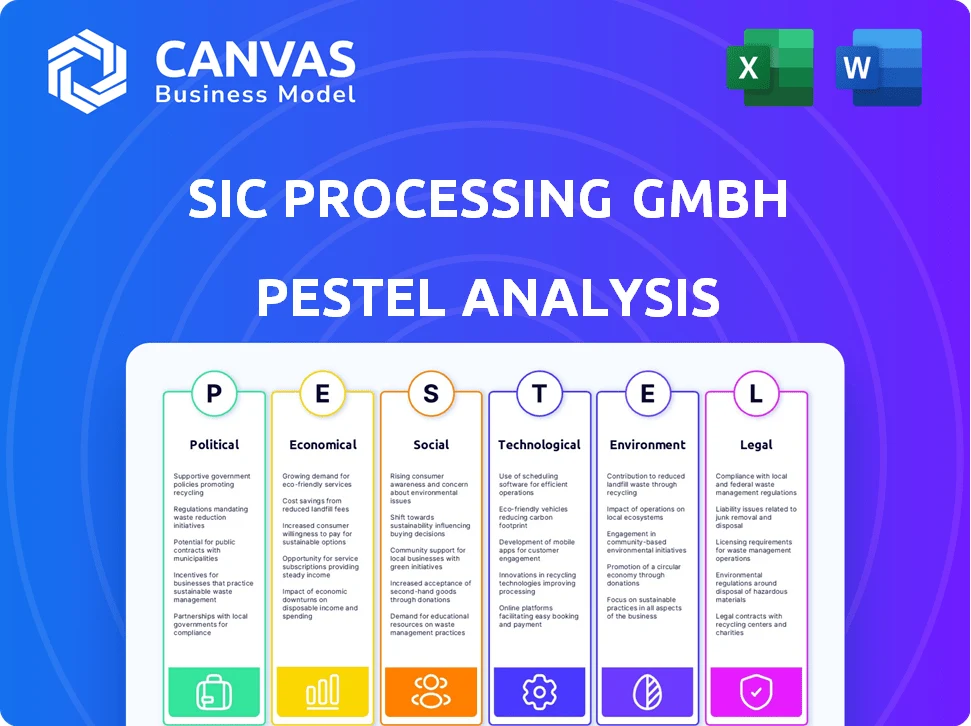
SIC PROCESSING GMBH PESTLE ANALYSIS TEMPLATE RESEARCH
What is included in the product
 Detailed Word Document
This analysis details how PESTLE factors impact SiC Processing GmbH, including opportunities and threats.

 Customizable Excel Spreadsheet
Helps support discussions on external risk and market positioning during planning sessions.
Same Document Delivered
SiC Processing GmbH PESTLE Analysis
The SiC Processing GmbH PESTLE Analysis preview showcases the complete document you'll get.
What you see now reflects the finished report, perfectly formatted and ready.
The structure, content, and insights presented here will be delivered post-purchase.
No need to imagine, this is the final product, instantly downloadable.
Get the real analysis instantly—what you see is exactly what you receive!

PESTLE Analysis Template

Make Smarter Strategic Decisions with a Complete PESTEL View
SiC Processing GmbH faces a dynamic landscape. This PESTLE Analysis explores key political, economic, social, technological, legal, and environmental factors impacting its operations. Discover how regulations, market trends, and technological advancements influence the company's strategy and growth. Gain a critical understanding of risks and opportunities. For deeper strategic insights, download the full PESTLE Analysis now.
Political factors

Government Support for Semiconductor and Solar Industries
Government support for semiconductors and solar, key SiC users, affects SiC Processing GmbH. Funding, tax breaks, and regulations boost industry growth, increasing SiC waste supply. For example, the U.S. CHIPS Act allocated billions, and solar tax credits drive demand. This creates more raw material for SiC processing, influencing the company's operations.
Circular Economy Policies
Governments are pushing circular economy policies to cut waste and boost resource use. SiC Processing GmbH gains from this, as recycling is their core. Favorable policies can improve operations and create new chances. For example, the EU's Circular Economy Action Plan aims to double the circular material use rate by 2030.

Trade Policies and Supply Chain Security
Geopolitical tensions and protectionist trade policies impact raw material costs and availability. The U.S. imposed tariffs on Chinese goods, affecting supply chains. SiC Processing GmbH must secure stable waste material supplies. This includes adapting to changes in trade regulations and securing technology access.

Waste Management Regulations
Changes in waste management regulations significantly impact SiC Processing GmbH. Mandates for waste segregation and higher recycling targets affect the volume and type of waste available for processing. Stricter rules can boost recyclable SiC waste supply, creating new revenue streams. The global waste management market is projected to reach $2.4 trillion by 2028.
- EU's Circular Economy Action Plan aims to double the circular material use rate by 2030.
- China's National Sword policy in 2018 increased the demand for high-quality recyclable materials.
International Environmental Agreements
International environmental agreements significantly impact SiC Processing GmbH. Global accords on waste reduction and resource sharing influence national policies, fostering a positive environment for circular economy businesses. These agreements affect the demand for recycled materials and promote sustainable practices. For instance, the EU's Circular Economy Action Plan aims to double the circular material use rate by 2030, from 8.6% in 2021.
- EU's Circular Economy Action Plan: Aiming to double circular material use by 2030.
- Global agreements influence national policies and business practices.
- Demand for recycled materials is affected by international accords.
Political Winds Shaping SiC Processing GmbH's Future
Political factors heavily influence SiC Processing GmbH. Government subsidies, like the U.S. CHIPS Act (billions allocated), and circular economy policies boost SiC's waste supply. Trade policies and geopolitical tensions (tariffs on Chinese goods) impact raw material access, while waste management regulations affect the availability of recyclable SiC. The global waste management market is set to hit $2.4T by 2028.
| Policy Area | Impact on SiC Processing GmbH | Relevant Data |
|---|---|---|
| Government Support | Boosts industry and waste supply | U.S. CHIPS Act (billions) |
| Circular Economy | Enhances recycling opportunities | EU aims to double material use by 2030 |
| Trade & Geopolitics | Affects material access and costs | China's National Sword Policy |
Economic factors

Growth of Semiconductor and Solar Markets
The semiconductor and solar industries are crucial for SiC Processing GmbH, supplying SiC waste. The semiconductor market is projected to grow significantly, with a 13.1% CAGR from 2024-2030. Solar power installations are also expanding, increasing the availability of waste. This growth is an important economic driver for SiC Processing GmbH.
Raw Material Costs and Availability
Raw material costs, particularly silicon carbide (SiC) feedstock, are pivotal. Supply chain issues, like those seen in 2024, can spike prices. For example, SiC prices rose by 15% in Q3 2024 due to logistics problems. This directly impacts processing costs.

Demand for Recycled Materials
SiC Processing GmbH's economic success hinges on the demand for recycled SiC. Increased adoption of circular economy principles and corporate sustainability efforts can boost demand. The cost of virgin materials heavily influences the value of recycled SiC. The global market for recycled materials is projected to reach $63.8 billion by 2025, reflecting growing demand.

Investment in Circular Economy and Recycling Technologies
Investment in circular economy and recycling technologies presents opportunities for SiC Processing GmbH. This could lead to process improvements, capacity expansion, and new recycling solutions. Both public and private funding sources are available for these initiatives. The global waste recycling market is projected to reach $78.1 billion by 2028.
- Growing demand for sustainable practices.
- Potential for government grants and incentives.
- Opportunities to reduce waste and costs.
- Development of innovative recycling methods.
Global Economic Conditions
Global economic conditions and market stability significantly impact semiconductor and solar panel demand, affecting SiC waste generation. Downturns can reduce manufacturing and recycling material supply. The World Bank forecasts global growth at 2.6% in 2024, influenced by inflation and interest rates. Market volatility, such as the 2023-2024 banking turmoil, adds uncertainty.
- Global GDP growth in 2024 is projected at 2.6% by the World Bank.
- The semiconductor market is expected to reach $588 billion in 2024.
SiC Processing's Economic Crossroads: Semiconductor & Solar Impact
SiC Processing GmbH faces economic influences tied to semiconductor and solar sectors, which both fuel SiC waste. The semiconductor market is expected to hit $588B in 2024. Raw material expenses, particularly SiC feedstock, and supply chain snags affect costs, such as a 15% price jump in Q3 2024.
| Factor | Impact | Data |
|---|---|---|
| Semiconductor Growth | Increased waste availability | 13.1% CAGR 2024-2030 |
| Raw Material Costs | Influence on Processing | SiC price increase: 15% in Q3 2024 |
| Global Economic Growth | Demand and Waste Generation | World Bank forecasts 2.6% in 2024 |
Sociological factors

Growing Environmental Awareness
Growing environmental awareness is reshaping consumer and business behavior. This trend favors companies like SiC Processing GmbH. The global green technology and sustainability market is projected to reach $74.6 billion by 2025, with a CAGR of 11.2% from 2019 to 2025.
Corporate Sustainability Goals
Corporate sustainability goals are increasingly influencing business decisions. Many firms, including those in the semiconductor and solar sectors, have set ambitious zero-waste targets. This trend boosts the demand for effective SiC waste management solutions. For instance, the global waste management market is projected to reach $2.5 trillion by 2028, signaling significant growth potential for SiC Processing GmbH's recycling services.

Consumer Demand for Sustainable Products
Consumers increasingly favor sustainable products, driving companies to use recycled materials. This shift could boost demand for recycled SiC, benefiting SiC Processing GmbH. For example, in 2024, the sustainable products market grew by 15%, showing this trend's impact. This preference is particularly strong among millennials and Gen Z, who represent a significant market share. This growth signals a promising opportunity for SiC Processing GmbH.

Workforce Skills and Availability
SiC Processing GmbH heavily relies on a skilled workforce. Availability of experts in materials science and chemical processing is vital. Trends in education impact talent acquisition and retention. The global semiconductor workforce shortage, as of early 2024, highlights this challenge. Vocational training programs are essential.
- In 2023, the semiconductor industry faced a talent gap of approximately 1 million workers globally.
- The median salary for materials scientists in the US was around $105,000 in 2024.
- Investments in STEM education increased by 15% in OECD countries between 2020 and 2023.
Community Perception and Stakeholder Engagement
Community perception and stakeholder engagement significantly impact SiC Processing GmbH's social license. Public views on industrial recycling are crucial for operations. Positive relationships and showcasing environmental benefits are key for long-term success. For instance, 70% of consumers favor eco-friendly companies. Building trust through transparency is vital.
- 70% of consumers prefer eco-friendly companies (2024).
- Community support can increase project approval rates by 20% (2024).
Sustainable Practices Drive Market Growth
Societal shifts highlight environmental awareness, favoring sustainable practices like SiC recycling. In 2024, the sustainable products market grew 15%, reflecting this trend. A skilled workforce, vital for SiC Processing GmbH, faces challenges like the semiconductor talent gap. Positive community perception, driven by transparency, is crucial, with 70% of consumers favoring eco-friendly firms.
| Sociological Factor | Impact on SiC Processing GmbH | Data/Statistics |
|---|---|---|
| Environmental Awareness | Increased demand for sustainable products | Sustainable products market grew 15% (2024) |
| Workforce Skills | Impacts talent acquisition | Semiconductor industry talent gap (2023): 1 million workers |
| Community Perception | Affects operational success | 70% consumers prefer eco-friendly firms (2024) |
SIC PROCESSING GMBH PESTLE ANALYSIS TEMPLATE RESEARCH
What is included in the product
Detailed Word Document
This analysis details how PESTLE factors impact SiC Processing GmbH, including opportunities and threats.
Customizable Excel Spreadsheet
Helps support discussions on external risk and market positioning during planning sessions.
Same Document Delivered
SiC Processing GmbH PESTLE Analysis
The SiC Processing GmbH PESTLE Analysis preview showcases the complete document you'll get.
What you see now reflects the finished report, perfectly formatted and ready.
The structure, content, and insights presented here will be delivered post-purchase.
No need to imagine, this is the final product, instantly downloadable.
Get the real analysis instantly—what you see is exactly what you receive!
PESTLE Analysis Template
Make Smarter Strategic Decisions with a Complete PESTEL View
SiC Processing GmbH faces a dynamic landscape. This PESTLE Analysis explores key political, economic, social, technological, legal, and environmental factors impacting its operations. Discover how regulations, market trends, and technological advancements influence the company's strategy and growth. Gain a critical understanding of risks and opportunities. For deeper strategic insights, download the full PESTLE Analysis now.
Political factors
Government Support for Semiconductor and Solar Industries
Government support for semiconductors and solar, key SiC users, affects SiC Processing GmbH. Funding, tax breaks, and regulations boost industry growth, increasing SiC waste supply. For example, the U.S. CHIPS Act allocated billions, and solar tax credits drive demand. This creates more raw material for SiC processing, influencing the company's operations.
Circular Economy Policies
Governments are pushing circular economy policies to cut waste and boost resource use. SiC Processing GmbH gains from this, as recycling is their core. Favorable policies can improve operations and create new chances. For example, the EU's Circular Economy Action Plan aims to double the circular material use rate by 2030.
Trade Policies and Supply Chain Security
Geopolitical tensions and protectionist trade policies impact raw material costs and availability. The U.S. imposed tariffs on Chinese goods, affecting supply chains. SiC Processing GmbH must secure stable waste material supplies. This includes adapting to changes in trade regulations and securing technology access.
Waste Management Regulations
Changes in waste management regulations significantly impact SiC Processing GmbH. Mandates for waste segregation and higher recycling targets affect the volume and type of waste available for processing. Stricter rules can boost recyclable SiC waste supply, creating new revenue streams. The global waste management market is projected to reach $2.4 trillion by 2028.
- EU's Circular Economy Action Plan aims to double the circular material use rate by 2030.
- China's National Sword policy in 2018 increased the demand for high-quality recyclable materials.
International Environmental Agreements
International environmental agreements significantly impact SiC Processing GmbH. Global accords on waste reduction and resource sharing influence national policies, fostering a positive environment for circular economy businesses. These agreements affect the demand for recycled materials and promote sustainable practices. For instance, the EU's Circular Economy Action Plan aims to double the circular material use rate by 2030, from 8.6% in 2021.
- EU's Circular Economy Action Plan: Aiming to double circular material use by 2030.
- Global agreements influence national policies and business practices.
- Demand for recycled materials is affected by international accords.
Political Winds Shaping SiC Processing GmbH's Future
Political factors heavily influence SiC Processing GmbH. Government subsidies, like the U.S. CHIPS Act (billions allocated), and circular economy policies boost SiC's waste supply. Trade policies and geopolitical tensions (tariffs on Chinese goods) impact raw material access, while waste management regulations affect the availability of recyclable SiC. The global waste management market is set to hit $2.4T by 2028.
| Policy Area | Impact on SiC Processing GmbH | Relevant Data |
|---|---|---|
| Government Support | Boosts industry and waste supply | U.S. CHIPS Act (billions) |
| Circular Economy | Enhances recycling opportunities | EU aims to double material use by 2030 |
| Trade & Geopolitics | Affects material access and costs | China's National Sword Policy |
Economic factors
Growth of Semiconductor and Solar Markets
The semiconductor and solar industries are crucial for SiC Processing GmbH, supplying SiC waste. The semiconductor market is projected to grow significantly, with a 13.1% CAGR from 2024-2030. Solar power installations are also expanding, increasing the availability of waste. This growth is an important economic driver for SiC Processing GmbH.
Raw Material Costs and Availability
Raw material costs, particularly silicon carbide (SiC) feedstock, are pivotal. Supply chain issues, like those seen in 2024, can spike prices. For example, SiC prices rose by 15% in Q3 2024 due to logistics problems. This directly impacts processing costs.
Demand for Recycled Materials
SiC Processing GmbH's economic success hinges on the demand for recycled SiC. Increased adoption of circular economy principles and corporate sustainability efforts can boost demand. The cost of virgin materials heavily influences the value of recycled SiC. The global market for recycled materials is projected to reach $63.8 billion by 2025, reflecting growing demand.
Investment in Circular Economy and Recycling Technologies
Investment in circular economy and recycling technologies presents opportunities for SiC Processing GmbH. This could lead to process improvements, capacity expansion, and new recycling solutions. Both public and private funding sources are available for these initiatives. The global waste recycling market is projected to reach $78.1 billion by 2028.
- Growing demand for sustainable practices.
- Potential for government grants and incentives.
- Opportunities to reduce waste and costs.
- Development of innovative recycling methods.
Global Economic Conditions
Global economic conditions and market stability significantly impact semiconductor and solar panel demand, affecting SiC waste generation. Downturns can reduce manufacturing and recycling material supply. The World Bank forecasts global growth at 2.6% in 2024, influenced by inflation and interest rates. Market volatility, such as the 2023-2024 banking turmoil, adds uncertainty.
- Global GDP growth in 2024 is projected at 2.6% by the World Bank.
- The semiconductor market is expected to reach $588 billion in 2024.
SiC Processing's Economic Crossroads: Semiconductor & Solar Impact
SiC Processing GmbH faces economic influences tied to semiconductor and solar sectors, which both fuel SiC waste. The semiconductor market is expected to hit $588B in 2024. Raw material expenses, particularly SiC feedstock, and supply chain snags affect costs, such as a 15% price jump in Q3 2024.
| Factor | Impact | Data |
|---|---|---|
| Semiconductor Growth | Increased waste availability | 13.1% CAGR 2024-2030 |
| Raw Material Costs | Influence on Processing | SiC price increase: 15% in Q3 2024 |
| Global Economic Growth | Demand and Waste Generation | World Bank forecasts 2.6% in 2024 |
Sociological factors
Growing Environmental Awareness
Growing environmental awareness is reshaping consumer and business behavior. This trend favors companies like SiC Processing GmbH. The global green technology and sustainability market is projected to reach $74.6 billion by 2025, with a CAGR of 11.2% from 2019 to 2025.
Corporate Sustainability Goals
Corporate sustainability goals are increasingly influencing business decisions. Many firms, including those in the semiconductor and solar sectors, have set ambitious zero-waste targets. This trend boosts the demand for effective SiC waste management solutions. For instance, the global waste management market is projected to reach $2.5 trillion by 2028, signaling significant growth potential for SiC Processing GmbH's recycling services.
Consumer Demand for Sustainable Products
Consumers increasingly favor sustainable products, driving companies to use recycled materials. This shift could boost demand for recycled SiC, benefiting SiC Processing GmbH. For example, in 2024, the sustainable products market grew by 15%, showing this trend's impact. This preference is particularly strong among millennials and Gen Z, who represent a significant market share. This growth signals a promising opportunity for SiC Processing GmbH.
Workforce Skills and Availability
SiC Processing GmbH heavily relies on a skilled workforce. Availability of experts in materials science and chemical processing is vital. Trends in education impact talent acquisition and retention. The global semiconductor workforce shortage, as of early 2024, highlights this challenge. Vocational training programs are essential.
- In 2023, the semiconductor industry faced a talent gap of approximately 1 million workers globally.
- The median salary for materials scientists in the US was around $105,000 in 2024.
- Investments in STEM education increased by 15% in OECD countries between 2020 and 2023.
Community Perception and Stakeholder Engagement
Community perception and stakeholder engagement significantly impact SiC Processing GmbH's social license. Public views on industrial recycling are crucial for operations. Positive relationships and showcasing environmental benefits are key for long-term success. For instance, 70% of consumers favor eco-friendly companies. Building trust through transparency is vital.
- 70% of consumers prefer eco-friendly companies (2024).
- Community support can increase project approval rates by 20% (2024).
Sustainable Practices Drive Market Growth
Societal shifts highlight environmental awareness, favoring sustainable practices like SiC recycling. In 2024, the sustainable products market grew 15%, reflecting this trend. A skilled workforce, vital for SiC Processing GmbH, faces challenges like the semiconductor talent gap. Positive community perception, driven by transparency, is crucial, with 70% of consumers favoring eco-friendly firms.
| Sociological Factor | Impact on SiC Processing GmbH | Data/Statistics |
|---|---|---|
| Environmental Awareness | Increased demand for sustainable products | Sustainable products market grew 15% (2024) |
| Workforce Skills | Impacts talent acquisition | Semiconductor industry talent gap (2023): 1 million workers |
| Community Perception | Affects operational success | 70% consumers prefer eco-friendly firms (2024) |
Product Information
Product Information
Shipping & Returns
Shipping & Returns
Description
What is included in the product
Detailed Word Document
This analysis details how PESTLE factors impact SiC Processing GmbH, including opportunities and threats.
Customizable Excel Spreadsheet
Helps support discussions on external risk and market positioning during planning sessions.
Same Document Delivered
SiC Processing GmbH PESTLE Analysis
The SiC Processing GmbH PESTLE Analysis preview showcases the complete document you'll get.
What you see now reflects the finished report, perfectly formatted and ready.
The structure, content, and insights presented here will be delivered post-purchase.
No need to imagine, this is the final product, instantly downloadable.
Get the real analysis instantly—what you see is exactly what you receive!
PESTLE Analysis Template
Make Smarter Strategic Decisions with a Complete PESTEL View
SiC Processing GmbH faces a dynamic landscape. This PESTLE Analysis explores key political, economic, social, technological, legal, and environmental factors impacting its operations. Discover how regulations, market trends, and technological advancements influence the company's strategy and growth. Gain a critical understanding of risks and opportunities. For deeper strategic insights, download the full PESTLE Analysis now.
Political factors
Government Support for Semiconductor and Solar Industries
Government support for semiconductors and solar, key SiC users, affects SiC Processing GmbH. Funding, tax breaks, and regulations boost industry growth, increasing SiC waste supply. For example, the U.S. CHIPS Act allocated billions, and solar tax credits drive demand. This creates more raw material for SiC processing, influencing the company's operations.
Circular Economy Policies
Governments are pushing circular economy policies to cut waste and boost resource use. SiC Processing GmbH gains from this, as recycling is their core. Favorable policies can improve operations and create new chances. For example, the EU's Circular Economy Action Plan aims to double the circular material use rate by 2030.
Trade Policies and Supply Chain Security
Geopolitical tensions and protectionist trade policies impact raw material costs and availability. The U.S. imposed tariffs on Chinese goods, affecting supply chains. SiC Processing GmbH must secure stable waste material supplies. This includes adapting to changes in trade regulations and securing technology access.
Waste Management Regulations
Changes in waste management regulations significantly impact SiC Processing GmbH. Mandates for waste segregation and higher recycling targets affect the volume and type of waste available for processing. Stricter rules can boost recyclable SiC waste supply, creating new revenue streams. The global waste management market is projected to reach $2.4 trillion by 2028.
- EU's Circular Economy Action Plan aims to double the circular material use rate by 2030.
- China's National Sword policy in 2018 increased the demand for high-quality recyclable materials.
International Environmental Agreements
International environmental agreements significantly impact SiC Processing GmbH. Global accords on waste reduction and resource sharing influence national policies, fostering a positive environment for circular economy businesses. These agreements affect the demand for recycled materials and promote sustainable practices. For instance, the EU's Circular Economy Action Plan aims to double the circular material use rate by 2030, from 8.6% in 2021.
- EU's Circular Economy Action Plan: Aiming to double circular material use by 2030.
- Global agreements influence national policies and business practices.
- Demand for recycled materials is affected by international accords.
Political Winds Shaping SiC Processing GmbH's Future
Political factors heavily influence SiC Processing GmbH. Government subsidies, like the U.S. CHIPS Act (billions allocated), and circular economy policies boost SiC's waste supply. Trade policies and geopolitical tensions (tariffs on Chinese goods) impact raw material access, while waste management regulations affect the availability of recyclable SiC. The global waste management market is set to hit $2.4T by 2028.
| Policy Area | Impact on SiC Processing GmbH | Relevant Data |
|---|---|---|
| Government Support | Boosts industry and waste supply | U.S. CHIPS Act (billions) |
| Circular Economy | Enhances recycling opportunities | EU aims to double material use by 2030 |
| Trade & Geopolitics | Affects material access and costs | China's National Sword Policy |
Economic factors
Growth of Semiconductor and Solar Markets
The semiconductor and solar industries are crucial for SiC Processing GmbH, supplying SiC waste. The semiconductor market is projected to grow significantly, with a 13.1% CAGR from 2024-2030. Solar power installations are also expanding, increasing the availability of waste. This growth is an important economic driver for SiC Processing GmbH.
Raw Material Costs and Availability
Raw material costs, particularly silicon carbide (SiC) feedstock, are pivotal. Supply chain issues, like those seen in 2024, can spike prices. For example, SiC prices rose by 15% in Q3 2024 due to logistics problems. This directly impacts processing costs.
Demand for Recycled Materials
SiC Processing GmbH's economic success hinges on the demand for recycled SiC. Increased adoption of circular economy principles and corporate sustainability efforts can boost demand. The cost of virgin materials heavily influences the value of recycled SiC. The global market for recycled materials is projected to reach $63.8 billion by 2025, reflecting growing demand.
Investment in Circular Economy and Recycling Technologies
Investment in circular economy and recycling technologies presents opportunities for SiC Processing GmbH. This could lead to process improvements, capacity expansion, and new recycling solutions. Both public and private funding sources are available for these initiatives. The global waste recycling market is projected to reach $78.1 billion by 2028.
- Growing demand for sustainable practices.
- Potential for government grants and incentives.
- Opportunities to reduce waste and costs.
- Development of innovative recycling methods.
Global Economic Conditions
Global economic conditions and market stability significantly impact semiconductor and solar panel demand, affecting SiC waste generation. Downturns can reduce manufacturing and recycling material supply. The World Bank forecasts global growth at 2.6% in 2024, influenced by inflation and interest rates. Market volatility, such as the 2023-2024 banking turmoil, adds uncertainty.
- Global GDP growth in 2024 is projected at 2.6% by the World Bank.
- The semiconductor market is expected to reach $588 billion in 2024.
SiC Processing's Economic Crossroads: Semiconductor & Solar Impact
SiC Processing GmbH faces economic influences tied to semiconductor and solar sectors, which both fuel SiC waste. The semiconductor market is expected to hit $588B in 2024. Raw material expenses, particularly SiC feedstock, and supply chain snags affect costs, such as a 15% price jump in Q3 2024.
| Factor | Impact | Data |
|---|---|---|
| Semiconductor Growth | Increased waste availability | 13.1% CAGR 2024-2030 |
| Raw Material Costs | Influence on Processing | SiC price increase: 15% in Q3 2024 |
| Global Economic Growth | Demand and Waste Generation | World Bank forecasts 2.6% in 2024 |
Sociological factors
Growing Environmental Awareness
Growing environmental awareness is reshaping consumer and business behavior. This trend favors companies like SiC Processing GmbH. The global green technology and sustainability market is projected to reach $74.6 billion by 2025, with a CAGR of 11.2% from 2019 to 2025.
Corporate Sustainability Goals
Corporate sustainability goals are increasingly influencing business decisions. Many firms, including those in the semiconductor and solar sectors, have set ambitious zero-waste targets. This trend boosts the demand for effective SiC waste management solutions. For instance, the global waste management market is projected to reach $2.5 trillion by 2028, signaling significant growth potential for SiC Processing GmbH's recycling services.
Consumer Demand for Sustainable Products
Consumers increasingly favor sustainable products, driving companies to use recycled materials. This shift could boost demand for recycled SiC, benefiting SiC Processing GmbH. For example, in 2024, the sustainable products market grew by 15%, showing this trend's impact. This preference is particularly strong among millennials and Gen Z, who represent a significant market share. This growth signals a promising opportunity for SiC Processing GmbH.
Workforce Skills and Availability
SiC Processing GmbH heavily relies on a skilled workforce. Availability of experts in materials science and chemical processing is vital. Trends in education impact talent acquisition and retention. The global semiconductor workforce shortage, as of early 2024, highlights this challenge. Vocational training programs are essential.
- In 2023, the semiconductor industry faced a talent gap of approximately 1 million workers globally.
- The median salary for materials scientists in the US was around $105,000 in 2024.
- Investments in STEM education increased by 15% in OECD countries between 2020 and 2023.
Community Perception and Stakeholder Engagement
Community perception and stakeholder engagement significantly impact SiC Processing GmbH's social license. Public views on industrial recycling are crucial for operations. Positive relationships and showcasing environmental benefits are key for long-term success. For instance, 70% of consumers favor eco-friendly companies. Building trust through transparency is vital.
- 70% of consumers prefer eco-friendly companies (2024).
- Community support can increase project approval rates by 20% (2024).
Sustainable Practices Drive Market Growth
Societal shifts highlight environmental awareness, favoring sustainable practices like SiC recycling. In 2024, the sustainable products market grew 15%, reflecting this trend. A skilled workforce, vital for SiC Processing GmbH, faces challenges like the semiconductor talent gap. Positive community perception, driven by transparency, is crucial, with 70% of consumers favoring eco-friendly firms.
| Sociological Factor | Impact on SiC Processing GmbH | Data/Statistics |
|---|---|---|
| Environmental Awareness | Increased demand for sustainable products | Sustainable products market grew 15% (2024) |
| Workforce Skills | Impacts talent acquisition | Semiconductor industry talent gap (2023): 1 million workers |
| Community Perception | Affects operational success | 70% consumers prefer eco-friendly firms (2024) |


