
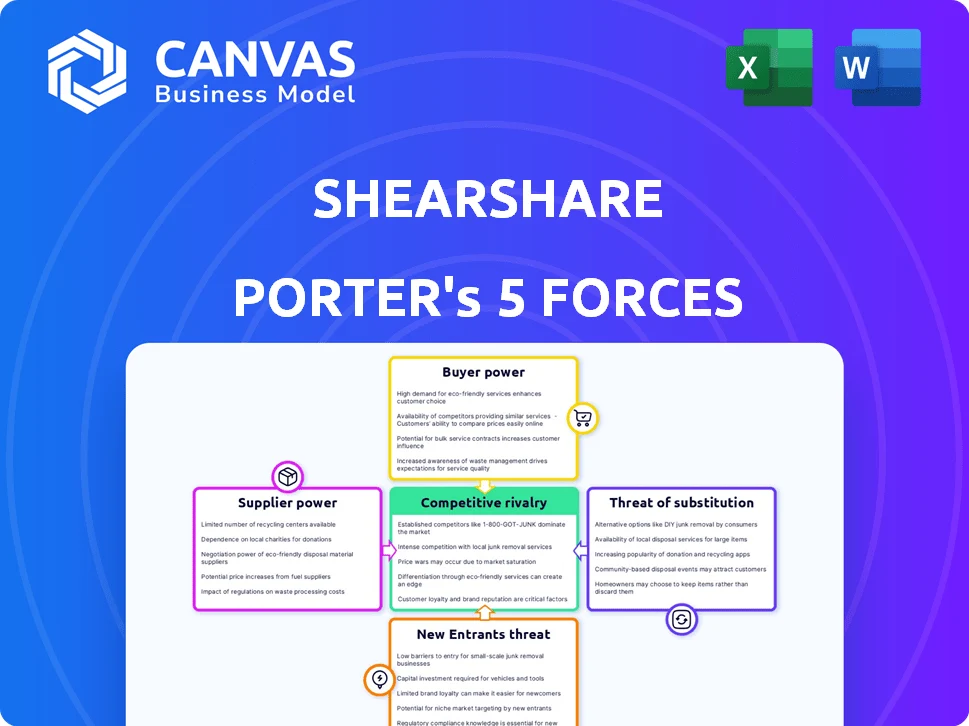
SHEARSHARE PORTER'S FIVE FORCES TEMPLATE RESEARCH
What is included in the product
 Detailed Word Document
Evaluates control held by suppliers and buyers, and their influence on pricing and profitability.

 Customizable Excel Spreadsheet
Customize pressure levels based on new data or evolving market trends.
Preview Before You Purchase
ShearShare Porter's Five Forces Analysis
This preview showcases the complete Porter's Five Forces analysis of ShearShare. The document you see here is the same one you will receive immediately after your purchase, providing a ready-to-use evaluation. The full analysis includes details on competitive rivalry, new entrants, supplier power, buyer power, and the threat of substitutes. You'll gain instant access to this comprehensive file after payment.

Porter's Five Forces Analysis Template

A Must-Have Tool for Decision-Makers
ShearShare faces a dynamic market shaped by several forces. Buyer power is moderate, influenced by platform options and price sensitivity. Competitive rivalry is intense, with several booking platforms vying for market share. The threat of new entrants is substantial, given the relatively low barriers to entry. Substitute threats include traditional salons and mobile services. Supplier power, representing salon owners, is moderate, tied to the platform's value proposition.
Our full Porter's Five Forces report goes deeper—offering a data-driven framework to understand ShearShare's real business risks and market opportunities.
Suppliers Bargaining Power

Availability of alternative workspaces
The availability of alternative workspaces significantly influences supplier power within ShearShare's ecosystem. In 2024, the rise of suite rentals and independent contractor models offered more options for beauty professionals. This increased competition, potentially weakening the bargaining power of traditional salon owners. For instance, the number of licensed cosmetologists in the U.S. has grown to over 1.2 million, increasing the supply of labor and workspace options.
Uniqueness of the space and amenities
If a salon or suite provides unique services or features, like advanced aesthetic equipment or a sought-after location, it gains leverage. This distinctiveness makes their space more attractive to professionals, boosting their bargaining power. For example, in 2024, salons in high-traffic urban areas saw rental rates increase by up to 15% due to demand. Spaces with specialized equipment also command higher prices, reflecting their value.

Concentration of salon/suite owners
In regions with limited salon/suite options, owners gain leverage in pricing. This is evident in 2024 data, with suite rental prices in high-demand areas up to 15% higher. Fewer choices mean owners dictate terms, impacting ShearShare's operational costs. This dynamic affects the platform's ability to attract and retain stylists.

Switching costs for salon/suite owners
Salon/suite owners' power hinges on switching costs. The effort and disruption of listing on ShearShare versus alternatives matter. A 2024 survey found 60% of owners use multiple platforms, reducing ShearShare's influence. High switching costs increase supplier power.
- Time investment in setting up listings.
- Potential loss of income during transition.
- Familiarity with existing platforms versus new ones.
- Contractual obligations.
ShearShare's reliance on specific locations or types of spaces
If ShearShare depends on specific spaces or locations, those space owners gain power. This can affect ShearShare's costs and flexibility. For example, in 2024, commercial real estate prices in major US cities varied greatly, impacting operational costs. High demand in certain areas gives space owners more control.
- Space Location: Prime locations equal higher owner power.
- Space Type: Unique spaces boost owner leverage.
- Cost Impact: Increased supplier influence raises costs.
- Flexibility: Limited options reduce ShearShare's adaptability.
Workspace Dynamics: Power Shifts in 2024
Supplier power in ShearShare's market is shaped by workspace alternatives and distinct offerings. The rise of suite rentals and independent models in 2024 provided more options. Unique services or prime locations give salon owners leverage, as seen with rental rate increases up to 15% in high-demand areas.
| Factor | Impact on Supplier Power | 2024 Data |
|---|---|---|
| Workspace Alternatives | Increased options weaken power. | 60% of owners use multiple platforms. |
| Unique Services/Location | Boosts owner leverage. | Rental rates up to 15% in high-demand areas. |
| Switching Costs | High costs increase power. | Time, income loss, platform familiarity. |
Customers Bargaining Power

Availability of alternative work arrangements
Beauty and barber professionals have choices beyond ShearShare. The rise of booth rental and mobile services, as seen with the 2024 surge in mobile hairstylists, gives them leverage. This flexibility, alongside traditional employment, boosts their ability to negotiate better terms, impacting ShearShare's pricing. Data from 2024 shows a 15% increase in professionals opting for independent setups.
Price sensitivity of professionals
Independent professionals, particularly those new to the field or with fluctuating incomes, often show strong price sensitivity when it comes to renting space. This sensitivity grants them considerable bargaining power, enabling them to negotiate better rates or opt for more affordable alternatives. For instance, in 2024, average rental costs for flexible workspaces in major US cities varied significantly, with prices ranging from $200 to $800 per month depending on location and amenities, highlighting the impact of price on decision-making. This dynamic is especially relevant in the beauty and wellness industries, where independent professionals frequently seek flexible and cost-effective solutions.

Concentration of professionals in a location
If many beauty professionals are in one spot, like a big city, they can easily compare ShearShare to other options. This gives them more power to negotiate prices or demand better services. For example, in New York City, with over 40,000 beauty salons, competition is fierce. This high concentration drives customer power, potentially impacting ShearShare's pricing strategy.

Switching costs for professionals
The bargaining power of customers, in this case, professionals using ShearShare, is significantly influenced by switching costs. If it's easy for a stylist to move to another platform or rent a suite independently, their power to negotiate terms with ShearShare increases. Conversely, higher switching costs, like established client relationships tied to ShearShare, reduce their bargaining leverage. In 2024, the average cost for a salon suite rental ranged from $800 to $2,500 monthly, a factor that can impact a professional's decision to switch platforms. The availability of alternative platforms and independent opportunities, which are ever-growing, also plays a crucial role.
- Ease of switching platforms directly impacts a professional's bargaining power.
- High switching costs, such as established client bases, can decrease bargaining power.
- The cost of alternative rentals or independent work affects the decision to switch.
- The availability of competing platforms and options influences customer power.
Importance of ShearShare to a professional's business
The bargaining power of customers on ShearShare varies. Professionals who depend on ShearShare for workspace and client acquisition have less power. Those who use it less frequently have greater leverage. In 2024, the platform facilitated over $10 million in bookings. This shows the significant role it plays.
- Dependence level impacts bargaining power.
- ShearShare's booking volume indicates its influence.
- Occasional users have more negotiation ability.
Beauty Pros' Leverage: Alternatives & Market Dynamics
Beauty pros' bargaining power against ShearShare hinges on their alternatives. Options like booth rentals, mobile services, and traditional employment give them leverage. In 2024, the rise in independent setups, with a 15% increase, strengthens their position.
Price sensitivity among these professionals also boosts their power. A wide range of monthly rental costs ($200-$800 in 2024) influences their choices. Easy switching and alternative platforms further enhance their ability to negotiate.
Dependence on ShearShare affects negotiation ability. Frequent users have less power than occasional ones. In 2024, the platform's $10M+ bookings reflect its significance, impacting customer dynamics.
| Factor | Impact on Bargaining Power | 2024 Data/Example |
|---|---|---|
| Availability of Alternatives | Increases | 15% rise in independent setups |
| Price Sensitivity | Increases | Rental costs: $200-$800/month |
| Switching Costs | Decreases | Easy switching to other platforms |
Rivalry Among Competitors

Number and intensity of competitors
ShearShare faces competition from platforms like StyleSeat and traditional salon rentals. The beauty industry is fragmented, with many salons and independent stylists. In 2024, the US beauty services market was estimated at $85 billion, indicating significant competition for market share. The intensity is high, given the low barriers to entry for both platforms and traditional salons.
Market growth rate
Market growth significantly impacts competitive rivalry. Rapidly expanding markets often see reduced rivalry because demand can accommodate multiple firms. However, in a stagnant market, competition intensifies as companies fight for existing market share. For example, the global beauty industry, valued at $580 billion in 2023, shows varying rivalry based on segment growth. Faster-growing segments experience less direct competition.

Differentiation of offerings
If ShearShare distinguishes itself, competition lessens. Unique features, pricing, and space quality are key. Consider Airbnb's success through diverse listings and user experiences. In 2024, Airbnb's revenue was $9.9 billion. Differentiation is crucial for standing out in the market.

Exit barriers
Exit barriers significantly shape competitive rivalry. If leaving the market is tough, firms might fight harder to survive. This can mean price wars or intense marketing battles. High exit barriers often prolong conflicts, affecting profitability. For example, in 2024, industries like airlines showed this, with companies battling for survival despite overcapacity.
- High exit barriers can lead to prolonged price wars.
- Intense marketing battles are common in such scenarios.
- Industries with high exit barriers often face lower profitability.
- The airline industry in 2024 exemplifies this.
Industry concentration
Competitive rivalry intensifies in fragmented markets, where numerous small players compete. This is because no single entity holds significant market power, leading to aggressive strategies to gain share. The beauty and wellness industry, for instance, features many small salons and spas. This structure fuels intense competition for customers and resources.
- Fragmented markets foster higher rivalry due to the absence of dominant firms.
- This often results in price wars, increased marketing efforts, and innovation.
- In 2024, the beauty industry's revenue reached $600 billion globally.
- Competition drives businesses to seek differentiation.
Market Rivalry: Key Factors and Examples
Competitive rivalry for ShearShare is intense due to a fragmented market and low barriers to entry, as seen in the $85 billion US beauty services market in 2024. Market growth influences rivalry; faster-growing segments see less direct competition. Differentiation, like Airbnb's $9.9 billion revenue in 2024, is key. High exit barriers, common in industries like airlines, can lead to prolonged battles.
| Factor | Impact on Rivalry | Example (2024 Data) |
|---|---|---|
| Market Fragmentation | Increases Rivalry | Beauty Industry: $600B global revenue |
| Market Growth | Decreases Rivalry in Growing Segments | Faster growth = less direct competition |
| Differentiation | Reduces Rivalry | Airbnb's $9.9B revenue |
Original: $10.00
-65%$10.00
$3.50SHEARSHARE PORTER'S FIVE FORCES TEMPLATE RESEARCH
What is included in the product
Detailed Word Document
Evaluates control held by suppliers and buyers, and their influence on pricing and profitability.
Customizable Excel Spreadsheet
Customize pressure levels based on new data or evolving market trends.
Preview Before You Purchase
ShearShare Porter's Five Forces Analysis
This preview showcases the complete Porter's Five Forces analysis of ShearShare. The document you see here is the same one you will receive immediately after your purchase, providing a ready-to-use evaluation. The full analysis includes details on competitive rivalry, new entrants, supplier power, buyer power, and the threat of substitutes. You'll gain instant access to this comprehensive file after payment.
Porter's Five Forces Analysis Template
A Must-Have Tool for Decision-Makers
ShearShare faces a dynamic market shaped by several forces. Buyer power is moderate, influenced by platform options and price sensitivity. Competitive rivalry is intense, with several booking platforms vying for market share. The threat of new entrants is substantial, given the relatively low barriers to entry. Substitute threats include traditional salons and mobile services. Supplier power, representing salon owners, is moderate, tied to the platform's value proposition.
Our full Porter's Five Forces report goes deeper—offering a data-driven framework to understand ShearShare's real business risks and market opportunities.
Suppliers Bargaining Power
Availability of alternative workspaces
The availability of alternative workspaces significantly influences supplier power within ShearShare's ecosystem. In 2024, the rise of suite rentals and independent contractor models offered more options for beauty professionals. This increased competition, potentially weakening the bargaining power of traditional salon owners. For instance, the number of licensed cosmetologists in the U.S. has grown to over 1.2 million, increasing the supply of labor and workspace options.
Uniqueness of the space and amenities
If a salon or suite provides unique services or features, like advanced aesthetic equipment or a sought-after location, it gains leverage. This distinctiveness makes their space more attractive to professionals, boosting their bargaining power. For example, in 2024, salons in high-traffic urban areas saw rental rates increase by up to 15% due to demand. Spaces with specialized equipment also command higher prices, reflecting their value.
Concentration of salon/suite owners
In regions with limited salon/suite options, owners gain leverage in pricing. This is evident in 2024 data, with suite rental prices in high-demand areas up to 15% higher. Fewer choices mean owners dictate terms, impacting ShearShare's operational costs. This dynamic affects the platform's ability to attract and retain stylists.
Switching costs for salon/suite owners
Salon/suite owners' power hinges on switching costs. The effort and disruption of listing on ShearShare versus alternatives matter. A 2024 survey found 60% of owners use multiple platforms, reducing ShearShare's influence. High switching costs increase supplier power.
- Time investment in setting up listings.
- Potential loss of income during transition.
- Familiarity with existing platforms versus new ones.
- Contractual obligations.
ShearShare's reliance on specific locations or types of spaces
If ShearShare depends on specific spaces or locations, those space owners gain power. This can affect ShearShare's costs and flexibility. For example, in 2024, commercial real estate prices in major US cities varied greatly, impacting operational costs. High demand in certain areas gives space owners more control.
- Space Location: Prime locations equal higher owner power.
- Space Type: Unique spaces boost owner leverage.
- Cost Impact: Increased supplier influence raises costs.
- Flexibility: Limited options reduce ShearShare's adaptability.
Workspace Dynamics: Power Shifts in 2024
Supplier power in ShearShare's market is shaped by workspace alternatives and distinct offerings. The rise of suite rentals and independent models in 2024 provided more options. Unique services or prime locations give salon owners leverage, as seen with rental rate increases up to 15% in high-demand areas.
| Factor | Impact on Supplier Power | 2024 Data |
|---|---|---|
| Workspace Alternatives | Increased options weaken power. | 60% of owners use multiple platforms. |
| Unique Services/Location | Boosts owner leverage. | Rental rates up to 15% in high-demand areas. |
| Switching Costs | High costs increase power. | Time, income loss, platform familiarity. |
Customers Bargaining Power
Availability of alternative work arrangements
Beauty and barber professionals have choices beyond ShearShare. The rise of booth rental and mobile services, as seen with the 2024 surge in mobile hairstylists, gives them leverage. This flexibility, alongside traditional employment, boosts their ability to negotiate better terms, impacting ShearShare's pricing. Data from 2024 shows a 15% increase in professionals opting for independent setups.
Price sensitivity of professionals
Independent professionals, particularly those new to the field or with fluctuating incomes, often show strong price sensitivity when it comes to renting space. This sensitivity grants them considerable bargaining power, enabling them to negotiate better rates or opt for more affordable alternatives. For instance, in 2024, average rental costs for flexible workspaces in major US cities varied significantly, with prices ranging from $200 to $800 per month depending on location and amenities, highlighting the impact of price on decision-making. This dynamic is especially relevant in the beauty and wellness industries, where independent professionals frequently seek flexible and cost-effective solutions.
Concentration of professionals in a location
If many beauty professionals are in one spot, like a big city, they can easily compare ShearShare to other options. This gives them more power to negotiate prices or demand better services. For example, in New York City, with over 40,000 beauty salons, competition is fierce. This high concentration drives customer power, potentially impacting ShearShare's pricing strategy.
Switching costs for professionals
The bargaining power of customers, in this case, professionals using ShearShare, is significantly influenced by switching costs. If it's easy for a stylist to move to another platform or rent a suite independently, their power to negotiate terms with ShearShare increases. Conversely, higher switching costs, like established client relationships tied to ShearShare, reduce their bargaining leverage. In 2024, the average cost for a salon suite rental ranged from $800 to $2,500 monthly, a factor that can impact a professional's decision to switch platforms. The availability of alternative platforms and independent opportunities, which are ever-growing, also plays a crucial role.
- Ease of switching platforms directly impacts a professional's bargaining power.
- High switching costs, such as established client bases, can decrease bargaining power.
- The cost of alternative rentals or independent work affects the decision to switch.
- The availability of competing platforms and options influences customer power.
Importance of ShearShare to a professional's business
The bargaining power of customers on ShearShare varies. Professionals who depend on ShearShare for workspace and client acquisition have less power. Those who use it less frequently have greater leverage. In 2024, the platform facilitated over $10 million in bookings. This shows the significant role it plays.
- Dependence level impacts bargaining power.
- ShearShare's booking volume indicates its influence.
- Occasional users have more negotiation ability.
Beauty Pros' Leverage: Alternatives & Market Dynamics
Beauty pros' bargaining power against ShearShare hinges on their alternatives. Options like booth rentals, mobile services, and traditional employment give them leverage. In 2024, the rise in independent setups, with a 15% increase, strengthens their position.
Price sensitivity among these professionals also boosts their power. A wide range of monthly rental costs ($200-$800 in 2024) influences their choices. Easy switching and alternative platforms further enhance their ability to negotiate.
Dependence on ShearShare affects negotiation ability. Frequent users have less power than occasional ones. In 2024, the platform's $10M+ bookings reflect its significance, impacting customer dynamics.
| Factor | Impact on Bargaining Power | 2024 Data/Example |
|---|---|---|
| Availability of Alternatives | Increases | 15% rise in independent setups |
| Price Sensitivity | Increases | Rental costs: $200-$800/month |
| Switching Costs | Decreases | Easy switching to other platforms |
Rivalry Among Competitors
Number and intensity of competitors
ShearShare faces competition from platforms like StyleSeat and traditional salon rentals. The beauty industry is fragmented, with many salons and independent stylists. In 2024, the US beauty services market was estimated at $85 billion, indicating significant competition for market share. The intensity is high, given the low barriers to entry for both platforms and traditional salons.
Market growth rate
Market growth significantly impacts competitive rivalry. Rapidly expanding markets often see reduced rivalry because demand can accommodate multiple firms. However, in a stagnant market, competition intensifies as companies fight for existing market share. For example, the global beauty industry, valued at $580 billion in 2023, shows varying rivalry based on segment growth. Faster-growing segments experience less direct competition.
Differentiation of offerings
If ShearShare distinguishes itself, competition lessens. Unique features, pricing, and space quality are key. Consider Airbnb's success through diverse listings and user experiences. In 2024, Airbnb's revenue was $9.9 billion. Differentiation is crucial for standing out in the market.
Exit barriers
Exit barriers significantly shape competitive rivalry. If leaving the market is tough, firms might fight harder to survive. This can mean price wars or intense marketing battles. High exit barriers often prolong conflicts, affecting profitability. For example, in 2024, industries like airlines showed this, with companies battling for survival despite overcapacity.
- High exit barriers can lead to prolonged price wars.
- Intense marketing battles are common in such scenarios.
- Industries with high exit barriers often face lower profitability.
- The airline industry in 2024 exemplifies this.
Industry concentration
Competitive rivalry intensifies in fragmented markets, where numerous small players compete. This is because no single entity holds significant market power, leading to aggressive strategies to gain share. The beauty and wellness industry, for instance, features many small salons and spas. This structure fuels intense competition for customers and resources.
- Fragmented markets foster higher rivalry due to the absence of dominant firms.
- This often results in price wars, increased marketing efforts, and innovation.
- In 2024, the beauty industry's revenue reached $600 billion globally.
- Competition drives businesses to seek differentiation.
Market Rivalry: Key Factors and Examples
Competitive rivalry for ShearShare is intense due to a fragmented market and low barriers to entry, as seen in the $85 billion US beauty services market in 2024. Market growth influences rivalry; faster-growing segments see less direct competition. Differentiation, like Airbnb's $9.9 billion revenue in 2024, is key. High exit barriers, common in industries like airlines, can lead to prolonged battles.
| Factor | Impact on Rivalry | Example (2024 Data) |
|---|---|---|
| Market Fragmentation | Increases Rivalry | Beauty Industry: $600B global revenue |
| Market Growth | Decreases Rivalry in Growing Segments | Faster growth = less direct competition |
| Differentiation | Reduces Rivalry | Airbnb's $9.9B revenue |
Product Information
Product Information
Shipping & Returns
Shipping & Returns
Description
What is included in the product
Detailed Word Document
Evaluates control held by suppliers and buyers, and their influence on pricing and profitability.
Customizable Excel Spreadsheet
Customize pressure levels based on new data or evolving market trends.
Preview Before You Purchase
ShearShare Porter's Five Forces Analysis
This preview showcases the complete Porter's Five Forces analysis of ShearShare. The document you see here is the same one you will receive immediately after your purchase, providing a ready-to-use evaluation. The full analysis includes details on competitive rivalry, new entrants, supplier power, buyer power, and the threat of substitutes. You'll gain instant access to this comprehensive file after payment.
Porter's Five Forces Analysis Template
A Must-Have Tool for Decision-Makers
ShearShare faces a dynamic market shaped by several forces. Buyer power is moderate, influenced by platform options and price sensitivity. Competitive rivalry is intense, with several booking platforms vying for market share. The threat of new entrants is substantial, given the relatively low barriers to entry. Substitute threats include traditional salons and mobile services. Supplier power, representing salon owners, is moderate, tied to the platform's value proposition.
Our full Porter's Five Forces report goes deeper—offering a data-driven framework to understand ShearShare's real business risks and market opportunities.
Suppliers Bargaining Power
Availability of alternative workspaces
The availability of alternative workspaces significantly influences supplier power within ShearShare's ecosystem. In 2024, the rise of suite rentals and independent contractor models offered more options for beauty professionals. This increased competition, potentially weakening the bargaining power of traditional salon owners. For instance, the number of licensed cosmetologists in the U.S. has grown to over 1.2 million, increasing the supply of labor and workspace options.
Uniqueness of the space and amenities
If a salon or suite provides unique services or features, like advanced aesthetic equipment or a sought-after location, it gains leverage. This distinctiveness makes their space more attractive to professionals, boosting their bargaining power. For example, in 2024, salons in high-traffic urban areas saw rental rates increase by up to 15% due to demand. Spaces with specialized equipment also command higher prices, reflecting their value.
Concentration of salon/suite owners
In regions with limited salon/suite options, owners gain leverage in pricing. This is evident in 2024 data, with suite rental prices in high-demand areas up to 15% higher. Fewer choices mean owners dictate terms, impacting ShearShare's operational costs. This dynamic affects the platform's ability to attract and retain stylists.
Switching costs for salon/suite owners
Salon/suite owners' power hinges on switching costs. The effort and disruption of listing on ShearShare versus alternatives matter. A 2024 survey found 60% of owners use multiple platforms, reducing ShearShare's influence. High switching costs increase supplier power.
- Time investment in setting up listings.
- Potential loss of income during transition.
- Familiarity with existing platforms versus new ones.
- Contractual obligations.
ShearShare's reliance on specific locations or types of spaces
If ShearShare depends on specific spaces or locations, those space owners gain power. This can affect ShearShare's costs and flexibility. For example, in 2024, commercial real estate prices in major US cities varied greatly, impacting operational costs. High demand in certain areas gives space owners more control.
- Space Location: Prime locations equal higher owner power.
- Space Type: Unique spaces boost owner leverage.
- Cost Impact: Increased supplier influence raises costs.
- Flexibility: Limited options reduce ShearShare's adaptability.
Workspace Dynamics: Power Shifts in 2024
Supplier power in ShearShare's market is shaped by workspace alternatives and distinct offerings. The rise of suite rentals and independent models in 2024 provided more options. Unique services or prime locations give salon owners leverage, as seen with rental rate increases up to 15% in high-demand areas.
| Factor | Impact on Supplier Power | 2024 Data |
|---|---|---|
| Workspace Alternatives | Increased options weaken power. | 60% of owners use multiple platforms. |
| Unique Services/Location | Boosts owner leverage. | Rental rates up to 15% in high-demand areas. |
| Switching Costs | High costs increase power. | Time, income loss, platform familiarity. |
Customers Bargaining Power
Availability of alternative work arrangements
Beauty and barber professionals have choices beyond ShearShare. The rise of booth rental and mobile services, as seen with the 2024 surge in mobile hairstylists, gives them leverage. This flexibility, alongside traditional employment, boosts their ability to negotiate better terms, impacting ShearShare's pricing. Data from 2024 shows a 15% increase in professionals opting for independent setups.
Price sensitivity of professionals
Independent professionals, particularly those new to the field or with fluctuating incomes, often show strong price sensitivity when it comes to renting space. This sensitivity grants them considerable bargaining power, enabling them to negotiate better rates or opt for more affordable alternatives. For instance, in 2024, average rental costs for flexible workspaces in major US cities varied significantly, with prices ranging from $200 to $800 per month depending on location and amenities, highlighting the impact of price on decision-making. This dynamic is especially relevant in the beauty and wellness industries, where independent professionals frequently seek flexible and cost-effective solutions.
Concentration of professionals in a location
If many beauty professionals are in one spot, like a big city, they can easily compare ShearShare to other options. This gives them more power to negotiate prices or demand better services. For example, in New York City, with over 40,000 beauty salons, competition is fierce. This high concentration drives customer power, potentially impacting ShearShare's pricing strategy.
Switching costs for professionals
The bargaining power of customers, in this case, professionals using ShearShare, is significantly influenced by switching costs. If it's easy for a stylist to move to another platform or rent a suite independently, their power to negotiate terms with ShearShare increases. Conversely, higher switching costs, like established client relationships tied to ShearShare, reduce their bargaining leverage. In 2024, the average cost for a salon suite rental ranged from $800 to $2,500 monthly, a factor that can impact a professional's decision to switch platforms. The availability of alternative platforms and independent opportunities, which are ever-growing, also plays a crucial role.
- Ease of switching platforms directly impacts a professional's bargaining power.
- High switching costs, such as established client bases, can decrease bargaining power.
- The cost of alternative rentals or independent work affects the decision to switch.
- The availability of competing platforms and options influences customer power.
Importance of ShearShare to a professional's business
The bargaining power of customers on ShearShare varies. Professionals who depend on ShearShare for workspace and client acquisition have less power. Those who use it less frequently have greater leverage. In 2024, the platform facilitated over $10 million in bookings. This shows the significant role it plays.
- Dependence level impacts bargaining power.
- ShearShare's booking volume indicates its influence.
- Occasional users have more negotiation ability.
Beauty Pros' Leverage: Alternatives & Market Dynamics
Beauty pros' bargaining power against ShearShare hinges on their alternatives. Options like booth rentals, mobile services, and traditional employment give them leverage. In 2024, the rise in independent setups, with a 15% increase, strengthens their position.
Price sensitivity among these professionals also boosts their power. A wide range of monthly rental costs ($200-$800 in 2024) influences their choices. Easy switching and alternative platforms further enhance their ability to negotiate.
Dependence on ShearShare affects negotiation ability. Frequent users have less power than occasional ones. In 2024, the platform's $10M+ bookings reflect its significance, impacting customer dynamics.
| Factor | Impact on Bargaining Power | 2024 Data/Example |
|---|---|---|
| Availability of Alternatives | Increases | 15% rise in independent setups |
| Price Sensitivity | Increases | Rental costs: $200-$800/month |
| Switching Costs | Decreases | Easy switching to other platforms |
Rivalry Among Competitors
Number and intensity of competitors
ShearShare faces competition from platforms like StyleSeat and traditional salon rentals. The beauty industry is fragmented, with many salons and independent stylists. In 2024, the US beauty services market was estimated at $85 billion, indicating significant competition for market share. The intensity is high, given the low barriers to entry for both platforms and traditional salons.
Market growth rate
Market growth significantly impacts competitive rivalry. Rapidly expanding markets often see reduced rivalry because demand can accommodate multiple firms. However, in a stagnant market, competition intensifies as companies fight for existing market share. For example, the global beauty industry, valued at $580 billion in 2023, shows varying rivalry based on segment growth. Faster-growing segments experience less direct competition.
Differentiation of offerings
If ShearShare distinguishes itself, competition lessens. Unique features, pricing, and space quality are key. Consider Airbnb's success through diverse listings and user experiences. In 2024, Airbnb's revenue was $9.9 billion. Differentiation is crucial for standing out in the market.
Exit barriers
Exit barriers significantly shape competitive rivalry. If leaving the market is tough, firms might fight harder to survive. This can mean price wars or intense marketing battles. High exit barriers often prolong conflicts, affecting profitability. For example, in 2024, industries like airlines showed this, with companies battling for survival despite overcapacity.
- High exit barriers can lead to prolonged price wars.
- Intense marketing battles are common in such scenarios.
- Industries with high exit barriers often face lower profitability.
- The airline industry in 2024 exemplifies this.
Industry concentration
Competitive rivalry intensifies in fragmented markets, where numerous small players compete. This is because no single entity holds significant market power, leading to aggressive strategies to gain share. The beauty and wellness industry, for instance, features many small salons and spas. This structure fuels intense competition for customers and resources.
- Fragmented markets foster higher rivalry due to the absence of dominant firms.
- This often results in price wars, increased marketing efforts, and innovation.
- In 2024, the beauty industry's revenue reached $600 billion globally.
- Competition drives businesses to seek differentiation.
Market Rivalry: Key Factors and Examples
Competitive rivalry for ShearShare is intense due to a fragmented market and low barriers to entry, as seen in the $85 billion US beauty services market in 2024. Market growth influences rivalry; faster-growing segments see less direct competition. Differentiation, like Airbnb's $9.9 billion revenue in 2024, is key. High exit barriers, common in industries like airlines, can lead to prolonged battles.
| Factor | Impact on Rivalry | Example (2024 Data) |
|---|---|---|
| Market Fragmentation | Increases Rivalry | Beauty Industry: $600B global revenue |
| Market Growth | Decreases Rivalry in Growing Segments | Faster growth = less direct competition |
| Differentiation | Reduces Rivalry | Airbnb's $9.9B revenue |


