
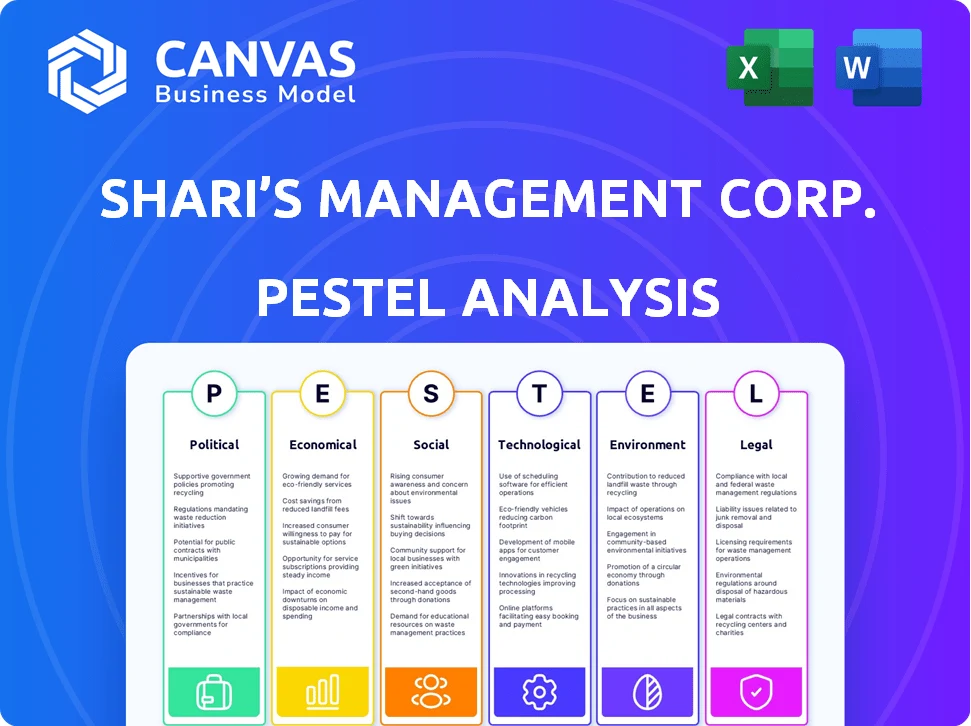
SHARI’S MANAGEMENT CORP. (AKA SHARI’S RESTAURANTS) PESTLE ANALYSIS TEMPLATE RESEARCH
What is included in the product
 Detailed Word Document
Evaluates how external macro-environmental elements uniquely impact Shari’s Restaurants.
Covers Political, Economic, Social, Technological, Environmental & Legal factors.

 Customizable Excel Spreadsheet
Provides a concise version ideal for PowerPoint or group planning sessions.
Same Document Delivered
Shari’s Management Corp. (aka Shari’s Restaurants) PESTLE Analysis
This preview presents the complete PESTLE analysis of Shari’s Management Corp. including key factors affecting its strategy. It assesses Political, Economic, Social, Technological, Legal, and Environmental influences.
The factors analyzed span industry trends, competitor actions, and compliance issues for the company.
You'll get detailed data that affects decision making in these six crucial areas.
This real document is yours right after your purchase, just like it is presented.
This document comes ready for use, with all relevant factors considered.

PESTLE Analysis Template

Make Smarter Strategic Decisions with a Complete PESTEL View
Explore the external forces influencing Shari's Management Corp. (aka Shari's Restaurants) with our PESTLE analysis. From fluctuating economic conditions to evolving social trends, we examine how these factors impact the business. Understand regulatory hurdles and technology advancements. Our comprehensive analysis identifies both threats and opportunities. Gain actionable insights for strategic planning. Download the complete PESTLE analysis now for expert-level intelligence.
Political factors

Government Regulations on Food Service
Government regulations heavily influence Shari's operations. Food safety laws, labor standards, and business licenses are critical. Compliance with these federal, state, and local rules is essential for Shari's. In 2024, the restaurant industry faced increased scrutiny on labor practices. Changes in regulations can impact operational costs.
Minimum Wage and Labor Laws
Minimum wage hikes, like California's $20/hour for fast-food workers in 2024, sharply increase Shari's labor costs. Benefit mandates and scheduling rules also affect expenses. Unionization efforts, though not widespread, could further raise costs. Adapting to these labor law changes is vital for financial planning.

Tax Policies
Tax policies significantly impact Shari's Restaurants' profitability. Corporate tax rates, sales taxes, and payroll taxes affect financial burdens. For example, in 2024, the federal corporate tax rate remains at 21%. Sales tax rates vary by state, impacting pricing strategies.

Political Stability and Trade Policies
Political stability directly impacts Shari's Restaurants' operations, ensuring consistent business environments. Trade policies significantly influence the cost and availability of ingredients and supplies. Although Shari's prioritizes local sourcing, some products may be affected by trade regulations. Fluctuations in tariffs or trade agreements could alter operational expenses.
- Stable political climates ensure predictable supply chains.
- Changes in trade policies can increase costs, affecting profitability.
- Local sourcing helps mitigate some trade risks.
Government Support and Incentives
Government support can significantly impact Shari's. Federal, state, and local programs targeting small businesses or restaurants offer crucial aid. These incentives may include tax breaks or grants, potentially boosting profitability. Shari's should actively seek and leverage these opportunities for expansion. In 2024, the SBA approved over $36 billion in loans to small businesses.
- Tax credits for energy-efficient equipment could reduce operational expenses.
- Grants for workforce development could improve employee skills and productivity.
- Subsidized loans might facilitate expansion or renovation projects.
- Regulatory changes related to labor laws could impact operational costs.
Political Hurdles for Business Success
Political factors deeply influence Shari's. Labor laws and minimum wage changes, like the $20/hour rate in California (2024), impact labor costs.
Tax policies also affect financial performance. Corporate tax rates and sales taxes influence pricing and profitability strategies. Stable trade policies are essential for supply chain stability.
Government support offers aid to small businesses. Incentives such as tax breaks can boost profitability and expansion efforts.
| Aspect | Impact | Example (2024/2025) |
|---|---|---|
| Labor Laws | Affect operational costs | CA min wage: $20/hr (fast food) |
| Taxation | Impacts profitability | Federal Corp Tax: 21% |
| Trade Policies | Supply chain/costs | Tariff fluctuations affect imports. |
Economic factors

Consumer Spending Habits
Consumer spending habits are crucial for Shari's Restaurants. Discretionary spending directly impacts the dining-out frequency and spending. Employment rates, inflation, and consumer confidence significantly influence these habits. For instance, in 2024, restaurant sales saw fluctuations tied to economic shifts. Shari's, as a family-style restaurant, is sensitive to its customers' financial health.
Inflation and Cost of Goods
Inflation significantly impacts Shari's Restaurants. Rising food prices and operational costs squeeze profit margins. To combat this, Shari's must optimize its supply chain. The company should also explore strategic pricing. In 2024, the U.S. inflation rate was around 3.1%.

Labor Costs and Availability
Labor costs and availability are crucial for Shari's Restaurants. High turnover and staffing issues increase expenses. The restaurant industry's average hourly wage rose to $16.87 in 2024. This impacts service quality and profitability. Finding and keeping skilled employees is a constant challenge.

Economic Growth and Recession
Economic growth or recession significantly affects Shari's Restaurants. During economic downturns, consumers often cut back on dining out, impacting restaurant sales. The National Restaurant Association projects 2024 restaurant sales to reach $1.1 trillion, a 5.5% increase. However, inflation and rising costs could squeeze profit margins. Recessions can lead to decreased customer traffic and lower average spending per visit.
- 2024 restaurant sales projected at $1.1 trillion.
- 5.5% growth expected in 2024.
- Inflation and costs may squeeze profits.
- Recessions reduce customer traffic.
Interest Rates and Access to Capital
Interest rates are a key economic factor that impacts Shari's Restaurants' borrowing costs for investments and expansion. Access to capital is essential for renovations, tech upgrades, and new locations. Economic conditions strongly influence financing availability and terms. In early 2024, the Federal Reserve maintained a target range of 5.25% to 5.50% for the federal funds rate. This impacts Shari's ability to secure loans.
- Federal Funds Rate: 5.25% - 5.50% (early 2024)
- Prime Rate: Approximately 8.25% - 8.50% (early 2024)
- Restaurant Industry Debt: $89.7 billion (Q4 2023)
- Inflation Rate: 3.1% (January 2024)
Economic Forces Shaping Restaurant Success
Economic conditions heavily influence Shari's performance. Consumer spending, directly tied to employment and confidence, shapes dining habits. Inflation, at 3.1% in early 2024, pressures profits through rising costs. Interest rates, such as the early 2024 Federal Funds Rate of 5.25%-5.50%, impact borrowing and expansion.
| Factor | Impact on Shari's | Data (Early 2024) |
|---|---|---|
| Consumer Spending | Dining frequency & spending | Restaurant sales projected at $1.1T (2024) |
| Inflation | Increased costs, margin squeeze | U.S. Inflation Rate: 3.1% |
| Interest Rates | Borrowing costs & expansion | Federal Funds Rate: 5.25% - 5.50% |
Sociological factors

Changing Dining Trends and Preferences
Consumer preferences shift; Shari's must adapt. Demand for healthier, plant-based, and off-premises dining grows. In 2024, the plant-based food market hit $8.3 billion. Shari's needs to update its menu and service styles. This ensures relevance and meets evolving customer expectations.
Lifestyle and Work Habits
Shari's Restaurants must adapt to evolving lifestyles. The rise of remote work and hectic schedules impacts dining habits, potentially boosting demand for takeout and delivery. For example, in 2024, online food delivery sales reached $94.4 billion, showing a clear shift. These trends influence the timing and types of meals customers prefer, and Shari's needs to adjust its services accordingly.

Demographics and Family Structure
Shari's Restaurants focuses on families; shifts in family size and structure directly influence their customer base. For instance, the U.S. birth rate in 2023 was 1.62 births per woman, impacting family dining needs. Catering to diverse age groups and family types is crucial for adapting their menu and marketing strategies.

Health and Wellness Awareness
Health and wellness awareness is significantly shaping consumer choices, influencing the restaurant industry. Shari's, to stay competitive, must adapt its menu. The National Restaurant Association's 2024 forecast indicates increasing demand for healthy options. This includes accommodating dietary restrictions and providing clear allergen information.
- Menu diversification: Offering options like salads, grilled items, and plant-based dishes.
- Transparency: Clearly labeling ingredients and nutritional facts.
- Consumer demand: 70% of consumers seek healthier choices.
Community Involvement and Social Responsibility
Consumers today highly value businesses actively involved in their communities and demonstrating social responsibility. Shari’s community engagement and sustainability initiatives can significantly boost its brand image and customer loyalty. This includes supporting local events, donating to charities, and implementing eco-friendly practices. Increased consumer preference for socially responsible companies is evident in recent surveys, with approximately 77% of consumers expressing a preference for brands committed to social and environmental issues in 2024.
- Supporting local charities and events enhances brand perception.
- Eco-friendly practices resonate well with environmentally conscious customers.
- Customer loyalty increases with demonstrated social responsibility.
- Shari's can leverage these efforts to attract and retain customers.
Adapting to Change: Key Trends for Success
Shari's must adapt to shifting family structures and preferences, including lower U.S. birth rates influencing demand. Increased awareness of health, including specific dietary demands, pressures restaurant menus. Consumers value businesses engaged in their communities, like social responsibility practices. Socially responsible company preferences reached 77% in 2024.
| Factor | Impact | Data (2024) |
|---|---|---|
| Family Trends | Menu & Strategy Adaptation | Birth Rate: 1.62 births/woman |
| Health Awareness | Menu Adjustments | 70% seek healthy options |
| Social Responsibility | Brand & Loyalty | 77% prefer responsible brands |
SHARI’S MANAGEMENT CORP. (AKA SHARI’S RESTAURANTS) PESTLE ANALYSIS TEMPLATE RESEARCH
What is included in the product
Detailed Word Document
Evaluates how external macro-environmental elements uniquely impact Shari’s Restaurants.
Covers Political, Economic, Social, Technological, Environmental & Legal factors.
Customizable Excel Spreadsheet
Provides a concise version ideal for PowerPoint or group planning sessions.
Same Document Delivered
Shari’s Management Corp. (aka Shari’s Restaurants) PESTLE Analysis
This preview presents the complete PESTLE analysis of Shari’s Management Corp. including key factors affecting its strategy. It assesses Political, Economic, Social, Technological, Legal, and Environmental influences.
The factors analyzed span industry trends, competitor actions, and compliance issues for the company.
You'll get detailed data that affects decision making in these six crucial areas.
This real document is yours right after your purchase, just like it is presented.
This document comes ready for use, with all relevant factors considered.
PESTLE Analysis Template
Make Smarter Strategic Decisions with a Complete PESTEL View
Explore the external forces influencing Shari's Management Corp. (aka Shari's Restaurants) with our PESTLE analysis. From fluctuating economic conditions to evolving social trends, we examine how these factors impact the business. Understand regulatory hurdles and technology advancements. Our comprehensive analysis identifies both threats and opportunities. Gain actionable insights for strategic planning. Download the complete PESTLE analysis now for expert-level intelligence.
Political factors
Government Regulations on Food Service
Government regulations heavily influence Shari's operations. Food safety laws, labor standards, and business licenses are critical. Compliance with these federal, state, and local rules is essential for Shari's. In 2024, the restaurant industry faced increased scrutiny on labor practices. Changes in regulations can impact operational costs.
Minimum Wage and Labor Laws
Minimum wage hikes, like California's $20/hour for fast-food workers in 2024, sharply increase Shari's labor costs. Benefit mandates and scheduling rules also affect expenses. Unionization efforts, though not widespread, could further raise costs. Adapting to these labor law changes is vital for financial planning.
Tax Policies
Tax policies significantly impact Shari's Restaurants' profitability. Corporate tax rates, sales taxes, and payroll taxes affect financial burdens. For example, in 2024, the federal corporate tax rate remains at 21%. Sales tax rates vary by state, impacting pricing strategies.
Political Stability and Trade Policies
Political stability directly impacts Shari's Restaurants' operations, ensuring consistent business environments. Trade policies significantly influence the cost and availability of ingredients and supplies. Although Shari's prioritizes local sourcing, some products may be affected by trade regulations. Fluctuations in tariffs or trade agreements could alter operational expenses.
- Stable political climates ensure predictable supply chains.
- Changes in trade policies can increase costs, affecting profitability.
- Local sourcing helps mitigate some trade risks.
Government Support and Incentives
Government support can significantly impact Shari's. Federal, state, and local programs targeting small businesses or restaurants offer crucial aid. These incentives may include tax breaks or grants, potentially boosting profitability. Shari's should actively seek and leverage these opportunities for expansion. In 2024, the SBA approved over $36 billion in loans to small businesses.
- Tax credits for energy-efficient equipment could reduce operational expenses.
- Grants for workforce development could improve employee skills and productivity.
- Subsidized loans might facilitate expansion or renovation projects.
- Regulatory changes related to labor laws could impact operational costs.
Political Hurdles for Business Success
Political factors deeply influence Shari's. Labor laws and minimum wage changes, like the $20/hour rate in California (2024), impact labor costs.
Tax policies also affect financial performance. Corporate tax rates and sales taxes influence pricing and profitability strategies. Stable trade policies are essential for supply chain stability.
Government support offers aid to small businesses. Incentives such as tax breaks can boost profitability and expansion efforts.
| Aspect | Impact | Example (2024/2025) |
|---|---|---|
| Labor Laws | Affect operational costs | CA min wage: $20/hr (fast food) |
| Taxation | Impacts profitability | Federal Corp Tax: 21% |
| Trade Policies | Supply chain/costs | Tariff fluctuations affect imports. |
Economic factors
Consumer Spending Habits
Consumer spending habits are crucial for Shari's Restaurants. Discretionary spending directly impacts the dining-out frequency and spending. Employment rates, inflation, and consumer confidence significantly influence these habits. For instance, in 2024, restaurant sales saw fluctuations tied to economic shifts. Shari's, as a family-style restaurant, is sensitive to its customers' financial health.
Inflation and Cost of Goods
Inflation significantly impacts Shari's Restaurants. Rising food prices and operational costs squeeze profit margins. To combat this, Shari's must optimize its supply chain. The company should also explore strategic pricing. In 2024, the U.S. inflation rate was around 3.1%.
Labor Costs and Availability
Labor costs and availability are crucial for Shari's Restaurants. High turnover and staffing issues increase expenses. The restaurant industry's average hourly wage rose to $16.87 in 2024. This impacts service quality and profitability. Finding and keeping skilled employees is a constant challenge.
Economic Growth and Recession
Economic growth or recession significantly affects Shari's Restaurants. During economic downturns, consumers often cut back on dining out, impacting restaurant sales. The National Restaurant Association projects 2024 restaurant sales to reach $1.1 trillion, a 5.5% increase. However, inflation and rising costs could squeeze profit margins. Recessions can lead to decreased customer traffic and lower average spending per visit.
- 2024 restaurant sales projected at $1.1 trillion.
- 5.5% growth expected in 2024.
- Inflation and costs may squeeze profits.
- Recessions reduce customer traffic.
Interest Rates and Access to Capital
Interest rates are a key economic factor that impacts Shari's Restaurants' borrowing costs for investments and expansion. Access to capital is essential for renovations, tech upgrades, and new locations. Economic conditions strongly influence financing availability and terms. In early 2024, the Federal Reserve maintained a target range of 5.25% to 5.50% for the federal funds rate. This impacts Shari's ability to secure loans.
- Federal Funds Rate: 5.25% - 5.50% (early 2024)
- Prime Rate: Approximately 8.25% - 8.50% (early 2024)
- Restaurant Industry Debt: $89.7 billion (Q4 2023)
- Inflation Rate: 3.1% (January 2024)
Economic Forces Shaping Restaurant Success
Economic conditions heavily influence Shari's performance. Consumer spending, directly tied to employment and confidence, shapes dining habits. Inflation, at 3.1% in early 2024, pressures profits through rising costs. Interest rates, such as the early 2024 Federal Funds Rate of 5.25%-5.50%, impact borrowing and expansion.
| Factor | Impact on Shari's | Data (Early 2024) |
|---|---|---|
| Consumer Spending | Dining frequency & spending | Restaurant sales projected at $1.1T (2024) |
| Inflation | Increased costs, margin squeeze | U.S. Inflation Rate: 3.1% |
| Interest Rates | Borrowing costs & expansion | Federal Funds Rate: 5.25% - 5.50% |
Sociological factors
Changing Dining Trends and Preferences
Consumer preferences shift; Shari's must adapt. Demand for healthier, plant-based, and off-premises dining grows. In 2024, the plant-based food market hit $8.3 billion. Shari's needs to update its menu and service styles. This ensures relevance and meets evolving customer expectations.
Lifestyle and Work Habits
Shari's Restaurants must adapt to evolving lifestyles. The rise of remote work and hectic schedules impacts dining habits, potentially boosting demand for takeout and delivery. For example, in 2024, online food delivery sales reached $94.4 billion, showing a clear shift. These trends influence the timing and types of meals customers prefer, and Shari's needs to adjust its services accordingly.
Demographics and Family Structure
Shari's Restaurants focuses on families; shifts in family size and structure directly influence their customer base. For instance, the U.S. birth rate in 2023 was 1.62 births per woman, impacting family dining needs. Catering to diverse age groups and family types is crucial for adapting their menu and marketing strategies.
Health and Wellness Awareness
Health and wellness awareness is significantly shaping consumer choices, influencing the restaurant industry. Shari's, to stay competitive, must adapt its menu. The National Restaurant Association's 2024 forecast indicates increasing demand for healthy options. This includes accommodating dietary restrictions and providing clear allergen information.
- Menu diversification: Offering options like salads, grilled items, and plant-based dishes.
- Transparency: Clearly labeling ingredients and nutritional facts.
- Consumer demand: 70% of consumers seek healthier choices.
Community Involvement and Social Responsibility
Consumers today highly value businesses actively involved in their communities and demonstrating social responsibility. Shari’s community engagement and sustainability initiatives can significantly boost its brand image and customer loyalty. This includes supporting local events, donating to charities, and implementing eco-friendly practices. Increased consumer preference for socially responsible companies is evident in recent surveys, with approximately 77% of consumers expressing a preference for brands committed to social and environmental issues in 2024.
- Supporting local charities and events enhances brand perception.
- Eco-friendly practices resonate well with environmentally conscious customers.
- Customer loyalty increases with demonstrated social responsibility.
- Shari's can leverage these efforts to attract and retain customers.
Adapting to Change: Key Trends for Success
Shari's must adapt to shifting family structures and preferences, including lower U.S. birth rates influencing demand. Increased awareness of health, including specific dietary demands, pressures restaurant menus. Consumers value businesses engaged in their communities, like social responsibility practices. Socially responsible company preferences reached 77% in 2024.
| Factor | Impact | Data (2024) |
|---|---|---|
| Family Trends | Menu & Strategy Adaptation | Birth Rate: 1.62 births/woman |
| Health Awareness | Menu Adjustments | 70% seek healthy options |
| Social Responsibility | Brand & Loyalty | 77% prefer responsible brands |
Product Information
Product Information
Shipping & Returns
Shipping & Returns
Description
What is included in the product
Detailed Word Document
Evaluates how external macro-environmental elements uniquely impact Shari’s Restaurants.
Covers Political, Economic, Social, Technological, Environmental & Legal factors.
Customizable Excel Spreadsheet
Provides a concise version ideal for PowerPoint or group planning sessions.
Same Document Delivered
Shari’s Management Corp. (aka Shari’s Restaurants) PESTLE Analysis
This preview presents the complete PESTLE analysis of Shari’s Management Corp. including key factors affecting its strategy. It assesses Political, Economic, Social, Technological, Legal, and Environmental influences.
The factors analyzed span industry trends, competitor actions, and compliance issues for the company.
You'll get detailed data that affects decision making in these six crucial areas.
This real document is yours right after your purchase, just like it is presented.
This document comes ready for use, with all relevant factors considered.
PESTLE Analysis Template
Make Smarter Strategic Decisions with a Complete PESTEL View
Explore the external forces influencing Shari's Management Corp. (aka Shari's Restaurants) with our PESTLE analysis. From fluctuating economic conditions to evolving social trends, we examine how these factors impact the business. Understand regulatory hurdles and technology advancements. Our comprehensive analysis identifies both threats and opportunities. Gain actionable insights for strategic planning. Download the complete PESTLE analysis now for expert-level intelligence.
Political factors
Government Regulations on Food Service
Government regulations heavily influence Shari's operations. Food safety laws, labor standards, and business licenses are critical. Compliance with these federal, state, and local rules is essential for Shari's. In 2024, the restaurant industry faced increased scrutiny on labor practices. Changes in regulations can impact operational costs.
Minimum Wage and Labor Laws
Minimum wage hikes, like California's $20/hour for fast-food workers in 2024, sharply increase Shari's labor costs. Benefit mandates and scheduling rules also affect expenses. Unionization efforts, though not widespread, could further raise costs. Adapting to these labor law changes is vital for financial planning.
Tax Policies
Tax policies significantly impact Shari's Restaurants' profitability. Corporate tax rates, sales taxes, and payroll taxes affect financial burdens. For example, in 2024, the federal corporate tax rate remains at 21%. Sales tax rates vary by state, impacting pricing strategies.
Political Stability and Trade Policies
Political stability directly impacts Shari's Restaurants' operations, ensuring consistent business environments. Trade policies significantly influence the cost and availability of ingredients and supplies. Although Shari's prioritizes local sourcing, some products may be affected by trade regulations. Fluctuations in tariffs or trade agreements could alter operational expenses.
- Stable political climates ensure predictable supply chains.
- Changes in trade policies can increase costs, affecting profitability.
- Local sourcing helps mitigate some trade risks.
Government Support and Incentives
Government support can significantly impact Shari's. Federal, state, and local programs targeting small businesses or restaurants offer crucial aid. These incentives may include tax breaks or grants, potentially boosting profitability. Shari's should actively seek and leverage these opportunities for expansion. In 2024, the SBA approved over $36 billion in loans to small businesses.
- Tax credits for energy-efficient equipment could reduce operational expenses.
- Grants for workforce development could improve employee skills and productivity.
- Subsidized loans might facilitate expansion or renovation projects.
- Regulatory changes related to labor laws could impact operational costs.
Political Hurdles for Business Success
Political factors deeply influence Shari's. Labor laws and minimum wage changes, like the $20/hour rate in California (2024), impact labor costs.
Tax policies also affect financial performance. Corporate tax rates and sales taxes influence pricing and profitability strategies. Stable trade policies are essential for supply chain stability.
Government support offers aid to small businesses. Incentives such as tax breaks can boost profitability and expansion efforts.
| Aspect | Impact | Example (2024/2025) |
|---|---|---|
| Labor Laws | Affect operational costs | CA min wage: $20/hr (fast food) |
| Taxation | Impacts profitability | Federal Corp Tax: 21% |
| Trade Policies | Supply chain/costs | Tariff fluctuations affect imports. |
Economic factors
Consumer Spending Habits
Consumer spending habits are crucial for Shari's Restaurants. Discretionary spending directly impacts the dining-out frequency and spending. Employment rates, inflation, and consumer confidence significantly influence these habits. For instance, in 2024, restaurant sales saw fluctuations tied to economic shifts. Shari's, as a family-style restaurant, is sensitive to its customers' financial health.
Inflation and Cost of Goods
Inflation significantly impacts Shari's Restaurants. Rising food prices and operational costs squeeze profit margins. To combat this, Shari's must optimize its supply chain. The company should also explore strategic pricing. In 2024, the U.S. inflation rate was around 3.1%.
Labor Costs and Availability
Labor costs and availability are crucial for Shari's Restaurants. High turnover and staffing issues increase expenses. The restaurant industry's average hourly wage rose to $16.87 in 2024. This impacts service quality and profitability. Finding and keeping skilled employees is a constant challenge.
Economic Growth and Recession
Economic growth or recession significantly affects Shari's Restaurants. During economic downturns, consumers often cut back on dining out, impacting restaurant sales. The National Restaurant Association projects 2024 restaurant sales to reach $1.1 trillion, a 5.5% increase. However, inflation and rising costs could squeeze profit margins. Recessions can lead to decreased customer traffic and lower average spending per visit.
- 2024 restaurant sales projected at $1.1 trillion.
- 5.5% growth expected in 2024.
- Inflation and costs may squeeze profits.
- Recessions reduce customer traffic.
Interest Rates and Access to Capital
Interest rates are a key economic factor that impacts Shari's Restaurants' borrowing costs for investments and expansion. Access to capital is essential for renovations, tech upgrades, and new locations. Economic conditions strongly influence financing availability and terms. In early 2024, the Federal Reserve maintained a target range of 5.25% to 5.50% for the federal funds rate. This impacts Shari's ability to secure loans.
- Federal Funds Rate: 5.25% - 5.50% (early 2024)
- Prime Rate: Approximately 8.25% - 8.50% (early 2024)
- Restaurant Industry Debt: $89.7 billion (Q4 2023)
- Inflation Rate: 3.1% (January 2024)
Economic Forces Shaping Restaurant Success
Economic conditions heavily influence Shari's performance. Consumer spending, directly tied to employment and confidence, shapes dining habits. Inflation, at 3.1% in early 2024, pressures profits through rising costs. Interest rates, such as the early 2024 Federal Funds Rate of 5.25%-5.50%, impact borrowing and expansion.
| Factor | Impact on Shari's | Data (Early 2024) |
|---|---|---|
| Consumer Spending | Dining frequency & spending | Restaurant sales projected at $1.1T (2024) |
| Inflation | Increased costs, margin squeeze | U.S. Inflation Rate: 3.1% |
| Interest Rates | Borrowing costs & expansion | Federal Funds Rate: 5.25% - 5.50% |
Sociological factors
Changing Dining Trends and Preferences
Consumer preferences shift; Shari's must adapt. Demand for healthier, plant-based, and off-premises dining grows. In 2024, the plant-based food market hit $8.3 billion. Shari's needs to update its menu and service styles. This ensures relevance and meets evolving customer expectations.
Lifestyle and Work Habits
Shari's Restaurants must adapt to evolving lifestyles. The rise of remote work and hectic schedules impacts dining habits, potentially boosting demand for takeout and delivery. For example, in 2024, online food delivery sales reached $94.4 billion, showing a clear shift. These trends influence the timing and types of meals customers prefer, and Shari's needs to adjust its services accordingly.
Demographics and Family Structure
Shari's Restaurants focuses on families; shifts in family size and structure directly influence their customer base. For instance, the U.S. birth rate in 2023 was 1.62 births per woman, impacting family dining needs. Catering to diverse age groups and family types is crucial for adapting their menu and marketing strategies.
Health and Wellness Awareness
Health and wellness awareness is significantly shaping consumer choices, influencing the restaurant industry. Shari's, to stay competitive, must adapt its menu. The National Restaurant Association's 2024 forecast indicates increasing demand for healthy options. This includes accommodating dietary restrictions and providing clear allergen information.
- Menu diversification: Offering options like salads, grilled items, and plant-based dishes.
- Transparency: Clearly labeling ingredients and nutritional facts.
- Consumer demand: 70% of consumers seek healthier choices.
Community Involvement and Social Responsibility
Consumers today highly value businesses actively involved in their communities and demonstrating social responsibility. Shari’s community engagement and sustainability initiatives can significantly boost its brand image and customer loyalty. This includes supporting local events, donating to charities, and implementing eco-friendly practices. Increased consumer preference for socially responsible companies is evident in recent surveys, with approximately 77% of consumers expressing a preference for brands committed to social and environmental issues in 2024.
- Supporting local charities and events enhances brand perception.
- Eco-friendly practices resonate well with environmentally conscious customers.
- Customer loyalty increases with demonstrated social responsibility.
- Shari's can leverage these efforts to attract and retain customers.
Adapting to Change: Key Trends for Success
Shari's must adapt to shifting family structures and preferences, including lower U.S. birth rates influencing demand. Increased awareness of health, including specific dietary demands, pressures restaurant menus. Consumers value businesses engaged in their communities, like social responsibility practices. Socially responsible company preferences reached 77% in 2024.
| Factor | Impact | Data (2024) |
|---|---|---|
| Family Trends | Menu & Strategy Adaptation | Birth Rate: 1.62 births/woman |
| Health Awareness | Menu Adjustments | 70% seek healthy options |
| Social Responsibility | Brand & Loyalty | 77% prefer responsible brands |


