
SCHNUCK MARKETS PESTLE ANALYSIS TEMPLATE RESEARCH
What is included in the product
 Detailed Word Document
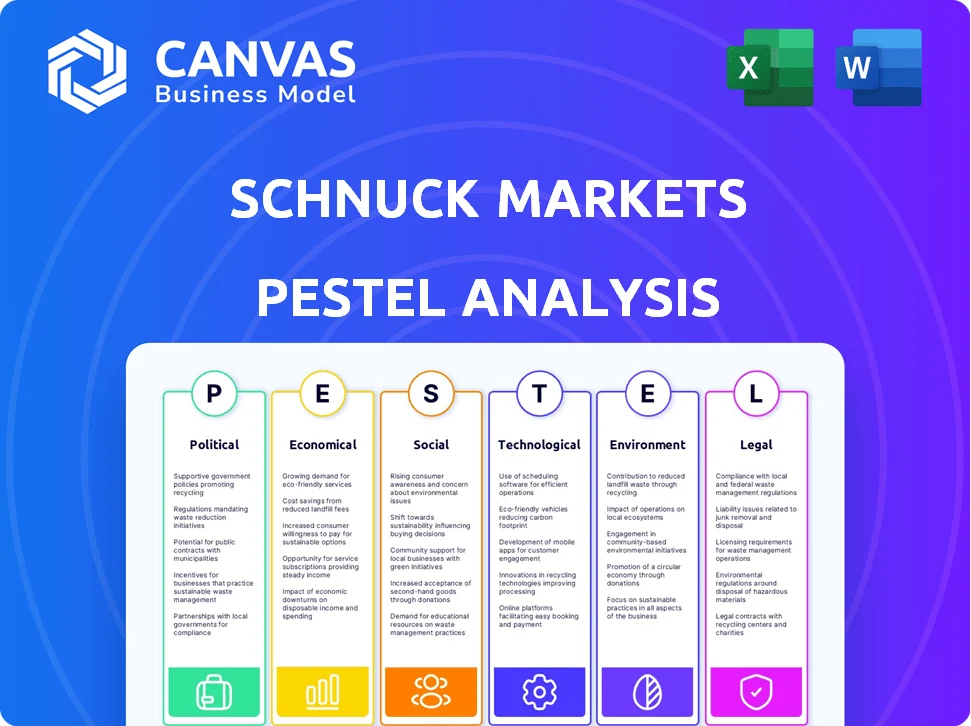
The analysis provides a PESTLE framework showing external factors' impact on Schnuck Markets. It helps identify market threats & opportunities.

 Customizable Excel Spreadsheet
Helps support discussions on external risk & market positioning during planning sessions.
What You See Is What You Get
Schnuck Markets PESTLE Analysis
See the real Schnuck Markets PESTLE analysis! This preview is the same complete, ready-to-use document you'll download. It's fully formatted, professional and ready for immediate use after purchase.

PESTLE Analysis Template

Plan Smarter. Present Sharper. Compete Stronger.
Discover Schnuck Markets's trajectory with our PESTLE Analysis! We've examined crucial external factors shaping the company's future. Political and economic shifts directly affect its operations and strategies. Plus, we uncover the social, technological, legal, and environmental trends influencing Schnuck's success. For deep-dive insights, download the complete analysis instantly and make smarter business decisions.
Political factors

Government Regulations on Food Safety
Government regulations significantly affect Schnucks, particularly through the FDA in the US. These regulations dictate food safety standards, ensuring consumer health. For instance, the FDA's Food Safety Modernization Act (FSMA) aims to prevent foodborne illnesses. Compliance costs can be substantial; in 2023, the food industry spent approximately $15 billion on regulatory compliance. These rules also require clear nutritional labeling, influencing Schnucks' product sourcing and handling practices.
Labor Laws and Minimum Wage
Schnuck Markets must navigate evolving labor laws, including minimum wage adjustments, which directly impact expenses. For example, the minimum wage in Missouri, where Schnucks operates, rose to $12.30 per hour in 2023. These changes necessitate adjustments to staffing levels and pricing models. Higher labor costs can squeeze profit margins, requiring strategic financial planning to maintain competitiveness.

Trade Policies and Tariffs
Trade policies and tariffs significantly affect Schnuck Markets. Tariffs on imported food can raise costs, impacting consumer prices. Political decisions about trade agreements influence Schnucks' supply chain. For example, the US-China trade war in 2018-2020 led to higher food prices. In 2024, monitoring these policies is crucial.

Political Stability
Political stability is crucial for Schnuck Markets' operations. A stable political environment fosters predictability, crucial for supply chains and consumer trust. Conversely, instability can disrupt operations, impacting profitability. For instance, Missouri's economic output in 2024 was approximately $350 billion, reflecting a generally stable environment.
- Missouri's GDP growth in 2024 was around 2.5%.
- Stable political climates reduce investment risks.
- Political instability increases operational costs.
Government Economic Policies
Government economic policies significantly influence consumer spending and, consequently, Schnuck Markets' performance. Stimulus packages and tax adjustments directly impact the disposable income available to shoppers. For instance, the 2023-2024 tax policies in Missouri, where Schnucks has a strong presence, saw changes that affected household budgets. These shifts necessitate careful adjustments to pricing and promotional strategies to maintain sales volume.
- Impact of tax policies on consumer spending.
- Changes in pricing and promotional strategies.
- Missouri's 2023-2024 tax policies.
Navigating the Political Landscape: A Grocery Chain's Strategy
Schnucks faces governmental regulations from the FDA on food safety and labeling, influencing sourcing and costs. Evolving labor laws, such as minimum wage adjustments in Missouri ($12.30/hour in 2023), require strategic planning. Trade policies and political stability are also vital, affecting supply chains and consumer confidence in its operations. In 2024, understanding these elements will define success.
| Political Factor | Impact on Schnucks | Data/Example (2024/2025) |
|---|---|---|
| Regulations (FDA) | Food safety and labeling compliance, increased costs. | Food industry spent ~$15B on compliance (2023) |
| Labor Laws | Wage adjustments; impact on expenses and pricing. | Missouri minimum wage: $12.30/hour (2023) |
| Trade Policies/Stability | Affects supply chains, consumer prices and operations. | Missouri GDP growth (2024): ~2.5% |
Economic factors

Inflation and Food Prices
Inflation directly affects Schnuck Markets' operational costs and customer spending habits. The U.S. inflation rate in March 2024 was 3.5%, influencing food prices. Schnuck must adapt pricing strategies. Inventory management is crucial to handle price volatility and maintain customer trust.
Consumer Disposable Income
Consumer disposable income levels significantly affect Schnuck Markets' sales. In 2024, U.S. real disposable personal income rose, indicating potential increased spending. During economic slowdowns, consumers might opt for store brands. Schnucks must adjust its product mix and marketing to stay competitive. For instance, in 2024, the inflation rate was around 3.1%.

Competition in the Grocery Market
The grocery market is fiercely competitive. Schnucks faces rivals like Kroger, Walmart, and Aldi. Price, product choice, and customer service are key. Grocery sales in the US in 2024 are around $800 billion.

Operating Costs
Schnuck Markets deals with significant operating costs, including labor, rent, and utilities. Efficient management of these costs is vital for profitability within a competitive landscape. The grocery industry sees thin margins, emphasizing the need for cost control. For example, labor costs can constitute a large portion of expenses.
- Labor costs often represent a substantial portion of a grocery store's expenses, sometimes exceeding 50% of operating costs.
- Rent and lease payments can vary widely based on location, impacting overall profitability.
- Utilities, especially for refrigeration, contribute significantly to operational expenses.
- Inventory management is critical to minimize waste and spoilage costs.
Supply Chain Costs and Disruptions
Supply chain costs and reliability are critical for Schnucks. Disruptions can cause higher expenses and product scarcity, affecting their capacity to satisfy customer needs. For example, the global supply chain disruptions in 2021-2023 increased transportation costs by up to 300%. Schnucks must navigate these challenges to maintain profitability and customer satisfaction.
- 2024: Supply chain issues continue to affect industries.
- 2024-2025: Inflation and energy prices will affect costs.
- 2025: Expect further volatility and strategic planning.
Economic Forces Shaping Grocery Retail
Economic factors significantly shape Schnuck Markets’ operations and financial performance. Inflation, at 3.5% in March 2024, impacts pricing and costs. Consumer disposable income influences spending habits, crucial for sales. In 2024, US grocery sales reached approximately $800 billion, highlighting the competitive landscape.
| Economic Factor | Impact on Schnucks | Data/Statistics (2024) |
|---|---|---|
| Inflation | Affects pricing strategies, operational costs, and consumer behavior. | U.S. Inflation Rate: 3.5% (March) |
| Consumer Income | Impacts sales via disposable income & store brand. | US real disposable personal income increased. |
| Market Dynamics | Influence on grocery sales. | US Grocery Sales: ~$800 Billion. |
Sociological factors

Changing Consumer Lifestyles and Preferences
Changing consumer lifestyles significantly impact Schnuck Markets. Demand for ready-to-eat meals is up; in 2024, the prepared foods market grew by 6.2%. The company must adapt to dietary shifts, including a 10% rise in plant-based product sales. Evolving demographics also shape product needs, with ethnic food demand increasing.
Health and Wellness Trends
Consumers are increasingly prioritizing health and wellness, influencing their shopping habits. Schnucks must adapt by expanding its range of healthy, organic, and specialized dietary products. For example, the organic food market is projected to reach $297.8 billion by 2027. Schnucks can capitalize on this trend. This strategic shift can boost sales and customer loyalty.

Influence of Social Media and Digital Communication
Social media and digital platforms shape consumer views, affecting Schnuck Markets' image. Customers share experiences and reviews online, emphasizing the need for strong online reputation management. In 2024, 70% of U.S. adults used social media, showing its widespread influence. Negative online reviews can significantly decrease sales, highlighting the importance of proactive customer engagement.

Community Engagement and Social Responsibility
Schnuck Markets actively engages in community outreach and social responsibility efforts, which are key to building consumer trust and enhancing its brand image. Their commitment to initiatives like food insecurity programs and workforce development significantly shapes public perception. These actions create a positive impact, fostering strong community ties and boosting customer loyalty. In 2024, Schnucks donated over $1 million to local food banks and community organizations.
- Community involvement boosts consumer loyalty.
- Social responsibility enhances brand image.
- Food insecurity programs have a positive impact.
- Workforce development improves public perception.
Demand for Convenience and Online Shopping
The escalating consumer desire for convenience and the surge in online grocery shopping are crucial sociological factors. Schnucks must adapt to meet these changing preferences by investing in e-commerce platforms and delivery services. This includes integrating in-store technologies to streamline the shopping experience. In 2024, online grocery sales in the U.S. are projected to reach $115 billion.
- Online grocery sales are expected to continue growing in 2025, with projections of $130 billion.
- Consumers are increasingly using mobile apps to manage their shopping needs.
- Schnucks can leverage data analytics to personalize offers and improve customer engagement.
Schnucks Adapts: Trends Drive Growth
Consumer lifestyles impact Schnucks, boosting ready-to-eat meals' demand; the market grew 6.2% in 2024. Health and wellness focus drives organic food growth, with $297.8B projected by 2027. Social media shapes brand image; 70% of U.S. adults use it, requiring proactive customer management.
| Sociological Factor | Impact on Schnucks | 2024 Data |
|---|---|---|
| Lifestyle Changes | Adapt to demand | Prepared foods market grew 6.2% |
| Health Focus | Expand healthy products | Organic market to reach $297.8B by 2027 |
| Digital Influence | Manage online reputation | 70% of U.S. adults use social media |
SCHNUCK MARKETS PESTLE ANALYSIS TEMPLATE RESEARCH
What is included in the product
Detailed Word Document
The analysis provides a PESTLE framework showing external factors' impact on Schnuck Markets. It helps identify market threats & opportunities.
Customizable Excel Spreadsheet
Helps support discussions on external risk & market positioning during planning sessions.
What You See Is What You Get
Schnuck Markets PESTLE Analysis
See the real Schnuck Markets PESTLE analysis! This preview is the same complete, ready-to-use document you'll download. It's fully formatted, professional and ready for immediate use after purchase.
PESTLE Analysis Template
Plan Smarter. Present Sharper. Compete Stronger.
Discover Schnuck Markets's trajectory with our PESTLE Analysis! We've examined crucial external factors shaping the company's future. Political and economic shifts directly affect its operations and strategies. Plus, we uncover the social, technological, legal, and environmental trends influencing Schnuck's success. For deep-dive insights, download the complete analysis instantly and make smarter business decisions.
Political factors
Government Regulations on Food Safety
Government regulations significantly affect Schnucks, particularly through the FDA in the US. These regulations dictate food safety standards, ensuring consumer health. For instance, the FDA's Food Safety Modernization Act (FSMA) aims to prevent foodborne illnesses. Compliance costs can be substantial; in 2023, the food industry spent approximately $15 billion on regulatory compliance. These rules also require clear nutritional labeling, influencing Schnucks' product sourcing and handling practices.
Labor Laws and Minimum Wage
Schnuck Markets must navigate evolving labor laws, including minimum wage adjustments, which directly impact expenses. For example, the minimum wage in Missouri, where Schnucks operates, rose to $12.30 per hour in 2023. These changes necessitate adjustments to staffing levels and pricing models. Higher labor costs can squeeze profit margins, requiring strategic financial planning to maintain competitiveness.
Trade Policies and Tariffs
Trade policies and tariffs significantly affect Schnuck Markets. Tariffs on imported food can raise costs, impacting consumer prices. Political decisions about trade agreements influence Schnucks' supply chain. For example, the US-China trade war in 2018-2020 led to higher food prices. In 2024, monitoring these policies is crucial.
Political Stability
Political stability is crucial for Schnuck Markets' operations. A stable political environment fosters predictability, crucial for supply chains and consumer trust. Conversely, instability can disrupt operations, impacting profitability. For instance, Missouri's economic output in 2024 was approximately $350 billion, reflecting a generally stable environment.
- Missouri's GDP growth in 2024 was around 2.5%.
- Stable political climates reduce investment risks.
- Political instability increases operational costs.
Government Economic Policies
Government economic policies significantly influence consumer spending and, consequently, Schnuck Markets' performance. Stimulus packages and tax adjustments directly impact the disposable income available to shoppers. For instance, the 2023-2024 tax policies in Missouri, where Schnucks has a strong presence, saw changes that affected household budgets. These shifts necessitate careful adjustments to pricing and promotional strategies to maintain sales volume.
- Impact of tax policies on consumer spending.
- Changes in pricing and promotional strategies.
- Missouri's 2023-2024 tax policies.
Navigating the Political Landscape: A Grocery Chain's Strategy
Schnucks faces governmental regulations from the FDA on food safety and labeling, influencing sourcing and costs. Evolving labor laws, such as minimum wage adjustments in Missouri ($12.30/hour in 2023), require strategic planning. Trade policies and political stability are also vital, affecting supply chains and consumer confidence in its operations. In 2024, understanding these elements will define success.
| Political Factor | Impact on Schnucks | Data/Example (2024/2025) |
|---|---|---|
| Regulations (FDA) | Food safety and labeling compliance, increased costs. | Food industry spent ~$15B on compliance (2023) |
| Labor Laws | Wage adjustments; impact on expenses and pricing. | Missouri minimum wage: $12.30/hour (2023) |
| Trade Policies/Stability | Affects supply chains, consumer prices and operations. | Missouri GDP growth (2024): ~2.5% |
Economic factors
Inflation and Food Prices
Inflation directly affects Schnuck Markets' operational costs and customer spending habits. The U.S. inflation rate in March 2024 was 3.5%, influencing food prices. Schnuck must adapt pricing strategies. Inventory management is crucial to handle price volatility and maintain customer trust.
Consumer Disposable Income
Consumer disposable income levels significantly affect Schnuck Markets' sales. In 2024, U.S. real disposable personal income rose, indicating potential increased spending. During economic slowdowns, consumers might opt for store brands. Schnucks must adjust its product mix and marketing to stay competitive. For instance, in 2024, the inflation rate was around 3.1%.
Competition in the Grocery Market
The grocery market is fiercely competitive. Schnucks faces rivals like Kroger, Walmart, and Aldi. Price, product choice, and customer service are key. Grocery sales in the US in 2024 are around $800 billion.
Operating Costs
Schnuck Markets deals with significant operating costs, including labor, rent, and utilities. Efficient management of these costs is vital for profitability within a competitive landscape. The grocery industry sees thin margins, emphasizing the need for cost control. For example, labor costs can constitute a large portion of expenses.
- Labor costs often represent a substantial portion of a grocery store's expenses, sometimes exceeding 50% of operating costs.
- Rent and lease payments can vary widely based on location, impacting overall profitability.
- Utilities, especially for refrigeration, contribute significantly to operational expenses.
- Inventory management is critical to minimize waste and spoilage costs.
Supply Chain Costs and Disruptions
Supply chain costs and reliability are critical for Schnucks. Disruptions can cause higher expenses and product scarcity, affecting their capacity to satisfy customer needs. For example, the global supply chain disruptions in 2021-2023 increased transportation costs by up to 300%. Schnucks must navigate these challenges to maintain profitability and customer satisfaction.
- 2024: Supply chain issues continue to affect industries.
- 2024-2025: Inflation and energy prices will affect costs.
- 2025: Expect further volatility and strategic planning.
Economic Forces Shaping Grocery Retail
Economic factors significantly shape Schnuck Markets’ operations and financial performance. Inflation, at 3.5% in March 2024, impacts pricing and costs. Consumer disposable income influences spending habits, crucial for sales. In 2024, US grocery sales reached approximately $800 billion, highlighting the competitive landscape.
| Economic Factor | Impact on Schnucks | Data/Statistics (2024) |
|---|---|---|
| Inflation | Affects pricing strategies, operational costs, and consumer behavior. | U.S. Inflation Rate: 3.5% (March) |
| Consumer Income | Impacts sales via disposable income & store brand. | US real disposable personal income increased. |
| Market Dynamics | Influence on grocery sales. | US Grocery Sales: ~$800 Billion. |
Sociological factors
Changing Consumer Lifestyles and Preferences
Changing consumer lifestyles significantly impact Schnuck Markets. Demand for ready-to-eat meals is up; in 2024, the prepared foods market grew by 6.2%. The company must adapt to dietary shifts, including a 10% rise in plant-based product sales. Evolving demographics also shape product needs, with ethnic food demand increasing.
Health and Wellness Trends
Consumers are increasingly prioritizing health and wellness, influencing their shopping habits. Schnucks must adapt by expanding its range of healthy, organic, and specialized dietary products. For example, the organic food market is projected to reach $297.8 billion by 2027. Schnucks can capitalize on this trend. This strategic shift can boost sales and customer loyalty.
Influence of Social Media and Digital Communication
Social media and digital platforms shape consumer views, affecting Schnuck Markets' image. Customers share experiences and reviews online, emphasizing the need for strong online reputation management. In 2024, 70% of U.S. adults used social media, showing its widespread influence. Negative online reviews can significantly decrease sales, highlighting the importance of proactive customer engagement.
Community Engagement and Social Responsibility
Schnuck Markets actively engages in community outreach and social responsibility efforts, which are key to building consumer trust and enhancing its brand image. Their commitment to initiatives like food insecurity programs and workforce development significantly shapes public perception. These actions create a positive impact, fostering strong community ties and boosting customer loyalty. In 2024, Schnucks donated over $1 million to local food banks and community organizations.
- Community involvement boosts consumer loyalty.
- Social responsibility enhances brand image.
- Food insecurity programs have a positive impact.
- Workforce development improves public perception.
Demand for Convenience and Online Shopping
The escalating consumer desire for convenience and the surge in online grocery shopping are crucial sociological factors. Schnucks must adapt to meet these changing preferences by investing in e-commerce platforms and delivery services. This includes integrating in-store technologies to streamline the shopping experience. In 2024, online grocery sales in the U.S. are projected to reach $115 billion.
- Online grocery sales are expected to continue growing in 2025, with projections of $130 billion.
- Consumers are increasingly using mobile apps to manage their shopping needs.
- Schnucks can leverage data analytics to personalize offers and improve customer engagement.
Schnucks Adapts: Trends Drive Growth
Consumer lifestyles impact Schnucks, boosting ready-to-eat meals' demand; the market grew 6.2% in 2024. Health and wellness focus drives organic food growth, with $297.8B projected by 2027. Social media shapes brand image; 70% of U.S. adults use it, requiring proactive customer management.
| Sociological Factor | Impact on Schnucks | 2024 Data |
|---|---|---|
| Lifestyle Changes | Adapt to demand | Prepared foods market grew 6.2% |
| Health Focus | Expand healthy products | Organic market to reach $297.8B by 2027 |
| Digital Influence | Manage online reputation | 70% of U.S. adults use social media |
Product Information
Product Information
Shipping & Returns
Shipping & Returns
Description
What is included in the product
Detailed Word Document
The analysis provides a PESTLE framework showing external factors' impact on Schnuck Markets. It helps identify market threats & opportunities.
Customizable Excel Spreadsheet
Helps support discussions on external risk & market positioning during planning sessions.
What You See Is What You Get
Schnuck Markets PESTLE Analysis
See the real Schnuck Markets PESTLE analysis! This preview is the same complete, ready-to-use document you'll download. It's fully formatted, professional and ready for immediate use after purchase.
PESTLE Analysis Template
Plan Smarter. Present Sharper. Compete Stronger.
Discover Schnuck Markets's trajectory with our PESTLE Analysis! We've examined crucial external factors shaping the company's future. Political and economic shifts directly affect its operations and strategies. Plus, we uncover the social, technological, legal, and environmental trends influencing Schnuck's success. For deep-dive insights, download the complete analysis instantly and make smarter business decisions.
Political factors
Government Regulations on Food Safety
Government regulations significantly affect Schnucks, particularly through the FDA in the US. These regulations dictate food safety standards, ensuring consumer health. For instance, the FDA's Food Safety Modernization Act (FSMA) aims to prevent foodborne illnesses. Compliance costs can be substantial; in 2023, the food industry spent approximately $15 billion on regulatory compliance. These rules also require clear nutritional labeling, influencing Schnucks' product sourcing and handling practices.
Labor Laws and Minimum Wage
Schnuck Markets must navigate evolving labor laws, including minimum wage adjustments, which directly impact expenses. For example, the minimum wage in Missouri, where Schnucks operates, rose to $12.30 per hour in 2023. These changes necessitate adjustments to staffing levels and pricing models. Higher labor costs can squeeze profit margins, requiring strategic financial planning to maintain competitiveness.
Trade Policies and Tariffs
Trade policies and tariffs significantly affect Schnuck Markets. Tariffs on imported food can raise costs, impacting consumer prices. Political decisions about trade agreements influence Schnucks' supply chain. For example, the US-China trade war in 2018-2020 led to higher food prices. In 2024, monitoring these policies is crucial.
Political Stability
Political stability is crucial for Schnuck Markets' operations. A stable political environment fosters predictability, crucial for supply chains and consumer trust. Conversely, instability can disrupt operations, impacting profitability. For instance, Missouri's economic output in 2024 was approximately $350 billion, reflecting a generally stable environment.
- Missouri's GDP growth in 2024 was around 2.5%.
- Stable political climates reduce investment risks.
- Political instability increases operational costs.
Government Economic Policies
Government economic policies significantly influence consumer spending and, consequently, Schnuck Markets' performance. Stimulus packages and tax adjustments directly impact the disposable income available to shoppers. For instance, the 2023-2024 tax policies in Missouri, where Schnucks has a strong presence, saw changes that affected household budgets. These shifts necessitate careful adjustments to pricing and promotional strategies to maintain sales volume.
- Impact of tax policies on consumer spending.
- Changes in pricing and promotional strategies.
- Missouri's 2023-2024 tax policies.
Navigating the Political Landscape: A Grocery Chain's Strategy
Schnucks faces governmental regulations from the FDA on food safety and labeling, influencing sourcing and costs. Evolving labor laws, such as minimum wage adjustments in Missouri ($12.30/hour in 2023), require strategic planning. Trade policies and political stability are also vital, affecting supply chains and consumer confidence in its operations. In 2024, understanding these elements will define success.
| Political Factor | Impact on Schnucks | Data/Example (2024/2025) |
|---|---|---|
| Regulations (FDA) | Food safety and labeling compliance, increased costs. | Food industry spent ~$15B on compliance (2023) |
| Labor Laws | Wage adjustments; impact on expenses and pricing. | Missouri minimum wage: $12.30/hour (2023) |
| Trade Policies/Stability | Affects supply chains, consumer prices and operations. | Missouri GDP growth (2024): ~2.5% |
Economic factors
Inflation and Food Prices
Inflation directly affects Schnuck Markets' operational costs and customer spending habits. The U.S. inflation rate in March 2024 was 3.5%, influencing food prices. Schnuck must adapt pricing strategies. Inventory management is crucial to handle price volatility and maintain customer trust.
Consumer Disposable Income
Consumer disposable income levels significantly affect Schnuck Markets' sales. In 2024, U.S. real disposable personal income rose, indicating potential increased spending. During economic slowdowns, consumers might opt for store brands. Schnucks must adjust its product mix and marketing to stay competitive. For instance, in 2024, the inflation rate was around 3.1%.
Competition in the Grocery Market
The grocery market is fiercely competitive. Schnucks faces rivals like Kroger, Walmart, and Aldi. Price, product choice, and customer service are key. Grocery sales in the US in 2024 are around $800 billion.
Operating Costs
Schnuck Markets deals with significant operating costs, including labor, rent, and utilities. Efficient management of these costs is vital for profitability within a competitive landscape. The grocery industry sees thin margins, emphasizing the need for cost control. For example, labor costs can constitute a large portion of expenses.
- Labor costs often represent a substantial portion of a grocery store's expenses, sometimes exceeding 50% of operating costs.
- Rent and lease payments can vary widely based on location, impacting overall profitability.
- Utilities, especially for refrigeration, contribute significantly to operational expenses.
- Inventory management is critical to minimize waste and spoilage costs.
Supply Chain Costs and Disruptions
Supply chain costs and reliability are critical for Schnucks. Disruptions can cause higher expenses and product scarcity, affecting their capacity to satisfy customer needs. For example, the global supply chain disruptions in 2021-2023 increased transportation costs by up to 300%. Schnucks must navigate these challenges to maintain profitability and customer satisfaction.
- 2024: Supply chain issues continue to affect industries.
- 2024-2025: Inflation and energy prices will affect costs.
- 2025: Expect further volatility and strategic planning.
Economic Forces Shaping Grocery Retail
Economic factors significantly shape Schnuck Markets’ operations and financial performance. Inflation, at 3.5% in March 2024, impacts pricing and costs. Consumer disposable income influences spending habits, crucial for sales. In 2024, US grocery sales reached approximately $800 billion, highlighting the competitive landscape.
| Economic Factor | Impact on Schnucks | Data/Statistics (2024) |
|---|---|---|
| Inflation | Affects pricing strategies, operational costs, and consumer behavior. | U.S. Inflation Rate: 3.5% (March) |
| Consumer Income | Impacts sales via disposable income & store brand. | US real disposable personal income increased. |
| Market Dynamics | Influence on grocery sales. | US Grocery Sales: ~$800 Billion. |
Sociological factors
Changing Consumer Lifestyles and Preferences
Changing consumer lifestyles significantly impact Schnuck Markets. Demand for ready-to-eat meals is up; in 2024, the prepared foods market grew by 6.2%. The company must adapt to dietary shifts, including a 10% rise in plant-based product sales. Evolving demographics also shape product needs, with ethnic food demand increasing.
Health and Wellness Trends
Consumers are increasingly prioritizing health and wellness, influencing their shopping habits. Schnucks must adapt by expanding its range of healthy, organic, and specialized dietary products. For example, the organic food market is projected to reach $297.8 billion by 2027. Schnucks can capitalize on this trend. This strategic shift can boost sales and customer loyalty.
Influence of Social Media and Digital Communication
Social media and digital platforms shape consumer views, affecting Schnuck Markets' image. Customers share experiences and reviews online, emphasizing the need for strong online reputation management. In 2024, 70% of U.S. adults used social media, showing its widespread influence. Negative online reviews can significantly decrease sales, highlighting the importance of proactive customer engagement.
Community Engagement and Social Responsibility
Schnuck Markets actively engages in community outreach and social responsibility efforts, which are key to building consumer trust and enhancing its brand image. Their commitment to initiatives like food insecurity programs and workforce development significantly shapes public perception. These actions create a positive impact, fostering strong community ties and boosting customer loyalty. In 2024, Schnucks donated over $1 million to local food banks and community organizations.
- Community involvement boosts consumer loyalty.
- Social responsibility enhances brand image.
- Food insecurity programs have a positive impact.
- Workforce development improves public perception.
Demand for Convenience and Online Shopping
The escalating consumer desire for convenience and the surge in online grocery shopping are crucial sociological factors. Schnucks must adapt to meet these changing preferences by investing in e-commerce platforms and delivery services. This includes integrating in-store technologies to streamline the shopping experience. In 2024, online grocery sales in the U.S. are projected to reach $115 billion.
- Online grocery sales are expected to continue growing in 2025, with projections of $130 billion.
- Consumers are increasingly using mobile apps to manage their shopping needs.
- Schnucks can leverage data analytics to personalize offers and improve customer engagement.
Schnucks Adapts: Trends Drive Growth
Consumer lifestyles impact Schnucks, boosting ready-to-eat meals' demand; the market grew 6.2% in 2024. Health and wellness focus drives organic food growth, with $297.8B projected by 2027. Social media shapes brand image; 70% of U.S. adults use it, requiring proactive customer management.
| Sociological Factor | Impact on Schnucks | 2024 Data |
|---|---|---|
| Lifestyle Changes | Adapt to demand | Prepared foods market grew 6.2% |
| Health Focus | Expand healthy products | Organic market to reach $297.8B by 2027 |
| Digital Influence | Manage online reputation | 70% of U.S. adults use social media |


