
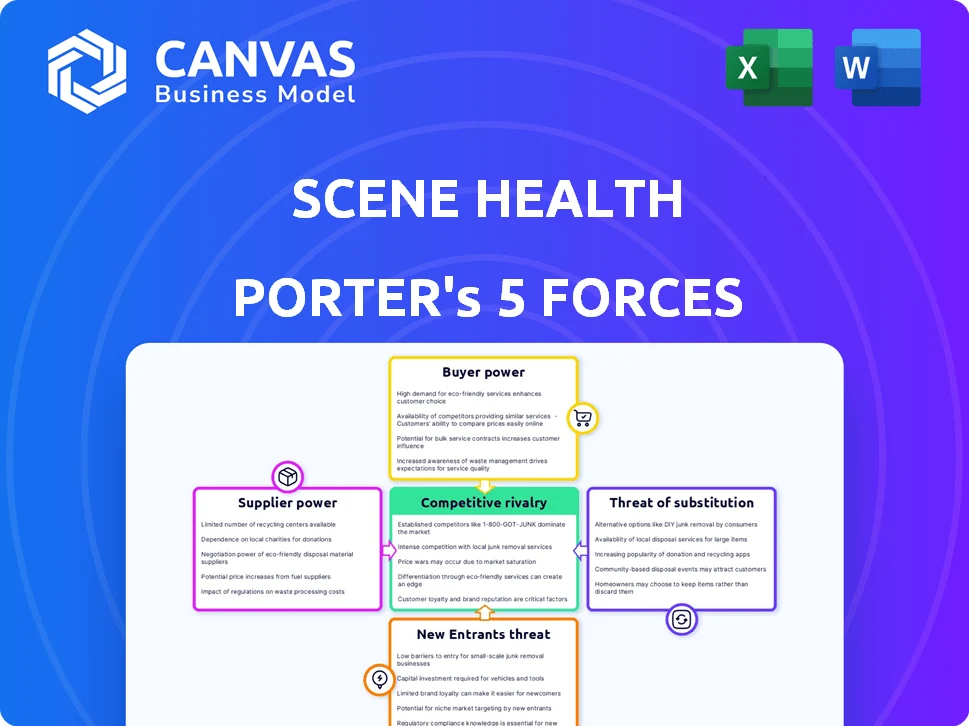
SCENE HEALTH PORTER'S FIVE FORCES TEMPLATE RESEARCH
What is included in the product
 Detailed Word Document
Analyzes Scene Health's competitive forces: rivals, buyers, suppliers, entrants, and substitutes.

 Customizable Excel Spreadsheet
Get actionable insights fast with color-coded threat levels.
Same Document Delivered
Scene Health Porter's Five Forces Analysis
This preview provides the complete Scene Health Porter's Five Forces analysis. It's the exact document, fully formatted, and ready for immediate download after purchase.

Porter's Five Forces Analysis Template

Go Beyond the Preview—Access the Full Strategic Report
Scene Health's competitive landscape is shaped by distinct forces. Buyer power, stemming from diverse healthcare options, presents a moderate challenge. The threat of new entrants is relatively low, due to industry barriers. Substitute products pose a moderate threat, impacted by evolving tech.
Supplier bargaining power has a moderate impact on Scene Health's operations. Rivalry among existing competitors is intense, fueled by market competition. This brief snapshot only scratches the surface. Unlock the full Porter's Five Forces Analysis to explore Scene Health’s competitive dynamics, market pressures, and strategic advantages in detail.
Suppliers Bargaining Power

Technology Platform Providers
Scene Health depends on tech platforms for video and data. Providers, especially those with unique tech, hold bargaining power. A few dominant players in health tech could affect pricing. In 2024, the health tech market is valued at over $100 billion, increasing these providers' leverage. This could impact Scene Health's operational costs.
Healthcare Professionals
Scene Health's reliance on pharmacists, nurses, and health coaches means their bargaining power is significant. Their expertise is crucial for the platform's human-centered approach. In 2024, the healthcare sector saw a continued shortage of skilled professionals, driving up salaries. For example, registered nurses' median annual salary was around $86,070. This impacts Scene Health's operational costs.

Data and Analytics Providers
Scene Health relies heavily on data analytics for personalized patient support and outcome demonstration. Suppliers of advanced AI-driven data analytics tools could wield significant bargaining power. In 2024, the AI market surged, with growth rates exceeding 20% annually. This leverage is amplified if their tech is essential for Scene Health's competitive edge.

Content and Educational Material Providers
Scene Health relies on educational content and motivational materials to support patients. Providers of high-quality, evidence-based health education content could wield some bargaining power, particularly if their materials are unique or highly effective. This power is amplified if the content significantly boosts patient adherence, which directly impacts health outcomes and potentially reduces healthcare costs. The market for digital health education is growing, with a projected value of $61.7 billion by 2024.
- Market Growth: The digital health education market is expected to reach $61.7 billion in 2024.
- Content Differentiation: Unique and effective content can increase supplier power.
- Impact on Adherence: High-quality materials improve patient adherence and outcomes.
- Cost Reduction: Better adherence can lead to reduced healthcare costs.
Integration and Interoperability Solution Providers
Scene Health relies on smooth data flow, necessitating integration with EHRs and pharmacy systems. Companies offering seamless integration solutions can wield significant bargaining power. This is because these solutions are critical for Scene Health's operations and overall value. The interoperability solutions market was valued at $4.7 billion in 2024, and is projected to reach $9.8 billion by 2030.
- Market growth in interoperability solutions is significant.
- Integration is key for Scene Health's operations.
- Suppliers with strong solutions gain leverage.
- Data flow is vital for Scene Health's value.
Scene Health's Supplier Power Dynamics
Scene Health faces supplier bargaining power from tech providers, especially those with unique platforms. The health tech market, valued at over $100 billion in 2024, gives these suppliers leverage. Skilled healthcare professionals, like nurses with a median salary of $86,070 in 2024, also hold significant power.
Suppliers of advanced AI-driven data analytics tools, experiencing over 20% annual growth in 2024, have strong bargaining power. Providers of high-quality health education content, with a market projected at $61.7 billion in 2024, also have influence. Companies offering seamless EHR integration solutions, part of a $4.7 billion market in 2024, also hold significant power for Scene Health.
| Supplier Type | Impact on Scene Health | 2024 Market Data |
|---|---|---|
| Tech Platforms | Pricing, Operational Costs | $100B+ Health Tech Market |
| Healthcare Professionals | Operational Costs | $86,070 (RN Median Salary) |
| Data Analytics | Competitive Edge | 20%+ Annual Growth (AI) |
| Health Education | Patient Outcomes | $61.7B Digital Health Ed |
| Integration Solutions | Operations, Value | $4.7B Interoperability |
Customers Bargaining Power

Health Plans and Payers
Scene Health's primary customers are Medicaid, Medicare managed care plans, and other health plans, wielding substantial bargaining power. These entities, managing large patient volumes, prioritize cost savings and value-based care, allowing them to negotiate favorable terms. For example, in 2024, Medicare Advantage enrollment hit over 30 million, intensifying price competition. Health plans leverage their scale to drive down prices based on proven outcomes and reduced costs.
Public Health Departments
Scene Health collaborates with public health departments, whose bargaining power is shaped by government funding and public health goals. These departments often seek cost-effective solutions aligned with broader health initiatives. For instance, in 2024, the CDC allocated over $1 billion to address chronic diseases, influencing purchasing decisions. This focus can affect Scene Health's pricing and service offerings.

Pharmaceutical Companies and Clinical Research Organizations
Scene Health's client base includes pharmaceutical companies and clinical research organizations. These entities seek patient adherence solutions for effective drug outcomes and successful clinical trials. Their bargaining power is significant, as they can select providers based on demonstrated results and robust data collection. The global pharmaceutical market was valued at approximately $1.5 trillion in 2023, highlighting the financial stakes involved. Clinical trials, costing millions, depend on adherence data, giving clients considerable leverage.

Hospitals and Health Systems
Scene Health's interaction with hospitals places them in a customer-centric environment. Hospitals and health systems, key users of medication adherence solutions, wield considerable purchasing power. Their large patient volumes and focus on outcomes, especially reducing readmissions, give them leverage. In 2024, hospital readmissions cost the U.S. healthcare system over $40 billion.
- Hospitals' bargaining power stems from their volume of patients and focus on outcomes.
- Medication adherence directly impacts readmission rates, a major hospital concern.
- The financial impact of readmissions strengthens hospital bargaining power.
- Health systems can negotiate favorable terms due to their influence.
Patients and Caregivers
Patients and caregivers, as end-users, significantly shape Scene Health's service value. Their satisfaction directly impacts the platform's perceived effectiveness, influencing the willingness of contracting entities to engage. This indirect influence gives patients and caregivers a degree of bargaining power. The emphasis on patient-centered care is growing.
- Patient satisfaction scores directly influence healthcare provider contracts.
- Caregiver feedback affects service adoption rates.
- User engagement is a key performance indicator (KPI) in 2024.
- Positive user reviews boost Scene Health's market position.
Customer Power Dynamics in Healthcare
Scene Health's customers, including health plans and hospitals, wield considerable bargaining power. Health plans, managing substantial patient volumes, prioritize cost savings. Hospitals' focus on outcomes, like reduced readmissions, strengthens their leverage.
| Customer Type | Bargaining Power Drivers | 2024 Impact |
|---|---|---|
| Health Plans | Large patient volumes, cost focus | Negotiate favorable terms, price pressure |
| Hospitals | Patient volumes, readmission reduction | Demand outcome-based solutions, cost control |
| Pharmaceuticals | Drug outcomes, clinical trials | Seek adherence data, influence service |
Rivalry Among Competitors

Other Medication Adherence Companies
The medication adherence market is expanding, drawing in various competitors with diverse offerings. Scene Health confronts rivalry from tech-focused platforms and companies specializing in smart packaging or reminders. Competitors like Medisafe have secured substantial funding, with over $60 million raised by 2024. This competitive landscape intensifies pressure on Scene Health to innovate and differentiate.
In-House Programs by Healthcare Organizations
Large health systems and payers are increasingly launching in-house medication adherence programs. This strategy allows them to control costs and patient data. The competition intensifies for external providers like Scene Health. For example, UnitedHealth Group's OptumRx offers similar services. This internal approach can create significant competitive pressure.

Pharmaceutical Company Support Programs
Pharmaceutical companies' patient support programs, including adherence components, compete with Scene Health. In 2024, these programs, like those offered by major pharma firms, included medication reminders and educational resources. This competition intensifies as companies develop in-house or partnered adherence solutions. For example, in 2024, the market for patient support programs was valued at over $15 billion. Scene Health must differentiate to compete effectively.

Traditional Healthcare Providers
Traditional healthcare providers, including doctors and pharmacists, offer medication adherence support through patient education and counseling. Their influence impacts the demand for external solutions like Scene Health. A 2024 study showed that 65% of patients still rely on their physicians for medication guidance. This reliance can create competition for adherence solutions. However, effective collaboration enhances patient outcomes.
- 65% of patients rely on physicians for medication guidance (2024).
- Traditional methods influence the perceived value of external solutions.
- Collaboration between providers and solutions improves results.
- The effectiveness of traditional methods creates competition.
Fragmented Market Landscape
The medication adherence market features many companies, each with unique offerings. This setup fosters strong competition as businesses vie for customer attention. To succeed, Scene Health must highlight its complete strategy. This differentiation is key in a crowded field.
- Market fragmentation boosts competition.
- Scene Health needs a standout strategy.
- Differentiation is crucial for success.
Scene Health's Competitive Landscape: A Deep Dive
Scene Health faces intense competition from various players in the medication adherence market. Competitors like Medisafe have raised significant funding, showcasing the market's attractiveness. Traditional healthcare providers also offer similar services, impacting demand. Differentiation and a strong strategy are crucial for Scene Health to succeed.
| Competitor Type | Examples | Competitive Pressure |
|---|---|---|
| Tech Platforms | Medisafe, Mango Health | High; well-funded, tech-focused |
| Health Systems/Payers | OptumRx (UnitedHealth) | High; in-house programs |
| Pharma Companies | Various, with patient support programs | High; offering adherence components |
| Traditional Providers | Doctors, pharmacists | Moderate; reliance on existing relationships |
Original: $10.00
-65%$10.00
$3.50SCENE HEALTH PORTER'S FIVE FORCES TEMPLATE RESEARCH
What is included in the product
Detailed Word Document
Analyzes Scene Health's competitive forces: rivals, buyers, suppliers, entrants, and substitutes.
Customizable Excel Spreadsheet
Get actionable insights fast with color-coded threat levels.
Same Document Delivered
Scene Health Porter's Five Forces Analysis
This preview provides the complete Scene Health Porter's Five Forces analysis. It's the exact document, fully formatted, and ready for immediate download after purchase.
Porter's Five Forces Analysis Template
Go Beyond the Preview—Access the Full Strategic Report
Scene Health's competitive landscape is shaped by distinct forces. Buyer power, stemming from diverse healthcare options, presents a moderate challenge. The threat of new entrants is relatively low, due to industry barriers. Substitute products pose a moderate threat, impacted by evolving tech.
Supplier bargaining power has a moderate impact on Scene Health's operations. Rivalry among existing competitors is intense, fueled by market competition. This brief snapshot only scratches the surface. Unlock the full Porter's Five Forces Analysis to explore Scene Health’s competitive dynamics, market pressures, and strategic advantages in detail.
Suppliers Bargaining Power
Technology Platform Providers
Scene Health depends on tech platforms for video and data. Providers, especially those with unique tech, hold bargaining power. A few dominant players in health tech could affect pricing. In 2024, the health tech market is valued at over $100 billion, increasing these providers' leverage. This could impact Scene Health's operational costs.
Healthcare Professionals
Scene Health's reliance on pharmacists, nurses, and health coaches means their bargaining power is significant. Their expertise is crucial for the platform's human-centered approach. In 2024, the healthcare sector saw a continued shortage of skilled professionals, driving up salaries. For example, registered nurses' median annual salary was around $86,070. This impacts Scene Health's operational costs.
Data and Analytics Providers
Scene Health relies heavily on data analytics for personalized patient support and outcome demonstration. Suppliers of advanced AI-driven data analytics tools could wield significant bargaining power. In 2024, the AI market surged, with growth rates exceeding 20% annually. This leverage is amplified if their tech is essential for Scene Health's competitive edge.
Content and Educational Material Providers
Scene Health relies on educational content and motivational materials to support patients. Providers of high-quality, evidence-based health education content could wield some bargaining power, particularly if their materials are unique or highly effective. This power is amplified if the content significantly boosts patient adherence, which directly impacts health outcomes and potentially reduces healthcare costs. The market for digital health education is growing, with a projected value of $61.7 billion by 2024.
- Market Growth: The digital health education market is expected to reach $61.7 billion in 2024.
- Content Differentiation: Unique and effective content can increase supplier power.
- Impact on Adherence: High-quality materials improve patient adherence and outcomes.
- Cost Reduction: Better adherence can lead to reduced healthcare costs.
Integration and Interoperability Solution Providers
Scene Health relies on smooth data flow, necessitating integration with EHRs and pharmacy systems. Companies offering seamless integration solutions can wield significant bargaining power. This is because these solutions are critical for Scene Health's operations and overall value. The interoperability solutions market was valued at $4.7 billion in 2024, and is projected to reach $9.8 billion by 2030.
- Market growth in interoperability solutions is significant.
- Integration is key for Scene Health's operations.
- Suppliers with strong solutions gain leverage.
- Data flow is vital for Scene Health's value.
Scene Health's Supplier Power Dynamics
Scene Health faces supplier bargaining power from tech providers, especially those with unique platforms. The health tech market, valued at over $100 billion in 2024, gives these suppliers leverage. Skilled healthcare professionals, like nurses with a median salary of $86,070 in 2024, also hold significant power.
Suppliers of advanced AI-driven data analytics tools, experiencing over 20% annual growth in 2024, have strong bargaining power. Providers of high-quality health education content, with a market projected at $61.7 billion in 2024, also have influence. Companies offering seamless EHR integration solutions, part of a $4.7 billion market in 2024, also hold significant power for Scene Health.
| Supplier Type | Impact on Scene Health | 2024 Market Data |
|---|---|---|
| Tech Platforms | Pricing, Operational Costs | $100B+ Health Tech Market |
| Healthcare Professionals | Operational Costs | $86,070 (RN Median Salary) |
| Data Analytics | Competitive Edge | 20%+ Annual Growth (AI) |
| Health Education | Patient Outcomes | $61.7B Digital Health Ed |
| Integration Solutions | Operations, Value | $4.7B Interoperability |
Customers Bargaining Power
Health Plans and Payers
Scene Health's primary customers are Medicaid, Medicare managed care plans, and other health plans, wielding substantial bargaining power. These entities, managing large patient volumes, prioritize cost savings and value-based care, allowing them to negotiate favorable terms. For example, in 2024, Medicare Advantage enrollment hit over 30 million, intensifying price competition. Health plans leverage their scale to drive down prices based on proven outcomes and reduced costs.
Public Health Departments
Scene Health collaborates with public health departments, whose bargaining power is shaped by government funding and public health goals. These departments often seek cost-effective solutions aligned with broader health initiatives. For instance, in 2024, the CDC allocated over $1 billion to address chronic diseases, influencing purchasing decisions. This focus can affect Scene Health's pricing and service offerings.
Pharmaceutical Companies and Clinical Research Organizations
Scene Health's client base includes pharmaceutical companies and clinical research organizations. These entities seek patient adherence solutions for effective drug outcomes and successful clinical trials. Their bargaining power is significant, as they can select providers based on demonstrated results and robust data collection. The global pharmaceutical market was valued at approximately $1.5 trillion in 2023, highlighting the financial stakes involved. Clinical trials, costing millions, depend on adherence data, giving clients considerable leverage.
Hospitals and Health Systems
Scene Health's interaction with hospitals places them in a customer-centric environment. Hospitals and health systems, key users of medication adherence solutions, wield considerable purchasing power. Their large patient volumes and focus on outcomes, especially reducing readmissions, give them leverage. In 2024, hospital readmissions cost the U.S. healthcare system over $40 billion.
- Hospitals' bargaining power stems from their volume of patients and focus on outcomes.
- Medication adherence directly impacts readmission rates, a major hospital concern.
- The financial impact of readmissions strengthens hospital bargaining power.
- Health systems can negotiate favorable terms due to their influence.
Patients and Caregivers
Patients and caregivers, as end-users, significantly shape Scene Health's service value. Their satisfaction directly impacts the platform's perceived effectiveness, influencing the willingness of contracting entities to engage. This indirect influence gives patients and caregivers a degree of bargaining power. The emphasis on patient-centered care is growing.
- Patient satisfaction scores directly influence healthcare provider contracts.
- Caregiver feedback affects service adoption rates.
- User engagement is a key performance indicator (KPI) in 2024.
- Positive user reviews boost Scene Health's market position.
Customer Power Dynamics in Healthcare
Scene Health's customers, including health plans and hospitals, wield considerable bargaining power. Health plans, managing substantial patient volumes, prioritize cost savings. Hospitals' focus on outcomes, like reduced readmissions, strengthens their leverage.
| Customer Type | Bargaining Power Drivers | 2024 Impact |
|---|---|---|
| Health Plans | Large patient volumes, cost focus | Negotiate favorable terms, price pressure |
| Hospitals | Patient volumes, readmission reduction | Demand outcome-based solutions, cost control |
| Pharmaceuticals | Drug outcomes, clinical trials | Seek adherence data, influence service |
Rivalry Among Competitors
Other Medication Adherence Companies
The medication adherence market is expanding, drawing in various competitors with diverse offerings. Scene Health confronts rivalry from tech-focused platforms and companies specializing in smart packaging or reminders. Competitors like Medisafe have secured substantial funding, with over $60 million raised by 2024. This competitive landscape intensifies pressure on Scene Health to innovate and differentiate.
In-House Programs by Healthcare Organizations
Large health systems and payers are increasingly launching in-house medication adherence programs. This strategy allows them to control costs and patient data. The competition intensifies for external providers like Scene Health. For example, UnitedHealth Group's OptumRx offers similar services. This internal approach can create significant competitive pressure.
Pharmaceutical Company Support Programs
Pharmaceutical companies' patient support programs, including adherence components, compete with Scene Health. In 2024, these programs, like those offered by major pharma firms, included medication reminders and educational resources. This competition intensifies as companies develop in-house or partnered adherence solutions. For example, in 2024, the market for patient support programs was valued at over $15 billion. Scene Health must differentiate to compete effectively.
Traditional Healthcare Providers
Traditional healthcare providers, including doctors and pharmacists, offer medication adherence support through patient education and counseling. Their influence impacts the demand for external solutions like Scene Health. A 2024 study showed that 65% of patients still rely on their physicians for medication guidance. This reliance can create competition for adherence solutions. However, effective collaboration enhances patient outcomes.
- 65% of patients rely on physicians for medication guidance (2024).
- Traditional methods influence the perceived value of external solutions.
- Collaboration between providers and solutions improves results.
- The effectiveness of traditional methods creates competition.
Fragmented Market Landscape
The medication adherence market features many companies, each with unique offerings. This setup fosters strong competition as businesses vie for customer attention. To succeed, Scene Health must highlight its complete strategy. This differentiation is key in a crowded field.
- Market fragmentation boosts competition.
- Scene Health needs a standout strategy.
- Differentiation is crucial for success.
Scene Health's Competitive Landscape: A Deep Dive
Scene Health faces intense competition from various players in the medication adherence market. Competitors like Medisafe have raised significant funding, showcasing the market's attractiveness. Traditional healthcare providers also offer similar services, impacting demand. Differentiation and a strong strategy are crucial for Scene Health to succeed.
| Competitor Type | Examples | Competitive Pressure |
|---|---|---|
| Tech Platforms | Medisafe, Mango Health | High; well-funded, tech-focused |
| Health Systems/Payers | OptumRx (UnitedHealth) | High; in-house programs |
| Pharma Companies | Various, with patient support programs | High; offering adherence components |
| Traditional Providers | Doctors, pharmacists | Moderate; reliance on existing relationships |
Product Information
Product Information
Shipping & Returns
Shipping & Returns
Description
What is included in the product
Detailed Word Document
Analyzes Scene Health's competitive forces: rivals, buyers, suppliers, entrants, and substitutes.
Customizable Excel Spreadsheet
Get actionable insights fast with color-coded threat levels.
Same Document Delivered
Scene Health Porter's Five Forces Analysis
This preview provides the complete Scene Health Porter's Five Forces analysis. It's the exact document, fully formatted, and ready for immediate download after purchase.
Porter's Five Forces Analysis Template
Go Beyond the Preview—Access the Full Strategic Report
Scene Health's competitive landscape is shaped by distinct forces. Buyer power, stemming from diverse healthcare options, presents a moderate challenge. The threat of new entrants is relatively low, due to industry barriers. Substitute products pose a moderate threat, impacted by evolving tech.
Supplier bargaining power has a moderate impact on Scene Health's operations. Rivalry among existing competitors is intense, fueled by market competition. This brief snapshot only scratches the surface. Unlock the full Porter's Five Forces Analysis to explore Scene Health’s competitive dynamics, market pressures, and strategic advantages in detail.
Suppliers Bargaining Power
Technology Platform Providers
Scene Health depends on tech platforms for video and data. Providers, especially those with unique tech, hold bargaining power. A few dominant players in health tech could affect pricing. In 2024, the health tech market is valued at over $100 billion, increasing these providers' leverage. This could impact Scene Health's operational costs.
Healthcare Professionals
Scene Health's reliance on pharmacists, nurses, and health coaches means their bargaining power is significant. Their expertise is crucial for the platform's human-centered approach. In 2024, the healthcare sector saw a continued shortage of skilled professionals, driving up salaries. For example, registered nurses' median annual salary was around $86,070. This impacts Scene Health's operational costs.
Data and Analytics Providers
Scene Health relies heavily on data analytics for personalized patient support and outcome demonstration. Suppliers of advanced AI-driven data analytics tools could wield significant bargaining power. In 2024, the AI market surged, with growth rates exceeding 20% annually. This leverage is amplified if their tech is essential for Scene Health's competitive edge.
Content and Educational Material Providers
Scene Health relies on educational content and motivational materials to support patients. Providers of high-quality, evidence-based health education content could wield some bargaining power, particularly if their materials are unique or highly effective. This power is amplified if the content significantly boosts patient adherence, which directly impacts health outcomes and potentially reduces healthcare costs. The market for digital health education is growing, with a projected value of $61.7 billion by 2024.
- Market Growth: The digital health education market is expected to reach $61.7 billion in 2024.
- Content Differentiation: Unique and effective content can increase supplier power.
- Impact on Adherence: High-quality materials improve patient adherence and outcomes.
- Cost Reduction: Better adherence can lead to reduced healthcare costs.
Integration and Interoperability Solution Providers
Scene Health relies on smooth data flow, necessitating integration with EHRs and pharmacy systems. Companies offering seamless integration solutions can wield significant bargaining power. This is because these solutions are critical for Scene Health's operations and overall value. The interoperability solutions market was valued at $4.7 billion in 2024, and is projected to reach $9.8 billion by 2030.
- Market growth in interoperability solutions is significant.
- Integration is key for Scene Health's operations.
- Suppliers with strong solutions gain leverage.
- Data flow is vital for Scene Health's value.
Scene Health's Supplier Power Dynamics
Scene Health faces supplier bargaining power from tech providers, especially those with unique platforms. The health tech market, valued at over $100 billion in 2024, gives these suppliers leverage. Skilled healthcare professionals, like nurses with a median salary of $86,070 in 2024, also hold significant power.
Suppliers of advanced AI-driven data analytics tools, experiencing over 20% annual growth in 2024, have strong bargaining power. Providers of high-quality health education content, with a market projected at $61.7 billion in 2024, also have influence. Companies offering seamless EHR integration solutions, part of a $4.7 billion market in 2024, also hold significant power for Scene Health.
| Supplier Type | Impact on Scene Health | 2024 Market Data |
|---|---|---|
| Tech Platforms | Pricing, Operational Costs | $100B+ Health Tech Market |
| Healthcare Professionals | Operational Costs | $86,070 (RN Median Salary) |
| Data Analytics | Competitive Edge | 20%+ Annual Growth (AI) |
| Health Education | Patient Outcomes | $61.7B Digital Health Ed |
| Integration Solutions | Operations, Value | $4.7B Interoperability |
Customers Bargaining Power
Health Plans and Payers
Scene Health's primary customers are Medicaid, Medicare managed care plans, and other health plans, wielding substantial bargaining power. These entities, managing large patient volumes, prioritize cost savings and value-based care, allowing them to negotiate favorable terms. For example, in 2024, Medicare Advantage enrollment hit over 30 million, intensifying price competition. Health plans leverage their scale to drive down prices based on proven outcomes and reduced costs.
Public Health Departments
Scene Health collaborates with public health departments, whose bargaining power is shaped by government funding and public health goals. These departments often seek cost-effective solutions aligned with broader health initiatives. For instance, in 2024, the CDC allocated over $1 billion to address chronic diseases, influencing purchasing decisions. This focus can affect Scene Health's pricing and service offerings.
Pharmaceutical Companies and Clinical Research Organizations
Scene Health's client base includes pharmaceutical companies and clinical research organizations. These entities seek patient adherence solutions for effective drug outcomes and successful clinical trials. Their bargaining power is significant, as they can select providers based on demonstrated results and robust data collection. The global pharmaceutical market was valued at approximately $1.5 trillion in 2023, highlighting the financial stakes involved. Clinical trials, costing millions, depend on adherence data, giving clients considerable leverage.
Hospitals and Health Systems
Scene Health's interaction with hospitals places them in a customer-centric environment. Hospitals and health systems, key users of medication adherence solutions, wield considerable purchasing power. Their large patient volumes and focus on outcomes, especially reducing readmissions, give them leverage. In 2024, hospital readmissions cost the U.S. healthcare system over $40 billion.
- Hospitals' bargaining power stems from their volume of patients and focus on outcomes.
- Medication adherence directly impacts readmission rates, a major hospital concern.
- The financial impact of readmissions strengthens hospital bargaining power.
- Health systems can negotiate favorable terms due to their influence.
Patients and Caregivers
Patients and caregivers, as end-users, significantly shape Scene Health's service value. Their satisfaction directly impacts the platform's perceived effectiveness, influencing the willingness of contracting entities to engage. This indirect influence gives patients and caregivers a degree of bargaining power. The emphasis on patient-centered care is growing.
- Patient satisfaction scores directly influence healthcare provider contracts.
- Caregiver feedback affects service adoption rates.
- User engagement is a key performance indicator (KPI) in 2024.
- Positive user reviews boost Scene Health's market position.
Customer Power Dynamics in Healthcare
Scene Health's customers, including health plans and hospitals, wield considerable bargaining power. Health plans, managing substantial patient volumes, prioritize cost savings. Hospitals' focus on outcomes, like reduced readmissions, strengthens their leverage.
| Customer Type | Bargaining Power Drivers | 2024 Impact |
|---|---|---|
| Health Plans | Large patient volumes, cost focus | Negotiate favorable terms, price pressure |
| Hospitals | Patient volumes, readmission reduction | Demand outcome-based solutions, cost control |
| Pharmaceuticals | Drug outcomes, clinical trials | Seek adherence data, influence service |
Rivalry Among Competitors
Other Medication Adherence Companies
The medication adherence market is expanding, drawing in various competitors with diverse offerings. Scene Health confronts rivalry from tech-focused platforms and companies specializing in smart packaging or reminders. Competitors like Medisafe have secured substantial funding, with over $60 million raised by 2024. This competitive landscape intensifies pressure on Scene Health to innovate and differentiate.
In-House Programs by Healthcare Organizations
Large health systems and payers are increasingly launching in-house medication adherence programs. This strategy allows them to control costs and patient data. The competition intensifies for external providers like Scene Health. For example, UnitedHealth Group's OptumRx offers similar services. This internal approach can create significant competitive pressure.
Pharmaceutical Company Support Programs
Pharmaceutical companies' patient support programs, including adherence components, compete with Scene Health. In 2024, these programs, like those offered by major pharma firms, included medication reminders and educational resources. This competition intensifies as companies develop in-house or partnered adherence solutions. For example, in 2024, the market for patient support programs was valued at over $15 billion. Scene Health must differentiate to compete effectively.
Traditional Healthcare Providers
Traditional healthcare providers, including doctors and pharmacists, offer medication adherence support through patient education and counseling. Their influence impacts the demand for external solutions like Scene Health. A 2024 study showed that 65% of patients still rely on their physicians for medication guidance. This reliance can create competition for adherence solutions. However, effective collaboration enhances patient outcomes.
- 65% of patients rely on physicians for medication guidance (2024).
- Traditional methods influence the perceived value of external solutions.
- Collaboration between providers and solutions improves results.
- The effectiveness of traditional methods creates competition.
Fragmented Market Landscape
The medication adherence market features many companies, each with unique offerings. This setup fosters strong competition as businesses vie for customer attention. To succeed, Scene Health must highlight its complete strategy. This differentiation is key in a crowded field.
- Market fragmentation boosts competition.
- Scene Health needs a standout strategy.
- Differentiation is crucial for success.
Scene Health's Competitive Landscape: A Deep Dive
Scene Health faces intense competition from various players in the medication adherence market. Competitors like Medisafe have raised significant funding, showcasing the market's attractiveness. Traditional healthcare providers also offer similar services, impacting demand. Differentiation and a strong strategy are crucial for Scene Health to succeed.
| Competitor Type | Examples | Competitive Pressure |
|---|---|---|
| Tech Platforms | Medisafe, Mango Health | High; well-funded, tech-focused |
| Health Systems/Payers | OptumRx (UnitedHealth) | High; in-house programs |
| Pharma Companies | Various, with patient support programs | High; offering adherence components |
| Traditional Providers | Doctors, pharmacists | Moderate; reliance on existing relationships |


