SARONIC PORTER'S FIVE FORCES TEMPLATE RESEARCH

From Overview to Strategy Blueprint
Saronic faces moderate buyer power and supplier concentration, with niche differentiation limiting substitutes but regulatory hurdles and new entrants keeping margins in check.
This brief snapshot only scratches the surface. Unlock the full Porter's Five Forces Analysis to explore Saronic's competitive dynamics, market pressures, and strategic advantages in detail.
Suppliers Bargaining Power

Specialized Semiconductor and AI Chip Dependency
Saronic's autonomy relies on specialized AI chips from few suppliers-NVIDIA and defense-grade vendors-creating high supplier power; NVIDIA's data-center GPU revenue hit $62.1B in FY2025, underscoring tight demand and pricing leverage.
With global AI chip shortages and lead times >24 weeks in 2025, Saronic faces limited substitutes, so supply shocks or price hikes would directly raise unit costs and slow edge-compute rollouts.
Proprietary Sensor Technology Integration
Saronic depends on few vendors for ruggedized Lidar, Radar, and sonar meeting MIL-SPEC; supplier concentration lets them set pricing and 12-24 week lead times, while top suppliers saw 18% revenue growth in 2025 as US Navy autonomous procurements rose 27% YOY to $1.9B.

Specialized Marine Propulsion and Battery Systems
The shift to long-endurance electric/hybrid propulsion makes Saronic highly dependent on advanced battery suppliers; global Li-ion cell capacity reached ~1,500 GWh in 2025, driven by automotive OEMs, squeezing defense demand.
High-energy-density cells face supply competition: battery raw material prices rose ~45% since 2020, and EV makers lock multi-year offtakes, raising supplier bargaining power over Saronic.
Cell production lead times extended to 18-24 months in 2025; without costly multi-year contracts or equity stakes, Saronic risks delayed scale-up and higher unit costs.

Software and Cybersecurity Compliance Partners
Operating in the defense sector forces Saronic to use vetted vendors; fewer than 50 DoD-approved suppliers provide encrypted comms and secure cloud services, raising switching costs and time-re-certification averages 9-18 months and can cost $0.5-2.0M per module.
Regulation concentration gives suppliers high bargaining power: vendors can command 12-25% premium pricing and impose long lead times, limiting Saronic's negotiation leverage and margin flexibility.
- DoD-approved suppliers: <50
- Re-certification time: 9-18 months
- Re-certification cost: $0.5-2.0M/module
- Supplier pricing premium: 12-25%
Skilled Labor and Engineering Talent
The supply of specialized roboticists and AI engineers is a critical input for Saronic, not a traditional material supplier; in 2025 the median total compensation for senior AI engineers hit about $300k, squeezing margins as Saronic competes with defense primes and Big Tech.
Poaching is common: 42% of advanced robotics hires left within 18 months across firms in 2025, raising replacement costs and extending product timelines by ~6-9 months when senior staff depart.
- High pay: median senior AI pay ≈ $300k (2025)
- Turnover: 42% leave within 18 months (2025)
- Time impact: departures add ~6-9 months to dev cycles
- Supplier power: elevates operational costs, enables talent-driven bargaining
Supplier power squeezes Saronic: chip, battery, and talent bottlenecks hit margins
Saronic faces high supplier power: NVIDIA DC GPU rev $62.1B (FY2025), AI chip lead times >24 weeks, Li-ion capacity ~1,500 GWh (2025), battery raw materials +45% since 2020, DoD-approved vendors <50, re-cert 9-18 months ($0.5-2.0M), senior AI median pay ~$300k, turnover 42% (2025).
| Metric | 2025 Value |
|---|---|
| NVIDIA DC GPU rev | $62.1B |
| AI chip lead time | >24 weeks |
| Li-ion capacity | ~1,500 GWh |
| Battery price change | +45% since 2020 |
| DoD vendors | <50 |
| Re-cert cost/time | $0.5-2.0M / 9-18m |
| Senior AI pay | $300k |
| Turnover | 42% |
What is included in the product
 Detailed Word Document
Tailored exclusively for Saronic, this Porter's Five Forces overview uncovers key competitive drivers, supplier and buyer power, entry barriers, substitutes, and emergent threats shaping Saronic's pricing, profitability, and strategic positioning.

 Customizable Excel Spreadsheet
Saronic Porter's Five Forces delivers a one-sheet, customizable snapshot that quantifies competitive pressure and outputs a radar chart-ideal for quick strategic decisions, slide-ready reporting, and easy integration into existing decks or dashboards.
Customers Bargaining Power

High Concentration of Government Buyers
The US Department of Defense-primarily the Navy-accounts for over 70% of Saronic's 2025 revenue, creating an oligopsony where the buyer sets pricing ceilings and strict milestones; DoD procurement totaled $842B in FY2025, concentrating bargaining power.
Stringent Performance and Reliability Standards
Buyers in the maritime defense sector demand near-perfect reliability in contested environments, enabling rejection of platforms that fail even minor tests; for Saronic Company this means meeting MIL-STD standards and achieving >99.9% mission availability demanded by navies.

Shift Toward Attritable and Low-Cost Mass
Saronic faces rising buyer power as the US Navy's attritable-systems push-aiming for unit prices often under $1M (e.g., Navy targets for attritable drones)-forces Saronic to cut per-unit cost, compressing gross margins.

Long Procurement and Budgetary Cycles
Government customers use multi-year budgets tied to Congress; in 2025 Congress approved $858 billion for defense, but program starts still slip, forcing Saronic to hold high liquidity to bridge the valley of death from prototype to Program of Record.
Delays or reprogramming give buyers structural power-a single pivot can defer millions in revenue and extend burn runway needs by 12-36 months, reshaping Saronic's roadmap and funding needs.
- 2025 US DoD budget: $858B
- Typical prototype-to-Procurement gap: 12-36 months
- Startup liquidity need: cover 12-36 months of burn
- Customer can delay/pivot funding, shifting roadmap
Interoperability and Open Architecture Requirements
Modern naval doctrine forces autonomous systems into unified command-and-control; the U.S. Navy's open-architecture mandate (ONW) reduces Saronic's lock-in and lowers switching costs-recent Navy procurements show 60%+ of contracts require open APIs and NATO STANAG compatibility.
By requiring interoperability with competitor software, buyers can replace Saronic hardware if competitors offer 10-25% lower lifecycle costs or faster integration, increasing customer bargaining power and compressing margins.
- Naval policy: open-architecture mandate; 60%+ contracts require APIs
- Interoperability: NATO STANAG compliance expected
- Price pressure: potential 10-25% lifecycle cost swaps
- Switching risk: lower lock-in, higher buyer leverage
DoD Dominance: Saronic's 70% Revenue Risk-99.9% Uptime, <$1M Units, 12-36m Cash Crunch
The US DoD (mainly Navy) drives >70% of Saronic's 2025 revenue, giving buyers oligopsony power-DoD FY2025 procurement $842B, defense budget $858B-demanding >99.9% mission availability, MIL-STD/STANAG compliance, open-architecture (60%+ contracts), and price targets (attritable units < $1M) that compress margins and force 12-36 month liquidity planning.
| Metric | 2025 Value |
|---|---|
| DoD procurement | $842B |
| Defense budget | $858B |
| Saronic rev share from DoD | >70% |
| Mission availability required | >99.9% |
| Open-architecture contracts | 60%+ |
| Attritable unit target | <$1M |
| Prototype-to-Procurement gap | 12-36 months |
What You See Is What You Get
Saronic Porter's Five Forces Analysis
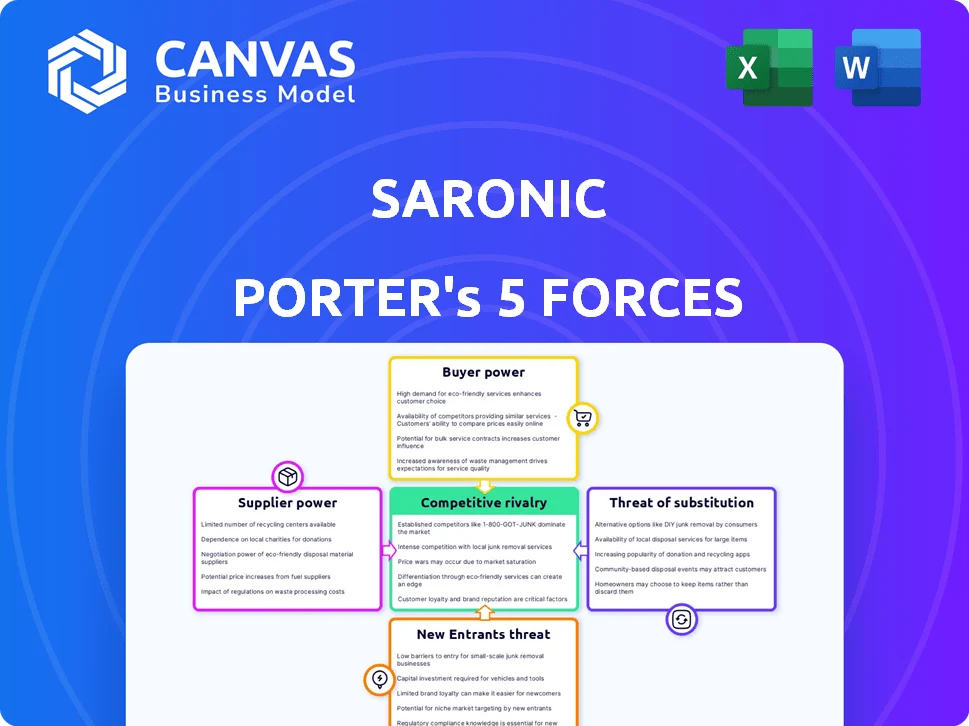
This preview shows the exact Saronic Porter's Five Forces analysis you'll receive-no placeholders or samples-fully formatted and ready for immediate download after purchase.

Original: $10.00
-65%$10.00
$3.50SARONIC PORTER'S FIVE FORCES TEMPLATE RESEARCH
From Overview to Strategy Blueprint
Saronic faces moderate buyer power and supplier concentration, with niche differentiation limiting substitutes but regulatory hurdles and new entrants keeping margins in check.
This brief snapshot only scratches the surface. Unlock the full Porter's Five Forces Analysis to explore Saronic's competitive dynamics, market pressures, and strategic advantages in detail.
Suppliers Bargaining Power
Specialized Semiconductor and AI Chip Dependency
Saronic's autonomy relies on specialized AI chips from few suppliers-NVIDIA and defense-grade vendors-creating high supplier power; NVIDIA's data-center GPU revenue hit $62.1B in FY2025, underscoring tight demand and pricing leverage.
With global AI chip shortages and lead times >24 weeks in 2025, Saronic faces limited substitutes, so supply shocks or price hikes would directly raise unit costs and slow edge-compute rollouts.
Proprietary Sensor Technology Integration
Saronic depends on few vendors for ruggedized Lidar, Radar, and sonar meeting MIL-SPEC; supplier concentration lets them set pricing and 12-24 week lead times, while top suppliers saw 18% revenue growth in 2025 as US Navy autonomous procurements rose 27% YOY to $1.9B.
Specialized Marine Propulsion and Battery Systems
The shift to long-endurance electric/hybrid propulsion makes Saronic highly dependent on advanced battery suppliers; global Li-ion cell capacity reached ~1,500 GWh in 2025, driven by automotive OEMs, squeezing defense demand.
High-energy-density cells face supply competition: battery raw material prices rose ~45% since 2020, and EV makers lock multi-year offtakes, raising supplier bargaining power over Saronic.
Cell production lead times extended to 18-24 months in 2025; without costly multi-year contracts or equity stakes, Saronic risks delayed scale-up and higher unit costs.
Software and Cybersecurity Compliance Partners
Operating in the defense sector forces Saronic to use vetted vendors; fewer than 50 DoD-approved suppliers provide encrypted comms and secure cloud services, raising switching costs and time-re-certification averages 9-18 months and can cost $0.5-2.0M per module.
Regulation concentration gives suppliers high bargaining power: vendors can command 12-25% premium pricing and impose long lead times, limiting Saronic's negotiation leverage and margin flexibility.
- DoD-approved suppliers: <50
- Re-certification time: 9-18 months
- Re-certification cost: $0.5-2.0M/module
- Supplier pricing premium: 12-25%
Skilled Labor and Engineering Talent
The supply of specialized roboticists and AI engineers is a critical input for Saronic, not a traditional material supplier; in 2025 the median total compensation for senior AI engineers hit about $300k, squeezing margins as Saronic competes with defense primes and Big Tech.
Poaching is common: 42% of advanced robotics hires left within 18 months across firms in 2025, raising replacement costs and extending product timelines by ~6-9 months when senior staff depart.
- High pay: median senior AI pay ≈ $300k (2025)
- Turnover: 42% leave within 18 months (2025)
- Time impact: departures add ~6-9 months to dev cycles
- Supplier power: elevates operational costs, enables talent-driven bargaining
Supplier power squeezes Saronic: chip, battery, and talent bottlenecks hit margins
Saronic faces high supplier power: NVIDIA DC GPU rev $62.1B (FY2025), AI chip lead times >24 weeks, Li-ion capacity ~1,500 GWh (2025), battery raw materials +45% since 2020, DoD-approved vendors <50, re-cert 9-18 months ($0.5-2.0M), senior AI median pay ~$300k, turnover 42% (2025).
| Metric | 2025 Value |
|---|---|
| NVIDIA DC GPU rev | $62.1B |
| AI chip lead time | >24 weeks |
| Li-ion capacity | ~1,500 GWh |
| Battery price change | +45% since 2020 |
| DoD vendors | <50 |
| Re-cert cost/time | $0.5-2.0M / 9-18m |
| Senior AI pay | $300k |
| Turnover | 42% |
What is included in the product
Detailed Word Document
Tailored exclusively for Saronic, this Porter's Five Forces overview uncovers key competitive drivers, supplier and buyer power, entry barriers, substitutes, and emergent threats shaping Saronic's pricing, profitability, and strategic positioning.
Customizable Excel Spreadsheet
Saronic Porter's Five Forces delivers a one-sheet, customizable snapshot that quantifies competitive pressure and outputs a radar chart-ideal for quick strategic decisions, slide-ready reporting, and easy integration into existing decks or dashboards.
Customers Bargaining Power
High Concentration of Government Buyers
The US Department of Defense-primarily the Navy-accounts for over 70% of Saronic's 2025 revenue, creating an oligopsony where the buyer sets pricing ceilings and strict milestones; DoD procurement totaled $842B in FY2025, concentrating bargaining power.
Stringent Performance and Reliability Standards
Buyers in the maritime defense sector demand near-perfect reliability in contested environments, enabling rejection of platforms that fail even minor tests; for Saronic Company this means meeting MIL-STD standards and achieving >99.9% mission availability demanded by navies.
Shift Toward Attritable and Low-Cost Mass
Saronic faces rising buyer power as the US Navy's attritable-systems push-aiming for unit prices often under $1M (e.g., Navy targets for attritable drones)-forces Saronic to cut per-unit cost, compressing gross margins.
Long Procurement and Budgetary Cycles
Government customers use multi-year budgets tied to Congress; in 2025 Congress approved $858 billion for defense, but program starts still slip, forcing Saronic to hold high liquidity to bridge the valley of death from prototype to Program of Record.
Delays or reprogramming give buyers structural power-a single pivot can defer millions in revenue and extend burn runway needs by 12-36 months, reshaping Saronic's roadmap and funding needs.
- 2025 US DoD budget: $858B
- Typical prototype-to-Procurement gap: 12-36 months
- Startup liquidity need: cover 12-36 months of burn
- Customer can delay/pivot funding, shifting roadmap
Interoperability and Open Architecture Requirements
Modern naval doctrine forces autonomous systems into unified command-and-control; the U.S. Navy's open-architecture mandate (ONW) reduces Saronic's lock-in and lowers switching costs-recent Navy procurements show 60%+ of contracts require open APIs and NATO STANAG compatibility.
By requiring interoperability with competitor software, buyers can replace Saronic hardware if competitors offer 10-25% lower lifecycle costs or faster integration, increasing customer bargaining power and compressing margins.
- Naval policy: open-architecture mandate; 60%+ contracts require APIs
- Interoperability: NATO STANAG compliance expected
- Price pressure: potential 10-25% lifecycle cost swaps
- Switching risk: lower lock-in, higher buyer leverage
DoD Dominance: Saronic's 70% Revenue Risk-99.9% Uptime, <$1M Units, 12-36m Cash Crunch
The US DoD (mainly Navy) drives >70% of Saronic's 2025 revenue, giving buyers oligopsony power-DoD FY2025 procurement $842B, defense budget $858B-demanding >99.9% mission availability, MIL-STD/STANAG compliance, open-architecture (60%+ contracts), and price targets (attritable units < $1M) that compress margins and force 12-36 month liquidity planning.
| Metric | 2025 Value |
|---|---|
| DoD procurement | $842B |
| Defense budget | $858B |
| Saronic rev share from DoD | >70% |
| Mission availability required | >99.9% |
| Open-architecture contracts | 60%+ |
| Attritable unit target | <$1M |
| Prototype-to-Procurement gap | 12-36 months |
What You See Is What You Get
Saronic Porter's Five Forces Analysis
This preview shows the exact Saronic Porter's Five Forces analysis you'll receive-no placeholders or samples-fully formatted and ready for immediate download after purchase.
Product Information
Product Information
Shipping & Returns
Shipping & Returns
Description
From Overview to Strategy Blueprint
Saronic faces moderate buyer power and supplier concentration, with niche differentiation limiting substitutes but regulatory hurdles and new entrants keeping margins in check.
This brief snapshot only scratches the surface. Unlock the full Porter's Five Forces Analysis to explore Saronic's competitive dynamics, market pressures, and strategic advantages in detail.
Suppliers Bargaining Power
Specialized Semiconductor and AI Chip Dependency
Saronic's autonomy relies on specialized AI chips from few suppliers-NVIDIA and defense-grade vendors-creating high supplier power; NVIDIA's data-center GPU revenue hit $62.1B in FY2025, underscoring tight demand and pricing leverage.
With global AI chip shortages and lead times >24 weeks in 2025, Saronic faces limited substitutes, so supply shocks or price hikes would directly raise unit costs and slow edge-compute rollouts.
Proprietary Sensor Technology Integration
Saronic depends on few vendors for ruggedized Lidar, Radar, and sonar meeting MIL-SPEC; supplier concentration lets them set pricing and 12-24 week lead times, while top suppliers saw 18% revenue growth in 2025 as US Navy autonomous procurements rose 27% YOY to $1.9B.
Specialized Marine Propulsion and Battery Systems
The shift to long-endurance electric/hybrid propulsion makes Saronic highly dependent on advanced battery suppliers; global Li-ion cell capacity reached ~1,500 GWh in 2025, driven by automotive OEMs, squeezing defense demand.
High-energy-density cells face supply competition: battery raw material prices rose ~45% since 2020, and EV makers lock multi-year offtakes, raising supplier bargaining power over Saronic.
Cell production lead times extended to 18-24 months in 2025; without costly multi-year contracts or equity stakes, Saronic risks delayed scale-up and higher unit costs.
Software and Cybersecurity Compliance Partners
Operating in the defense sector forces Saronic to use vetted vendors; fewer than 50 DoD-approved suppliers provide encrypted comms and secure cloud services, raising switching costs and time-re-certification averages 9-18 months and can cost $0.5-2.0M per module.
Regulation concentration gives suppliers high bargaining power: vendors can command 12-25% premium pricing and impose long lead times, limiting Saronic's negotiation leverage and margin flexibility.
- DoD-approved suppliers: <50
- Re-certification time: 9-18 months
- Re-certification cost: $0.5-2.0M/module
- Supplier pricing premium: 12-25%
Skilled Labor and Engineering Talent
The supply of specialized roboticists and AI engineers is a critical input for Saronic, not a traditional material supplier; in 2025 the median total compensation for senior AI engineers hit about $300k, squeezing margins as Saronic competes with defense primes and Big Tech.
Poaching is common: 42% of advanced robotics hires left within 18 months across firms in 2025, raising replacement costs and extending product timelines by ~6-9 months when senior staff depart.
- High pay: median senior AI pay ≈ $300k (2025)
- Turnover: 42% leave within 18 months (2025)
- Time impact: departures add ~6-9 months to dev cycles
- Supplier power: elevates operational costs, enables talent-driven bargaining
Supplier power squeezes Saronic: chip, battery, and talent bottlenecks hit margins
Saronic faces high supplier power: NVIDIA DC GPU rev $62.1B (FY2025), AI chip lead times >24 weeks, Li-ion capacity ~1,500 GWh (2025), battery raw materials +45% since 2020, DoD-approved vendors <50, re-cert 9-18 months ($0.5-2.0M), senior AI median pay ~$300k, turnover 42% (2025).
| Metric | 2025 Value |
|---|---|
| NVIDIA DC GPU rev | $62.1B |
| AI chip lead time | >24 weeks |
| Li-ion capacity | ~1,500 GWh |
| Battery price change | +45% since 2020 |
| DoD vendors | <50 |
| Re-cert cost/time | $0.5-2.0M / 9-18m |
| Senior AI pay | $300k |
| Turnover | 42% |
What is included in the product
Detailed Word Document
Tailored exclusively for Saronic, this Porter's Five Forces overview uncovers key competitive drivers, supplier and buyer power, entry barriers, substitutes, and emergent threats shaping Saronic's pricing, profitability, and strategic positioning.
Customizable Excel Spreadsheet
Saronic Porter's Five Forces delivers a one-sheet, customizable snapshot that quantifies competitive pressure and outputs a radar chart-ideal for quick strategic decisions, slide-ready reporting, and easy integration into existing decks or dashboards.
Customers Bargaining Power
High Concentration of Government Buyers
The US Department of Defense-primarily the Navy-accounts for over 70% of Saronic's 2025 revenue, creating an oligopsony where the buyer sets pricing ceilings and strict milestones; DoD procurement totaled $842B in FY2025, concentrating bargaining power.
Stringent Performance and Reliability Standards
Buyers in the maritime defense sector demand near-perfect reliability in contested environments, enabling rejection of platforms that fail even minor tests; for Saronic Company this means meeting MIL-STD standards and achieving >99.9% mission availability demanded by navies.
Shift Toward Attritable and Low-Cost Mass
Saronic faces rising buyer power as the US Navy's attritable-systems push-aiming for unit prices often under $1M (e.g., Navy targets for attritable drones)-forces Saronic to cut per-unit cost, compressing gross margins.
Long Procurement and Budgetary Cycles
Government customers use multi-year budgets tied to Congress; in 2025 Congress approved $858 billion for defense, but program starts still slip, forcing Saronic to hold high liquidity to bridge the valley of death from prototype to Program of Record.
Delays or reprogramming give buyers structural power-a single pivot can defer millions in revenue and extend burn runway needs by 12-36 months, reshaping Saronic's roadmap and funding needs.
- 2025 US DoD budget: $858B
- Typical prototype-to-Procurement gap: 12-36 months
- Startup liquidity need: cover 12-36 months of burn
- Customer can delay/pivot funding, shifting roadmap
Interoperability and Open Architecture Requirements
Modern naval doctrine forces autonomous systems into unified command-and-control; the U.S. Navy's open-architecture mandate (ONW) reduces Saronic's lock-in and lowers switching costs-recent Navy procurements show 60%+ of contracts require open APIs and NATO STANAG compatibility.
By requiring interoperability with competitor software, buyers can replace Saronic hardware if competitors offer 10-25% lower lifecycle costs or faster integration, increasing customer bargaining power and compressing margins.
- Naval policy: open-architecture mandate; 60%+ contracts require APIs
- Interoperability: NATO STANAG compliance expected
- Price pressure: potential 10-25% lifecycle cost swaps
- Switching risk: lower lock-in, higher buyer leverage
DoD Dominance: Saronic's 70% Revenue Risk-99.9% Uptime, <$1M Units, 12-36m Cash Crunch
The US DoD (mainly Navy) drives >70% of Saronic's 2025 revenue, giving buyers oligopsony power-DoD FY2025 procurement $842B, defense budget $858B-demanding >99.9% mission availability, MIL-STD/STANAG compliance, open-architecture (60%+ contracts), and price targets (attritable units < $1M) that compress margins and force 12-36 month liquidity planning.
| Metric | 2025 Value |
|---|---|
| DoD procurement | $842B |
| Defense budget | $858B |
| Saronic rev share from DoD | >70% |
| Mission availability required | >99.9% |
| Open-architecture contracts | 60%+ |
| Attritable unit target | <$1M |
| Prototype-to-Procurement gap | 12-36 months |
What You See Is What You Get
Saronic Porter's Five Forces Analysis
This preview shows the exact Saronic Porter's Five Forces analysis you'll receive-no placeholders or samples-fully formatted and ready for immediate download after purchase.