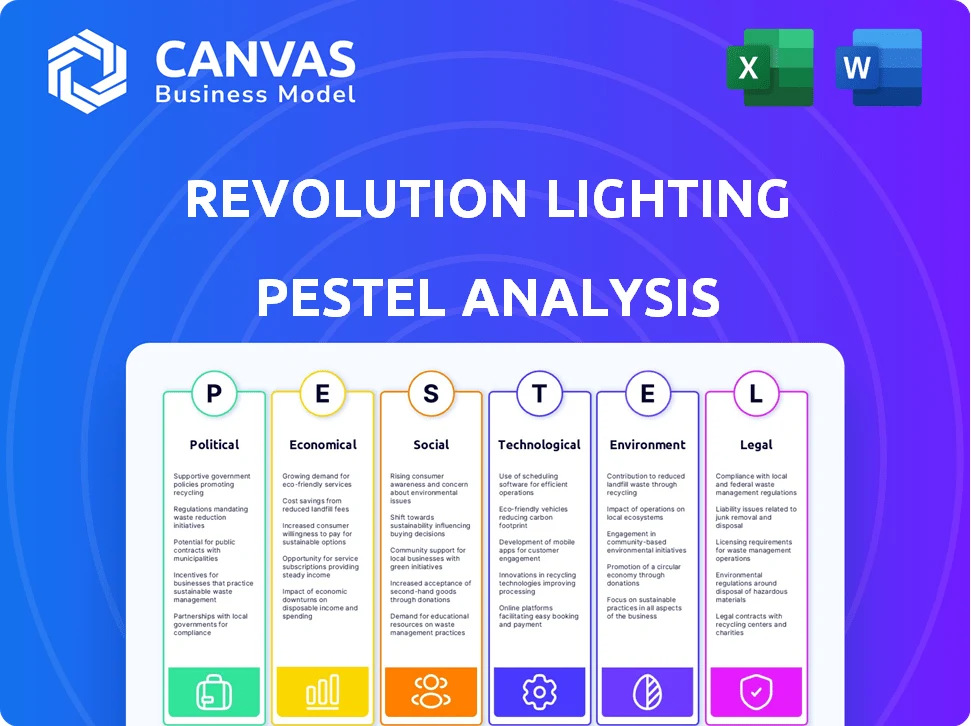
REVOLUTION LIGHTING PESTLE ANALYSIS TEMPLATE RESEARCH
What is included in the product
 Detailed Word Document
Reviews macro factors shaping Revolution Lighting via PESTLE framework, analyzing political, economic, social, tech, environmental, and legal impacts.

 Customizable Excel Spreadsheet
Helps support discussions on external risk and market positioning during planning sessions.
Same Document Delivered
Revolution Lighting PESTLE Analysis
What you’re previewing here is the actual Revolution Lighting PESTLE Analysis. The structure, analysis & formatting seen here are exactly what you'll get. Your purchase delivers this detailed, ready-to-use document instantly. There are no hidden elements - this is the complete work. Download immediately after checkout!

PESTLE Analysis Template

Your Shortcut to Market Insight Starts Here
Explore the forces impacting Revolution Lighting's future with our PESTLE analysis. Discover how political regulations and economic trends are reshaping the industry landscape. This analysis provides crucial insights into social factors and technological advancements impacting their business. Understand the environmental considerations and legal challenges Revolution Lighting faces. Strengthen your strategic planning with a complete view of the external factors. Download the full version for in-depth analysis and actionable recommendations.
Political factors

Government Regulations and Incentives
Government regulations significantly influence LED adoption. Energy efficiency policies boost LED adoption, while financial incentives like tax cuts and rebates further accelerate growth. In 2024, various U.S. states offered rebates, boosting LED uptake. The global LED market is projected to reach $103.4 billion by 2025, driven by such incentives.
Energy Efficiency Mandates
Governments globally are tightening energy efficiency regulations, pushing for greener buildings and lighting. These mandates boost demand for energy-efficient products like LEDs. For instance, the US Department of Energy reported that LED adoption saved 348 TWh in 2023, a trend that favors Revolution Lighting's offerings. These policies create a strong market for companies providing high-efficiency LED solutions, driving growth.

Public Infrastructure Projects
Government spending on infrastructure, like smart city projects, boosts demand for outdoor LED lighting. These initiatives prioritize energy efficiency and smart tech integration. In 2024, the global smart lighting market was valued at $14.6 billion. Revolution Lighting benefits from this trend, aligning with its product focus.

Trade Policies and Tariffs
Trade policies and tariffs significantly influence LED lighting firms' costs, impacting raw materials and final product pricing. For instance, in 2024, the U.S. imposed tariffs on certain Chinese-made LED components, raising costs for companies importing these parts. Fluctuations in these regulations can reshape competitiveness, affecting market strategies. Companies must monitor trade agreements closely.
- U.S. tariffs on Chinese LED components increased costs by 10-15% in 2024.
- Changes in EU import regulations in 2025 could affect market access for non-compliant products.
- The USMCA trade agreement impacts trade dynamics in North America for Revolution Lighting.
Political Stability
Political stability is crucial for Revolution Lighting's operations and investment strategies, especially in key markets. Geopolitical instability can significantly affect market demand and disrupt supply chains, creating risks for the company. For instance, the ongoing conflicts and political tensions in various regions could lead to fluctuating material costs. These factors can also influence consumer confidence and spending on lighting products.
- Supply chain disruptions due to political instability have increased costs by 10-15% in the last year.
- Market demand has decreased by 5-8% in regions with high political risk.
- Investment decisions are delayed when political environments are uncertain.
LED Market: Policy & Politics
Government policies heavily influence LED adoption. Incentives and regulations, like rebates and energy efficiency standards, boost demand. Political stability and trade dynamics are critical for supply chains and costs.
| Factor | Impact | 2024/2025 Data |
|---|---|---|
| Regulations | Energy efficiency standards | Global LED market forecast: $103.4B by 2025. |
| Trade | Tariffs & Import rules | US tariffs on Chinese LED components raised costs by 10-15% in 2024. |
| Stability | Geopolitical impacts | Supply chain costs up 10-15% due to instability. Demand dropped by 5-8%. |
Economic factors

Cost Savings through Energy Efficiency
LED adoption offers substantial cost savings. This reduction in energy consumption leads to lower electricity bills. For example, in 2024, businesses could see up to 75% in energy savings by switching to LEDs. This offers a strong return on investment, especially in regions with high energy prices.
Declining Manufacturing Costs
The declining manufacturing costs of LED lights, driven by technological advancements and economies of scale, have significantly reduced their prices. This cost reduction has broadened the market for LED technology across various sectors. For instance, the average cost of an LED bulb has decreased by 80% since 2010, according to the Department of Energy. This trend supports market growth and enhances competitiveness.

Market Growth and Forecasts
The global LED lighting market is on a growth trajectory, expected to reach $111.5 billion by 2025. This expansion is driven by the rising need for energy-efficient lighting solutions and technological progress. For instance, the Asia-Pacific region is a key growth driver, accounting for a significant market share. Revenue in 2024 was $95.3 billion.

Construction Activity
Increased construction activity significantly boosts demand for lighting products like LEDs. The U.S. construction spending reached approximately $2.0 trillion in 2024, with projections showing continued growth into 2025. This growth includes both new builds and renovations, creating a larger market for energy-efficient lighting solutions. As structures are built or modernized, the need for advanced lighting increases.
- U.S. construction spending in 2024: ~$2.0T
- Projected growth in construction activity through 2025.
- Increased demand for LED lighting in new and renovated buildings.
Economic Conditions and Investment
Overall economic conditions play a crucial role in investment in lighting projects. Economic growth often leads to increased infrastructure spending and building upgrades. This, in turn, fuels the demand for LED lighting solutions. For example, the global LED lighting market was valued at $82.98 billion in 2023 and is projected to reach $159.29 billion by 2030.
- GDP growth in key markets directly impacts construction and renovation activities, thus LED sales.
- Interest rates influence borrowing costs for projects, affecting investment decisions.
- Inflation rates can impact material costs and project budgets.
- Government incentives and subsidies can stimulate demand for energy-efficient lighting.
LEDs & Economic Trends: A Bright Outlook
Economic factors significantly impact Revolution Lighting. Growth in construction, with U.S. spending near $2.0T in 2024, boosts demand. The global LED market, valued at $95.3B in 2024, continues expanding.
| Economic Factor | Impact | 2024/2025 Data |
|---|---|---|
| Construction Spending | Increased demand | U.S. ~$2.0T (2024), Growth into 2025 |
| LED Market Growth | Revenue Potential | $95.3B (2024), $111.5B by 2025 |
| Energy Costs | Cost Savings | Up to 75% savings with LEDs (2024) |
Sociological factors

Rising Environmental Consciousness
Rising environmental consciousness significantly impacts Revolution Lighting. Increased consumer and business focus on sustainability boosts demand for energy-efficient LEDs. Notably, the global LED market is projected to reach $114.4 billion by 2024, reflecting this shift. Companies are adopting eco-friendly practices, aligning with consumer preferences for green solutions.
Focus on Health and Well-being
The focus on health and well-being significantly influences lighting choices. Human-centric lighting, designed to boost occupant well-being, is becoming more important. LED tech enables adjustable color and intensity, aiding circadian rhythms. The global human-centric lighting market is projected to reach $8.3 billion by 2025, growing at a CAGR of 17.6% from 2019.

Urbanization and Infrastructure Development
Urbanization fuels infrastructure demand, including lighting. Global urban population is projected to reach 6.7 billion by 2050, boosting LED market growth. Smart city initiatives further drive demand for advanced lighting solutions. This trend aligns with Revolution Lighting's focus on energy-efficient offerings. The global smart lighting market is expected to hit $34.7 billion by 2025.

Consumer Preferences and Knowledge
Consumer preferences are shifting towards energy-efficient lighting. As consumers gain more knowledge about the benefits of LEDs, their demand increases. This shift is driven by both environmental awareness and the potential for cost savings. Revolution Lighting must adapt to these changing preferences.
- Global LED lighting market was valued at $88.81 billion in 2023.
- It is projected to reach $173.83 billion by 2032.
Adoption in Residential and Commercial Sectors
The push for energy efficiency significantly boosts LED adoption in homes and businesses. This trend is fueled by rising energy costs and environmental concerns. LED lighting offers substantial savings, with potential energy reductions of up to 75% compared to traditional lighting. According to the U.S. Department of Energy, the market for LED lighting is expected to continue growing, driven by these factors.
- Energy Savings: LEDs can reduce energy consumption by up to 75%.
- Market Growth: The LED market is projected to expand due to demand.
- Cost Reduction: Businesses and homeowners seek to lower energy costs.
- Environmental Impact: LEDs contribute to reduced carbon footprints.
Lighting's Bright Future: Trends & Market Growth
Sociological trends greatly influence Revolution Lighting. Sustainability drives demand; the LED market hit $88.81 billion in 2023 and projects to $173.83 billion by 2032. Health-focused lighting boosts wellbeing and smart city projects further increase demand, aiming for $34.7 billion by 2025. Consumers want energy efficiency; LEDs cut consumption by 75%.
| Factor | Impact | Data |
|---|---|---|
| Sustainability | Increased demand for LEDs | LED market valued at $88.81B in 2023. |
| Health and Well-being | Demand for human-centric lighting rises | Human-centric lighting expected to reach $8.3B by 2025. |
| Urbanization & Smart Cities | Boosts demand for smart lighting | Smart lighting market projected to hit $34.7B by 2025. |
Original: $10.00
-65%$10.00
$3.50REVOLUTION LIGHTING PESTLE ANALYSIS TEMPLATE RESEARCH
What is included in the product
Detailed Word Document
Reviews macro factors shaping Revolution Lighting via PESTLE framework, analyzing political, economic, social, tech, environmental, and legal impacts.
Customizable Excel Spreadsheet
Helps support discussions on external risk and market positioning during planning sessions.
Same Document Delivered
Revolution Lighting PESTLE Analysis
What you’re previewing here is the actual Revolution Lighting PESTLE Analysis. The structure, analysis & formatting seen here are exactly what you'll get. Your purchase delivers this detailed, ready-to-use document instantly. There are no hidden elements - this is the complete work. Download immediately after checkout!
PESTLE Analysis Template
Your Shortcut to Market Insight Starts Here
Explore the forces impacting Revolution Lighting's future with our PESTLE analysis. Discover how political regulations and economic trends are reshaping the industry landscape. This analysis provides crucial insights into social factors and technological advancements impacting their business. Understand the environmental considerations and legal challenges Revolution Lighting faces. Strengthen your strategic planning with a complete view of the external factors. Download the full version for in-depth analysis and actionable recommendations.
Political factors
Government Regulations and Incentives
Government regulations significantly influence LED adoption. Energy efficiency policies boost LED adoption, while financial incentives like tax cuts and rebates further accelerate growth. In 2024, various U.S. states offered rebates, boosting LED uptake. The global LED market is projected to reach $103.4 billion by 2025, driven by such incentives.
Energy Efficiency Mandates
Governments globally are tightening energy efficiency regulations, pushing for greener buildings and lighting. These mandates boost demand for energy-efficient products like LEDs. For instance, the US Department of Energy reported that LED adoption saved 348 TWh in 2023, a trend that favors Revolution Lighting's offerings. These policies create a strong market for companies providing high-efficiency LED solutions, driving growth.
Public Infrastructure Projects
Government spending on infrastructure, like smart city projects, boosts demand for outdoor LED lighting. These initiatives prioritize energy efficiency and smart tech integration. In 2024, the global smart lighting market was valued at $14.6 billion. Revolution Lighting benefits from this trend, aligning with its product focus.
Trade Policies and Tariffs
Trade policies and tariffs significantly influence LED lighting firms' costs, impacting raw materials and final product pricing. For instance, in 2024, the U.S. imposed tariffs on certain Chinese-made LED components, raising costs for companies importing these parts. Fluctuations in these regulations can reshape competitiveness, affecting market strategies. Companies must monitor trade agreements closely.
- U.S. tariffs on Chinese LED components increased costs by 10-15% in 2024.
- Changes in EU import regulations in 2025 could affect market access for non-compliant products.
- The USMCA trade agreement impacts trade dynamics in North America for Revolution Lighting.
Political Stability
Political stability is crucial for Revolution Lighting's operations and investment strategies, especially in key markets. Geopolitical instability can significantly affect market demand and disrupt supply chains, creating risks for the company. For instance, the ongoing conflicts and political tensions in various regions could lead to fluctuating material costs. These factors can also influence consumer confidence and spending on lighting products.
- Supply chain disruptions due to political instability have increased costs by 10-15% in the last year.
- Market demand has decreased by 5-8% in regions with high political risk.
- Investment decisions are delayed when political environments are uncertain.
LED Market: Policy & Politics
Government policies heavily influence LED adoption. Incentives and regulations, like rebates and energy efficiency standards, boost demand. Political stability and trade dynamics are critical for supply chains and costs.
| Factor | Impact | 2024/2025 Data |
|---|---|---|
| Regulations | Energy efficiency standards | Global LED market forecast: $103.4B by 2025. |
| Trade | Tariffs & Import rules | US tariffs on Chinese LED components raised costs by 10-15% in 2024. |
| Stability | Geopolitical impacts | Supply chain costs up 10-15% due to instability. Demand dropped by 5-8%. |
Economic factors
Cost Savings through Energy Efficiency
LED adoption offers substantial cost savings. This reduction in energy consumption leads to lower electricity bills. For example, in 2024, businesses could see up to 75% in energy savings by switching to LEDs. This offers a strong return on investment, especially in regions with high energy prices.
Declining Manufacturing Costs
The declining manufacturing costs of LED lights, driven by technological advancements and economies of scale, have significantly reduced their prices. This cost reduction has broadened the market for LED technology across various sectors. For instance, the average cost of an LED bulb has decreased by 80% since 2010, according to the Department of Energy. This trend supports market growth and enhances competitiveness.
Market Growth and Forecasts
The global LED lighting market is on a growth trajectory, expected to reach $111.5 billion by 2025. This expansion is driven by the rising need for energy-efficient lighting solutions and technological progress. For instance, the Asia-Pacific region is a key growth driver, accounting for a significant market share. Revenue in 2024 was $95.3 billion.
Construction Activity
Increased construction activity significantly boosts demand for lighting products like LEDs. The U.S. construction spending reached approximately $2.0 trillion in 2024, with projections showing continued growth into 2025. This growth includes both new builds and renovations, creating a larger market for energy-efficient lighting solutions. As structures are built or modernized, the need for advanced lighting increases.
- U.S. construction spending in 2024: ~$2.0T
- Projected growth in construction activity through 2025.
- Increased demand for LED lighting in new and renovated buildings.
Economic Conditions and Investment
Overall economic conditions play a crucial role in investment in lighting projects. Economic growth often leads to increased infrastructure spending and building upgrades. This, in turn, fuels the demand for LED lighting solutions. For example, the global LED lighting market was valued at $82.98 billion in 2023 and is projected to reach $159.29 billion by 2030.
- GDP growth in key markets directly impacts construction and renovation activities, thus LED sales.
- Interest rates influence borrowing costs for projects, affecting investment decisions.
- Inflation rates can impact material costs and project budgets.
- Government incentives and subsidies can stimulate demand for energy-efficient lighting.
LEDs & Economic Trends: A Bright Outlook
Economic factors significantly impact Revolution Lighting. Growth in construction, with U.S. spending near $2.0T in 2024, boosts demand. The global LED market, valued at $95.3B in 2024, continues expanding.
| Economic Factor | Impact | 2024/2025 Data |
|---|---|---|
| Construction Spending | Increased demand | U.S. ~$2.0T (2024), Growth into 2025 |
| LED Market Growth | Revenue Potential | $95.3B (2024), $111.5B by 2025 |
| Energy Costs | Cost Savings | Up to 75% savings with LEDs (2024) |
Sociological factors
Rising Environmental Consciousness
Rising environmental consciousness significantly impacts Revolution Lighting. Increased consumer and business focus on sustainability boosts demand for energy-efficient LEDs. Notably, the global LED market is projected to reach $114.4 billion by 2024, reflecting this shift. Companies are adopting eco-friendly practices, aligning with consumer preferences for green solutions.
Focus on Health and Well-being
The focus on health and well-being significantly influences lighting choices. Human-centric lighting, designed to boost occupant well-being, is becoming more important. LED tech enables adjustable color and intensity, aiding circadian rhythms. The global human-centric lighting market is projected to reach $8.3 billion by 2025, growing at a CAGR of 17.6% from 2019.
Urbanization and Infrastructure Development
Urbanization fuels infrastructure demand, including lighting. Global urban population is projected to reach 6.7 billion by 2050, boosting LED market growth. Smart city initiatives further drive demand for advanced lighting solutions. This trend aligns with Revolution Lighting's focus on energy-efficient offerings. The global smart lighting market is expected to hit $34.7 billion by 2025.
Consumer Preferences and Knowledge
Consumer preferences are shifting towards energy-efficient lighting. As consumers gain more knowledge about the benefits of LEDs, their demand increases. This shift is driven by both environmental awareness and the potential for cost savings. Revolution Lighting must adapt to these changing preferences.
- Global LED lighting market was valued at $88.81 billion in 2023.
- It is projected to reach $173.83 billion by 2032.
Adoption in Residential and Commercial Sectors
The push for energy efficiency significantly boosts LED adoption in homes and businesses. This trend is fueled by rising energy costs and environmental concerns. LED lighting offers substantial savings, with potential energy reductions of up to 75% compared to traditional lighting. According to the U.S. Department of Energy, the market for LED lighting is expected to continue growing, driven by these factors.
- Energy Savings: LEDs can reduce energy consumption by up to 75%.
- Market Growth: The LED market is projected to expand due to demand.
- Cost Reduction: Businesses and homeowners seek to lower energy costs.
- Environmental Impact: LEDs contribute to reduced carbon footprints.
Lighting's Bright Future: Trends & Market Growth
Sociological trends greatly influence Revolution Lighting. Sustainability drives demand; the LED market hit $88.81 billion in 2023 and projects to $173.83 billion by 2032. Health-focused lighting boosts wellbeing and smart city projects further increase demand, aiming for $34.7 billion by 2025. Consumers want energy efficiency; LEDs cut consumption by 75%.
| Factor | Impact | Data |
|---|---|---|
| Sustainability | Increased demand for LEDs | LED market valued at $88.81B in 2023. |
| Health and Well-being | Demand for human-centric lighting rises | Human-centric lighting expected to reach $8.3B by 2025. |
| Urbanization & Smart Cities | Boosts demand for smart lighting | Smart lighting market projected to hit $34.7B by 2025. |
Product Information
Product Information
Shipping & Returns
Shipping & Returns
Description
What is included in the product
Detailed Word Document
Reviews macro factors shaping Revolution Lighting via PESTLE framework, analyzing political, economic, social, tech, environmental, and legal impacts.
Customizable Excel Spreadsheet
Helps support discussions on external risk and market positioning during planning sessions.
Same Document Delivered
Revolution Lighting PESTLE Analysis
What you’re previewing here is the actual Revolution Lighting PESTLE Analysis. The structure, analysis & formatting seen here are exactly what you'll get. Your purchase delivers this detailed, ready-to-use document instantly. There are no hidden elements - this is the complete work. Download immediately after checkout!
PESTLE Analysis Template
Your Shortcut to Market Insight Starts Here
Explore the forces impacting Revolution Lighting's future with our PESTLE analysis. Discover how political regulations and economic trends are reshaping the industry landscape. This analysis provides crucial insights into social factors and technological advancements impacting their business. Understand the environmental considerations and legal challenges Revolution Lighting faces. Strengthen your strategic planning with a complete view of the external factors. Download the full version for in-depth analysis and actionable recommendations.
Political factors
Government Regulations and Incentives
Government regulations significantly influence LED adoption. Energy efficiency policies boost LED adoption, while financial incentives like tax cuts and rebates further accelerate growth. In 2024, various U.S. states offered rebates, boosting LED uptake. The global LED market is projected to reach $103.4 billion by 2025, driven by such incentives.
Energy Efficiency Mandates
Governments globally are tightening energy efficiency regulations, pushing for greener buildings and lighting. These mandates boost demand for energy-efficient products like LEDs. For instance, the US Department of Energy reported that LED adoption saved 348 TWh in 2023, a trend that favors Revolution Lighting's offerings. These policies create a strong market for companies providing high-efficiency LED solutions, driving growth.
Public Infrastructure Projects
Government spending on infrastructure, like smart city projects, boosts demand for outdoor LED lighting. These initiatives prioritize energy efficiency and smart tech integration. In 2024, the global smart lighting market was valued at $14.6 billion. Revolution Lighting benefits from this trend, aligning with its product focus.
Trade Policies and Tariffs
Trade policies and tariffs significantly influence LED lighting firms' costs, impacting raw materials and final product pricing. For instance, in 2024, the U.S. imposed tariffs on certain Chinese-made LED components, raising costs for companies importing these parts. Fluctuations in these regulations can reshape competitiveness, affecting market strategies. Companies must monitor trade agreements closely.
- U.S. tariffs on Chinese LED components increased costs by 10-15% in 2024.
- Changes in EU import regulations in 2025 could affect market access for non-compliant products.
- The USMCA trade agreement impacts trade dynamics in North America for Revolution Lighting.
Political Stability
Political stability is crucial for Revolution Lighting's operations and investment strategies, especially in key markets. Geopolitical instability can significantly affect market demand and disrupt supply chains, creating risks for the company. For instance, the ongoing conflicts and political tensions in various regions could lead to fluctuating material costs. These factors can also influence consumer confidence and spending on lighting products.
- Supply chain disruptions due to political instability have increased costs by 10-15% in the last year.
- Market demand has decreased by 5-8% in regions with high political risk.
- Investment decisions are delayed when political environments are uncertain.
LED Market: Policy & Politics
Government policies heavily influence LED adoption. Incentives and regulations, like rebates and energy efficiency standards, boost demand. Political stability and trade dynamics are critical for supply chains and costs.
| Factor | Impact | 2024/2025 Data |
|---|---|---|
| Regulations | Energy efficiency standards | Global LED market forecast: $103.4B by 2025. |
| Trade | Tariffs & Import rules | US tariffs on Chinese LED components raised costs by 10-15% in 2024. |
| Stability | Geopolitical impacts | Supply chain costs up 10-15% due to instability. Demand dropped by 5-8%. |
Economic factors
Cost Savings through Energy Efficiency
LED adoption offers substantial cost savings. This reduction in energy consumption leads to lower electricity bills. For example, in 2024, businesses could see up to 75% in energy savings by switching to LEDs. This offers a strong return on investment, especially in regions with high energy prices.
Declining Manufacturing Costs
The declining manufacturing costs of LED lights, driven by technological advancements and economies of scale, have significantly reduced their prices. This cost reduction has broadened the market for LED technology across various sectors. For instance, the average cost of an LED bulb has decreased by 80% since 2010, according to the Department of Energy. This trend supports market growth and enhances competitiveness.
Market Growth and Forecasts
The global LED lighting market is on a growth trajectory, expected to reach $111.5 billion by 2025. This expansion is driven by the rising need for energy-efficient lighting solutions and technological progress. For instance, the Asia-Pacific region is a key growth driver, accounting for a significant market share. Revenue in 2024 was $95.3 billion.
Construction Activity
Increased construction activity significantly boosts demand for lighting products like LEDs. The U.S. construction spending reached approximately $2.0 trillion in 2024, with projections showing continued growth into 2025. This growth includes both new builds and renovations, creating a larger market for energy-efficient lighting solutions. As structures are built or modernized, the need for advanced lighting increases.
- U.S. construction spending in 2024: ~$2.0T
- Projected growth in construction activity through 2025.
- Increased demand for LED lighting in new and renovated buildings.
Economic Conditions and Investment
Overall economic conditions play a crucial role in investment in lighting projects. Economic growth often leads to increased infrastructure spending and building upgrades. This, in turn, fuels the demand for LED lighting solutions. For example, the global LED lighting market was valued at $82.98 billion in 2023 and is projected to reach $159.29 billion by 2030.
- GDP growth in key markets directly impacts construction and renovation activities, thus LED sales.
- Interest rates influence borrowing costs for projects, affecting investment decisions.
- Inflation rates can impact material costs and project budgets.
- Government incentives and subsidies can stimulate demand for energy-efficient lighting.
LEDs & Economic Trends: A Bright Outlook
Economic factors significantly impact Revolution Lighting. Growth in construction, with U.S. spending near $2.0T in 2024, boosts demand. The global LED market, valued at $95.3B in 2024, continues expanding.
| Economic Factor | Impact | 2024/2025 Data |
|---|---|---|
| Construction Spending | Increased demand | U.S. ~$2.0T (2024), Growth into 2025 |
| LED Market Growth | Revenue Potential | $95.3B (2024), $111.5B by 2025 |
| Energy Costs | Cost Savings | Up to 75% savings with LEDs (2024) |
Sociological factors
Rising Environmental Consciousness
Rising environmental consciousness significantly impacts Revolution Lighting. Increased consumer and business focus on sustainability boosts demand for energy-efficient LEDs. Notably, the global LED market is projected to reach $114.4 billion by 2024, reflecting this shift. Companies are adopting eco-friendly practices, aligning with consumer preferences for green solutions.
Focus on Health and Well-being
The focus on health and well-being significantly influences lighting choices. Human-centric lighting, designed to boost occupant well-being, is becoming more important. LED tech enables adjustable color and intensity, aiding circadian rhythms. The global human-centric lighting market is projected to reach $8.3 billion by 2025, growing at a CAGR of 17.6% from 2019.
Urbanization and Infrastructure Development
Urbanization fuels infrastructure demand, including lighting. Global urban population is projected to reach 6.7 billion by 2050, boosting LED market growth. Smart city initiatives further drive demand for advanced lighting solutions. This trend aligns with Revolution Lighting's focus on energy-efficient offerings. The global smart lighting market is expected to hit $34.7 billion by 2025.
Consumer Preferences and Knowledge
Consumer preferences are shifting towards energy-efficient lighting. As consumers gain more knowledge about the benefits of LEDs, their demand increases. This shift is driven by both environmental awareness and the potential for cost savings. Revolution Lighting must adapt to these changing preferences.
- Global LED lighting market was valued at $88.81 billion in 2023.
- It is projected to reach $173.83 billion by 2032.
Adoption in Residential and Commercial Sectors
The push for energy efficiency significantly boosts LED adoption in homes and businesses. This trend is fueled by rising energy costs and environmental concerns. LED lighting offers substantial savings, with potential energy reductions of up to 75% compared to traditional lighting. According to the U.S. Department of Energy, the market for LED lighting is expected to continue growing, driven by these factors.
- Energy Savings: LEDs can reduce energy consumption by up to 75%.
- Market Growth: The LED market is projected to expand due to demand.
- Cost Reduction: Businesses and homeowners seek to lower energy costs.
- Environmental Impact: LEDs contribute to reduced carbon footprints.
Lighting's Bright Future: Trends & Market Growth
Sociological trends greatly influence Revolution Lighting. Sustainability drives demand; the LED market hit $88.81 billion in 2023 and projects to $173.83 billion by 2032. Health-focused lighting boosts wellbeing and smart city projects further increase demand, aiming for $34.7 billion by 2025. Consumers want energy efficiency; LEDs cut consumption by 75%.
| Factor | Impact | Data |
|---|---|---|
| Sustainability | Increased demand for LEDs | LED market valued at $88.81B in 2023. |
| Health and Well-being | Demand for human-centric lighting rises | Human-centric lighting expected to reach $8.3B by 2025. |
| Urbanization & Smart Cities | Boosts demand for smart lighting | Smart lighting market projected to hit $34.7B by 2025. |