RIGBY GROUP PLC PESTLE ANALYSIS TEMPLATE RESEARCH
What is included in the product
 Detailed Word Document
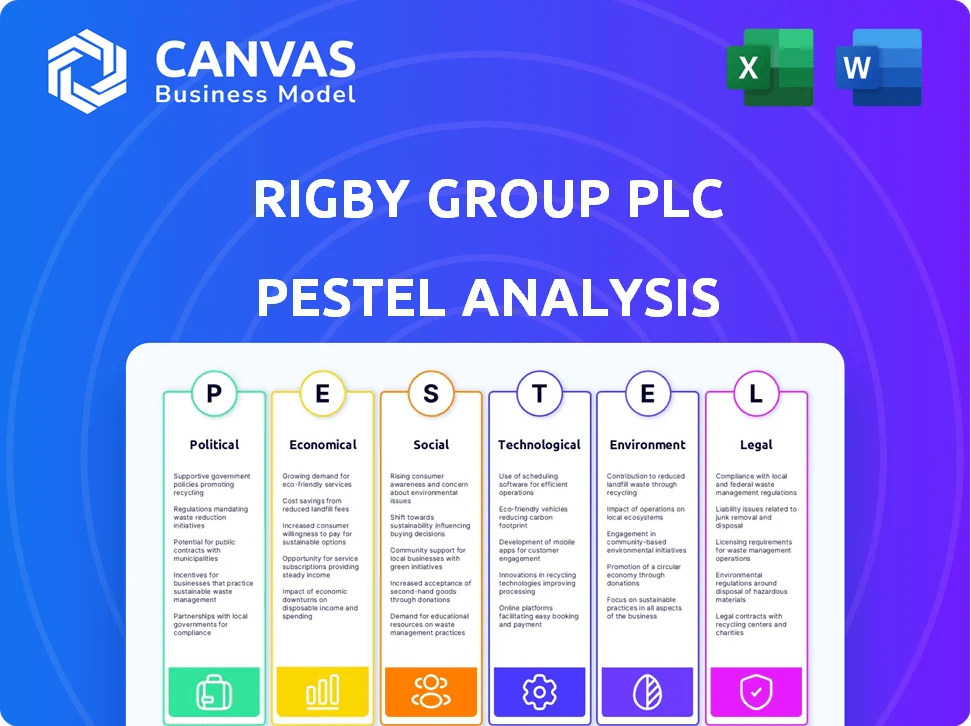
Analyzes external factors affecting Rigby Group PLC, including Political, Economic, Social, Technological, Environmental, and Legal dimensions.

 Customizable Excel Spreadsheet
Provides a concise version that can be dropped into PowerPoints or used in group planning sessions.
Preview the Actual Deliverable
Rigby Group PLC PESTLE Analysis
The content you're previewing provides a comprehensive PESTLE analysis of Rigby Group PLC. The detailed layout and insights visible here are exactly what you will download immediately after buying.

PESTLE Analysis Template

Make Smarter Strategic Decisions with a Complete PESTEL View
Gain critical insights into Rigby Group PLC with our expertly crafted PESTLE analysis. Uncover the impact of political, economic, social, technological, legal, and environmental factors shaping their strategies. This comprehensive analysis empowers informed decision-making and strategic planning. Download the full version to reveal invaluable market intelligence for your success.
Political factors

Government policies on technology and digital transformation
Government policies heavily influence Rigby Group's technology division, SCC. Initiatives like the UK government's £2.5 billion investment in AI could boost SCC's AI-related projects. Favorable policies, such as tax breaks for tech companies, can spur growth. Changes in government priorities, as seen with shifting cybersecurity regulations, pose challenges. SCC must adapt to navigate these political shifts effectively.
Political stability in operating regions
Operating across Europe, the Middle East, and Asia, Rigby Group faces varying political stability. Political instability in these regions could impact its airport, hotel, and real estate ventures. For example, political shifts in the Middle East could directly affect hotel occupancy rates. Recent data shows fluctuating tourism in Asia due to political tensions, influencing investment returns.

Trade agreements and international relations
Rigby Group, with its global footprint, is significantly influenced by trade agreements and international relations. For example, the UK's trade deal with the EU post-Brexit continues to shape its operational costs. Fluctuations in tariffs, like the 10% tariff on certain imported goods, directly impact profit margins. The company must navigate these dynamics to maintain market access and manage supply chains effectively.

Government support for infrastructure development
Government backing for infrastructure, especially in areas like airports and real estate, significantly influences Rigby Group. Increased government spending on these projects can create new avenues for Rigby's involved divisions. For example, in 2024, the UK government allocated £2.3 billion for transport infrastructure, potentially impacting Rigby's operations. Supportive policies drive operational gains.
- UK government's £2.3 billion investment in transport infrastructure in 2024.
- Infrastructure projects can bring new business opportunities.
- Improved operational efficiency due to better infrastructure.
Regulatory environment for diverse sectors
Rigby Group's varied interests mean it faces a complex regulatory landscape. The company must navigate sector-specific rules in tech, aviation, hospitality, real estate, and finance. For instance, the EU's GDPR significantly impacts data handling across all of its operations.
Stricter environmental standards could affect real estate and aviation units. Changes in labor laws also pose compliance challenges and could alter operational costs. The financial services sector is heavily regulated; any shifts in these rules could impact Rigby's financial practices.
- Data privacy regulations, like GDPR, continue to evolve, requiring ongoing compliance efforts.
- Environmental standards are becoming stricter, impacting sectors like real estate and aviation.
- Labor laws are subject to change, potentially affecting operational costs and practices.
- Financial services regulations are under constant review, influencing the group's financial strategies.
Political Forces: Shaping Business Strategies
Political factors significantly shape Rigby Group's operations. Government policies like the UK's £2.3 billion infrastructure investment in 2024 create opportunities. Trade agreements, such as post-Brexit deals, influence operational costs. Regulatory landscapes, like evolving GDPR, require continuous compliance, affecting strategy and finances.
| Political Factor | Impact | Data Point (2024/2025) |
|---|---|---|
| Government Spending | Infrastructure investment | UK allocated £2.3B in 2024. |
| Trade Agreements | Operational costs & Market Access | Post-Brexit deals reshaping trade. |
| Regulations | Compliance burdens | GDPR and data privacy regulations evolving. |
Economic factors

Economic growth and stability in key markets
Economic growth and stability significantly impact Rigby Group's performance across its technology, hotel, and real estate sectors. Strong economic conditions in the UK, where Rigby has a substantial presence, could lead to increased consumer spending and business investment. For example, the UK's GDP growth in 2024 is projected to be around 0.7%, potentially boosting demand for Rigby's services. Conversely, economic downturns could negatively affect these divisions.
Inflation and interest rates
Inflation, impacting operating costs, saw the UK's CPI at 3.2% in March 2024. Interest rates, crucial for borrowing, have the Bank of England's base rate at 5.25% as of May 2024. These factors affect Rigby Group's profitability and investment decisions. The company must monitor these indicators closely.

Currency exchange rates
Rigby Group's global operations mean currency exchange rates are crucial. Changes in rates can alter the value of international sales and costs. For example, a weaker GBP in 2024 could boost reported overseas revenue. Conversely, a stronger GBP could lower the value of foreign earnings.

Consumer spending and business investment levels
Consumer spending on travel and hospitality directly influences Rigby Group's airports and hotels. Business investment in tech and real estate affects its related sectors. High consumer and business confidence are vital economic signs for Rigby Group. In 2024, U.S. consumer spending grew, but business investment was mixed. This trend will continue into 2025.
- U.S. consumer spending increased by 2.5% in Q1 2024.
- Business investment in equipment saw a 1.9% rise in the same period.
- Hotel occupancy rates are projected to reach 68% by the end of 2024.
- Air travel is expected to grow by 4% in 2025.
Availability of credit and financing
Rigby Group PLC's expansion, including investments and acquisitions, is directly tied to credit and financing conditions. The company's ability to secure funding significantly impacts its growth plans. Fluctuations in interest rates and credit availability are critical. For instance, in 2024, the UK base rate stood at 5.25%, impacting borrowing costs.
- Changes in interest rates directly affect the cost of borrowing for Rigby Group.
- Availability of credit influences the feasibility of acquisitions and investment projects.
- Economic downturns can restrict credit, potentially slowing down Rigby Group's expansion.
- Strong credit markets provide opportunities for favorable financing terms.
Rigby Group PLC: Economic Climate's Influence
Economic factors profoundly influence Rigby Group PLC. The UK's projected 2024 GDP growth of 0.7% impacts consumer spending and business investment. Inflation, like the UK's 3.2% CPI in March 2024, and interest rates (5.25% in May 2024) affect costs and borrowing.
Currency exchange rates, especially the GBP's value, impact international sales revenue. U.S. consumer spending grew by 2.5% in Q1 2024, influencing travel and hospitality.
| Indicator | Value | Impact on Rigby |
|---|---|---|
| UK GDP Growth (2024) | 0.7% (Projected) | Affects Consumer Spending, Business Investment |
| UK CPI (March 2024) | 3.2% | Impacts Operating Costs |
| UK Base Rate (May 2024) | 5.25% | Influences Borrowing Costs |
Sociological factors

Demographic trends and population shifts
Demographic shifts significantly impact Rigby Group. An aging population could alter the workforce availability, potentially affecting operational costs. Population growth in key regions, like those seeing increased international travel, may boost demand for airport services. Data from 2024 shows a 1.2% increase in the global elderly population. This impacts the demand for Rigby Group's services.
Consumer behavior and lifestyle changes
Consumer behavior significantly shapes Rigby Group's strategies. The demand for digital services and sustainable practices is growing. For example, in 2024, online retail sales increased by 7%, and there was a 15% rise in eco-friendly travel bookings. Rigby must adapt to these trends.

Workforce trends and labor availability
Rigby Group PLC's tech divisions depend on skilled labor. Societal trends like education levels and workforce participation rates affect the ability to hire and keep employees. In 2024, the UK's labor participation rate was around 62.6%, influencing recruitment. Changing work attitudes also impact labor costs.

Cultural attitudes and social responsibility expectations
Societal shifts towards greater social responsibility significantly shape Rigby Group's operations and brand perception. Consumers and stakeholders increasingly prioritize ethical conduct, community engagement, and environmental sustainability. Companies demonstrating strong CSR initiatives often experience enhanced brand value and improved stakeholder relations. According to a 2024 study, 77% of consumers prefer brands committed to social causes.
- Consumer preferences increasingly favor socially responsible companies.
- Ethical practices and sustainability are key for positive brand image.
- Community involvement strengthens stakeholder relationships.
- Commitment to CSR can drive revenue growth.
Urbanization and infrastructure development
Urbanization drives demand for real estate and airport services. Rigby Group's investments are influenced by urban planning and development. For example, in 2024, urban population growth in the UK was around 0.8%. Infrastructure projects, such as high-speed rail, directly affect Rigby's strategic decisions. These factors are crucial for identifying growth opportunities.
- Urban population growth impacts real estate.
- Infrastructure projects influence investment locations.
- High-speed rail affects strategic decisions.
- Urban planning shapes investment choices.
Market Trends Shaping Business Strategies
Societal attitudes influence Rigby Group’s operations, with consumer demand shifting toward ethical and sustainable practices. Corporate Social Responsibility (CSR) initiatives impact brand value; a 2024 survey showed 77% of consumers favor socially responsible brands. Urbanization and infrastructure projects also steer investments.
| Factor | Impact | Data (2024) |
|---|---|---|
| Consumer Behavior | Demand for ethical and sustainable practices | Online retail sales rose by 7%, Eco-friendly travel up 15% |
| CSR | Enhances brand value, stakeholder relations | 77% consumers prefer socially responsible brands |
| Urbanization | Drives demand for services; real estate | UK urban population growth: ~0.8% |
RIGBY GROUP PLC PESTLE ANALYSIS TEMPLATE RESEARCH
What is included in the product
Detailed Word Document
Analyzes external factors affecting Rigby Group PLC, including Political, Economic, Social, Technological, Environmental, and Legal dimensions.
Customizable Excel Spreadsheet
Provides a concise version that can be dropped into PowerPoints or used in group planning sessions.
Preview the Actual Deliverable
Rigby Group PLC PESTLE Analysis
The content you're previewing provides a comprehensive PESTLE analysis of Rigby Group PLC. The detailed layout and insights visible here are exactly what you will download immediately after buying.
PESTLE Analysis Template
Make Smarter Strategic Decisions with a Complete PESTEL View
Gain critical insights into Rigby Group PLC with our expertly crafted PESTLE analysis. Uncover the impact of political, economic, social, technological, legal, and environmental factors shaping their strategies. This comprehensive analysis empowers informed decision-making and strategic planning. Download the full version to reveal invaluable market intelligence for your success.
Political factors
Government policies on technology and digital transformation
Government policies heavily influence Rigby Group's technology division, SCC. Initiatives like the UK government's £2.5 billion investment in AI could boost SCC's AI-related projects. Favorable policies, such as tax breaks for tech companies, can spur growth. Changes in government priorities, as seen with shifting cybersecurity regulations, pose challenges. SCC must adapt to navigate these political shifts effectively.
Political stability in operating regions
Operating across Europe, the Middle East, and Asia, Rigby Group faces varying political stability. Political instability in these regions could impact its airport, hotel, and real estate ventures. For example, political shifts in the Middle East could directly affect hotel occupancy rates. Recent data shows fluctuating tourism in Asia due to political tensions, influencing investment returns.
Trade agreements and international relations
Rigby Group, with its global footprint, is significantly influenced by trade agreements and international relations. For example, the UK's trade deal with the EU post-Brexit continues to shape its operational costs. Fluctuations in tariffs, like the 10% tariff on certain imported goods, directly impact profit margins. The company must navigate these dynamics to maintain market access and manage supply chains effectively.
Government support for infrastructure development
Government backing for infrastructure, especially in areas like airports and real estate, significantly influences Rigby Group. Increased government spending on these projects can create new avenues for Rigby's involved divisions. For example, in 2024, the UK government allocated £2.3 billion for transport infrastructure, potentially impacting Rigby's operations. Supportive policies drive operational gains.
- UK government's £2.3 billion investment in transport infrastructure in 2024.
- Infrastructure projects can bring new business opportunities.
- Improved operational efficiency due to better infrastructure.
Regulatory environment for diverse sectors
Rigby Group's varied interests mean it faces a complex regulatory landscape. The company must navigate sector-specific rules in tech, aviation, hospitality, real estate, and finance. For instance, the EU's GDPR significantly impacts data handling across all of its operations.
Stricter environmental standards could affect real estate and aviation units. Changes in labor laws also pose compliance challenges and could alter operational costs. The financial services sector is heavily regulated; any shifts in these rules could impact Rigby's financial practices.
- Data privacy regulations, like GDPR, continue to evolve, requiring ongoing compliance efforts.
- Environmental standards are becoming stricter, impacting sectors like real estate and aviation.
- Labor laws are subject to change, potentially affecting operational costs and practices.
- Financial services regulations are under constant review, influencing the group's financial strategies.
Political Forces: Shaping Business Strategies
Political factors significantly shape Rigby Group's operations. Government policies like the UK's £2.3 billion infrastructure investment in 2024 create opportunities. Trade agreements, such as post-Brexit deals, influence operational costs. Regulatory landscapes, like evolving GDPR, require continuous compliance, affecting strategy and finances.
| Political Factor | Impact | Data Point (2024/2025) |
|---|---|---|
| Government Spending | Infrastructure investment | UK allocated £2.3B in 2024. |
| Trade Agreements | Operational costs & Market Access | Post-Brexit deals reshaping trade. |
| Regulations | Compliance burdens | GDPR and data privacy regulations evolving. |
Economic factors
Economic growth and stability in key markets
Economic growth and stability significantly impact Rigby Group's performance across its technology, hotel, and real estate sectors. Strong economic conditions in the UK, where Rigby has a substantial presence, could lead to increased consumer spending and business investment. For example, the UK's GDP growth in 2024 is projected to be around 0.7%, potentially boosting demand for Rigby's services. Conversely, economic downturns could negatively affect these divisions.
Inflation and interest rates
Inflation, impacting operating costs, saw the UK's CPI at 3.2% in March 2024. Interest rates, crucial for borrowing, have the Bank of England's base rate at 5.25% as of May 2024. These factors affect Rigby Group's profitability and investment decisions. The company must monitor these indicators closely.
Currency exchange rates
Rigby Group's global operations mean currency exchange rates are crucial. Changes in rates can alter the value of international sales and costs. For example, a weaker GBP in 2024 could boost reported overseas revenue. Conversely, a stronger GBP could lower the value of foreign earnings.
Consumer spending and business investment levels
Consumer spending on travel and hospitality directly influences Rigby Group's airports and hotels. Business investment in tech and real estate affects its related sectors. High consumer and business confidence are vital economic signs for Rigby Group. In 2024, U.S. consumer spending grew, but business investment was mixed. This trend will continue into 2025.
- U.S. consumer spending increased by 2.5% in Q1 2024.
- Business investment in equipment saw a 1.9% rise in the same period.
- Hotel occupancy rates are projected to reach 68% by the end of 2024.
- Air travel is expected to grow by 4% in 2025.
Availability of credit and financing
Rigby Group PLC's expansion, including investments and acquisitions, is directly tied to credit and financing conditions. The company's ability to secure funding significantly impacts its growth plans. Fluctuations in interest rates and credit availability are critical. For instance, in 2024, the UK base rate stood at 5.25%, impacting borrowing costs.
- Changes in interest rates directly affect the cost of borrowing for Rigby Group.
- Availability of credit influences the feasibility of acquisitions and investment projects.
- Economic downturns can restrict credit, potentially slowing down Rigby Group's expansion.
- Strong credit markets provide opportunities for favorable financing terms.
Rigby Group PLC: Economic Climate's Influence
Economic factors profoundly influence Rigby Group PLC. The UK's projected 2024 GDP growth of 0.7% impacts consumer spending and business investment. Inflation, like the UK's 3.2% CPI in March 2024, and interest rates (5.25% in May 2024) affect costs and borrowing.
Currency exchange rates, especially the GBP's value, impact international sales revenue. U.S. consumer spending grew by 2.5% in Q1 2024, influencing travel and hospitality.
| Indicator | Value | Impact on Rigby |
|---|---|---|
| UK GDP Growth (2024) | 0.7% (Projected) | Affects Consumer Spending, Business Investment |
| UK CPI (March 2024) | 3.2% | Impacts Operating Costs |
| UK Base Rate (May 2024) | 5.25% | Influences Borrowing Costs |
Sociological factors
Demographic trends and population shifts
Demographic shifts significantly impact Rigby Group. An aging population could alter the workforce availability, potentially affecting operational costs. Population growth in key regions, like those seeing increased international travel, may boost demand for airport services. Data from 2024 shows a 1.2% increase in the global elderly population. This impacts the demand for Rigby Group's services.
Consumer behavior and lifestyle changes
Consumer behavior significantly shapes Rigby Group's strategies. The demand for digital services and sustainable practices is growing. For example, in 2024, online retail sales increased by 7%, and there was a 15% rise in eco-friendly travel bookings. Rigby must adapt to these trends.
Workforce trends and labor availability
Rigby Group PLC's tech divisions depend on skilled labor. Societal trends like education levels and workforce participation rates affect the ability to hire and keep employees. In 2024, the UK's labor participation rate was around 62.6%, influencing recruitment. Changing work attitudes also impact labor costs.
Cultural attitudes and social responsibility expectations
Societal shifts towards greater social responsibility significantly shape Rigby Group's operations and brand perception. Consumers and stakeholders increasingly prioritize ethical conduct, community engagement, and environmental sustainability. Companies demonstrating strong CSR initiatives often experience enhanced brand value and improved stakeholder relations. According to a 2024 study, 77% of consumers prefer brands committed to social causes.
- Consumer preferences increasingly favor socially responsible companies.
- Ethical practices and sustainability are key for positive brand image.
- Community involvement strengthens stakeholder relationships.
- Commitment to CSR can drive revenue growth.
Urbanization and infrastructure development
Urbanization drives demand for real estate and airport services. Rigby Group's investments are influenced by urban planning and development. For example, in 2024, urban population growth in the UK was around 0.8%. Infrastructure projects, such as high-speed rail, directly affect Rigby's strategic decisions. These factors are crucial for identifying growth opportunities.
- Urban population growth impacts real estate.
- Infrastructure projects influence investment locations.
- High-speed rail affects strategic decisions.
- Urban planning shapes investment choices.
Market Trends Shaping Business Strategies
Societal attitudes influence Rigby Group’s operations, with consumer demand shifting toward ethical and sustainable practices. Corporate Social Responsibility (CSR) initiatives impact brand value; a 2024 survey showed 77% of consumers favor socially responsible brands. Urbanization and infrastructure projects also steer investments.
| Factor | Impact | Data (2024) |
|---|---|---|
| Consumer Behavior | Demand for ethical and sustainable practices | Online retail sales rose by 7%, Eco-friendly travel up 15% |
| CSR | Enhances brand value, stakeholder relations | 77% consumers prefer socially responsible brands |
| Urbanization | Drives demand for services; real estate | UK urban population growth: ~0.8% |
Product Information
Product Information
Shipping & Returns
Shipping & Returns
Description
What is included in the product
Detailed Word Document
Analyzes external factors affecting Rigby Group PLC, including Political, Economic, Social, Technological, Environmental, and Legal dimensions.
Customizable Excel Spreadsheet
Provides a concise version that can be dropped into PowerPoints or used in group planning sessions.
Preview the Actual Deliverable
Rigby Group PLC PESTLE Analysis
The content you're previewing provides a comprehensive PESTLE analysis of Rigby Group PLC. The detailed layout and insights visible here are exactly what you will download immediately after buying.
PESTLE Analysis Template
Make Smarter Strategic Decisions with a Complete PESTEL View
Gain critical insights into Rigby Group PLC with our expertly crafted PESTLE analysis. Uncover the impact of political, economic, social, technological, legal, and environmental factors shaping their strategies. This comprehensive analysis empowers informed decision-making and strategic planning. Download the full version to reveal invaluable market intelligence for your success.
Political factors
Government policies on technology and digital transformation
Government policies heavily influence Rigby Group's technology division, SCC. Initiatives like the UK government's £2.5 billion investment in AI could boost SCC's AI-related projects. Favorable policies, such as tax breaks for tech companies, can spur growth. Changes in government priorities, as seen with shifting cybersecurity regulations, pose challenges. SCC must adapt to navigate these political shifts effectively.
Political stability in operating regions
Operating across Europe, the Middle East, and Asia, Rigby Group faces varying political stability. Political instability in these regions could impact its airport, hotel, and real estate ventures. For example, political shifts in the Middle East could directly affect hotel occupancy rates. Recent data shows fluctuating tourism in Asia due to political tensions, influencing investment returns.
Trade agreements and international relations
Rigby Group, with its global footprint, is significantly influenced by trade agreements and international relations. For example, the UK's trade deal with the EU post-Brexit continues to shape its operational costs. Fluctuations in tariffs, like the 10% tariff on certain imported goods, directly impact profit margins. The company must navigate these dynamics to maintain market access and manage supply chains effectively.
Government support for infrastructure development
Government backing for infrastructure, especially in areas like airports and real estate, significantly influences Rigby Group. Increased government spending on these projects can create new avenues for Rigby's involved divisions. For example, in 2024, the UK government allocated £2.3 billion for transport infrastructure, potentially impacting Rigby's operations. Supportive policies drive operational gains.
- UK government's £2.3 billion investment in transport infrastructure in 2024.
- Infrastructure projects can bring new business opportunities.
- Improved operational efficiency due to better infrastructure.
Regulatory environment for diverse sectors
Rigby Group's varied interests mean it faces a complex regulatory landscape. The company must navigate sector-specific rules in tech, aviation, hospitality, real estate, and finance. For instance, the EU's GDPR significantly impacts data handling across all of its operations.
Stricter environmental standards could affect real estate and aviation units. Changes in labor laws also pose compliance challenges and could alter operational costs. The financial services sector is heavily regulated; any shifts in these rules could impact Rigby's financial practices.
- Data privacy regulations, like GDPR, continue to evolve, requiring ongoing compliance efforts.
- Environmental standards are becoming stricter, impacting sectors like real estate and aviation.
- Labor laws are subject to change, potentially affecting operational costs and practices.
- Financial services regulations are under constant review, influencing the group's financial strategies.
Political Forces: Shaping Business Strategies
Political factors significantly shape Rigby Group's operations. Government policies like the UK's £2.3 billion infrastructure investment in 2024 create opportunities. Trade agreements, such as post-Brexit deals, influence operational costs. Regulatory landscapes, like evolving GDPR, require continuous compliance, affecting strategy and finances.
| Political Factor | Impact | Data Point (2024/2025) |
|---|---|---|
| Government Spending | Infrastructure investment | UK allocated £2.3B in 2024. |
| Trade Agreements | Operational costs & Market Access | Post-Brexit deals reshaping trade. |
| Regulations | Compliance burdens | GDPR and data privacy regulations evolving. |
Economic factors
Economic growth and stability in key markets
Economic growth and stability significantly impact Rigby Group's performance across its technology, hotel, and real estate sectors. Strong economic conditions in the UK, where Rigby has a substantial presence, could lead to increased consumer spending and business investment. For example, the UK's GDP growth in 2024 is projected to be around 0.7%, potentially boosting demand for Rigby's services. Conversely, economic downturns could negatively affect these divisions.
Inflation and interest rates
Inflation, impacting operating costs, saw the UK's CPI at 3.2% in March 2024. Interest rates, crucial for borrowing, have the Bank of England's base rate at 5.25% as of May 2024. These factors affect Rigby Group's profitability and investment decisions. The company must monitor these indicators closely.
Currency exchange rates
Rigby Group's global operations mean currency exchange rates are crucial. Changes in rates can alter the value of international sales and costs. For example, a weaker GBP in 2024 could boost reported overseas revenue. Conversely, a stronger GBP could lower the value of foreign earnings.
Consumer spending and business investment levels
Consumer spending on travel and hospitality directly influences Rigby Group's airports and hotels. Business investment in tech and real estate affects its related sectors. High consumer and business confidence are vital economic signs for Rigby Group. In 2024, U.S. consumer spending grew, but business investment was mixed. This trend will continue into 2025.
- U.S. consumer spending increased by 2.5% in Q1 2024.
- Business investment in equipment saw a 1.9% rise in the same period.
- Hotel occupancy rates are projected to reach 68% by the end of 2024.
- Air travel is expected to grow by 4% in 2025.
Availability of credit and financing
Rigby Group PLC's expansion, including investments and acquisitions, is directly tied to credit and financing conditions. The company's ability to secure funding significantly impacts its growth plans. Fluctuations in interest rates and credit availability are critical. For instance, in 2024, the UK base rate stood at 5.25%, impacting borrowing costs.
- Changes in interest rates directly affect the cost of borrowing for Rigby Group.
- Availability of credit influences the feasibility of acquisitions and investment projects.
- Economic downturns can restrict credit, potentially slowing down Rigby Group's expansion.
- Strong credit markets provide opportunities for favorable financing terms.
Rigby Group PLC: Economic Climate's Influence
Economic factors profoundly influence Rigby Group PLC. The UK's projected 2024 GDP growth of 0.7% impacts consumer spending and business investment. Inflation, like the UK's 3.2% CPI in March 2024, and interest rates (5.25% in May 2024) affect costs and borrowing.
Currency exchange rates, especially the GBP's value, impact international sales revenue. U.S. consumer spending grew by 2.5% in Q1 2024, influencing travel and hospitality.
| Indicator | Value | Impact on Rigby |
|---|---|---|
| UK GDP Growth (2024) | 0.7% (Projected) | Affects Consumer Spending, Business Investment |
| UK CPI (March 2024) | 3.2% | Impacts Operating Costs |
| UK Base Rate (May 2024) | 5.25% | Influences Borrowing Costs |
Sociological factors
Demographic trends and population shifts
Demographic shifts significantly impact Rigby Group. An aging population could alter the workforce availability, potentially affecting operational costs. Population growth in key regions, like those seeing increased international travel, may boost demand for airport services. Data from 2024 shows a 1.2% increase in the global elderly population. This impacts the demand for Rigby Group's services.
Consumer behavior and lifestyle changes
Consumer behavior significantly shapes Rigby Group's strategies. The demand for digital services and sustainable practices is growing. For example, in 2024, online retail sales increased by 7%, and there was a 15% rise in eco-friendly travel bookings. Rigby must adapt to these trends.
Workforce trends and labor availability
Rigby Group PLC's tech divisions depend on skilled labor. Societal trends like education levels and workforce participation rates affect the ability to hire and keep employees. In 2024, the UK's labor participation rate was around 62.6%, influencing recruitment. Changing work attitudes also impact labor costs.
Cultural attitudes and social responsibility expectations
Societal shifts towards greater social responsibility significantly shape Rigby Group's operations and brand perception. Consumers and stakeholders increasingly prioritize ethical conduct, community engagement, and environmental sustainability. Companies demonstrating strong CSR initiatives often experience enhanced brand value and improved stakeholder relations. According to a 2024 study, 77% of consumers prefer brands committed to social causes.
- Consumer preferences increasingly favor socially responsible companies.
- Ethical practices and sustainability are key for positive brand image.
- Community involvement strengthens stakeholder relationships.
- Commitment to CSR can drive revenue growth.
Urbanization and infrastructure development
Urbanization drives demand for real estate and airport services. Rigby Group's investments are influenced by urban planning and development. For example, in 2024, urban population growth in the UK was around 0.8%. Infrastructure projects, such as high-speed rail, directly affect Rigby's strategic decisions. These factors are crucial for identifying growth opportunities.
- Urban population growth impacts real estate.
- Infrastructure projects influence investment locations.
- High-speed rail affects strategic decisions.
- Urban planning shapes investment choices.
Market Trends Shaping Business Strategies
Societal attitudes influence Rigby Group’s operations, with consumer demand shifting toward ethical and sustainable practices. Corporate Social Responsibility (CSR) initiatives impact brand value; a 2024 survey showed 77% of consumers favor socially responsible brands. Urbanization and infrastructure projects also steer investments.
| Factor | Impact | Data (2024) |
|---|---|---|
| Consumer Behavior | Demand for ethical and sustainable practices | Online retail sales rose by 7%, Eco-friendly travel up 15% |
| CSR | Enhances brand value, stakeholder relations | 77% consumers prefer socially responsible brands |
| Urbanization | Drives demand for services; real estate | UK urban population growth: ~0.8% |