
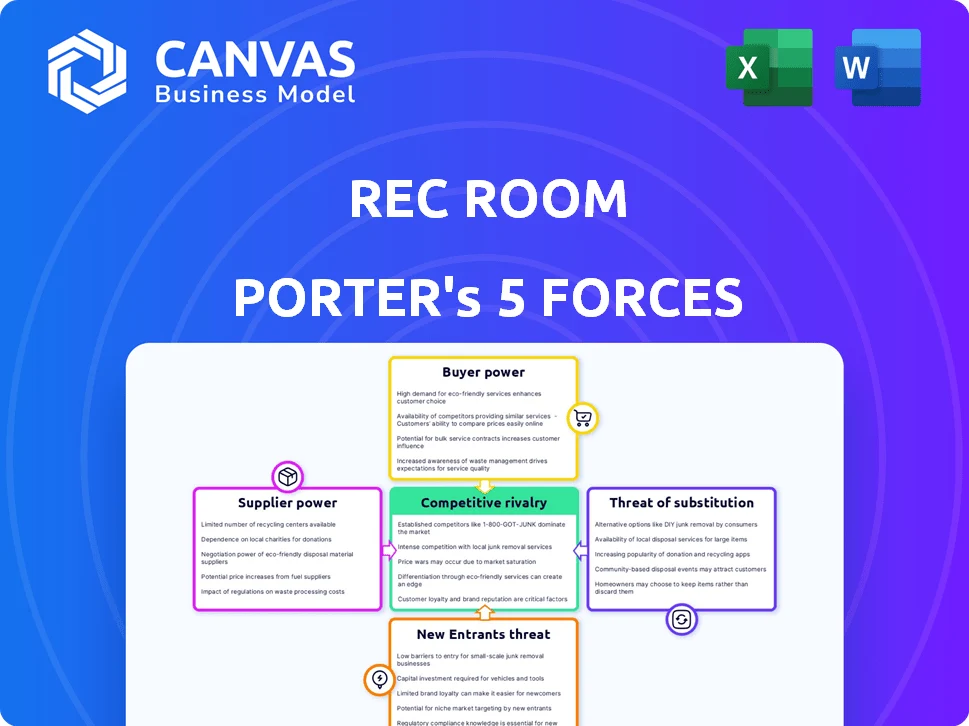
REC ROOM PORTER'S FIVE FORCES TEMPLATE RESEARCH
What is included in the product
 Detailed Word Document
Tailored exclusively for Rec Room, analyzing its position within its competitive landscape.

 Customizable Excel Spreadsheet
Quickly understand Rec Room's strategic position with dynamic, color-coded force analysis.
Same Document Delivered
Rec Room Porter's Five Forces Analysis
This is the complete Porter's Five Forces analysis for Rec Room. The document you see, detailing competitive rivalry, supplier power, buyer power, threat of substitution, and threat of new entrants, is the same analysis you will download immediately after purchase.

Porter's Five Forces Analysis Template

Elevate Your Analysis with the Complete Porter's Five Forces Analysis
Rec Room's competitive landscape is shaped by forces like intense rivalry & evolving buyer power. The threat of new entrants & readily available substitutes also play a role. Supplier bargaining power, while present, is comparatively moderate. Understanding these dynamics is vital for strategic planning.
Unlock the full Porter's Five Forces Analysis to explore Rec Room’s competitive dynamics, market pressures, and strategic advantages in detail.
Suppliers Bargaining Power

Limited number of VR hardware manufacturers
The VR hardware market is dominated by a few key suppliers, including Meta, Sony, and HTC, as of late 2024. This concentration gives these suppliers considerable bargaining power. For instance, Meta's Quest 2 and Quest 3 headsets have captured a large market share, influencing component pricing. Limited suppliers can dictate terms, impacting Rec Room's costs.
Dependency on software development tools and platforms
Rec Room's reliance on software development tools, like Unity, gives those suppliers leverage. Licensing fees from platforms can increase Rec Room's expenses. Unity's revenue in 2023 reached $2.2 billion, showcasing their financial strength and bargaining power. These suppliers can impact Rec Room's profit margins.

Reliance on third-party content creators
Rec Room's dependence on content creators gives them bargaining power. Skilled creators, vital for engaging experiences, can demand better terms. The platform's success hinges on attracting and retaining these creators. Their contributions directly impact user engagement and platform value.

Platform availability and terms
Rec Room's multi-platform availability, spanning VR, mobile, and consoles, subjects it to platform operator terms. These terms, set by entities like app stores and console makers, shape Rec Room's reach, monetization, and revenue splits. Platform providers thus wield bargaining power, influencing Rec Room's financial outcomes.
- Apple's App Store and Google Play Store, for example, take a percentage of in-app purchases, impacting Rec Room's revenue.
- Console manufacturers like Sony and Microsoft also have their own revenue-sharing models.
- In 2024, the gaming industry saw platform fees ranging from 15% to 30%.
- These fees can significantly affect Rec Room's profitability and financial strategy.
Talent pool for specialized skills
Rec Room's need for specialized skills in VR development, game design, and community management impacts its labor costs. The limited supply of VR developers, for example, increases the bargaining power of potential and current employees. This can lead to higher salaries and benefits to attract and retain top talent. For instance, the average salary for a VR developer in the US was about $110,000 in 2024.
- VR developers' salaries influence costs.
- High demand boosts employee power.
- Rec Room faces talent acquisition challenges.
- Labor costs are a key factor.
VR Game's Cost Dynamics: Suppliers, Platforms, and Developers
Suppliers of VR hardware and software tools hold significant bargaining power, impacting Rec Room's costs. Platform providers, like app stores, dictate revenue splits, affecting profitability. The need for skilled VR developers also increases labor costs. In 2024, platform fees ranged from 15% to 30%.
| Supplier Type | Bargaining Power Factor | Impact on Rec Room |
|---|---|---|
| VR Hardware | Concentration of suppliers | Influences component pricing |
| Software Tools | Licensing fees (e.g., Unity) | Increases expenses |
| Platform Providers | Revenue-sharing models | Affects profitability |
Customers Bargaining Power

Large and growing user base
Rec Room boasts a considerable and expanding user base spanning multiple platforms. Though individual users may wield minimal influence, the aggregate power of this community significantly shapes the platform. User feedback and content creation strongly affect Rec Room's evolution, content, and policies. In 2024, the platform reported over 100 million lifetime users.
Availability of alternative platforms
Rec Room faces competition from platforms like VRChat and Roblox. These alternatives offer similar social VR and gaming experiences. The presence of these options reduces customer dependence, giving them more power. For instance, Roblox had over 71.5 million daily active users in Q4 2023. This user base illustrates the availability of alternatives, influencing Rec Room's customer relationships.

User-generated content creation
Rec Room's business model is heavily reliant on user-generated content. Popular content creators attract and retain users, increasing their influence. This gives creators bargaining power within the platform. For example, top creators can negotiate better terms. In 2024, user-generated content accounted for 70% of Rec Room's engagement.

Price sensitivity and freemium model
Rec Room's freemium model significantly impacts customer bargaining power. The free access to core features allows a large user base to avoid paying, increasing their collective influence. This dynamic enables users to exert pressure regarding pricing and features, potentially reducing Rec Room's profitability. In 2024, freemium models continue to be popular, with about 65% of mobile app revenue coming from in-app purchases.
- Freemium model allows free access.
- Non-paying users can influence pricing.
- Impacts profitability.
- About 65% of mobile app revenue from in-app purchases.
Cross-platform accessibility
Rec Room's broad device support enhances user mobility, yet this accessibility also boosts customer bargaining power. Users can effortlessly shift to competing entertainment options on their devices, intensifying the competition for their attention. This ease of switching can pressure Rec Room to continually improve and offer better value to retain its user base. In 2024, the VR gaming market, where Rec Room competes, saw a 10% increase in active users, showing the dynamic shifts in user preferences and options.
- Increased user mobility across devices.
- Heightened competition for user attention.
- Pressure on Rec Room to improve.
- Dynamic shifts in user preferences.
User Power Dynamics in VR Gaming
Rec Room users have considerable bargaining power due to the freemium model and platform competition. The large user base influences pricing and features, impacting profitability. User-generated content also increases user influence. In 2024, the VR market grew, increasing options for users.
| Factor | Impact | Data |
|---|---|---|
| Freemium Model | Influences pricing | 65% mobile app revenue from in-app purchases (2024) |
| User-Generated Content | Increases user influence | 70% engagement from UGC (2024) |
| Market Competition | Increases user options | VR market grew 10% in active users (2024) |
Rivalry Among Competitors

Presence of established competitors
Rec Room faces fierce competition. Roblox, a major rival, reported over 71.5 million daily active users in Q3 2023. VRChat also competes, though with a smaller user base. This rivalry drives innovation but also increases marketing costs for Rec Room. The fight for user attention is constant.
Emergence of new social VR platforms
The social VR market is booming, drawing in fresh competitors. This intensifies rivalry for user engagement and time. In 2024, the VR market hit $40 billion, with social platforms growing rapidly. New entrants increase competitive pressure. This impacts Rec Room's market share.

Competition from traditional gaming and social media
Rec Room faces competition from traditional gaming and social media, vying for user attention and leisure time. In 2024, the gaming industry generated over $184 billion globally, highlighting the vast alternative entertainment options. Social media platforms like TikTok and Instagram, with billions of active users, also compete for user engagement. This indirect competition impacts Rec Room's user acquisition and retention strategies.

Focus on user-generated content
Competitive rivalry in the user-generated content (UGC) space is fierce. Platforms like Roblox and VRChat also rely heavily on UGC, vying for creators' attention. This competition is intensified by the need to provide superior tools and monetization options to attract and retain creators. The UGC market is projected to reach $411 billion by 2024, reflecting the high stakes in this rivalry.
- Roblox's revenue in 2023 was approximately $3.5 billion.
- VRChat's user base has grown significantly, but exact monetization data is not publicly available.
- The global UGC market is experiencing an annual growth rate of around 20%.
- Platforms are investing heavily in creator tools and support programs.
Platform accessibility and reach
Rec Room's cross-platform availability is a significant competitive edge, yet rivals are also broadening their device support. This expansion across platforms, offering seamless experiences, is a core area of competitive rivalry. The capacity to engage users on diverse devices is crucial for attracting and retaining players in 2024. For example, Roblox, a key competitor, reported over 71.5 million daily active users in Q4 2023, highlighting the importance of broad accessibility.
- Cross-platform availability is a key competitive factor.
- Competitors are also expanding their reach across devices.
- Seamless experience across various platforms is crucial.
- Roblox had over 71.5 million daily active users in Q4 2023.
VR's $40B Stage: Rivals Clash, Costs Rise!
Rec Room's competitive landscape is intense. Rivals like Roblox, with $3.5B revenue in 2023, and VRChat, drive innovation but increase costs. The VR market, valued at $40B in 2024, attracts new entrants, heightening rivalry.
| Factor | Impact | Data (2024) |
|---|---|---|
| Market Growth | Attracts Rivals | VR market: $40B |
| UGC Market | Creator Competition | $411B projected |
| Cross-Platform | Key Advantage | Roblox: 71.5M DAU |
REC ROOM PORTER'S FIVE FORCES TEMPLATE RESEARCH
What is included in the product
Detailed Word Document
Tailored exclusively for Rec Room, analyzing its position within its competitive landscape.
Customizable Excel Spreadsheet
Quickly understand Rec Room's strategic position with dynamic, color-coded force analysis.
Same Document Delivered
Rec Room Porter's Five Forces Analysis
This is the complete Porter's Five Forces analysis for Rec Room. The document you see, detailing competitive rivalry, supplier power, buyer power, threat of substitution, and threat of new entrants, is the same analysis you will download immediately after purchase.
Porter's Five Forces Analysis Template
Elevate Your Analysis with the Complete Porter's Five Forces Analysis
Rec Room's competitive landscape is shaped by forces like intense rivalry & evolving buyer power. The threat of new entrants & readily available substitutes also play a role. Supplier bargaining power, while present, is comparatively moderate. Understanding these dynamics is vital for strategic planning.
Unlock the full Porter's Five Forces Analysis to explore Rec Room’s competitive dynamics, market pressures, and strategic advantages in detail.
Suppliers Bargaining Power
Limited number of VR hardware manufacturers
The VR hardware market is dominated by a few key suppliers, including Meta, Sony, and HTC, as of late 2024. This concentration gives these suppliers considerable bargaining power. For instance, Meta's Quest 2 and Quest 3 headsets have captured a large market share, influencing component pricing. Limited suppliers can dictate terms, impacting Rec Room's costs.
Dependency on software development tools and platforms
Rec Room's reliance on software development tools, like Unity, gives those suppliers leverage. Licensing fees from platforms can increase Rec Room's expenses. Unity's revenue in 2023 reached $2.2 billion, showcasing their financial strength and bargaining power. These suppliers can impact Rec Room's profit margins.
Reliance on third-party content creators
Rec Room's dependence on content creators gives them bargaining power. Skilled creators, vital for engaging experiences, can demand better terms. The platform's success hinges on attracting and retaining these creators. Their contributions directly impact user engagement and platform value.
Platform availability and terms
Rec Room's multi-platform availability, spanning VR, mobile, and consoles, subjects it to platform operator terms. These terms, set by entities like app stores and console makers, shape Rec Room's reach, monetization, and revenue splits. Platform providers thus wield bargaining power, influencing Rec Room's financial outcomes.
- Apple's App Store and Google Play Store, for example, take a percentage of in-app purchases, impacting Rec Room's revenue.
- Console manufacturers like Sony and Microsoft also have their own revenue-sharing models.
- In 2024, the gaming industry saw platform fees ranging from 15% to 30%.
- These fees can significantly affect Rec Room's profitability and financial strategy.
Talent pool for specialized skills
Rec Room's need for specialized skills in VR development, game design, and community management impacts its labor costs. The limited supply of VR developers, for example, increases the bargaining power of potential and current employees. This can lead to higher salaries and benefits to attract and retain top talent. For instance, the average salary for a VR developer in the US was about $110,000 in 2024.
- VR developers' salaries influence costs.
- High demand boosts employee power.
- Rec Room faces talent acquisition challenges.
- Labor costs are a key factor.
VR Game's Cost Dynamics: Suppliers, Platforms, and Developers
Suppliers of VR hardware and software tools hold significant bargaining power, impacting Rec Room's costs. Platform providers, like app stores, dictate revenue splits, affecting profitability. The need for skilled VR developers also increases labor costs. In 2024, platform fees ranged from 15% to 30%.
| Supplier Type | Bargaining Power Factor | Impact on Rec Room |
|---|---|---|
| VR Hardware | Concentration of suppliers | Influences component pricing |
| Software Tools | Licensing fees (e.g., Unity) | Increases expenses |
| Platform Providers | Revenue-sharing models | Affects profitability |
Customers Bargaining Power
Large and growing user base
Rec Room boasts a considerable and expanding user base spanning multiple platforms. Though individual users may wield minimal influence, the aggregate power of this community significantly shapes the platform. User feedback and content creation strongly affect Rec Room's evolution, content, and policies. In 2024, the platform reported over 100 million lifetime users.
Availability of alternative platforms
Rec Room faces competition from platforms like VRChat and Roblox. These alternatives offer similar social VR and gaming experiences. The presence of these options reduces customer dependence, giving them more power. For instance, Roblox had over 71.5 million daily active users in Q4 2023. This user base illustrates the availability of alternatives, influencing Rec Room's customer relationships.
User-generated content creation
Rec Room's business model is heavily reliant on user-generated content. Popular content creators attract and retain users, increasing their influence. This gives creators bargaining power within the platform. For example, top creators can negotiate better terms. In 2024, user-generated content accounted for 70% of Rec Room's engagement.
Price sensitivity and freemium model
Rec Room's freemium model significantly impacts customer bargaining power. The free access to core features allows a large user base to avoid paying, increasing their collective influence. This dynamic enables users to exert pressure regarding pricing and features, potentially reducing Rec Room's profitability. In 2024, freemium models continue to be popular, with about 65% of mobile app revenue coming from in-app purchases.
- Freemium model allows free access.
- Non-paying users can influence pricing.
- Impacts profitability.
- About 65% of mobile app revenue from in-app purchases.
Cross-platform accessibility
Rec Room's broad device support enhances user mobility, yet this accessibility also boosts customer bargaining power. Users can effortlessly shift to competing entertainment options on their devices, intensifying the competition for their attention. This ease of switching can pressure Rec Room to continually improve and offer better value to retain its user base. In 2024, the VR gaming market, where Rec Room competes, saw a 10% increase in active users, showing the dynamic shifts in user preferences and options.
- Increased user mobility across devices.
- Heightened competition for user attention.
- Pressure on Rec Room to improve.
- Dynamic shifts in user preferences.
User Power Dynamics in VR Gaming
Rec Room users have considerable bargaining power due to the freemium model and platform competition. The large user base influences pricing and features, impacting profitability. User-generated content also increases user influence. In 2024, the VR market grew, increasing options for users.
| Factor | Impact | Data |
|---|---|---|
| Freemium Model | Influences pricing | 65% mobile app revenue from in-app purchases (2024) |
| User-Generated Content | Increases user influence | 70% engagement from UGC (2024) |
| Market Competition | Increases user options | VR market grew 10% in active users (2024) |
Rivalry Among Competitors
Presence of established competitors
Rec Room faces fierce competition. Roblox, a major rival, reported over 71.5 million daily active users in Q3 2023. VRChat also competes, though with a smaller user base. This rivalry drives innovation but also increases marketing costs for Rec Room. The fight for user attention is constant.
Emergence of new social VR platforms
The social VR market is booming, drawing in fresh competitors. This intensifies rivalry for user engagement and time. In 2024, the VR market hit $40 billion, with social platforms growing rapidly. New entrants increase competitive pressure. This impacts Rec Room's market share.
Competition from traditional gaming and social media
Rec Room faces competition from traditional gaming and social media, vying for user attention and leisure time. In 2024, the gaming industry generated over $184 billion globally, highlighting the vast alternative entertainment options. Social media platforms like TikTok and Instagram, with billions of active users, also compete for user engagement. This indirect competition impacts Rec Room's user acquisition and retention strategies.
Focus on user-generated content
Competitive rivalry in the user-generated content (UGC) space is fierce. Platforms like Roblox and VRChat also rely heavily on UGC, vying for creators' attention. This competition is intensified by the need to provide superior tools and monetization options to attract and retain creators. The UGC market is projected to reach $411 billion by 2024, reflecting the high stakes in this rivalry.
- Roblox's revenue in 2023 was approximately $3.5 billion.
- VRChat's user base has grown significantly, but exact monetization data is not publicly available.
- The global UGC market is experiencing an annual growth rate of around 20%.
- Platforms are investing heavily in creator tools and support programs.
Platform accessibility and reach
Rec Room's cross-platform availability is a significant competitive edge, yet rivals are also broadening their device support. This expansion across platforms, offering seamless experiences, is a core area of competitive rivalry. The capacity to engage users on diverse devices is crucial for attracting and retaining players in 2024. For example, Roblox, a key competitor, reported over 71.5 million daily active users in Q4 2023, highlighting the importance of broad accessibility.
- Cross-platform availability is a key competitive factor.
- Competitors are also expanding their reach across devices.
- Seamless experience across various platforms is crucial.
- Roblox had over 71.5 million daily active users in Q4 2023.
VR's $40B Stage: Rivals Clash, Costs Rise!
Rec Room's competitive landscape is intense. Rivals like Roblox, with $3.5B revenue in 2023, and VRChat, drive innovation but increase costs. The VR market, valued at $40B in 2024, attracts new entrants, heightening rivalry.
| Factor | Impact | Data (2024) |
|---|---|---|
| Market Growth | Attracts Rivals | VR market: $40B |
| UGC Market | Creator Competition | $411B projected |
| Cross-Platform | Key Advantage | Roblox: 71.5M DAU |
Product Information
Product Information
Shipping & Returns
Shipping & Returns
Description
What is included in the product
Detailed Word Document
Tailored exclusively for Rec Room, analyzing its position within its competitive landscape.
Customizable Excel Spreadsheet
Quickly understand Rec Room's strategic position with dynamic, color-coded force analysis.
Same Document Delivered
Rec Room Porter's Five Forces Analysis
This is the complete Porter's Five Forces analysis for Rec Room. The document you see, detailing competitive rivalry, supplier power, buyer power, threat of substitution, and threat of new entrants, is the same analysis you will download immediately after purchase.
Porter's Five Forces Analysis Template
Elevate Your Analysis with the Complete Porter's Five Forces Analysis
Rec Room's competitive landscape is shaped by forces like intense rivalry & evolving buyer power. The threat of new entrants & readily available substitutes also play a role. Supplier bargaining power, while present, is comparatively moderate. Understanding these dynamics is vital for strategic planning.
Unlock the full Porter's Five Forces Analysis to explore Rec Room’s competitive dynamics, market pressures, and strategic advantages in detail.
Suppliers Bargaining Power
Limited number of VR hardware manufacturers
The VR hardware market is dominated by a few key suppliers, including Meta, Sony, and HTC, as of late 2024. This concentration gives these suppliers considerable bargaining power. For instance, Meta's Quest 2 and Quest 3 headsets have captured a large market share, influencing component pricing. Limited suppliers can dictate terms, impacting Rec Room's costs.
Dependency on software development tools and platforms
Rec Room's reliance on software development tools, like Unity, gives those suppliers leverage. Licensing fees from platforms can increase Rec Room's expenses. Unity's revenue in 2023 reached $2.2 billion, showcasing their financial strength and bargaining power. These suppliers can impact Rec Room's profit margins.
Reliance on third-party content creators
Rec Room's dependence on content creators gives them bargaining power. Skilled creators, vital for engaging experiences, can demand better terms. The platform's success hinges on attracting and retaining these creators. Their contributions directly impact user engagement and platform value.
Platform availability and terms
Rec Room's multi-platform availability, spanning VR, mobile, and consoles, subjects it to platform operator terms. These terms, set by entities like app stores and console makers, shape Rec Room's reach, monetization, and revenue splits. Platform providers thus wield bargaining power, influencing Rec Room's financial outcomes.
- Apple's App Store and Google Play Store, for example, take a percentage of in-app purchases, impacting Rec Room's revenue.
- Console manufacturers like Sony and Microsoft also have their own revenue-sharing models.
- In 2024, the gaming industry saw platform fees ranging from 15% to 30%.
- These fees can significantly affect Rec Room's profitability and financial strategy.
Talent pool for specialized skills
Rec Room's need for specialized skills in VR development, game design, and community management impacts its labor costs. The limited supply of VR developers, for example, increases the bargaining power of potential and current employees. This can lead to higher salaries and benefits to attract and retain top talent. For instance, the average salary for a VR developer in the US was about $110,000 in 2024.
- VR developers' salaries influence costs.
- High demand boosts employee power.
- Rec Room faces talent acquisition challenges.
- Labor costs are a key factor.
VR Game's Cost Dynamics: Suppliers, Platforms, and Developers
Suppliers of VR hardware and software tools hold significant bargaining power, impacting Rec Room's costs. Platform providers, like app stores, dictate revenue splits, affecting profitability. The need for skilled VR developers also increases labor costs. In 2024, platform fees ranged from 15% to 30%.
| Supplier Type | Bargaining Power Factor | Impact on Rec Room |
|---|---|---|
| VR Hardware | Concentration of suppliers | Influences component pricing |
| Software Tools | Licensing fees (e.g., Unity) | Increases expenses |
| Platform Providers | Revenue-sharing models | Affects profitability |
Customers Bargaining Power
Large and growing user base
Rec Room boasts a considerable and expanding user base spanning multiple platforms. Though individual users may wield minimal influence, the aggregate power of this community significantly shapes the platform. User feedback and content creation strongly affect Rec Room's evolution, content, and policies. In 2024, the platform reported over 100 million lifetime users.
Availability of alternative platforms
Rec Room faces competition from platforms like VRChat and Roblox. These alternatives offer similar social VR and gaming experiences. The presence of these options reduces customer dependence, giving them more power. For instance, Roblox had over 71.5 million daily active users in Q4 2023. This user base illustrates the availability of alternatives, influencing Rec Room's customer relationships.
User-generated content creation
Rec Room's business model is heavily reliant on user-generated content. Popular content creators attract and retain users, increasing their influence. This gives creators bargaining power within the platform. For example, top creators can negotiate better terms. In 2024, user-generated content accounted for 70% of Rec Room's engagement.
Price sensitivity and freemium model
Rec Room's freemium model significantly impacts customer bargaining power. The free access to core features allows a large user base to avoid paying, increasing their collective influence. This dynamic enables users to exert pressure regarding pricing and features, potentially reducing Rec Room's profitability. In 2024, freemium models continue to be popular, with about 65% of mobile app revenue coming from in-app purchases.
- Freemium model allows free access.
- Non-paying users can influence pricing.
- Impacts profitability.
- About 65% of mobile app revenue from in-app purchases.
Cross-platform accessibility
Rec Room's broad device support enhances user mobility, yet this accessibility also boosts customer bargaining power. Users can effortlessly shift to competing entertainment options on their devices, intensifying the competition for their attention. This ease of switching can pressure Rec Room to continually improve and offer better value to retain its user base. In 2024, the VR gaming market, where Rec Room competes, saw a 10% increase in active users, showing the dynamic shifts in user preferences and options.
- Increased user mobility across devices.
- Heightened competition for user attention.
- Pressure on Rec Room to improve.
- Dynamic shifts in user preferences.
User Power Dynamics in VR Gaming
Rec Room users have considerable bargaining power due to the freemium model and platform competition. The large user base influences pricing and features, impacting profitability. User-generated content also increases user influence. In 2024, the VR market grew, increasing options for users.
| Factor | Impact | Data |
|---|---|---|
| Freemium Model | Influences pricing | 65% mobile app revenue from in-app purchases (2024) |
| User-Generated Content | Increases user influence | 70% engagement from UGC (2024) |
| Market Competition | Increases user options | VR market grew 10% in active users (2024) |
Rivalry Among Competitors
Presence of established competitors
Rec Room faces fierce competition. Roblox, a major rival, reported over 71.5 million daily active users in Q3 2023. VRChat also competes, though with a smaller user base. This rivalry drives innovation but also increases marketing costs for Rec Room. The fight for user attention is constant.
Emergence of new social VR platforms
The social VR market is booming, drawing in fresh competitors. This intensifies rivalry for user engagement and time. In 2024, the VR market hit $40 billion, with social platforms growing rapidly. New entrants increase competitive pressure. This impacts Rec Room's market share.
Competition from traditional gaming and social media
Rec Room faces competition from traditional gaming and social media, vying for user attention and leisure time. In 2024, the gaming industry generated over $184 billion globally, highlighting the vast alternative entertainment options. Social media platforms like TikTok and Instagram, with billions of active users, also compete for user engagement. This indirect competition impacts Rec Room's user acquisition and retention strategies.
Focus on user-generated content
Competitive rivalry in the user-generated content (UGC) space is fierce. Platforms like Roblox and VRChat also rely heavily on UGC, vying for creators' attention. This competition is intensified by the need to provide superior tools and monetization options to attract and retain creators. The UGC market is projected to reach $411 billion by 2024, reflecting the high stakes in this rivalry.
- Roblox's revenue in 2023 was approximately $3.5 billion.
- VRChat's user base has grown significantly, but exact monetization data is not publicly available.
- The global UGC market is experiencing an annual growth rate of around 20%.
- Platforms are investing heavily in creator tools and support programs.
Platform accessibility and reach
Rec Room's cross-platform availability is a significant competitive edge, yet rivals are also broadening their device support. This expansion across platforms, offering seamless experiences, is a core area of competitive rivalry. The capacity to engage users on diverse devices is crucial for attracting and retaining players in 2024. For example, Roblox, a key competitor, reported over 71.5 million daily active users in Q4 2023, highlighting the importance of broad accessibility.
- Cross-platform availability is a key competitive factor.
- Competitors are also expanding their reach across devices.
- Seamless experience across various platforms is crucial.
- Roblox had over 71.5 million daily active users in Q4 2023.
VR's $40B Stage: Rivals Clash, Costs Rise!
Rec Room's competitive landscape is intense. Rivals like Roblox, with $3.5B revenue in 2023, and VRChat, drive innovation but increase costs. The VR market, valued at $40B in 2024, attracts new entrants, heightening rivalry.
| Factor | Impact | Data (2024) |
|---|---|---|
| Market Growth | Attracts Rivals | VR market: $40B |
| UGC Market | Creator Competition | $411B projected |
| Cross-Platform | Key Advantage | Roblox: 71.5M DAU |


