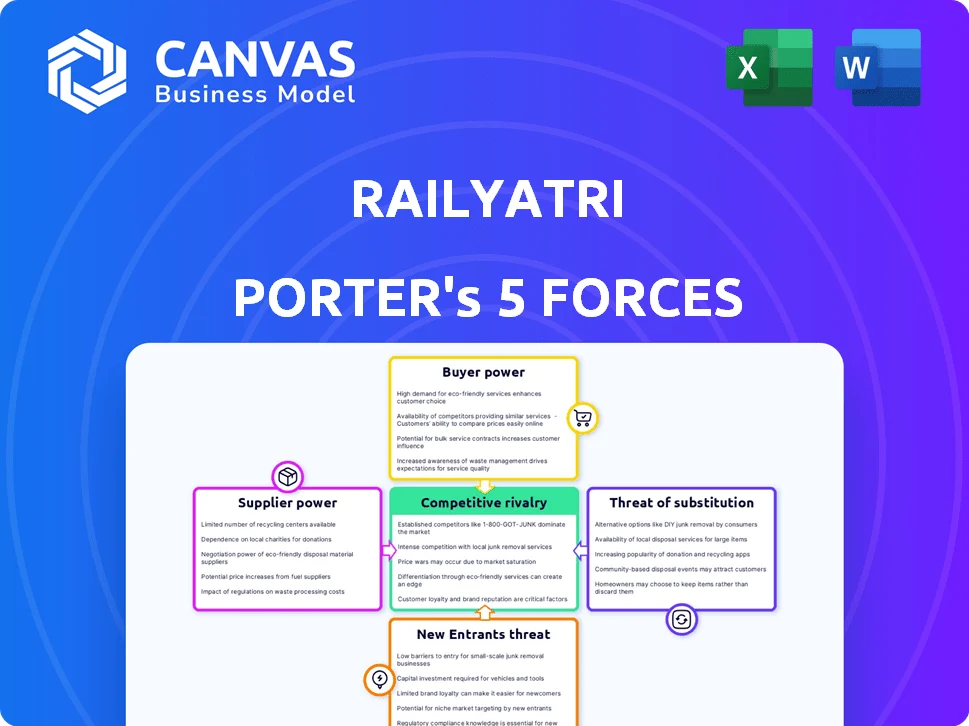
RAILYATRI PORTER'S FIVE FORCES TEMPLATE RESEARCH
What is included in the product
 Detailed Word Document
Evaluates control held by suppliers and buyers, and their influence on pricing and profitability.

 Customizable Excel Spreadsheet
Instantly identify pressure points and strategic advantage for quicker decisions.
Full Version Awaits
RailYatri Porter's Five Forces Analysis
You are viewing the complete Porter's Five Forces analysis for RailYatri Porter. This preview is identical to the document you'll receive instantly after your purchase.

Porter's Five Forces Analysis Template

A Must-Have Tool for Decision-Makers
RailYatri's success hinges on navigating complex market dynamics. The threat of new entrants, especially tech-savvy rivals, looms large. Buyer power, fueled by price-conscious travelers, also presents a challenge. Supplier leverage and substitute threats, like bus services, are significant factors. Understanding these forces is vital for sustainable growth.
This brief snapshot only scratches the surface. Unlock the full Porter's Five Forces Analysis to explore RailYatri’s competitive dynamics, market pressures, and strategic advantages in detail.
Suppliers Bargaining Power

Dependence on Indian Railways
RailYatri's business model is significantly influenced by Indian Railways (IR). The company depends on IR for essential data like train schedules and real-time updates. IR's control over this information directly affects RailYatri's operational capacity. Any changes by IR can greatly impact RailYatri's services. In 2024, IR's revenue was approximately $30 billion.
Technology Providers
RailYatri relies on technology providers for its platform. The cost and availability of services, like cloud hosting, impact its operations. For instance, cloud spending rose significantly in 2024, affecting tech-dependent firms. Switching providers offers some leverage, but integration challenges exist. This dynamic influences supplier power within RailYatri's business model.

Payment Gateway Providers
RailYatri, as an online platform, relies heavily on payment gateway providers. These providers, such as Razorpay and PayU, dictate transaction fees and terms. In 2024, these fees typically range from 1.5% to 3% per transaction, impacting RailYatri's margins. Stronger bargaining power from providers could increase costs.

Partnerships for Ancillary Services
RailYatri's partnerships for services like food delivery and hotel bookings influence supplier bargaining power. The strength of these partners depends on their uniqueness and how easily RailYatri can switch to other providers. For instance, partnerships with major hotel chains or unique food vendors give them more leverage. In 2024, the online travel market, including ancillary services, was valued at over $200 billion, showing the scale of these partnerships.
- Partners with unique offerings have more bargaining power.
- Easy substitution weakens partner leverage.
- Market size and competition affect partner power.
- In 2024, the online travel market was $200B+.
Data Analytics and Technology Infrastructure
RailYatri Porter relies on data analytics tools and cloud infrastructure, making suppliers crucial. These suppliers' pricing and service level agreements directly affect RailYatri's costs and operational efficiency. The bargaining power of these suppliers is significant, potentially influencing profitability. This is especially true in a market where switching costs can be high due to the complexity of integrating new systems.
- Cloud computing market reached $670.6 billion in 2024.
- Data analytics market is projected to reach $274.3 billion by 2026.
- Switching costs can be substantial, potentially locking in RailYatri.
Data's Dominance: How Tech Shapes Supplier Power
RailYatri Porter's reliance on data analytics and cloud infrastructure gives suppliers strong bargaining power. Suppliers' pricing and service level agreements directly affect costs and efficiency. The cloud computing market hit $670.6 billion in 2024, indicating the scale and influence of these suppliers.
| Factor | Impact on RailYatri | Data (2024) |
|---|---|---|
| Cloud Computing Market | Cost of Infrastructure | $670.6 billion |
| Data Analytics Market | Cost of Tools | Projected $274.3B by 2026 |
| Switching Costs | Operational Efficiency | High due to integration complexity |
Customers Bargaining Power

Availability of Alternatives
Customers can choose between IRCTC and various OTAs for train tickets. This competition, including 2024's rising OTAs, intensifies customer power. For example, in 2024, IRCTC handled around 80% of online bookings. However, the remaining 20% is divided among OTAs, giving customers leverage.
Low Switching Costs
Switching costs for train service platforms are low, increasing customer bargaining power. Customers can easily compare RailYatri with competitors like IRCTC or Ixigo. This ease of switching forces RailYatri to maintain competitive pricing and service quality. In 2024, the online travel market, including train bookings, saw over 150 million users in India, highlighting the competition.

Price Sensitivity
Indian railway passengers, especially in lower classes, exhibit significant price sensitivity. This sensitivity empowers customers to seek competitive pricing and discounts. RailYatri's revenue and margins can be directly impacted by these customer demands. In 2024, Indian Railways saw over 8 billion passengers, highlighting the scale of potential price sensitivity. Lower fares are more common in the general and sleeper classes.

Access to Information
Customers wield significant bargaining power due to readily available information. Online platforms offer transparent data on train schedules, pricing, and availability. This allows for easy comparison, enhancing customer decision-making capabilities. This increased transparency puts pressure on RailYatri Porter to offer competitive services.
- In 2024, over 70% of Indian train travelers used online platforms for booking and information.
- Price comparison websites saw a 30% rise in usage.
- This data underscores the importance of competitive pricing.
Influence through Reviews and Feedback
Customer influence is amplified through online reviews and feedback, significantly affecting RailYatri's market position. Platforms like Google Reviews and TripAdvisor give customers a voice, shaping perceptions of service quality. Positive reviews attract, while negative ones can deter potential users, directly impacting RailYatri's customer acquisition. This collective feedback mechanism increases customer power.
- 88% of consumers trust online reviews as much as personal recommendations.
- Websites like Trustpilot host millions of reviews, influencing purchase decisions.
- In 2024, negative reviews cost businesses an average of 15% in potential revenue.
- RailYatri's review scores directly correlate with booking volumes.
Customer Power Drives Competitive Pressure
Customers have significant bargaining power, amplified by online options and price sensitivity. Switching costs are low, enabling easy comparison among platforms. This forces RailYatri to maintain competitive pricing and service quality to retain customers.
| Aspect | Impact | Data |
|---|---|---|
| Platform Choice | High | 80% IRCTC bookings, 20% split among OTAs in 2024 |
| Price Sensitivity | High | 8 billion railway passengers in 2024 |
| Online Reviews | Significant | 88% trust online reviews; 15% revenue loss due to negative reviews in 2024 |
Rivalry Among Competitors

Presence of Multiple OTAs
The Indian online travel market is intensely competitive, significantly impacting RailYatri Porter. Numerous Online Travel Agencies (OTAs), including MakeMyTrip and Goibibo, vie for customer attention. Ixigo, owning ConfirmTkt, further intensifies competition in train ticketing. This rivalry pressures pricing and innovation.
IRCTC's Dominance
Indian Railway Catering and Tourism Corporation (IRCTC) is the dominant force as the official platform for Indian Railways. IRCTC's direct control over bookings and data gives it a competitive edge. In 2024, IRCTC generated over ₹3,500 crore in revenue from its catering and tourism services. RailYatri and other online travel agencies (OTAs) are integrated with IRCTC, but IRCTC’s direct access creates a strong competitive rivalry.

Diversification of Services by Competitors
Many competitors provide comprehensive travel services, including flights, hotels, and buses, unlike RailYatri's initial train focus. This broadens their appeal, making them a one-stop shop and heightening rivalry. For example, platforms like MakeMyTrip and EaseMyTrip, reported revenues of $687 million and $75 million, respectively, in fiscal year 2024, showcasing the competitive landscape. This diversification puts pressure on RailYatri to expand its offerings to stay competitive.

Pricing and Discount Wars
Competition in the travel sector, like that faced by RailYatri, frequently triggers price wars, discounts, and cashback offers to lure customers. This can squeeze profit margins, as companies compete to offer the lowest prices. In 2024, the online travel market in India saw intense price competition, with some platforms offering discounts of up to 30% to gain market share. RailYatri must continuously innovate and manage costs to stay competitive.
- Discounting Impact: Aggressive pricing strategies can lower overall revenue.
- Profitability Squeeze: Constant discounts reduce profit margins, affecting financial health.
- Market Dynamics: The need for innovation is a must to maintain a competitive edge.
- Customer Acquisition: Price wars can boost short-term sales but may not ensure long-term loyalty.
Focus on User Experience and Features
Competitors in the online travel booking space are always upping their game, focusing on user experience and adding new features to attract customers. RailYatri must continuously innovate its platform to stay competitive and retain its user base. This constant need to improve intensifies rivalry among platforms. As of 2024, the online travel market is highly competitive, with companies investing heavily in technology and user-friendly interfaces.
- Competition drives innovation, forcing RailYatri to evolve.
- User experience and features are key differentiators.
- Companies invest heavily in technology.
- Market is dynamic and competitive.
Travel Platform's Fierce Battle for Market Share
RailYatri faces intense competition from OTAs like MakeMyTrip and Goibibo, and IRCTC. This drives price wars and innovation pressures. Diversification by competitors, such as offering flights and hotels, broadens the competitive scope. As of 2024, the online travel market is highly competitive.
| Aspect | Impact | Data |
|---|---|---|
| Price Wars | Reduced margins | Discounts up to 30% in 2024 |
| Competition | Innovation focus | MakeMyTrip revenue: $687M (FY24) |
| IRCTC Dominance | Competitive edge | IRCTC revenue from catering: ₹3,500Cr (2024) |
RAILYATRI PORTER'S FIVE FORCES TEMPLATE RESEARCH
What is included in the product
Detailed Word Document
Evaluates control held by suppliers and buyers, and their influence on pricing and profitability.
Customizable Excel Spreadsheet
Instantly identify pressure points and strategic advantage for quicker decisions.
Full Version Awaits
RailYatri Porter's Five Forces Analysis
You are viewing the complete Porter's Five Forces analysis for RailYatri Porter. This preview is identical to the document you'll receive instantly after your purchase.
Porter's Five Forces Analysis Template
A Must-Have Tool for Decision-Makers
RailYatri's success hinges on navigating complex market dynamics. The threat of new entrants, especially tech-savvy rivals, looms large. Buyer power, fueled by price-conscious travelers, also presents a challenge. Supplier leverage and substitute threats, like bus services, are significant factors. Understanding these forces is vital for sustainable growth.
This brief snapshot only scratches the surface. Unlock the full Porter's Five Forces Analysis to explore RailYatri’s competitive dynamics, market pressures, and strategic advantages in detail.
Suppliers Bargaining Power
Dependence on Indian Railways
RailYatri's business model is significantly influenced by Indian Railways (IR). The company depends on IR for essential data like train schedules and real-time updates. IR's control over this information directly affects RailYatri's operational capacity. Any changes by IR can greatly impact RailYatri's services. In 2024, IR's revenue was approximately $30 billion.
Technology Providers
RailYatri relies on technology providers for its platform. The cost and availability of services, like cloud hosting, impact its operations. For instance, cloud spending rose significantly in 2024, affecting tech-dependent firms. Switching providers offers some leverage, but integration challenges exist. This dynamic influences supplier power within RailYatri's business model.
Payment Gateway Providers
RailYatri, as an online platform, relies heavily on payment gateway providers. These providers, such as Razorpay and PayU, dictate transaction fees and terms. In 2024, these fees typically range from 1.5% to 3% per transaction, impacting RailYatri's margins. Stronger bargaining power from providers could increase costs.
Partnerships for Ancillary Services
RailYatri's partnerships for services like food delivery and hotel bookings influence supplier bargaining power. The strength of these partners depends on their uniqueness and how easily RailYatri can switch to other providers. For instance, partnerships with major hotel chains or unique food vendors give them more leverage. In 2024, the online travel market, including ancillary services, was valued at over $200 billion, showing the scale of these partnerships.
- Partners with unique offerings have more bargaining power.
- Easy substitution weakens partner leverage.
- Market size and competition affect partner power.
- In 2024, the online travel market was $200B+.
Data Analytics and Technology Infrastructure
RailYatri Porter relies on data analytics tools and cloud infrastructure, making suppliers crucial. These suppliers' pricing and service level agreements directly affect RailYatri's costs and operational efficiency. The bargaining power of these suppliers is significant, potentially influencing profitability. This is especially true in a market where switching costs can be high due to the complexity of integrating new systems.
- Cloud computing market reached $670.6 billion in 2024.
- Data analytics market is projected to reach $274.3 billion by 2026.
- Switching costs can be substantial, potentially locking in RailYatri.
Data's Dominance: How Tech Shapes Supplier Power
RailYatri Porter's reliance on data analytics and cloud infrastructure gives suppliers strong bargaining power. Suppliers' pricing and service level agreements directly affect costs and efficiency. The cloud computing market hit $670.6 billion in 2024, indicating the scale and influence of these suppliers.
| Factor | Impact on RailYatri | Data (2024) |
|---|---|---|
| Cloud Computing Market | Cost of Infrastructure | $670.6 billion |
| Data Analytics Market | Cost of Tools | Projected $274.3B by 2026 |
| Switching Costs | Operational Efficiency | High due to integration complexity |
Customers Bargaining Power
Availability of Alternatives
Customers can choose between IRCTC and various OTAs for train tickets. This competition, including 2024's rising OTAs, intensifies customer power. For example, in 2024, IRCTC handled around 80% of online bookings. However, the remaining 20% is divided among OTAs, giving customers leverage.
Low Switching Costs
Switching costs for train service platforms are low, increasing customer bargaining power. Customers can easily compare RailYatri with competitors like IRCTC or Ixigo. This ease of switching forces RailYatri to maintain competitive pricing and service quality. In 2024, the online travel market, including train bookings, saw over 150 million users in India, highlighting the competition.
Price Sensitivity
Indian railway passengers, especially in lower classes, exhibit significant price sensitivity. This sensitivity empowers customers to seek competitive pricing and discounts. RailYatri's revenue and margins can be directly impacted by these customer demands. In 2024, Indian Railways saw over 8 billion passengers, highlighting the scale of potential price sensitivity. Lower fares are more common in the general and sleeper classes.
Access to Information
Customers wield significant bargaining power due to readily available information. Online platforms offer transparent data on train schedules, pricing, and availability. This allows for easy comparison, enhancing customer decision-making capabilities. This increased transparency puts pressure on RailYatri Porter to offer competitive services.
- In 2024, over 70% of Indian train travelers used online platforms for booking and information.
- Price comparison websites saw a 30% rise in usage.
- This data underscores the importance of competitive pricing.
Influence through Reviews and Feedback
Customer influence is amplified through online reviews and feedback, significantly affecting RailYatri's market position. Platforms like Google Reviews and TripAdvisor give customers a voice, shaping perceptions of service quality. Positive reviews attract, while negative ones can deter potential users, directly impacting RailYatri's customer acquisition. This collective feedback mechanism increases customer power.
- 88% of consumers trust online reviews as much as personal recommendations.
- Websites like Trustpilot host millions of reviews, influencing purchase decisions.
- In 2024, negative reviews cost businesses an average of 15% in potential revenue.
- RailYatri's review scores directly correlate with booking volumes.
Customer Power Drives Competitive Pressure
Customers have significant bargaining power, amplified by online options and price sensitivity. Switching costs are low, enabling easy comparison among platforms. This forces RailYatri to maintain competitive pricing and service quality to retain customers.
| Aspect | Impact | Data |
|---|---|---|
| Platform Choice | High | 80% IRCTC bookings, 20% split among OTAs in 2024 |
| Price Sensitivity | High | 8 billion railway passengers in 2024 |
| Online Reviews | Significant | 88% trust online reviews; 15% revenue loss due to negative reviews in 2024 |
Rivalry Among Competitors
Presence of Multiple OTAs
The Indian online travel market is intensely competitive, significantly impacting RailYatri Porter. Numerous Online Travel Agencies (OTAs), including MakeMyTrip and Goibibo, vie for customer attention. Ixigo, owning ConfirmTkt, further intensifies competition in train ticketing. This rivalry pressures pricing and innovation.
IRCTC's Dominance
Indian Railway Catering and Tourism Corporation (IRCTC) is the dominant force as the official platform for Indian Railways. IRCTC's direct control over bookings and data gives it a competitive edge. In 2024, IRCTC generated over ₹3,500 crore in revenue from its catering and tourism services. RailYatri and other online travel agencies (OTAs) are integrated with IRCTC, but IRCTC’s direct access creates a strong competitive rivalry.
Diversification of Services by Competitors
Many competitors provide comprehensive travel services, including flights, hotels, and buses, unlike RailYatri's initial train focus. This broadens their appeal, making them a one-stop shop and heightening rivalry. For example, platforms like MakeMyTrip and EaseMyTrip, reported revenues of $687 million and $75 million, respectively, in fiscal year 2024, showcasing the competitive landscape. This diversification puts pressure on RailYatri to expand its offerings to stay competitive.
Pricing and Discount Wars
Competition in the travel sector, like that faced by RailYatri, frequently triggers price wars, discounts, and cashback offers to lure customers. This can squeeze profit margins, as companies compete to offer the lowest prices. In 2024, the online travel market in India saw intense price competition, with some platforms offering discounts of up to 30% to gain market share. RailYatri must continuously innovate and manage costs to stay competitive.
- Discounting Impact: Aggressive pricing strategies can lower overall revenue.
- Profitability Squeeze: Constant discounts reduce profit margins, affecting financial health.
- Market Dynamics: The need for innovation is a must to maintain a competitive edge.
- Customer Acquisition: Price wars can boost short-term sales but may not ensure long-term loyalty.
Focus on User Experience and Features
Competitors in the online travel booking space are always upping their game, focusing on user experience and adding new features to attract customers. RailYatri must continuously innovate its platform to stay competitive and retain its user base. This constant need to improve intensifies rivalry among platforms. As of 2024, the online travel market is highly competitive, with companies investing heavily in technology and user-friendly interfaces.
- Competition drives innovation, forcing RailYatri to evolve.
- User experience and features are key differentiators.
- Companies invest heavily in technology.
- Market is dynamic and competitive.
Travel Platform's Fierce Battle for Market Share
RailYatri faces intense competition from OTAs like MakeMyTrip and Goibibo, and IRCTC. This drives price wars and innovation pressures. Diversification by competitors, such as offering flights and hotels, broadens the competitive scope. As of 2024, the online travel market is highly competitive.
| Aspect | Impact | Data |
|---|---|---|
| Price Wars | Reduced margins | Discounts up to 30% in 2024 |
| Competition | Innovation focus | MakeMyTrip revenue: $687M (FY24) |
| IRCTC Dominance | Competitive edge | IRCTC revenue from catering: ₹3,500Cr (2024) |
Product Information
Product Information
Shipping & Returns
Shipping & Returns
Description
What is included in the product
Detailed Word Document
Evaluates control held by suppliers and buyers, and their influence on pricing and profitability.
Customizable Excel Spreadsheet
Instantly identify pressure points and strategic advantage for quicker decisions.
Full Version Awaits
RailYatri Porter's Five Forces Analysis
You are viewing the complete Porter's Five Forces analysis for RailYatri Porter. This preview is identical to the document you'll receive instantly after your purchase.
Porter's Five Forces Analysis Template
A Must-Have Tool for Decision-Makers
RailYatri's success hinges on navigating complex market dynamics. The threat of new entrants, especially tech-savvy rivals, looms large. Buyer power, fueled by price-conscious travelers, also presents a challenge. Supplier leverage and substitute threats, like bus services, are significant factors. Understanding these forces is vital for sustainable growth.
This brief snapshot only scratches the surface. Unlock the full Porter's Five Forces Analysis to explore RailYatri’s competitive dynamics, market pressures, and strategic advantages in detail.
Suppliers Bargaining Power
Dependence on Indian Railways
RailYatri's business model is significantly influenced by Indian Railways (IR). The company depends on IR for essential data like train schedules and real-time updates. IR's control over this information directly affects RailYatri's operational capacity. Any changes by IR can greatly impact RailYatri's services. In 2024, IR's revenue was approximately $30 billion.
Technology Providers
RailYatri relies on technology providers for its platform. The cost and availability of services, like cloud hosting, impact its operations. For instance, cloud spending rose significantly in 2024, affecting tech-dependent firms. Switching providers offers some leverage, but integration challenges exist. This dynamic influences supplier power within RailYatri's business model.
Payment Gateway Providers
RailYatri, as an online platform, relies heavily on payment gateway providers. These providers, such as Razorpay and PayU, dictate transaction fees and terms. In 2024, these fees typically range from 1.5% to 3% per transaction, impacting RailYatri's margins. Stronger bargaining power from providers could increase costs.
Partnerships for Ancillary Services
RailYatri's partnerships for services like food delivery and hotel bookings influence supplier bargaining power. The strength of these partners depends on their uniqueness and how easily RailYatri can switch to other providers. For instance, partnerships with major hotel chains or unique food vendors give them more leverage. In 2024, the online travel market, including ancillary services, was valued at over $200 billion, showing the scale of these partnerships.
- Partners with unique offerings have more bargaining power.
- Easy substitution weakens partner leverage.
- Market size and competition affect partner power.
- In 2024, the online travel market was $200B+.
Data Analytics and Technology Infrastructure
RailYatri Porter relies on data analytics tools and cloud infrastructure, making suppliers crucial. These suppliers' pricing and service level agreements directly affect RailYatri's costs and operational efficiency. The bargaining power of these suppliers is significant, potentially influencing profitability. This is especially true in a market where switching costs can be high due to the complexity of integrating new systems.
- Cloud computing market reached $670.6 billion in 2024.
- Data analytics market is projected to reach $274.3 billion by 2026.
- Switching costs can be substantial, potentially locking in RailYatri.
Data's Dominance: How Tech Shapes Supplier Power
RailYatri Porter's reliance on data analytics and cloud infrastructure gives suppliers strong bargaining power. Suppliers' pricing and service level agreements directly affect costs and efficiency. The cloud computing market hit $670.6 billion in 2024, indicating the scale and influence of these suppliers.
| Factor | Impact on RailYatri | Data (2024) |
|---|---|---|
| Cloud Computing Market | Cost of Infrastructure | $670.6 billion |
| Data Analytics Market | Cost of Tools | Projected $274.3B by 2026 |
| Switching Costs | Operational Efficiency | High due to integration complexity |
Customers Bargaining Power
Availability of Alternatives
Customers can choose between IRCTC and various OTAs for train tickets. This competition, including 2024's rising OTAs, intensifies customer power. For example, in 2024, IRCTC handled around 80% of online bookings. However, the remaining 20% is divided among OTAs, giving customers leverage.
Low Switching Costs
Switching costs for train service platforms are low, increasing customer bargaining power. Customers can easily compare RailYatri with competitors like IRCTC or Ixigo. This ease of switching forces RailYatri to maintain competitive pricing and service quality. In 2024, the online travel market, including train bookings, saw over 150 million users in India, highlighting the competition.
Price Sensitivity
Indian railway passengers, especially in lower classes, exhibit significant price sensitivity. This sensitivity empowers customers to seek competitive pricing and discounts. RailYatri's revenue and margins can be directly impacted by these customer demands. In 2024, Indian Railways saw over 8 billion passengers, highlighting the scale of potential price sensitivity. Lower fares are more common in the general and sleeper classes.
Access to Information
Customers wield significant bargaining power due to readily available information. Online platforms offer transparent data on train schedules, pricing, and availability. This allows for easy comparison, enhancing customer decision-making capabilities. This increased transparency puts pressure on RailYatri Porter to offer competitive services.
- In 2024, over 70% of Indian train travelers used online platforms for booking and information.
- Price comparison websites saw a 30% rise in usage.
- This data underscores the importance of competitive pricing.
Influence through Reviews and Feedback
Customer influence is amplified through online reviews and feedback, significantly affecting RailYatri's market position. Platforms like Google Reviews and TripAdvisor give customers a voice, shaping perceptions of service quality. Positive reviews attract, while negative ones can deter potential users, directly impacting RailYatri's customer acquisition. This collective feedback mechanism increases customer power.
- 88% of consumers trust online reviews as much as personal recommendations.
- Websites like Trustpilot host millions of reviews, influencing purchase decisions.
- In 2024, negative reviews cost businesses an average of 15% in potential revenue.
- RailYatri's review scores directly correlate with booking volumes.
Customer Power Drives Competitive Pressure
Customers have significant bargaining power, amplified by online options and price sensitivity. Switching costs are low, enabling easy comparison among platforms. This forces RailYatri to maintain competitive pricing and service quality to retain customers.
| Aspect | Impact | Data |
|---|---|---|
| Platform Choice | High | 80% IRCTC bookings, 20% split among OTAs in 2024 |
| Price Sensitivity | High | 8 billion railway passengers in 2024 |
| Online Reviews | Significant | 88% trust online reviews; 15% revenue loss due to negative reviews in 2024 |
Rivalry Among Competitors
Presence of Multiple OTAs
The Indian online travel market is intensely competitive, significantly impacting RailYatri Porter. Numerous Online Travel Agencies (OTAs), including MakeMyTrip and Goibibo, vie for customer attention. Ixigo, owning ConfirmTkt, further intensifies competition in train ticketing. This rivalry pressures pricing and innovation.
IRCTC's Dominance
Indian Railway Catering and Tourism Corporation (IRCTC) is the dominant force as the official platform for Indian Railways. IRCTC's direct control over bookings and data gives it a competitive edge. In 2024, IRCTC generated over ₹3,500 crore in revenue from its catering and tourism services. RailYatri and other online travel agencies (OTAs) are integrated with IRCTC, but IRCTC’s direct access creates a strong competitive rivalry.
Diversification of Services by Competitors
Many competitors provide comprehensive travel services, including flights, hotels, and buses, unlike RailYatri's initial train focus. This broadens their appeal, making them a one-stop shop and heightening rivalry. For example, platforms like MakeMyTrip and EaseMyTrip, reported revenues of $687 million and $75 million, respectively, in fiscal year 2024, showcasing the competitive landscape. This diversification puts pressure on RailYatri to expand its offerings to stay competitive.
Pricing and Discount Wars
Competition in the travel sector, like that faced by RailYatri, frequently triggers price wars, discounts, and cashback offers to lure customers. This can squeeze profit margins, as companies compete to offer the lowest prices. In 2024, the online travel market in India saw intense price competition, with some platforms offering discounts of up to 30% to gain market share. RailYatri must continuously innovate and manage costs to stay competitive.
- Discounting Impact: Aggressive pricing strategies can lower overall revenue.
- Profitability Squeeze: Constant discounts reduce profit margins, affecting financial health.
- Market Dynamics: The need for innovation is a must to maintain a competitive edge.
- Customer Acquisition: Price wars can boost short-term sales but may not ensure long-term loyalty.
Focus on User Experience and Features
Competitors in the online travel booking space are always upping their game, focusing on user experience and adding new features to attract customers. RailYatri must continuously innovate its platform to stay competitive and retain its user base. This constant need to improve intensifies rivalry among platforms. As of 2024, the online travel market is highly competitive, with companies investing heavily in technology and user-friendly interfaces.
- Competition drives innovation, forcing RailYatri to evolve.
- User experience and features are key differentiators.
- Companies invest heavily in technology.
- Market is dynamic and competitive.
Travel Platform's Fierce Battle for Market Share
RailYatri faces intense competition from OTAs like MakeMyTrip and Goibibo, and IRCTC. This drives price wars and innovation pressures. Diversification by competitors, such as offering flights and hotels, broadens the competitive scope. As of 2024, the online travel market is highly competitive.
| Aspect | Impact | Data |
|---|---|---|
| Price Wars | Reduced margins | Discounts up to 30% in 2024 |
| Competition | Innovation focus | MakeMyTrip revenue: $687M (FY24) |
| IRCTC Dominance | Competitive edge | IRCTC revenue from catering: ₹3,500Cr (2024) |