
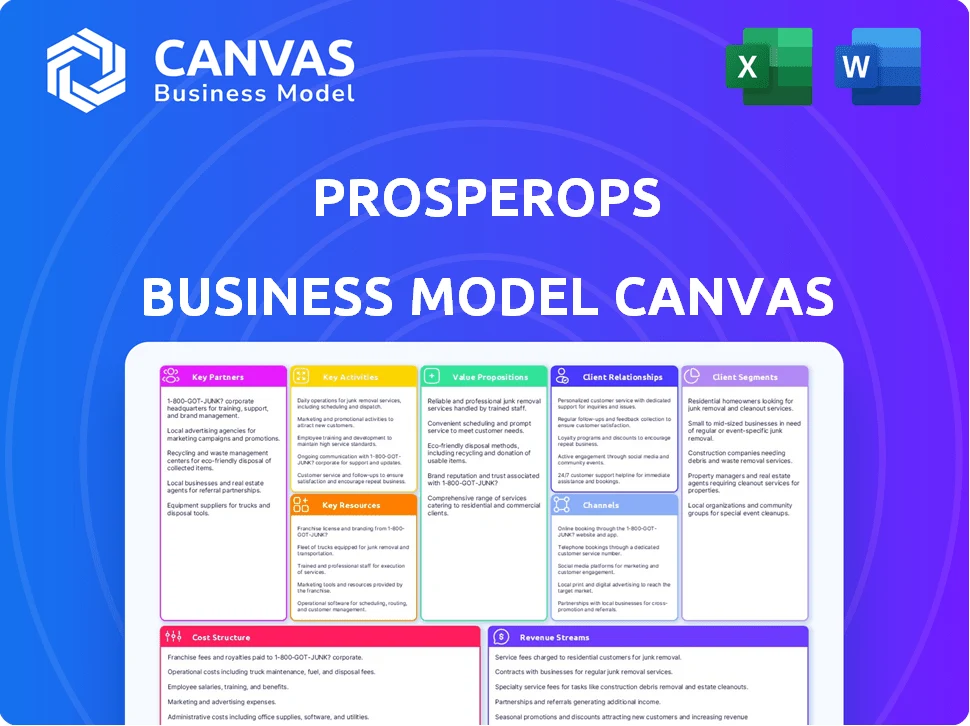
PROSPEROPS BUSINESS MODEL CANVAS TEMPLATE RESEARCH
What is included in the product
 Detailed Word Document
Organized into 9 classic BMC blocks with full narrative and insights.

 Customizable Excel Spreadsheet
High-level view of the company's business model with editable cells.
Preview Before You Purchase
Business Model Canvas
What you see is what you get! This Business Model Canvas preview mirrors the final, fully accessible document. Purchasing grants you immediate access to this same, complete file. It's ready for immediate use and customization.

Business Model Canvas Template

ProsperOps: Unveiling the Business Model Canvas
Discover the core of ProsperOps's strategy with its Business Model Canvas. This in-depth analysis unveils how ProsperOps creates value, reaches customers, and generates revenue. It's perfect for investors and analysts.
Partnerships

Cloud Service Providers
Key partnerships with cloud service providers like AWS, Google Cloud, and Microsoft Azure are vital for ProsperOps. These partnerships ensure seamless integration and access to essential APIs. In 2024, AWS held about 32% of the cloud market, Azure 25%, and Google Cloud 11%.
FinOps and Cloud Management Platforms
ProsperOps collaborates with FinOps tools and cloud management platforms. This includes partnerships with Kion and CloudZero. These integrations offer enhanced cost management and governance. Such alliances expand ProsperOps' market presence. In 2024, the FinOps market is expected to reach $1.9 billion.

Managed Service Providers (MSPs) and Cloud Consulting Firms
Collaborating with Managed Service Providers (MSPs) and cloud consulting firms expands ProsperOps' reach to businesses needing cloud optimization. These partners integrate ProsperOps' automation, offering clients significant cost savings. In 2024, the cloud optimization market grew, with MSPs managing a larger share, providing a key distribution channel. Partnering with MSPs can lead to a 15-20% reduction in cloud costs for clients.

Technology Partners
ProsperOps benefits from collaborations with technology partners. These partnerships enhance its cloud cost optimization services. Such partnerships can include monitoring tools and automation platforms. These tools integrate and increase the value of ProsperOps' offerings. In 2024, cloud optimization spending reached $2.8 billion.
- Partnerships expand functionality.
- Monitoring tools improve cost visibility.
- Automation platforms streamline processes.
- Cloud optimization market grows.
Industry Foundations and Communities
Key partnerships with industry foundations and communities are crucial for ProsperOps. Being part of the FinOps Foundation, for example, boosts their reputation. It also helps them stay aligned with cloud financial management best practices. These partnerships offer networking opportunities, which are essential for business growth. In 2024, the FinOps Foundation saw its membership grow by 30%, highlighting the importance of such connections.
- Establishes credibility within the FinOps community.
- Contributes to and benefits from industry best practices.
- Provides networking opportunities for growth.
- Aligns with the latest cloud financial management trends.
Strategic Alliances Drive Growth
ProsperOps’ success hinges on strategic partnerships. They partner with cloud providers like AWS, Azure, and Google Cloud. These partnerships expand market reach and integrate essential tools. Additionally, they collaborate with FinOps tools and MSPs to enhance cost management and expand client offerings. Industry partnerships through the FinOps Foundation boost credibility.
| Partnership Type | Partners | Benefit in 2024 |
|---|---|---|
| Cloud Providers | AWS, Azure, Google Cloud | Access to APIs and infrastructure. AWS market share: ~32% |
| FinOps & Cloud Mgmt | Kion, CloudZero | Enhanced cost management and governance. FinOps market: ~$1.9B |
| MSPs & Cloud Consulting | Various | Expanded market reach & cost savings (15-20%). |
Activities

Developing and Maintaining Optimization Algorithms
ProsperOps' key activity revolves around creating and maintaining optimization algorithms. These algorithms, crucial for analyzing cloud usage and managing Savings Plans and Reserved Instances, are constantly updated. This ensures the delivery of effective and autonomous cost savings for clients. In 2024, the company's algorithms helped clients achieve an average of 25% savings on their cloud spending.
Integrating with Cloud Provider APIs
ProsperOps' core function relies heavily on seamless integration with major cloud providers like AWS, Google Cloud, and Azure. This involves constantly updating API connections to gather usage data, which is essential for accurate recommendations. In 2024, cloud spending reached over $670 billion globally, highlighting the need for effective cost management. These integrations enable the platform to automate commitment purchases and adjustments, optimizing cloud spending for clients.

Monitoring and Analyzing Cloud Spending
ProsperOps actively monitors cloud environments to understand spending. They analyze patterns and spot anomalies, seeking optimization. This real-time analysis fuels automated cost reductions. In 2024, cloud waste averaged 35% across companies.

Executing Automated Savings Strategies
A key activity for ProsperOps is executing automated savings strategies. The platform's automation of Savings Plans and Reserved Instances is central. This hands-free approach is a core value proposition, optimizing cloud spending efficiently. It continuously adjusts to maximize savings.
- Automated Purchasing: The platform automatically buys Savings Plans and Reserved Instances.
- Continuous Optimization: It dynamically adjusts these resources.
- Cost Reduction: This activity directly lowers cloud spending.
- Hands-Free Management: Users benefit from automated management.
Providing Reporting and Insights
ProsperOps focuses on generating reports and insights to show customers their cloud spending and savings. This transparency helps clients see the value of the service, allowing them to make better decisions. In 2024, the cloud optimization market grew substantially, with companies like AWS and Microsoft Azure seeing increased demand for cost-saving solutions. By providing clear data on cloud spending, ProsperOps helps customers understand their financial position and identify opportunities for further savings.
- Cloud spending optimization market projected to reach $30 billion by 2025.
- Companies can reduce cloud costs by 30% through effective optimization strategies.
- ProsperOps reports help clients identify and implement cost-saving measures.
- Data-driven insights empower informed financial decisions.
Cloud Cost Savings: Automate, Optimize, Save!
ProsperOps actively manages cloud resources through automated purchasing and adjustments. This hands-free approach ensures efficient optimization, creating significant cost savings. By dynamically managing Savings Plans and Reserved Instances, ProsperOps reduces cloud spending without user intervention.
| Key Activity | Description | 2024 Impact |
|---|---|---|
| Automated Savings Strategies | Automated purchasing and adjusting Savings Plans/RIs | Average client savings of 25% on cloud costs |
| Real-time Analysis | Continuously monitors cloud usage for anomalies | Helped prevent an average of 35% cloud waste |
| Reporting and Insights | Generating detailed cloud spending and saving reports | Facilitated data-driven decisions for better cost management. |
Resources

Optimization Algorithms and Technology
ProsperOps' proprietary algorithms and technology are crucial for autonomous cloud cost optimization, representing core intellectual property. These algorithms analyze cloud spending patterns to identify and implement savings opportunities. In 2024, companies using similar technologies reported average cloud cost reductions of 20-40%. This technology platform is a key resource for delivering value.
Skilled Engineering and Data Science Teams
ProsperOps relies heavily on a skilled team for its operations. This includes cloud computing, software engineering, data science, and financial analysis experts. These teams are crucial for developing and maintaining the platform and its algorithms. As of 2024, companies in these fields saw average salaries ranging from $80,000 to $150,000+ depending on experience and location.

Cloud Infrastructure
Cloud infrastructure is crucial for ProsperOps, housing its platform and operations across providers. In 2024, global cloud spending reached ~$670B, highlighting its importance. This infrastructure's scalability and cost-efficiency are vital for managing customer workloads. It ensures ProsperOps can handle increasing demands.

Customer Usage Data
Customer usage data is crucial for ProsperOps. This data fuels the platform's optimization algorithms, enabling it to function effectively. Analyzing this data allows the identification of cloud cost-saving opportunities. This data-driven approach is key to ProsperOps' value proposition.
- Data volume: Analyzing terabytes of cloud usage data daily.
- Optimization: Identifying potential savings of up to 40% on cloud spending.
- Impact: Real-time cost optimization for clients.
Partnerships and Integrations
Partnerships and integrations are crucial for ProsperOps. They leverage existing relationships with cloud providers and other platforms. These collaborations enhance service delivery, making it more effective. Strong partnerships can lead to greater market reach and operational efficiency. This is a key resource.
- 2024: Cloud computing market is projected to reach $678.8 billion.
- Strategic partnerships drive innovation and scalability.
- Integrations streamline user experience and adoption.
- Partnerships with AWS, Azure, and GCP are essential.
Essential Resources Powering Cloud Cost Optimization
Key resources for ProsperOps include its proprietary algorithms, which allow cloud cost optimization. A skilled team of experts and reliable cloud infrastructure are also essential components. Customer usage data fuels the platform, ensuring effective function. Lastly, strategic partnerships with cloud providers are vital.
| Resource | Description | 2024 Impact |
|---|---|---|
| Algorithms | Proprietary tech for cloud cost savings. | 20-40% cost reduction, as seen by similar companies |
| Team | Cloud, software, and financial experts. | Avg. salaries $80k-$150k+ (varies) |
| Infrastructure | Cloud platforms (AWS, Azure, GCP). | ~$670B in global cloud spending. |
Value Propositions

Automated Cloud Cost Savings
ProsperOps automates cloud cost savings, optimizing Savings Plans and Reserved Instances. This leads to significant cost reductions for clients. Customers often see substantial savings without manual work.
Reduced Manual Effort and Complexity
ProsperOps significantly cuts down on manual effort. The platform automates cloud commitment management. This frees teams to focus on strategic tasks. By 2024, cloud cost optimization is a major focus.

Minimized Commitment Risk
ProsperOps minimizes commitment risk by adapting to your cloud usage. This dynamic approach helps prevent overspending on resources like Reserved Instances. In 2024, many companies struggled with wasted cloud spend. ProsperOps aims to reduce this waste, which can be as high as 30% in some cases. This means better budget control and resource allocation.

Improved Financial Visibility and Control
ProsperOps enhances financial visibility by offering detailed reports on cloud spending, helping businesses understand costs. This promotes data-driven decision-making and improved cost control. In 2024, cloud spending surged, with global spending exceeding $670 billion, highlighting the need for such insights. The platform's clarity allows for better budget allocation and optimization strategies.
- Real-time Cost Tracking: Monitor cloud expenses as they occur.
- Customizable Dashboards: Tailor views to specific needs and departments.
- Automated Reporting: Generate regular reports on spending trends.
- Cost Optimization Alerts: Receive notifications about potential savings.
Continuous Optimization
ProsperOps' value proposition of Continuous Optimization means they don't just set up cost savings and walk away. Instead, they actively and consistently monitor cloud spending. This dynamic approach ensures the best possible pricing and resource allocation over time. The goal is to adapt to changing cloud usage patterns. This is much more effective than a one-off cost reduction effort.
- Real-time Monitoring: ProsperOps uses live data feeds to track cloud spending.
- Automated Adjustments: They automatically adjust resource allocation and pricing.
- Cost Savings: They are able to achieve an average of 30-60% cloud cost savings for their customers.
- Adaptability: The system adjusts to new cloud services and usage patterns.
Cloud Cost Optimization: Automate & Save!
ProsperOps offers automated cloud cost optimization. It aims to reduce cloud spending waste. By adapting to cloud usage, it minimizes risk and improves budget control.
The platform's real-time tracking and automated adjustments help with ongoing cost savings. ProsperOps provides financial visibility, offering detailed reports and insights into cloud expenses, promoting data-driven decision-making. In 2024, cloud spending surged past $670 billion globally, highlighting the importance of such solutions.
| Value Proposition | Description | Benefits |
|---|---|---|
| Automated Cost Savings | Optimize Savings Plans & Reserved Instances. | Significant cost reductions, reducing cloud waste up to 30%. |
| Reduced Manual Effort | Automates cloud commitment management. | Frees up teams for strategic tasks; saves time and resources. |
| Minimized Commitment Risk | Adapts to cloud usage; avoids overspending. | Better budget control, efficient resource allocation. |
PROSPEROPS BUSINESS MODEL CANVAS TEMPLATE RESEARCH
What is included in the product
Detailed Word Document
Organized into 9 classic BMC blocks with full narrative and insights.
Customizable Excel Spreadsheet
High-level view of the company's business model with editable cells.
Preview Before You Purchase
Business Model Canvas
What you see is what you get! This Business Model Canvas preview mirrors the final, fully accessible document. Purchasing grants you immediate access to this same, complete file. It's ready for immediate use and customization.
Business Model Canvas Template
ProsperOps: Unveiling the Business Model Canvas
Discover the core of ProsperOps's strategy with its Business Model Canvas. This in-depth analysis unveils how ProsperOps creates value, reaches customers, and generates revenue. It's perfect for investors and analysts.
Partnerships
Cloud Service Providers
Key partnerships with cloud service providers like AWS, Google Cloud, and Microsoft Azure are vital for ProsperOps. These partnerships ensure seamless integration and access to essential APIs. In 2024, AWS held about 32% of the cloud market, Azure 25%, and Google Cloud 11%.
FinOps and Cloud Management Platforms
ProsperOps collaborates with FinOps tools and cloud management platforms. This includes partnerships with Kion and CloudZero. These integrations offer enhanced cost management and governance. Such alliances expand ProsperOps' market presence. In 2024, the FinOps market is expected to reach $1.9 billion.
Managed Service Providers (MSPs) and Cloud Consulting Firms
Collaborating with Managed Service Providers (MSPs) and cloud consulting firms expands ProsperOps' reach to businesses needing cloud optimization. These partners integrate ProsperOps' automation, offering clients significant cost savings. In 2024, the cloud optimization market grew, with MSPs managing a larger share, providing a key distribution channel. Partnering with MSPs can lead to a 15-20% reduction in cloud costs for clients.
Technology Partners
ProsperOps benefits from collaborations with technology partners. These partnerships enhance its cloud cost optimization services. Such partnerships can include monitoring tools and automation platforms. These tools integrate and increase the value of ProsperOps' offerings. In 2024, cloud optimization spending reached $2.8 billion.
- Partnerships expand functionality.
- Monitoring tools improve cost visibility.
- Automation platforms streamline processes.
- Cloud optimization market grows.
Industry Foundations and Communities
Key partnerships with industry foundations and communities are crucial for ProsperOps. Being part of the FinOps Foundation, for example, boosts their reputation. It also helps them stay aligned with cloud financial management best practices. These partnerships offer networking opportunities, which are essential for business growth. In 2024, the FinOps Foundation saw its membership grow by 30%, highlighting the importance of such connections.
- Establishes credibility within the FinOps community.
- Contributes to and benefits from industry best practices.
- Provides networking opportunities for growth.
- Aligns with the latest cloud financial management trends.
Strategic Alliances Drive Growth
ProsperOps’ success hinges on strategic partnerships. They partner with cloud providers like AWS, Azure, and Google Cloud. These partnerships expand market reach and integrate essential tools. Additionally, they collaborate with FinOps tools and MSPs to enhance cost management and expand client offerings. Industry partnerships through the FinOps Foundation boost credibility.
| Partnership Type | Partners | Benefit in 2024 |
|---|---|---|
| Cloud Providers | AWS, Azure, Google Cloud | Access to APIs and infrastructure. AWS market share: ~32% |
| FinOps & Cloud Mgmt | Kion, CloudZero | Enhanced cost management and governance. FinOps market: ~$1.9B |
| MSPs & Cloud Consulting | Various | Expanded market reach & cost savings (15-20%). |
Activities
Developing and Maintaining Optimization Algorithms
ProsperOps' key activity revolves around creating and maintaining optimization algorithms. These algorithms, crucial for analyzing cloud usage and managing Savings Plans and Reserved Instances, are constantly updated. This ensures the delivery of effective and autonomous cost savings for clients. In 2024, the company's algorithms helped clients achieve an average of 25% savings on their cloud spending.
Integrating with Cloud Provider APIs
ProsperOps' core function relies heavily on seamless integration with major cloud providers like AWS, Google Cloud, and Azure. This involves constantly updating API connections to gather usage data, which is essential for accurate recommendations. In 2024, cloud spending reached over $670 billion globally, highlighting the need for effective cost management. These integrations enable the platform to automate commitment purchases and adjustments, optimizing cloud spending for clients.
Monitoring and Analyzing Cloud Spending
ProsperOps actively monitors cloud environments to understand spending. They analyze patterns and spot anomalies, seeking optimization. This real-time analysis fuels automated cost reductions. In 2024, cloud waste averaged 35% across companies.
Executing Automated Savings Strategies
A key activity for ProsperOps is executing automated savings strategies. The platform's automation of Savings Plans and Reserved Instances is central. This hands-free approach is a core value proposition, optimizing cloud spending efficiently. It continuously adjusts to maximize savings.
- Automated Purchasing: The platform automatically buys Savings Plans and Reserved Instances.
- Continuous Optimization: It dynamically adjusts these resources.
- Cost Reduction: This activity directly lowers cloud spending.
- Hands-Free Management: Users benefit from automated management.
Providing Reporting and Insights
ProsperOps focuses on generating reports and insights to show customers their cloud spending and savings. This transparency helps clients see the value of the service, allowing them to make better decisions. In 2024, the cloud optimization market grew substantially, with companies like AWS and Microsoft Azure seeing increased demand for cost-saving solutions. By providing clear data on cloud spending, ProsperOps helps customers understand their financial position and identify opportunities for further savings.
- Cloud spending optimization market projected to reach $30 billion by 2025.
- Companies can reduce cloud costs by 30% through effective optimization strategies.
- ProsperOps reports help clients identify and implement cost-saving measures.
- Data-driven insights empower informed financial decisions.
Cloud Cost Savings: Automate, Optimize, Save!
ProsperOps actively manages cloud resources through automated purchasing and adjustments. This hands-free approach ensures efficient optimization, creating significant cost savings. By dynamically managing Savings Plans and Reserved Instances, ProsperOps reduces cloud spending without user intervention.
| Key Activity | Description | 2024 Impact |
|---|---|---|
| Automated Savings Strategies | Automated purchasing and adjusting Savings Plans/RIs | Average client savings of 25% on cloud costs |
| Real-time Analysis | Continuously monitors cloud usage for anomalies | Helped prevent an average of 35% cloud waste |
| Reporting and Insights | Generating detailed cloud spending and saving reports | Facilitated data-driven decisions for better cost management. |
Resources
Optimization Algorithms and Technology
ProsperOps' proprietary algorithms and technology are crucial for autonomous cloud cost optimization, representing core intellectual property. These algorithms analyze cloud spending patterns to identify and implement savings opportunities. In 2024, companies using similar technologies reported average cloud cost reductions of 20-40%. This technology platform is a key resource for delivering value.
Skilled Engineering and Data Science Teams
ProsperOps relies heavily on a skilled team for its operations. This includes cloud computing, software engineering, data science, and financial analysis experts. These teams are crucial for developing and maintaining the platform and its algorithms. As of 2024, companies in these fields saw average salaries ranging from $80,000 to $150,000+ depending on experience and location.
Cloud Infrastructure
Cloud infrastructure is crucial for ProsperOps, housing its platform and operations across providers. In 2024, global cloud spending reached ~$670B, highlighting its importance. This infrastructure's scalability and cost-efficiency are vital for managing customer workloads. It ensures ProsperOps can handle increasing demands.
Customer Usage Data
Customer usage data is crucial for ProsperOps. This data fuels the platform's optimization algorithms, enabling it to function effectively. Analyzing this data allows the identification of cloud cost-saving opportunities. This data-driven approach is key to ProsperOps' value proposition.
- Data volume: Analyzing terabytes of cloud usage data daily.
- Optimization: Identifying potential savings of up to 40% on cloud spending.
- Impact: Real-time cost optimization for clients.
Partnerships and Integrations
Partnerships and integrations are crucial for ProsperOps. They leverage existing relationships with cloud providers and other platforms. These collaborations enhance service delivery, making it more effective. Strong partnerships can lead to greater market reach and operational efficiency. This is a key resource.
- 2024: Cloud computing market is projected to reach $678.8 billion.
- Strategic partnerships drive innovation and scalability.
- Integrations streamline user experience and adoption.
- Partnerships with AWS, Azure, and GCP are essential.
Essential Resources Powering Cloud Cost Optimization
Key resources for ProsperOps include its proprietary algorithms, which allow cloud cost optimization. A skilled team of experts and reliable cloud infrastructure are also essential components. Customer usage data fuels the platform, ensuring effective function. Lastly, strategic partnerships with cloud providers are vital.
| Resource | Description | 2024 Impact |
|---|---|---|
| Algorithms | Proprietary tech for cloud cost savings. | 20-40% cost reduction, as seen by similar companies |
| Team | Cloud, software, and financial experts. | Avg. salaries $80k-$150k+ (varies) |
| Infrastructure | Cloud platforms (AWS, Azure, GCP). | ~$670B in global cloud spending. |
Value Propositions
Automated Cloud Cost Savings
ProsperOps automates cloud cost savings, optimizing Savings Plans and Reserved Instances. This leads to significant cost reductions for clients. Customers often see substantial savings without manual work.
Reduced Manual Effort and Complexity
ProsperOps significantly cuts down on manual effort. The platform automates cloud commitment management. This frees teams to focus on strategic tasks. By 2024, cloud cost optimization is a major focus.
Minimized Commitment Risk
ProsperOps minimizes commitment risk by adapting to your cloud usage. This dynamic approach helps prevent overspending on resources like Reserved Instances. In 2024, many companies struggled with wasted cloud spend. ProsperOps aims to reduce this waste, which can be as high as 30% in some cases. This means better budget control and resource allocation.
Improved Financial Visibility and Control
ProsperOps enhances financial visibility by offering detailed reports on cloud spending, helping businesses understand costs. This promotes data-driven decision-making and improved cost control. In 2024, cloud spending surged, with global spending exceeding $670 billion, highlighting the need for such insights. The platform's clarity allows for better budget allocation and optimization strategies.
- Real-time Cost Tracking: Monitor cloud expenses as they occur.
- Customizable Dashboards: Tailor views to specific needs and departments.
- Automated Reporting: Generate regular reports on spending trends.
- Cost Optimization Alerts: Receive notifications about potential savings.
Continuous Optimization
ProsperOps' value proposition of Continuous Optimization means they don't just set up cost savings and walk away. Instead, they actively and consistently monitor cloud spending. This dynamic approach ensures the best possible pricing and resource allocation over time. The goal is to adapt to changing cloud usage patterns. This is much more effective than a one-off cost reduction effort.
- Real-time Monitoring: ProsperOps uses live data feeds to track cloud spending.
- Automated Adjustments: They automatically adjust resource allocation and pricing.
- Cost Savings: They are able to achieve an average of 30-60% cloud cost savings for their customers.
- Adaptability: The system adjusts to new cloud services and usage patterns.
Cloud Cost Optimization: Automate & Save!
ProsperOps offers automated cloud cost optimization. It aims to reduce cloud spending waste. By adapting to cloud usage, it minimizes risk and improves budget control.
The platform's real-time tracking and automated adjustments help with ongoing cost savings. ProsperOps provides financial visibility, offering detailed reports and insights into cloud expenses, promoting data-driven decision-making. In 2024, cloud spending surged past $670 billion globally, highlighting the importance of such solutions.
| Value Proposition | Description | Benefits |
|---|---|---|
| Automated Cost Savings | Optimize Savings Plans & Reserved Instances. | Significant cost reductions, reducing cloud waste up to 30%. |
| Reduced Manual Effort | Automates cloud commitment management. | Frees up teams for strategic tasks; saves time and resources. |
| Minimized Commitment Risk | Adapts to cloud usage; avoids overspending. | Better budget control, efficient resource allocation. |
Product Information
Product Information
Shipping & Returns
Shipping & Returns
Description
What is included in the product
Detailed Word Document
Organized into 9 classic BMC blocks with full narrative and insights.
Customizable Excel Spreadsheet
High-level view of the company's business model with editable cells.
Preview Before You Purchase
Business Model Canvas
What you see is what you get! This Business Model Canvas preview mirrors the final, fully accessible document. Purchasing grants you immediate access to this same, complete file. It's ready for immediate use and customization.
Business Model Canvas Template
ProsperOps: Unveiling the Business Model Canvas
Discover the core of ProsperOps's strategy with its Business Model Canvas. This in-depth analysis unveils how ProsperOps creates value, reaches customers, and generates revenue. It's perfect for investors and analysts.
Partnerships
Cloud Service Providers
Key partnerships with cloud service providers like AWS, Google Cloud, and Microsoft Azure are vital for ProsperOps. These partnerships ensure seamless integration and access to essential APIs. In 2024, AWS held about 32% of the cloud market, Azure 25%, and Google Cloud 11%.
FinOps and Cloud Management Platforms
ProsperOps collaborates with FinOps tools and cloud management platforms. This includes partnerships with Kion and CloudZero. These integrations offer enhanced cost management and governance. Such alliances expand ProsperOps' market presence. In 2024, the FinOps market is expected to reach $1.9 billion.
Managed Service Providers (MSPs) and Cloud Consulting Firms
Collaborating with Managed Service Providers (MSPs) and cloud consulting firms expands ProsperOps' reach to businesses needing cloud optimization. These partners integrate ProsperOps' automation, offering clients significant cost savings. In 2024, the cloud optimization market grew, with MSPs managing a larger share, providing a key distribution channel. Partnering with MSPs can lead to a 15-20% reduction in cloud costs for clients.
Technology Partners
ProsperOps benefits from collaborations with technology partners. These partnerships enhance its cloud cost optimization services. Such partnerships can include monitoring tools and automation platforms. These tools integrate and increase the value of ProsperOps' offerings. In 2024, cloud optimization spending reached $2.8 billion.
- Partnerships expand functionality.
- Monitoring tools improve cost visibility.
- Automation platforms streamline processes.
- Cloud optimization market grows.
Industry Foundations and Communities
Key partnerships with industry foundations and communities are crucial for ProsperOps. Being part of the FinOps Foundation, for example, boosts their reputation. It also helps them stay aligned with cloud financial management best practices. These partnerships offer networking opportunities, which are essential for business growth. In 2024, the FinOps Foundation saw its membership grow by 30%, highlighting the importance of such connections.
- Establishes credibility within the FinOps community.
- Contributes to and benefits from industry best practices.
- Provides networking opportunities for growth.
- Aligns with the latest cloud financial management trends.
Strategic Alliances Drive Growth
ProsperOps’ success hinges on strategic partnerships. They partner with cloud providers like AWS, Azure, and Google Cloud. These partnerships expand market reach and integrate essential tools. Additionally, they collaborate with FinOps tools and MSPs to enhance cost management and expand client offerings. Industry partnerships through the FinOps Foundation boost credibility.
| Partnership Type | Partners | Benefit in 2024 |
|---|---|---|
| Cloud Providers | AWS, Azure, Google Cloud | Access to APIs and infrastructure. AWS market share: ~32% |
| FinOps & Cloud Mgmt | Kion, CloudZero | Enhanced cost management and governance. FinOps market: ~$1.9B |
| MSPs & Cloud Consulting | Various | Expanded market reach & cost savings (15-20%). |
Activities
Developing and Maintaining Optimization Algorithms
ProsperOps' key activity revolves around creating and maintaining optimization algorithms. These algorithms, crucial for analyzing cloud usage and managing Savings Plans and Reserved Instances, are constantly updated. This ensures the delivery of effective and autonomous cost savings for clients. In 2024, the company's algorithms helped clients achieve an average of 25% savings on their cloud spending.
Integrating with Cloud Provider APIs
ProsperOps' core function relies heavily on seamless integration with major cloud providers like AWS, Google Cloud, and Azure. This involves constantly updating API connections to gather usage data, which is essential for accurate recommendations. In 2024, cloud spending reached over $670 billion globally, highlighting the need for effective cost management. These integrations enable the platform to automate commitment purchases and adjustments, optimizing cloud spending for clients.
Monitoring and Analyzing Cloud Spending
ProsperOps actively monitors cloud environments to understand spending. They analyze patterns and spot anomalies, seeking optimization. This real-time analysis fuels automated cost reductions. In 2024, cloud waste averaged 35% across companies.
Executing Automated Savings Strategies
A key activity for ProsperOps is executing automated savings strategies. The platform's automation of Savings Plans and Reserved Instances is central. This hands-free approach is a core value proposition, optimizing cloud spending efficiently. It continuously adjusts to maximize savings.
- Automated Purchasing: The platform automatically buys Savings Plans and Reserved Instances.
- Continuous Optimization: It dynamically adjusts these resources.
- Cost Reduction: This activity directly lowers cloud spending.
- Hands-Free Management: Users benefit from automated management.
Providing Reporting and Insights
ProsperOps focuses on generating reports and insights to show customers their cloud spending and savings. This transparency helps clients see the value of the service, allowing them to make better decisions. In 2024, the cloud optimization market grew substantially, with companies like AWS and Microsoft Azure seeing increased demand for cost-saving solutions. By providing clear data on cloud spending, ProsperOps helps customers understand their financial position and identify opportunities for further savings.
- Cloud spending optimization market projected to reach $30 billion by 2025.
- Companies can reduce cloud costs by 30% through effective optimization strategies.
- ProsperOps reports help clients identify and implement cost-saving measures.
- Data-driven insights empower informed financial decisions.
Cloud Cost Savings: Automate, Optimize, Save!
ProsperOps actively manages cloud resources through automated purchasing and adjustments. This hands-free approach ensures efficient optimization, creating significant cost savings. By dynamically managing Savings Plans and Reserved Instances, ProsperOps reduces cloud spending without user intervention.
| Key Activity | Description | 2024 Impact |
|---|---|---|
| Automated Savings Strategies | Automated purchasing and adjusting Savings Plans/RIs | Average client savings of 25% on cloud costs |
| Real-time Analysis | Continuously monitors cloud usage for anomalies | Helped prevent an average of 35% cloud waste |
| Reporting and Insights | Generating detailed cloud spending and saving reports | Facilitated data-driven decisions for better cost management. |
Resources
Optimization Algorithms and Technology
ProsperOps' proprietary algorithms and technology are crucial for autonomous cloud cost optimization, representing core intellectual property. These algorithms analyze cloud spending patterns to identify and implement savings opportunities. In 2024, companies using similar technologies reported average cloud cost reductions of 20-40%. This technology platform is a key resource for delivering value.
Skilled Engineering and Data Science Teams
ProsperOps relies heavily on a skilled team for its operations. This includes cloud computing, software engineering, data science, and financial analysis experts. These teams are crucial for developing and maintaining the platform and its algorithms. As of 2024, companies in these fields saw average salaries ranging from $80,000 to $150,000+ depending on experience and location.
Cloud Infrastructure
Cloud infrastructure is crucial for ProsperOps, housing its platform and operations across providers. In 2024, global cloud spending reached ~$670B, highlighting its importance. This infrastructure's scalability and cost-efficiency are vital for managing customer workloads. It ensures ProsperOps can handle increasing demands.
Customer Usage Data
Customer usage data is crucial for ProsperOps. This data fuels the platform's optimization algorithms, enabling it to function effectively. Analyzing this data allows the identification of cloud cost-saving opportunities. This data-driven approach is key to ProsperOps' value proposition.
- Data volume: Analyzing terabytes of cloud usage data daily.
- Optimization: Identifying potential savings of up to 40% on cloud spending.
- Impact: Real-time cost optimization for clients.
Partnerships and Integrations
Partnerships and integrations are crucial for ProsperOps. They leverage existing relationships with cloud providers and other platforms. These collaborations enhance service delivery, making it more effective. Strong partnerships can lead to greater market reach and operational efficiency. This is a key resource.
- 2024: Cloud computing market is projected to reach $678.8 billion.
- Strategic partnerships drive innovation and scalability.
- Integrations streamline user experience and adoption.
- Partnerships with AWS, Azure, and GCP are essential.
Essential Resources Powering Cloud Cost Optimization
Key resources for ProsperOps include its proprietary algorithms, which allow cloud cost optimization. A skilled team of experts and reliable cloud infrastructure are also essential components. Customer usage data fuels the platform, ensuring effective function. Lastly, strategic partnerships with cloud providers are vital.
| Resource | Description | 2024 Impact |
|---|---|---|
| Algorithms | Proprietary tech for cloud cost savings. | 20-40% cost reduction, as seen by similar companies |
| Team | Cloud, software, and financial experts. | Avg. salaries $80k-$150k+ (varies) |
| Infrastructure | Cloud platforms (AWS, Azure, GCP). | ~$670B in global cloud spending. |
Value Propositions
Automated Cloud Cost Savings
ProsperOps automates cloud cost savings, optimizing Savings Plans and Reserved Instances. This leads to significant cost reductions for clients. Customers often see substantial savings without manual work.
Reduced Manual Effort and Complexity
ProsperOps significantly cuts down on manual effort. The platform automates cloud commitment management. This frees teams to focus on strategic tasks. By 2024, cloud cost optimization is a major focus.
Minimized Commitment Risk
ProsperOps minimizes commitment risk by adapting to your cloud usage. This dynamic approach helps prevent overspending on resources like Reserved Instances. In 2024, many companies struggled with wasted cloud spend. ProsperOps aims to reduce this waste, which can be as high as 30% in some cases. This means better budget control and resource allocation.
Improved Financial Visibility and Control
ProsperOps enhances financial visibility by offering detailed reports on cloud spending, helping businesses understand costs. This promotes data-driven decision-making and improved cost control. In 2024, cloud spending surged, with global spending exceeding $670 billion, highlighting the need for such insights. The platform's clarity allows for better budget allocation and optimization strategies.
- Real-time Cost Tracking: Monitor cloud expenses as they occur.
- Customizable Dashboards: Tailor views to specific needs and departments.
- Automated Reporting: Generate regular reports on spending trends.
- Cost Optimization Alerts: Receive notifications about potential savings.
Continuous Optimization
ProsperOps' value proposition of Continuous Optimization means they don't just set up cost savings and walk away. Instead, they actively and consistently monitor cloud spending. This dynamic approach ensures the best possible pricing and resource allocation over time. The goal is to adapt to changing cloud usage patterns. This is much more effective than a one-off cost reduction effort.
- Real-time Monitoring: ProsperOps uses live data feeds to track cloud spending.
- Automated Adjustments: They automatically adjust resource allocation and pricing.
- Cost Savings: They are able to achieve an average of 30-60% cloud cost savings for their customers.
- Adaptability: The system adjusts to new cloud services and usage patterns.
Cloud Cost Optimization: Automate & Save!
ProsperOps offers automated cloud cost optimization. It aims to reduce cloud spending waste. By adapting to cloud usage, it minimizes risk and improves budget control.
The platform's real-time tracking and automated adjustments help with ongoing cost savings. ProsperOps provides financial visibility, offering detailed reports and insights into cloud expenses, promoting data-driven decision-making. In 2024, cloud spending surged past $670 billion globally, highlighting the importance of such solutions.
| Value Proposition | Description | Benefits |
|---|---|---|
| Automated Cost Savings | Optimize Savings Plans & Reserved Instances. | Significant cost reductions, reducing cloud waste up to 30%. |
| Reduced Manual Effort | Automates cloud commitment management. | Frees up teams for strategic tasks; saves time and resources. |
| Minimized Commitment Risk | Adapts to cloud usage; avoids overspending. | Better budget control, efficient resource allocation. |


