POSTI GROUP OYJ PESTLE ANALYSIS TEMPLATE RESEARCH
What is included in the product
 Detailed Word Document
Examines Posti's external environment across six PESTLE factors. It helps identify threats & opportunities for strategic decisions.

 Customizable Excel Spreadsheet
Helps support discussions on external risk & market positioning during planning sessions.
What You See Is What You Get
Posti Group Oyj PESTLE Analysis
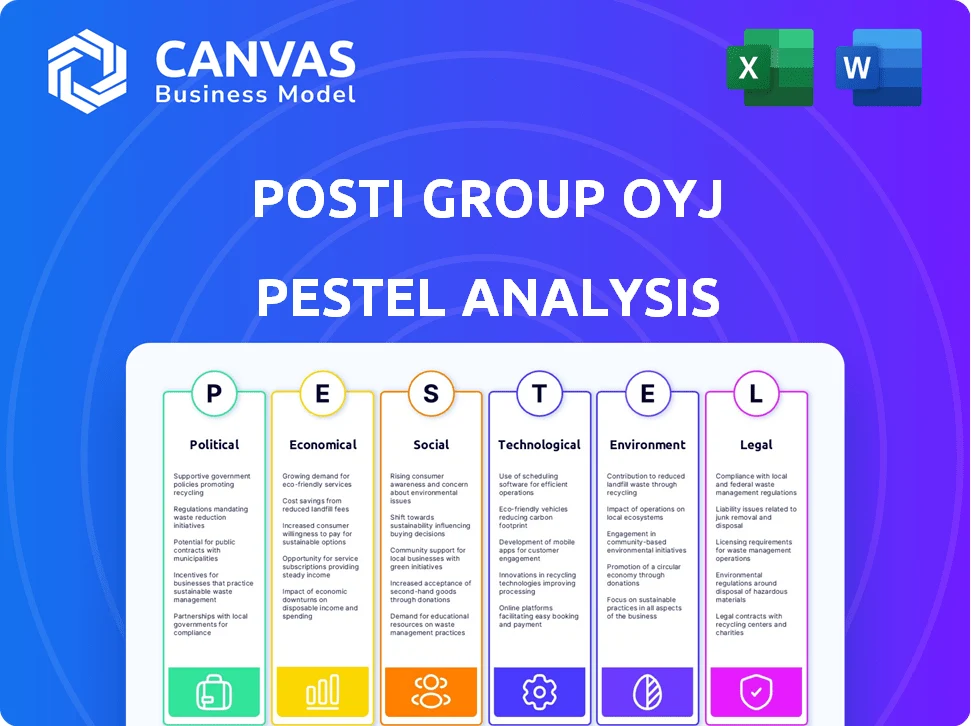
What you’re previewing here is the actual file—fully formatted and professionally structured. This Posti Group Oyj PESTLE analysis you see, detailing political, economic, social, technological, legal, and environmental factors, is complete. You'll receive this exact analysis instantly upon purchase. It's ready to use.

PESTLE Analysis Template

Your Competitive Advantage Starts with This Report
Navigating the evolving postal and logistics landscape requires a sharp understanding of external forces. Our PESTLE Analysis of Posti Group Oyj meticulously examines the political, economic, social, technological, legal, and environmental factors shaping its trajectory. Discover how regulations, market trends, and technological advancements are impacting Posti Group Oyj's strategy. Understand potential risks and opportunities with our expert insights. Download the full PESTLE analysis now and get the strategic edge you need.
Political factors

Government Ownership and Influence
As a state-owned entity, Posti Group's strategies are heavily shaped by Finnish government policies. The government's priorities can influence pricing, service standards, and investment choices. For instance, in 2024, the Finnish government discussed potential changes to postal services regulations. This could affect Posti's operational scope and profitability.
Regulatory Environment
Posti Group Oyj operates within a heavily regulated environment. Regulations at both national and EU levels significantly influence its operations. For example, the Finnish Communications Regulatory Authority (FICORA) oversees postal services. In 2024, the EU's Digital Services Act (DSA) and Digital Markets Act (DMA) further shaped the regulatory landscape, impacting data handling and competition.

Political Strikes and Labor Relations
Political strikes and labor disputes, like those impacting Finland in early 2024, can severely disrupt Posti's operations. Such actions might cause delivery delays. For example, in 2024, labor disputes caused a decrease of 5% in delivery efficiency. Stable labor relations are vital for Posti's consistent service delivery.

International Relations and Trade Policies
Posti Group's global presence means international relations and trade policies directly affect its operations. Geopolitical instability and shifts in trade agreements can disrupt cross-border deliveries and alter demand. For example, the Russia-Ukraine war impacted Posti's services. The EU's trade policies also affect Posti.
- EU trade accounted for 60% of Posti's international revenue in 2023.
- Posti saw a 15% decrease in shipments to Russia in 2022.
- Changes in customs regulations increased delivery times by 10% in 2024.
Universal Service Obligation
Posti Group Oyj's obligation to offer universal postal services is a key political factor. This includes serving remote areas, which affects its operational costs and service strategies. The Finnish government mandates these services to ensure nationwide accessibility. This obligation can create financial burdens, particularly in sparsely populated regions.
- Posti must maintain service standards even in low-density areas.
- The government may adjust regulations influencing Posti's operations.
- Changes in postal legislation can impact Posti's business model.
Political Winds: Shaping the Future of Postal Services
Political factors significantly impact Posti Group's operations, particularly through government regulations and policies. The Finnish government's decisions influence pricing, service standards, and investment, as seen in discussions around postal service regulations in 2024. Political instability, such as the Russia-Ukraine war, and EU trade policies affect cross-border deliveries and demand. Maintaining universal postal services, especially in remote areas, adds to operational costs.
| Political Factor | Impact | 2024/2025 Data |
|---|---|---|
| Government Regulations | Influences pricing, service, investment | Discussions on postal regulations (2024) |
| International Relations | Affects cross-border deliveries and demand | EU trade accounted for 60% int. revenue in 2023, 15% decrease in shipments to Russia (2022), customs increased delivery times by 10% (2024) |
| Universal Postal Service | Affects operational costs | Mandatory service standards in low-density areas, increased financial burdens. |
Economic factors

Economic Slowdown and Consumer Demand
The economic slowdown, influenced by inflation and interest rates, significantly impacts Posti. Consumer confidence fluctuations directly affect e-commerce and parcel volumes. Posti's net sales are vulnerable in a low economic environment. For instance, in Q1 2024, Posti's revenue decreased by 6.6% year-on-year, reflecting economic pressures.
E-commerce Growth and Competition
E-commerce expansion offers Posti opportunities, but competition is fierce. The e-commerce market in Finland grew by 8% in 2024. Increased competition could squeeze profit margins. Posti must adapt to maintain market share and profitability in 2025.

Inflation and Cost Management
Inflation poses a challenge, potentially increasing Posti's operational costs, including fuel and labor. In 2024, Finland's inflation rate was around 3.2%, impacting expenses. Posti must focus on cost management. This includes streamlining operations to preserve profitability. In Q1 2024, Posti's operating expenses were EUR 341.8 million.

Investment in Infrastructure and Technology
Posti Group Oyj's strategic investments in infrastructure and technology are crucial for adapting to economic shifts. These investments involve automation, technology upgrades, and enhancing logistics networks to boost efficiency and service quality. For example, in 2024, Posti allocated €100 million towards digital transformation and automation projects.
This focus on technology enables Posti to optimize its operations, reduce costs, and improve delivery times, which are key to staying competitive. These investments are directly tied to economic growth and the increasing demand for e-commerce solutions. The investments also include modernizing sorting facilities and expanding its electric vehicle fleet to support sustainable logistics.
- €100 million allocated for digital transformation in 2024.
- Expansion of electric vehicle fleet.
- Modernization of sorting facilities.
Revenue Diversification
Posti Group Oyj must diversify its revenue due to the drop in traditional mail. E-commerce solutions and logistics are key for financial stability. In 2023, Posti's revenue was about EUR 1.6 billion. The company is expanding services like parcel delivery and warehousing. This diversification aims to offset the decline in letters and improve its market position.
- E-commerce growth is crucial.
- Logistics services are also expanding.
- 2023 revenue was approximately EUR 1.6 billion.
- Focus is on parcel and warehousing services.
Economic Shifts Challenge Posti's Performance
Economic factors such as inflation and e-commerce growth strongly impact Posti Group Oyj. Economic slowdown affected revenue; Q1 2024 revenue dropped 6.6%. Adaptations are necessary, fueled by the 2024 e-commerce market in Finland growing by 8%.
| Key Economic Factor | Impact on Posti | Relevant Data (2024-2025) |
|---|---|---|
| Inflation | Increases costs | Finland's inflation was 3.2% in 2024; operational expenses in Q1 2024 were EUR 341.8 million. |
| E-commerce Growth | Opportunities, but competition exists. | Finland e-commerce market grew 8% in 2024; Posti's 2023 revenue was approximately EUR 1.6 billion. |
| Economic Slowdown | Impacts revenues & confidence. | Q1 2024 revenue decrease 6.6% year-on-year. |
Sociological factors

Changing Consumer Behavior
The rise of e-commerce is reshaping consumer behavior, boosting demand for parcel delivery and related services. Traditional postal services face declining demand as digital communication grows. Posti Group's parcel volume in 2023 increased by 3.7% year-on-year. E-commerce's share of retail sales continues to climb.
Demographic Shifts
Demographic shifts significantly impact Posti Group. Aging populations and urbanization alter service needs. For example, Finland's population is aging, with 22.7% aged 65+ in 2023. Urban areas require more delivery services. Posti must adapt to these evolving demands.

Customer Expectations
Rising customer demands for swift, easy, and clear delivery services compel Posti to invest in tech and refine its delivery methods. This includes tracking and real-time updates. In 2024, e-commerce sales increased by 7%, heightening these expectations. Posti handled 1.2 billion items in 2023.

Social Responsibility and Ethical Practices
Posti Group Oyj faces increasing scrutiny regarding its social responsibility and ethical practices. This includes labor standards, data protection, and environmental sustainability. The company's commitment to these areas impacts its brand reputation and operational costs. A 2024 report indicated that 75% of consumers prefer companies with strong ethical standards.
- Posti's 2023 Sustainability Report highlights environmental initiatives.
- Data protection compliance is essential due to GDPR regulations.
- Ethical sourcing and fair labor practices gain importance.
Workforce and Labor Relations
Posti Group Oyj prioritizes workforce well-being and positive labor relations to boost operational efficiency and public image. In 2024, Posti faced challenges, including labor disputes and strikes, impacting service reliability. Maintaining a skilled, satisfied workforce is crucial, especially with the rise of e-commerce driving demand. Posti's labor costs in 2024 were approximately €700 million, reflecting the importance of efficient labor management.
- Labor disputes in 2024 caused service disruptions.
- Employee satisfaction surveys are regularly conducted.
- Focus on training programs to enhance employee skills.
- Negotiations with unions impact wage agreements.
E-commerce, Demographics, and Parcel Services
E-commerce fuels parcel demand. Posti adapted to evolving demographics, such as Finland's aging population (22.7% over 65 in 2023) and urbanization, to manage service needs. Consumer expectations rise. Posti's handled 1.2 billion items in 2023.
| Sociological Factor | Impact | 2023-2024 Data/Trends |
|---|---|---|
| E-commerce Growth | Increased demand for parcel services | Parcel volume increased by 3.7% (2023), e-commerce sales +7% (2024) |
| Demographic Shifts | Altered service demands, e.g., more deliveries to urban areas. | Aging population in Finland (22.7% aged 65+ in 2023). |
| Consumer Expectations | Demand for swift, clear, and trackable services. | Posti handled 1.2B items (2023), high expectations. |
POSTI GROUP OYJ PESTLE ANALYSIS TEMPLATE RESEARCH
What is included in the product
Detailed Word Document
Examines Posti's external environment across six PESTLE factors. It helps identify threats & opportunities for strategic decisions.
Customizable Excel Spreadsheet
Helps support discussions on external risk & market positioning during planning sessions.
What You See Is What You Get
Posti Group Oyj PESTLE Analysis
What you’re previewing here is the actual file—fully formatted and professionally structured. This Posti Group Oyj PESTLE analysis you see, detailing political, economic, social, technological, legal, and environmental factors, is complete. You'll receive this exact analysis instantly upon purchase. It's ready to use.
PESTLE Analysis Template
Your Competitive Advantage Starts with This Report
Navigating the evolving postal and logistics landscape requires a sharp understanding of external forces. Our PESTLE Analysis of Posti Group Oyj meticulously examines the political, economic, social, technological, legal, and environmental factors shaping its trajectory. Discover how regulations, market trends, and technological advancements are impacting Posti Group Oyj's strategy. Understand potential risks and opportunities with our expert insights. Download the full PESTLE analysis now and get the strategic edge you need.
Political factors
Government Ownership and Influence
As a state-owned entity, Posti Group's strategies are heavily shaped by Finnish government policies. The government's priorities can influence pricing, service standards, and investment choices. For instance, in 2024, the Finnish government discussed potential changes to postal services regulations. This could affect Posti's operational scope and profitability.
Regulatory Environment
Posti Group Oyj operates within a heavily regulated environment. Regulations at both national and EU levels significantly influence its operations. For example, the Finnish Communications Regulatory Authority (FICORA) oversees postal services. In 2024, the EU's Digital Services Act (DSA) and Digital Markets Act (DMA) further shaped the regulatory landscape, impacting data handling and competition.
Political Strikes and Labor Relations
Political strikes and labor disputes, like those impacting Finland in early 2024, can severely disrupt Posti's operations. Such actions might cause delivery delays. For example, in 2024, labor disputes caused a decrease of 5% in delivery efficiency. Stable labor relations are vital for Posti's consistent service delivery.
International Relations and Trade Policies
Posti Group's global presence means international relations and trade policies directly affect its operations. Geopolitical instability and shifts in trade agreements can disrupt cross-border deliveries and alter demand. For example, the Russia-Ukraine war impacted Posti's services. The EU's trade policies also affect Posti.
- EU trade accounted for 60% of Posti's international revenue in 2023.
- Posti saw a 15% decrease in shipments to Russia in 2022.
- Changes in customs regulations increased delivery times by 10% in 2024.
Universal Service Obligation
Posti Group Oyj's obligation to offer universal postal services is a key political factor. This includes serving remote areas, which affects its operational costs and service strategies. The Finnish government mandates these services to ensure nationwide accessibility. This obligation can create financial burdens, particularly in sparsely populated regions.
- Posti must maintain service standards even in low-density areas.
- The government may adjust regulations influencing Posti's operations.
- Changes in postal legislation can impact Posti's business model.
Political Winds: Shaping the Future of Postal Services
Political factors significantly impact Posti Group's operations, particularly through government regulations and policies. The Finnish government's decisions influence pricing, service standards, and investment, as seen in discussions around postal service regulations in 2024. Political instability, such as the Russia-Ukraine war, and EU trade policies affect cross-border deliveries and demand. Maintaining universal postal services, especially in remote areas, adds to operational costs.
| Political Factor | Impact | 2024/2025 Data |
|---|---|---|
| Government Regulations | Influences pricing, service, investment | Discussions on postal regulations (2024) |
| International Relations | Affects cross-border deliveries and demand | EU trade accounted for 60% int. revenue in 2023, 15% decrease in shipments to Russia (2022), customs increased delivery times by 10% (2024) |
| Universal Postal Service | Affects operational costs | Mandatory service standards in low-density areas, increased financial burdens. |
Economic factors
Economic Slowdown and Consumer Demand
The economic slowdown, influenced by inflation and interest rates, significantly impacts Posti. Consumer confidence fluctuations directly affect e-commerce and parcel volumes. Posti's net sales are vulnerable in a low economic environment. For instance, in Q1 2024, Posti's revenue decreased by 6.6% year-on-year, reflecting economic pressures.
E-commerce Growth and Competition
E-commerce expansion offers Posti opportunities, but competition is fierce. The e-commerce market in Finland grew by 8% in 2024. Increased competition could squeeze profit margins. Posti must adapt to maintain market share and profitability in 2025.
Inflation and Cost Management
Inflation poses a challenge, potentially increasing Posti's operational costs, including fuel and labor. In 2024, Finland's inflation rate was around 3.2%, impacting expenses. Posti must focus on cost management. This includes streamlining operations to preserve profitability. In Q1 2024, Posti's operating expenses were EUR 341.8 million.
Investment in Infrastructure and Technology
Posti Group Oyj's strategic investments in infrastructure and technology are crucial for adapting to economic shifts. These investments involve automation, technology upgrades, and enhancing logistics networks to boost efficiency and service quality. For example, in 2024, Posti allocated €100 million towards digital transformation and automation projects.
This focus on technology enables Posti to optimize its operations, reduce costs, and improve delivery times, which are key to staying competitive. These investments are directly tied to economic growth and the increasing demand for e-commerce solutions. The investments also include modernizing sorting facilities and expanding its electric vehicle fleet to support sustainable logistics.
- €100 million allocated for digital transformation in 2024.
- Expansion of electric vehicle fleet.
- Modernization of sorting facilities.
Revenue Diversification
Posti Group Oyj must diversify its revenue due to the drop in traditional mail. E-commerce solutions and logistics are key for financial stability. In 2023, Posti's revenue was about EUR 1.6 billion. The company is expanding services like parcel delivery and warehousing. This diversification aims to offset the decline in letters and improve its market position.
- E-commerce growth is crucial.
- Logistics services are also expanding.
- 2023 revenue was approximately EUR 1.6 billion.
- Focus is on parcel and warehousing services.
Economic Shifts Challenge Posti's Performance
Economic factors such as inflation and e-commerce growth strongly impact Posti Group Oyj. Economic slowdown affected revenue; Q1 2024 revenue dropped 6.6%. Adaptations are necessary, fueled by the 2024 e-commerce market in Finland growing by 8%.
| Key Economic Factor | Impact on Posti | Relevant Data (2024-2025) |
|---|---|---|
| Inflation | Increases costs | Finland's inflation was 3.2% in 2024; operational expenses in Q1 2024 were EUR 341.8 million. |
| E-commerce Growth | Opportunities, but competition exists. | Finland e-commerce market grew 8% in 2024; Posti's 2023 revenue was approximately EUR 1.6 billion. |
| Economic Slowdown | Impacts revenues & confidence. | Q1 2024 revenue decrease 6.6% year-on-year. |
Sociological factors
Changing Consumer Behavior
The rise of e-commerce is reshaping consumer behavior, boosting demand for parcel delivery and related services. Traditional postal services face declining demand as digital communication grows. Posti Group's parcel volume in 2023 increased by 3.7% year-on-year. E-commerce's share of retail sales continues to climb.
Demographic Shifts
Demographic shifts significantly impact Posti Group. Aging populations and urbanization alter service needs. For example, Finland's population is aging, with 22.7% aged 65+ in 2023. Urban areas require more delivery services. Posti must adapt to these evolving demands.
Customer Expectations
Rising customer demands for swift, easy, and clear delivery services compel Posti to invest in tech and refine its delivery methods. This includes tracking and real-time updates. In 2024, e-commerce sales increased by 7%, heightening these expectations. Posti handled 1.2 billion items in 2023.
Social Responsibility and Ethical Practices
Posti Group Oyj faces increasing scrutiny regarding its social responsibility and ethical practices. This includes labor standards, data protection, and environmental sustainability. The company's commitment to these areas impacts its brand reputation and operational costs. A 2024 report indicated that 75% of consumers prefer companies with strong ethical standards.
- Posti's 2023 Sustainability Report highlights environmental initiatives.
- Data protection compliance is essential due to GDPR regulations.
- Ethical sourcing and fair labor practices gain importance.
Workforce and Labor Relations
Posti Group Oyj prioritizes workforce well-being and positive labor relations to boost operational efficiency and public image. In 2024, Posti faced challenges, including labor disputes and strikes, impacting service reliability. Maintaining a skilled, satisfied workforce is crucial, especially with the rise of e-commerce driving demand. Posti's labor costs in 2024 were approximately €700 million, reflecting the importance of efficient labor management.
- Labor disputes in 2024 caused service disruptions.
- Employee satisfaction surveys are regularly conducted.
- Focus on training programs to enhance employee skills.
- Negotiations with unions impact wage agreements.
E-commerce, Demographics, and Parcel Services
E-commerce fuels parcel demand. Posti adapted to evolving demographics, such as Finland's aging population (22.7% over 65 in 2023) and urbanization, to manage service needs. Consumer expectations rise. Posti's handled 1.2 billion items in 2023.
| Sociological Factor | Impact | 2023-2024 Data/Trends |
|---|---|---|
| E-commerce Growth | Increased demand for parcel services | Parcel volume increased by 3.7% (2023), e-commerce sales +7% (2024) |
| Demographic Shifts | Altered service demands, e.g., more deliveries to urban areas. | Aging population in Finland (22.7% aged 65+ in 2023). |
| Consumer Expectations | Demand for swift, clear, and trackable services. | Posti handled 1.2B items (2023), high expectations. |
Product Information
Product Information
Shipping & Returns
Shipping & Returns
Description
What is included in the product
Detailed Word Document
Examines Posti's external environment across six PESTLE factors. It helps identify threats & opportunities for strategic decisions.
Customizable Excel Spreadsheet
Helps support discussions on external risk & market positioning during planning sessions.
What You See Is What You Get
Posti Group Oyj PESTLE Analysis
What you’re previewing here is the actual file—fully formatted and professionally structured. This Posti Group Oyj PESTLE analysis you see, detailing political, economic, social, technological, legal, and environmental factors, is complete. You'll receive this exact analysis instantly upon purchase. It's ready to use.
PESTLE Analysis Template
Your Competitive Advantage Starts with This Report
Navigating the evolving postal and logistics landscape requires a sharp understanding of external forces. Our PESTLE Analysis of Posti Group Oyj meticulously examines the political, economic, social, technological, legal, and environmental factors shaping its trajectory. Discover how regulations, market trends, and technological advancements are impacting Posti Group Oyj's strategy. Understand potential risks and opportunities with our expert insights. Download the full PESTLE analysis now and get the strategic edge you need.
Political factors
Government Ownership and Influence
As a state-owned entity, Posti Group's strategies are heavily shaped by Finnish government policies. The government's priorities can influence pricing, service standards, and investment choices. For instance, in 2024, the Finnish government discussed potential changes to postal services regulations. This could affect Posti's operational scope and profitability.
Regulatory Environment
Posti Group Oyj operates within a heavily regulated environment. Regulations at both national and EU levels significantly influence its operations. For example, the Finnish Communications Regulatory Authority (FICORA) oversees postal services. In 2024, the EU's Digital Services Act (DSA) and Digital Markets Act (DMA) further shaped the regulatory landscape, impacting data handling and competition.
Political Strikes and Labor Relations
Political strikes and labor disputes, like those impacting Finland in early 2024, can severely disrupt Posti's operations. Such actions might cause delivery delays. For example, in 2024, labor disputes caused a decrease of 5% in delivery efficiency. Stable labor relations are vital for Posti's consistent service delivery.
International Relations and Trade Policies
Posti Group's global presence means international relations and trade policies directly affect its operations. Geopolitical instability and shifts in trade agreements can disrupt cross-border deliveries and alter demand. For example, the Russia-Ukraine war impacted Posti's services. The EU's trade policies also affect Posti.
- EU trade accounted for 60% of Posti's international revenue in 2023.
- Posti saw a 15% decrease in shipments to Russia in 2022.
- Changes in customs regulations increased delivery times by 10% in 2024.
Universal Service Obligation
Posti Group Oyj's obligation to offer universal postal services is a key political factor. This includes serving remote areas, which affects its operational costs and service strategies. The Finnish government mandates these services to ensure nationwide accessibility. This obligation can create financial burdens, particularly in sparsely populated regions.
- Posti must maintain service standards even in low-density areas.
- The government may adjust regulations influencing Posti's operations.
- Changes in postal legislation can impact Posti's business model.
Political Winds: Shaping the Future of Postal Services
Political factors significantly impact Posti Group's operations, particularly through government regulations and policies. The Finnish government's decisions influence pricing, service standards, and investment, as seen in discussions around postal service regulations in 2024. Political instability, such as the Russia-Ukraine war, and EU trade policies affect cross-border deliveries and demand. Maintaining universal postal services, especially in remote areas, adds to operational costs.
| Political Factor | Impact | 2024/2025 Data |
|---|---|---|
| Government Regulations | Influences pricing, service, investment | Discussions on postal regulations (2024) |
| International Relations | Affects cross-border deliveries and demand | EU trade accounted for 60% int. revenue in 2023, 15% decrease in shipments to Russia (2022), customs increased delivery times by 10% (2024) |
| Universal Postal Service | Affects operational costs | Mandatory service standards in low-density areas, increased financial burdens. |
Economic factors
Economic Slowdown and Consumer Demand
The economic slowdown, influenced by inflation and interest rates, significantly impacts Posti. Consumer confidence fluctuations directly affect e-commerce and parcel volumes. Posti's net sales are vulnerable in a low economic environment. For instance, in Q1 2024, Posti's revenue decreased by 6.6% year-on-year, reflecting economic pressures.
E-commerce Growth and Competition
E-commerce expansion offers Posti opportunities, but competition is fierce. The e-commerce market in Finland grew by 8% in 2024. Increased competition could squeeze profit margins. Posti must adapt to maintain market share and profitability in 2025.
Inflation and Cost Management
Inflation poses a challenge, potentially increasing Posti's operational costs, including fuel and labor. In 2024, Finland's inflation rate was around 3.2%, impacting expenses. Posti must focus on cost management. This includes streamlining operations to preserve profitability. In Q1 2024, Posti's operating expenses were EUR 341.8 million.
Investment in Infrastructure and Technology
Posti Group Oyj's strategic investments in infrastructure and technology are crucial for adapting to economic shifts. These investments involve automation, technology upgrades, and enhancing logistics networks to boost efficiency and service quality. For example, in 2024, Posti allocated €100 million towards digital transformation and automation projects.
This focus on technology enables Posti to optimize its operations, reduce costs, and improve delivery times, which are key to staying competitive. These investments are directly tied to economic growth and the increasing demand for e-commerce solutions. The investments also include modernizing sorting facilities and expanding its electric vehicle fleet to support sustainable logistics.
- €100 million allocated for digital transformation in 2024.
- Expansion of electric vehicle fleet.
- Modernization of sorting facilities.
Revenue Diversification
Posti Group Oyj must diversify its revenue due to the drop in traditional mail. E-commerce solutions and logistics are key for financial stability. In 2023, Posti's revenue was about EUR 1.6 billion. The company is expanding services like parcel delivery and warehousing. This diversification aims to offset the decline in letters and improve its market position.
- E-commerce growth is crucial.
- Logistics services are also expanding.
- 2023 revenue was approximately EUR 1.6 billion.
- Focus is on parcel and warehousing services.
Economic Shifts Challenge Posti's Performance
Economic factors such as inflation and e-commerce growth strongly impact Posti Group Oyj. Economic slowdown affected revenue; Q1 2024 revenue dropped 6.6%. Adaptations are necessary, fueled by the 2024 e-commerce market in Finland growing by 8%.
| Key Economic Factor | Impact on Posti | Relevant Data (2024-2025) |
|---|---|---|
| Inflation | Increases costs | Finland's inflation was 3.2% in 2024; operational expenses in Q1 2024 were EUR 341.8 million. |
| E-commerce Growth | Opportunities, but competition exists. | Finland e-commerce market grew 8% in 2024; Posti's 2023 revenue was approximately EUR 1.6 billion. |
| Economic Slowdown | Impacts revenues & confidence. | Q1 2024 revenue decrease 6.6% year-on-year. |
Sociological factors
Changing Consumer Behavior
The rise of e-commerce is reshaping consumer behavior, boosting demand for parcel delivery and related services. Traditional postal services face declining demand as digital communication grows. Posti Group's parcel volume in 2023 increased by 3.7% year-on-year. E-commerce's share of retail sales continues to climb.
Demographic Shifts
Demographic shifts significantly impact Posti Group. Aging populations and urbanization alter service needs. For example, Finland's population is aging, with 22.7% aged 65+ in 2023. Urban areas require more delivery services. Posti must adapt to these evolving demands.
Customer Expectations
Rising customer demands for swift, easy, and clear delivery services compel Posti to invest in tech and refine its delivery methods. This includes tracking and real-time updates. In 2024, e-commerce sales increased by 7%, heightening these expectations. Posti handled 1.2 billion items in 2023.
Social Responsibility and Ethical Practices
Posti Group Oyj faces increasing scrutiny regarding its social responsibility and ethical practices. This includes labor standards, data protection, and environmental sustainability. The company's commitment to these areas impacts its brand reputation and operational costs. A 2024 report indicated that 75% of consumers prefer companies with strong ethical standards.
- Posti's 2023 Sustainability Report highlights environmental initiatives.
- Data protection compliance is essential due to GDPR regulations.
- Ethical sourcing and fair labor practices gain importance.
Workforce and Labor Relations
Posti Group Oyj prioritizes workforce well-being and positive labor relations to boost operational efficiency and public image. In 2024, Posti faced challenges, including labor disputes and strikes, impacting service reliability. Maintaining a skilled, satisfied workforce is crucial, especially with the rise of e-commerce driving demand. Posti's labor costs in 2024 were approximately €700 million, reflecting the importance of efficient labor management.
- Labor disputes in 2024 caused service disruptions.
- Employee satisfaction surveys are regularly conducted.
- Focus on training programs to enhance employee skills.
- Negotiations with unions impact wage agreements.
E-commerce, Demographics, and Parcel Services
E-commerce fuels parcel demand. Posti adapted to evolving demographics, such as Finland's aging population (22.7% over 65 in 2023) and urbanization, to manage service needs. Consumer expectations rise. Posti's handled 1.2 billion items in 2023.
| Sociological Factor | Impact | 2023-2024 Data/Trends |
|---|---|---|
| E-commerce Growth | Increased demand for parcel services | Parcel volume increased by 3.7% (2023), e-commerce sales +7% (2024) |
| Demographic Shifts | Altered service demands, e.g., more deliveries to urban areas. | Aging population in Finland (22.7% aged 65+ in 2023). |
| Consumer Expectations | Demand for swift, clear, and trackable services. | Posti handled 1.2B items (2023), high expectations. |