
PEXA PORTER'S FIVE FORCES TEMPLATE RESEARCH
What is included in the product
 Detailed Word Document
Examines competitive pressures, supplier/buyer power, and entry barriers for PEXA.

 Customizable Excel Spreadsheet
Easily visualize competitive forces with an interactive dashboard, making strategic analysis simple.
Preview the Actual Deliverable
PEXA Porter's Five Forces Analysis
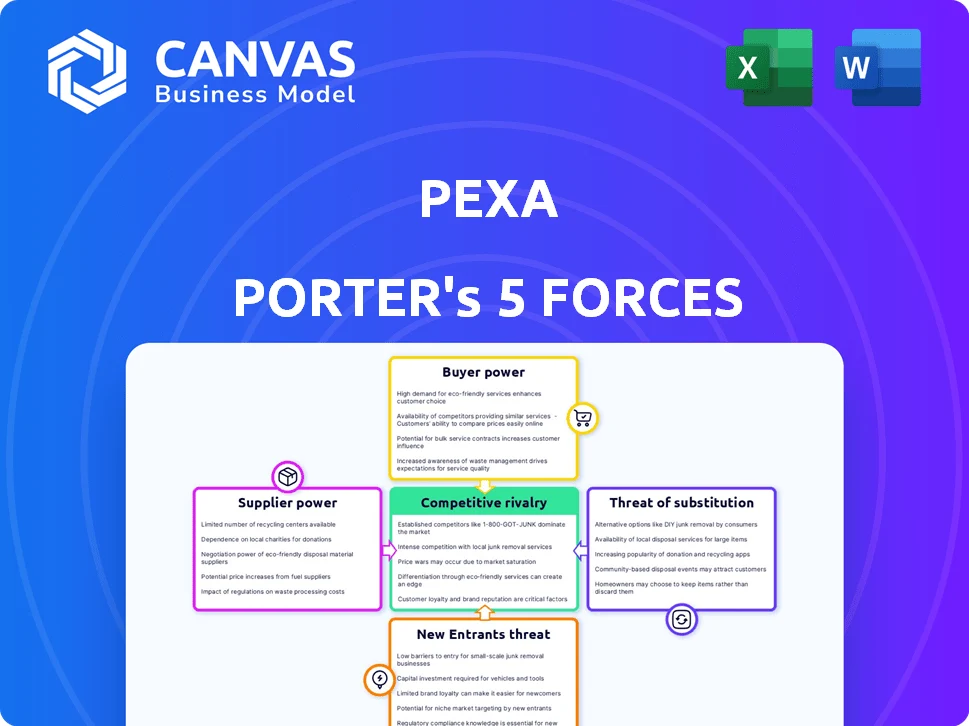
This preview offers the complete PEXA Porter's Five Forces analysis. It assesses industry competition, supplier power, buyer power, threat of new entrants, and threat of substitutes. This comprehensive analysis is fully formatted and ready for immediate use.

Porter's Five Forces Analysis Template

From Overview to Strategy Blueprint
PEXA's industry landscape is shaped by potent forces. The threat of new entrants and substitutes, coupled with buyer and supplier power, creates dynamic pressure. Understanding these forces is key to assessing its competitive positioning. Assessing rivalry amongst competitors is also essential. This brief snapshot only scratches the surface. Unlock the full Porter's Five Forces Analysis to explore PEXA’s competitive dynamics, market pressures, and strategic advantages in detail.
Suppliers Bargaining Power

Limited number of critical suppliers
PEXA's bargaining power with suppliers is complex. It depends on crucial infrastructure and data from land registries and financial institutions. PEXA's dominance in e-conveyancing offers some leverage. However, government-backed suppliers may limit PEXA's power. In 2024, PEXA processed over $300 billion in property transactions.
Regulatory environment and historical context
PEXA's history as a government initiative, now privatized, shapes its supplier relationships. Regulatory bodies like ARNECC influence these terms. In 2024, PEXA faced scrutiny, highlighting the impact of regulation on supplier agreements. This regulatory oversight affects cost structures and service agreements with essential government entities.

Technology and infrastructure providers
PEXA heavily relies on technology and infrastructure for its platform. Suppliers of these services, like cloud computing and cybersecurity, could wield some power. However, the competitive tech market, featuring many providers, limits supplier dominance. For instance, in 2024, the cloud computing market alone was worth over $600 billion globally. This offers PEXA choices, reducing supplier leverage.

Specialized software and data providers
PEXA's dependence on specialized software and data providers for conveyancing introduces supplier bargaining power dynamics. The influence of these suppliers is determined by the distinctiveness of their services and the expenses PEXA would incur to switch providers. For example, in 2024, the market for legal tech solutions, which are crucial for PEXA, was valued at approximately $20 billion globally. The more unique a supplier's offering, the greater its leverage over PEXA.
- Market size: The legal tech market valued at $20 billion in 2024.
- Switching costs: High switching costs increase supplier power.
- Supplier uniqueness: Unique offerings enhance supplier bargaining power.
- Dependency: PEXA's reliance on specific tech.
Employee base and specialized skills
PEXA's employee base, especially those with tech and regulatory expertise, acts as an internal supplier. The scarcity of these specialized skills can elevate operational expenses. In 2024, PEXA's operating expenses were significantly influenced by staff costs. High demand for tech professionals is a key factor.
- Employee costs significantly impact PEXA's operational expenses.
- Specialized tech and regulatory skills are crucial.
- High demand for skilled professionals affects costs.
PEXA's Supplier Dynamics: Infrastructure, Tech, and Regulation
PEXA's supplier power is multifaceted, influenced by infrastructure, regulation, and technology. Dependence on unique suppliers and specialized skills affects costs. In 2024, legal tech market was $20B, impacting PEXA.
| Factor | Impact on PEXA | 2024 Data |
|---|---|---|
| Infrastructure & Data | High Dependence | $300B+ property transactions processed |
| Regulatory Influence | Cost & Service Agreements | Increased scrutiny in 2024 |
| Tech Market | Competitive, Reducing Supplier Power | Cloud computing market: $600B+ globally |
Customers Bargaining Power

Concentrated customer base
PEXA's main clients are legal/conveyancing firms and financial institutions. These professional users, particularly major banks, are concentrated. This concentration, coupled with their sophistication, grants them considerable bargaining power. For instance, in 2024, major banks accounted for a significant portion of PEXA's transaction volume, which amplified their influence on pricing and service terms.
High switching costs (currently)
Switching from PEXA is costly due to network effects. As of late 2024, PEXA handled over 90% of Australian property settlements. This dominance limits customers' ability to negotiate better terms.

Push for interoperability
The push for interoperability among ELNOs enhances customer choice, significantly increasing their bargaining power. This shift reduces switching costs, allowing customers to move more freely between platforms. Interoperability reforms are a crucial factor in shaping customer influence within the industry. For example, in 2024, initiatives to connect different ELNO systems gained momentum, aiming to give customers more control.

Price sensitivity
Customers of PEXA, including conveyancers and financial institutions, show price sensitivity despite regulatory constraints on pricing. This sensitivity stems from the competitive landscape of legal and financial services, where cost-effectiveness is crucial. The presence of rival Electronic Lodgement Network Operators (ELNOs) creates pressure for competitive pricing. PEXA's revenue for FY23 was $292.4 million.
- Price sensitivity is heightened by competition among service providers.
- Alternative ELNOs are a key factor in driving price competition.
- PEXA's FY23 revenue reflects the financial stakes involved.
Reliance on the platform for core business
Legal firms and financial institutions heavily depend on PEXA for property transactions, making them somewhat less likely to strongly pressure PEXA. Their need for a dependable and secure system reduces their leverage. Disrupting core business operations is a significant risk they're unlikely to take. This dependency maintains PEXA's pricing power.
- PEXA processed $4.1 trillion in property transactions in FY23.
- Over 16,000 legal and financial firms use PEXA.
- 90% of Australian property settlements use PEXA.
- PEXA's revenue increased by 12% in FY23.
PEXA's Market Dominance: Customer Power Dynamics
PEXA's customers, like legal firms and banks, have some bargaining power, especially larger financial institutions. Concentration among these users gives them leverage in negotiations. However, PEXA's dominance in the market limits customer choices, reducing their ability to demand better terms. Interoperability initiatives are increasing customer influence, fostering more competition.
| Aspect | Details | Impact |
|---|---|---|
| Market Share | PEXA handles over 90% of Australian property settlements | Reduces customer bargaining power due to limited alternatives. |
| Interoperability | Initiatives to connect ELNOs. | Increases customer choice and bargaining power. |
| Revenue FY23 | $292.4 million | Reflects the financial stakes and competitive pressures. |
Rivalry Among Competitors

Dominant market position
PEXA's strong market presence in Australia's e-conveyancing sector, handling about 85% of digital property deals, significantly shapes competitive dynamics. This dominance, reflected in its substantial revenue of approximately $280 million in FY24, makes it hard for new rivals to gain ground. Competitors face the challenge of displacing a platform deeply integrated into the property transaction process. PEXA's established network and brand recognition further solidify its competitive advantage.
Emergence of competitors
While PEXA holds a strong position, the emergence of competitors like Sympli intensifies rivalry. Sympli's presence challenges PEXA's dominance, fostering competition. This competitive dynamic encourages innovation and potentially affects pricing strategies. In 2024, Sympli's market share increased, indicating growing competition in the ELNO market.

Interoperability as a catalyst for competition
Interoperability among Electronic Lodgment Network Operators (ELNOs) is key. It's expected to boost competition in the property settlement market. Delays in achieving this have, until recently, limited the competitive landscape. As of late 2024, the Australian Competition and Consumer Commission (ACCC) continues to monitor this space closely. The goal is to ensure fair competition and consumer choice.

Competition on features and innovation
ELNOs, including PEXA, fiercely compete on platform features and innovation. PEXA invests heavily in innovation, aiming to maintain its market leadership. Competitors like Sympli focus on areas where PEXA can improve, such as system stability. For instance, PEXA processed over $4 trillion in property settlements in 2024, yet faced scrutiny over occasional system disruptions.
- PEXA's revenue for FY24 was approximately $330 million.
- Sympli has been actively expanding its market share, particularly in New South Wales.
- Customer satisfaction scores vary, with competitors targeting PEXA's weaknesses.
- Investment in technology and platform enhancements is a key battleground.
Regulatory influence on competition
Regulatory influence significantly impacts competitive rivalry. Government policies and regulatory bodies like the ACCC and ARNECC shape competition in e-conveyancing. These entities can either promote or restrict market dynamics. For example, regulatory decisions influence barriers to entry and market access. This directly affects the intensity of rivalry among existing players.
- ACCC has intervened in the past to address competition concerns.
- ARNECC sets the standards for e-conveyancing operations.
- Regulatory changes can quickly shift market share.
- Compliance costs are significant for all participants.
PEXA's Market: Intense Rivalry & Key Stats
Competitive rivalry in PEXA's market is intense, despite its dominance, with Sympli challenging its position. Interoperability among ELNOs is crucial, and regulatory bodies like ACCC and ARNECC significantly influence competition. Innovation and platform features are key battlegrounds.
| Aspect | Details | 2024 Data |
|---|---|---|
| Market Share | PEXA vs. Competitors | PEXA: ~85%; Sympli: Growing |
| Revenue | PEXA's FY24 Revenue | Approximately $330 million |
| Settlements Value | PEXA's 2024 Settlements | Over $4 trillion |
PEXA PORTER'S FIVE FORCES TEMPLATE RESEARCH
What is included in the product
Detailed Word Document
Examines competitive pressures, supplier/buyer power, and entry barriers for PEXA.
Customizable Excel Spreadsheet
Easily visualize competitive forces with an interactive dashboard, making strategic analysis simple.
Preview the Actual Deliverable
PEXA Porter's Five Forces Analysis
This preview offers the complete PEXA Porter's Five Forces analysis. It assesses industry competition, supplier power, buyer power, threat of new entrants, and threat of substitutes. This comprehensive analysis is fully formatted and ready for immediate use.
Porter's Five Forces Analysis Template
From Overview to Strategy Blueprint
PEXA's industry landscape is shaped by potent forces. The threat of new entrants and substitutes, coupled with buyer and supplier power, creates dynamic pressure. Understanding these forces is key to assessing its competitive positioning. Assessing rivalry amongst competitors is also essential. This brief snapshot only scratches the surface. Unlock the full Porter's Five Forces Analysis to explore PEXA’s competitive dynamics, market pressures, and strategic advantages in detail.
Suppliers Bargaining Power
Limited number of critical suppliers
PEXA's bargaining power with suppliers is complex. It depends on crucial infrastructure and data from land registries and financial institutions. PEXA's dominance in e-conveyancing offers some leverage. However, government-backed suppliers may limit PEXA's power. In 2024, PEXA processed over $300 billion in property transactions.
Regulatory environment and historical context
PEXA's history as a government initiative, now privatized, shapes its supplier relationships. Regulatory bodies like ARNECC influence these terms. In 2024, PEXA faced scrutiny, highlighting the impact of regulation on supplier agreements. This regulatory oversight affects cost structures and service agreements with essential government entities.
Technology and infrastructure providers
PEXA heavily relies on technology and infrastructure for its platform. Suppliers of these services, like cloud computing and cybersecurity, could wield some power. However, the competitive tech market, featuring many providers, limits supplier dominance. For instance, in 2024, the cloud computing market alone was worth over $600 billion globally. This offers PEXA choices, reducing supplier leverage.
Specialized software and data providers
PEXA's dependence on specialized software and data providers for conveyancing introduces supplier bargaining power dynamics. The influence of these suppliers is determined by the distinctiveness of their services and the expenses PEXA would incur to switch providers. For example, in 2024, the market for legal tech solutions, which are crucial for PEXA, was valued at approximately $20 billion globally. The more unique a supplier's offering, the greater its leverage over PEXA.
- Market size: The legal tech market valued at $20 billion in 2024.
- Switching costs: High switching costs increase supplier power.
- Supplier uniqueness: Unique offerings enhance supplier bargaining power.
- Dependency: PEXA's reliance on specific tech.
Employee base and specialized skills
PEXA's employee base, especially those with tech and regulatory expertise, acts as an internal supplier. The scarcity of these specialized skills can elevate operational expenses. In 2024, PEXA's operating expenses were significantly influenced by staff costs. High demand for tech professionals is a key factor.
- Employee costs significantly impact PEXA's operational expenses.
- Specialized tech and regulatory skills are crucial.
- High demand for skilled professionals affects costs.
PEXA's Supplier Dynamics: Infrastructure, Tech, and Regulation
PEXA's supplier power is multifaceted, influenced by infrastructure, regulation, and technology. Dependence on unique suppliers and specialized skills affects costs. In 2024, legal tech market was $20B, impacting PEXA.
| Factor | Impact on PEXA | 2024 Data |
|---|---|---|
| Infrastructure & Data | High Dependence | $300B+ property transactions processed |
| Regulatory Influence | Cost & Service Agreements | Increased scrutiny in 2024 |
| Tech Market | Competitive, Reducing Supplier Power | Cloud computing market: $600B+ globally |
Customers Bargaining Power
Concentrated customer base
PEXA's main clients are legal/conveyancing firms and financial institutions. These professional users, particularly major banks, are concentrated. This concentration, coupled with their sophistication, grants them considerable bargaining power. For instance, in 2024, major banks accounted for a significant portion of PEXA's transaction volume, which amplified their influence on pricing and service terms.
High switching costs (currently)
Switching from PEXA is costly due to network effects. As of late 2024, PEXA handled over 90% of Australian property settlements. This dominance limits customers' ability to negotiate better terms.
Push for interoperability
The push for interoperability among ELNOs enhances customer choice, significantly increasing their bargaining power. This shift reduces switching costs, allowing customers to move more freely between platforms. Interoperability reforms are a crucial factor in shaping customer influence within the industry. For example, in 2024, initiatives to connect different ELNO systems gained momentum, aiming to give customers more control.
Price sensitivity
Customers of PEXA, including conveyancers and financial institutions, show price sensitivity despite regulatory constraints on pricing. This sensitivity stems from the competitive landscape of legal and financial services, where cost-effectiveness is crucial. The presence of rival Electronic Lodgement Network Operators (ELNOs) creates pressure for competitive pricing. PEXA's revenue for FY23 was $292.4 million.
- Price sensitivity is heightened by competition among service providers.
- Alternative ELNOs are a key factor in driving price competition.
- PEXA's FY23 revenue reflects the financial stakes involved.
Reliance on the platform for core business
Legal firms and financial institutions heavily depend on PEXA for property transactions, making them somewhat less likely to strongly pressure PEXA. Their need for a dependable and secure system reduces their leverage. Disrupting core business operations is a significant risk they're unlikely to take. This dependency maintains PEXA's pricing power.
- PEXA processed $4.1 trillion in property transactions in FY23.
- Over 16,000 legal and financial firms use PEXA.
- 90% of Australian property settlements use PEXA.
- PEXA's revenue increased by 12% in FY23.
PEXA's Market Dominance: Customer Power Dynamics
PEXA's customers, like legal firms and banks, have some bargaining power, especially larger financial institutions. Concentration among these users gives them leverage in negotiations. However, PEXA's dominance in the market limits customer choices, reducing their ability to demand better terms. Interoperability initiatives are increasing customer influence, fostering more competition.
| Aspect | Details | Impact |
|---|---|---|
| Market Share | PEXA handles over 90% of Australian property settlements | Reduces customer bargaining power due to limited alternatives. |
| Interoperability | Initiatives to connect ELNOs. | Increases customer choice and bargaining power. |
| Revenue FY23 | $292.4 million | Reflects the financial stakes and competitive pressures. |
Rivalry Among Competitors
Dominant market position
PEXA's strong market presence in Australia's e-conveyancing sector, handling about 85% of digital property deals, significantly shapes competitive dynamics. This dominance, reflected in its substantial revenue of approximately $280 million in FY24, makes it hard for new rivals to gain ground. Competitors face the challenge of displacing a platform deeply integrated into the property transaction process. PEXA's established network and brand recognition further solidify its competitive advantage.
Emergence of competitors
While PEXA holds a strong position, the emergence of competitors like Sympli intensifies rivalry. Sympli's presence challenges PEXA's dominance, fostering competition. This competitive dynamic encourages innovation and potentially affects pricing strategies. In 2024, Sympli's market share increased, indicating growing competition in the ELNO market.
Interoperability as a catalyst for competition
Interoperability among Electronic Lodgment Network Operators (ELNOs) is key. It's expected to boost competition in the property settlement market. Delays in achieving this have, until recently, limited the competitive landscape. As of late 2024, the Australian Competition and Consumer Commission (ACCC) continues to monitor this space closely. The goal is to ensure fair competition and consumer choice.
Competition on features and innovation
ELNOs, including PEXA, fiercely compete on platform features and innovation. PEXA invests heavily in innovation, aiming to maintain its market leadership. Competitors like Sympli focus on areas where PEXA can improve, such as system stability. For instance, PEXA processed over $4 trillion in property settlements in 2024, yet faced scrutiny over occasional system disruptions.
- PEXA's revenue for FY24 was approximately $330 million.
- Sympli has been actively expanding its market share, particularly in New South Wales.
- Customer satisfaction scores vary, with competitors targeting PEXA's weaknesses.
- Investment in technology and platform enhancements is a key battleground.
Regulatory influence on competition
Regulatory influence significantly impacts competitive rivalry. Government policies and regulatory bodies like the ACCC and ARNECC shape competition in e-conveyancing. These entities can either promote or restrict market dynamics. For example, regulatory decisions influence barriers to entry and market access. This directly affects the intensity of rivalry among existing players.
- ACCC has intervened in the past to address competition concerns.
- ARNECC sets the standards for e-conveyancing operations.
- Regulatory changes can quickly shift market share.
- Compliance costs are significant for all participants.
PEXA's Market: Intense Rivalry & Key Stats
Competitive rivalry in PEXA's market is intense, despite its dominance, with Sympli challenging its position. Interoperability among ELNOs is crucial, and regulatory bodies like ACCC and ARNECC significantly influence competition. Innovation and platform features are key battlegrounds.
| Aspect | Details | 2024 Data |
|---|---|---|
| Market Share | PEXA vs. Competitors | PEXA: ~85%; Sympli: Growing |
| Revenue | PEXA's FY24 Revenue | Approximately $330 million |
| Settlements Value | PEXA's 2024 Settlements | Over $4 trillion |
Product Information
Product Information
Shipping & Returns
Shipping & Returns
Description
What is included in the product
Detailed Word Document
Examines competitive pressures, supplier/buyer power, and entry barriers for PEXA.
Customizable Excel Spreadsheet
Easily visualize competitive forces with an interactive dashboard, making strategic analysis simple.
Preview the Actual Deliverable
PEXA Porter's Five Forces Analysis
This preview offers the complete PEXA Porter's Five Forces analysis. It assesses industry competition, supplier power, buyer power, threat of new entrants, and threat of substitutes. This comprehensive analysis is fully formatted and ready for immediate use.
Porter's Five Forces Analysis Template
From Overview to Strategy Blueprint
PEXA's industry landscape is shaped by potent forces. The threat of new entrants and substitutes, coupled with buyer and supplier power, creates dynamic pressure. Understanding these forces is key to assessing its competitive positioning. Assessing rivalry amongst competitors is also essential. This brief snapshot only scratches the surface. Unlock the full Porter's Five Forces Analysis to explore PEXA’s competitive dynamics, market pressures, and strategic advantages in detail.
Suppliers Bargaining Power
Limited number of critical suppliers
PEXA's bargaining power with suppliers is complex. It depends on crucial infrastructure and data from land registries and financial institutions. PEXA's dominance in e-conveyancing offers some leverage. However, government-backed suppliers may limit PEXA's power. In 2024, PEXA processed over $300 billion in property transactions.
Regulatory environment and historical context
PEXA's history as a government initiative, now privatized, shapes its supplier relationships. Regulatory bodies like ARNECC influence these terms. In 2024, PEXA faced scrutiny, highlighting the impact of regulation on supplier agreements. This regulatory oversight affects cost structures and service agreements with essential government entities.
Technology and infrastructure providers
PEXA heavily relies on technology and infrastructure for its platform. Suppliers of these services, like cloud computing and cybersecurity, could wield some power. However, the competitive tech market, featuring many providers, limits supplier dominance. For instance, in 2024, the cloud computing market alone was worth over $600 billion globally. This offers PEXA choices, reducing supplier leverage.
Specialized software and data providers
PEXA's dependence on specialized software and data providers for conveyancing introduces supplier bargaining power dynamics. The influence of these suppliers is determined by the distinctiveness of their services and the expenses PEXA would incur to switch providers. For example, in 2024, the market for legal tech solutions, which are crucial for PEXA, was valued at approximately $20 billion globally. The more unique a supplier's offering, the greater its leverage over PEXA.
- Market size: The legal tech market valued at $20 billion in 2024.
- Switching costs: High switching costs increase supplier power.
- Supplier uniqueness: Unique offerings enhance supplier bargaining power.
- Dependency: PEXA's reliance on specific tech.
Employee base and specialized skills
PEXA's employee base, especially those with tech and regulatory expertise, acts as an internal supplier. The scarcity of these specialized skills can elevate operational expenses. In 2024, PEXA's operating expenses were significantly influenced by staff costs. High demand for tech professionals is a key factor.
- Employee costs significantly impact PEXA's operational expenses.
- Specialized tech and regulatory skills are crucial.
- High demand for skilled professionals affects costs.
PEXA's Supplier Dynamics: Infrastructure, Tech, and Regulation
PEXA's supplier power is multifaceted, influenced by infrastructure, regulation, and technology. Dependence on unique suppliers and specialized skills affects costs. In 2024, legal tech market was $20B, impacting PEXA.
| Factor | Impact on PEXA | 2024 Data |
|---|---|---|
| Infrastructure & Data | High Dependence | $300B+ property transactions processed |
| Regulatory Influence | Cost & Service Agreements | Increased scrutiny in 2024 |
| Tech Market | Competitive, Reducing Supplier Power | Cloud computing market: $600B+ globally |
Customers Bargaining Power
Concentrated customer base
PEXA's main clients are legal/conveyancing firms and financial institutions. These professional users, particularly major banks, are concentrated. This concentration, coupled with their sophistication, grants them considerable bargaining power. For instance, in 2024, major banks accounted for a significant portion of PEXA's transaction volume, which amplified their influence on pricing and service terms.
High switching costs (currently)
Switching from PEXA is costly due to network effects. As of late 2024, PEXA handled over 90% of Australian property settlements. This dominance limits customers' ability to negotiate better terms.
Push for interoperability
The push for interoperability among ELNOs enhances customer choice, significantly increasing their bargaining power. This shift reduces switching costs, allowing customers to move more freely between platforms. Interoperability reforms are a crucial factor in shaping customer influence within the industry. For example, in 2024, initiatives to connect different ELNO systems gained momentum, aiming to give customers more control.
Price sensitivity
Customers of PEXA, including conveyancers and financial institutions, show price sensitivity despite regulatory constraints on pricing. This sensitivity stems from the competitive landscape of legal and financial services, where cost-effectiveness is crucial. The presence of rival Electronic Lodgement Network Operators (ELNOs) creates pressure for competitive pricing. PEXA's revenue for FY23 was $292.4 million.
- Price sensitivity is heightened by competition among service providers.
- Alternative ELNOs are a key factor in driving price competition.
- PEXA's FY23 revenue reflects the financial stakes involved.
Reliance on the platform for core business
Legal firms and financial institutions heavily depend on PEXA for property transactions, making them somewhat less likely to strongly pressure PEXA. Their need for a dependable and secure system reduces their leverage. Disrupting core business operations is a significant risk they're unlikely to take. This dependency maintains PEXA's pricing power.
- PEXA processed $4.1 trillion in property transactions in FY23.
- Over 16,000 legal and financial firms use PEXA.
- 90% of Australian property settlements use PEXA.
- PEXA's revenue increased by 12% in FY23.
PEXA's Market Dominance: Customer Power Dynamics
PEXA's customers, like legal firms and banks, have some bargaining power, especially larger financial institutions. Concentration among these users gives them leverage in negotiations. However, PEXA's dominance in the market limits customer choices, reducing their ability to demand better terms. Interoperability initiatives are increasing customer influence, fostering more competition.
| Aspect | Details | Impact |
|---|---|---|
| Market Share | PEXA handles over 90% of Australian property settlements | Reduces customer bargaining power due to limited alternatives. |
| Interoperability | Initiatives to connect ELNOs. | Increases customer choice and bargaining power. |
| Revenue FY23 | $292.4 million | Reflects the financial stakes and competitive pressures. |
Rivalry Among Competitors
Dominant market position
PEXA's strong market presence in Australia's e-conveyancing sector, handling about 85% of digital property deals, significantly shapes competitive dynamics. This dominance, reflected in its substantial revenue of approximately $280 million in FY24, makes it hard for new rivals to gain ground. Competitors face the challenge of displacing a platform deeply integrated into the property transaction process. PEXA's established network and brand recognition further solidify its competitive advantage.
Emergence of competitors
While PEXA holds a strong position, the emergence of competitors like Sympli intensifies rivalry. Sympli's presence challenges PEXA's dominance, fostering competition. This competitive dynamic encourages innovation and potentially affects pricing strategies. In 2024, Sympli's market share increased, indicating growing competition in the ELNO market.
Interoperability as a catalyst for competition
Interoperability among Electronic Lodgment Network Operators (ELNOs) is key. It's expected to boost competition in the property settlement market. Delays in achieving this have, until recently, limited the competitive landscape. As of late 2024, the Australian Competition and Consumer Commission (ACCC) continues to monitor this space closely. The goal is to ensure fair competition and consumer choice.
Competition on features and innovation
ELNOs, including PEXA, fiercely compete on platform features and innovation. PEXA invests heavily in innovation, aiming to maintain its market leadership. Competitors like Sympli focus on areas where PEXA can improve, such as system stability. For instance, PEXA processed over $4 trillion in property settlements in 2024, yet faced scrutiny over occasional system disruptions.
- PEXA's revenue for FY24 was approximately $330 million.
- Sympli has been actively expanding its market share, particularly in New South Wales.
- Customer satisfaction scores vary, with competitors targeting PEXA's weaknesses.
- Investment in technology and platform enhancements is a key battleground.
Regulatory influence on competition
Regulatory influence significantly impacts competitive rivalry. Government policies and regulatory bodies like the ACCC and ARNECC shape competition in e-conveyancing. These entities can either promote or restrict market dynamics. For example, regulatory decisions influence barriers to entry and market access. This directly affects the intensity of rivalry among existing players.
- ACCC has intervened in the past to address competition concerns.
- ARNECC sets the standards for e-conveyancing operations.
- Regulatory changes can quickly shift market share.
- Compliance costs are significant for all participants.
PEXA's Market: Intense Rivalry & Key Stats
Competitive rivalry in PEXA's market is intense, despite its dominance, with Sympli challenging its position. Interoperability among ELNOs is crucial, and regulatory bodies like ACCC and ARNECC significantly influence competition. Innovation and platform features are key battlegrounds.
| Aspect | Details | 2024 Data |
|---|---|---|
| Market Share | PEXA vs. Competitors | PEXA: ~85%; Sympli: Growing |
| Revenue | PEXA's FY24 Revenue | Approximately $330 million |
| Settlements Value | PEXA's 2024 Settlements | Over $4 trillion |


