PENSKE CORP. PESTLE ANALYSIS TEMPLATE RESEARCH
What is included in the product
 Detailed Word Document
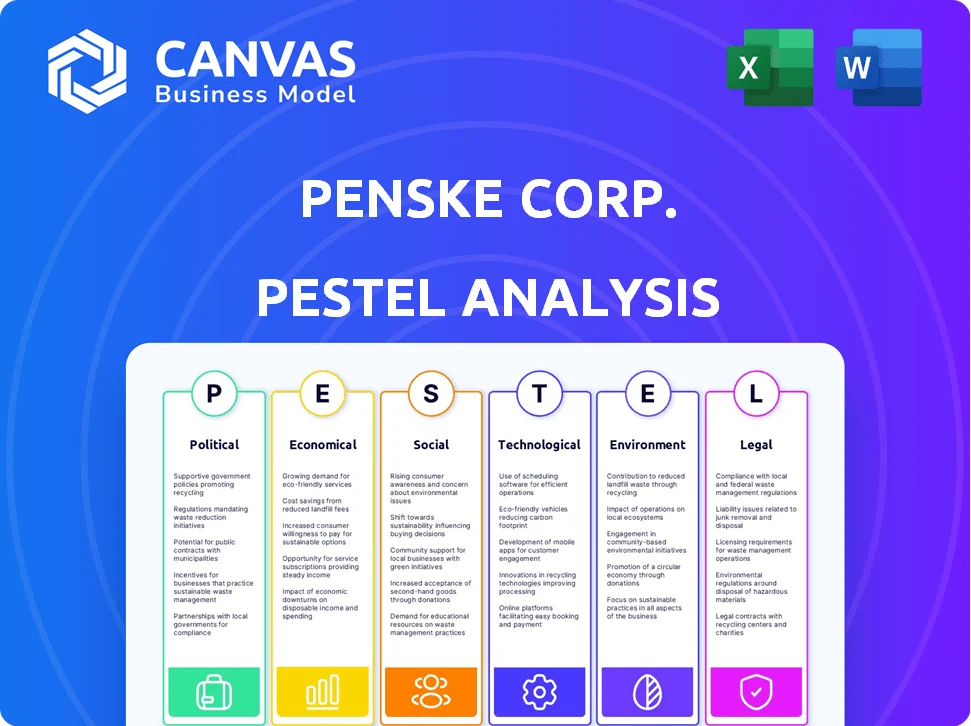
A comprehensive PESTLE analysis assesses Penske Corp.'s macro-environment through Political, Economic, etc. dimensions.

 Customizable Excel Spreadsheet
Provides a concise version that can be dropped into PowerPoints or used in group planning sessions.
Same Document Delivered
Penske Corp. PESTLE Analysis
This Penske Corp. PESTLE Analysis preview mirrors the final document. The detailed assessment, structure, and content are precisely what you'll download after purchase. It's professionally crafted, fully formatted and instantly accessible. The preview is your complete final deliverable.

PESTLE Analysis Template

Your Competitive Advantage Starts with This Report
Penske Corp. faces a dynamic landscape shaped by shifting political regulations and economic volatility. Social trends, including evolving consumer preferences, also play a significant role. Technological advancements are transforming logistics and transportation, while environmental concerns impact sustainability efforts. Moreover, the legal and regulatory framework significantly affects operations. Want to dive deeper and understand the nuances? Download the complete PESTLE analysis now for detailed insights and strategic advantages.
Political factors

Government Regulations and Mandates
Government regulations, especially emissions standards, are crucial for Penske. Stricter rules mean they must adapt their vehicle fleet. In 2024, the EPA set new emission standards. This affects maintenance costs and investments in cleaner tech. Policy shifts create both hurdles and chances for growth.
Trade Policies and Tariffs
Trade policies and tariffs significantly influence Penske's costs. For example, the U.S. imposed tariffs on imported tires, impacting companies like Penske. Geopolitical events, such as the Russia-Ukraine war, have disrupted supply chains, increasing costs and creating uncertainty. In 2024, the automotive industry faced supply chain challenges, affecting production and pricing.

Political Stability in Operating Regions
Penske Corporation's global presence exposes it to political risks. Political instability and policy shifts in operating regions can disrupt business operations. For instance, changes in trade policies or regulations can impact logistics and costs. Data from 2024 show varying levels of political stability across countries where Penske operates.

Government Incentives and Funding
Government support significantly shapes Penske's strategic options. Incentives for sustainable transport, like tax credits or grants, can lower the costs of transitioning to electric or alternative fuel fleets. The U.S. government has committed billions to clean energy initiatives through the Inflation Reduction Act of 2022. These programs boost Penske's ability to adopt green technologies.
- The Inflation Reduction Act of 2022 allocated $369 billion to climate and energy programs.
- Federal grants for electric vehicle charging infrastructure are available through various programs.
- State-level incentives also vary, adding another layer of potential benefits.
Lobbying and Political Contributions
Penske Corporation, like many large corporations, actively participates in lobbying and makes political contributions. This involvement aims to influence policies impacting the transportation and automotive sectors. In 2023-2024, Penske's lobbying efforts focused on transportation infrastructure and vehicle safety regulations. These activities are designed to protect and advance the company's business interests within a changing regulatory environment.
- Penske Corporation has a dedicated Government Relations team.
- The company's political contributions are reported to the FEC (Federal Election Commission).
- Lobbying is a significant part of their operational costs.
- They focus on issues like autonomous vehicle regulations.
Penske's 2024: Navigating Policy, Costs, and Tech
Penske faces impacts from emissions standards, affecting fleet adjustments; the EPA set new 2024 standards. Trade policies and geopolitical events also affect costs, with supply chain issues impacting 2024's automotive industry.
Government support through incentives, like the Inflation Reduction Act, aids the transition to cleaner technologies. Penske engages in lobbying to influence transportation policies.
| Political Factor | Impact on Penske | 2024/2025 Data Point |
|---|---|---|
| Emissions Regulations | Fleet Adaptation Costs | EPA's 2024 Standards |
| Trade Policies | Cost of Goods Sold | Tariffs impact: tire costs |
| Government Support | Technology Adoption | $369B for energy via the Inflation Reduction Act |
Economic factors

Economic Growth and Recession
Economic growth is crucial for Penske. Increased economic activity boosts demand for its truck leasing, rental, and logistics services. In 2024, the US economy showed moderate growth, impacting Penske's performance. A recession, however, could decrease demand, affecting revenue. The company must navigate economic cycles effectively.
Interest Rate Fluctuations
Interest rate changes directly impact Penske's financial health. Higher rates increase borrowing costs for fleet expansion and equipment upgrades. In Q1 2024, the Federal Reserve held rates steady, but future shifts could affect vehicle leasing demand. A 1% rate change can significantly alter operational expenses.

Inflation and Cost Management
Inflation presents a significant challenge for Penske Corporation, potentially increasing operating expenses like fuel, labor, and parts. In 2024, the US inflation rate was around 3.1%, impacting transportation costs. Penske's success hinges on effective cost management and pricing strategies. The company's ability to adapt to fluctuating costs directly affects its profitability and competitiveness in the market.

Freight Market Conditions
Freight market dynamics heavily influence Penske's operations, especially its leasing and logistics divisions. A sluggish freight market can diminish the need for trucks, directly affecting profitability. In 2024, the Cass Freight Index showed fluctuating volumes, indicating market volatility. This volatility can pressure Penske's margins and revenue. For example, a 10% drop in freight volume might translate to a 5% decrease in truck leasing demand.
- Weak freight market leads to decreased demand for trucks.
- Profitability is directly impacted by freight market conditions.
- Cass Freight Index reflects market volume fluctuations.
- Penske's margins and revenue are exposed to market volatility.
Consumer Spending and Confidence
Consumer spending and confidence are crucial for Penske Corporation's automotive retail segment. High consumer confidence often boosts vehicle purchases, positively impacting Penske's revenue. Conversely, economic downturns can decrease consumer spending on big-ticket items like cars. In Q1 2024, U.S. consumer spending rose by 2.5%, indicating continued demand, although inflation remains a concern.
- Rising interest rates could potentially cool consumer spending.
- Penske's ability to adapt to changing consumer preferences, such as the demand for EVs, is essential.
- Changes in unemployment rates also directly affect consumer confidence and spending habits.
Penske's 2024 Economic Hurdles: Growth, Inflation & Rates
Economic fluctuations significantly impact Penske Corporation. The US economy showed moderate growth in 2024, affecting its performance. Inflation at 3.1% in 2024 increased operational expenses. A weak freight market also decreases demand.
| Economic Factor | Impact on Penske | 2024 Data/Trend |
|---|---|---|
| Economic Growth | Affects demand for services | Moderate growth in US |
| Interest Rates | Influence borrowing costs | Rates held steady in Q1 |
| Inflation | Raises operating costs | 3.1% in 2024 |
Sociological factors

Labor Market Trends and Workforce Availability
Penske faces sociological challenges in the labor market. A shortage of skilled workers, like truck drivers and technicians, impacts operations. The American Trucking Associations projected a need for 60,000 more drivers in 2024. This shortage drives up labor costs. Maintaining service quality is crucial amidst these labor pressures.
Changing Consumer Preferences
Consumer preferences are shifting, impacting Penske. There's a rise in demand for EVs, and alternative transport options. The global EV market is projected to reach $823.8 billion by 2030. This shift affects Penske's vehicle sales and services. Consumers increasingly seek sustainable mobility choices.

Work-Life Balance and Remote Work
Societal shifts prioritize work-life balance, affecting commuting and vehicle demand. Remote work's rise impacts truck rentals and logistics services. In 2024, 60% of U.S. employees desired remote work options. This influenced demand for transportation services. These trends could reshape Penske's business model.

Demographic Shifts
Demographic shifts significantly influence Penske's operations. Population aging and urbanization trends shape demand for transportation services, particularly in areas with growing elderly populations. An aging workforce presents labor challenges, potentially increasing operational costs and impacting service delivery. Understanding these demographic changes is crucial for strategic planning and resource allocation. For instance, the U.S. population aged 65+ is projected to reach 83.7 million by 2050.
- Aging population increases demand for specialized transport.
- Urbanization drives expansion of logistics networks.
- Labor shortages necessitate workforce strategies.
- Demand for last-mile delivery services is boosted.
Social Responsibility and Corporate Image
Societal expectations around corporate social responsibility (CSR) and sustainability are rising, affecting how customers view companies. Penske's actions in environmental sustainability and ethical conduct directly shape its brand image. A strong CSR approach boosts customer loyalty and can lead to positive brand perception. For example, companies with robust ESG (Environmental, Social, and Governance) strategies often see improved financial performance.
- Penske's focus on electric vehicle (EV) adoption and sustainable logistics could significantly improve its brand image.
- Consumers increasingly favor brands committed to ethical sourcing and fair labor practices.
- Companies with high ESG ratings tend to attract more investment and have lower financial risks.
- Penske's community involvement and philanthropic activities enhance its reputation and customer relationships.
Sociological Trends Shaping the Future
Penske's success is influenced by sociological trends, particularly in labor and consumer behaviors. A key challenge is the truck driver shortage, estimated to be around 60,000 in 2024. Demand for sustainable options like EVs, projected to be an $823.8 billion market by 2030, affects vehicle services. Focusing on ESG, (Environmental, Social, and Governance) such as EVs and community involvement strengthens the brand.
| Factor | Impact | Data |
|---|---|---|
| Labor Shortage | Higher costs, service impact | 60,000 driver shortage (2024) |
| EV Demand | Shifts vehicle services | $823.8B market by 2030 |
| CSR/ESG | Brand image, investment | Improved financial performance. |
Original: $10.00
-65%$10.00
$3.50PENSKE CORP. PESTLE ANALYSIS TEMPLATE RESEARCH
What is included in the product
Detailed Word Document
A comprehensive PESTLE analysis assesses Penske Corp.'s macro-environment through Political, Economic, etc. dimensions.
Customizable Excel Spreadsheet
Provides a concise version that can be dropped into PowerPoints or used in group planning sessions.
Same Document Delivered
Penske Corp. PESTLE Analysis
This Penske Corp. PESTLE Analysis preview mirrors the final document. The detailed assessment, structure, and content are precisely what you'll download after purchase. It's professionally crafted, fully formatted and instantly accessible. The preview is your complete final deliverable.
PESTLE Analysis Template
Your Competitive Advantage Starts with This Report
Penske Corp. faces a dynamic landscape shaped by shifting political regulations and economic volatility. Social trends, including evolving consumer preferences, also play a significant role. Technological advancements are transforming logistics and transportation, while environmental concerns impact sustainability efforts. Moreover, the legal and regulatory framework significantly affects operations. Want to dive deeper and understand the nuances? Download the complete PESTLE analysis now for detailed insights and strategic advantages.
Political factors
Government Regulations and Mandates
Government regulations, especially emissions standards, are crucial for Penske. Stricter rules mean they must adapt their vehicle fleet. In 2024, the EPA set new emission standards. This affects maintenance costs and investments in cleaner tech. Policy shifts create both hurdles and chances for growth.
Trade Policies and Tariffs
Trade policies and tariffs significantly influence Penske's costs. For example, the U.S. imposed tariffs on imported tires, impacting companies like Penske. Geopolitical events, such as the Russia-Ukraine war, have disrupted supply chains, increasing costs and creating uncertainty. In 2024, the automotive industry faced supply chain challenges, affecting production and pricing.
Political Stability in Operating Regions
Penske Corporation's global presence exposes it to political risks. Political instability and policy shifts in operating regions can disrupt business operations. For instance, changes in trade policies or regulations can impact logistics and costs. Data from 2024 show varying levels of political stability across countries where Penske operates.
Government Incentives and Funding
Government support significantly shapes Penske's strategic options. Incentives for sustainable transport, like tax credits or grants, can lower the costs of transitioning to electric or alternative fuel fleets. The U.S. government has committed billions to clean energy initiatives through the Inflation Reduction Act of 2022. These programs boost Penske's ability to adopt green technologies.
- The Inflation Reduction Act of 2022 allocated $369 billion to climate and energy programs.
- Federal grants for electric vehicle charging infrastructure are available through various programs.
- State-level incentives also vary, adding another layer of potential benefits.
Lobbying and Political Contributions
Penske Corporation, like many large corporations, actively participates in lobbying and makes political contributions. This involvement aims to influence policies impacting the transportation and automotive sectors. In 2023-2024, Penske's lobbying efforts focused on transportation infrastructure and vehicle safety regulations. These activities are designed to protect and advance the company's business interests within a changing regulatory environment.
- Penske Corporation has a dedicated Government Relations team.
- The company's political contributions are reported to the FEC (Federal Election Commission).
- Lobbying is a significant part of their operational costs.
- They focus on issues like autonomous vehicle regulations.
Penske's 2024: Navigating Policy, Costs, and Tech
Penske faces impacts from emissions standards, affecting fleet adjustments; the EPA set new 2024 standards. Trade policies and geopolitical events also affect costs, with supply chain issues impacting 2024's automotive industry.
Government support through incentives, like the Inflation Reduction Act, aids the transition to cleaner technologies. Penske engages in lobbying to influence transportation policies.
| Political Factor | Impact on Penske | 2024/2025 Data Point |
|---|---|---|
| Emissions Regulations | Fleet Adaptation Costs | EPA's 2024 Standards |
| Trade Policies | Cost of Goods Sold | Tariffs impact: tire costs |
| Government Support | Technology Adoption | $369B for energy via the Inflation Reduction Act |
Economic factors
Economic Growth and Recession
Economic growth is crucial for Penske. Increased economic activity boosts demand for its truck leasing, rental, and logistics services. In 2024, the US economy showed moderate growth, impacting Penske's performance. A recession, however, could decrease demand, affecting revenue. The company must navigate economic cycles effectively.
Interest Rate Fluctuations
Interest rate changes directly impact Penske's financial health. Higher rates increase borrowing costs for fleet expansion and equipment upgrades. In Q1 2024, the Federal Reserve held rates steady, but future shifts could affect vehicle leasing demand. A 1% rate change can significantly alter operational expenses.
Inflation and Cost Management
Inflation presents a significant challenge for Penske Corporation, potentially increasing operating expenses like fuel, labor, and parts. In 2024, the US inflation rate was around 3.1%, impacting transportation costs. Penske's success hinges on effective cost management and pricing strategies. The company's ability to adapt to fluctuating costs directly affects its profitability and competitiveness in the market.
Freight Market Conditions
Freight market dynamics heavily influence Penske's operations, especially its leasing and logistics divisions. A sluggish freight market can diminish the need for trucks, directly affecting profitability. In 2024, the Cass Freight Index showed fluctuating volumes, indicating market volatility. This volatility can pressure Penske's margins and revenue. For example, a 10% drop in freight volume might translate to a 5% decrease in truck leasing demand.
- Weak freight market leads to decreased demand for trucks.
- Profitability is directly impacted by freight market conditions.
- Cass Freight Index reflects market volume fluctuations.
- Penske's margins and revenue are exposed to market volatility.
Consumer Spending and Confidence
Consumer spending and confidence are crucial for Penske Corporation's automotive retail segment. High consumer confidence often boosts vehicle purchases, positively impacting Penske's revenue. Conversely, economic downturns can decrease consumer spending on big-ticket items like cars. In Q1 2024, U.S. consumer spending rose by 2.5%, indicating continued demand, although inflation remains a concern.
- Rising interest rates could potentially cool consumer spending.
- Penske's ability to adapt to changing consumer preferences, such as the demand for EVs, is essential.
- Changes in unemployment rates also directly affect consumer confidence and spending habits.
Penske's 2024 Economic Hurdles: Growth, Inflation & Rates
Economic fluctuations significantly impact Penske Corporation. The US economy showed moderate growth in 2024, affecting its performance. Inflation at 3.1% in 2024 increased operational expenses. A weak freight market also decreases demand.
| Economic Factor | Impact on Penske | 2024 Data/Trend |
|---|---|---|
| Economic Growth | Affects demand for services | Moderate growth in US |
| Interest Rates | Influence borrowing costs | Rates held steady in Q1 |
| Inflation | Raises operating costs | 3.1% in 2024 |
Sociological factors
Labor Market Trends and Workforce Availability
Penske faces sociological challenges in the labor market. A shortage of skilled workers, like truck drivers and technicians, impacts operations. The American Trucking Associations projected a need for 60,000 more drivers in 2024. This shortage drives up labor costs. Maintaining service quality is crucial amidst these labor pressures.
Changing Consumer Preferences
Consumer preferences are shifting, impacting Penske. There's a rise in demand for EVs, and alternative transport options. The global EV market is projected to reach $823.8 billion by 2030. This shift affects Penske's vehicle sales and services. Consumers increasingly seek sustainable mobility choices.
Work-Life Balance and Remote Work
Societal shifts prioritize work-life balance, affecting commuting and vehicle demand. Remote work's rise impacts truck rentals and logistics services. In 2024, 60% of U.S. employees desired remote work options. This influenced demand for transportation services. These trends could reshape Penske's business model.
Demographic Shifts
Demographic shifts significantly influence Penske's operations. Population aging and urbanization trends shape demand for transportation services, particularly in areas with growing elderly populations. An aging workforce presents labor challenges, potentially increasing operational costs and impacting service delivery. Understanding these demographic changes is crucial for strategic planning and resource allocation. For instance, the U.S. population aged 65+ is projected to reach 83.7 million by 2050.
- Aging population increases demand for specialized transport.
- Urbanization drives expansion of logistics networks.
- Labor shortages necessitate workforce strategies.
- Demand for last-mile delivery services is boosted.
Social Responsibility and Corporate Image
Societal expectations around corporate social responsibility (CSR) and sustainability are rising, affecting how customers view companies. Penske's actions in environmental sustainability and ethical conduct directly shape its brand image. A strong CSR approach boosts customer loyalty and can lead to positive brand perception. For example, companies with robust ESG (Environmental, Social, and Governance) strategies often see improved financial performance.
- Penske's focus on electric vehicle (EV) adoption and sustainable logistics could significantly improve its brand image.
- Consumers increasingly favor brands committed to ethical sourcing and fair labor practices.
- Companies with high ESG ratings tend to attract more investment and have lower financial risks.
- Penske's community involvement and philanthropic activities enhance its reputation and customer relationships.
Sociological Trends Shaping the Future
Penske's success is influenced by sociological trends, particularly in labor and consumer behaviors. A key challenge is the truck driver shortage, estimated to be around 60,000 in 2024. Demand for sustainable options like EVs, projected to be an $823.8 billion market by 2030, affects vehicle services. Focusing on ESG, (Environmental, Social, and Governance) such as EVs and community involvement strengthens the brand.
| Factor | Impact | Data |
|---|---|---|
| Labor Shortage | Higher costs, service impact | 60,000 driver shortage (2024) |
| EV Demand | Shifts vehicle services | $823.8B market by 2030 |
| CSR/ESG | Brand image, investment | Improved financial performance. |
Product Information
Product Information
Shipping & Returns
Shipping & Returns
Description
What is included in the product
Detailed Word Document
A comprehensive PESTLE analysis assesses Penske Corp.'s macro-environment through Political, Economic, etc. dimensions.
Customizable Excel Spreadsheet
Provides a concise version that can be dropped into PowerPoints or used in group planning sessions.
Same Document Delivered
Penske Corp. PESTLE Analysis
This Penske Corp. PESTLE Analysis preview mirrors the final document. The detailed assessment, structure, and content are precisely what you'll download after purchase. It's professionally crafted, fully formatted and instantly accessible. The preview is your complete final deliverable.
PESTLE Analysis Template
Your Competitive Advantage Starts with This Report
Penske Corp. faces a dynamic landscape shaped by shifting political regulations and economic volatility. Social trends, including evolving consumer preferences, also play a significant role. Technological advancements are transforming logistics and transportation, while environmental concerns impact sustainability efforts. Moreover, the legal and regulatory framework significantly affects operations. Want to dive deeper and understand the nuances? Download the complete PESTLE analysis now for detailed insights and strategic advantages.
Political factors
Government Regulations and Mandates
Government regulations, especially emissions standards, are crucial for Penske. Stricter rules mean they must adapt their vehicle fleet. In 2024, the EPA set new emission standards. This affects maintenance costs and investments in cleaner tech. Policy shifts create both hurdles and chances for growth.
Trade Policies and Tariffs
Trade policies and tariffs significantly influence Penske's costs. For example, the U.S. imposed tariffs on imported tires, impacting companies like Penske. Geopolitical events, such as the Russia-Ukraine war, have disrupted supply chains, increasing costs and creating uncertainty. In 2024, the automotive industry faced supply chain challenges, affecting production and pricing.
Political Stability in Operating Regions
Penske Corporation's global presence exposes it to political risks. Political instability and policy shifts in operating regions can disrupt business operations. For instance, changes in trade policies or regulations can impact logistics and costs. Data from 2024 show varying levels of political stability across countries where Penske operates.
Government Incentives and Funding
Government support significantly shapes Penske's strategic options. Incentives for sustainable transport, like tax credits or grants, can lower the costs of transitioning to electric or alternative fuel fleets. The U.S. government has committed billions to clean energy initiatives through the Inflation Reduction Act of 2022. These programs boost Penske's ability to adopt green technologies.
- The Inflation Reduction Act of 2022 allocated $369 billion to climate and energy programs.
- Federal grants for electric vehicle charging infrastructure are available through various programs.
- State-level incentives also vary, adding another layer of potential benefits.
Lobbying and Political Contributions
Penske Corporation, like many large corporations, actively participates in lobbying and makes political contributions. This involvement aims to influence policies impacting the transportation and automotive sectors. In 2023-2024, Penske's lobbying efforts focused on transportation infrastructure and vehicle safety regulations. These activities are designed to protect and advance the company's business interests within a changing regulatory environment.
- Penske Corporation has a dedicated Government Relations team.
- The company's political contributions are reported to the FEC (Federal Election Commission).
- Lobbying is a significant part of their operational costs.
- They focus on issues like autonomous vehicle regulations.
Penske's 2024: Navigating Policy, Costs, and Tech
Penske faces impacts from emissions standards, affecting fleet adjustments; the EPA set new 2024 standards. Trade policies and geopolitical events also affect costs, with supply chain issues impacting 2024's automotive industry.
Government support through incentives, like the Inflation Reduction Act, aids the transition to cleaner technologies. Penske engages in lobbying to influence transportation policies.
| Political Factor | Impact on Penske | 2024/2025 Data Point |
|---|---|---|
| Emissions Regulations | Fleet Adaptation Costs | EPA's 2024 Standards |
| Trade Policies | Cost of Goods Sold | Tariffs impact: tire costs |
| Government Support | Technology Adoption | $369B for energy via the Inflation Reduction Act |
Economic factors
Economic Growth and Recession
Economic growth is crucial for Penske. Increased economic activity boosts demand for its truck leasing, rental, and logistics services. In 2024, the US economy showed moderate growth, impacting Penske's performance. A recession, however, could decrease demand, affecting revenue. The company must navigate economic cycles effectively.
Interest Rate Fluctuations
Interest rate changes directly impact Penske's financial health. Higher rates increase borrowing costs for fleet expansion and equipment upgrades. In Q1 2024, the Federal Reserve held rates steady, but future shifts could affect vehicle leasing demand. A 1% rate change can significantly alter operational expenses.
Inflation and Cost Management
Inflation presents a significant challenge for Penske Corporation, potentially increasing operating expenses like fuel, labor, and parts. In 2024, the US inflation rate was around 3.1%, impacting transportation costs. Penske's success hinges on effective cost management and pricing strategies. The company's ability to adapt to fluctuating costs directly affects its profitability and competitiveness in the market.
Freight Market Conditions
Freight market dynamics heavily influence Penske's operations, especially its leasing and logistics divisions. A sluggish freight market can diminish the need for trucks, directly affecting profitability. In 2024, the Cass Freight Index showed fluctuating volumes, indicating market volatility. This volatility can pressure Penske's margins and revenue. For example, a 10% drop in freight volume might translate to a 5% decrease in truck leasing demand.
- Weak freight market leads to decreased demand for trucks.
- Profitability is directly impacted by freight market conditions.
- Cass Freight Index reflects market volume fluctuations.
- Penske's margins and revenue are exposed to market volatility.
Consumer Spending and Confidence
Consumer spending and confidence are crucial for Penske Corporation's automotive retail segment. High consumer confidence often boosts vehicle purchases, positively impacting Penske's revenue. Conversely, economic downturns can decrease consumer spending on big-ticket items like cars. In Q1 2024, U.S. consumer spending rose by 2.5%, indicating continued demand, although inflation remains a concern.
- Rising interest rates could potentially cool consumer spending.
- Penske's ability to adapt to changing consumer preferences, such as the demand for EVs, is essential.
- Changes in unemployment rates also directly affect consumer confidence and spending habits.
Penske's 2024 Economic Hurdles: Growth, Inflation & Rates
Economic fluctuations significantly impact Penske Corporation. The US economy showed moderate growth in 2024, affecting its performance. Inflation at 3.1% in 2024 increased operational expenses. A weak freight market also decreases demand.
| Economic Factor | Impact on Penske | 2024 Data/Trend |
|---|---|---|
| Economic Growth | Affects demand for services | Moderate growth in US |
| Interest Rates | Influence borrowing costs | Rates held steady in Q1 |
| Inflation | Raises operating costs | 3.1% in 2024 |
Sociological factors
Labor Market Trends and Workforce Availability
Penske faces sociological challenges in the labor market. A shortage of skilled workers, like truck drivers and technicians, impacts operations. The American Trucking Associations projected a need for 60,000 more drivers in 2024. This shortage drives up labor costs. Maintaining service quality is crucial amidst these labor pressures.
Changing Consumer Preferences
Consumer preferences are shifting, impacting Penske. There's a rise in demand for EVs, and alternative transport options. The global EV market is projected to reach $823.8 billion by 2030. This shift affects Penske's vehicle sales and services. Consumers increasingly seek sustainable mobility choices.
Work-Life Balance and Remote Work
Societal shifts prioritize work-life balance, affecting commuting and vehicle demand. Remote work's rise impacts truck rentals and logistics services. In 2024, 60% of U.S. employees desired remote work options. This influenced demand for transportation services. These trends could reshape Penske's business model.
Demographic Shifts
Demographic shifts significantly influence Penske's operations. Population aging and urbanization trends shape demand for transportation services, particularly in areas with growing elderly populations. An aging workforce presents labor challenges, potentially increasing operational costs and impacting service delivery. Understanding these demographic changes is crucial for strategic planning and resource allocation. For instance, the U.S. population aged 65+ is projected to reach 83.7 million by 2050.
- Aging population increases demand for specialized transport.
- Urbanization drives expansion of logistics networks.
- Labor shortages necessitate workforce strategies.
- Demand for last-mile delivery services is boosted.
Social Responsibility and Corporate Image
Societal expectations around corporate social responsibility (CSR) and sustainability are rising, affecting how customers view companies. Penske's actions in environmental sustainability and ethical conduct directly shape its brand image. A strong CSR approach boosts customer loyalty and can lead to positive brand perception. For example, companies with robust ESG (Environmental, Social, and Governance) strategies often see improved financial performance.
- Penske's focus on electric vehicle (EV) adoption and sustainable logistics could significantly improve its brand image.
- Consumers increasingly favor brands committed to ethical sourcing and fair labor practices.
- Companies with high ESG ratings tend to attract more investment and have lower financial risks.
- Penske's community involvement and philanthropic activities enhance its reputation and customer relationships.
Sociological Trends Shaping the Future
Penske's success is influenced by sociological trends, particularly in labor and consumer behaviors. A key challenge is the truck driver shortage, estimated to be around 60,000 in 2024. Demand for sustainable options like EVs, projected to be an $823.8 billion market by 2030, affects vehicle services. Focusing on ESG, (Environmental, Social, and Governance) such as EVs and community involvement strengthens the brand.
| Factor | Impact | Data |
|---|---|---|
| Labor Shortage | Higher costs, service impact | 60,000 driver shortage (2024) |
| EV Demand | Shifts vehicle services | $823.8B market by 2030 |
| CSR/ESG | Brand image, investment | Improved financial performance. |