
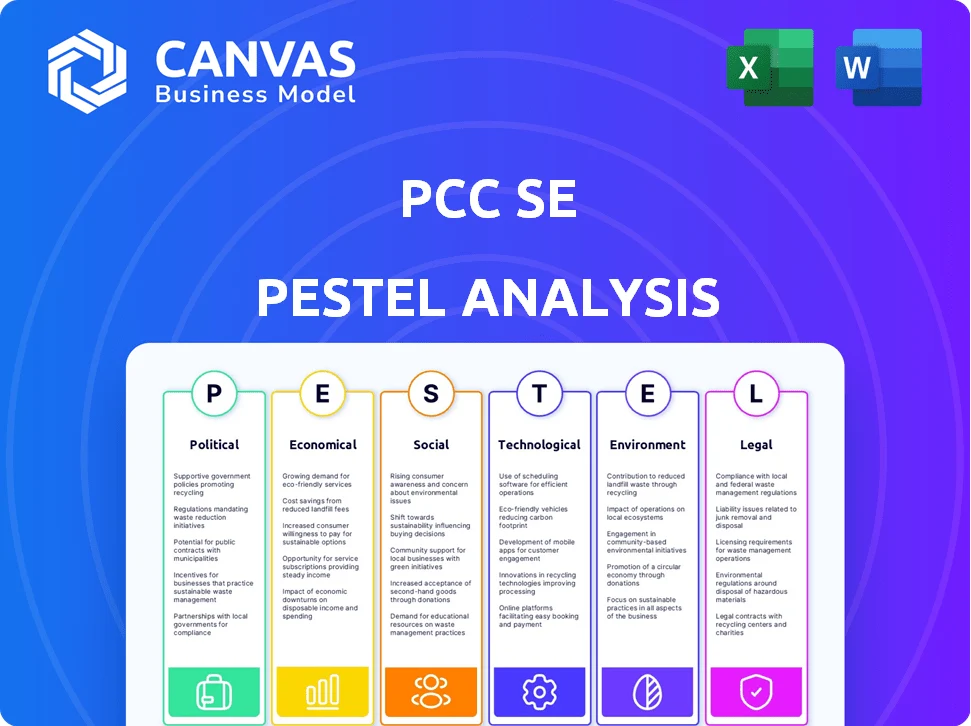
PCC SE PESTLE ANALYSIS TEMPLATE RESEARCH
What is included in the product
 Detailed Word Document
Helps identify threats and opportunities through a six-factor analysis: Political, Economic, Social, Technological, Environmental, and Legal.

 Customizable Excel Spreadsheet
Facilitates data-driven decisions with direct links to data supporting the claims within each PESTLE category.
What You See Is What You Get
PCC SE PESTLE Analysis
This preview showcases the full PCC SE PESTLE Analysis. The file you see is the actual document you will receive. All the details presented are identical to the downloaded version. Ready-to-use immediately after purchase. You can be sure you will receive what you see.

PESTLE Analysis Template

Plan Smarter. Present Sharper. Compete Stronger.
Navigate the complexities impacting PCC SE with our PESTLE analysis. We unpack the Political, Economic, Social, Technological, Legal, and Environmental forces shaping their trajectory. Understand market risks and identify opportunities for growth. Our report is packed with actionable insights you can use to improve your decision making and future planning. Purchase the complete PESTLE analysis and gain a strategic edge right away!
Political factors

Government Policy and Regulation
Government policies heavily influence PCC SE. Trade agreements, like those impacting chemical exports, are crucial. Industrial regulations, such as environmental standards, affect operational costs. For instance, Poland's chemical sector saw a 3% rise in compliance costs in 2024 due to new EU regulations. Government support through subsidies can also be a factor.
Geopolitical Stability
Geopolitical instability significantly impacts PCC SE, given its diverse sector operations and global presence. Disruptions in supply chains, as seen during the Russia-Ukraine conflict, can directly affect production costs. Energy price fluctuations, influenced by geopolitical events, also hit profitability. In 2024, global conflicts led to a 15% increase in energy costs for similar companies. Market demand is also sensitive, with economic sanctions potentially shrinking market access.

Trade Agreements and Tariffs
Changes in trade agreements and tariffs significantly influence PCC SE. For example, in 2024, tariffs on imported steel (a key raw material) may increase production costs. This can affect the pricing of their products. Logistics costs fluctuate, with the World Bank estimating a 10-15% rise in global shipping prices due to trade disputes.

Political Risk in Investment Locations
PCC SE's investments in renewable energy and other projects face political risks tied to location-specific stability and regulations. Government changes or policy shifts can jeopardize these ventures. For example, the instability in certain African nations has led to project delays. Political factors significantly impact the feasibility and profitability of international projects. Investors should closely monitor political landscapes.
- Political instability in emerging markets can increase investment risk.
- Changes in renewable energy subsidies can affect project returns.
- Regulatory approvals and permitting processes can be delayed by political interference.
- Geopolitical tensions can disrupt supply chains and increase costs.
Government Support for Renewable Energy
Government policies significantly impact PCC SE's renewable energy ventures. Incentives, subsidies, and regulations are crucial drivers. The U.S. government allocated over $400 billion for clean energy initiatives via the Inflation Reduction Act of 2022. Such support can lower costs and boost project viability. However, changes in political leadership can shift these policies, creating uncertainty.
- The Inflation Reduction Act of 2022 allocated over $400 billion for clean energy.
- Policy shifts can introduce investment risks.
Political Winds: Navigating Risks and Rewards
Political factors present significant challenges and opportunities for PCC SE's business. Government regulations in the chemicals sector have introduced cost increases, like the 3% rise in Poland. Geopolitical instability's influence is crucial for global operations. Trade policies, especially tariffs, impact raw material costs and global supply chains.
The company faces risks with investments in renewables due to political instability. Support, through the U.S. Inflation Reduction Act (IRA), offers advantages, despite policy risks. The dynamics influence projects returns, market access and operational profitability.
| Factor | Impact | 2024-2025 Data |
|---|---|---|
| Trade Agreements | Tariffs affect raw materials | Steel tariff rises increased costs. Shipping prices rose 10-15%. |
| Government Support | Subsidies/incentives | The IRA provided over $400B for clean energy. |
| Political Instability | Project Delays & Supply chains | Geopolitical events increased energy costs by 15%. |
Economic factors

Global and Regional Economic Growth
PCC SE's financial success is heavily influenced by global and regional economic performance. Strong economic growth typically boosts demand for chemicals, energy, and logistics, which are key areas for PCC SE. In 2024, the global chemical market is projected to reach $6 trillion, indicating a significant market for PCC SE. Regional economic conditions, like in Central and Eastern Europe (CEE) where PCC SE has a strong presence, directly impact its sales and profitability. The CEE region's GDP growth rate is expected to be around 3% in 2024, affecting PCC SE's operational performance.
Inflation and Interest Rates
Inflation significantly influences PCC SE's operational costs, especially raw materials and energy. Rising interest rates in 2024, with the Federal Reserve holding rates steady, impact borrowing costs. PCC SE's investment strategies are directly affected by these financial dynamics. The U.S. inflation rate was 3.1% in January 2024, impacting various sectors.

Currency Exchange Rates
PCC SE faces currency risk due to its global presence. The Euro's value against other currencies directly affects reported financials. For example, in 2024, a stronger Euro could make exports from Eurozone subsidiaries more expensive, impacting sales. Conversely, a weaker Euro boosts competitiveness. The exchange rate volatility requires hedging strategies.

Energy Prices
Energy prices are a critical economic factor for PCC SE, given its energy sector involvement and the energy-intensive nature of chemical production. Fluctuations in oil, natural gas, and electricity prices directly impact PCC SE's production costs and profitability. For instance, in 2024, natural gas prices in Europe saw significant volatility, affecting chemical manufacturers' margins. These fluctuations can influence investment decisions and strategic planning within the company.
- In Q1 2024, Brent crude oil prices averaged around $83 per barrel.
- The U.S. Energy Information Administration (EIA) projects a slight increase in energy prices through 2025.
- European natural gas prices experienced a 20% increase in Q1 2024.
Market Demand in Key Sectors
Market demand is a pivotal economic factor for PCC SE, especially in sectors like construction, manufacturing, and automotive. The demand for chemical raw materials, silicon metal, and logistics services directly impacts the company's financial performance. For example, in 2024, the construction sector in Europe saw a 3% growth, which boosted the demand for related chemical products. This highlights the importance of understanding sector-specific demand trends.
- Construction sector growth in Europe (2024): 3%
- Impact on chemical product demand: Increased
- Key materials: Raw materials, silicon metal
- Services affected: Logistics
Economic Forces Shaping Financials
Economic factors significantly shape PCC SE's financial outcomes, including global market dynamics and regional performance, notably in CEE where GDP growth is expected to be around 3% in 2024. Inflation and interest rates impact operational costs and borrowing, with U.S. inflation at 3.1% in January 2024. Currency fluctuations also pose risk, potentially influencing export competitiveness. Energy prices are critical given the company's involvement and energy-intensive operations.
| Economic Factor | Impact on PCC SE | Data (2024) |
|---|---|---|
| Global Economic Growth | Affects demand for chemicals, energy, and logistics. | Global chemical market projected at $6T |
| Regional GDP | Influences sales and profitability, specifically in CEE. | CEE GDP growth ~3% |
| Inflation | Raises operational costs (raw materials, energy). | U.S. inflation 3.1% (Jan) |
Sociological factors

Demographic Trends
Shifts in population size, age, and urban living significantly impact PCC SE. Urbanization, for example, drives demand for chemicals used in construction and infrastructure. The global population is projected to reach 8 billion in 2024. The median age in many developed countries is increasing, altering consumer needs.
Consumer Preferences and Lifestyle Changes
Consumer preferences are shifting, with demand for sustainable products rising. This affects chemical markets and logistics. For example, the global market for sustainable chemicals is projected to reach $100 billion by 2025. Changes in lifestyle, like increased online shopping, boost logistics needs. E-commerce sales grew by 14% in 2024, influencing transportation demands.

Labor Availability and Skills
The availability of skilled labor in the chemicals, energy, and logistics sectors impacts PCC SE. Labor costs and expansion capabilities are directly affected. For instance, the chemical industry faces a skills gap; in 2024, 30% of firms reported difficulty filling technical roles. This impacts operational efficiency.

Social Acceptance of Industrial Operations
Social acceptance is key for industrial operations, especially in chemical production and energy. Public perception directly affects regulations, community relations, and project viability. For instance, a 2024 study showed 60% of Americans support renewable energy, influencing investment. Negative perceptions can lead to project delays or cancellations, impacting financial outcomes. Consider the community impact, as 70% of consumers prefer brands with strong CSR.
- Public support for renewable energy is at 60% (2024).
- 70% of consumers favor brands with strong CSR (2024).
- Project delays can cost companies millions.
Corporate Social Responsibility Expectations
Societal expectations for corporate social responsibility (CSR) are rising, influencing PCC SE's standing and activities. Consumers increasingly favor ethical sourcing, fair labor practices, and community involvement. A 2024 study showed that 77% of consumers prefer brands with strong CSR commitments. Companies with robust CSR strategies often see better financial performance, and a 2025 forecast projects a 15% increase in CSR-related investments.
- 77% of consumers prefer brands with strong CSR commitments (2024).
- 15% increase in CSR-related investments projected (2025 forecast).
Social Trends Reshape Business Strategies
Social trends strongly impact PCC SE. Rising CSR demands influence ethical practices, and consumer preferences shift towards sustainability. Public support for renewable energy affects operational viability and investment decisions. Companies with strong CSR strategies often perform better, with 77% of consumers favoring such brands in 2024.
| Factor | Impact | Data |
|---|---|---|
| CSR Preference | Positive brand perception | 77% prefer strong CSR (2024) |
| Renewable Energy Support | Impact on investments | 60% support renewable (2024) |
| Consumer Shift | Demand for sustainable | Sustainable chem market: $100B by 2025 |
Original: $10.00
-65%$10.00
$3.50PCC SE PESTLE ANALYSIS TEMPLATE RESEARCH
What is included in the product
Detailed Word Document
Helps identify threats and opportunities through a six-factor analysis: Political, Economic, Social, Technological, Environmental, and Legal.
Customizable Excel Spreadsheet
Facilitates data-driven decisions with direct links to data supporting the claims within each PESTLE category.
What You See Is What You Get
PCC SE PESTLE Analysis
This preview showcases the full PCC SE PESTLE Analysis. The file you see is the actual document you will receive. All the details presented are identical to the downloaded version. Ready-to-use immediately after purchase. You can be sure you will receive what you see.
PESTLE Analysis Template
Plan Smarter. Present Sharper. Compete Stronger.
Navigate the complexities impacting PCC SE with our PESTLE analysis. We unpack the Political, Economic, Social, Technological, Legal, and Environmental forces shaping their trajectory. Understand market risks and identify opportunities for growth. Our report is packed with actionable insights you can use to improve your decision making and future planning. Purchase the complete PESTLE analysis and gain a strategic edge right away!
Political factors
Government Policy and Regulation
Government policies heavily influence PCC SE. Trade agreements, like those impacting chemical exports, are crucial. Industrial regulations, such as environmental standards, affect operational costs. For instance, Poland's chemical sector saw a 3% rise in compliance costs in 2024 due to new EU regulations. Government support through subsidies can also be a factor.
Geopolitical Stability
Geopolitical instability significantly impacts PCC SE, given its diverse sector operations and global presence. Disruptions in supply chains, as seen during the Russia-Ukraine conflict, can directly affect production costs. Energy price fluctuations, influenced by geopolitical events, also hit profitability. In 2024, global conflicts led to a 15% increase in energy costs for similar companies. Market demand is also sensitive, with economic sanctions potentially shrinking market access.
Trade Agreements and Tariffs
Changes in trade agreements and tariffs significantly influence PCC SE. For example, in 2024, tariffs on imported steel (a key raw material) may increase production costs. This can affect the pricing of their products. Logistics costs fluctuate, with the World Bank estimating a 10-15% rise in global shipping prices due to trade disputes.
Political Risk in Investment Locations
PCC SE's investments in renewable energy and other projects face political risks tied to location-specific stability and regulations. Government changes or policy shifts can jeopardize these ventures. For example, the instability in certain African nations has led to project delays. Political factors significantly impact the feasibility and profitability of international projects. Investors should closely monitor political landscapes.
- Political instability in emerging markets can increase investment risk.
- Changes in renewable energy subsidies can affect project returns.
- Regulatory approvals and permitting processes can be delayed by political interference.
- Geopolitical tensions can disrupt supply chains and increase costs.
Government Support for Renewable Energy
Government policies significantly impact PCC SE's renewable energy ventures. Incentives, subsidies, and regulations are crucial drivers. The U.S. government allocated over $400 billion for clean energy initiatives via the Inflation Reduction Act of 2022. Such support can lower costs and boost project viability. However, changes in political leadership can shift these policies, creating uncertainty.
- The Inflation Reduction Act of 2022 allocated over $400 billion for clean energy.
- Policy shifts can introduce investment risks.
Political Winds: Navigating Risks and Rewards
Political factors present significant challenges and opportunities for PCC SE's business. Government regulations in the chemicals sector have introduced cost increases, like the 3% rise in Poland. Geopolitical instability's influence is crucial for global operations. Trade policies, especially tariffs, impact raw material costs and global supply chains.
The company faces risks with investments in renewables due to political instability. Support, through the U.S. Inflation Reduction Act (IRA), offers advantages, despite policy risks. The dynamics influence projects returns, market access and operational profitability.
| Factor | Impact | 2024-2025 Data |
|---|---|---|
| Trade Agreements | Tariffs affect raw materials | Steel tariff rises increased costs. Shipping prices rose 10-15%. |
| Government Support | Subsidies/incentives | The IRA provided over $400B for clean energy. |
| Political Instability | Project Delays & Supply chains | Geopolitical events increased energy costs by 15%. |
Economic factors
Global and Regional Economic Growth
PCC SE's financial success is heavily influenced by global and regional economic performance. Strong economic growth typically boosts demand for chemicals, energy, and logistics, which are key areas for PCC SE. In 2024, the global chemical market is projected to reach $6 trillion, indicating a significant market for PCC SE. Regional economic conditions, like in Central and Eastern Europe (CEE) where PCC SE has a strong presence, directly impact its sales and profitability. The CEE region's GDP growth rate is expected to be around 3% in 2024, affecting PCC SE's operational performance.
Inflation and Interest Rates
Inflation significantly influences PCC SE's operational costs, especially raw materials and energy. Rising interest rates in 2024, with the Federal Reserve holding rates steady, impact borrowing costs. PCC SE's investment strategies are directly affected by these financial dynamics. The U.S. inflation rate was 3.1% in January 2024, impacting various sectors.
Currency Exchange Rates
PCC SE faces currency risk due to its global presence. The Euro's value against other currencies directly affects reported financials. For example, in 2024, a stronger Euro could make exports from Eurozone subsidiaries more expensive, impacting sales. Conversely, a weaker Euro boosts competitiveness. The exchange rate volatility requires hedging strategies.
Energy Prices
Energy prices are a critical economic factor for PCC SE, given its energy sector involvement and the energy-intensive nature of chemical production. Fluctuations in oil, natural gas, and electricity prices directly impact PCC SE's production costs and profitability. For instance, in 2024, natural gas prices in Europe saw significant volatility, affecting chemical manufacturers' margins. These fluctuations can influence investment decisions and strategic planning within the company.
- In Q1 2024, Brent crude oil prices averaged around $83 per barrel.
- The U.S. Energy Information Administration (EIA) projects a slight increase in energy prices through 2025.
- European natural gas prices experienced a 20% increase in Q1 2024.
Market Demand in Key Sectors
Market demand is a pivotal economic factor for PCC SE, especially in sectors like construction, manufacturing, and automotive. The demand for chemical raw materials, silicon metal, and logistics services directly impacts the company's financial performance. For example, in 2024, the construction sector in Europe saw a 3% growth, which boosted the demand for related chemical products. This highlights the importance of understanding sector-specific demand trends.
- Construction sector growth in Europe (2024): 3%
- Impact on chemical product demand: Increased
- Key materials: Raw materials, silicon metal
- Services affected: Logistics
Economic Forces Shaping Financials
Economic factors significantly shape PCC SE's financial outcomes, including global market dynamics and regional performance, notably in CEE where GDP growth is expected to be around 3% in 2024. Inflation and interest rates impact operational costs and borrowing, with U.S. inflation at 3.1% in January 2024. Currency fluctuations also pose risk, potentially influencing export competitiveness. Energy prices are critical given the company's involvement and energy-intensive operations.
| Economic Factor | Impact on PCC SE | Data (2024) |
|---|---|---|
| Global Economic Growth | Affects demand for chemicals, energy, and logistics. | Global chemical market projected at $6T |
| Regional GDP | Influences sales and profitability, specifically in CEE. | CEE GDP growth ~3% |
| Inflation | Raises operational costs (raw materials, energy). | U.S. inflation 3.1% (Jan) |
Sociological factors
Demographic Trends
Shifts in population size, age, and urban living significantly impact PCC SE. Urbanization, for example, drives demand for chemicals used in construction and infrastructure. The global population is projected to reach 8 billion in 2024. The median age in many developed countries is increasing, altering consumer needs.
Consumer Preferences and Lifestyle Changes
Consumer preferences are shifting, with demand for sustainable products rising. This affects chemical markets and logistics. For example, the global market for sustainable chemicals is projected to reach $100 billion by 2025. Changes in lifestyle, like increased online shopping, boost logistics needs. E-commerce sales grew by 14% in 2024, influencing transportation demands.
Labor Availability and Skills
The availability of skilled labor in the chemicals, energy, and logistics sectors impacts PCC SE. Labor costs and expansion capabilities are directly affected. For instance, the chemical industry faces a skills gap; in 2024, 30% of firms reported difficulty filling technical roles. This impacts operational efficiency.
Social Acceptance of Industrial Operations
Social acceptance is key for industrial operations, especially in chemical production and energy. Public perception directly affects regulations, community relations, and project viability. For instance, a 2024 study showed 60% of Americans support renewable energy, influencing investment. Negative perceptions can lead to project delays or cancellations, impacting financial outcomes. Consider the community impact, as 70% of consumers prefer brands with strong CSR.
- Public support for renewable energy is at 60% (2024).
- 70% of consumers favor brands with strong CSR (2024).
- Project delays can cost companies millions.
Corporate Social Responsibility Expectations
Societal expectations for corporate social responsibility (CSR) are rising, influencing PCC SE's standing and activities. Consumers increasingly favor ethical sourcing, fair labor practices, and community involvement. A 2024 study showed that 77% of consumers prefer brands with strong CSR commitments. Companies with robust CSR strategies often see better financial performance, and a 2025 forecast projects a 15% increase in CSR-related investments.
- 77% of consumers prefer brands with strong CSR commitments (2024).
- 15% increase in CSR-related investments projected (2025 forecast).
Social Trends Reshape Business Strategies
Social trends strongly impact PCC SE. Rising CSR demands influence ethical practices, and consumer preferences shift towards sustainability. Public support for renewable energy affects operational viability and investment decisions. Companies with strong CSR strategies often perform better, with 77% of consumers favoring such brands in 2024.
| Factor | Impact | Data |
|---|---|---|
| CSR Preference | Positive brand perception | 77% prefer strong CSR (2024) |
| Renewable Energy Support | Impact on investments | 60% support renewable (2024) |
| Consumer Shift | Demand for sustainable | Sustainable chem market: $100B by 2025 |
Product Information
Product Information
Shipping & Returns
Shipping & Returns
Description
What is included in the product
Detailed Word Document
Helps identify threats and opportunities through a six-factor analysis: Political, Economic, Social, Technological, Environmental, and Legal.
Customizable Excel Spreadsheet
Facilitates data-driven decisions with direct links to data supporting the claims within each PESTLE category.
What You See Is What You Get
PCC SE PESTLE Analysis
This preview showcases the full PCC SE PESTLE Analysis. The file you see is the actual document you will receive. All the details presented are identical to the downloaded version. Ready-to-use immediately after purchase. You can be sure you will receive what you see.
PESTLE Analysis Template
Plan Smarter. Present Sharper. Compete Stronger.
Navigate the complexities impacting PCC SE with our PESTLE analysis. We unpack the Political, Economic, Social, Technological, Legal, and Environmental forces shaping their trajectory. Understand market risks and identify opportunities for growth. Our report is packed with actionable insights you can use to improve your decision making and future planning. Purchase the complete PESTLE analysis and gain a strategic edge right away!
Political factors
Government Policy and Regulation
Government policies heavily influence PCC SE. Trade agreements, like those impacting chemical exports, are crucial. Industrial regulations, such as environmental standards, affect operational costs. For instance, Poland's chemical sector saw a 3% rise in compliance costs in 2024 due to new EU regulations. Government support through subsidies can also be a factor.
Geopolitical Stability
Geopolitical instability significantly impacts PCC SE, given its diverse sector operations and global presence. Disruptions in supply chains, as seen during the Russia-Ukraine conflict, can directly affect production costs. Energy price fluctuations, influenced by geopolitical events, also hit profitability. In 2024, global conflicts led to a 15% increase in energy costs for similar companies. Market demand is also sensitive, with economic sanctions potentially shrinking market access.
Trade Agreements and Tariffs
Changes in trade agreements and tariffs significantly influence PCC SE. For example, in 2024, tariffs on imported steel (a key raw material) may increase production costs. This can affect the pricing of their products. Logistics costs fluctuate, with the World Bank estimating a 10-15% rise in global shipping prices due to trade disputes.
Political Risk in Investment Locations
PCC SE's investments in renewable energy and other projects face political risks tied to location-specific stability and regulations. Government changes or policy shifts can jeopardize these ventures. For example, the instability in certain African nations has led to project delays. Political factors significantly impact the feasibility and profitability of international projects. Investors should closely monitor political landscapes.
- Political instability in emerging markets can increase investment risk.
- Changes in renewable energy subsidies can affect project returns.
- Regulatory approvals and permitting processes can be delayed by political interference.
- Geopolitical tensions can disrupt supply chains and increase costs.
Government Support for Renewable Energy
Government policies significantly impact PCC SE's renewable energy ventures. Incentives, subsidies, and regulations are crucial drivers. The U.S. government allocated over $400 billion for clean energy initiatives via the Inflation Reduction Act of 2022. Such support can lower costs and boost project viability. However, changes in political leadership can shift these policies, creating uncertainty.
- The Inflation Reduction Act of 2022 allocated over $400 billion for clean energy.
- Policy shifts can introduce investment risks.
Political Winds: Navigating Risks and Rewards
Political factors present significant challenges and opportunities for PCC SE's business. Government regulations in the chemicals sector have introduced cost increases, like the 3% rise in Poland. Geopolitical instability's influence is crucial for global operations. Trade policies, especially tariffs, impact raw material costs and global supply chains.
The company faces risks with investments in renewables due to political instability. Support, through the U.S. Inflation Reduction Act (IRA), offers advantages, despite policy risks. The dynamics influence projects returns, market access and operational profitability.
| Factor | Impact | 2024-2025 Data |
|---|---|---|
| Trade Agreements | Tariffs affect raw materials | Steel tariff rises increased costs. Shipping prices rose 10-15%. |
| Government Support | Subsidies/incentives | The IRA provided over $400B for clean energy. |
| Political Instability | Project Delays & Supply chains | Geopolitical events increased energy costs by 15%. |
Economic factors
Global and Regional Economic Growth
PCC SE's financial success is heavily influenced by global and regional economic performance. Strong economic growth typically boosts demand for chemicals, energy, and logistics, which are key areas for PCC SE. In 2024, the global chemical market is projected to reach $6 trillion, indicating a significant market for PCC SE. Regional economic conditions, like in Central and Eastern Europe (CEE) where PCC SE has a strong presence, directly impact its sales and profitability. The CEE region's GDP growth rate is expected to be around 3% in 2024, affecting PCC SE's operational performance.
Inflation and Interest Rates
Inflation significantly influences PCC SE's operational costs, especially raw materials and energy. Rising interest rates in 2024, with the Federal Reserve holding rates steady, impact borrowing costs. PCC SE's investment strategies are directly affected by these financial dynamics. The U.S. inflation rate was 3.1% in January 2024, impacting various sectors.
Currency Exchange Rates
PCC SE faces currency risk due to its global presence. The Euro's value against other currencies directly affects reported financials. For example, in 2024, a stronger Euro could make exports from Eurozone subsidiaries more expensive, impacting sales. Conversely, a weaker Euro boosts competitiveness. The exchange rate volatility requires hedging strategies.
Energy Prices
Energy prices are a critical economic factor for PCC SE, given its energy sector involvement and the energy-intensive nature of chemical production. Fluctuations in oil, natural gas, and electricity prices directly impact PCC SE's production costs and profitability. For instance, in 2024, natural gas prices in Europe saw significant volatility, affecting chemical manufacturers' margins. These fluctuations can influence investment decisions and strategic planning within the company.
- In Q1 2024, Brent crude oil prices averaged around $83 per barrel.
- The U.S. Energy Information Administration (EIA) projects a slight increase in energy prices through 2025.
- European natural gas prices experienced a 20% increase in Q1 2024.
Market Demand in Key Sectors
Market demand is a pivotal economic factor for PCC SE, especially in sectors like construction, manufacturing, and automotive. The demand for chemical raw materials, silicon metal, and logistics services directly impacts the company's financial performance. For example, in 2024, the construction sector in Europe saw a 3% growth, which boosted the demand for related chemical products. This highlights the importance of understanding sector-specific demand trends.
- Construction sector growth in Europe (2024): 3%
- Impact on chemical product demand: Increased
- Key materials: Raw materials, silicon metal
- Services affected: Logistics
Economic Forces Shaping Financials
Economic factors significantly shape PCC SE's financial outcomes, including global market dynamics and regional performance, notably in CEE where GDP growth is expected to be around 3% in 2024. Inflation and interest rates impact operational costs and borrowing, with U.S. inflation at 3.1% in January 2024. Currency fluctuations also pose risk, potentially influencing export competitiveness. Energy prices are critical given the company's involvement and energy-intensive operations.
| Economic Factor | Impact on PCC SE | Data (2024) |
|---|---|---|
| Global Economic Growth | Affects demand for chemicals, energy, and logistics. | Global chemical market projected at $6T |
| Regional GDP | Influences sales and profitability, specifically in CEE. | CEE GDP growth ~3% |
| Inflation | Raises operational costs (raw materials, energy). | U.S. inflation 3.1% (Jan) |
Sociological factors
Demographic Trends
Shifts in population size, age, and urban living significantly impact PCC SE. Urbanization, for example, drives demand for chemicals used in construction and infrastructure. The global population is projected to reach 8 billion in 2024. The median age in many developed countries is increasing, altering consumer needs.
Consumer Preferences and Lifestyle Changes
Consumer preferences are shifting, with demand for sustainable products rising. This affects chemical markets and logistics. For example, the global market for sustainable chemicals is projected to reach $100 billion by 2025. Changes in lifestyle, like increased online shopping, boost logistics needs. E-commerce sales grew by 14% in 2024, influencing transportation demands.
Labor Availability and Skills
The availability of skilled labor in the chemicals, energy, and logistics sectors impacts PCC SE. Labor costs and expansion capabilities are directly affected. For instance, the chemical industry faces a skills gap; in 2024, 30% of firms reported difficulty filling technical roles. This impacts operational efficiency.
Social Acceptance of Industrial Operations
Social acceptance is key for industrial operations, especially in chemical production and energy. Public perception directly affects regulations, community relations, and project viability. For instance, a 2024 study showed 60% of Americans support renewable energy, influencing investment. Negative perceptions can lead to project delays or cancellations, impacting financial outcomes. Consider the community impact, as 70% of consumers prefer brands with strong CSR.
- Public support for renewable energy is at 60% (2024).
- 70% of consumers favor brands with strong CSR (2024).
- Project delays can cost companies millions.
Corporate Social Responsibility Expectations
Societal expectations for corporate social responsibility (CSR) are rising, influencing PCC SE's standing and activities. Consumers increasingly favor ethical sourcing, fair labor practices, and community involvement. A 2024 study showed that 77% of consumers prefer brands with strong CSR commitments. Companies with robust CSR strategies often see better financial performance, and a 2025 forecast projects a 15% increase in CSR-related investments.
- 77% of consumers prefer brands with strong CSR commitments (2024).
- 15% increase in CSR-related investments projected (2025 forecast).
Social Trends Reshape Business Strategies
Social trends strongly impact PCC SE. Rising CSR demands influence ethical practices, and consumer preferences shift towards sustainability. Public support for renewable energy affects operational viability and investment decisions. Companies with strong CSR strategies often perform better, with 77% of consumers favoring such brands in 2024.
| Factor | Impact | Data |
|---|---|---|
| CSR Preference | Positive brand perception | 77% prefer strong CSR (2024) |
| Renewable Energy Support | Impact on investments | 60% support renewable (2024) |
| Consumer Shift | Demand for sustainable | Sustainable chem market: $100B by 2025 |


