PARAGON CORPORATE HOLDINGS, INC. PESTLE ANALYSIS TEMPLATE RESEARCH
What is included in the product
 Detailed Word Document
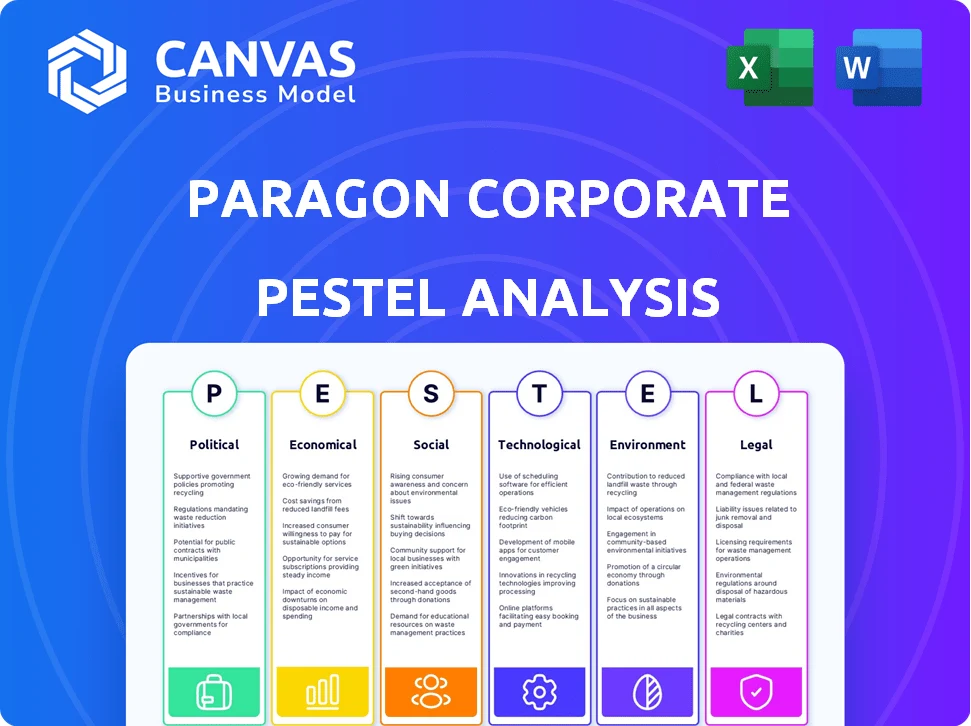
A detailed PESTLE analysis evaluating the macro-environmental factors impacting Paragon Corporate Holdings.

 Customizable Excel Spreadsheet
Helps support discussions on external risk and market positioning during planning sessions.
Preview Before You Purchase
Paragon Corporate Holdings, Inc. PESTLE Analysis
This is a preview of the Paragon Corporate Holdings, Inc. PESTLE Analysis. You’re seeing the complete document. The content in the preview is identical to the file you will download. There are no alterations after purchase. Your file will be ready to use!

PESTLE Analysis Template

Plan Smarter. Present Sharper. Compete Stronger.
Navigate Paragon Corporate Holdings, Inc.'s future with clarity. Our PESTLE Analysis uncovers key political, economic, social, technological, legal, and environmental factors. We explore how these forces influence its strategies and performance. Access insightful market intelligence to strengthen your own strategies.
Political factors

Government Regulations and Policies
Paragon Corporate Holdings, Inc. must navigate government regulations on packaging, janitorial, and safety products. Product safety, environmental compliance, and labor laws are crucial factors. Trade policies and tariffs impact the cost of goods and distribution. In 2024, compliance costs rose 5% due to stricter environmental standards.
Political Stability in Operating Regions
Political stability significantly impacts Paragon's operations. The company's subsidiary in Colombia, for example, faces political risk. Disruptions to supply chains and operational challenges can arise from instability. Such risks can affect financial performance, as seen in sectors with high political sensitivity. In 2024, Colombia's political climate showed moderate risk, impacting business planning.

Trade Agreements and Tariffs
Changes to trade deals and tariffs directly affect import/export costs. Paragon, in distribution and supply chain, sees pricing and profit shifts. For instance, the US-China trade war impacted many sectors. In 2024, tariff rates on certain goods remain at 25%.

Government Spending and Infrastructure Investment
Government spending on infrastructure significantly influences Paragon's supply chain efficiency. Increased investment, especially in transportation and logistics, can streamline distribution networks. For example, the U.S. government's infrastructure plan includes $1.2 trillion, potentially boosting logistics. Such investment could decrease Paragon's operational costs and enhance service delivery.
- U.S. infrastructure plan: $1.2 trillion investment.
- Improved logistics can lead to lower operational costs.
- Enhanced service delivery due to better infrastructure.
Political Risk in Foreign Operations
Paragon Corporate Holdings, Inc.'s operations in foreign markets, including Colombia, face political risks. These risks involve potential government changes, industry nationalization, and civil unrest, impacting business and financial outcomes. Political instability can cause significant financial losses. For example, in 2024, political instability in several South American countries led to a 15% decrease in foreign investment.
- Government instability: Changes in leadership can lead to policy shifts.
- Nationalization: Risk of government seizure of assets.
- Civil unrest: Protests and conflicts can disrupt operations.
- Regulatory changes: New laws can impact business.
Political Hurdles: Impacting Operations
Paragon navigates political risks like regulatory changes and trade policies, significantly impacting operational costs and supply chains. In 2024, compliance costs grew due to environmental standards, affecting the company's bottom line. Political instability, particularly in international markets, remains a critical factor for financial performance.
| Political Factor | Impact on Paragon | 2024 Data/Examples |
|---|---|---|
| Regulatory Changes | Increased compliance costs; changes to operations | Compliance costs +5% |
| Trade Policies/Tariffs | Affects import/export costs; supply chain efficiency | Tariffs on goods remain at 25% |
| Political Stability | Disrupts operations; financial risks in foreign markets | Colombia's moderate political risk affected planning. |
Economic factors

Overall Economic Conditions
Overall economic conditions significantly impact Paragon Corporate Holdings. Economic growth, inflation, and consumer spending directly influence demand for their subsidiaries' offerings. In Q1 2024, the U.S. GDP grew by 1.6%, while inflation hovered around 3.5%. Economic downturns can decrease demand. Consumer spending rose by 2.5% in the same period, showing resilience.
Inflation and Cost of Goods
Inflation significantly affects Paragon's operational costs. Rising prices of raw materials, like plastics for packaging, increase production expenses. In 2024, the Producer Price Index (PPI) for plastic products saw a 3.2% increase. Paragon's ability to adjust pricing and manage supply chain efficiencies will be crucial for preserving profit margins amidst these inflationary pressures.

Currency Exchange Rates
Currency exchange rates are critical for Paragon, especially given its international footprint. Fluctuations directly impact the financial performance of its subsidiaries. For instance, Paragon's Colombian operations face currency risks. In 2024, the Colombian Peso's volatility affected profitability. Monitoring exchange rates is essential for financial planning.

Interest Rates and Access to Capital
Interest rates significantly affect Paragon Corporate Holdings' borrowing costs and client investment decisions. Higher rates can increase borrowing expenses for potential acquisitions or strategic investments. Access to capital is crucial for funding these initiatives and maintaining operational flexibility. Currently, the Federal Reserve has maintained the federal funds rate, impacting borrowing costs. Fluctuations in interest rates directly influence Paragon's financial planning and market competitiveness.
- Federal Reserve held rates steady in May 2024.
- Prime rate currently at 8.50%.
- Corporate bond yields are around 5-6%.
- Access to capital is essential for growth.
Industry-Specific Economic Trends
Industry-specific economic trends are crucial for Paragon Corporate Holdings, Inc. For instance, a slowdown in manufacturing, where Paragon supplies packaging, could decrease demand. The healthcare sector's growth, where they offer safety products, might boost sales. Analyzing these sector-specific economic indicators is vital.
- Manufacturing output in the US grew by 1.0% in Q1 2024, impacting packaging needs.
- Healthcare spending is projected to increase by 5.2% in 2024, potentially raising demand for safety products.
Paragon's Economic Landscape: Key Factors
Economic factors are crucial for Paragon, impacting demand and operational costs. In Q1 2024, U.S. GDP grew by 1.6%, and inflation remained around 3.5%. Currency fluctuations, such as the Colombian Peso's volatility, and interest rates significantly influence financial planning and investment.
| Economic Factor | Impact on Paragon | Data/Statistics (2024) |
|---|---|---|
| GDP Growth | Affects demand | Q1: 1.6% |
| Inflation | Raises costs | Around 3.5% |
| Interest Rates | Impacts borrowing costs | Federal Reserve held rates steady in May 2024. Prime rate currently at 8.50%. |
Sociological factors

Workforce Demographics and Labor Availability
Changes in workforce demographics and availability of skilled labor affect Paragon. An aging workforce or shortages can impact efficiency and costs. For example, the US faces a skilled labor shortage, with 54% of manufacturers reporting difficulty finding qualified workers in 2024. This could drive up wages and training expenses.
Consumer Trends and Preferences
Consumer preferences indirectly affect Paragon, a B2B firm. Rising consumer demand for sustainable packaging boosts related product lines. The global sustainable packaging market, valued at $280 billion in 2023, is projected to reach $437 billion by 2028. Hygiene standards also influence product demand, mirroring consumer health concerns.

Health and Safety Awareness
Societal focus on health and safety boosts demand for safety and janitorial supplies. Stricter workplace protocols offer opportunities for Paragon. The global cleaning products market is projected to reach $78.1 billion by 2025, fueled by health awareness. This growth highlights Paragon's potential in this sector.

Corporate Social Responsibility (CSR) Expectations
Societal expectations for corporate social responsibility (CSR) are intensifying, impacting how companies like Paragon are perceived. Paragon's dedication to sustainability and ethical conduct significantly shapes its reputation. This commitment is crucial for fostering strong relationships with clients and stakeholders in today's market. Such practices often lead to enhanced brand value and customer loyalty.
- In 2024, 86% of consumers indicated they would be more loyal to a company that supports social or environmental issues.
- Companies with strong CSR initiatives often see a 5-10% increase in brand value.
- Ethical practices can lead to a 15-20% improvement in employee retention rates.
Education and Skill Levels of the Workforce
The educational attainment and skill sets of the workforce significantly impact Paragon Corporate Holdings' ability to integrate new technologies and optimize supply chains. A well-educated workforce is crucial for managing sophisticated logistics operations and adopting advanced inventory systems. According to the U.S. Bureau of Labor Statistics, employment in transportation and material moving occupations is projected to grow 4% from 2022 to 2032. This growth underscores the need for skilled workers.
- Demand for skilled workers in logistics is rising, with a projected 4% growth by 2032.
- Advanced inventory systems require employees proficient in data analysis and technology.
- Educational initiatives and training programs are essential for workforce development.
- A skilled workforce improves operational efficiency and reduces costs.
Paragon's Path: Trends, Data & Strategic Insights
Societal trends significantly impact Paragon. Health awareness boosts demand for cleaning products, with the market expected to hit $78.1 billion by 2025. Corporate Social Responsibility is vital; 86% of consumers favor socially conscious companies. Skill shortages and workforce demographics affect operational efficiency.
| Factor | Impact | Data |
|---|---|---|
| Health & Safety | Increased demand | Cleaning products market: $78.1B by 2025 |
| CSR | Brand reputation & loyalty | 86% consumers favor CSR |
| Workforce | Operational efficiency | Skilled labor shortages in the US |
PARAGON CORPORATE HOLDINGS, INC. PESTLE ANALYSIS TEMPLATE RESEARCH
What is included in the product
Detailed Word Document
A detailed PESTLE analysis evaluating the macro-environmental factors impacting Paragon Corporate Holdings.
Customizable Excel Spreadsheet
Helps support discussions on external risk and market positioning during planning sessions.
Preview Before You Purchase
Paragon Corporate Holdings, Inc. PESTLE Analysis
This is a preview of the Paragon Corporate Holdings, Inc. PESTLE Analysis. You’re seeing the complete document. The content in the preview is identical to the file you will download. There are no alterations after purchase. Your file will be ready to use!
PESTLE Analysis Template
Plan Smarter. Present Sharper. Compete Stronger.
Navigate Paragon Corporate Holdings, Inc.'s future with clarity. Our PESTLE Analysis uncovers key political, economic, social, technological, legal, and environmental factors. We explore how these forces influence its strategies and performance. Access insightful market intelligence to strengthen your own strategies.
Political factors
Government Regulations and Policies
Paragon Corporate Holdings, Inc. must navigate government regulations on packaging, janitorial, and safety products. Product safety, environmental compliance, and labor laws are crucial factors. Trade policies and tariffs impact the cost of goods and distribution. In 2024, compliance costs rose 5% due to stricter environmental standards.
Political Stability in Operating Regions
Political stability significantly impacts Paragon's operations. The company's subsidiary in Colombia, for example, faces political risk. Disruptions to supply chains and operational challenges can arise from instability. Such risks can affect financial performance, as seen in sectors with high political sensitivity. In 2024, Colombia's political climate showed moderate risk, impacting business planning.
Trade Agreements and Tariffs
Changes to trade deals and tariffs directly affect import/export costs. Paragon, in distribution and supply chain, sees pricing and profit shifts. For instance, the US-China trade war impacted many sectors. In 2024, tariff rates on certain goods remain at 25%.
Government Spending and Infrastructure Investment
Government spending on infrastructure significantly influences Paragon's supply chain efficiency. Increased investment, especially in transportation and logistics, can streamline distribution networks. For example, the U.S. government's infrastructure plan includes $1.2 trillion, potentially boosting logistics. Such investment could decrease Paragon's operational costs and enhance service delivery.
- U.S. infrastructure plan: $1.2 trillion investment.
- Improved logistics can lead to lower operational costs.
- Enhanced service delivery due to better infrastructure.
Political Risk in Foreign Operations
Paragon Corporate Holdings, Inc.'s operations in foreign markets, including Colombia, face political risks. These risks involve potential government changes, industry nationalization, and civil unrest, impacting business and financial outcomes. Political instability can cause significant financial losses. For example, in 2024, political instability in several South American countries led to a 15% decrease in foreign investment.
- Government instability: Changes in leadership can lead to policy shifts.
- Nationalization: Risk of government seizure of assets.
- Civil unrest: Protests and conflicts can disrupt operations.
- Regulatory changes: New laws can impact business.
Political Hurdles: Impacting Operations
Paragon navigates political risks like regulatory changes and trade policies, significantly impacting operational costs and supply chains. In 2024, compliance costs grew due to environmental standards, affecting the company's bottom line. Political instability, particularly in international markets, remains a critical factor for financial performance.
| Political Factor | Impact on Paragon | 2024 Data/Examples |
|---|---|---|
| Regulatory Changes | Increased compliance costs; changes to operations | Compliance costs +5% |
| Trade Policies/Tariffs | Affects import/export costs; supply chain efficiency | Tariffs on goods remain at 25% |
| Political Stability | Disrupts operations; financial risks in foreign markets | Colombia's moderate political risk affected planning. |
Economic factors
Overall Economic Conditions
Overall economic conditions significantly impact Paragon Corporate Holdings. Economic growth, inflation, and consumer spending directly influence demand for their subsidiaries' offerings. In Q1 2024, the U.S. GDP grew by 1.6%, while inflation hovered around 3.5%. Economic downturns can decrease demand. Consumer spending rose by 2.5% in the same period, showing resilience.
Inflation and Cost of Goods
Inflation significantly affects Paragon's operational costs. Rising prices of raw materials, like plastics for packaging, increase production expenses. In 2024, the Producer Price Index (PPI) for plastic products saw a 3.2% increase. Paragon's ability to adjust pricing and manage supply chain efficiencies will be crucial for preserving profit margins amidst these inflationary pressures.
Currency Exchange Rates
Currency exchange rates are critical for Paragon, especially given its international footprint. Fluctuations directly impact the financial performance of its subsidiaries. For instance, Paragon's Colombian operations face currency risks. In 2024, the Colombian Peso's volatility affected profitability. Monitoring exchange rates is essential for financial planning.
Interest Rates and Access to Capital
Interest rates significantly affect Paragon Corporate Holdings' borrowing costs and client investment decisions. Higher rates can increase borrowing expenses for potential acquisitions or strategic investments. Access to capital is crucial for funding these initiatives and maintaining operational flexibility. Currently, the Federal Reserve has maintained the federal funds rate, impacting borrowing costs. Fluctuations in interest rates directly influence Paragon's financial planning and market competitiveness.
- Federal Reserve held rates steady in May 2024.
- Prime rate currently at 8.50%.
- Corporate bond yields are around 5-6%.
- Access to capital is essential for growth.
Industry-Specific Economic Trends
Industry-specific economic trends are crucial for Paragon Corporate Holdings, Inc. For instance, a slowdown in manufacturing, where Paragon supplies packaging, could decrease demand. The healthcare sector's growth, where they offer safety products, might boost sales. Analyzing these sector-specific economic indicators is vital.
- Manufacturing output in the US grew by 1.0% in Q1 2024, impacting packaging needs.
- Healthcare spending is projected to increase by 5.2% in 2024, potentially raising demand for safety products.
Paragon's Economic Landscape: Key Factors
Economic factors are crucial for Paragon, impacting demand and operational costs. In Q1 2024, U.S. GDP grew by 1.6%, and inflation remained around 3.5%. Currency fluctuations, such as the Colombian Peso's volatility, and interest rates significantly influence financial planning and investment.
| Economic Factor | Impact on Paragon | Data/Statistics (2024) |
|---|---|---|
| GDP Growth | Affects demand | Q1: 1.6% |
| Inflation | Raises costs | Around 3.5% |
| Interest Rates | Impacts borrowing costs | Federal Reserve held rates steady in May 2024. Prime rate currently at 8.50%. |
Sociological factors
Workforce Demographics and Labor Availability
Changes in workforce demographics and availability of skilled labor affect Paragon. An aging workforce or shortages can impact efficiency and costs. For example, the US faces a skilled labor shortage, with 54% of manufacturers reporting difficulty finding qualified workers in 2024. This could drive up wages and training expenses.
Consumer Trends and Preferences
Consumer preferences indirectly affect Paragon, a B2B firm. Rising consumer demand for sustainable packaging boosts related product lines. The global sustainable packaging market, valued at $280 billion in 2023, is projected to reach $437 billion by 2028. Hygiene standards also influence product demand, mirroring consumer health concerns.
Health and Safety Awareness
Societal focus on health and safety boosts demand for safety and janitorial supplies. Stricter workplace protocols offer opportunities for Paragon. The global cleaning products market is projected to reach $78.1 billion by 2025, fueled by health awareness. This growth highlights Paragon's potential in this sector.
Corporate Social Responsibility (CSR) Expectations
Societal expectations for corporate social responsibility (CSR) are intensifying, impacting how companies like Paragon are perceived. Paragon's dedication to sustainability and ethical conduct significantly shapes its reputation. This commitment is crucial for fostering strong relationships with clients and stakeholders in today's market. Such practices often lead to enhanced brand value and customer loyalty.
- In 2024, 86% of consumers indicated they would be more loyal to a company that supports social or environmental issues.
- Companies with strong CSR initiatives often see a 5-10% increase in brand value.
- Ethical practices can lead to a 15-20% improvement in employee retention rates.
Education and Skill Levels of the Workforce
The educational attainment and skill sets of the workforce significantly impact Paragon Corporate Holdings' ability to integrate new technologies and optimize supply chains. A well-educated workforce is crucial for managing sophisticated logistics operations and adopting advanced inventory systems. According to the U.S. Bureau of Labor Statistics, employment in transportation and material moving occupations is projected to grow 4% from 2022 to 2032. This growth underscores the need for skilled workers.
- Demand for skilled workers in logistics is rising, with a projected 4% growth by 2032.
- Advanced inventory systems require employees proficient in data analysis and technology.
- Educational initiatives and training programs are essential for workforce development.
- A skilled workforce improves operational efficiency and reduces costs.
Paragon's Path: Trends, Data & Strategic Insights
Societal trends significantly impact Paragon. Health awareness boosts demand for cleaning products, with the market expected to hit $78.1 billion by 2025. Corporate Social Responsibility is vital; 86% of consumers favor socially conscious companies. Skill shortages and workforce demographics affect operational efficiency.
| Factor | Impact | Data |
|---|---|---|
| Health & Safety | Increased demand | Cleaning products market: $78.1B by 2025 |
| CSR | Brand reputation & loyalty | 86% consumers favor CSR |
| Workforce | Operational efficiency | Skilled labor shortages in the US |
Product Information
Product Information
Shipping & Returns
Shipping & Returns
Description
What is included in the product
Detailed Word Document
A detailed PESTLE analysis evaluating the macro-environmental factors impacting Paragon Corporate Holdings.
Customizable Excel Spreadsheet
Helps support discussions on external risk and market positioning during planning sessions.
Preview Before You Purchase
Paragon Corporate Holdings, Inc. PESTLE Analysis
This is a preview of the Paragon Corporate Holdings, Inc. PESTLE Analysis. You’re seeing the complete document. The content in the preview is identical to the file you will download. There are no alterations after purchase. Your file will be ready to use!
PESTLE Analysis Template
Plan Smarter. Present Sharper. Compete Stronger.
Navigate Paragon Corporate Holdings, Inc.'s future with clarity. Our PESTLE Analysis uncovers key political, economic, social, technological, legal, and environmental factors. We explore how these forces influence its strategies and performance. Access insightful market intelligence to strengthen your own strategies.
Political factors
Government Regulations and Policies
Paragon Corporate Holdings, Inc. must navigate government regulations on packaging, janitorial, and safety products. Product safety, environmental compliance, and labor laws are crucial factors. Trade policies and tariffs impact the cost of goods and distribution. In 2024, compliance costs rose 5% due to stricter environmental standards.
Political Stability in Operating Regions
Political stability significantly impacts Paragon's operations. The company's subsidiary in Colombia, for example, faces political risk. Disruptions to supply chains and operational challenges can arise from instability. Such risks can affect financial performance, as seen in sectors with high political sensitivity. In 2024, Colombia's political climate showed moderate risk, impacting business planning.
Trade Agreements and Tariffs
Changes to trade deals and tariffs directly affect import/export costs. Paragon, in distribution and supply chain, sees pricing and profit shifts. For instance, the US-China trade war impacted many sectors. In 2024, tariff rates on certain goods remain at 25%.
Government Spending and Infrastructure Investment
Government spending on infrastructure significantly influences Paragon's supply chain efficiency. Increased investment, especially in transportation and logistics, can streamline distribution networks. For example, the U.S. government's infrastructure plan includes $1.2 trillion, potentially boosting logistics. Such investment could decrease Paragon's operational costs and enhance service delivery.
- U.S. infrastructure plan: $1.2 trillion investment.
- Improved logistics can lead to lower operational costs.
- Enhanced service delivery due to better infrastructure.
Political Risk in Foreign Operations
Paragon Corporate Holdings, Inc.'s operations in foreign markets, including Colombia, face political risks. These risks involve potential government changes, industry nationalization, and civil unrest, impacting business and financial outcomes. Political instability can cause significant financial losses. For example, in 2024, political instability in several South American countries led to a 15% decrease in foreign investment.
- Government instability: Changes in leadership can lead to policy shifts.
- Nationalization: Risk of government seizure of assets.
- Civil unrest: Protests and conflicts can disrupt operations.
- Regulatory changes: New laws can impact business.
Political Hurdles: Impacting Operations
Paragon navigates political risks like regulatory changes and trade policies, significantly impacting operational costs and supply chains. In 2024, compliance costs grew due to environmental standards, affecting the company's bottom line. Political instability, particularly in international markets, remains a critical factor for financial performance.
| Political Factor | Impact on Paragon | 2024 Data/Examples |
|---|---|---|
| Regulatory Changes | Increased compliance costs; changes to operations | Compliance costs +5% |
| Trade Policies/Tariffs | Affects import/export costs; supply chain efficiency | Tariffs on goods remain at 25% |
| Political Stability | Disrupts operations; financial risks in foreign markets | Colombia's moderate political risk affected planning. |
Economic factors
Overall Economic Conditions
Overall economic conditions significantly impact Paragon Corporate Holdings. Economic growth, inflation, and consumer spending directly influence demand for their subsidiaries' offerings. In Q1 2024, the U.S. GDP grew by 1.6%, while inflation hovered around 3.5%. Economic downturns can decrease demand. Consumer spending rose by 2.5% in the same period, showing resilience.
Inflation and Cost of Goods
Inflation significantly affects Paragon's operational costs. Rising prices of raw materials, like plastics for packaging, increase production expenses. In 2024, the Producer Price Index (PPI) for plastic products saw a 3.2% increase. Paragon's ability to adjust pricing and manage supply chain efficiencies will be crucial for preserving profit margins amidst these inflationary pressures.
Currency Exchange Rates
Currency exchange rates are critical for Paragon, especially given its international footprint. Fluctuations directly impact the financial performance of its subsidiaries. For instance, Paragon's Colombian operations face currency risks. In 2024, the Colombian Peso's volatility affected profitability. Monitoring exchange rates is essential for financial planning.
Interest Rates and Access to Capital
Interest rates significantly affect Paragon Corporate Holdings' borrowing costs and client investment decisions. Higher rates can increase borrowing expenses for potential acquisitions or strategic investments. Access to capital is crucial for funding these initiatives and maintaining operational flexibility. Currently, the Federal Reserve has maintained the federal funds rate, impacting borrowing costs. Fluctuations in interest rates directly influence Paragon's financial planning and market competitiveness.
- Federal Reserve held rates steady in May 2024.
- Prime rate currently at 8.50%.
- Corporate bond yields are around 5-6%.
- Access to capital is essential for growth.
Industry-Specific Economic Trends
Industry-specific economic trends are crucial for Paragon Corporate Holdings, Inc. For instance, a slowdown in manufacturing, where Paragon supplies packaging, could decrease demand. The healthcare sector's growth, where they offer safety products, might boost sales. Analyzing these sector-specific economic indicators is vital.
- Manufacturing output in the US grew by 1.0% in Q1 2024, impacting packaging needs.
- Healthcare spending is projected to increase by 5.2% in 2024, potentially raising demand for safety products.
Paragon's Economic Landscape: Key Factors
Economic factors are crucial for Paragon, impacting demand and operational costs. In Q1 2024, U.S. GDP grew by 1.6%, and inflation remained around 3.5%. Currency fluctuations, such as the Colombian Peso's volatility, and interest rates significantly influence financial planning and investment.
| Economic Factor | Impact on Paragon | Data/Statistics (2024) |
|---|---|---|
| GDP Growth | Affects demand | Q1: 1.6% |
| Inflation | Raises costs | Around 3.5% |
| Interest Rates | Impacts borrowing costs | Federal Reserve held rates steady in May 2024. Prime rate currently at 8.50%. |
Sociological factors
Workforce Demographics and Labor Availability
Changes in workforce demographics and availability of skilled labor affect Paragon. An aging workforce or shortages can impact efficiency and costs. For example, the US faces a skilled labor shortage, with 54% of manufacturers reporting difficulty finding qualified workers in 2024. This could drive up wages and training expenses.
Consumer Trends and Preferences
Consumer preferences indirectly affect Paragon, a B2B firm. Rising consumer demand for sustainable packaging boosts related product lines. The global sustainable packaging market, valued at $280 billion in 2023, is projected to reach $437 billion by 2028. Hygiene standards also influence product demand, mirroring consumer health concerns.
Health and Safety Awareness
Societal focus on health and safety boosts demand for safety and janitorial supplies. Stricter workplace protocols offer opportunities for Paragon. The global cleaning products market is projected to reach $78.1 billion by 2025, fueled by health awareness. This growth highlights Paragon's potential in this sector.
Corporate Social Responsibility (CSR) Expectations
Societal expectations for corporate social responsibility (CSR) are intensifying, impacting how companies like Paragon are perceived. Paragon's dedication to sustainability and ethical conduct significantly shapes its reputation. This commitment is crucial for fostering strong relationships with clients and stakeholders in today's market. Such practices often lead to enhanced brand value and customer loyalty.
- In 2024, 86% of consumers indicated they would be more loyal to a company that supports social or environmental issues.
- Companies with strong CSR initiatives often see a 5-10% increase in brand value.
- Ethical practices can lead to a 15-20% improvement in employee retention rates.
Education and Skill Levels of the Workforce
The educational attainment and skill sets of the workforce significantly impact Paragon Corporate Holdings' ability to integrate new technologies and optimize supply chains. A well-educated workforce is crucial for managing sophisticated logistics operations and adopting advanced inventory systems. According to the U.S. Bureau of Labor Statistics, employment in transportation and material moving occupations is projected to grow 4% from 2022 to 2032. This growth underscores the need for skilled workers.
- Demand for skilled workers in logistics is rising, with a projected 4% growth by 2032.
- Advanced inventory systems require employees proficient in data analysis and technology.
- Educational initiatives and training programs are essential for workforce development.
- A skilled workforce improves operational efficiency and reduces costs.
Paragon's Path: Trends, Data & Strategic Insights
Societal trends significantly impact Paragon. Health awareness boosts demand for cleaning products, with the market expected to hit $78.1 billion by 2025. Corporate Social Responsibility is vital; 86% of consumers favor socially conscious companies. Skill shortages and workforce demographics affect operational efficiency.
| Factor | Impact | Data |
|---|---|---|
| Health & Safety | Increased demand | Cleaning products market: $78.1B by 2025 |
| CSR | Brand reputation & loyalty | 86% consumers favor CSR |
| Workforce | Operational efficiency | Skilled labor shortages in the US |