
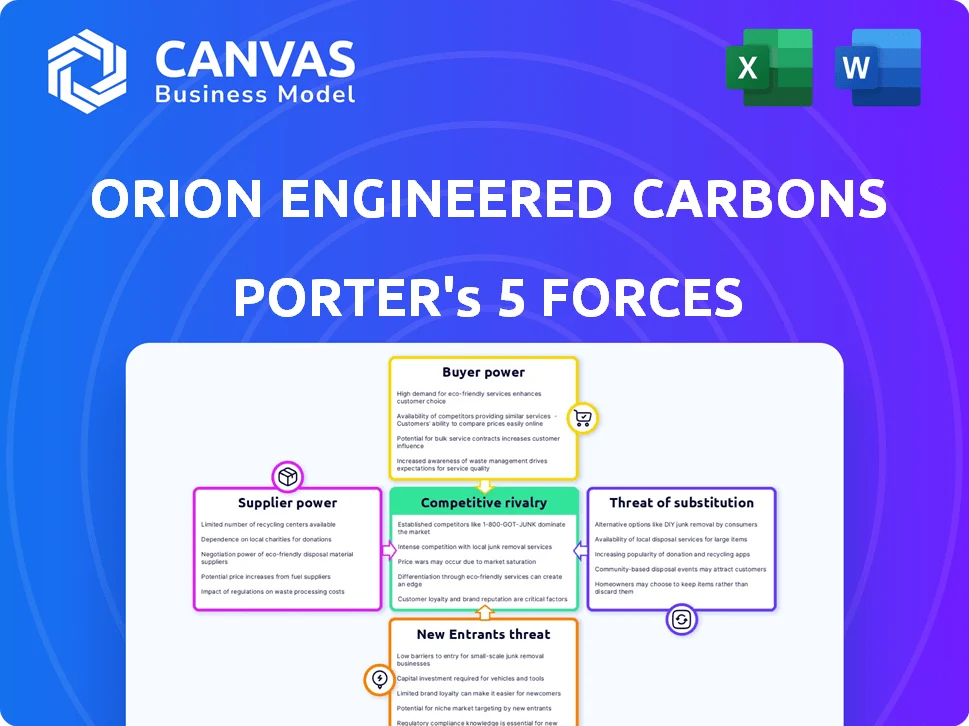
ORION ENGINEERED CARBONS GMBH PORTER'S FIVE FORCES TEMPLATE RESEARCH
What is included in the product
 Detailed Word Document
Detailed analysis of each competitive force, supported by industry data and strategic commentary.

 Customizable Excel Spreadsheet
Designed to pair with the Word report—offering both a deep dive and a high-level executive view.
Full Version Awaits
Orion Engineered Carbons GmbH Porter's Five Forces Analysis
This is the complete Orion Engineered Carbons GmbH Porter's Five Forces analysis. The preview provides the same in-depth, professionally-formatted document the customer receives immediately after purchase. It details industry rivalry, supplier power, buyer power, threat of substitutes, and threat of new entrants. You'll gain instant access to this comprehensive analysis upon completion.

Porter's Five Forces Analysis Template

A Must-Have Tool for Decision-Makers
Orion Engineered Carbons GmbH operates in a market influenced by various forces. Buyer power is moderate due to diverse customers. The threat of new entrants is limited by high capital costs and technology barriers. Supplier power is a key factor, influenced by raw material availability. Competitive rivalry is intense, with several key players. Substitutes pose a moderate threat, especially from alternative materials.
Unlock the full Porter's Five Forces Analysis to explore Orion Engineered Carbons GmbH’s competitive dynamics, market pressures, and strategic advantages in detail.
Suppliers Bargaining Power

Concentrated Raw Material Supply
Orion Engineered Carbons depends on materials like coal tar and FCC slurry oil. These are key in carbon black production. The petroleum industry's volatility affects their prices. Limited suppliers for feedstocks increase their power. In 2024, crude oil prices fluctuated, impacting feedstock costs.
Specialty vs. Standard Feedstocks
The type of carbon black significantly affects supplier power. Specialty carbon black production, demanding specific, high-purity feedstocks, gives suppliers more leverage. For standard grades, widely used in tires, reliance on furnace black oil is critical. In 2024, the global carbon black market was valued at approximately $18 billion. The price of furnace black oil, a key feedstock, fluctuated significantly in 2024, impacting production costs.

Switching Costs for Manufacturers
Orion faces switching costs, mainly in adjusting to different carbon black feedstock. Changing between grades requires technical changes. This gives suppliers, like petrochemical companies, some power.

Development of Alternative Feedstocks
Orion Engineered Carbons is exploring alternative feedstocks to lessen reliance on traditional suppliers. This includes tire pyrolysis oil and bio-based materials. Success here could diminish the power of petrochemical suppliers. The company's shift toward these sources is a strategic move.
- In 2024, the global market for carbon black, a key product for Orion, was valued at approximately $15 billion.
- Orion's investments in sustainable raw materials are growing, with an estimated 5% of its R&D budget allocated to this area in 2024.
- The price of traditional feedstocks, like crude oil, has fluctuated significantly, with a 20% increase in the first half of 2024.
Geopolitical and Regulatory Factors
Geopolitical instability and environmental regulations significantly affect supplier power by altering raw material availability and costs. Suppliers in regions with favorable regulations or stable feedstock access gain a competitive edge. For instance, the price of carbon black feedstock, such as oil, is highly sensitive to global events. Regulations like the EU's REACH can also increase supplier compliance costs.
- Oil prices, a key feedstock cost, fluctuated significantly in 2024 due to geopolitical tensions, impacting carbon black production costs.
- The EU's REACH regulations continue to influence the compliance costs for carbon black suppliers, especially those exporting to Europe.
- Supply chain disruptions in 2024, stemming from geopolitical events, affected the timely delivery of raw materials, increasing supplier leverage.
Supplier Dynamics: Feedstock & Market Influence
Orion's supplier power hinges on feedstock availability and market dynamics. Limited feedstock sources, like coal tar and FCC slurry oil, increase supplier influence. Specialty carbon black production, requiring specific feedstocks, further empowers suppliers. The company's strategic shift to alternative feedstocks, such as tire pyrolysis oil, aims to counter this.
| Aspect | Impact | 2024 Data |
|---|---|---|
| Feedstock Dependence | High, especially for key materials | Crude oil prices increased by 20% in H1 2024 |
| Specialty vs. Standard Grades | Specialty grades give suppliers more leverage | Global carbon black market was $18B in 2024 |
| Strategic Initiatives | Efforts to diversify reduce supplier power | 5% R&D budget allocated to sustainable raw materials in 2024 |
Customers Bargaining Power

Large Tire Manufacturers
The tire industry is a key consumer of carbon black, and it's dominated by a few giants. These large tire manufacturers hold substantial purchasing power. They can influence prices and terms due to the volume of carbon black they buy. In 2024, the top 5 tire companies accounted for over 60% of global tire sales.
Diverse Customer Base in Specialty Markets
Orion Engineered Carbons caters to diverse sectors like coatings and batteries. This spread helps balance customer power. For example, in 2024, the specialty segment accounted for a significant portion of Orion's revenue. It reduces reliance on any single customer.

Customer Concentration in Specific Segments
Within Orion Engineered Carbons, customer concentration varies. In specialized areas like conductive additives for batteries, a few major customers could wield significant bargaining power. For example, the battery market is rapidly growing, with an estimated value of $89.6 billion in 2024. This concentration can influence pricing and terms.

Availability of Multiple Suppliers
Customers in the carbon black market, particularly for standard grades, benefit from numerous global and regional suppliers, enhancing their bargaining power. This widespread availability allows customers to compare offerings and negotiate favorable terms. For instance, in 2024, Orion Engineered Carbons faced competition from approximately 15 major carbon black producers worldwide. The ease of switching suppliers further strengthens customer leverage.
- Competition from global and regional suppliers.
- Ability to switch based on price, quality, and service.
- Orion faced competition from 15 major carbon black producers worldwide in 2024.
Customer Requirements and Customization
Orion Engineered Carbons (OEC) caters to customer demands with customized solutions, especially in specialty carbon black. This approach builds strong customer relationships, potentially lessening price-driven switching. OEC's technical support also aids in customer retention. In 2024, the specialty carbon black market saw a demand increase, showing the value of tailored products.
- Customization: Orion offers tailored carbon black solutions.
- Customer Relationships: Strong relationships reduce switching.
- Technical Support: Orion provides technical assistance.
- Market Data: Specialty carbon black demand grew in 2024.
Tire Giants' Grip: How Buyers Shape Carbon Black's Fate
Customer bargaining power significantly impacts Orion Engineered Carbons. Major tire manufacturers exert considerable influence due to their purchasing volume. The carbon black market's competitive landscape, with about 15 major producers in 2024, strengthens customer leverage.
| Aspect | Impact | 2024 Data |
|---|---|---|
| Customer Concentration | High in tire industry; varies elsewhere | Top 5 tire companies >60% global sales |
| Supplier Competition | High, enhancing customer power | Approx. 15 major carbon black producers |
| Customization | Mitigates price sensitivity | Specialty segment demand grew |
Rivalry Among Competitors

Presence of Major Global Players
The carbon black market features intense competition from giants such as Orion, Cabot, and Birla. These firms battle for market share through pricing, quality, and innovation. Orion's 2024 revenue was approximately $1.8 billion, reflecting its strong global presence. This rivalry impacts profitability and market dynamics.
Market Concentration
The carbon black market is consolidated, with key players like Orion Engineered Carbons holding substantial market share. This concentration fuels fierce competition among these major companies. In 2024, the top five carbon black producers controlled over 60% of the global market. This intense rivalry affects pricing strategies and innovation efforts.

Competition in Specialty vs. Standard Grades
Competition varies significantly between carbon black grades. The standard grade market, driven by tire manufacturing, is highly price-sensitive. Data from 2024 indicates a slight price increase in standard grades. Specialty grades, used in diverse applications, compete on performance and technical solutions. This segment saw an estimated 4% growth in 2024, reflecting a focus on innovation.

Capacity Expansion and Strategic Initiatives
Orion Engineered Carbons GmbH faces intense rivalry as major players expand capacity and pursue strategic moves. These include mergers and acquisitions aimed at boosting market share. Investments in R&D are also crucial. In 2024, the carbon black market saw significant activity, with companies like Birla Carbon increasing their footprint.
- Birla Carbon expanded capacity in India in 2024, increasing production by 10%.
- Cabot Corporation acquired a specialty carbon black business in early 2024.
- Orion invested $50 million in 2024 for sustainable carbon black.
- The global carbon black market is projected to reach $20 billion by 2028.
Regional Market Dynamics
Competitive rivalry also varies regionally, especially with the Asia-Pacific market's dominance. This region is the largest and most dynamic for Orion Engineered Carbons GmbH. Intense competition exists in emerging economies, driven by growing automotive and manufacturing sectors. For example, in 2024, the Asia-Pacific carbon black market accounted for roughly 45% of global consumption.
- Asia-Pacific's market share in 2024 was approximately 45%.
- Competition is fierce in emerging markets due to industrial growth.
- Orion faces strong rivals in key regional markets.
Orion's Competitive Carbon Black Landscape
Orion faces intense competition, with major players like Cabot and Birla battling for market share. The carbon black market is consolidated, and top producers control over 60%. Competition varies across grades, with standard grades being price-sensitive.
| Metric | 2024 Data | Notes |
|---|---|---|
| Orion Revenue | $1.8B | Reflects global presence |
| Market Share Top 5 Producers | >60% | Highly concentrated |
| Asia-Pacific Market Share | ~45% | Dominant region |
Original: $10.00
-65%$10.00
$3.50ORION ENGINEERED CARBONS GMBH PORTER'S FIVE FORCES TEMPLATE RESEARCH
What is included in the product
Detailed Word Document
Detailed analysis of each competitive force, supported by industry data and strategic commentary.
Customizable Excel Spreadsheet
Designed to pair with the Word report—offering both a deep dive and a high-level executive view.
Full Version Awaits
Orion Engineered Carbons GmbH Porter's Five Forces Analysis
This is the complete Orion Engineered Carbons GmbH Porter's Five Forces analysis. The preview provides the same in-depth, professionally-formatted document the customer receives immediately after purchase. It details industry rivalry, supplier power, buyer power, threat of substitutes, and threat of new entrants. You'll gain instant access to this comprehensive analysis upon completion.
Porter's Five Forces Analysis Template
A Must-Have Tool for Decision-Makers
Orion Engineered Carbons GmbH operates in a market influenced by various forces. Buyer power is moderate due to diverse customers. The threat of new entrants is limited by high capital costs and technology barriers. Supplier power is a key factor, influenced by raw material availability. Competitive rivalry is intense, with several key players. Substitutes pose a moderate threat, especially from alternative materials.
Unlock the full Porter's Five Forces Analysis to explore Orion Engineered Carbons GmbH’s competitive dynamics, market pressures, and strategic advantages in detail.
Suppliers Bargaining Power
Concentrated Raw Material Supply
Orion Engineered Carbons depends on materials like coal tar and FCC slurry oil. These are key in carbon black production. The petroleum industry's volatility affects their prices. Limited suppliers for feedstocks increase their power. In 2024, crude oil prices fluctuated, impacting feedstock costs.
Specialty vs. Standard Feedstocks
The type of carbon black significantly affects supplier power. Specialty carbon black production, demanding specific, high-purity feedstocks, gives suppliers more leverage. For standard grades, widely used in tires, reliance on furnace black oil is critical. In 2024, the global carbon black market was valued at approximately $18 billion. The price of furnace black oil, a key feedstock, fluctuated significantly in 2024, impacting production costs.
Switching Costs for Manufacturers
Orion faces switching costs, mainly in adjusting to different carbon black feedstock. Changing between grades requires technical changes. This gives suppliers, like petrochemical companies, some power.
Development of Alternative Feedstocks
Orion Engineered Carbons is exploring alternative feedstocks to lessen reliance on traditional suppliers. This includes tire pyrolysis oil and bio-based materials. Success here could diminish the power of petrochemical suppliers. The company's shift toward these sources is a strategic move.
- In 2024, the global market for carbon black, a key product for Orion, was valued at approximately $15 billion.
- Orion's investments in sustainable raw materials are growing, with an estimated 5% of its R&D budget allocated to this area in 2024.
- The price of traditional feedstocks, like crude oil, has fluctuated significantly, with a 20% increase in the first half of 2024.
Geopolitical and Regulatory Factors
Geopolitical instability and environmental regulations significantly affect supplier power by altering raw material availability and costs. Suppliers in regions with favorable regulations or stable feedstock access gain a competitive edge. For instance, the price of carbon black feedstock, such as oil, is highly sensitive to global events. Regulations like the EU's REACH can also increase supplier compliance costs.
- Oil prices, a key feedstock cost, fluctuated significantly in 2024 due to geopolitical tensions, impacting carbon black production costs.
- The EU's REACH regulations continue to influence the compliance costs for carbon black suppliers, especially those exporting to Europe.
- Supply chain disruptions in 2024, stemming from geopolitical events, affected the timely delivery of raw materials, increasing supplier leverage.
Supplier Dynamics: Feedstock & Market Influence
Orion's supplier power hinges on feedstock availability and market dynamics. Limited feedstock sources, like coal tar and FCC slurry oil, increase supplier influence. Specialty carbon black production, requiring specific feedstocks, further empowers suppliers. The company's strategic shift to alternative feedstocks, such as tire pyrolysis oil, aims to counter this.
| Aspect | Impact | 2024 Data |
|---|---|---|
| Feedstock Dependence | High, especially for key materials | Crude oil prices increased by 20% in H1 2024 |
| Specialty vs. Standard Grades | Specialty grades give suppliers more leverage | Global carbon black market was $18B in 2024 |
| Strategic Initiatives | Efforts to diversify reduce supplier power | 5% R&D budget allocated to sustainable raw materials in 2024 |
Customers Bargaining Power
Large Tire Manufacturers
The tire industry is a key consumer of carbon black, and it's dominated by a few giants. These large tire manufacturers hold substantial purchasing power. They can influence prices and terms due to the volume of carbon black they buy. In 2024, the top 5 tire companies accounted for over 60% of global tire sales.
Diverse Customer Base in Specialty Markets
Orion Engineered Carbons caters to diverse sectors like coatings and batteries. This spread helps balance customer power. For example, in 2024, the specialty segment accounted for a significant portion of Orion's revenue. It reduces reliance on any single customer.
Customer Concentration in Specific Segments
Within Orion Engineered Carbons, customer concentration varies. In specialized areas like conductive additives for batteries, a few major customers could wield significant bargaining power. For example, the battery market is rapidly growing, with an estimated value of $89.6 billion in 2024. This concentration can influence pricing and terms.
Availability of Multiple Suppliers
Customers in the carbon black market, particularly for standard grades, benefit from numerous global and regional suppliers, enhancing their bargaining power. This widespread availability allows customers to compare offerings and negotiate favorable terms. For instance, in 2024, Orion Engineered Carbons faced competition from approximately 15 major carbon black producers worldwide. The ease of switching suppliers further strengthens customer leverage.
- Competition from global and regional suppliers.
- Ability to switch based on price, quality, and service.
- Orion faced competition from 15 major carbon black producers worldwide in 2024.
Customer Requirements and Customization
Orion Engineered Carbons (OEC) caters to customer demands with customized solutions, especially in specialty carbon black. This approach builds strong customer relationships, potentially lessening price-driven switching. OEC's technical support also aids in customer retention. In 2024, the specialty carbon black market saw a demand increase, showing the value of tailored products.
- Customization: Orion offers tailored carbon black solutions.
- Customer Relationships: Strong relationships reduce switching.
- Technical Support: Orion provides technical assistance.
- Market Data: Specialty carbon black demand grew in 2024.
Tire Giants' Grip: How Buyers Shape Carbon Black's Fate
Customer bargaining power significantly impacts Orion Engineered Carbons. Major tire manufacturers exert considerable influence due to their purchasing volume. The carbon black market's competitive landscape, with about 15 major producers in 2024, strengthens customer leverage.
| Aspect | Impact | 2024 Data |
|---|---|---|
| Customer Concentration | High in tire industry; varies elsewhere | Top 5 tire companies >60% global sales |
| Supplier Competition | High, enhancing customer power | Approx. 15 major carbon black producers |
| Customization | Mitigates price sensitivity | Specialty segment demand grew |
Rivalry Among Competitors
Presence of Major Global Players
The carbon black market features intense competition from giants such as Orion, Cabot, and Birla. These firms battle for market share through pricing, quality, and innovation. Orion's 2024 revenue was approximately $1.8 billion, reflecting its strong global presence. This rivalry impacts profitability and market dynamics.
Market Concentration
The carbon black market is consolidated, with key players like Orion Engineered Carbons holding substantial market share. This concentration fuels fierce competition among these major companies. In 2024, the top five carbon black producers controlled over 60% of the global market. This intense rivalry affects pricing strategies and innovation efforts.
Competition in Specialty vs. Standard Grades
Competition varies significantly between carbon black grades. The standard grade market, driven by tire manufacturing, is highly price-sensitive. Data from 2024 indicates a slight price increase in standard grades. Specialty grades, used in diverse applications, compete on performance and technical solutions. This segment saw an estimated 4% growth in 2024, reflecting a focus on innovation.
Capacity Expansion and Strategic Initiatives
Orion Engineered Carbons GmbH faces intense rivalry as major players expand capacity and pursue strategic moves. These include mergers and acquisitions aimed at boosting market share. Investments in R&D are also crucial. In 2024, the carbon black market saw significant activity, with companies like Birla Carbon increasing their footprint.
- Birla Carbon expanded capacity in India in 2024, increasing production by 10%.
- Cabot Corporation acquired a specialty carbon black business in early 2024.
- Orion invested $50 million in 2024 for sustainable carbon black.
- The global carbon black market is projected to reach $20 billion by 2028.
Regional Market Dynamics
Competitive rivalry also varies regionally, especially with the Asia-Pacific market's dominance. This region is the largest and most dynamic for Orion Engineered Carbons GmbH. Intense competition exists in emerging economies, driven by growing automotive and manufacturing sectors. For example, in 2024, the Asia-Pacific carbon black market accounted for roughly 45% of global consumption.
- Asia-Pacific's market share in 2024 was approximately 45%.
- Competition is fierce in emerging markets due to industrial growth.
- Orion faces strong rivals in key regional markets.
Orion's Competitive Carbon Black Landscape
Orion faces intense competition, with major players like Cabot and Birla battling for market share. The carbon black market is consolidated, and top producers control over 60%. Competition varies across grades, with standard grades being price-sensitive.
| Metric | 2024 Data | Notes |
|---|---|---|
| Orion Revenue | $1.8B | Reflects global presence |
| Market Share Top 5 Producers | >60% | Highly concentrated |
| Asia-Pacific Market Share | ~45% | Dominant region |
Product Information
Product Information
Shipping & Returns
Shipping & Returns
Description
What is included in the product
Detailed Word Document
Detailed analysis of each competitive force, supported by industry data and strategic commentary.
Customizable Excel Spreadsheet
Designed to pair with the Word report—offering both a deep dive and a high-level executive view.
Full Version Awaits
Orion Engineered Carbons GmbH Porter's Five Forces Analysis
This is the complete Orion Engineered Carbons GmbH Porter's Five Forces analysis. The preview provides the same in-depth, professionally-formatted document the customer receives immediately after purchase. It details industry rivalry, supplier power, buyer power, threat of substitutes, and threat of new entrants. You'll gain instant access to this comprehensive analysis upon completion.
Porter's Five Forces Analysis Template
A Must-Have Tool for Decision-Makers
Orion Engineered Carbons GmbH operates in a market influenced by various forces. Buyer power is moderate due to diverse customers. The threat of new entrants is limited by high capital costs and technology barriers. Supplier power is a key factor, influenced by raw material availability. Competitive rivalry is intense, with several key players. Substitutes pose a moderate threat, especially from alternative materials.
Unlock the full Porter's Five Forces Analysis to explore Orion Engineered Carbons GmbH’s competitive dynamics, market pressures, and strategic advantages in detail.
Suppliers Bargaining Power
Concentrated Raw Material Supply
Orion Engineered Carbons depends on materials like coal tar and FCC slurry oil. These are key in carbon black production. The petroleum industry's volatility affects their prices. Limited suppliers for feedstocks increase their power. In 2024, crude oil prices fluctuated, impacting feedstock costs.
Specialty vs. Standard Feedstocks
The type of carbon black significantly affects supplier power. Specialty carbon black production, demanding specific, high-purity feedstocks, gives suppliers more leverage. For standard grades, widely used in tires, reliance on furnace black oil is critical. In 2024, the global carbon black market was valued at approximately $18 billion. The price of furnace black oil, a key feedstock, fluctuated significantly in 2024, impacting production costs.
Switching Costs for Manufacturers
Orion faces switching costs, mainly in adjusting to different carbon black feedstock. Changing between grades requires technical changes. This gives suppliers, like petrochemical companies, some power.
Development of Alternative Feedstocks
Orion Engineered Carbons is exploring alternative feedstocks to lessen reliance on traditional suppliers. This includes tire pyrolysis oil and bio-based materials. Success here could diminish the power of petrochemical suppliers. The company's shift toward these sources is a strategic move.
- In 2024, the global market for carbon black, a key product for Orion, was valued at approximately $15 billion.
- Orion's investments in sustainable raw materials are growing, with an estimated 5% of its R&D budget allocated to this area in 2024.
- The price of traditional feedstocks, like crude oil, has fluctuated significantly, with a 20% increase in the first half of 2024.
Geopolitical and Regulatory Factors
Geopolitical instability and environmental regulations significantly affect supplier power by altering raw material availability and costs. Suppliers in regions with favorable regulations or stable feedstock access gain a competitive edge. For instance, the price of carbon black feedstock, such as oil, is highly sensitive to global events. Regulations like the EU's REACH can also increase supplier compliance costs.
- Oil prices, a key feedstock cost, fluctuated significantly in 2024 due to geopolitical tensions, impacting carbon black production costs.
- The EU's REACH regulations continue to influence the compliance costs for carbon black suppliers, especially those exporting to Europe.
- Supply chain disruptions in 2024, stemming from geopolitical events, affected the timely delivery of raw materials, increasing supplier leverage.
Supplier Dynamics: Feedstock & Market Influence
Orion's supplier power hinges on feedstock availability and market dynamics. Limited feedstock sources, like coal tar and FCC slurry oil, increase supplier influence. Specialty carbon black production, requiring specific feedstocks, further empowers suppliers. The company's strategic shift to alternative feedstocks, such as tire pyrolysis oil, aims to counter this.
| Aspect | Impact | 2024 Data |
|---|---|---|
| Feedstock Dependence | High, especially for key materials | Crude oil prices increased by 20% in H1 2024 |
| Specialty vs. Standard Grades | Specialty grades give suppliers more leverage | Global carbon black market was $18B in 2024 |
| Strategic Initiatives | Efforts to diversify reduce supplier power | 5% R&D budget allocated to sustainable raw materials in 2024 |
Customers Bargaining Power
Large Tire Manufacturers
The tire industry is a key consumer of carbon black, and it's dominated by a few giants. These large tire manufacturers hold substantial purchasing power. They can influence prices and terms due to the volume of carbon black they buy. In 2024, the top 5 tire companies accounted for over 60% of global tire sales.
Diverse Customer Base in Specialty Markets
Orion Engineered Carbons caters to diverse sectors like coatings and batteries. This spread helps balance customer power. For example, in 2024, the specialty segment accounted for a significant portion of Orion's revenue. It reduces reliance on any single customer.
Customer Concentration in Specific Segments
Within Orion Engineered Carbons, customer concentration varies. In specialized areas like conductive additives for batteries, a few major customers could wield significant bargaining power. For example, the battery market is rapidly growing, with an estimated value of $89.6 billion in 2024. This concentration can influence pricing and terms.
Availability of Multiple Suppliers
Customers in the carbon black market, particularly for standard grades, benefit from numerous global and regional suppliers, enhancing their bargaining power. This widespread availability allows customers to compare offerings and negotiate favorable terms. For instance, in 2024, Orion Engineered Carbons faced competition from approximately 15 major carbon black producers worldwide. The ease of switching suppliers further strengthens customer leverage.
- Competition from global and regional suppliers.
- Ability to switch based on price, quality, and service.
- Orion faced competition from 15 major carbon black producers worldwide in 2024.
Customer Requirements and Customization
Orion Engineered Carbons (OEC) caters to customer demands with customized solutions, especially in specialty carbon black. This approach builds strong customer relationships, potentially lessening price-driven switching. OEC's technical support also aids in customer retention. In 2024, the specialty carbon black market saw a demand increase, showing the value of tailored products.
- Customization: Orion offers tailored carbon black solutions.
- Customer Relationships: Strong relationships reduce switching.
- Technical Support: Orion provides technical assistance.
- Market Data: Specialty carbon black demand grew in 2024.
Tire Giants' Grip: How Buyers Shape Carbon Black's Fate
Customer bargaining power significantly impacts Orion Engineered Carbons. Major tire manufacturers exert considerable influence due to their purchasing volume. The carbon black market's competitive landscape, with about 15 major producers in 2024, strengthens customer leverage.
| Aspect | Impact | 2024 Data |
|---|---|---|
| Customer Concentration | High in tire industry; varies elsewhere | Top 5 tire companies >60% global sales |
| Supplier Competition | High, enhancing customer power | Approx. 15 major carbon black producers |
| Customization | Mitigates price sensitivity | Specialty segment demand grew |
Rivalry Among Competitors
Presence of Major Global Players
The carbon black market features intense competition from giants such as Orion, Cabot, and Birla. These firms battle for market share through pricing, quality, and innovation. Orion's 2024 revenue was approximately $1.8 billion, reflecting its strong global presence. This rivalry impacts profitability and market dynamics.
Market Concentration
The carbon black market is consolidated, with key players like Orion Engineered Carbons holding substantial market share. This concentration fuels fierce competition among these major companies. In 2024, the top five carbon black producers controlled over 60% of the global market. This intense rivalry affects pricing strategies and innovation efforts.
Competition in Specialty vs. Standard Grades
Competition varies significantly between carbon black grades. The standard grade market, driven by tire manufacturing, is highly price-sensitive. Data from 2024 indicates a slight price increase in standard grades. Specialty grades, used in diverse applications, compete on performance and technical solutions. This segment saw an estimated 4% growth in 2024, reflecting a focus on innovation.
Capacity Expansion and Strategic Initiatives
Orion Engineered Carbons GmbH faces intense rivalry as major players expand capacity and pursue strategic moves. These include mergers and acquisitions aimed at boosting market share. Investments in R&D are also crucial. In 2024, the carbon black market saw significant activity, with companies like Birla Carbon increasing their footprint.
- Birla Carbon expanded capacity in India in 2024, increasing production by 10%.
- Cabot Corporation acquired a specialty carbon black business in early 2024.
- Orion invested $50 million in 2024 for sustainable carbon black.
- The global carbon black market is projected to reach $20 billion by 2028.
Regional Market Dynamics
Competitive rivalry also varies regionally, especially with the Asia-Pacific market's dominance. This region is the largest and most dynamic for Orion Engineered Carbons GmbH. Intense competition exists in emerging economies, driven by growing automotive and manufacturing sectors. For example, in 2024, the Asia-Pacific carbon black market accounted for roughly 45% of global consumption.
- Asia-Pacific's market share in 2024 was approximately 45%.
- Competition is fierce in emerging markets due to industrial growth.
- Orion faces strong rivals in key regional markets.
Orion's Competitive Carbon Black Landscape
Orion faces intense competition, with major players like Cabot and Birla battling for market share. The carbon black market is consolidated, and top producers control over 60%. Competition varies across grades, with standard grades being price-sensitive.
| Metric | 2024 Data | Notes |
|---|---|---|
| Orion Revenue | $1.8B | Reflects global presence |
| Market Share Top 5 Producers | >60% | Highly concentrated |
| Asia-Pacific Market Share | ~45% | Dominant region |


