
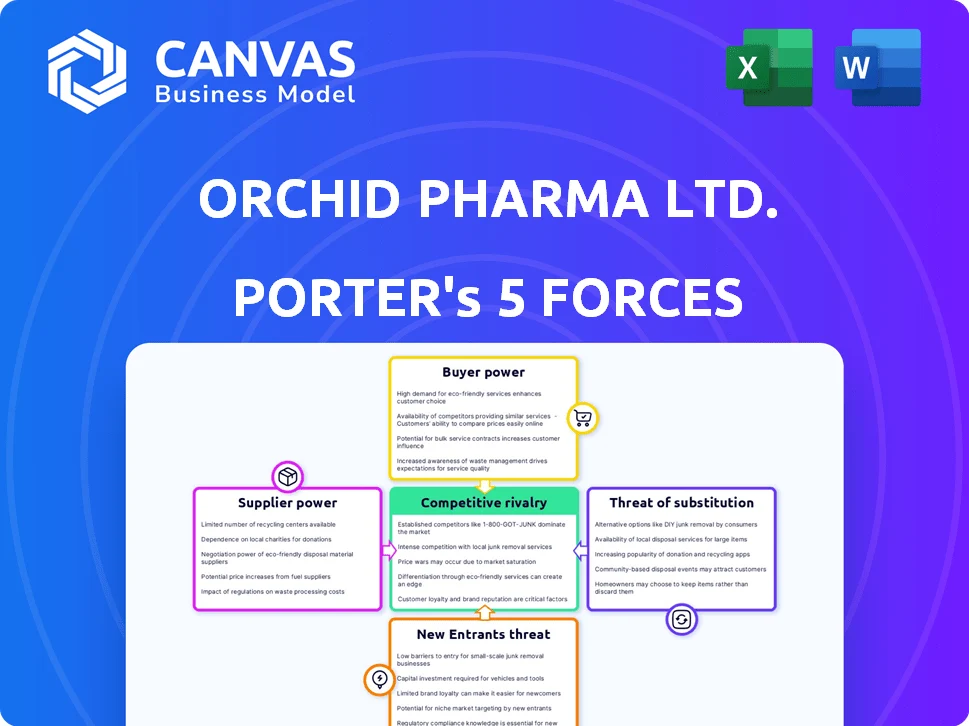
ORCHID PHARMA LTD. PORTER'S FIVE FORCES TEMPLATE RESEARCH
What is included in the product
 Detailed Word Document
Tailored exclusively for Orchid Pharma Ltd., analyzing its position within its competitive landscape.

 Customizable Excel Spreadsheet
Customize pressure levels based on new data or evolving market trends.
Same Document Delivered
Orchid Pharma Ltd. Porter's Five Forces Analysis
This document contains a thorough Porter's Five Forces analysis of Orchid Pharma Ltd. It examines competitive rivalry, supplier power, buyer power, the threat of new entrants, and the threat of substitutes. The comprehensive assessment of these forces provides valuable insights into the company's industry positioning. You will receive the complete analysis in the document you are previewing. It's ready for immediate use after purchase.

Porter's Five Forces Analysis Template

Go Beyond the Preview—Access the Full Strategic Report
Orchid Pharma Ltd. operates in a dynamic pharmaceutical market. Supplier power impacts costs, especially for APIs. Buyer power, driven by generic competition, influences pricing. The threat of new entrants is moderate, but established players hold advantages. Substitute products pose a risk, particularly from innovative therapies. Competitive rivalry is intense, shaped by market share battles and regulatory hurdles.
This brief snapshot only scratches the surface. Unlock the full Porter's Five Forces Analysis to explore Orchid Pharma Ltd.’s competitive dynamics, market pressures, and strategic advantages in detail.
Suppliers Bargaining Power

Concentration of Suppliers
If Orchid Pharma relies on a few suppliers for raw materials or APIs, those suppliers gain leverage. This is crucial for specialized or patented inputs, where alternatives are scarce. Orchid Pharma sourced key starting materials from China, potentially increasing supplier power. In 2024, API imports from China were valued at $2.5 billion, highlighting dependence.
Switching Costs
Switching costs significantly influence Orchid Pharma's supplier power. High costs, due to specialized equipment or regulatory demands, strengthen suppliers' positions. Changing API suppliers in pharma involves extensive validation processes. For instance, in 2024, API validation could take up to 6-12 months. This gives suppliers more power.

Threat of Forward Integration
Suppliers' bargaining power rises if they can forward integrate, becoming competitors. This is especially relevant in pharma, where chemical companies could make drugs. Consider the possibility that a key raw material supplier, could start producing generic versions of Orchid Pharma's drugs. This move would directly challenge Orchid Pharma's market position. For example, a major API supplier could leverage its existing infrastructure to manufacture finished drug formulations, reducing Orchid Pharma's market share and profitability. In 2024, the API market was valued at $185 billion, showing supplier influence.

Uniqueness of Inputs
The uniqueness of inputs, such as raw materials and APIs, significantly impacts supplier bargaining power. Suppliers with patented or specialized ingredients, like some APIs, hold considerable leverage. Orchid Pharma's specialization in specific therapeutic areas and APIs likely involves some unique inputs. This can affect cost structures and negotiation dynamics.
- Orchid Pharma's revenue for FY2023 was approximately ₹760 crore.
- The company's focus on niche APIs suggests reliance on specific suppliers.
- High-quality APIs with limited suppliers increase supplier power.
Supplier's Contribution to Quality and Cost
Suppliers' bargaining power affects Orchid Pharma's costs and quality. If suppliers' inputs greatly influence the final product, they gain power. In pharma, API quality is crucial for efficacy and safety. Orchid Pharma must manage supplier relationships to control costs and maintain quality.
- API prices can significantly impact a pharmaceutical company's cost of goods sold (COGS).
- The regulatory environment, such as FDA inspections and approvals, also influences supplier power.
- Orchid Pharma's ability to switch suppliers and the availability of alternative sources of APIs are key factors.
- In 2024, the global API market was valued at approximately $180 billion.
Supplier Power Dynamics: A Pharma Perspective
Orchid Pharma faces supplier power challenges, especially with critical raw materials like APIs, where alternatives may be limited. High switching costs, due to validation processes, also strengthen suppliers. In 2024, the API market was valued at $180 billion, which gives an idea of the supplier power.
| Factor | Impact on Orchid Pharma | 2024 Data/Example |
|---|---|---|
| API Dependency | High supplier power | $2.5B API imports from China |
| Switching Costs | Increases supplier leverage | API validation: 6-12 months |
| Market Size | Supplier market influence | Global API market: $180B |
Customers Bargaining Power

Concentration of Customers
Orchid Pharma's bargaining power from customers is influenced by customer concentration. If a few large buyers dominate sales, they can pressure prices and terms. In 2024, institutional sales made up a significant portion of pharmaceutical revenue. Targeting hospitals and large pharmacy chains can amplify this power dynamic.
Price Sensitivity of Customers
The bargaining power of Orchid Pharma's customers is influenced by their price sensitivity. In 2024, factors like insurance coverage and availability of generics impact this. India's Drug Price Control Order significantly affects pricing, impacting the company. These dynamics shape customer influence in the market.

Customer Information and Awareness
Customers with access to information on alternatives and pricing can wield more power. In 2024, the rise of online pharmacies and price comparison tools has increased customer awareness. This enables them to negotiate better deals. The availability of generic drugs and international pricing data further boosts customer bargaining power. This can affect Orchid Pharma Ltd.'s profitability.

Availability of Substitute Products
The availability of substitute products significantly impacts customer bargaining power for Orchid Pharma. Customers can opt for alternative treatments if Orchid Pharma's offerings become too expensive or less effective. This competitive landscape forces Orchid Pharma to maintain competitive pricing and continuously innovate to retain its customer base. For instance, in 2024, the global antibiotics market faced strong competition, with various generic alternatives available, affecting pricing strategies.
- Market competition from generic drugs.
- Customer access to alternative treatments.
- Impact on pricing and profitability.
- Need for continuous innovation.
Customers' Threat of Backward Integration
Customers' threat of backward integration can reduce bargaining power. This threat is less common for individual patients but more relevant to large entities. Hospital groups or government bodies could produce their own drugs or source APIs. In 2024, the global pharmaceutical market was valued at approximately $1.5 trillion. Such integration could significantly impact Orchid Pharma Ltd.
- Large hospital groups could seek to produce their own drugs.
- Government entities might consider sourcing APIs directly.
- This reduces reliance on Orchid Pharma's products.
- Market dynamics can shift with such integrations.
Customer Power Dynamics in 2024
Customer bargaining power for Orchid Pharma is shaped by market dynamics and access to alternatives. Price sensitivity, influenced by insurance and generics, affects their influence. The rise of online pharmacies and price comparison tools in 2024 increased customer awareness, influencing pricing.
Substitute product availability, like generic drugs, also empowers customers to seek alternatives. The threat of backward integration by large buyers, such as hospitals, further reduces Orchid Pharma's pricing power. These factors collectively impact Orchid Pharma's profitability and market competitiveness.
| Factor | Impact | 2024 Data |
|---|---|---|
| Customer Concentration | High concentration = High power | Institutional sales: Significant portion of revenue |
| Price Sensitivity | High sensitivity = High power | Insurance coverage, generics availability |
| Information Access | More info = High power | Online pharmacies, price comparison tools |
Rivalry Among Competitors

Industry Fragmentation and Number of Competitors
The Indian pharma market is highly fragmented, intensifying competition among numerous players. Orchid Pharma competes in diverse therapeutic areas, facing rivals of all sizes. In 2024, the Indian pharmaceutical market reached $50 billion, with over 3,000 companies. This fragmentation leads to pricing pressures and innovation challenges for Orchid Pharma.
Industry Growth Rate
The pharmaceutical market's growth rate significantly impacts competitive rivalry. High-growth areas often see less intense competition due to ample market opportunities. Conversely, slow-growing segments foster fierce battles for market share. In 2024, the global pharma market is projected to grow, but competition remains intense. Orchid Pharma Ltd. will experience this dynamic. The industry's growth influences Orchid's strategic decisions.

Product Differentiation
Product differentiation in pharmaceuticals significantly influences competitive rivalry. Patented drugs, offering unique benefits, encounter less direct competition compared to generic drugs. Orchid Pharma's portfolio, encompassing APIs and finished dosages, including innovative compounds like Enmetazobactam, affects its competitive positioning. For instance, in 2024, the global market for novel antibiotics, where Enmetazobactam competes, was valued at approximately $5 billion, highlighting the stakes.

Exit Barriers
High exit barriers, like specialized facilities and regulatory hurdles, are significant for Orchid Pharma. These barriers, coupled with the need for ongoing R&D investments, can keep underperforming companies in the market. This intensifies competition within the pharmaceutical industry. For example, the average cost to bring a new drug to market can exceed $2 billion, demonstrating the investment required.
- Specialized manufacturing facilities require significant capital.
- Regulatory obligations, such as FDA approvals, are costly and time-consuming.
- Long-term R&D investments tie up capital for years.
- These factors make it difficult for companies to exit, increasing rivalry.
Diversity of Competitors
Orchid Pharma faces varied competitors, impacting rivalry dynamics. These range from global giants to niche firms. This diversity affects competition strategies and market share battles. In 2024, the Indian pharma market, where Orchid operates, saw intense rivalry.
- Market size in India reached $50 billion in 2024.
- Top 10 companies hold about 60% of the market.
- Orchid Pharma's revenue in 2024 was approximately $250 million.
- Competition is fierce due to price wars and product innovation.
Pharma Market Dynamics: Competition Factors
Competitive rivalry in the pharma market is fierce, influenced by fragmentation and growth rates. Product differentiation, like patented drugs, impacts the intensity of competition. High exit barriers, such as specialized facilities and regulatory hurdles, also contribute to rivalry.
| Factor | Impact on Rivalry | Example (2024) |
|---|---|---|
| Market Fragmentation | Intensifies competition | Over 3,000 pharma companies in India |
| Market Growth | Influences competitive intensity | Indian market: $50B, Global market: projected growth |
| Product Differentiation | Affects competition | Novel antibiotics market ~$5B |
Original: $10.00
-65%$10.00
$3.50ORCHID PHARMA LTD. PORTER'S FIVE FORCES TEMPLATE RESEARCH
What is included in the product
Detailed Word Document
Tailored exclusively for Orchid Pharma Ltd., analyzing its position within its competitive landscape.
Customizable Excel Spreadsheet
Customize pressure levels based on new data or evolving market trends.
Same Document Delivered
Orchid Pharma Ltd. Porter's Five Forces Analysis
This document contains a thorough Porter's Five Forces analysis of Orchid Pharma Ltd. It examines competitive rivalry, supplier power, buyer power, the threat of new entrants, and the threat of substitutes. The comprehensive assessment of these forces provides valuable insights into the company's industry positioning. You will receive the complete analysis in the document you are previewing. It's ready for immediate use after purchase.
Porter's Five Forces Analysis Template
Go Beyond the Preview—Access the Full Strategic Report
Orchid Pharma Ltd. operates in a dynamic pharmaceutical market. Supplier power impacts costs, especially for APIs. Buyer power, driven by generic competition, influences pricing. The threat of new entrants is moderate, but established players hold advantages. Substitute products pose a risk, particularly from innovative therapies. Competitive rivalry is intense, shaped by market share battles and regulatory hurdles.
This brief snapshot only scratches the surface. Unlock the full Porter's Five Forces Analysis to explore Orchid Pharma Ltd.’s competitive dynamics, market pressures, and strategic advantages in detail.
Suppliers Bargaining Power
Concentration of Suppliers
If Orchid Pharma relies on a few suppliers for raw materials or APIs, those suppliers gain leverage. This is crucial for specialized or patented inputs, where alternatives are scarce. Orchid Pharma sourced key starting materials from China, potentially increasing supplier power. In 2024, API imports from China were valued at $2.5 billion, highlighting dependence.
Switching Costs
Switching costs significantly influence Orchid Pharma's supplier power. High costs, due to specialized equipment or regulatory demands, strengthen suppliers' positions. Changing API suppliers in pharma involves extensive validation processes. For instance, in 2024, API validation could take up to 6-12 months. This gives suppliers more power.
Threat of Forward Integration
Suppliers' bargaining power rises if they can forward integrate, becoming competitors. This is especially relevant in pharma, where chemical companies could make drugs. Consider the possibility that a key raw material supplier, could start producing generic versions of Orchid Pharma's drugs. This move would directly challenge Orchid Pharma's market position. For example, a major API supplier could leverage its existing infrastructure to manufacture finished drug formulations, reducing Orchid Pharma's market share and profitability. In 2024, the API market was valued at $185 billion, showing supplier influence.
Uniqueness of Inputs
The uniqueness of inputs, such as raw materials and APIs, significantly impacts supplier bargaining power. Suppliers with patented or specialized ingredients, like some APIs, hold considerable leverage. Orchid Pharma's specialization in specific therapeutic areas and APIs likely involves some unique inputs. This can affect cost structures and negotiation dynamics.
- Orchid Pharma's revenue for FY2023 was approximately ₹760 crore.
- The company's focus on niche APIs suggests reliance on specific suppliers.
- High-quality APIs with limited suppliers increase supplier power.
Supplier's Contribution to Quality and Cost
Suppliers' bargaining power affects Orchid Pharma's costs and quality. If suppliers' inputs greatly influence the final product, they gain power. In pharma, API quality is crucial for efficacy and safety. Orchid Pharma must manage supplier relationships to control costs and maintain quality.
- API prices can significantly impact a pharmaceutical company's cost of goods sold (COGS).
- The regulatory environment, such as FDA inspections and approvals, also influences supplier power.
- Orchid Pharma's ability to switch suppliers and the availability of alternative sources of APIs are key factors.
- In 2024, the global API market was valued at approximately $180 billion.
Supplier Power Dynamics: A Pharma Perspective
Orchid Pharma faces supplier power challenges, especially with critical raw materials like APIs, where alternatives may be limited. High switching costs, due to validation processes, also strengthen suppliers. In 2024, the API market was valued at $180 billion, which gives an idea of the supplier power.
| Factor | Impact on Orchid Pharma | 2024 Data/Example |
|---|---|---|
| API Dependency | High supplier power | $2.5B API imports from China |
| Switching Costs | Increases supplier leverage | API validation: 6-12 months |
| Market Size | Supplier market influence | Global API market: $180B |
Customers Bargaining Power
Concentration of Customers
Orchid Pharma's bargaining power from customers is influenced by customer concentration. If a few large buyers dominate sales, they can pressure prices and terms. In 2024, institutional sales made up a significant portion of pharmaceutical revenue. Targeting hospitals and large pharmacy chains can amplify this power dynamic.
Price Sensitivity of Customers
The bargaining power of Orchid Pharma's customers is influenced by their price sensitivity. In 2024, factors like insurance coverage and availability of generics impact this. India's Drug Price Control Order significantly affects pricing, impacting the company. These dynamics shape customer influence in the market.
Customer Information and Awareness
Customers with access to information on alternatives and pricing can wield more power. In 2024, the rise of online pharmacies and price comparison tools has increased customer awareness. This enables them to negotiate better deals. The availability of generic drugs and international pricing data further boosts customer bargaining power. This can affect Orchid Pharma Ltd.'s profitability.
Availability of Substitute Products
The availability of substitute products significantly impacts customer bargaining power for Orchid Pharma. Customers can opt for alternative treatments if Orchid Pharma's offerings become too expensive or less effective. This competitive landscape forces Orchid Pharma to maintain competitive pricing and continuously innovate to retain its customer base. For instance, in 2024, the global antibiotics market faced strong competition, with various generic alternatives available, affecting pricing strategies.
- Market competition from generic drugs.
- Customer access to alternative treatments.
- Impact on pricing and profitability.
- Need for continuous innovation.
Customers' Threat of Backward Integration
Customers' threat of backward integration can reduce bargaining power. This threat is less common for individual patients but more relevant to large entities. Hospital groups or government bodies could produce their own drugs or source APIs. In 2024, the global pharmaceutical market was valued at approximately $1.5 trillion. Such integration could significantly impact Orchid Pharma Ltd.
- Large hospital groups could seek to produce their own drugs.
- Government entities might consider sourcing APIs directly.
- This reduces reliance on Orchid Pharma's products.
- Market dynamics can shift with such integrations.
Customer Power Dynamics in 2024
Customer bargaining power for Orchid Pharma is shaped by market dynamics and access to alternatives. Price sensitivity, influenced by insurance and generics, affects their influence. The rise of online pharmacies and price comparison tools in 2024 increased customer awareness, influencing pricing.
Substitute product availability, like generic drugs, also empowers customers to seek alternatives. The threat of backward integration by large buyers, such as hospitals, further reduces Orchid Pharma's pricing power. These factors collectively impact Orchid Pharma's profitability and market competitiveness.
| Factor | Impact | 2024 Data |
|---|---|---|
| Customer Concentration | High concentration = High power | Institutional sales: Significant portion of revenue |
| Price Sensitivity | High sensitivity = High power | Insurance coverage, generics availability |
| Information Access | More info = High power | Online pharmacies, price comparison tools |
Rivalry Among Competitors
Industry Fragmentation and Number of Competitors
The Indian pharma market is highly fragmented, intensifying competition among numerous players. Orchid Pharma competes in diverse therapeutic areas, facing rivals of all sizes. In 2024, the Indian pharmaceutical market reached $50 billion, with over 3,000 companies. This fragmentation leads to pricing pressures and innovation challenges for Orchid Pharma.
Industry Growth Rate
The pharmaceutical market's growth rate significantly impacts competitive rivalry. High-growth areas often see less intense competition due to ample market opportunities. Conversely, slow-growing segments foster fierce battles for market share. In 2024, the global pharma market is projected to grow, but competition remains intense. Orchid Pharma Ltd. will experience this dynamic. The industry's growth influences Orchid's strategic decisions.
Product Differentiation
Product differentiation in pharmaceuticals significantly influences competitive rivalry. Patented drugs, offering unique benefits, encounter less direct competition compared to generic drugs. Orchid Pharma's portfolio, encompassing APIs and finished dosages, including innovative compounds like Enmetazobactam, affects its competitive positioning. For instance, in 2024, the global market for novel antibiotics, where Enmetazobactam competes, was valued at approximately $5 billion, highlighting the stakes.
Exit Barriers
High exit barriers, like specialized facilities and regulatory hurdles, are significant for Orchid Pharma. These barriers, coupled with the need for ongoing R&D investments, can keep underperforming companies in the market. This intensifies competition within the pharmaceutical industry. For example, the average cost to bring a new drug to market can exceed $2 billion, demonstrating the investment required.
- Specialized manufacturing facilities require significant capital.
- Regulatory obligations, such as FDA approvals, are costly and time-consuming.
- Long-term R&D investments tie up capital for years.
- These factors make it difficult for companies to exit, increasing rivalry.
Diversity of Competitors
Orchid Pharma faces varied competitors, impacting rivalry dynamics. These range from global giants to niche firms. This diversity affects competition strategies and market share battles. In 2024, the Indian pharma market, where Orchid operates, saw intense rivalry.
- Market size in India reached $50 billion in 2024.
- Top 10 companies hold about 60% of the market.
- Orchid Pharma's revenue in 2024 was approximately $250 million.
- Competition is fierce due to price wars and product innovation.
Pharma Market Dynamics: Competition Factors
Competitive rivalry in the pharma market is fierce, influenced by fragmentation and growth rates. Product differentiation, like patented drugs, impacts the intensity of competition. High exit barriers, such as specialized facilities and regulatory hurdles, also contribute to rivalry.
| Factor | Impact on Rivalry | Example (2024) |
|---|---|---|
| Market Fragmentation | Intensifies competition | Over 3,000 pharma companies in India |
| Market Growth | Influences competitive intensity | Indian market: $50B, Global market: projected growth |
| Product Differentiation | Affects competition | Novel antibiotics market ~$5B |
Product Information
Product Information
Shipping & Returns
Shipping & Returns
Description
What is included in the product
Detailed Word Document
Tailored exclusively for Orchid Pharma Ltd., analyzing its position within its competitive landscape.
Customizable Excel Spreadsheet
Customize pressure levels based on new data or evolving market trends.
Same Document Delivered
Orchid Pharma Ltd. Porter's Five Forces Analysis
This document contains a thorough Porter's Five Forces analysis of Orchid Pharma Ltd. It examines competitive rivalry, supplier power, buyer power, the threat of new entrants, and the threat of substitutes. The comprehensive assessment of these forces provides valuable insights into the company's industry positioning. You will receive the complete analysis in the document you are previewing. It's ready for immediate use after purchase.
Porter's Five Forces Analysis Template
Go Beyond the Preview—Access the Full Strategic Report
Orchid Pharma Ltd. operates in a dynamic pharmaceutical market. Supplier power impacts costs, especially for APIs. Buyer power, driven by generic competition, influences pricing. The threat of new entrants is moderate, but established players hold advantages. Substitute products pose a risk, particularly from innovative therapies. Competitive rivalry is intense, shaped by market share battles and regulatory hurdles.
This brief snapshot only scratches the surface. Unlock the full Porter's Five Forces Analysis to explore Orchid Pharma Ltd.’s competitive dynamics, market pressures, and strategic advantages in detail.
Suppliers Bargaining Power
Concentration of Suppliers
If Orchid Pharma relies on a few suppliers for raw materials or APIs, those suppliers gain leverage. This is crucial for specialized or patented inputs, where alternatives are scarce. Orchid Pharma sourced key starting materials from China, potentially increasing supplier power. In 2024, API imports from China were valued at $2.5 billion, highlighting dependence.
Switching Costs
Switching costs significantly influence Orchid Pharma's supplier power. High costs, due to specialized equipment or regulatory demands, strengthen suppliers' positions. Changing API suppliers in pharma involves extensive validation processes. For instance, in 2024, API validation could take up to 6-12 months. This gives suppliers more power.
Threat of Forward Integration
Suppliers' bargaining power rises if they can forward integrate, becoming competitors. This is especially relevant in pharma, where chemical companies could make drugs. Consider the possibility that a key raw material supplier, could start producing generic versions of Orchid Pharma's drugs. This move would directly challenge Orchid Pharma's market position. For example, a major API supplier could leverage its existing infrastructure to manufacture finished drug formulations, reducing Orchid Pharma's market share and profitability. In 2024, the API market was valued at $185 billion, showing supplier influence.
Uniqueness of Inputs
The uniqueness of inputs, such as raw materials and APIs, significantly impacts supplier bargaining power. Suppliers with patented or specialized ingredients, like some APIs, hold considerable leverage. Orchid Pharma's specialization in specific therapeutic areas and APIs likely involves some unique inputs. This can affect cost structures and negotiation dynamics.
- Orchid Pharma's revenue for FY2023 was approximately ₹760 crore.
- The company's focus on niche APIs suggests reliance on specific suppliers.
- High-quality APIs with limited suppliers increase supplier power.
Supplier's Contribution to Quality and Cost
Suppliers' bargaining power affects Orchid Pharma's costs and quality. If suppliers' inputs greatly influence the final product, they gain power. In pharma, API quality is crucial for efficacy and safety. Orchid Pharma must manage supplier relationships to control costs and maintain quality.
- API prices can significantly impact a pharmaceutical company's cost of goods sold (COGS).
- The regulatory environment, such as FDA inspections and approvals, also influences supplier power.
- Orchid Pharma's ability to switch suppliers and the availability of alternative sources of APIs are key factors.
- In 2024, the global API market was valued at approximately $180 billion.
Supplier Power Dynamics: A Pharma Perspective
Orchid Pharma faces supplier power challenges, especially with critical raw materials like APIs, where alternatives may be limited. High switching costs, due to validation processes, also strengthen suppliers. In 2024, the API market was valued at $180 billion, which gives an idea of the supplier power.
| Factor | Impact on Orchid Pharma | 2024 Data/Example |
|---|---|---|
| API Dependency | High supplier power | $2.5B API imports from China |
| Switching Costs | Increases supplier leverage | API validation: 6-12 months |
| Market Size | Supplier market influence | Global API market: $180B |
Customers Bargaining Power
Concentration of Customers
Orchid Pharma's bargaining power from customers is influenced by customer concentration. If a few large buyers dominate sales, they can pressure prices and terms. In 2024, institutional sales made up a significant portion of pharmaceutical revenue. Targeting hospitals and large pharmacy chains can amplify this power dynamic.
Price Sensitivity of Customers
The bargaining power of Orchid Pharma's customers is influenced by their price sensitivity. In 2024, factors like insurance coverage and availability of generics impact this. India's Drug Price Control Order significantly affects pricing, impacting the company. These dynamics shape customer influence in the market.
Customer Information and Awareness
Customers with access to information on alternatives and pricing can wield more power. In 2024, the rise of online pharmacies and price comparison tools has increased customer awareness. This enables them to negotiate better deals. The availability of generic drugs and international pricing data further boosts customer bargaining power. This can affect Orchid Pharma Ltd.'s profitability.
Availability of Substitute Products
The availability of substitute products significantly impacts customer bargaining power for Orchid Pharma. Customers can opt for alternative treatments if Orchid Pharma's offerings become too expensive or less effective. This competitive landscape forces Orchid Pharma to maintain competitive pricing and continuously innovate to retain its customer base. For instance, in 2024, the global antibiotics market faced strong competition, with various generic alternatives available, affecting pricing strategies.
- Market competition from generic drugs.
- Customer access to alternative treatments.
- Impact on pricing and profitability.
- Need for continuous innovation.
Customers' Threat of Backward Integration
Customers' threat of backward integration can reduce bargaining power. This threat is less common for individual patients but more relevant to large entities. Hospital groups or government bodies could produce their own drugs or source APIs. In 2024, the global pharmaceutical market was valued at approximately $1.5 trillion. Such integration could significantly impact Orchid Pharma Ltd.
- Large hospital groups could seek to produce their own drugs.
- Government entities might consider sourcing APIs directly.
- This reduces reliance on Orchid Pharma's products.
- Market dynamics can shift with such integrations.
Customer Power Dynamics in 2024
Customer bargaining power for Orchid Pharma is shaped by market dynamics and access to alternatives. Price sensitivity, influenced by insurance and generics, affects their influence. The rise of online pharmacies and price comparison tools in 2024 increased customer awareness, influencing pricing.
Substitute product availability, like generic drugs, also empowers customers to seek alternatives. The threat of backward integration by large buyers, such as hospitals, further reduces Orchid Pharma's pricing power. These factors collectively impact Orchid Pharma's profitability and market competitiveness.
| Factor | Impact | 2024 Data |
|---|---|---|
| Customer Concentration | High concentration = High power | Institutional sales: Significant portion of revenue |
| Price Sensitivity | High sensitivity = High power | Insurance coverage, generics availability |
| Information Access | More info = High power | Online pharmacies, price comparison tools |
Rivalry Among Competitors
Industry Fragmentation and Number of Competitors
The Indian pharma market is highly fragmented, intensifying competition among numerous players. Orchid Pharma competes in diverse therapeutic areas, facing rivals of all sizes. In 2024, the Indian pharmaceutical market reached $50 billion, with over 3,000 companies. This fragmentation leads to pricing pressures and innovation challenges for Orchid Pharma.
Industry Growth Rate
The pharmaceutical market's growth rate significantly impacts competitive rivalry. High-growth areas often see less intense competition due to ample market opportunities. Conversely, slow-growing segments foster fierce battles for market share. In 2024, the global pharma market is projected to grow, but competition remains intense. Orchid Pharma Ltd. will experience this dynamic. The industry's growth influences Orchid's strategic decisions.
Product Differentiation
Product differentiation in pharmaceuticals significantly influences competitive rivalry. Patented drugs, offering unique benefits, encounter less direct competition compared to generic drugs. Orchid Pharma's portfolio, encompassing APIs and finished dosages, including innovative compounds like Enmetazobactam, affects its competitive positioning. For instance, in 2024, the global market for novel antibiotics, where Enmetazobactam competes, was valued at approximately $5 billion, highlighting the stakes.
Exit Barriers
High exit barriers, like specialized facilities and regulatory hurdles, are significant for Orchid Pharma. These barriers, coupled with the need for ongoing R&D investments, can keep underperforming companies in the market. This intensifies competition within the pharmaceutical industry. For example, the average cost to bring a new drug to market can exceed $2 billion, demonstrating the investment required.
- Specialized manufacturing facilities require significant capital.
- Regulatory obligations, such as FDA approvals, are costly and time-consuming.
- Long-term R&D investments tie up capital for years.
- These factors make it difficult for companies to exit, increasing rivalry.
Diversity of Competitors
Orchid Pharma faces varied competitors, impacting rivalry dynamics. These range from global giants to niche firms. This diversity affects competition strategies and market share battles. In 2024, the Indian pharma market, where Orchid operates, saw intense rivalry.
- Market size in India reached $50 billion in 2024.
- Top 10 companies hold about 60% of the market.
- Orchid Pharma's revenue in 2024 was approximately $250 million.
- Competition is fierce due to price wars and product innovation.
Pharma Market Dynamics: Competition Factors
Competitive rivalry in the pharma market is fierce, influenced by fragmentation and growth rates. Product differentiation, like patented drugs, impacts the intensity of competition. High exit barriers, such as specialized facilities and regulatory hurdles, also contribute to rivalry.
| Factor | Impact on Rivalry | Example (2024) |
|---|---|---|
| Market Fragmentation | Intensifies competition | Over 3,000 pharma companies in India |
| Market Growth | Influences competitive intensity | Indian market: $50B, Global market: projected growth |
| Product Differentiation | Affects competition | Novel antibiotics market ~$5B |


