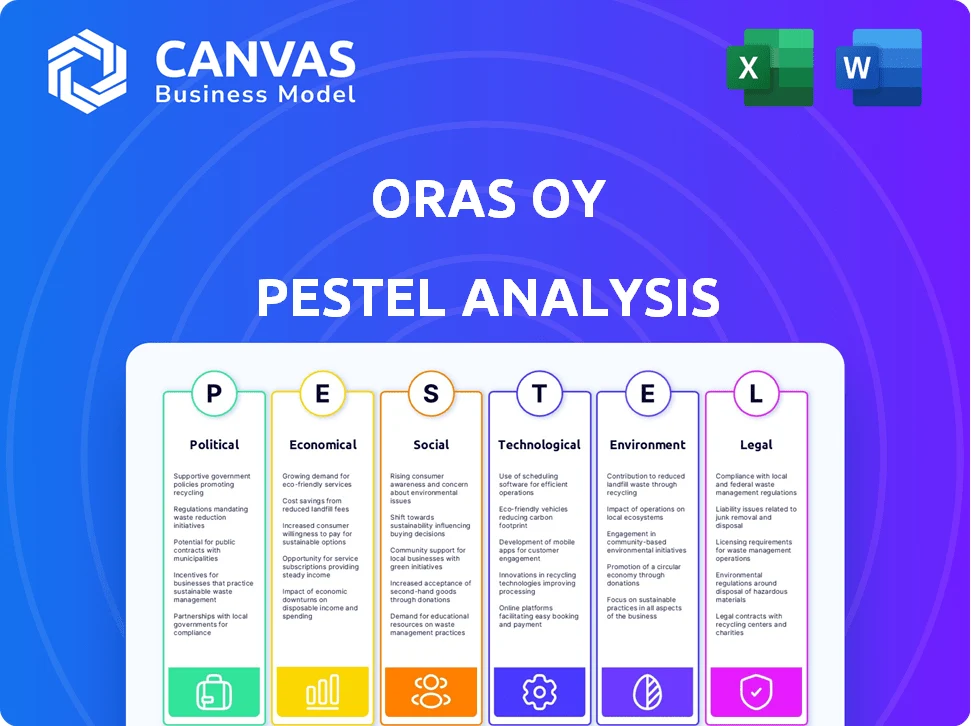
ORAS OY PESTLE ANALYSIS TEMPLATE RESEARCH
What is included in the product
 Detailed Word Document
Evaluates the Oras Oy's external environment.
Uses six dimensions to show threats/opportunities.

 Customizable Excel Spreadsheet
A summarized version of the PESTLE, supporting easy sharing and alignment across teams and departments.
Preview Before You Purchase
Oras Oy PESTLE Analysis
The preview here displays the complete Oras Oy PESTLE Analysis. Its content and structure are identical to the document you'll receive after purchasing.

PESTLE Analysis Template

Plan Smarter. Present Sharper. Compete Stronger.
Navigate the complex landscape influencing Oras Oy with our focused PESTLE analysis. Discover critical impacts from political stability to technological advancements affecting the firm. Uncover how environmental considerations and legal frameworks shape their strategy. Our analysis helps you foresee risks and capitalize on opportunities within the company's future. Download the full PESTLE analysis and receive actionable insights ready for strategic planning.
Political factors

Government Regulations on Water and Energy Efficiency
Governments, particularly in the EU, are tightening water and energy regulations in buildings. The Energy Performance of Buildings Directive and Energy Efficiency Directive push for lower energy use and renewables. This creates demand for companies like Oras Oy, which offers water and energy-saving products. The EU aims to cut greenhouse gas emissions by at least 55% by 2030.
Political Stability and Geopolitical Events
Political stability, especially in Europe, is vital for Oras Oy's operations and market demand. Geopolitical risks, per Eurasia Group's 2025 outlook, can affect investor confidence. For example, construction sector growth in the EU is projected at 2.5% in 2024, influenced by political factors. These uncertainties can significantly impact Oras Oy's sales and investment decisions.

Government Support for Construction and Renovation
Government backing for construction and renovation heavily impacts sanitary ware demand. In 2024, the North European construction sector faced challenges. However, anticipated improvements in 2025, due to factors like decreasing interest rates, may be enhanced by government support. For example, Finland's government is expected to launch new housing projects.

Trade Policies and Tariffs
Trade policies and tariffs significantly influence Oras Oy's operational costs. In 2024, global economic uncertainties led to increased tariff discussions, potentially impacting financing. Higher tariffs could elevate the price of imported raw materials used in manufacturing. These changes could also affect the final prices of Oras Oy's products.
- Tariffs on steel and aluminum, key materials, can increase production costs.
- Trade disputes might disrupt supply chains, causing delays and higher expenses.
- Changes in trade agreements can alter the company's market access.
- Oras Oy needs to monitor these policies to manage financial risks effectively.
Public Procurement Policies
Government and municipal procurement policies favoring eco-friendly products create opportunities for Oras Oy. Environmental Product Declarations (EPDs) are gaining importance, likely influencing public procurement. The EU Green Public Procurement (GPP) criteria promote sustainability. Public sector spending on green initiatives is rising. This trend benefits companies with strong environmental credentials like Oras Oy.
- EU GPP criteria promote sustainable products and services.
- Public sector spending on green initiatives is increasing.
- EPDs are becoming more crucial in construction projects.
- Oras Oy can benefit from its environmental focus.
Oras Oy: Riding the Green Wave in Construction
EU water & energy regulations are tightening, pushing for sustainable products, benefiting Oras Oy. Geopolitical risks impact construction sector growth; EU's 2024 growth is at 2.5%. Government support for construction, like Finland's housing projects, impacts demand.
| Factor | Impact | Data |
|---|---|---|
| Regulations | Increased Demand | EU emissions cut goal by 55% by 2030 |
| Stability | Investor confidence | 2024 EU construction at 2.5% |
| Procurement | Opportunity | EU Green Public Procurement (GPP) criteria |
Economic factors

Construction Market Trends
The construction market's performance, especially in Northern Europe, is crucial for Oras Group. Residential newbuilds faced weakness in 2024. A slow recovery is anticipated in 2025, with uncertainty around the pace. The global sanitary ware market is projected to expand, fueled by urbanization and construction, with a projected value of $70.7 billion by 2025.
Disposable Income and Consumer Spending
Rising disposable incomes, particularly in emerging markets, boost consumer spending on home improvements and luxury sanitary ware. Data from 2024 shows a 7% increase in spending on bathroom renovations. Wealthier consumers often opt for advanced, stylish fixtures, driving market growth. The global sanitary ware market is projected to reach $85 billion by 2025.

Inflation and Interest Rates
Persistent inflation and high interest rates can negatively affect Oras Oy by increasing construction costs and reducing consumer spending. In 2024, the Eurozone inflation rate was around 2.4%, and the ECB's key interest rate was at 4.5%. While inflation is expected to stabilize, and interest rates may decrease, these factors still present challenges for 2025.

Urbanization and Infrastructure Development
Urbanization and infrastructure development significantly influence the sanitary ware market. The expansion of cities, especially in developing nations, fuels the demand for residential and commercial construction. This growth directly increases the need for sanitary fittings in new buildings and infrastructure projects.
- Global urban population is projected to reach 6.7 billion by 2050.
- Infrastructure spending in Asia-Pacific is expected to reach $2.4 trillion by 2025.
Global Economic Growth
Global economic growth, particularly in Europe, directly affects demand for Oras Oy's products. The International Monetary Fund (IMF) projects global GDP growth of 3.2% in 2024 and 3.2% in 2025. However, European growth is slower, with the Eurozone expected to grow by 0.8% in 2024 and 1.5% in 2025. Economic uncertainties and potential disruptions, such as geopolitical tensions, could impact these projections.
- IMF projects 3.2% global GDP growth for 2024 and 2025.
- Eurozone growth is predicted at 0.8% (2024) and 1.5% (2025).
- Geopolitical risks and economic uncertainties pose challenges.
Oras Navigating Global Economic Currents
The global economy's 3.2% GDP growth in 2024/2025 is pivotal for Oras. Europe's slower growth, 0.8% (2024) and 1.5% (2025), presents challenges. Inflation and interest rates in the Eurozone also influence market dynamics.
| Economic Factor | 2024 Data | 2025 Projection |
|---|---|---|
| Global GDP Growth | 3.2% (IMF) | 3.2% (IMF) |
| Eurozone Growth | 0.8% | 1.5% |
| Eurozone Inflation Rate | 2.4% | Stabilizing |
Sociological factors

Awareness of Hygiene and Sanitation
Heightened awareness of hygiene and sanitation, fueled by global health concerns and governmental initiatives, is increasing the demand for modern, hygienic bathroom fixtures. This shift directly impacts consumer behavior, favoring higher-quality sanitary ware. In 2024, the global bathroom fixtures market was valued at $78.2 billion, with an expected CAGR of 4.5% through 2032, indicating a steady growth.
Changing Lifestyles and Design Trends
Changing lifestyles boost demand for modern sanitary ware. Comfort and convenience drive design choices. In 2024, the global bathroom fixtures market was valued at $58.4 billion. Stylish designs are key; the luxury bathroom market is growing. Expect further growth through 2025.

Aging Population and Accessibility Needs
An aging population increases the need for accessible sanitary fittings. The global elderly population (65+) is projected to reach 1.5 billion by 2050. This demographic shift drives demand for products with features like grab bars and ergonomic designs, and Oras Oy, as a sanitary ware manufacturer, can capitalize on this.

Influence of Social Media and Digital Marketing
Digital marketing and e-commerce are crucial for Oras Oy. Consumers increasingly research and buy sanitary ware online. In 2024, e-commerce sales in the bathroom fixtures market reached $1.5 billion. Adapting marketing strategies is key to reaching consumers online. Engaging on social media is also essential for brand visibility.
- E-commerce sales in the bathroom fixtures market projected to reach $1.7 billion by 2025.
- Social media engagement rates for sanitary ware brands increased by 15% in 2024.
- Oras Oy's online sales grew by 20% in the last year.
Corporate Social Responsibility Expectations
Consumers and stakeholders increasingly expect companies to be socially responsible, shaping business practices and product choices. Oras Group's commitment to sustainability reflects these societal demands, crucial for maintaining brand reputation and market access. This focus is vital, as 77% of consumers prefer sustainable brands (as of late 2024). Companies are now evaluated not just on profit but also on their environmental and social impact.
- 77% of consumers prefer sustainable brands (late 2024).
- Sustainability is key for brand reputation and market share.
- Growing consumer pressure for ethical practices.
Market Dynamics Reshape Business Strategies
Societal shifts impact Oras Oy's operations. Growing health awareness and aging populations drive demand for specific products. E-commerce and social media are key marketing channels, with online sales projected to reach $1.7 billion by 2025 in the bathroom fixtures market.
| Factor | Impact | Data |
|---|---|---|
| Hygiene Awareness | Higher demand for quality fixtures. | Market CAGR of 4.5% through 2032. |
| Lifestyle Changes | Boost for modern sanitary ware. | E-commerce sales projected: $1.7B (2025). |
| Aging Population | Demand for accessible designs. | Elderly pop. (65+) by 2050: 1.5B. |
ORAS OY PESTLE ANALYSIS TEMPLATE RESEARCH
What is included in the product
Detailed Word Document
Evaluates the Oras Oy's external environment.
Uses six dimensions to show threats/opportunities.
Customizable Excel Spreadsheet
A summarized version of the PESTLE, supporting easy sharing and alignment across teams and departments.
Preview Before You Purchase
Oras Oy PESTLE Analysis
The preview here displays the complete Oras Oy PESTLE Analysis. Its content and structure are identical to the document you'll receive after purchasing.
PESTLE Analysis Template
Plan Smarter. Present Sharper. Compete Stronger.
Navigate the complex landscape influencing Oras Oy with our focused PESTLE analysis. Discover critical impacts from political stability to technological advancements affecting the firm. Uncover how environmental considerations and legal frameworks shape their strategy. Our analysis helps you foresee risks and capitalize on opportunities within the company's future. Download the full PESTLE analysis and receive actionable insights ready for strategic planning.
Political factors
Government Regulations on Water and Energy Efficiency
Governments, particularly in the EU, are tightening water and energy regulations in buildings. The Energy Performance of Buildings Directive and Energy Efficiency Directive push for lower energy use and renewables. This creates demand for companies like Oras Oy, which offers water and energy-saving products. The EU aims to cut greenhouse gas emissions by at least 55% by 2030.
Political Stability and Geopolitical Events
Political stability, especially in Europe, is vital for Oras Oy's operations and market demand. Geopolitical risks, per Eurasia Group's 2025 outlook, can affect investor confidence. For example, construction sector growth in the EU is projected at 2.5% in 2024, influenced by political factors. These uncertainties can significantly impact Oras Oy's sales and investment decisions.
Government Support for Construction and Renovation
Government backing for construction and renovation heavily impacts sanitary ware demand. In 2024, the North European construction sector faced challenges. However, anticipated improvements in 2025, due to factors like decreasing interest rates, may be enhanced by government support. For example, Finland's government is expected to launch new housing projects.
Trade Policies and Tariffs
Trade policies and tariffs significantly influence Oras Oy's operational costs. In 2024, global economic uncertainties led to increased tariff discussions, potentially impacting financing. Higher tariffs could elevate the price of imported raw materials used in manufacturing. These changes could also affect the final prices of Oras Oy's products.
- Tariffs on steel and aluminum, key materials, can increase production costs.
- Trade disputes might disrupt supply chains, causing delays and higher expenses.
- Changes in trade agreements can alter the company's market access.
- Oras Oy needs to monitor these policies to manage financial risks effectively.
Public Procurement Policies
Government and municipal procurement policies favoring eco-friendly products create opportunities for Oras Oy. Environmental Product Declarations (EPDs) are gaining importance, likely influencing public procurement. The EU Green Public Procurement (GPP) criteria promote sustainability. Public sector spending on green initiatives is rising. This trend benefits companies with strong environmental credentials like Oras Oy.
- EU GPP criteria promote sustainable products and services.
- Public sector spending on green initiatives is increasing.
- EPDs are becoming more crucial in construction projects.
- Oras Oy can benefit from its environmental focus.
Oras Oy: Riding the Green Wave in Construction
EU water & energy regulations are tightening, pushing for sustainable products, benefiting Oras Oy. Geopolitical risks impact construction sector growth; EU's 2024 growth is at 2.5%. Government support for construction, like Finland's housing projects, impacts demand.
| Factor | Impact | Data |
|---|---|---|
| Regulations | Increased Demand | EU emissions cut goal by 55% by 2030 |
| Stability | Investor confidence | 2024 EU construction at 2.5% |
| Procurement | Opportunity | EU Green Public Procurement (GPP) criteria |
Economic factors
Construction Market Trends
The construction market's performance, especially in Northern Europe, is crucial for Oras Group. Residential newbuilds faced weakness in 2024. A slow recovery is anticipated in 2025, with uncertainty around the pace. The global sanitary ware market is projected to expand, fueled by urbanization and construction, with a projected value of $70.7 billion by 2025.
Disposable Income and Consumer Spending
Rising disposable incomes, particularly in emerging markets, boost consumer spending on home improvements and luxury sanitary ware. Data from 2024 shows a 7% increase in spending on bathroom renovations. Wealthier consumers often opt for advanced, stylish fixtures, driving market growth. The global sanitary ware market is projected to reach $85 billion by 2025.
Inflation and Interest Rates
Persistent inflation and high interest rates can negatively affect Oras Oy by increasing construction costs and reducing consumer spending. In 2024, the Eurozone inflation rate was around 2.4%, and the ECB's key interest rate was at 4.5%. While inflation is expected to stabilize, and interest rates may decrease, these factors still present challenges for 2025.
Urbanization and Infrastructure Development
Urbanization and infrastructure development significantly influence the sanitary ware market. The expansion of cities, especially in developing nations, fuels the demand for residential and commercial construction. This growth directly increases the need for sanitary fittings in new buildings and infrastructure projects.
- Global urban population is projected to reach 6.7 billion by 2050.
- Infrastructure spending in Asia-Pacific is expected to reach $2.4 trillion by 2025.
Global Economic Growth
Global economic growth, particularly in Europe, directly affects demand for Oras Oy's products. The International Monetary Fund (IMF) projects global GDP growth of 3.2% in 2024 and 3.2% in 2025. However, European growth is slower, with the Eurozone expected to grow by 0.8% in 2024 and 1.5% in 2025. Economic uncertainties and potential disruptions, such as geopolitical tensions, could impact these projections.
- IMF projects 3.2% global GDP growth for 2024 and 2025.
- Eurozone growth is predicted at 0.8% (2024) and 1.5% (2025).
- Geopolitical risks and economic uncertainties pose challenges.
Oras Navigating Global Economic Currents
The global economy's 3.2% GDP growth in 2024/2025 is pivotal for Oras. Europe's slower growth, 0.8% (2024) and 1.5% (2025), presents challenges. Inflation and interest rates in the Eurozone also influence market dynamics.
| Economic Factor | 2024 Data | 2025 Projection |
|---|---|---|
| Global GDP Growth | 3.2% (IMF) | 3.2% (IMF) |
| Eurozone Growth | 0.8% | 1.5% |
| Eurozone Inflation Rate | 2.4% | Stabilizing |
Sociological factors
Awareness of Hygiene and Sanitation
Heightened awareness of hygiene and sanitation, fueled by global health concerns and governmental initiatives, is increasing the demand for modern, hygienic bathroom fixtures. This shift directly impacts consumer behavior, favoring higher-quality sanitary ware. In 2024, the global bathroom fixtures market was valued at $78.2 billion, with an expected CAGR of 4.5% through 2032, indicating a steady growth.
Changing Lifestyles and Design Trends
Changing lifestyles boost demand for modern sanitary ware. Comfort and convenience drive design choices. In 2024, the global bathroom fixtures market was valued at $58.4 billion. Stylish designs are key; the luxury bathroom market is growing. Expect further growth through 2025.
Aging Population and Accessibility Needs
An aging population increases the need for accessible sanitary fittings. The global elderly population (65+) is projected to reach 1.5 billion by 2050. This demographic shift drives demand for products with features like grab bars and ergonomic designs, and Oras Oy, as a sanitary ware manufacturer, can capitalize on this.
Influence of Social Media and Digital Marketing
Digital marketing and e-commerce are crucial for Oras Oy. Consumers increasingly research and buy sanitary ware online. In 2024, e-commerce sales in the bathroom fixtures market reached $1.5 billion. Adapting marketing strategies is key to reaching consumers online. Engaging on social media is also essential for brand visibility.
- E-commerce sales in the bathroom fixtures market projected to reach $1.7 billion by 2025.
- Social media engagement rates for sanitary ware brands increased by 15% in 2024.
- Oras Oy's online sales grew by 20% in the last year.
Corporate Social Responsibility Expectations
Consumers and stakeholders increasingly expect companies to be socially responsible, shaping business practices and product choices. Oras Group's commitment to sustainability reflects these societal demands, crucial for maintaining brand reputation and market access. This focus is vital, as 77% of consumers prefer sustainable brands (as of late 2024). Companies are now evaluated not just on profit but also on their environmental and social impact.
- 77% of consumers prefer sustainable brands (late 2024).
- Sustainability is key for brand reputation and market share.
- Growing consumer pressure for ethical practices.
Market Dynamics Reshape Business Strategies
Societal shifts impact Oras Oy's operations. Growing health awareness and aging populations drive demand for specific products. E-commerce and social media are key marketing channels, with online sales projected to reach $1.7 billion by 2025 in the bathroom fixtures market.
| Factor | Impact | Data |
|---|---|---|
| Hygiene Awareness | Higher demand for quality fixtures. | Market CAGR of 4.5% through 2032. |
| Lifestyle Changes | Boost for modern sanitary ware. | E-commerce sales projected: $1.7B (2025). |
| Aging Population | Demand for accessible designs. | Elderly pop. (65+) by 2050: 1.5B. |
Product Information
Product Information
Shipping & Returns
Shipping & Returns
Description
What is included in the product
Detailed Word Document
Evaluates the Oras Oy's external environment.
Uses six dimensions to show threats/opportunities.
Customizable Excel Spreadsheet
A summarized version of the PESTLE, supporting easy sharing and alignment across teams and departments.
Preview Before You Purchase
Oras Oy PESTLE Analysis
The preview here displays the complete Oras Oy PESTLE Analysis. Its content and structure are identical to the document you'll receive after purchasing.
PESTLE Analysis Template
Plan Smarter. Present Sharper. Compete Stronger.
Navigate the complex landscape influencing Oras Oy with our focused PESTLE analysis. Discover critical impacts from political stability to technological advancements affecting the firm. Uncover how environmental considerations and legal frameworks shape their strategy. Our analysis helps you foresee risks and capitalize on opportunities within the company's future. Download the full PESTLE analysis and receive actionable insights ready for strategic planning.
Political factors
Government Regulations on Water and Energy Efficiency
Governments, particularly in the EU, are tightening water and energy regulations in buildings. The Energy Performance of Buildings Directive and Energy Efficiency Directive push for lower energy use and renewables. This creates demand for companies like Oras Oy, which offers water and energy-saving products. The EU aims to cut greenhouse gas emissions by at least 55% by 2030.
Political Stability and Geopolitical Events
Political stability, especially in Europe, is vital for Oras Oy's operations and market demand. Geopolitical risks, per Eurasia Group's 2025 outlook, can affect investor confidence. For example, construction sector growth in the EU is projected at 2.5% in 2024, influenced by political factors. These uncertainties can significantly impact Oras Oy's sales and investment decisions.
Government Support for Construction and Renovation
Government backing for construction and renovation heavily impacts sanitary ware demand. In 2024, the North European construction sector faced challenges. However, anticipated improvements in 2025, due to factors like decreasing interest rates, may be enhanced by government support. For example, Finland's government is expected to launch new housing projects.
Trade Policies and Tariffs
Trade policies and tariffs significantly influence Oras Oy's operational costs. In 2024, global economic uncertainties led to increased tariff discussions, potentially impacting financing. Higher tariffs could elevate the price of imported raw materials used in manufacturing. These changes could also affect the final prices of Oras Oy's products.
- Tariffs on steel and aluminum, key materials, can increase production costs.
- Trade disputes might disrupt supply chains, causing delays and higher expenses.
- Changes in trade agreements can alter the company's market access.
- Oras Oy needs to monitor these policies to manage financial risks effectively.
Public Procurement Policies
Government and municipal procurement policies favoring eco-friendly products create opportunities for Oras Oy. Environmental Product Declarations (EPDs) are gaining importance, likely influencing public procurement. The EU Green Public Procurement (GPP) criteria promote sustainability. Public sector spending on green initiatives is rising. This trend benefits companies with strong environmental credentials like Oras Oy.
- EU GPP criteria promote sustainable products and services.
- Public sector spending on green initiatives is increasing.
- EPDs are becoming more crucial in construction projects.
- Oras Oy can benefit from its environmental focus.
Oras Oy: Riding the Green Wave in Construction
EU water & energy regulations are tightening, pushing for sustainable products, benefiting Oras Oy. Geopolitical risks impact construction sector growth; EU's 2024 growth is at 2.5%. Government support for construction, like Finland's housing projects, impacts demand.
| Factor | Impact | Data |
|---|---|---|
| Regulations | Increased Demand | EU emissions cut goal by 55% by 2030 |
| Stability | Investor confidence | 2024 EU construction at 2.5% |
| Procurement | Opportunity | EU Green Public Procurement (GPP) criteria |
Economic factors
Construction Market Trends
The construction market's performance, especially in Northern Europe, is crucial for Oras Group. Residential newbuilds faced weakness in 2024. A slow recovery is anticipated in 2025, with uncertainty around the pace. The global sanitary ware market is projected to expand, fueled by urbanization and construction, with a projected value of $70.7 billion by 2025.
Disposable Income and Consumer Spending
Rising disposable incomes, particularly in emerging markets, boost consumer spending on home improvements and luxury sanitary ware. Data from 2024 shows a 7% increase in spending on bathroom renovations. Wealthier consumers often opt for advanced, stylish fixtures, driving market growth. The global sanitary ware market is projected to reach $85 billion by 2025.
Inflation and Interest Rates
Persistent inflation and high interest rates can negatively affect Oras Oy by increasing construction costs and reducing consumer spending. In 2024, the Eurozone inflation rate was around 2.4%, and the ECB's key interest rate was at 4.5%. While inflation is expected to stabilize, and interest rates may decrease, these factors still present challenges for 2025.
Urbanization and Infrastructure Development
Urbanization and infrastructure development significantly influence the sanitary ware market. The expansion of cities, especially in developing nations, fuels the demand for residential and commercial construction. This growth directly increases the need for sanitary fittings in new buildings and infrastructure projects.
- Global urban population is projected to reach 6.7 billion by 2050.
- Infrastructure spending in Asia-Pacific is expected to reach $2.4 trillion by 2025.
Global Economic Growth
Global economic growth, particularly in Europe, directly affects demand for Oras Oy's products. The International Monetary Fund (IMF) projects global GDP growth of 3.2% in 2024 and 3.2% in 2025. However, European growth is slower, with the Eurozone expected to grow by 0.8% in 2024 and 1.5% in 2025. Economic uncertainties and potential disruptions, such as geopolitical tensions, could impact these projections.
- IMF projects 3.2% global GDP growth for 2024 and 2025.
- Eurozone growth is predicted at 0.8% (2024) and 1.5% (2025).
- Geopolitical risks and economic uncertainties pose challenges.
Oras Navigating Global Economic Currents
The global economy's 3.2% GDP growth in 2024/2025 is pivotal for Oras. Europe's slower growth, 0.8% (2024) and 1.5% (2025), presents challenges. Inflation and interest rates in the Eurozone also influence market dynamics.
| Economic Factor | 2024 Data | 2025 Projection |
|---|---|---|
| Global GDP Growth | 3.2% (IMF) | 3.2% (IMF) |
| Eurozone Growth | 0.8% | 1.5% |
| Eurozone Inflation Rate | 2.4% | Stabilizing |
Sociological factors
Awareness of Hygiene and Sanitation
Heightened awareness of hygiene and sanitation, fueled by global health concerns and governmental initiatives, is increasing the demand for modern, hygienic bathroom fixtures. This shift directly impacts consumer behavior, favoring higher-quality sanitary ware. In 2024, the global bathroom fixtures market was valued at $78.2 billion, with an expected CAGR of 4.5% through 2032, indicating a steady growth.
Changing Lifestyles and Design Trends
Changing lifestyles boost demand for modern sanitary ware. Comfort and convenience drive design choices. In 2024, the global bathroom fixtures market was valued at $58.4 billion. Stylish designs are key; the luxury bathroom market is growing. Expect further growth through 2025.
Aging Population and Accessibility Needs
An aging population increases the need for accessible sanitary fittings. The global elderly population (65+) is projected to reach 1.5 billion by 2050. This demographic shift drives demand for products with features like grab bars and ergonomic designs, and Oras Oy, as a sanitary ware manufacturer, can capitalize on this.
Influence of Social Media and Digital Marketing
Digital marketing and e-commerce are crucial for Oras Oy. Consumers increasingly research and buy sanitary ware online. In 2024, e-commerce sales in the bathroom fixtures market reached $1.5 billion. Adapting marketing strategies is key to reaching consumers online. Engaging on social media is also essential for brand visibility.
- E-commerce sales in the bathroom fixtures market projected to reach $1.7 billion by 2025.
- Social media engagement rates for sanitary ware brands increased by 15% in 2024.
- Oras Oy's online sales grew by 20% in the last year.
Corporate Social Responsibility Expectations
Consumers and stakeholders increasingly expect companies to be socially responsible, shaping business practices and product choices. Oras Group's commitment to sustainability reflects these societal demands, crucial for maintaining brand reputation and market access. This focus is vital, as 77% of consumers prefer sustainable brands (as of late 2024). Companies are now evaluated not just on profit but also on their environmental and social impact.
- 77% of consumers prefer sustainable brands (late 2024).
- Sustainability is key for brand reputation and market share.
- Growing consumer pressure for ethical practices.
Market Dynamics Reshape Business Strategies
Societal shifts impact Oras Oy's operations. Growing health awareness and aging populations drive demand for specific products. E-commerce and social media are key marketing channels, with online sales projected to reach $1.7 billion by 2025 in the bathroom fixtures market.
| Factor | Impact | Data |
|---|---|---|
| Hygiene Awareness | Higher demand for quality fixtures. | Market CAGR of 4.5% through 2032. |
| Lifestyle Changes | Boost for modern sanitary ware. | E-commerce sales projected: $1.7B (2025). |
| Aging Population | Demand for accessible designs. | Elderly pop. (65+) by 2050: 1.5B. |