
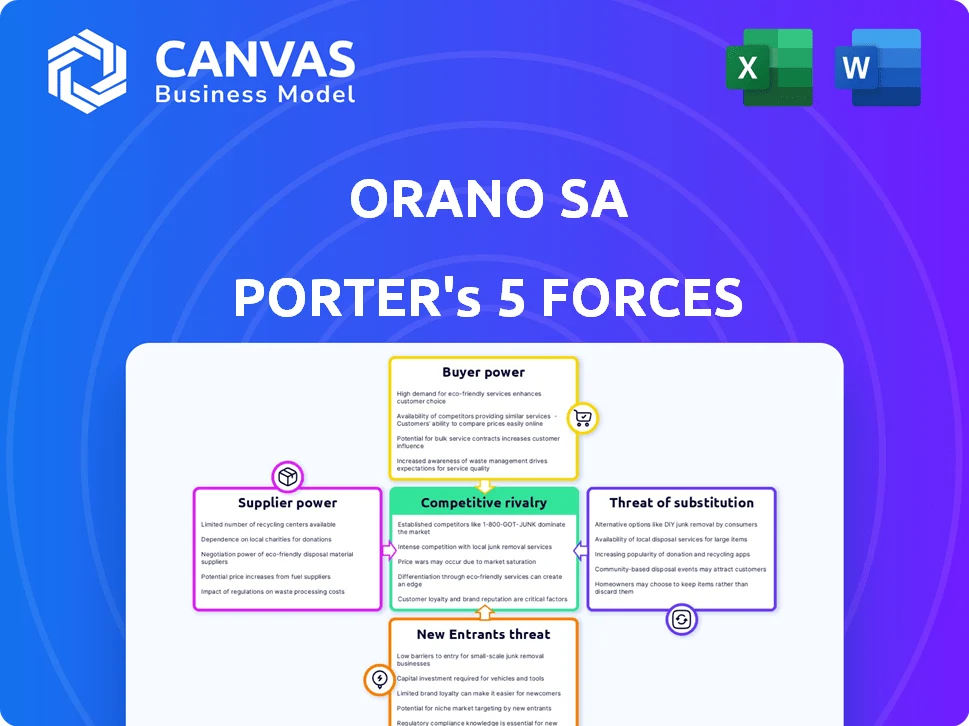
ORANO SA PORTER'S FIVE FORCES TEMPLATE RESEARCH
What is included in the product
 Detailed Word Document
Evaluates control held by suppliers and buyers, and their influence on pricing and profitability.

 Customizable Excel Spreadsheet
A clear, concise analysis instantly highlights key competitive threats.
What You See Is What You Get
Orano SA Porter's Five Forces Analysis
This is the complete Orano SA Porter's Five Forces Analysis. You're previewing the final, professionally formatted document.
The content displayed is identical to the analysis you'll receive immediately after purchase.
There are no differences between this preview and the downloadable file.
It's ready to download and ready to use once your purchase is complete.
No surprises: What you see is what you get!

Porter's Five Forces Analysis Template

A Must-Have Tool for Decision-Makers
Orano SA faces moderate rivalry, especially in uranium enrichment. Supplier power is significant due to resource concentration. Buyer power is somewhat balanced. New entrants are deterred by high barriers. Substitute threats, primarily from alternative energy sources, are present.
Ready to move beyond the basics? Get a full strategic breakdown of Orano SA’s market position, competitive intensity, and external threats—all in one powerful analysis.
Suppliers Bargaining Power

Concentration of Uranium Mining
Orano's bargaining power is influenced by its reliance on specific uranium suppliers. The concentration of uranium mining in certain regions can empower suppliers. For example, Niger's supply disruptions in 2023-2024 demonstrate the impact of regional instability. In 2023, uranium spot prices rose significantly, reflecting supply concerns.
Specialized Equipment and Technology
Orano SA's operations depend on specialized equipment and technology. The nuclear industry's unique demands limit supplier options. This gives suppliers bargaining power. For example, the global nuclear fuel market was valued at $10.36 billion in 2024.

Regulatory and Safety Requirements
Orano SA's suppliers face stringent regulatory demands, especially concerning safety in the nuclear sector. This necessitates that suppliers adhere to rigorous standards, potentially reducing the supplier pool. The strict compliance requirements bolster supplier power, as fewer entities can meet these demands. For instance, in 2024, the nuclear industry saw a 5% increase in regulatory audits, reflecting heightened scrutiny. This benefits suppliers who meet these standards, allowing them to negotiate better terms.

Labor Unions and Skilled Workforce
Orano SA faces supplier power from labor unions and a skilled workforce, especially in specialized nuclear fuel cycle areas. Labor unions can affect labor costs and operational conditions, potentially increasing their bargaining power. This can lead to higher expenses and operational constraints for Orano. The nuclear industry's demand for highly skilled workers further strengthens labor's position.
- Unionization rates in the French nuclear sector, where Orano operates, are relatively high, potentially impacting labor costs.
- The skills shortage in nuclear engineering and related fields can increase labor's leverage.
- According to the World Nuclear Association, the sector's labor costs are a significant part of overall operational expenses.
Geopolitical Factors
Geopolitical factors heavily influence Orano's supplier power. Political instability and government policies in uranium-sourcing countries directly affect supply chain reliability. These factors can lead to cost fluctuations and operational disruptions, increasing supplier leverage. For example, in 2024, uranium prices saw volatility due to geopolitical tensions.
- Political risks impact supply chain stability.
- Government policies influence uranium costs.
- Geopolitical events cause market fluctuations.
Orano's Supplier Power: Uranium, Tech, and Risks
Orano's supplier power hinges on uranium sourcing, specialized tech, and stringent regulations. Labor unions and geopolitical risks also play significant roles. These factors influence costs and operational stability, impacting Orano's profitability. For instance, the global nuclear fuel market was valued at $10.36 billion in 2024.
| Factor | Impact | Example (2024) |
|---|---|---|
| Uranium Supply | Concentration, disruptions | Spot prices rose due to supply concerns |
| Specialized Tech | Limited supplier options | Nuclear fuel market at $10.36B |
| Regulations | Stringent standards | 5% increase in regulatory audits |
Customers Bargaining Power

Concentrated Customer Base
Orano SA's primary clients are big utility companies and governments involved in nuclear power. This concentration of a few major customers hands them considerable bargaining power. For instance, in 2024, around 70% of Orano's revenue came from a handful of key clients. These clients can influence contract terms, affecting Orano's profitability.
Long-Term Contracts
Long-term contracts provide stability but may constrain Orano's pricing flexibility. This can elevate customer power, especially during market fluctuations. For instance, Orano's revenue in 2024 was impacted by contract terms. In 2024, the uranium spot price hit $80 per pound, showing market volatility.

Customer's In-House Capabilities
Some customers, like EDF, possess in-house capabilities in nuclear fuel cycle components. This self-sufficiency reduces their reliance on suppliers like Orano, boosting their negotiation leverage. For instance, EDF's investment in its own fuel fabrication facilities gives it more options. In 2024, EDF's revenue was approximately €80 billion, highlighting their financial strength to influence suppliers.

Government Influence and Regulation
Government influence significantly shapes the nuclear energy sector, impacting customer bargaining power. Policies and regulations can dictate project approvals and operational standards, affecting costs and timelines. Government ownership, as seen in many European utilities, further amplifies this influence. For example, France's EDF, a major player, has a substantial government stake, influencing nuclear power decisions.
- Regulatory approvals heavily influence project timelines and costs.
- Government ownership strengthens customer bargaining power.
- Policy changes can impact the attractiveness of nuclear energy.
Switching Costs
Switching costs in the nuclear fuel cycle are significant due to specialized services and long-term contracts. Customers of Orano SA face challenges in finding alternative suppliers. However, customer power exists where qualified alternatives are available for specific services. Orano's revenue in 2023 was about €4.4 billion, highlighting the scale of its operations.
- Orano's fuel services revenue is a key area where customer leverage may affect pricing.
- Long-term contracts can lock in customers, but also create vulnerabilities if Orano's service quality declines.
- The availability of alternative suppliers for enrichment or fuel fabrication directly impacts customer negotiating power.
Customer Power Dynamics: A Look at Key Factors
Orano SA's customers, mainly utilities and governments, wield considerable bargaining power. This power stems from their concentrated nature and the influence of long-term contracts. Government regulations and ownership further amplify this influence, shaping project costs and timelines.
Switching costs are high, but alternative suppliers for specific services impact negotiation. Orano's 2024 revenue was influenced by contract terms and market volatility. In 2023, Orano's revenue was about €4.4 billion, reflecting the scale of its operations.
| Aspect | Impact on Customer Power | 2024 Data |
|---|---|---|
| Customer Concentration | High, due to a few major clients | 70% revenue from key clients |
| Contract Terms | Long-term contracts impact pricing | Uranium spot price hit $80/lb |
| Government Influence | Strong, affecting project approvals | EDF's revenue approx. €80B |
Rivalry Among Competitors

Limited Number of Major Players
The nuclear fuel cycle industry sees fierce competition among a few key players. Orano SA, along with competitors, battles for market share. This rivalry affects pricing and innovation. In 2024, the industry's revenue was roughly $70 billion, showing the stakes involved.
High Barriers to Entry
Orano SA operates in a sector with high barriers to entry. The nuclear industry demands substantial capital investment, specialized technological expertise, and adherence to strict safety protocols. This, combined with long-term contracts and regulatory hurdles, restricts new entrants. For example, building a new nuclear power plant can cost billions of dollars and take over a decade to complete, as seen in recent projects.

Diverse Service Offerings
Orano SA faces competitive rivalry due to diverse service offerings in the nuclear fuel cycle. Companies like Cameco and Rosatom compete across segments, from uranium mining to waste management. The intensity of competition varies; for example, uranium spot prices in 2024 fluctuated, impacting mining profitability. This competition pressure affects pricing and market share for Orano.

Geopolitical Competition
Geopolitical competition significantly shapes the nuclear fuel market, influencing Orano SA's competitive landscape. Nations prioritize securing their nuclear fuel supply chains, impacting industry dynamics. This can lead to trade barriers or preferences for domestic suppliers. The push for energy independence fosters rivalry among companies like Orano.
- Global uranium production in 2023 reached approximately 49,355 tonnes.
- China's nuclear power capacity is rapidly expanding, with 24 reactors under construction.
- Orano has operations across several countries, including France, Kazakhstan, and Canada.
- Geopolitical tensions impact uranium prices, which saw fluctuations in 2024.
Market Demand and Price Fluctuations
Fluctuations in nuclear fuel demand and uranium market prices significantly impact competition. Companies fiercely compete for contracts amid price volatility, influencing profitability and market share. For instance, uranium spot prices in 2024 varied, affecting revenue projections. This instability forces strategic adjustments.
- Uranium spot prices in 2024 ranged from $65 to $90 per pound, reflecting market volatility.
- Orano's 2023 revenue was €4.6 billion, highlighting the scale of operations affected by market dynamics.
- The global nuclear fuel market is projected to grow, but demand varies by region, increasing competition.
Orano's Nuclear Fuel Cycle Battle: Key Market Insights
Orano SA competes fiercely within the nuclear fuel cycle, with rivals like Cameco and Rosatom vying for market share. The industry's competitive landscape is shaped by geopolitical factors and fluctuating uranium prices. In 2024, uranium spot prices ranged from $65 to $90 per pound, impacting profitability.
| Factor | Impact on Orano | 2024 Data |
|---|---|---|
| Competitive Rivalry | Pressures pricing and market share. | Uranium spot prices: $65-$90/lb. |
| Geopolitical Influence | Shapes supply chains and trade. | China has 24 reactors under construction. |
| Market Volatility | Requires strategic adjustments. | Orano 2023 revenue: €4.6B. |
Original: $10.00
-65%$10.00
$3.50ORANO SA PORTER'S FIVE FORCES TEMPLATE RESEARCH
What is included in the product
Detailed Word Document
Evaluates control held by suppliers and buyers, and their influence on pricing and profitability.
Customizable Excel Spreadsheet
A clear, concise analysis instantly highlights key competitive threats.
What You See Is What You Get
Orano SA Porter's Five Forces Analysis
This is the complete Orano SA Porter's Five Forces Analysis. You're previewing the final, professionally formatted document.
The content displayed is identical to the analysis you'll receive immediately after purchase.
There are no differences between this preview and the downloadable file.
It's ready to download and ready to use once your purchase is complete.
No surprises: What you see is what you get!
Porter's Five Forces Analysis Template
A Must-Have Tool for Decision-Makers
Orano SA faces moderate rivalry, especially in uranium enrichment. Supplier power is significant due to resource concentration. Buyer power is somewhat balanced. New entrants are deterred by high barriers. Substitute threats, primarily from alternative energy sources, are present.
Ready to move beyond the basics? Get a full strategic breakdown of Orano SA’s market position, competitive intensity, and external threats—all in one powerful analysis.
Suppliers Bargaining Power
Concentration of Uranium Mining
Orano's bargaining power is influenced by its reliance on specific uranium suppliers. The concentration of uranium mining in certain regions can empower suppliers. For example, Niger's supply disruptions in 2023-2024 demonstrate the impact of regional instability. In 2023, uranium spot prices rose significantly, reflecting supply concerns.
Specialized Equipment and Technology
Orano SA's operations depend on specialized equipment and technology. The nuclear industry's unique demands limit supplier options. This gives suppliers bargaining power. For example, the global nuclear fuel market was valued at $10.36 billion in 2024.
Regulatory and Safety Requirements
Orano SA's suppliers face stringent regulatory demands, especially concerning safety in the nuclear sector. This necessitates that suppliers adhere to rigorous standards, potentially reducing the supplier pool. The strict compliance requirements bolster supplier power, as fewer entities can meet these demands. For instance, in 2024, the nuclear industry saw a 5% increase in regulatory audits, reflecting heightened scrutiny. This benefits suppliers who meet these standards, allowing them to negotiate better terms.
Labor Unions and Skilled Workforce
Orano SA faces supplier power from labor unions and a skilled workforce, especially in specialized nuclear fuel cycle areas. Labor unions can affect labor costs and operational conditions, potentially increasing their bargaining power. This can lead to higher expenses and operational constraints for Orano. The nuclear industry's demand for highly skilled workers further strengthens labor's position.
- Unionization rates in the French nuclear sector, where Orano operates, are relatively high, potentially impacting labor costs.
- The skills shortage in nuclear engineering and related fields can increase labor's leverage.
- According to the World Nuclear Association, the sector's labor costs are a significant part of overall operational expenses.
Geopolitical Factors
Geopolitical factors heavily influence Orano's supplier power. Political instability and government policies in uranium-sourcing countries directly affect supply chain reliability. These factors can lead to cost fluctuations and operational disruptions, increasing supplier leverage. For example, in 2024, uranium prices saw volatility due to geopolitical tensions.
- Political risks impact supply chain stability.
- Government policies influence uranium costs.
- Geopolitical events cause market fluctuations.
Orano's Supplier Power: Uranium, Tech, and Risks
Orano's supplier power hinges on uranium sourcing, specialized tech, and stringent regulations. Labor unions and geopolitical risks also play significant roles. These factors influence costs and operational stability, impacting Orano's profitability. For instance, the global nuclear fuel market was valued at $10.36 billion in 2024.
| Factor | Impact | Example (2024) |
|---|---|---|
| Uranium Supply | Concentration, disruptions | Spot prices rose due to supply concerns |
| Specialized Tech | Limited supplier options | Nuclear fuel market at $10.36B |
| Regulations | Stringent standards | 5% increase in regulatory audits |
Customers Bargaining Power
Concentrated Customer Base
Orano SA's primary clients are big utility companies and governments involved in nuclear power. This concentration of a few major customers hands them considerable bargaining power. For instance, in 2024, around 70% of Orano's revenue came from a handful of key clients. These clients can influence contract terms, affecting Orano's profitability.
Long-Term Contracts
Long-term contracts provide stability but may constrain Orano's pricing flexibility. This can elevate customer power, especially during market fluctuations. For instance, Orano's revenue in 2024 was impacted by contract terms. In 2024, the uranium spot price hit $80 per pound, showing market volatility.
Customer's In-House Capabilities
Some customers, like EDF, possess in-house capabilities in nuclear fuel cycle components. This self-sufficiency reduces their reliance on suppliers like Orano, boosting their negotiation leverage. For instance, EDF's investment in its own fuel fabrication facilities gives it more options. In 2024, EDF's revenue was approximately €80 billion, highlighting their financial strength to influence suppliers.
Government Influence and Regulation
Government influence significantly shapes the nuclear energy sector, impacting customer bargaining power. Policies and regulations can dictate project approvals and operational standards, affecting costs and timelines. Government ownership, as seen in many European utilities, further amplifies this influence. For example, France's EDF, a major player, has a substantial government stake, influencing nuclear power decisions.
- Regulatory approvals heavily influence project timelines and costs.
- Government ownership strengthens customer bargaining power.
- Policy changes can impact the attractiveness of nuclear energy.
Switching Costs
Switching costs in the nuclear fuel cycle are significant due to specialized services and long-term contracts. Customers of Orano SA face challenges in finding alternative suppliers. However, customer power exists where qualified alternatives are available for specific services. Orano's revenue in 2023 was about €4.4 billion, highlighting the scale of its operations.
- Orano's fuel services revenue is a key area where customer leverage may affect pricing.
- Long-term contracts can lock in customers, but also create vulnerabilities if Orano's service quality declines.
- The availability of alternative suppliers for enrichment or fuel fabrication directly impacts customer negotiating power.
Customer Power Dynamics: A Look at Key Factors
Orano SA's customers, mainly utilities and governments, wield considerable bargaining power. This power stems from their concentrated nature and the influence of long-term contracts. Government regulations and ownership further amplify this influence, shaping project costs and timelines.
Switching costs are high, but alternative suppliers for specific services impact negotiation. Orano's 2024 revenue was influenced by contract terms and market volatility. In 2023, Orano's revenue was about €4.4 billion, reflecting the scale of its operations.
| Aspect | Impact on Customer Power | 2024 Data |
|---|---|---|
| Customer Concentration | High, due to a few major clients | 70% revenue from key clients |
| Contract Terms | Long-term contracts impact pricing | Uranium spot price hit $80/lb |
| Government Influence | Strong, affecting project approvals | EDF's revenue approx. €80B |
Rivalry Among Competitors
Limited Number of Major Players
The nuclear fuel cycle industry sees fierce competition among a few key players. Orano SA, along with competitors, battles for market share. This rivalry affects pricing and innovation. In 2024, the industry's revenue was roughly $70 billion, showing the stakes involved.
High Barriers to Entry
Orano SA operates in a sector with high barriers to entry. The nuclear industry demands substantial capital investment, specialized technological expertise, and adherence to strict safety protocols. This, combined with long-term contracts and regulatory hurdles, restricts new entrants. For example, building a new nuclear power plant can cost billions of dollars and take over a decade to complete, as seen in recent projects.
Diverse Service Offerings
Orano SA faces competitive rivalry due to diverse service offerings in the nuclear fuel cycle. Companies like Cameco and Rosatom compete across segments, from uranium mining to waste management. The intensity of competition varies; for example, uranium spot prices in 2024 fluctuated, impacting mining profitability. This competition pressure affects pricing and market share for Orano.
Geopolitical Competition
Geopolitical competition significantly shapes the nuclear fuel market, influencing Orano SA's competitive landscape. Nations prioritize securing their nuclear fuel supply chains, impacting industry dynamics. This can lead to trade barriers or preferences for domestic suppliers. The push for energy independence fosters rivalry among companies like Orano.
- Global uranium production in 2023 reached approximately 49,355 tonnes.
- China's nuclear power capacity is rapidly expanding, with 24 reactors under construction.
- Orano has operations across several countries, including France, Kazakhstan, and Canada.
- Geopolitical tensions impact uranium prices, which saw fluctuations in 2024.
Market Demand and Price Fluctuations
Fluctuations in nuclear fuel demand and uranium market prices significantly impact competition. Companies fiercely compete for contracts amid price volatility, influencing profitability and market share. For instance, uranium spot prices in 2024 varied, affecting revenue projections. This instability forces strategic adjustments.
- Uranium spot prices in 2024 ranged from $65 to $90 per pound, reflecting market volatility.
- Orano's 2023 revenue was €4.6 billion, highlighting the scale of operations affected by market dynamics.
- The global nuclear fuel market is projected to grow, but demand varies by region, increasing competition.
Orano's Nuclear Fuel Cycle Battle: Key Market Insights
Orano SA competes fiercely within the nuclear fuel cycle, with rivals like Cameco and Rosatom vying for market share. The industry's competitive landscape is shaped by geopolitical factors and fluctuating uranium prices. In 2024, uranium spot prices ranged from $65 to $90 per pound, impacting profitability.
| Factor | Impact on Orano | 2024 Data |
|---|---|---|
| Competitive Rivalry | Pressures pricing and market share. | Uranium spot prices: $65-$90/lb. |
| Geopolitical Influence | Shapes supply chains and trade. | China has 24 reactors under construction. |
| Market Volatility | Requires strategic adjustments. | Orano 2023 revenue: €4.6B. |
Product Information
Product Information
Shipping & Returns
Shipping & Returns
Description
What is included in the product
Detailed Word Document
Evaluates control held by suppliers and buyers, and their influence on pricing and profitability.
Customizable Excel Spreadsheet
A clear, concise analysis instantly highlights key competitive threats.
What You See Is What You Get
Orano SA Porter's Five Forces Analysis
This is the complete Orano SA Porter's Five Forces Analysis. You're previewing the final, professionally formatted document.
The content displayed is identical to the analysis you'll receive immediately after purchase.
There are no differences between this preview and the downloadable file.
It's ready to download and ready to use once your purchase is complete.
No surprises: What you see is what you get!
Porter's Five Forces Analysis Template
A Must-Have Tool for Decision-Makers
Orano SA faces moderate rivalry, especially in uranium enrichment. Supplier power is significant due to resource concentration. Buyer power is somewhat balanced. New entrants are deterred by high barriers. Substitute threats, primarily from alternative energy sources, are present.
Ready to move beyond the basics? Get a full strategic breakdown of Orano SA’s market position, competitive intensity, and external threats—all in one powerful analysis.
Suppliers Bargaining Power
Concentration of Uranium Mining
Orano's bargaining power is influenced by its reliance on specific uranium suppliers. The concentration of uranium mining in certain regions can empower suppliers. For example, Niger's supply disruptions in 2023-2024 demonstrate the impact of regional instability. In 2023, uranium spot prices rose significantly, reflecting supply concerns.
Specialized Equipment and Technology
Orano SA's operations depend on specialized equipment and technology. The nuclear industry's unique demands limit supplier options. This gives suppliers bargaining power. For example, the global nuclear fuel market was valued at $10.36 billion in 2024.
Regulatory and Safety Requirements
Orano SA's suppliers face stringent regulatory demands, especially concerning safety in the nuclear sector. This necessitates that suppliers adhere to rigorous standards, potentially reducing the supplier pool. The strict compliance requirements bolster supplier power, as fewer entities can meet these demands. For instance, in 2024, the nuclear industry saw a 5% increase in regulatory audits, reflecting heightened scrutiny. This benefits suppliers who meet these standards, allowing them to negotiate better terms.
Labor Unions and Skilled Workforce
Orano SA faces supplier power from labor unions and a skilled workforce, especially in specialized nuclear fuel cycle areas. Labor unions can affect labor costs and operational conditions, potentially increasing their bargaining power. This can lead to higher expenses and operational constraints for Orano. The nuclear industry's demand for highly skilled workers further strengthens labor's position.
- Unionization rates in the French nuclear sector, where Orano operates, are relatively high, potentially impacting labor costs.
- The skills shortage in nuclear engineering and related fields can increase labor's leverage.
- According to the World Nuclear Association, the sector's labor costs are a significant part of overall operational expenses.
Geopolitical Factors
Geopolitical factors heavily influence Orano's supplier power. Political instability and government policies in uranium-sourcing countries directly affect supply chain reliability. These factors can lead to cost fluctuations and operational disruptions, increasing supplier leverage. For example, in 2024, uranium prices saw volatility due to geopolitical tensions.
- Political risks impact supply chain stability.
- Government policies influence uranium costs.
- Geopolitical events cause market fluctuations.
Orano's Supplier Power: Uranium, Tech, and Risks
Orano's supplier power hinges on uranium sourcing, specialized tech, and stringent regulations. Labor unions and geopolitical risks also play significant roles. These factors influence costs and operational stability, impacting Orano's profitability. For instance, the global nuclear fuel market was valued at $10.36 billion in 2024.
| Factor | Impact | Example (2024) |
|---|---|---|
| Uranium Supply | Concentration, disruptions | Spot prices rose due to supply concerns |
| Specialized Tech | Limited supplier options | Nuclear fuel market at $10.36B |
| Regulations | Stringent standards | 5% increase in regulatory audits |
Customers Bargaining Power
Concentrated Customer Base
Orano SA's primary clients are big utility companies and governments involved in nuclear power. This concentration of a few major customers hands them considerable bargaining power. For instance, in 2024, around 70% of Orano's revenue came from a handful of key clients. These clients can influence contract terms, affecting Orano's profitability.
Long-Term Contracts
Long-term contracts provide stability but may constrain Orano's pricing flexibility. This can elevate customer power, especially during market fluctuations. For instance, Orano's revenue in 2024 was impacted by contract terms. In 2024, the uranium spot price hit $80 per pound, showing market volatility.
Customer's In-House Capabilities
Some customers, like EDF, possess in-house capabilities in nuclear fuel cycle components. This self-sufficiency reduces their reliance on suppliers like Orano, boosting their negotiation leverage. For instance, EDF's investment in its own fuel fabrication facilities gives it more options. In 2024, EDF's revenue was approximately €80 billion, highlighting their financial strength to influence suppliers.
Government Influence and Regulation
Government influence significantly shapes the nuclear energy sector, impacting customer bargaining power. Policies and regulations can dictate project approvals and operational standards, affecting costs and timelines. Government ownership, as seen in many European utilities, further amplifies this influence. For example, France's EDF, a major player, has a substantial government stake, influencing nuclear power decisions.
- Regulatory approvals heavily influence project timelines and costs.
- Government ownership strengthens customer bargaining power.
- Policy changes can impact the attractiveness of nuclear energy.
Switching Costs
Switching costs in the nuclear fuel cycle are significant due to specialized services and long-term contracts. Customers of Orano SA face challenges in finding alternative suppliers. However, customer power exists where qualified alternatives are available for specific services. Orano's revenue in 2023 was about €4.4 billion, highlighting the scale of its operations.
- Orano's fuel services revenue is a key area where customer leverage may affect pricing.
- Long-term contracts can lock in customers, but also create vulnerabilities if Orano's service quality declines.
- The availability of alternative suppliers for enrichment or fuel fabrication directly impacts customer negotiating power.
Customer Power Dynamics: A Look at Key Factors
Orano SA's customers, mainly utilities and governments, wield considerable bargaining power. This power stems from their concentrated nature and the influence of long-term contracts. Government regulations and ownership further amplify this influence, shaping project costs and timelines.
Switching costs are high, but alternative suppliers for specific services impact negotiation. Orano's 2024 revenue was influenced by contract terms and market volatility. In 2023, Orano's revenue was about €4.4 billion, reflecting the scale of its operations.
| Aspect | Impact on Customer Power | 2024 Data |
|---|---|---|
| Customer Concentration | High, due to a few major clients | 70% revenue from key clients |
| Contract Terms | Long-term contracts impact pricing | Uranium spot price hit $80/lb |
| Government Influence | Strong, affecting project approvals | EDF's revenue approx. €80B |
Rivalry Among Competitors
Limited Number of Major Players
The nuclear fuel cycle industry sees fierce competition among a few key players. Orano SA, along with competitors, battles for market share. This rivalry affects pricing and innovation. In 2024, the industry's revenue was roughly $70 billion, showing the stakes involved.
High Barriers to Entry
Orano SA operates in a sector with high barriers to entry. The nuclear industry demands substantial capital investment, specialized technological expertise, and adherence to strict safety protocols. This, combined with long-term contracts and regulatory hurdles, restricts new entrants. For example, building a new nuclear power plant can cost billions of dollars and take over a decade to complete, as seen in recent projects.
Diverse Service Offerings
Orano SA faces competitive rivalry due to diverse service offerings in the nuclear fuel cycle. Companies like Cameco and Rosatom compete across segments, from uranium mining to waste management. The intensity of competition varies; for example, uranium spot prices in 2024 fluctuated, impacting mining profitability. This competition pressure affects pricing and market share for Orano.
Geopolitical Competition
Geopolitical competition significantly shapes the nuclear fuel market, influencing Orano SA's competitive landscape. Nations prioritize securing their nuclear fuel supply chains, impacting industry dynamics. This can lead to trade barriers or preferences for domestic suppliers. The push for energy independence fosters rivalry among companies like Orano.
- Global uranium production in 2023 reached approximately 49,355 tonnes.
- China's nuclear power capacity is rapidly expanding, with 24 reactors under construction.
- Orano has operations across several countries, including France, Kazakhstan, and Canada.
- Geopolitical tensions impact uranium prices, which saw fluctuations in 2024.
Market Demand and Price Fluctuations
Fluctuations in nuclear fuel demand and uranium market prices significantly impact competition. Companies fiercely compete for contracts amid price volatility, influencing profitability and market share. For instance, uranium spot prices in 2024 varied, affecting revenue projections. This instability forces strategic adjustments.
- Uranium spot prices in 2024 ranged from $65 to $90 per pound, reflecting market volatility.
- Orano's 2023 revenue was €4.6 billion, highlighting the scale of operations affected by market dynamics.
- The global nuclear fuel market is projected to grow, but demand varies by region, increasing competition.
Orano's Nuclear Fuel Cycle Battle: Key Market Insights
Orano SA competes fiercely within the nuclear fuel cycle, with rivals like Cameco and Rosatom vying for market share. The industry's competitive landscape is shaped by geopolitical factors and fluctuating uranium prices. In 2024, uranium spot prices ranged from $65 to $90 per pound, impacting profitability.
| Factor | Impact on Orano | 2024 Data |
|---|---|---|
| Competitive Rivalry | Pressures pricing and market share. | Uranium spot prices: $65-$90/lb. |
| Geopolitical Influence | Shapes supply chains and trade. | China has 24 reactors under construction. |
| Market Volatility | Requires strategic adjustments. | Orano 2023 revenue: €4.6B. |


