LINK MOTION, INC. PORTER'S FIVE FORCES TEMPLATE RESEARCH
What is included in the product
 Detailed Word Document
Detailed analysis of each competitive force, supported by industry data and strategic commentary.

 Customizable Excel Spreadsheet
Customize pressure levels based on new data or evolving market trends.
What You See Is What You Get
Link Motion, Inc. Porter's Five Forces Analysis
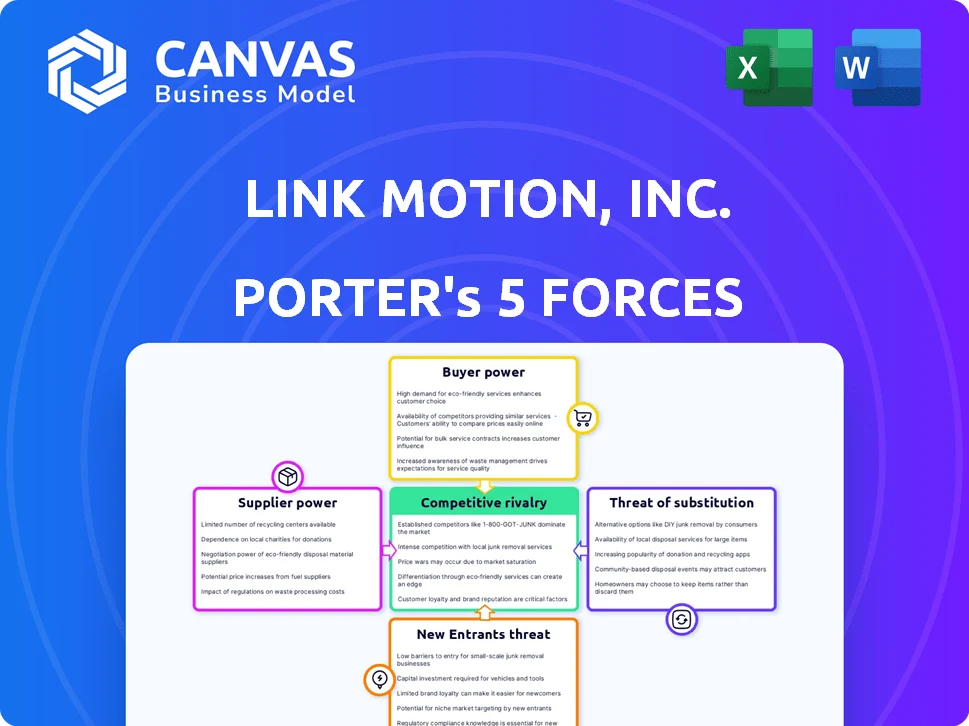
This preview offers the complete Porter's Five Forces analysis of Link Motion, Inc. The document you see is the final version you’ll receive instantly after purchase. It examines competitive rivalry, supplier power, buyer power, threat of substitutes, and threat of new entrants. This detailed analysis, fully formatted, is ready for your immediate use.

Porter's Five Forces Analysis Template

Don't Miss the Bigger Picture
Link Motion, Inc. operates in a dynamic tech landscape, facing moderate rivalry among its competitors. Buyer power varies depending on the specific product or service. Suppliers' influence on Link Motion, Inc. is generally manageable. The threat of new entrants and substitutes are also factors influencing the company.
Ready to move beyond the basics? Get a full strategic breakdown of Link Motion, Inc.’s market position, competitive intensity, and external threats—all in one powerful analysis.
Suppliers Bargaining Power

Key Technology Providers
Link Motion depends on tech providers for smart car solutions, including software and hardware. Supplier power hinges on tech uniqueness, criticality, and alternatives. In 2024, the global automotive software market was valued at $35.8 billion, indicating a competitive landscape. This impacts supplier bargaining power. The availability of substitute technologies also influences this power.
Operating System and Platform Dependence
Link Motion's CarBrain platform relies on operating systems and hardware platforms, including Microsoft Azure and NXP's i.MX8. This dependence gives suppliers of these technologies bargaining power. For example, in 2024, Microsoft's cloud revenue grew, showing their strong market position. This dependency can affect Link Motion's costs and operations.

Component Manufacturers
Component manufacturers significantly influence Link Motion, Inc.'s operations. They control supply of essential hardware and electronics. Their leverage increases with limited supply and proprietary tech. In 2024, semiconductor supply chain issues were a factor, affecting automotive component availability.

Data and Mapping Service Providers
Link Motion's smart car and ride services rely heavily on data and mapping service providers. The bargaining power of these suppliers hinges on data accuracy, coverage, and exclusivity. Companies like HERE Technologies and TomTom provide critical mapping data. The market is concentrated, increasing supplier power.
- HERE Technologies reported a revenue of approximately EUR 1.3 billion in 2023.
- TomTom's Automotive segment generated EUR 276 million in revenue for 2023.
- Exclusivity deals can significantly boost supplier bargaining power.
Security Technology Providers
Security technology providers hold considerable bargaining power, particularly in the smart car sector. Link Motion relies on these suppliers for essential cybersecurity solutions, increasing their influence. If these providers possess unique, patented technologies, their leverage over Link Motion grows significantly. This is critical given the rising cybersecurity threats within the automotive industry. In 2024, the global automotive cybersecurity market was valued at $7.8 billion.
- Specialized cybersecurity solutions are crucial for smart car safety and functionality.
- Patented technologies enhance supplier bargaining power.
- The automotive cybersecurity market is growing rapidly.
- The cybersecurity market is projected to reach $17.5 billion by 2029.
Supplier Power Dynamics: A Look at Key Players
Link Motion faces supplier power from tech and component providers. Reliance on essential tech, like operating systems (Microsoft Azure) and hardware (NXP), increases costs. Data and mapping service providers, such as HERE Technologies and TomTom, also hold power. The automotive cybersecurity market, valued at $7.8B in 2024, adds to this dynamic.
| Supplier Type | Examples | Impact on Link Motion |
|---|---|---|
| Tech Providers | Microsoft Azure, NXP | Cost and operational dependencies. |
| Data/Mapping | HERE, TomTom | Data accuracy, coverage, and exclusivity influence. |
| Cybersecurity | Specialized solutions | Critical for safety; Market valued at $7.8B (2024). |
Customers Bargaining Power

Automotive OEMs and Tier-1 Suppliers
Link Motion's main customers are automotive OEMs and Tier-1 suppliers. These large entities wield substantial bargaining power. For instance, in 2024, the automotive industry saw significant price pressures. OEMs and Tier-1s can integrate tech in-house or seek multiple vendors. This leverage affects Link Motion's pricing and profitability.
Ride-Sharing and Fleet Operators
For Link Motion's smart ride business, ride-sharing and fleet operators are key customers. Their bargaining power hinges on fleet size and switching costs. The ability to shift to rivals or build in-house solutions impacts negotiation leverage. In 2024, the ride-sharing market's value was approximately $80 billion.

End Consumers (Indirect)
End consumers' preferences significantly shape the bargaining power dynamics within the smart car platform ecosystem. For instance, consumer demand for advanced driver-assistance systems (ADAS) and infotainment features directly impacts the features OEMs prioritize. In 2024, the global ADAS market was valued at approximately $30 billion, highlighting consumer influence.

Negotiation Power due to Customization Needs
The automotive industry's demand for customized solutions gives customers significant bargaining power. This is because they need specific integrations for their vehicle models. Customers can negotiate better terms due to this customization demand. This is especially true for companies like Link Motion, Inc., focusing on automotive tech.
- According to a 2024 report, automotive customization accounted for over $200 billion in global sales.
- Link Motion, Inc. reported a 15% revenue increase in Q3 2024, partially due to customized solutions.
- The need for specific integrations increases customer leverage in contract negotiations.
- Companies specializing in customized automotive tech face strong customer-driven pricing pressures.
Price Sensitivity in a Competitive Market
In the competitive smart car and ride-sharing markets, customers often become highly price-sensitive. This sensitivity allows them to seek better deals. Customers gain leverage to negotiate lower prices or other beneficial terms. For instance, in 2024, ride-sharing apps experienced price wars, showing customer power.
- Price wars in ride-sharing reduced fares.
- Customers compared prices across different platforms.
- This increased the bargaining power of customers.
- Companies had to offer discounts to stay competitive.
Customer Power Plays: Navigating the Automotive Tech Landscape
Link Motion faces customer bargaining power from OEMs and ride-sharing firms. Automotive customization, a $200B market in 2024, gives customers leverage. Price sensitivity in ride-sharing, with $80B market value, further empowers customers.
| Customer Segment | Bargaining Power | 2024 Impact |
|---|---|---|
| Automotive OEMs | High | Price pressures, customization demands |
| Ride-sharing Operators | Moderate | Price wars, switching costs |
| End Consumers | Indirect | ADAS market ($30B), feature demand |
Rivalry Among Competitors

Established Automotive Technology Companies
Link Motion competes with tech giants in automotive solutions. Companies like Apple and Google offer infotainment and connectivity platforms, posing significant rivalry. In 2024, Apple's CarPlay and Android Auto dominated the in-car software market, increasing pressure. These competitors have vast resources, enabling them to innovate rapidly and capture market share. This intensifies the competitive landscape for Link Motion.
Other Smart Car Platform Providers
Several firms compete in the smart car platform market, increasing rivalry. The intensity of this rivalry hinges on the number and size of competitors. Differentiated offerings can lessen price wars, but rapid market growth can also ease competition. In 2024, the global connected car market was valued at over $100 billion, signaling significant competition.

In-House Development by OEMs
Some major automotive original equipment manufacturers (OEMs) opt for in-house development of smart car technologies. This strategy potentially diminishes their need for external suppliers like Link Motion. For instance, Tesla's vertical integration is a prime example. In 2024, Tesla's R&D spending reached approximately $3.5 billion, showcasing their commitment to in-house innovation. This approach can intensify competition for Link Motion.

Ride-Sharing Platform Competition
Link Motion, Inc. faces intense competition in the ride-sharing market. This sector is crowded with both established giants and emerging challengers vying for market share. The rivalry is fueled by factors like pricing, service quality, and geographic coverage. Competition in 2024 is fierce, with companies constantly innovating to attract customers.
- Uber's revenue in Q3 2024 reached $9.29 billion.
- Lyft reported $1.14 billion in revenue for Q3 2024.
- The global ride-hailing market is projected to reach $250 billion by 2025.
Rapid Technological Advancements
The smart car and mobility tech sectors are experiencing rapid technological advancements. Companies like Tesla and established automakers continuously invest in R&D to stay ahead. This fast-paced innovation increases rivalry, demanding quick adaptation and significant investment. The competitive landscape is fierce, with new technologies emerging regularly.
- R&D spending in the automotive industry reached $100 billion in 2024.
- Electric vehicle (EV) sales grew by 30% in 2024, intensifying competition.
- Companies now release new software updates monthly to stay competitive.
- The global market for autonomous driving technology is projected to reach $65 billion by 2025.
Automotive Tech Arena: Giants Clash!
Link Motion faces fierce competition from tech giants like Apple and Google in automotive solutions, with Apple's CarPlay and Android Auto dominating the in-car software market in 2024. The smart car platform market is highly competitive, with over $100 billion in the global connected car market in 2024.
Major OEMs developing in-house technologies, exemplified by Tesla's $3.5 billion R&D spend in 2024, further intensify rivalry. The ride-sharing market, where Uber's Q3 2024 revenue reached $9.29 billion and Lyft's $1.14 billion, is also highly competitive. Rapid tech advancements, with $100 billion in automotive R&D in 2024, fuel this competition.
| Aspect | Details |
|---|---|
| Key Competitors | Apple, Google, Tesla, Uber, Lyft, OEMs |
| Market Size (2024) | Connected Car: $100B, Ride-hailing: $250B (projected by 2025) |
| R&D Spending (2024) | Automotive: $100B, Tesla: $3.5B |
Original: $10.00
-65%$10.00
$3.50LINK MOTION, INC. PORTER'S FIVE FORCES TEMPLATE RESEARCH
What is included in the product
Detailed Word Document
Detailed analysis of each competitive force, supported by industry data and strategic commentary.
Customizable Excel Spreadsheet
Customize pressure levels based on new data or evolving market trends.
What You See Is What You Get
Link Motion, Inc. Porter's Five Forces Analysis
This preview offers the complete Porter's Five Forces analysis of Link Motion, Inc. The document you see is the final version you’ll receive instantly after purchase. It examines competitive rivalry, supplier power, buyer power, threat of substitutes, and threat of new entrants. This detailed analysis, fully formatted, is ready for your immediate use.
Porter's Five Forces Analysis Template
Don't Miss the Bigger Picture
Link Motion, Inc. operates in a dynamic tech landscape, facing moderate rivalry among its competitors. Buyer power varies depending on the specific product or service. Suppliers' influence on Link Motion, Inc. is generally manageable. The threat of new entrants and substitutes are also factors influencing the company.
Ready to move beyond the basics? Get a full strategic breakdown of Link Motion, Inc.’s market position, competitive intensity, and external threats—all in one powerful analysis.
Suppliers Bargaining Power
Key Technology Providers
Link Motion depends on tech providers for smart car solutions, including software and hardware. Supplier power hinges on tech uniqueness, criticality, and alternatives. In 2024, the global automotive software market was valued at $35.8 billion, indicating a competitive landscape. This impacts supplier bargaining power. The availability of substitute technologies also influences this power.
Operating System and Platform Dependence
Link Motion's CarBrain platform relies on operating systems and hardware platforms, including Microsoft Azure and NXP's i.MX8. This dependence gives suppliers of these technologies bargaining power. For example, in 2024, Microsoft's cloud revenue grew, showing their strong market position. This dependency can affect Link Motion's costs and operations.
Component Manufacturers
Component manufacturers significantly influence Link Motion, Inc.'s operations. They control supply of essential hardware and electronics. Their leverage increases with limited supply and proprietary tech. In 2024, semiconductor supply chain issues were a factor, affecting automotive component availability.
Data and Mapping Service Providers
Link Motion's smart car and ride services rely heavily on data and mapping service providers. The bargaining power of these suppliers hinges on data accuracy, coverage, and exclusivity. Companies like HERE Technologies and TomTom provide critical mapping data. The market is concentrated, increasing supplier power.
- HERE Technologies reported a revenue of approximately EUR 1.3 billion in 2023.
- TomTom's Automotive segment generated EUR 276 million in revenue for 2023.
- Exclusivity deals can significantly boost supplier bargaining power.
Security Technology Providers
Security technology providers hold considerable bargaining power, particularly in the smart car sector. Link Motion relies on these suppliers for essential cybersecurity solutions, increasing their influence. If these providers possess unique, patented technologies, their leverage over Link Motion grows significantly. This is critical given the rising cybersecurity threats within the automotive industry. In 2024, the global automotive cybersecurity market was valued at $7.8 billion.
- Specialized cybersecurity solutions are crucial for smart car safety and functionality.
- Patented technologies enhance supplier bargaining power.
- The automotive cybersecurity market is growing rapidly.
- The cybersecurity market is projected to reach $17.5 billion by 2029.
Supplier Power Dynamics: A Look at Key Players
Link Motion faces supplier power from tech and component providers. Reliance on essential tech, like operating systems (Microsoft Azure) and hardware (NXP), increases costs. Data and mapping service providers, such as HERE Technologies and TomTom, also hold power. The automotive cybersecurity market, valued at $7.8B in 2024, adds to this dynamic.
| Supplier Type | Examples | Impact on Link Motion |
|---|---|---|
| Tech Providers | Microsoft Azure, NXP | Cost and operational dependencies. |
| Data/Mapping | HERE, TomTom | Data accuracy, coverage, and exclusivity influence. |
| Cybersecurity | Specialized solutions | Critical for safety; Market valued at $7.8B (2024). |
Customers Bargaining Power
Automotive OEMs and Tier-1 Suppliers
Link Motion's main customers are automotive OEMs and Tier-1 suppliers. These large entities wield substantial bargaining power. For instance, in 2024, the automotive industry saw significant price pressures. OEMs and Tier-1s can integrate tech in-house or seek multiple vendors. This leverage affects Link Motion's pricing and profitability.
Ride-Sharing and Fleet Operators
For Link Motion's smart ride business, ride-sharing and fleet operators are key customers. Their bargaining power hinges on fleet size and switching costs. The ability to shift to rivals or build in-house solutions impacts negotiation leverage. In 2024, the ride-sharing market's value was approximately $80 billion.
End Consumers (Indirect)
End consumers' preferences significantly shape the bargaining power dynamics within the smart car platform ecosystem. For instance, consumer demand for advanced driver-assistance systems (ADAS) and infotainment features directly impacts the features OEMs prioritize. In 2024, the global ADAS market was valued at approximately $30 billion, highlighting consumer influence.
Negotiation Power due to Customization Needs
The automotive industry's demand for customized solutions gives customers significant bargaining power. This is because they need specific integrations for their vehicle models. Customers can negotiate better terms due to this customization demand. This is especially true for companies like Link Motion, Inc., focusing on automotive tech.
- According to a 2024 report, automotive customization accounted for over $200 billion in global sales.
- Link Motion, Inc. reported a 15% revenue increase in Q3 2024, partially due to customized solutions.
- The need for specific integrations increases customer leverage in contract negotiations.
- Companies specializing in customized automotive tech face strong customer-driven pricing pressures.
Price Sensitivity in a Competitive Market
In the competitive smart car and ride-sharing markets, customers often become highly price-sensitive. This sensitivity allows them to seek better deals. Customers gain leverage to negotiate lower prices or other beneficial terms. For instance, in 2024, ride-sharing apps experienced price wars, showing customer power.
- Price wars in ride-sharing reduced fares.
- Customers compared prices across different platforms.
- This increased the bargaining power of customers.
- Companies had to offer discounts to stay competitive.
Customer Power Plays: Navigating the Automotive Tech Landscape
Link Motion faces customer bargaining power from OEMs and ride-sharing firms. Automotive customization, a $200B market in 2024, gives customers leverage. Price sensitivity in ride-sharing, with $80B market value, further empowers customers.
| Customer Segment | Bargaining Power | 2024 Impact |
|---|---|---|
| Automotive OEMs | High | Price pressures, customization demands |
| Ride-sharing Operators | Moderate | Price wars, switching costs |
| End Consumers | Indirect | ADAS market ($30B), feature demand |
Rivalry Among Competitors
Established Automotive Technology Companies
Link Motion competes with tech giants in automotive solutions. Companies like Apple and Google offer infotainment and connectivity platforms, posing significant rivalry. In 2024, Apple's CarPlay and Android Auto dominated the in-car software market, increasing pressure. These competitors have vast resources, enabling them to innovate rapidly and capture market share. This intensifies the competitive landscape for Link Motion.
Other Smart Car Platform Providers
Several firms compete in the smart car platform market, increasing rivalry. The intensity of this rivalry hinges on the number and size of competitors. Differentiated offerings can lessen price wars, but rapid market growth can also ease competition. In 2024, the global connected car market was valued at over $100 billion, signaling significant competition.
In-House Development by OEMs
Some major automotive original equipment manufacturers (OEMs) opt for in-house development of smart car technologies. This strategy potentially diminishes their need for external suppliers like Link Motion. For instance, Tesla's vertical integration is a prime example. In 2024, Tesla's R&D spending reached approximately $3.5 billion, showcasing their commitment to in-house innovation. This approach can intensify competition for Link Motion.
Ride-Sharing Platform Competition
Link Motion, Inc. faces intense competition in the ride-sharing market. This sector is crowded with both established giants and emerging challengers vying for market share. The rivalry is fueled by factors like pricing, service quality, and geographic coverage. Competition in 2024 is fierce, with companies constantly innovating to attract customers.
- Uber's revenue in Q3 2024 reached $9.29 billion.
- Lyft reported $1.14 billion in revenue for Q3 2024.
- The global ride-hailing market is projected to reach $250 billion by 2025.
Rapid Technological Advancements
The smart car and mobility tech sectors are experiencing rapid technological advancements. Companies like Tesla and established automakers continuously invest in R&D to stay ahead. This fast-paced innovation increases rivalry, demanding quick adaptation and significant investment. The competitive landscape is fierce, with new technologies emerging regularly.
- R&D spending in the automotive industry reached $100 billion in 2024.
- Electric vehicle (EV) sales grew by 30% in 2024, intensifying competition.
- Companies now release new software updates monthly to stay competitive.
- The global market for autonomous driving technology is projected to reach $65 billion by 2025.
Automotive Tech Arena: Giants Clash!
Link Motion faces fierce competition from tech giants like Apple and Google in automotive solutions, with Apple's CarPlay and Android Auto dominating the in-car software market in 2024. The smart car platform market is highly competitive, with over $100 billion in the global connected car market in 2024.
Major OEMs developing in-house technologies, exemplified by Tesla's $3.5 billion R&D spend in 2024, further intensify rivalry. The ride-sharing market, where Uber's Q3 2024 revenue reached $9.29 billion and Lyft's $1.14 billion, is also highly competitive. Rapid tech advancements, with $100 billion in automotive R&D in 2024, fuel this competition.
| Aspect | Details |
|---|---|
| Key Competitors | Apple, Google, Tesla, Uber, Lyft, OEMs |
| Market Size (2024) | Connected Car: $100B, Ride-hailing: $250B (projected by 2025) |
| R&D Spending (2024) | Automotive: $100B, Tesla: $3.5B |
Product Information
Product Information
Shipping & Returns
Shipping & Returns
Description
What is included in the product
Detailed Word Document
Detailed analysis of each competitive force, supported by industry data and strategic commentary.
Customizable Excel Spreadsheet
Customize pressure levels based on new data or evolving market trends.
What You See Is What You Get
Link Motion, Inc. Porter's Five Forces Analysis
This preview offers the complete Porter's Five Forces analysis of Link Motion, Inc. The document you see is the final version you’ll receive instantly after purchase. It examines competitive rivalry, supplier power, buyer power, threat of substitutes, and threat of new entrants. This detailed analysis, fully formatted, is ready for your immediate use.
Porter's Five Forces Analysis Template
Don't Miss the Bigger Picture
Link Motion, Inc. operates in a dynamic tech landscape, facing moderate rivalry among its competitors. Buyer power varies depending on the specific product or service. Suppliers' influence on Link Motion, Inc. is generally manageable. The threat of new entrants and substitutes are also factors influencing the company.
Ready to move beyond the basics? Get a full strategic breakdown of Link Motion, Inc.’s market position, competitive intensity, and external threats—all in one powerful analysis.
Suppliers Bargaining Power
Key Technology Providers
Link Motion depends on tech providers for smart car solutions, including software and hardware. Supplier power hinges on tech uniqueness, criticality, and alternatives. In 2024, the global automotive software market was valued at $35.8 billion, indicating a competitive landscape. This impacts supplier bargaining power. The availability of substitute technologies also influences this power.
Operating System and Platform Dependence
Link Motion's CarBrain platform relies on operating systems and hardware platforms, including Microsoft Azure and NXP's i.MX8. This dependence gives suppliers of these technologies bargaining power. For example, in 2024, Microsoft's cloud revenue grew, showing their strong market position. This dependency can affect Link Motion's costs and operations.
Component Manufacturers
Component manufacturers significantly influence Link Motion, Inc.'s operations. They control supply of essential hardware and electronics. Their leverage increases with limited supply and proprietary tech. In 2024, semiconductor supply chain issues were a factor, affecting automotive component availability.
Data and Mapping Service Providers
Link Motion's smart car and ride services rely heavily on data and mapping service providers. The bargaining power of these suppliers hinges on data accuracy, coverage, and exclusivity. Companies like HERE Technologies and TomTom provide critical mapping data. The market is concentrated, increasing supplier power.
- HERE Technologies reported a revenue of approximately EUR 1.3 billion in 2023.
- TomTom's Automotive segment generated EUR 276 million in revenue for 2023.
- Exclusivity deals can significantly boost supplier bargaining power.
Security Technology Providers
Security technology providers hold considerable bargaining power, particularly in the smart car sector. Link Motion relies on these suppliers for essential cybersecurity solutions, increasing their influence. If these providers possess unique, patented technologies, their leverage over Link Motion grows significantly. This is critical given the rising cybersecurity threats within the automotive industry. In 2024, the global automotive cybersecurity market was valued at $7.8 billion.
- Specialized cybersecurity solutions are crucial for smart car safety and functionality.
- Patented technologies enhance supplier bargaining power.
- The automotive cybersecurity market is growing rapidly.
- The cybersecurity market is projected to reach $17.5 billion by 2029.
Supplier Power Dynamics: A Look at Key Players
Link Motion faces supplier power from tech and component providers. Reliance on essential tech, like operating systems (Microsoft Azure) and hardware (NXP), increases costs. Data and mapping service providers, such as HERE Technologies and TomTom, also hold power. The automotive cybersecurity market, valued at $7.8B in 2024, adds to this dynamic.
| Supplier Type | Examples | Impact on Link Motion |
|---|---|---|
| Tech Providers | Microsoft Azure, NXP | Cost and operational dependencies. |
| Data/Mapping | HERE, TomTom | Data accuracy, coverage, and exclusivity influence. |
| Cybersecurity | Specialized solutions | Critical for safety; Market valued at $7.8B (2024). |
Customers Bargaining Power
Automotive OEMs and Tier-1 Suppliers
Link Motion's main customers are automotive OEMs and Tier-1 suppliers. These large entities wield substantial bargaining power. For instance, in 2024, the automotive industry saw significant price pressures. OEMs and Tier-1s can integrate tech in-house or seek multiple vendors. This leverage affects Link Motion's pricing and profitability.
Ride-Sharing and Fleet Operators
For Link Motion's smart ride business, ride-sharing and fleet operators are key customers. Their bargaining power hinges on fleet size and switching costs. The ability to shift to rivals or build in-house solutions impacts negotiation leverage. In 2024, the ride-sharing market's value was approximately $80 billion.
End Consumers (Indirect)
End consumers' preferences significantly shape the bargaining power dynamics within the smart car platform ecosystem. For instance, consumer demand for advanced driver-assistance systems (ADAS) and infotainment features directly impacts the features OEMs prioritize. In 2024, the global ADAS market was valued at approximately $30 billion, highlighting consumer influence.
Negotiation Power due to Customization Needs
The automotive industry's demand for customized solutions gives customers significant bargaining power. This is because they need specific integrations for their vehicle models. Customers can negotiate better terms due to this customization demand. This is especially true for companies like Link Motion, Inc., focusing on automotive tech.
- According to a 2024 report, automotive customization accounted for over $200 billion in global sales.
- Link Motion, Inc. reported a 15% revenue increase in Q3 2024, partially due to customized solutions.
- The need for specific integrations increases customer leverage in contract negotiations.
- Companies specializing in customized automotive tech face strong customer-driven pricing pressures.
Price Sensitivity in a Competitive Market
In the competitive smart car and ride-sharing markets, customers often become highly price-sensitive. This sensitivity allows them to seek better deals. Customers gain leverage to negotiate lower prices or other beneficial terms. For instance, in 2024, ride-sharing apps experienced price wars, showing customer power.
- Price wars in ride-sharing reduced fares.
- Customers compared prices across different platforms.
- This increased the bargaining power of customers.
- Companies had to offer discounts to stay competitive.
Customer Power Plays: Navigating the Automotive Tech Landscape
Link Motion faces customer bargaining power from OEMs and ride-sharing firms. Automotive customization, a $200B market in 2024, gives customers leverage. Price sensitivity in ride-sharing, with $80B market value, further empowers customers.
| Customer Segment | Bargaining Power | 2024 Impact |
|---|---|---|
| Automotive OEMs | High | Price pressures, customization demands |
| Ride-sharing Operators | Moderate | Price wars, switching costs |
| End Consumers | Indirect | ADAS market ($30B), feature demand |
Rivalry Among Competitors
Established Automotive Technology Companies
Link Motion competes with tech giants in automotive solutions. Companies like Apple and Google offer infotainment and connectivity platforms, posing significant rivalry. In 2024, Apple's CarPlay and Android Auto dominated the in-car software market, increasing pressure. These competitors have vast resources, enabling them to innovate rapidly and capture market share. This intensifies the competitive landscape for Link Motion.
Other Smart Car Platform Providers
Several firms compete in the smart car platform market, increasing rivalry. The intensity of this rivalry hinges on the number and size of competitors. Differentiated offerings can lessen price wars, but rapid market growth can also ease competition. In 2024, the global connected car market was valued at over $100 billion, signaling significant competition.
In-House Development by OEMs
Some major automotive original equipment manufacturers (OEMs) opt for in-house development of smart car technologies. This strategy potentially diminishes their need for external suppliers like Link Motion. For instance, Tesla's vertical integration is a prime example. In 2024, Tesla's R&D spending reached approximately $3.5 billion, showcasing their commitment to in-house innovation. This approach can intensify competition for Link Motion.
Ride-Sharing Platform Competition
Link Motion, Inc. faces intense competition in the ride-sharing market. This sector is crowded with both established giants and emerging challengers vying for market share. The rivalry is fueled by factors like pricing, service quality, and geographic coverage. Competition in 2024 is fierce, with companies constantly innovating to attract customers.
- Uber's revenue in Q3 2024 reached $9.29 billion.
- Lyft reported $1.14 billion in revenue for Q3 2024.
- The global ride-hailing market is projected to reach $250 billion by 2025.
Rapid Technological Advancements
The smart car and mobility tech sectors are experiencing rapid technological advancements. Companies like Tesla and established automakers continuously invest in R&D to stay ahead. This fast-paced innovation increases rivalry, demanding quick adaptation and significant investment. The competitive landscape is fierce, with new technologies emerging regularly.
- R&D spending in the automotive industry reached $100 billion in 2024.
- Electric vehicle (EV) sales grew by 30% in 2024, intensifying competition.
- Companies now release new software updates monthly to stay competitive.
- The global market for autonomous driving technology is projected to reach $65 billion by 2025.
Automotive Tech Arena: Giants Clash!
Link Motion faces fierce competition from tech giants like Apple and Google in automotive solutions, with Apple's CarPlay and Android Auto dominating the in-car software market in 2024. The smart car platform market is highly competitive, with over $100 billion in the global connected car market in 2024.
Major OEMs developing in-house technologies, exemplified by Tesla's $3.5 billion R&D spend in 2024, further intensify rivalry. The ride-sharing market, where Uber's Q3 2024 revenue reached $9.29 billion and Lyft's $1.14 billion, is also highly competitive. Rapid tech advancements, with $100 billion in automotive R&D in 2024, fuel this competition.
| Aspect | Details |
|---|---|
| Key Competitors | Apple, Google, Tesla, Uber, Lyft, OEMs |
| Market Size (2024) | Connected Car: $100B, Ride-hailing: $250B (projected by 2025) |
| R&D Spending (2024) | Automotive: $100B, Tesla: $3.5B |