
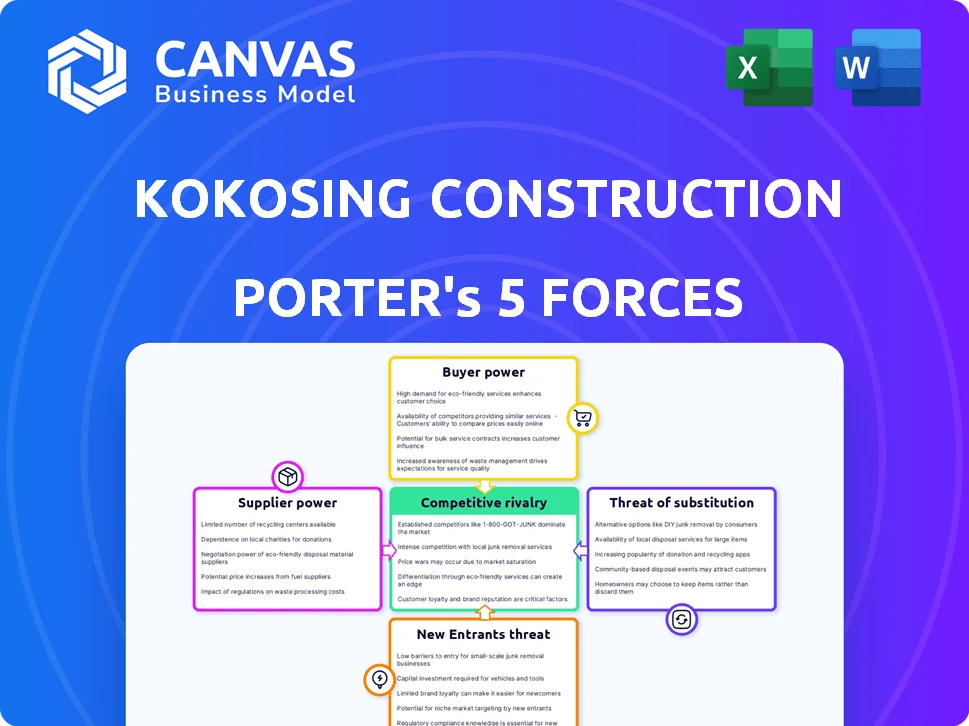
KOKOSING CONSTRUCTION PORTER'S FIVE FORCES TEMPLATE RESEARCH
What is included in the product
 Detailed Word Document
Tailored exclusively for Kokosing Construction, analyzing its position within its competitive landscape.

 Customizable Excel Spreadsheet
Customize pressure levels based on new data or evolving market trends.
Same Document Delivered
Kokosing Construction Porter's Five Forces Analysis
This preview presents the complete Porter's Five Forces analysis for Kokosing Construction. The document examines competitive rivalry, supplier power, buyer power, threat of substitutes, and threat of new entrants. You're seeing the same professionally crafted analysis file you'll instantly download. It is fully formatted, ready for immediate use upon purchase. No extra steps are needed; this is the final product.

Porter's Five Forces Analysis Template

A Must-Have Tool for Decision-Makers
Kokosing Construction faces moderate competition, with buyer power stemming from project owners' ability to negotiate. Supplier power, though, is somewhat limited due to readily available materials. Threat of new entrants is moderate, with high initial capital requirements. The industry's rivalry is intense, with many firms vying for contracts. Substitute threats are minimal.
Unlock key insights into Kokosing Construction’s industry forces—from buyer power to substitute threats—and use this knowledge to inform strategy or investment decisions.
Suppliers Bargaining Power

Availability of Key Materials
Kokosing Construction, like other firms, faces supplier bargaining power. Construction relies heavily on materials like concrete and steel. In 2024, steel prices fluctuated, impacting costs. Supply disruptions can delay projects. Material costs often represent 40-60% of total expenses.
Concentration of Suppliers
Kokosing Construction's profitability could be threatened by a limited number of key suppliers. These suppliers, controlling essential materials or equipment, gain leverage to set prices and terms. For example, in 2024, construction material costs rose, affecting project margins. This dynamic underscores the importance of diversified supplier relationships.

Supplier Switching Costs
Kokosing's ability to switch suppliers affects supplier power. High switching costs, like specialized materials, boost supplier power. For instance, if Kokosing uses unique concrete mixes, suppliers gain leverage. Consider that in 2024, construction material prices saw fluctuations, impacting supplier negotiations. This highlights how essential efficient supplier switching can be.

Forward Vertical Integration of Suppliers
If Kokosing Construction's suppliers could move into construction, they'd become a bigger threat. This strategy, known as forward vertical integration, lets suppliers control more of the process. It could mean they start competing directly with Kokosing. For example, in 2024, the construction materials market saw significant consolidation, with major suppliers increasing their market share, potentially giving them more leverage to integrate forward.
- Supplier integration reduces the construction company's control.
- Suppliers can capture higher profits.
- Increased competition for Kokosing.
- Market consolidation enhances supplier power.
Labor Availability and Cost
Labor availability significantly shapes supplier bargaining power. A skilled labor shortage boosts worker leverage, potentially increasing wage demands. This directly affects project expenses and completion schedules for construction firms. In 2024, the construction sector faced persistent labor gaps, impacting project costs. According to the Associated General Contractors of America, 72% of construction firms reported difficulty filling hourly craft positions in 2024.
- Wage growth in construction averaged around 4.5% in 2024, reflecting increased labor costs.
- Project delays due to labor shortages were common, with some projects extending by several months.
- Construction companies increasingly invested in training programs to mitigate the skills gap.
- The labor shortage particularly affected specialized trades, such as electricians and plumbers.
Supplier Dynamics: Impacting Project Costs
Supplier power significantly impacts Kokosing Construction. Key suppliers can dictate prices, influencing project costs. Labor shortages also boost supplier leverage, affecting project expenses.
In 2024, material cost fluctuations and labor gaps were crucial. These factors can squeeze profit margins. Diversifying suppliers is crucial to mitigate risks.
| Factor | Impact | 2024 Data |
|---|---|---|
| Material Costs | Influence on Project Costs | Steel prices fluctuated; 40-60% of expenses. |
| Labor Availability | Wage & Schedule Impact | 72% of firms faced labor shortages. |
| Supplier Concentration | Pricing Power | Market consolidation increased supplier leverage. |
Customers Bargaining Power

Concentration of Customers
Kokosing Construction's customer base includes government bodies and private firms. Large customers can wield more influence if they represent a substantial revenue share. For example, in 2024, approximately 30% of construction revenue came from government contracts. This concentration could elevate customer bargaining power.
Project Size and Value
Large projects amplify customer bargaining power. Kokosing, in 2024, secured a $400 million project. Customers, like government entities, can influence terms. They can negotiate pricing, payment schedules, and other contract details. This leverage stems from the substantial revenue at stake for Kokosing.

Availability of Other Contractors
When numerous construction companies are available, customers gain significant leverage. This increased availability enables them to compare bids and select the most favorable terms. For instance, in 2024, the construction industry saw a 5% increase in the number of active firms, amplifying customer choice. The ability to switch contractors easily strengthens their bargaining position.

Customer Switching Costs
Customers wield substantial power in the construction sector, especially during the initial contractor selection phase. Their ability to switch contractors before a project begins is a key factor. This pre-project phase provides customers with significant leverage. In 2024, the construction industry saw a 5% increase in project bidding, highlighting the competitive landscape where customers can easily choose.
- Easy contractor selection increases customer power.
- Switching costs are high, but initial choice is key.
- Competitive bidding gives customers leverage.
- Bidding volume rose by 5% in 2024.
Customer Sophistication and Knowledge
Experienced and knowledgeable customers, like government agencies, wield considerable bargaining power. They're well-versed in market rates and construction processes, giving them an edge in negotiations. This allows them to drive down prices or demand favorable terms. In 2024, government contracts accounted for a significant portion of Kokosing Construction's revenue, highlighting the impact of customer power.
- Government contracts often have strict requirements.
- Customers can compare bids from multiple construction firms.
- Negotiations can significantly impact profitability.
- Detailed specifications limit flexibility.
Customer Power Dynamics: A Look at Bargaining Influence
Kokosing's customers, including government bodies and private firms, hold notable bargaining power, especially when they represent a significant portion of revenue. In 2024, approximately 30% of Kokosing's construction revenue came from government contracts, amplifying customer influence. Large projects and competitive bidding further enhance customer leverage, enabling them to negotiate favorable terms.
| Factor | Impact | 2024 Data |
|---|---|---|
| Customer Concentration | Higher bargaining power | 30% revenue from government contracts |
| Project Size | Negotiating strength | $400M project secured |
| Industry Competition | Increased customer choice | 5% rise in active firms |
Rivalry Among Competitors

Number and Size of Competitors
The construction industry, especially in heavy civil, marine, and railroad, features a mix of large national and smaller regional firms. The number and size of competitors significantly affect rivalry intensity. In 2024, the U.S. construction market reached approximately $1.9 trillion. This landscape includes numerous competitors. The rivalry intensifies when competitors are similar in size and offer comparable services.
Industry Growth Rate
The heavy and civil engineering construction market saw a 4.3% rise in 2024. Marine construction also demonstrated growth, with an estimated 3.8% expansion. While expanding markets can ease rivalry, they also lure in new competitors. This dynamic increases competition.

Exit Barriers
High exit barriers are a significant factor in Kokosing Construction's competitive environment. Specialized equipment and long-term contracts make it tough for firms to leave. These barriers can intensify rivalry, especially during economic downturns.

Differentiation of Services
Kokosing Construction, like other construction firms, faces competitive rivalry shaped by service differentiation. While the core services are similar, companies distinguish themselves through specialization, quality, safety, and reputation. These factors influence pricing strategies and market positioning, affecting competition intensity. For instance, firms with impeccable safety records can command higher prices. This differentiation impacts the degree to which companies compete on price versus other value propositions.
- Specialization in areas like bridge construction or environmental remediation can reduce price sensitivity.
- High-quality work, as measured by project success rates, allows for premium pricing.
- Strong safety records, demonstrated through low incident rates, can lower insurance costs and enhance reputation.
- Innovation, such as adopting advanced construction technologies, can create a competitive edge.
Market Concentration
Market concentration significantly impacts Kokosing Construction's competitive environment. While numerous construction firms exist, the market for large-scale projects, such as heavy civil, marine, and railroad work, could be concentrated among a few dominant players. This concentration influences the intensity of rivalry, potentially leading to price wars or strategic alliances. The degree of concentration within Kokosing's specific market segments directly affects its competitive positioning and profitability.
- The construction industry's market share concentration can vary widely depending on the project type and geographical location.
- In 2024, the top 10 construction companies in the US accounted for roughly 30-40% of the total market revenue.
- Highly specialized segments like marine construction might be more concentrated, with the top 5 firms controlling a larger share.
- Market concentration can influence pricing strategies, with fewer competitors potentially leading to higher profit margins.
Construction Market Dynamics: A Competitive Overview
Competitive rivalry in Kokosing Construction's markets is shaped by market size, with the U.S. construction market reaching $1.9T in 2024. The presence of numerous competitors, along with similar service offerings, intensifies rivalry. High exit barriers and service differentiation, like safety records, further influence competition.
| Factor | Impact | Data (2024) |
|---|---|---|
| Market Size | More rivals | $1.9T US market |
| Exit Barriers | Intensify rivalry | Specialized equipment |
| Differentiation | Influence pricing | Safety records |
KOKOSING CONSTRUCTION PORTER'S FIVE FORCES TEMPLATE RESEARCH
What is included in the product
Detailed Word Document
Tailored exclusively for Kokosing Construction, analyzing its position within its competitive landscape.
Customizable Excel Spreadsheet
Customize pressure levels based on new data or evolving market trends.
Same Document Delivered
Kokosing Construction Porter's Five Forces Analysis
This preview presents the complete Porter's Five Forces analysis for Kokosing Construction. The document examines competitive rivalry, supplier power, buyer power, threat of substitutes, and threat of new entrants. You're seeing the same professionally crafted analysis file you'll instantly download. It is fully formatted, ready for immediate use upon purchase. No extra steps are needed; this is the final product.
Porter's Five Forces Analysis Template
A Must-Have Tool for Decision-Makers
Kokosing Construction faces moderate competition, with buyer power stemming from project owners' ability to negotiate. Supplier power, though, is somewhat limited due to readily available materials. Threat of new entrants is moderate, with high initial capital requirements. The industry's rivalry is intense, with many firms vying for contracts. Substitute threats are minimal.
Unlock key insights into Kokosing Construction’s industry forces—from buyer power to substitute threats—and use this knowledge to inform strategy or investment decisions.
Suppliers Bargaining Power
Availability of Key Materials
Kokosing Construction, like other firms, faces supplier bargaining power. Construction relies heavily on materials like concrete and steel. In 2024, steel prices fluctuated, impacting costs. Supply disruptions can delay projects. Material costs often represent 40-60% of total expenses.
Concentration of Suppliers
Kokosing Construction's profitability could be threatened by a limited number of key suppliers. These suppliers, controlling essential materials or equipment, gain leverage to set prices and terms. For example, in 2024, construction material costs rose, affecting project margins. This dynamic underscores the importance of diversified supplier relationships.
Supplier Switching Costs
Kokosing's ability to switch suppliers affects supplier power. High switching costs, like specialized materials, boost supplier power. For instance, if Kokosing uses unique concrete mixes, suppliers gain leverage. Consider that in 2024, construction material prices saw fluctuations, impacting supplier negotiations. This highlights how essential efficient supplier switching can be.
Forward Vertical Integration of Suppliers
If Kokosing Construction's suppliers could move into construction, they'd become a bigger threat. This strategy, known as forward vertical integration, lets suppliers control more of the process. It could mean they start competing directly with Kokosing. For example, in 2024, the construction materials market saw significant consolidation, with major suppliers increasing their market share, potentially giving them more leverage to integrate forward.
- Supplier integration reduces the construction company's control.
- Suppliers can capture higher profits.
- Increased competition for Kokosing.
- Market consolidation enhances supplier power.
Labor Availability and Cost
Labor availability significantly shapes supplier bargaining power. A skilled labor shortage boosts worker leverage, potentially increasing wage demands. This directly affects project expenses and completion schedules for construction firms. In 2024, the construction sector faced persistent labor gaps, impacting project costs. According to the Associated General Contractors of America, 72% of construction firms reported difficulty filling hourly craft positions in 2024.
- Wage growth in construction averaged around 4.5% in 2024, reflecting increased labor costs.
- Project delays due to labor shortages were common, with some projects extending by several months.
- Construction companies increasingly invested in training programs to mitigate the skills gap.
- The labor shortage particularly affected specialized trades, such as electricians and plumbers.
Supplier Dynamics: Impacting Project Costs
Supplier power significantly impacts Kokosing Construction. Key suppliers can dictate prices, influencing project costs. Labor shortages also boost supplier leverage, affecting project expenses.
In 2024, material cost fluctuations and labor gaps were crucial. These factors can squeeze profit margins. Diversifying suppliers is crucial to mitigate risks.
| Factor | Impact | 2024 Data |
|---|---|---|
| Material Costs | Influence on Project Costs | Steel prices fluctuated; 40-60% of expenses. |
| Labor Availability | Wage & Schedule Impact | 72% of firms faced labor shortages. |
| Supplier Concentration | Pricing Power | Market consolidation increased supplier leverage. |
Customers Bargaining Power
Concentration of Customers
Kokosing Construction's customer base includes government bodies and private firms. Large customers can wield more influence if they represent a substantial revenue share. For example, in 2024, approximately 30% of construction revenue came from government contracts. This concentration could elevate customer bargaining power.
Project Size and Value
Large projects amplify customer bargaining power. Kokosing, in 2024, secured a $400 million project. Customers, like government entities, can influence terms. They can negotiate pricing, payment schedules, and other contract details. This leverage stems from the substantial revenue at stake for Kokosing.
Availability of Other Contractors
When numerous construction companies are available, customers gain significant leverage. This increased availability enables them to compare bids and select the most favorable terms. For instance, in 2024, the construction industry saw a 5% increase in the number of active firms, amplifying customer choice. The ability to switch contractors easily strengthens their bargaining position.
Customer Switching Costs
Customers wield substantial power in the construction sector, especially during the initial contractor selection phase. Their ability to switch contractors before a project begins is a key factor. This pre-project phase provides customers with significant leverage. In 2024, the construction industry saw a 5% increase in project bidding, highlighting the competitive landscape where customers can easily choose.
- Easy contractor selection increases customer power.
- Switching costs are high, but initial choice is key.
- Competitive bidding gives customers leverage.
- Bidding volume rose by 5% in 2024.
Customer Sophistication and Knowledge
Experienced and knowledgeable customers, like government agencies, wield considerable bargaining power. They're well-versed in market rates and construction processes, giving them an edge in negotiations. This allows them to drive down prices or demand favorable terms. In 2024, government contracts accounted for a significant portion of Kokosing Construction's revenue, highlighting the impact of customer power.
- Government contracts often have strict requirements.
- Customers can compare bids from multiple construction firms.
- Negotiations can significantly impact profitability.
- Detailed specifications limit flexibility.
Customer Power Dynamics: A Look at Bargaining Influence
Kokosing's customers, including government bodies and private firms, hold notable bargaining power, especially when they represent a significant portion of revenue. In 2024, approximately 30% of Kokosing's construction revenue came from government contracts, amplifying customer influence. Large projects and competitive bidding further enhance customer leverage, enabling them to negotiate favorable terms.
| Factor | Impact | 2024 Data |
|---|---|---|
| Customer Concentration | Higher bargaining power | 30% revenue from government contracts |
| Project Size | Negotiating strength | $400M project secured |
| Industry Competition | Increased customer choice | 5% rise in active firms |
Rivalry Among Competitors
Number and Size of Competitors
The construction industry, especially in heavy civil, marine, and railroad, features a mix of large national and smaller regional firms. The number and size of competitors significantly affect rivalry intensity. In 2024, the U.S. construction market reached approximately $1.9 trillion. This landscape includes numerous competitors. The rivalry intensifies when competitors are similar in size and offer comparable services.
Industry Growth Rate
The heavy and civil engineering construction market saw a 4.3% rise in 2024. Marine construction also demonstrated growth, with an estimated 3.8% expansion. While expanding markets can ease rivalry, they also lure in new competitors. This dynamic increases competition.
Exit Barriers
High exit barriers are a significant factor in Kokosing Construction's competitive environment. Specialized equipment and long-term contracts make it tough for firms to leave. These barriers can intensify rivalry, especially during economic downturns.
Differentiation of Services
Kokosing Construction, like other construction firms, faces competitive rivalry shaped by service differentiation. While the core services are similar, companies distinguish themselves through specialization, quality, safety, and reputation. These factors influence pricing strategies and market positioning, affecting competition intensity. For instance, firms with impeccable safety records can command higher prices. This differentiation impacts the degree to which companies compete on price versus other value propositions.
- Specialization in areas like bridge construction or environmental remediation can reduce price sensitivity.
- High-quality work, as measured by project success rates, allows for premium pricing.
- Strong safety records, demonstrated through low incident rates, can lower insurance costs and enhance reputation.
- Innovation, such as adopting advanced construction technologies, can create a competitive edge.
Market Concentration
Market concentration significantly impacts Kokosing Construction's competitive environment. While numerous construction firms exist, the market for large-scale projects, such as heavy civil, marine, and railroad work, could be concentrated among a few dominant players. This concentration influences the intensity of rivalry, potentially leading to price wars or strategic alliances. The degree of concentration within Kokosing's specific market segments directly affects its competitive positioning and profitability.
- The construction industry's market share concentration can vary widely depending on the project type and geographical location.
- In 2024, the top 10 construction companies in the US accounted for roughly 30-40% of the total market revenue.
- Highly specialized segments like marine construction might be more concentrated, with the top 5 firms controlling a larger share.
- Market concentration can influence pricing strategies, with fewer competitors potentially leading to higher profit margins.
Construction Market Dynamics: A Competitive Overview
Competitive rivalry in Kokosing Construction's markets is shaped by market size, with the U.S. construction market reaching $1.9T in 2024. The presence of numerous competitors, along with similar service offerings, intensifies rivalry. High exit barriers and service differentiation, like safety records, further influence competition.
| Factor | Impact | Data (2024) |
|---|---|---|
| Market Size | More rivals | $1.9T US market |
| Exit Barriers | Intensify rivalry | Specialized equipment |
| Differentiation | Influence pricing | Safety records |
Product Information
Product Information
Shipping & Returns
Shipping & Returns
Description
What is included in the product
Detailed Word Document
Tailored exclusively for Kokosing Construction, analyzing its position within its competitive landscape.
Customizable Excel Spreadsheet
Customize pressure levels based on new data or evolving market trends.
Same Document Delivered
Kokosing Construction Porter's Five Forces Analysis
This preview presents the complete Porter's Five Forces analysis for Kokosing Construction. The document examines competitive rivalry, supplier power, buyer power, threat of substitutes, and threat of new entrants. You're seeing the same professionally crafted analysis file you'll instantly download. It is fully formatted, ready for immediate use upon purchase. No extra steps are needed; this is the final product.
Porter's Five Forces Analysis Template
A Must-Have Tool for Decision-Makers
Kokosing Construction faces moderate competition, with buyer power stemming from project owners' ability to negotiate. Supplier power, though, is somewhat limited due to readily available materials. Threat of new entrants is moderate, with high initial capital requirements. The industry's rivalry is intense, with many firms vying for contracts. Substitute threats are minimal.
Unlock key insights into Kokosing Construction’s industry forces—from buyer power to substitute threats—and use this knowledge to inform strategy or investment decisions.
Suppliers Bargaining Power
Availability of Key Materials
Kokosing Construction, like other firms, faces supplier bargaining power. Construction relies heavily on materials like concrete and steel. In 2024, steel prices fluctuated, impacting costs. Supply disruptions can delay projects. Material costs often represent 40-60% of total expenses.
Concentration of Suppliers
Kokosing Construction's profitability could be threatened by a limited number of key suppliers. These suppliers, controlling essential materials or equipment, gain leverage to set prices and terms. For example, in 2024, construction material costs rose, affecting project margins. This dynamic underscores the importance of diversified supplier relationships.
Supplier Switching Costs
Kokosing's ability to switch suppliers affects supplier power. High switching costs, like specialized materials, boost supplier power. For instance, if Kokosing uses unique concrete mixes, suppliers gain leverage. Consider that in 2024, construction material prices saw fluctuations, impacting supplier negotiations. This highlights how essential efficient supplier switching can be.
Forward Vertical Integration of Suppliers
If Kokosing Construction's suppliers could move into construction, they'd become a bigger threat. This strategy, known as forward vertical integration, lets suppliers control more of the process. It could mean they start competing directly with Kokosing. For example, in 2024, the construction materials market saw significant consolidation, with major suppliers increasing their market share, potentially giving them more leverage to integrate forward.
- Supplier integration reduces the construction company's control.
- Suppliers can capture higher profits.
- Increased competition for Kokosing.
- Market consolidation enhances supplier power.
Labor Availability and Cost
Labor availability significantly shapes supplier bargaining power. A skilled labor shortage boosts worker leverage, potentially increasing wage demands. This directly affects project expenses and completion schedules for construction firms. In 2024, the construction sector faced persistent labor gaps, impacting project costs. According to the Associated General Contractors of America, 72% of construction firms reported difficulty filling hourly craft positions in 2024.
- Wage growth in construction averaged around 4.5% in 2024, reflecting increased labor costs.
- Project delays due to labor shortages were common, with some projects extending by several months.
- Construction companies increasingly invested in training programs to mitigate the skills gap.
- The labor shortage particularly affected specialized trades, such as electricians and plumbers.
Supplier Dynamics: Impacting Project Costs
Supplier power significantly impacts Kokosing Construction. Key suppliers can dictate prices, influencing project costs. Labor shortages also boost supplier leverage, affecting project expenses.
In 2024, material cost fluctuations and labor gaps were crucial. These factors can squeeze profit margins. Diversifying suppliers is crucial to mitigate risks.
| Factor | Impact | 2024 Data |
|---|---|---|
| Material Costs | Influence on Project Costs | Steel prices fluctuated; 40-60% of expenses. |
| Labor Availability | Wage & Schedule Impact | 72% of firms faced labor shortages. |
| Supplier Concentration | Pricing Power | Market consolidation increased supplier leverage. |
Customers Bargaining Power
Concentration of Customers
Kokosing Construction's customer base includes government bodies and private firms. Large customers can wield more influence if they represent a substantial revenue share. For example, in 2024, approximately 30% of construction revenue came from government contracts. This concentration could elevate customer bargaining power.
Project Size and Value
Large projects amplify customer bargaining power. Kokosing, in 2024, secured a $400 million project. Customers, like government entities, can influence terms. They can negotiate pricing, payment schedules, and other contract details. This leverage stems from the substantial revenue at stake for Kokosing.
Availability of Other Contractors
When numerous construction companies are available, customers gain significant leverage. This increased availability enables them to compare bids and select the most favorable terms. For instance, in 2024, the construction industry saw a 5% increase in the number of active firms, amplifying customer choice. The ability to switch contractors easily strengthens their bargaining position.
Customer Switching Costs
Customers wield substantial power in the construction sector, especially during the initial contractor selection phase. Their ability to switch contractors before a project begins is a key factor. This pre-project phase provides customers with significant leverage. In 2024, the construction industry saw a 5% increase in project bidding, highlighting the competitive landscape where customers can easily choose.
- Easy contractor selection increases customer power.
- Switching costs are high, but initial choice is key.
- Competitive bidding gives customers leverage.
- Bidding volume rose by 5% in 2024.
Customer Sophistication and Knowledge
Experienced and knowledgeable customers, like government agencies, wield considerable bargaining power. They're well-versed in market rates and construction processes, giving them an edge in negotiations. This allows them to drive down prices or demand favorable terms. In 2024, government contracts accounted for a significant portion of Kokosing Construction's revenue, highlighting the impact of customer power.
- Government contracts often have strict requirements.
- Customers can compare bids from multiple construction firms.
- Negotiations can significantly impact profitability.
- Detailed specifications limit flexibility.
Customer Power Dynamics: A Look at Bargaining Influence
Kokosing's customers, including government bodies and private firms, hold notable bargaining power, especially when they represent a significant portion of revenue. In 2024, approximately 30% of Kokosing's construction revenue came from government contracts, amplifying customer influence. Large projects and competitive bidding further enhance customer leverage, enabling them to negotiate favorable terms.
| Factor | Impact | 2024 Data |
|---|---|---|
| Customer Concentration | Higher bargaining power | 30% revenue from government contracts |
| Project Size | Negotiating strength | $400M project secured |
| Industry Competition | Increased customer choice | 5% rise in active firms |
Rivalry Among Competitors
Number and Size of Competitors
The construction industry, especially in heavy civil, marine, and railroad, features a mix of large national and smaller regional firms. The number and size of competitors significantly affect rivalry intensity. In 2024, the U.S. construction market reached approximately $1.9 trillion. This landscape includes numerous competitors. The rivalry intensifies when competitors are similar in size and offer comparable services.
Industry Growth Rate
The heavy and civil engineering construction market saw a 4.3% rise in 2024. Marine construction also demonstrated growth, with an estimated 3.8% expansion. While expanding markets can ease rivalry, they also lure in new competitors. This dynamic increases competition.
Exit Barriers
High exit barriers are a significant factor in Kokosing Construction's competitive environment. Specialized equipment and long-term contracts make it tough for firms to leave. These barriers can intensify rivalry, especially during economic downturns.
Differentiation of Services
Kokosing Construction, like other construction firms, faces competitive rivalry shaped by service differentiation. While the core services are similar, companies distinguish themselves through specialization, quality, safety, and reputation. These factors influence pricing strategies and market positioning, affecting competition intensity. For instance, firms with impeccable safety records can command higher prices. This differentiation impacts the degree to which companies compete on price versus other value propositions.
- Specialization in areas like bridge construction or environmental remediation can reduce price sensitivity.
- High-quality work, as measured by project success rates, allows for premium pricing.
- Strong safety records, demonstrated through low incident rates, can lower insurance costs and enhance reputation.
- Innovation, such as adopting advanced construction technologies, can create a competitive edge.
Market Concentration
Market concentration significantly impacts Kokosing Construction's competitive environment. While numerous construction firms exist, the market for large-scale projects, such as heavy civil, marine, and railroad work, could be concentrated among a few dominant players. This concentration influences the intensity of rivalry, potentially leading to price wars or strategic alliances. The degree of concentration within Kokosing's specific market segments directly affects its competitive positioning and profitability.
- The construction industry's market share concentration can vary widely depending on the project type and geographical location.
- In 2024, the top 10 construction companies in the US accounted for roughly 30-40% of the total market revenue.
- Highly specialized segments like marine construction might be more concentrated, with the top 5 firms controlling a larger share.
- Market concentration can influence pricing strategies, with fewer competitors potentially leading to higher profit margins.
Construction Market Dynamics: A Competitive Overview
Competitive rivalry in Kokosing Construction's markets is shaped by market size, with the U.S. construction market reaching $1.9T in 2024. The presence of numerous competitors, along with similar service offerings, intensifies rivalry. High exit barriers and service differentiation, like safety records, further influence competition.
| Factor | Impact | Data (2024) |
|---|---|---|
| Market Size | More rivals | $1.9T US market |
| Exit Barriers | Intensify rivalry | Specialized equipment |
| Differentiation | Influence pricing | Safety records |


