KAKAO MOBILITY BUSINESS MODEL CANVAS TEMPLATE RESEARCH

Kakao Mobility Blueprint: Compact Business Model Canvas & Downloadable Toolkit
Unlock the full strategic blueprint behind Kakao Mobility's business model-this concise Business Model Canvas maps value propositions, customer segments, partnerships, and revenue levers to show how the company scales and defends market share; download the complete Word/Excel canvas for section-by-section insights perfect for investors, entrepreneurs, and strategists.
Partnerships

Strategic Alliance with Kia for PBVs
In 2025 Kakao Mobility deepened a strategic alliance with Kia to deploy purpose-built vehicles (PBVs) for ride‑hailing and logistics, integrating Kakao T software and optimized interiors to raise utilization and driver retention. The tie-up targets a 15% reduction in vehicle operating costs and plans 12,000 PBV rollouts in Korea, cutting fleet OPEX by about ₩45 billion annually.
Global Expansion via Splyt Integration
Kakao Mobility uses its 2024 acquisition of Splyt to link Kakao T with ride networks in 30 countries, letting South Korean users book abroad and inbound tourists hail local taxis via the Kakao T interface.
Cross-platform APIs now reach over 2 billion potential users and processed an estimated $1.2 billion gross transaction volume (GTV) across partner networks in 2025, expanding Kakao Mobility's international footprint and revenue channels.

Equity Investment and Tech Synergy with Google
Google holds a significant minority stake in Kakao Mobility, enabling tech transfer in autonomous driving and Google Cloud AI; Kakao Mobility runs dispatch algorithms processing >10 million daily requests, cutting ETA variance by ~12% in 2025 after Google Cloud ML integration.

Joint Venture with LG Energy Solution for EV Infrastructure
Kakao Mobility partnered with LG Energy Solution to install high-speed chargers at Kakao T parking zones, supporting its plan to convert 50,000 taxis to EVs by 2027 and reduce fleet emissions; pilot sites launched in 2025 serve Seoul and Busan with 150+ chargers.
Drivers receive discounted charging rates and in-app battery health monitoring; estimated savings per driver ~KRW 1.2M annually if charging shifts 60% to these stations, based on 2025 average electricity tariffs.
- 50,000 EV taxi target by 2027
- 150+ high-speed chargers operational (2025)
- KRW 1.2M estimated annual savings per driver
- In-app battery health monitoring and discounted rates
Public-Private Partnerships with Local Municipalities
Kakao Mobility partners with Seoul and Seongnam to ingest public transit feeds into Kakao T MaaS, running Digital Twin traffic simulations that cut congestion about 10%-validated in 2025 pilots covering 2.4 million daily trips and informing regulatory clearances for Urban Air Mobility pilots planned in 2026.
- Cities integrated: Seoul, Seongnam
- Daily trips modeled: 2.4M (2025)
- Congestion reduction: ~10%
- Use: Digital Twin for planning
- Outcome: regulatory path for 2026 UAM pilots
Kakao Mobility scales 12k PBVs, 50k EV taxis by 2027, $1.2B GTV & major OPEX, congestion cuts
Kakao Mobility's 2025 partnerships drove PBV fleet rollouts (12,000 units), 50,000 EV taxi target by 2027, 150+ fast chargers, ₩45bn annual OPEX cut, KRW1.2M driver savings, $1.2bn GTV via Splyt, 10% congestion drop across 2.4M modeled trips, and >10M daily dispatch requests with 12% ETA variance improvement.
| Metric | 2025/Target |
|---|---|
| PBV units | 12,000 |
| EV taxi target | 50,000 (2027) |
| Chargers live | 150+ |
| Fleet OPEX save | ₩45bn/yr |
| Driver savings | KRW1.2M/yr |
| GTV (partners) | $1.2bn |
| Daily dispatch | 10M+ |
| ETA variance ↓ | 12% |
| Congestion ↓ | ~10% (2.4M trips) |
What is included in the product
 Detailed Word Document
A concise Business Model Canvas for Kakao Mobility outlining customer segments, channels, value propositions, revenue streams, key partners, activities, resources, cost structure, and competitive edges tied to market opportunities and risks.

 Customizable Excel Spreadsheet
High-level view of Kakao Mobility's business model as a pain-point reliever, highlighting how integrated ride-hailing, navigation, and payment services streamline urban transportation, reduce user friction, and accelerate decision-making for partners and planners.
Activities

AI-Driven Dispatch and Route Optimization
Kakao Mobility processes over 1.2 billion trip events annually (2025 FY) to match supply/demand in real time, using predictive analytics to forecast rainstorm and late-night spikes and pre-position drivers, cutting metropolitan wait times to under three minutes on average.
Autonomous Driving and UAM Research and Development
Kakao Mobility is funding Level 4 autonomous vehicle trials in designated smart-city zones and advancing Urban Air Mobility (UAM) flight-control systems for airport-city shuttle services; these R&D programs consumed about 19.8% of annual operating expenditures in fiscal 2025, roughly KRW 198 billion of KRW 1.0 trillion Opex.

Platform Maintenance and Cybersecurity
Ensuring 24/7 availability of the Kakao T app requires robust server management and data protection for over 30 million users, with Kakao Mobility allocating roughly KRW 45 billion in IT and security capex in FY2025 to support uptime and scaling.
Defending against advanced cyber threats and guaranteeing seamless payment processing means continuous stress-testing to handle traffic surges-peak loads rise 3x during national holidays-plus real-time fraud monitoring that reduced payment incidents by 28% in 2025.

Marketing and Driver Relationship Management
Kakao Mobility runs ongoing incentive programs and brand campaigns to acquire and retain riders and drivers, spending an estimated ₩45.6 billion on marketing in FY2025 while driver incentives comprised ~18% of driver-related costs.
T-Blue centers (35 locations in 2025) provide tech support and health check-ups; maintaining driver NPS near 62 is critical to avoid churn to competitors UT and Tada, which report driver NPSs ~58-64.
- ₩45.6B marketing spend FY2025
- Driver incentives ≈18% of driver costs
- 35 T-Blue centers (2025)
- Driver NPS ≈62 (target)
Regulatory Liaison and Policy Advocacy
Kakao Mobility spends significant resources on regulatory liaison-its dedicated policy team engages the Ministry of Land, Infrastructure and Transport to shape labor and transport rules; in 2025 the company allocated an estimated KRW 17.8 billion to compliance and government affairs to support robotaxi and drone pilot programs.
Key actions:
- Negotiate robotaxi licensing, pilot trials 2024-25
- Define gig-worker classification with regulators
- Secure drone delivery airspace trials, 2025 budget KRW 3.2B
- Monitor tariff and safety standards changes
Kakao Mobility: 1.2B trips, KRW198B R&D push, 35 T-Blue centers, driver NPS 62
Kakao Mobility runs real-time matching on 1.2B trips (2025), spent KRW 198B (19.8% Opex) on AV/UAM R&D, KRW 45B IT capex, KRW 45.6B marketing, KRW 17.8B compliance; 35 T-Blue centers; driver NPS ~62; fraud incidents down 28%.
| Metric | 2025 |
|---|---|
| Trips processed | 1.2B |
| AV/UAM R&D | KRW 198B |
| IT capex | KRW 45B |
| Marketing | KRW 45.6B |
| Compliance | KRW 17.8B |
| T-Blue centers | 35 |
| Driver NPS | 62 |
Delivered as Displayed
Business Model Canvas
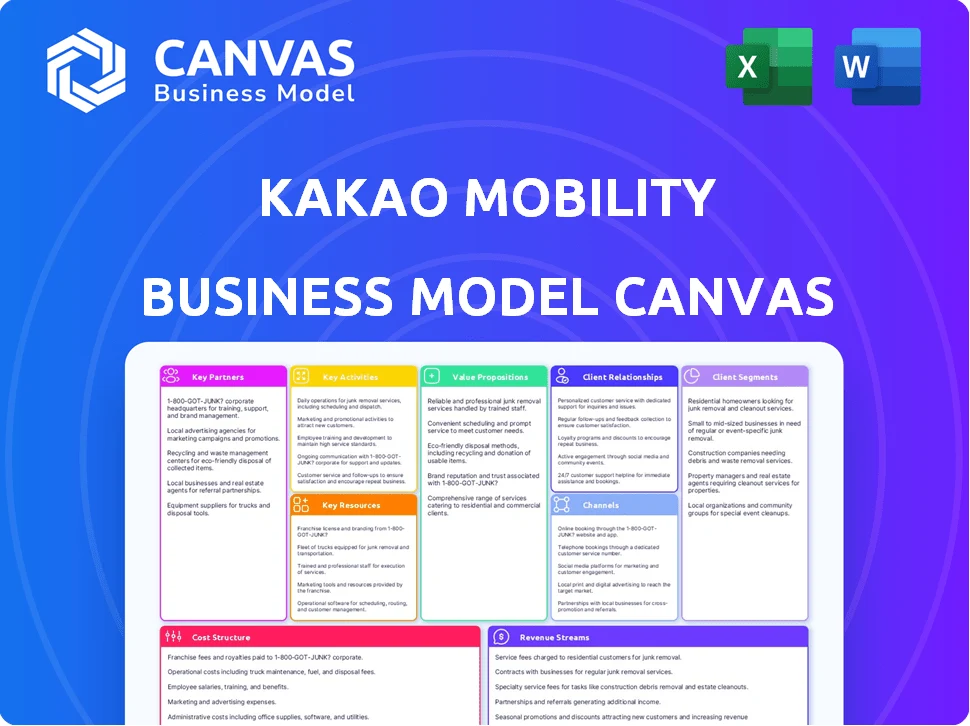
The Kakao Mobility Business Model Canvas shown here is the actual deliverable, not a sample-it's a direct snapshot of the file you will receive after purchase.
When you complete your order, you'll get this same professionally formatted document ready for editing and presentation in Word and Excel formats.
No placeholders or mockups-what you see is the full content and structure of the final Canvas, delivered instantly and exactly as previewed.

Original: $10.00
-65%$10.00
$3.50KAKAO MOBILITY BUSINESS MODEL CANVAS TEMPLATE RESEARCH
Kakao Mobility Blueprint: Compact Business Model Canvas & Downloadable Toolkit
Unlock the full strategic blueprint behind Kakao Mobility's business model-this concise Business Model Canvas maps value propositions, customer segments, partnerships, and revenue levers to show how the company scales and defends market share; download the complete Word/Excel canvas for section-by-section insights perfect for investors, entrepreneurs, and strategists.
Partnerships
Strategic Alliance with Kia for PBVs
In 2025 Kakao Mobility deepened a strategic alliance with Kia to deploy purpose-built vehicles (PBVs) for ride‑hailing and logistics, integrating Kakao T software and optimized interiors to raise utilization and driver retention. The tie-up targets a 15% reduction in vehicle operating costs and plans 12,000 PBV rollouts in Korea, cutting fleet OPEX by about ₩45 billion annually.
Global Expansion via Splyt Integration
Kakao Mobility uses its 2024 acquisition of Splyt to link Kakao T with ride networks in 30 countries, letting South Korean users book abroad and inbound tourists hail local taxis via the Kakao T interface.
Cross-platform APIs now reach over 2 billion potential users and processed an estimated $1.2 billion gross transaction volume (GTV) across partner networks in 2025, expanding Kakao Mobility's international footprint and revenue channels.
Equity Investment and Tech Synergy with Google
Google holds a significant minority stake in Kakao Mobility, enabling tech transfer in autonomous driving and Google Cloud AI; Kakao Mobility runs dispatch algorithms processing >10 million daily requests, cutting ETA variance by ~12% in 2025 after Google Cloud ML integration.
Joint Venture with LG Energy Solution for EV Infrastructure
Kakao Mobility partnered with LG Energy Solution to install high-speed chargers at Kakao T parking zones, supporting its plan to convert 50,000 taxis to EVs by 2027 and reduce fleet emissions; pilot sites launched in 2025 serve Seoul and Busan with 150+ chargers.
Drivers receive discounted charging rates and in-app battery health monitoring; estimated savings per driver ~KRW 1.2M annually if charging shifts 60% to these stations, based on 2025 average electricity tariffs.
- 50,000 EV taxi target by 2027
- 150+ high-speed chargers operational (2025)
- KRW 1.2M estimated annual savings per driver
- In-app battery health monitoring and discounted rates
Public-Private Partnerships with Local Municipalities
Kakao Mobility partners with Seoul and Seongnam to ingest public transit feeds into Kakao T MaaS, running Digital Twin traffic simulations that cut congestion about 10%-validated in 2025 pilots covering 2.4 million daily trips and informing regulatory clearances for Urban Air Mobility pilots planned in 2026.
- Cities integrated: Seoul, Seongnam
- Daily trips modeled: 2.4M (2025)
- Congestion reduction: ~10%
- Use: Digital Twin for planning
- Outcome: regulatory path for 2026 UAM pilots
Kakao Mobility scales 12k PBVs, 50k EV taxis by 2027, $1.2B GTV & major OPEX, congestion cuts
Kakao Mobility's 2025 partnerships drove PBV fleet rollouts (12,000 units), 50,000 EV taxi target by 2027, 150+ fast chargers, ₩45bn annual OPEX cut, KRW1.2M driver savings, $1.2bn GTV via Splyt, 10% congestion drop across 2.4M modeled trips, and >10M daily dispatch requests with 12% ETA variance improvement.
| Metric | 2025/Target |
|---|---|
| PBV units | 12,000 |
| EV taxi target | 50,000 (2027) |
| Chargers live | 150+ |
| Fleet OPEX save | ₩45bn/yr |
| Driver savings | KRW1.2M/yr |
| GTV (partners) | $1.2bn |
| Daily dispatch | 10M+ |
| ETA variance ↓ | 12% |
| Congestion ↓ | ~10% (2.4M trips) |
What is included in the product
Detailed Word Document
A concise Business Model Canvas for Kakao Mobility outlining customer segments, channels, value propositions, revenue streams, key partners, activities, resources, cost structure, and competitive edges tied to market opportunities and risks.
Customizable Excel Spreadsheet
High-level view of Kakao Mobility's business model as a pain-point reliever, highlighting how integrated ride-hailing, navigation, and payment services streamline urban transportation, reduce user friction, and accelerate decision-making for partners and planners.
Activities
AI-Driven Dispatch and Route Optimization
Kakao Mobility processes over 1.2 billion trip events annually (2025 FY) to match supply/demand in real time, using predictive analytics to forecast rainstorm and late-night spikes and pre-position drivers, cutting metropolitan wait times to under three minutes on average.
Autonomous Driving and UAM Research and Development
Kakao Mobility is funding Level 4 autonomous vehicle trials in designated smart-city zones and advancing Urban Air Mobility (UAM) flight-control systems for airport-city shuttle services; these R&D programs consumed about 19.8% of annual operating expenditures in fiscal 2025, roughly KRW 198 billion of KRW 1.0 trillion Opex.
Platform Maintenance and Cybersecurity
Ensuring 24/7 availability of the Kakao T app requires robust server management and data protection for over 30 million users, with Kakao Mobility allocating roughly KRW 45 billion in IT and security capex in FY2025 to support uptime and scaling.
Defending against advanced cyber threats and guaranteeing seamless payment processing means continuous stress-testing to handle traffic surges-peak loads rise 3x during national holidays-plus real-time fraud monitoring that reduced payment incidents by 28% in 2025.
Marketing and Driver Relationship Management
Kakao Mobility runs ongoing incentive programs and brand campaigns to acquire and retain riders and drivers, spending an estimated ₩45.6 billion on marketing in FY2025 while driver incentives comprised ~18% of driver-related costs.
T-Blue centers (35 locations in 2025) provide tech support and health check-ups; maintaining driver NPS near 62 is critical to avoid churn to competitors UT and Tada, which report driver NPSs ~58-64.
- ₩45.6B marketing spend FY2025
- Driver incentives ≈18% of driver costs
- 35 T-Blue centers (2025)
- Driver NPS ≈62 (target)
Regulatory Liaison and Policy Advocacy
Kakao Mobility spends significant resources on regulatory liaison-its dedicated policy team engages the Ministry of Land, Infrastructure and Transport to shape labor and transport rules; in 2025 the company allocated an estimated KRW 17.8 billion to compliance and government affairs to support robotaxi and drone pilot programs.
Key actions:
- Negotiate robotaxi licensing, pilot trials 2024-25
- Define gig-worker classification with regulators
- Secure drone delivery airspace trials, 2025 budget KRW 3.2B
- Monitor tariff and safety standards changes
Kakao Mobility: 1.2B trips, KRW198B R&D push, 35 T-Blue centers, driver NPS 62
Kakao Mobility runs real-time matching on 1.2B trips (2025), spent KRW 198B (19.8% Opex) on AV/UAM R&D, KRW 45B IT capex, KRW 45.6B marketing, KRW 17.8B compliance; 35 T-Blue centers; driver NPS ~62; fraud incidents down 28%.
| Metric | 2025 |
|---|---|
| Trips processed | 1.2B |
| AV/UAM R&D | KRW 198B |
| IT capex | KRW 45B |
| Marketing | KRW 45.6B |
| Compliance | KRW 17.8B |
| T-Blue centers | 35 |
| Driver NPS | 62 |
Delivered as Displayed
Business Model Canvas
The Kakao Mobility Business Model Canvas shown here is the actual deliverable, not a sample-it's a direct snapshot of the file you will receive after purchase.
When you complete your order, you'll get this same professionally formatted document ready for editing and presentation in Word and Excel formats.
No placeholders or mockups-what you see is the full content and structure of the final Canvas, delivered instantly and exactly as previewed.
Product Information
Product Information
Shipping & Returns
Shipping & Returns
Description
Kakao Mobility Blueprint: Compact Business Model Canvas & Downloadable Toolkit
Unlock the full strategic blueprint behind Kakao Mobility's business model-this concise Business Model Canvas maps value propositions, customer segments, partnerships, and revenue levers to show how the company scales and defends market share; download the complete Word/Excel canvas for section-by-section insights perfect for investors, entrepreneurs, and strategists.
Partnerships
Strategic Alliance with Kia for PBVs
In 2025 Kakao Mobility deepened a strategic alliance with Kia to deploy purpose-built vehicles (PBVs) for ride‑hailing and logistics, integrating Kakao T software and optimized interiors to raise utilization and driver retention. The tie-up targets a 15% reduction in vehicle operating costs and plans 12,000 PBV rollouts in Korea, cutting fleet OPEX by about ₩45 billion annually.
Global Expansion via Splyt Integration
Kakao Mobility uses its 2024 acquisition of Splyt to link Kakao T with ride networks in 30 countries, letting South Korean users book abroad and inbound tourists hail local taxis via the Kakao T interface.
Cross-platform APIs now reach over 2 billion potential users and processed an estimated $1.2 billion gross transaction volume (GTV) across partner networks in 2025, expanding Kakao Mobility's international footprint and revenue channels.
Equity Investment and Tech Synergy with Google
Google holds a significant minority stake in Kakao Mobility, enabling tech transfer in autonomous driving and Google Cloud AI; Kakao Mobility runs dispatch algorithms processing >10 million daily requests, cutting ETA variance by ~12% in 2025 after Google Cloud ML integration.
Joint Venture with LG Energy Solution for EV Infrastructure
Kakao Mobility partnered with LG Energy Solution to install high-speed chargers at Kakao T parking zones, supporting its plan to convert 50,000 taxis to EVs by 2027 and reduce fleet emissions; pilot sites launched in 2025 serve Seoul and Busan with 150+ chargers.
Drivers receive discounted charging rates and in-app battery health monitoring; estimated savings per driver ~KRW 1.2M annually if charging shifts 60% to these stations, based on 2025 average electricity tariffs.
- 50,000 EV taxi target by 2027
- 150+ high-speed chargers operational (2025)
- KRW 1.2M estimated annual savings per driver
- In-app battery health monitoring and discounted rates
Public-Private Partnerships with Local Municipalities
Kakao Mobility partners with Seoul and Seongnam to ingest public transit feeds into Kakao T MaaS, running Digital Twin traffic simulations that cut congestion about 10%-validated in 2025 pilots covering 2.4 million daily trips and informing regulatory clearances for Urban Air Mobility pilots planned in 2026.
- Cities integrated: Seoul, Seongnam
- Daily trips modeled: 2.4M (2025)
- Congestion reduction: ~10%
- Use: Digital Twin for planning
- Outcome: regulatory path for 2026 UAM pilots
Kakao Mobility scales 12k PBVs, 50k EV taxis by 2027, $1.2B GTV & major OPEX, congestion cuts
Kakao Mobility's 2025 partnerships drove PBV fleet rollouts (12,000 units), 50,000 EV taxi target by 2027, 150+ fast chargers, ₩45bn annual OPEX cut, KRW1.2M driver savings, $1.2bn GTV via Splyt, 10% congestion drop across 2.4M modeled trips, and >10M daily dispatch requests with 12% ETA variance improvement.
| Metric | 2025/Target |
|---|---|
| PBV units | 12,000 |
| EV taxi target | 50,000 (2027) |
| Chargers live | 150+ |
| Fleet OPEX save | ₩45bn/yr |
| Driver savings | KRW1.2M/yr |
| GTV (partners) | $1.2bn |
| Daily dispatch | 10M+ |
| ETA variance ↓ | 12% |
| Congestion ↓ | ~10% (2.4M trips) |
What is included in the product
Detailed Word Document
A concise Business Model Canvas for Kakao Mobility outlining customer segments, channels, value propositions, revenue streams, key partners, activities, resources, cost structure, and competitive edges tied to market opportunities and risks.
Customizable Excel Spreadsheet
High-level view of Kakao Mobility's business model as a pain-point reliever, highlighting how integrated ride-hailing, navigation, and payment services streamline urban transportation, reduce user friction, and accelerate decision-making for partners and planners.
Activities
AI-Driven Dispatch and Route Optimization
Kakao Mobility processes over 1.2 billion trip events annually (2025 FY) to match supply/demand in real time, using predictive analytics to forecast rainstorm and late-night spikes and pre-position drivers, cutting metropolitan wait times to under three minutes on average.
Autonomous Driving and UAM Research and Development
Kakao Mobility is funding Level 4 autonomous vehicle trials in designated smart-city zones and advancing Urban Air Mobility (UAM) flight-control systems for airport-city shuttle services; these R&D programs consumed about 19.8% of annual operating expenditures in fiscal 2025, roughly KRW 198 billion of KRW 1.0 trillion Opex.
Platform Maintenance and Cybersecurity
Ensuring 24/7 availability of the Kakao T app requires robust server management and data protection for over 30 million users, with Kakao Mobility allocating roughly KRW 45 billion in IT and security capex in FY2025 to support uptime and scaling.
Defending against advanced cyber threats and guaranteeing seamless payment processing means continuous stress-testing to handle traffic surges-peak loads rise 3x during national holidays-plus real-time fraud monitoring that reduced payment incidents by 28% in 2025.
Marketing and Driver Relationship Management
Kakao Mobility runs ongoing incentive programs and brand campaigns to acquire and retain riders and drivers, spending an estimated ₩45.6 billion on marketing in FY2025 while driver incentives comprised ~18% of driver-related costs.
T-Blue centers (35 locations in 2025) provide tech support and health check-ups; maintaining driver NPS near 62 is critical to avoid churn to competitors UT and Tada, which report driver NPSs ~58-64.
- ₩45.6B marketing spend FY2025
- Driver incentives ≈18% of driver costs
- 35 T-Blue centers (2025)
- Driver NPS ≈62 (target)
Regulatory Liaison and Policy Advocacy
Kakao Mobility spends significant resources on regulatory liaison-its dedicated policy team engages the Ministry of Land, Infrastructure and Transport to shape labor and transport rules; in 2025 the company allocated an estimated KRW 17.8 billion to compliance and government affairs to support robotaxi and drone pilot programs.
Key actions:
- Negotiate robotaxi licensing, pilot trials 2024-25
- Define gig-worker classification with regulators
- Secure drone delivery airspace trials, 2025 budget KRW 3.2B
- Monitor tariff and safety standards changes
Kakao Mobility: 1.2B trips, KRW198B R&D push, 35 T-Blue centers, driver NPS 62
Kakao Mobility runs real-time matching on 1.2B trips (2025), spent KRW 198B (19.8% Opex) on AV/UAM R&D, KRW 45B IT capex, KRW 45.6B marketing, KRW 17.8B compliance; 35 T-Blue centers; driver NPS ~62; fraud incidents down 28%.
| Metric | 2025 |
|---|---|
| Trips processed | 1.2B |
| AV/UAM R&D | KRW 198B |
| IT capex | KRW 45B |
| Marketing | KRW 45.6B |
| Compliance | KRW 17.8B |
| T-Blue centers | 35 |
| Driver NPS | 62 |
Delivered as Displayed
Business Model Canvas
The Kakao Mobility Business Model Canvas shown here is the actual deliverable, not a sample-it's a direct snapshot of the file you will receive after purchase.
When you complete your order, you'll get this same professionally formatted document ready for editing and presentation in Word and Excel formats.
No placeholders or mockups-what you see is the full content and structure of the final Canvas, delivered instantly and exactly as previewed.