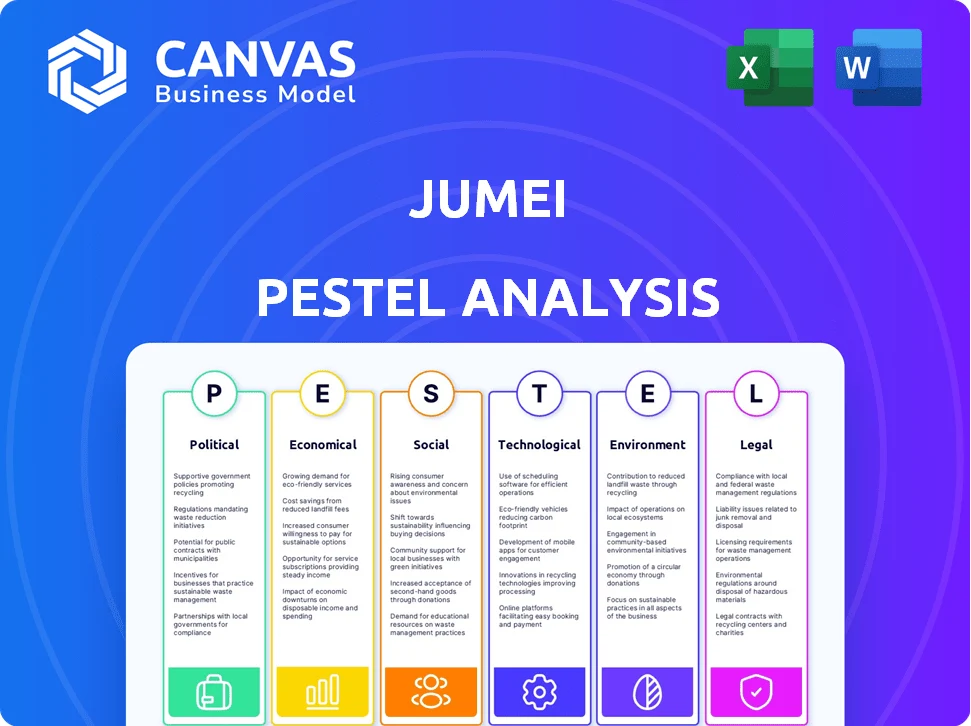
JUMEI PESTLE ANALYSIS TEMPLATE RESEARCH
What is included in the product
 Detailed Word Document
The Jumei PESTLE Analysis identifies external factors impacting Jumei.

 Customizable Excel Spreadsheet
Easily shareable summary format ideal for quick alignment across teams or departments.
What You See Is What You Get
Jumei PESTLE Analysis
What you're previewing here is the actual Jumei PESTLE analysis file—fully formatted and professionally structured.

PESTLE Analysis Template

Make Smarter Strategic Decisions with a Complete PESTEL View
Analyze Jumei's external landscape with our in-depth PESTLE Analysis. Discover how political changes and economic shifts affect their market strategies. This analysis covers social trends, technological advancements, legal considerations, and environmental impacts. It's a crucial resource for investors and strategic planners alike. Download the complete version and get the full breakdown now.
Political factors

Government Regulation of E-commerce and Livestreaming
The Chinese government's intensified regulation of e-commerce and livestreaming, crucial for Jumei, focuses on fair competition and consumer protection. New rules enforce platform transparency, impacting operational costs for merchants and marketing practices. In 2024, China's online retail sales hit approximately $2 trillion, reflecting the sector's significance. Jumei must adapt to these changes to remain compliant and competitive.
Policies Supporting Domestic Consumption
China's government is actively promoting domestic consumption through various policies. These include economic stimulus packages and incentives for trading in consumer goods. For instance, in 2024, the government allocated significant funds to support consumer spending. This strategy aims to boost sales for companies like Jumei. It's anticipated these measures will positively influence the beauty product market in 2025.

Geopolitical Tensions and Trade Policies
Geopolitical tensions, especially US-China relations, affect trade policies, creating market uncertainty. Jumei, focusing on China, may face supply chain issues or reduced imported goods. In 2024, trade between the US and China totaled over $600 billion, indicating their significant economic link despite tensions.

Increased Focus on Consumer Protection
Increased focus on consumer protection is reshaping online markets. New regulations are emerging to boost fairness and transparency. Jumei must comply with these rules, tackling issues like false advertising and fraud in online sales, including livestreaming. This impacts marketing strategies and operational costs. In 2024, China's e-commerce complaints rose by 11.6%, showing the need for robust consumer protection measures.
- Compliance costs may increase due to the need for updated systems and processes.
- Marketing strategies may need adjustment to ensure transparency and avoid misleading claims.
- Potential fines or legal actions for non-compliance could impact profitability.
- Enhanced consumer trust can be a competitive advantage.
Local Government Initiatives
Local governments in China are actively promoting livestreaming e-commerce and instant retail, which could benefit Jumei. These initiatives offer guidance and potentially advantageous conditions for Jumei's regional operations. For example, in 2024, several cities increased subsidies for e-commerce platforms. This support can reduce operational costs and boost market access. These policies aim to boost local economic growth.
- Government subsidies for e-commerce increased by 15% in key regions in 2024.
- Specific tax breaks are available for companies engaging in instant retail.
- Local governments are providing training programs for e-commerce entrepreneurs.
Navigating China's E-Commerce: Regulations & Opportunities
The Chinese government’s regulatory environment focuses on fair competition and consumer protection. This necessitates adaptation in operational practices to maintain compliance and competitive edge. Economic stimulus packages boosting domestic consumption and direct support aim to drive sales, benefiting businesses such as Jumei in 2025.
US-China geopolitical tensions create supply chain uncertainties. Increased focus on consumer protection, driven by regulation, reshapes online markets requiring transparency and fraud prevention strategies in areas like livestreaming. This increases operational costs.
| Political Factor | Impact | Data Point (2024/2025) |
|---|---|---|
| E-commerce Regulations | Increased Compliance Costs | China's online retail sales: $2T (2024) |
| Government Stimulus | Boost in Sales | Consumer spending support fund allocation: Significant |
| Geopolitical Tension | Supply Chain Issues | US-China Trade: $600B+ (2024) |
Economic factors

Consumer Spending and Confidence
Consumer spending in China is crucial for Jumei. Despite past economic hurdles, consumer confidence shows signs of stability. Jumei's sales closely reflect trends in beauty product spending. Retail sales of cosmetics and beauty products reached approximately $91 billion in 2024.
GDP Growth and Urbanization
China's GDP growth, although slowing, remains positive, influencing consumer spending on beauty products. Urbanization continues, with over 65% of the population projected to live in urban areas by 2025. This shift creates a larger, wealthier urban consumer base for Jumei, boosting demand. Increased disposable incomes in cities fuel growth in beauty and personal care product consumption. This trend offers Jumei significant market expansion potential.

Inflation and Price Trends
Consumer price index trends influence Jumei's customer buying power. Early 2025 data indicates a slight year-on-year CPI decrease. However, food, tobacco, alcohol, and fresh produce prices vary. For example, in Q1 2025, fresh produce prices saw a 3% increase. These trends affect Jumei's sales strategies.

Competition in the E-commerce Market
The Chinese e-commerce market is fiercely competitive. Major players like Alibaba and JD.com dominate, alongside rising local beauty brands. Jumei must compete aggressively on price, product range, and customer service to survive. In 2024, China's online retail sales reached $2.02 trillion, highlighting the market's scale and competition.
- Alibaba and JD.com's market share is over 70%.
- Local beauty brands are rapidly gaining popularity.
- Customer experience is crucial for retention.
- Pricing wars are common in the sector.
Impact of Global Economic Slowdown
A global economic slowdown presents risks to Jumei's operations, despite its primary focus on the Chinese domestic market. Reduced consumer spending in major economies can impact the demand for luxury goods, indirectly affecting Chinese consumer sentiment and purchasing behavior. For example, the IMF projects global growth to slow to 3.2% in 2024, down from 3.5% in 2022. This slowdown can lead to decreased investments and trade.
- IMF projects global growth to slow to 3.2% in 2024.
- Reduced consumer spending in major economies can impact demand for luxury goods.
Beauty Market Dynamics in China
Consumer confidence and China's GDP are vital. In 2024, retail sales of beauty products hit $91 billion. Early 2025 shows CPI variations impacting buying power, and growth potential exists due to urbanization.
| Factor | Impact | Data |
|---|---|---|
| GDP Growth | Influences spending on beauty products | Slowing but positive; Urbanization over 65% by 2025 |
| CPI Trends | Affects customer buying power | Slight year-on-year decrease in early 2025. |
| Global Economy | Risks via consumer sentiment | IMF projects 3.2% global growth in 2024. |
Sociological factors

Evolving Consumer Preferences
Chinese consumers increasingly prioritize quality and sustainability. This shift impacts Jumei's product selection. In 2024, sustainable product sales grew by 20% in China. Younger generations are driving this trend, demanding brands align with their values. Jumei must adapt to stay relevant.
Rise of the 'She Economy'
The 'She Economy' is booming in China, with women significantly influencing consumer spending, especially in beauty, wellness, and fashion. They prioritize self-care and are heavily influenced by social media, making platforms like Douyin and Xiaohongshu key for product discovery. This presents a huge opportunity for Jumei. In 2024, the beauty market in China reached an estimated $80 billion, with women driving a substantial portion of this growth.

Influence of Social Media and Livestreaming
Livestreaming and social commerce are key for sales in China. Consumers are highly influenced by social media and influencers. In 2024, social commerce sales reached ~$360B, growing significantly. Jumei already uses these channels effectively. This aligns well with current trends.

Increased Health and Safety Awareness
Consumers are increasingly focused on health and safety, influencing their purchasing decisions. This trend demands greater transparency from brands like Jumei, especially regarding product ingredients and safety standards. In 2024, the global market for natural and organic cosmetics reached $38 billion, reflecting this shift. Building consumer trust is crucial for Jumei's success in this environment.
- Product safety and clear communication are key.
- Transparency builds consumer trust.
- The natural cosmetics market is growing.
Changing Lifestyle Choices
Changing lifestyle choices significantly impact consumer spending, with trends like a surge in outdoor activities and the pet economy reshaping purchasing habits. These shifts, though seemingly distant from Jumei's beauty focus, present opportunities for product diversification or strategic marketing. For instance, the global pet care market is projected to reach $350 billion by 2027, indicating substantial consumer spending in related areas. Understanding these trends is crucial for Jumei to adapt and capitalize on evolving consumer preferences.
- Global pet care market: projected to hit $350B by 2027.
- Outdoor recreation spending: increased 10% in 2023.
- Beauty product demand: correlated with lifestyle trends.
Beauty's Billion-Dollar Boost: Trends Shaping the Future
Societal shifts prioritize quality and sustainability, impacting product choices. Younger generations drive this, boosting the $80B beauty market in 2024. Transparency and safety, key for trust, fuel growth in natural cosmetics.
| Trend | Impact on Jumei | 2024/2025 Data |
|---|---|---|
| Sustainability | Product selection | 20% growth in sustainable sales. |
| "She Economy" | Targeted marketing | Beauty market ~$80B, dominated by women. |
| Social Commerce | Sales channel effectiveness | Social commerce ~$360B. |
JUMEI PESTLE ANALYSIS TEMPLATE RESEARCH
What is included in the product
Detailed Word Document
The Jumei PESTLE Analysis identifies external factors impacting Jumei.
Customizable Excel Spreadsheet
Easily shareable summary format ideal for quick alignment across teams or departments.
What You See Is What You Get
Jumei PESTLE Analysis
What you're previewing here is the actual Jumei PESTLE analysis file—fully formatted and professionally structured.
PESTLE Analysis Template
Make Smarter Strategic Decisions with a Complete PESTEL View
Analyze Jumei's external landscape with our in-depth PESTLE Analysis. Discover how political changes and economic shifts affect their market strategies. This analysis covers social trends, technological advancements, legal considerations, and environmental impacts. It's a crucial resource for investors and strategic planners alike. Download the complete version and get the full breakdown now.
Political factors
Government Regulation of E-commerce and Livestreaming
The Chinese government's intensified regulation of e-commerce and livestreaming, crucial for Jumei, focuses on fair competition and consumer protection. New rules enforce platform transparency, impacting operational costs for merchants and marketing practices. In 2024, China's online retail sales hit approximately $2 trillion, reflecting the sector's significance. Jumei must adapt to these changes to remain compliant and competitive.
Policies Supporting Domestic Consumption
China's government is actively promoting domestic consumption through various policies. These include economic stimulus packages and incentives for trading in consumer goods. For instance, in 2024, the government allocated significant funds to support consumer spending. This strategy aims to boost sales for companies like Jumei. It's anticipated these measures will positively influence the beauty product market in 2025.
Geopolitical Tensions and Trade Policies
Geopolitical tensions, especially US-China relations, affect trade policies, creating market uncertainty. Jumei, focusing on China, may face supply chain issues or reduced imported goods. In 2024, trade between the US and China totaled over $600 billion, indicating their significant economic link despite tensions.
Increased Focus on Consumer Protection
Increased focus on consumer protection is reshaping online markets. New regulations are emerging to boost fairness and transparency. Jumei must comply with these rules, tackling issues like false advertising and fraud in online sales, including livestreaming. This impacts marketing strategies and operational costs. In 2024, China's e-commerce complaints rose by 11.6%, showing the need for robust consumer protection measures.
- Compliance costs may increase due to the need for updated systems and processes.
- Marketing strategies may need adjustment to ensure transparency and avoid misleading claims.
- Potential fines or legal actions for non-compliance could impact profitability.
- Enhanced consumer trust can be a competitive advantage.
Local Government Initiatives
Local governments in China are actively promoting livestreaming e-commerce and instant retail, which could benefit Jumei. These initiatives offer guidance and potentially advantageous conditions for Jumei's regional operations. For example, in 2024, several cities increased subsidies for e-commerce platforms. This support can reduce operational costs and boost market access. These policies aim to boost local economic growth.
- Government subsidies for e-commerce increased by 15% in key regions in 2024.
- Specific tax breaks are available for companies engaging in instant retail.
- Local governments are providing training programs for e-commerce entrepreneurs.
Navigating China's E-Commerce: Regulations & Opportunities
The Chinese government’s regulatory environment focuses on fair competition and consumer protection. This necessitates adaptation in operational practices to maintain compliance and competitive edge. Economic stimulus packages boosting domestic consumption and direct support aim to drive sales, benefiting businesses such as Jumei in 2025.
US-China geopolitical tensions create supply chain uncertainties. Increased focus on consumer protection, driven by regulation, reshapes online markets requiring transparency and fraud prevention strategies in areas like livestreaming. This increases operational costs.
| Political Factor | Impact | Data Point (2024/2025) |
|---|---|---|
| E-commerce Regulations | Increased Compliance Costs | China's online retail sales: $2T (2024) |
| Government Stimulus | Boost in Sales | Consumer spending support fund allocation: Significant |
| Geopolitical Tension | Supply Chain Issues | US-China Trade: $600B+ (2024) |
Economic factors
Consumer Spending and Confidence
Consumer spending in China is crucial for Jumei. Despite past economic hurdles, consumer confidence shows signs of stability. Jumei's sales closely reflect trends in beauty product spending. Retail sales of cosmetics and beauty products reached approximately $91 billion in 2024.
GDP Growth and Urbanization
China's GDP growth, although slowing, remains positive, influencing consumer spending on beauty products. Urbanization continues, with over 65% of the population projected to live in urban areas by 2025. This shift creates a larger, wealthier urban consumer base for Jumei, boosting demand. Increased disposable incomes in cities fuel growth in beauty and personal care product consumption. This trend offers Jumei significant market expansion potential.
Inflation and Price Trends
Consumer price index trends influence Jumei's customer buying power. Early 2025 data indicates a slight year-on-year CPI decrease. However, food, tobacco, alcohol, and fresh produce prices vary. For example, in Q1 2025, fresh produce prices saw a 3% increase. These trends affect Jumei's sales strategies.
Competition in the E-commerce Market
The Chinese e-commerce market is fiercely competitive. Major players like Alibaba and JD.com dominate, alongside rising local beauty brands. Jumei must compete aggressively on price, product range, and customer service to survive. In 2024, China's online retail sales reached $2.02 trillion, highlighting the market's scale and competition.
- Alibaba and JD.com's market share is over 70%.
- Local beauty brands are rapidly gaining popularity.
- Customer experience is crucial for retention.
- Pricing wars are common in the sector.
Impact of Global Economic Slowdown
A global economic slowdown presents risks to Jumei's operations, despite its primary focus on the Chinese domestic market. Reduced consumer spending in major economies can impact the demand for luxury goods, indirectly affecting Chinese consumer sentiment and purchasing behavior. For example, the IMF projects global growth to slow to 3.2% in 2024, down from 3.5% in 2022. This slowdown can lead to decreased investments and trade.
- IMF projects global growth to slow to 3.2% in 2024.
- Reduced consumer spending in major economies can impact demand for luxury goods.
Beauty Market Dynamics in China
Consumer confidence and China's GDP are vital. In 2024, retail sales of beauty products hit $91 billion. Early 2025 shows CPI variations impacting buying power, and growth potential exists due to urbanization.
| Factor | Impact | Data |
|---|---|---|
| GDP Growth | Influences spending on beauty products | Slowing but positive; Urbanization over 65% by 2025 |
| CPI Trends | Affects customer buying power | Slight year-on-year decrease in early 2025. |
| Global Economy | Risks via consumer sentiment | IMF projects 3.2% global growth in 2024. |
Sociological factors
Evolving Consumer Preferences
Chinese consumers increasingly prioritize quality and sustainability. This shift impacts Jumei's product selection. In 2024, sustainable product sales grew by 20% in China. Younger generations are driving this trend, demanding brands align with their values. Jumei must adapt to stay relevant.
Rise of the 'She Economy'
The 'She Economy' is booming in China, with women significantly influencing consumer spending, especially in beauty, wellness, and fashion. They prioritize self-care and are heavily influenced by social media, making platforms like Douyin and Xiaohongshu key for product discovery. This presents a huge opportunity for Jumei. In 2024, the beauty market in China reached an estimated $80 billion, with women driving a substantial portion of this growth.
Influence of Social Media and Livestreaming
Livestreaming and social commerce are key for sales in China. Consumers are highly influenced by social media and influencers. In 2024, social commerce sales reached ~$360B, growing significantly. Jumei already uses these channels effectively. This aligns well with current trends.
Increased Health and Safety Awareness
Consumers are increasingly focused on health and safety, influencing their purchasing decisions. This trend demands greater transparency from brands like Jumei, especially regarding product ingredients and safety standards. In 2024, the global market for natural and organic cosmetics reached $38 billion, reflecting this shift. Building consumer trust is crucial for Jumei's success in this environment.
- Product safety and clear communication are key.
- Transparency builds consumer trust.
- The natural cosmetics market is growing.
Changing Lifestyle Choices
Changing lifestyle choices significantly impact consumer spending, with trends like a surge in outdoor activities and the pet economy reshaping purchasing habits. These shifts, though seemingly distant from Jumei's beauty focus, present opportunities for product diversification or strategic marketing. For instance, the global pet care market is projected to reach $350 billion by 2027, indicating substantial consumer spending in related areas. Understanding these trends is crucial for Jumei to adapt and capitalize on evolving consumer preferences.
- Global pet care market: projected to hit $350B by 2027.
- Outdoor recreation spending: increased 10% in 2023.
- Beauty product demand: correlated with lifestyle trends.
Beauty's Billion-Dollar Boost: Trends Shaping the Future
Societal shifts prioritize quality and sustainability, impacting product choices. Younger generations drive this, boosting the $80B beauty market in 2024. Transparency and safety, key for trust, fuel growth in natural cosmetics.
| Trend | Impact on Jumei | 2024/2025 Data |
|---|---|---|
| Sustainability | Product selection | 20% growth in sustainable sales. |
| "She Economy" | Targeted marketing | Beauty market ~$80B, dominated by women. |
| Social Commerce | Sales channel effectiveness | Social commerce ~$360B. |
Product Information
Product Information
Shipping & Returns
Shipping & Returns
Description
What is included in the product
Detailed Word Document
The Jumei PESTLE Analysis identifies external factors impacting Jumei.
Customizable Excel Spreadsheet
Easily shareable summary format ideal for quick alignment across teams or departments.
What You See Is What You Get
Jumei PESTLE Analysis
What you're previewing here is the actual Jumei PESTLE analysis file—fully formatted and professionally structured.
PESTLE Analysis Template
Make Smarter Strategic Decisions with a Complete PESTEL View
Analyze Jumei's external landscape with our in-depth PESTLE Analysis. Discover how political changes and economic shifts affect their market strategies. This analysis covers social trends, technological advancements, legal considerations, and environmental impacts. It's a crucial resource for investors and strategic planners alike. Download the complete version and get the full breakdown now.
Political factors
Government Regulation of E-commerce and Livestreaming
The Chinese government's intensified regulation of e-commerce and livestreaming, crucial for Jumei, focuses on fair competition and consumer protection. New rules enforce platform transparency, impacting operational costs for merchants and marketing practices. In 2024, China's online retail sales hit approximately $2 trillion, reflecting the sector's significance. Jumei must adapt to these changes to remain compliant and competitive.
Policies Supporting Domestic Consumption
China's government is actively promoting domestic consumption through various policies. These include economic stimulus packages and incentives for trading in consumer goods. For instance, in 2024, the government allocated significant funds to support consumer spending. This strategy aims to boost sales for companies like Jumei. It's anticipated these measures will positively influence the beauty product market in 2025.
Geopolitical Tensions and Trade Policies
Geopolitical tensions, especially US-China relations, affect trade policies, creating market uncertainty. Jumei, focusing on China, may face supply chain issues or reduced imported goods. In 2024, trade between the US and China totaled over $600 billion, indicating their significant economic link despite tensions.
Increased Focus on Consumer Protection
Increased focus on consumer protection is reshaping online markets. New regulations are emerging to boost fairness and transparency. Jumei must comply with these rules, tackling issues like false advertising and fraud in online sales, including livestreaming. This impacts marketing strategies and operational costs. In 2024, China's e-commerce complaints rose by 11.6%, showing the need for robust consumer protection measures.
- Compliance costs may increase due to the need for updated systems and processes.
- Marketing strategies may need adjustment to ensure transparency and avoid misleading claims.
- Potential fines or legal actions for non-compliance could impact profitability.
- Enhanced consumer trust can be a competitive advantage.
Local Government Initiatives
Local governments in China are actively promoting livestreaming e-commerce and instant retail, which could benefit Jumei. These initiatives offer guidance and potentially advantageous conditions for Jumei's regional operations. For example, in 2024, several cities increased subsidies for e-commerce platforms. This support can reduce operational costs and boost market access. These policies aim to boost local economic growth.
- Government subsidies for e-commerce increased by 15% in key regions in 2024.
- Specific tax breaks are available for companies engaging in instant retail.
- Local governments are providing training programs for e-commerce entrepreneurs.
Navigating China's E-Commerce: Regulations & Opportunities
The Chinese government’s regulatory environment focuses on fair competition and consumer protection. This necessitates adaptation in operational practices to maintain compliance and competitive edge. Economic stimulus packages boosting domestic consumption and direct support aim to drive sales, benefiting businesses such as Jumei in 2025.
US-China geopolitical tensions create supply chain uncertainties. Increased focus on consumer protection, driven by regulation, reshapes online markets requiring transparency and fraud prevention strategies in areas like livestreaming. This increases operational costs.
| Political Factor | Impact | Data Point (2024/2025) |
|---|---|---|
| E-commerce Regulations | Increased Compliance Costs | China's online retail sales: $2T (2024) |
| Government Stimulus | Boost in Sales | Consumer spending support fund allocation: Significant |
| Geopolitical Tension | Supply Chain Issues | US-China Trade: $600B+ (2024) |
Economic factors
Consumer Spending and Confidence
Consumer spending in China is crucial for Jumei. Despite past economic hurdles, consumer confidence shows signs of stability. Jumei's sales closely reflect trends in beauty product spending. Retail sales of cosmetics and beauty products reached approximately $91 billion in 2024.
GDP Growth and Urbanization
China's GDP growth, although slowing, remains positive, influencing consumer spending on beauty products. Urbanization continues, with over 65% of the population projected to live in urban areas by 2025. This shift creates a larger, wealthier urban consumer base for Jumei, boosting demand. Increased disposable incomes in cities fuel growth in beauty and personal care product consumption. This trend offers Jumei significant market expansion potential.
Inflation and Price Trends
Consumer price index trends influence Jumei's customer buying power. Early 2025 data indicates a slight year-on-year CPI decrease. However, food, tobacco, alcohol, and fresh produce prices vary. For example, in Q1 2025, fresh produce prices saw a 3% increase. These trends affect Jumei's sales strategies.
Competition in the E-commerce Market
The Chinese e-commerce market is fiercely competitive. Major players like Alibaba and JD.com dominate, alongside rising local beauty brands. Jumei must compete aggressively on price, product range, and customer service to survive. In 2024, China's online retail sales reached $2.02 trillion, highlighting the market's scale and competition.
- Alibaba and JD.com's market share is over 70%.
- Local beauty brands are rapidly gaining popularity.
- Customer experience is crucial for retention.
- Pricing wars are common in the sector.
Impact of Global Economic Slowdown
A global economic slowdown presents risks to Jumei's operations, despite its primary focus on the Chinese domestic market. Reduced consumer spending in major economies can impact the demand for luxury goods, indirectly affecting Chinese consumer sentiment and purchasing behavior. For example, the IMF projects global growth to slow to 3.2% in 2024, down from 3.5% in 2022. This slowdown can lead to decreased investments and trade.
- IMF projects global growth to slow to 3.2% in 2024.
- Reduced consumer spending in major economies can impact demand for luxury goods.
Beauty Market Dynamics in China
Consumer confidence and China's GDP are vital. In 2024, retail sales of beauty products hit $91 billion. Early 2025 shows CPI variations impacting buying power, and growth potential exists due to urbanization.
| Factor | Impact | Data |
|---|---|---|
| GDP Growth | Influences spending on beauty products | Slowing but positive; Urbanization over 65% by 2025 |
| CPI Trends | Affects customer buying power | Slight year-on-year decrease in early 2025. |
| Global Economy | Risks via consumer sentiment | IMF projects 3.2% global growth in 2024. |
Sociological factors
Evolving Consumer Preferences
Chinese consumers increasingly prioritize quality and sustainability. This shift impacts Jumei's product selection. In 2024, sustainable product sales grew by 20% in China. Younger generations are driving this trend, demanding brands align with their values. Jumei must adapt to stay relevant.
Rise of the 'She Economy'
The 'She Economy' is booming in China, with women significantly influencing consumer spending, especially in beauty, wellness, and fashion. They prioritize self-care and are heavily influenced by social media, making platforms like Douyin and Xiaohongshu key for product discovery. This presents a huge opportunity for Jumei. In 2024, the beauty market in China reached an estimated $80 billion, with women driving a substantial portion of this growth.
Influence of Social Media and Livestreaming
Livestreaming and social commerce are key for sales in China. Consumers are highly influenced by social media and influencers. In 2024, social commerce sales reached ~$360B, growing significantly. Jumei already uses these channels effectively. This aligns well with current trends.
Increased Health and Safety Awareness
Consumers are increasingly focused on health and safety, influencing their purchasing decisions. This trend demands greater transparency from brands like Jumei, especially regarding product ingredients and safety standards. In 2024, the global market for natural and organic cosmetics reached $38 billion, reflecting this shift. Building consumer trust is crucial for Jumei's success in this environment.
- Product safety and clear communication are key.
- Transparency builds consumer trust.
- The natural cosmetics market is growing.
Changing Lifestyle Choices
Changing lifestyle choices significantly impact consumer spending, with trends like a surge in outdoor activities and the pet economy reshaping purchasing habits. These shifts, though seemingly distant from Jumei's beauty focus, present opportunities for product diversification or strategic marketing. For instance, the global pet care market is projected to reach $350 billion by 2027, indicating substantial consumer spending in related areas. Understanding these trends is crucial for Jumei to adapt and capitalize on evolving consumer preferences.
- Global pet care market: projected to hit $350B by 2027.
- Outdoor recreation spending: increased 10% in 2023.
- Beauty product demand: correlated with lifestyle trends.
Beauty's Billion-Dollar Boost: Trends Shaping the Future
Societal shifts prioritize quality and sustainability, impacting product choices. Younger generations drive this, boosting the $80B beauty market in 2024. Transparency and safety, key for trust, fuel growth in natural cosmetics.
| Trend | Impact on Jumei | 2024/2025 Data |
|---|---|---|
| Sustainability | Product selection | 20% growth in sustainable sales. |
| "She Economy" | Targeted marketing | Beauty market ~$80B, dominated by women. |
| Social Commerce | Sales channel effectiveness | Social commerce ~$360B. |