
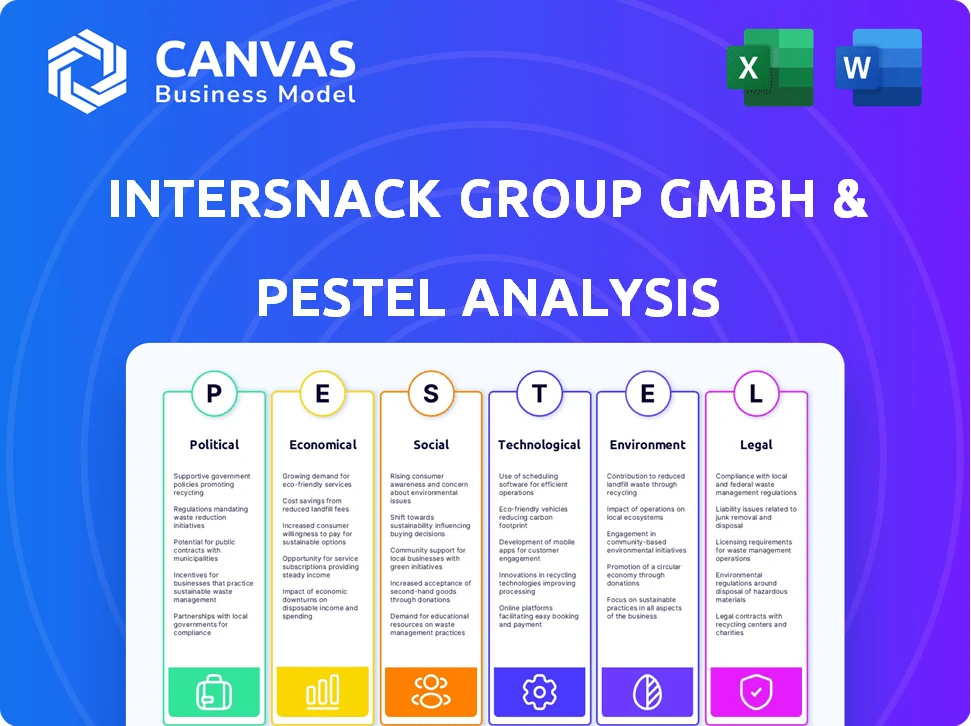
INTERSNACK GROUP GMBH & CO. KG PESTLE ANALYSIS TEMPLATE RESEARCH
What is included in the product
 Detailed Word Document
Assesses external factors impacting Intersnack across Political, Economic, Social, Technological, Environmental, and Legal sectors.
This analysis supports strategic decision-making for Intersnack, providing data-backed insights.

 Customizable Excel Spreadsheet
Helps support discussions on external risk & market positioning during planning sessions.
Full Version Awaits
Intersnack Group GmbH & Co. KG PESTLE Analysis
This Intersnack Group GmbH & Co. KG PESTLE analysis preview is the final version.
You'll receive the exact same document after your purchase—ready for immediate use.
All details shown are included—no content changes will be present post-purchase.
This ensures you know what you are paying for, offering clarity!
Enjoy!

PESTLE Analysis Template

Plan Smarter. Present Sharper. Compete Stronger.
Navigate the complex world of Intersnack Group GmbH & Co. KG with our insightful PESTLE Analysis. Uncover the critical external factors influencing its strategy and performance. Explore the political, economic, social, technological, legal, and environmental forces at play.
This analysis is perfect for investors, competitors, and anyone seeking a deeper understanding of the market. Stay informed about emerging opportunities and potential risks. Ready to make more informed decisions? Download the full PESTLE Analysis today.
Political factors

Trade Regulations and Tariffs
Intersnack Group, with its wide-ranging presence, faces diverse trade regulations and tariffs across Europe and other regions. For instance, the EU's Common Agricultural Policy (CAP) influences raw material costs. As of 2024, the average tariff on imported processed foods into the EU is around 10-15%. Changes in trade deals, like Brexit's impact, require continuous adaptation in sourcing and distribution.
Food Safety Standards and Regulations
Food safety standards are crucial, with governments globally setting strict rules. Intersnack faces diverse regulations across its operational regions. Compliance demands adjustments in production, ingredients, and labeling. For example, in 2024, the EU updated its food safety protocols, impacting snack manufacturers. Such changes often incur additional costs, influencing profit margins.

Agricultural Policies and Subsidies
Agricultural policies, including subsidies and farming regulations, significantly affect Intersnack's raw material costs. For example, the EU's Common Agricultural Policy (CAP) allocates €38.5 billion annually, impacting potato and nut prices. Changes in these policies can alter Intersnack's supply chain and profitability. Moreover, in 2024, the US farm bill discussions will likely affect global commodity prices.

Political Stability in Operating Regions
Political stability is vital for Intersnack's operations. Instability, civil unrest, or government changes can disrupt supply chains and sales. These disruptions can significantly impact profitability. Countries like Germany and Poland are key markets.
- In 2024, the World Bank reported varying political risk ratings for Intersnack's operating regions.
- Germany's political stability score was high, reflecting a stable environment.
- Poland's score showed moderate risk, indicating potential for disruption.
Government Stance on Health and Nutrition
Governments globally are increasingly prioritizing public health and nutrition, influencing the snack food industry. Policies like taxes on unhealthy foods or regulations on salt, sugar, and fat content are becoming more common. In the UK, the Soft Drinks Industry Levy, introduced in 2018, has shown some success in reducing sugar consumption. These changes impact InterSnack, potentially requiring product reformulation or affecting consumer choices.
- The UK's Soft Drinks Industry Levy has led to a 29% reduction in sugar content in drinks.
- Globally, 44 countries have implemented taxes on unhealthy foods.
- The global market for healthy snacks is projected to reach $32.8 billion by 2025.
Snack Industry's Political Hurdles & Market Growth
Intersnack navigates political landscapes shaped by trade policies and food regulations. EU tariffs on processed foods average 10-15% in 2024. The UK's sugar tax shows success in reducing consumption. Healthy snack market is projected to reach $32.8B by 2025.
| Factor | Impact | Examples/Data (2024/2025) |
|---|---|---|
| Trade Policies | Affects sourcing, costs, distribution | EU tariffs 10-15%; Brexit adjustments ongoing. |
| Food Regulations | Production, labeling adjustments. | EU food safety updates, cost implications. |
| Public Health Policies | Product reformulation, consumer choice impacts. | UK sugar tax (29% sugar reduction in drinks), global taxes in 44 countries. |
Economic factors

Inflation and Purchasing Power
Inflation significantly influences Intersnack's operational costs, impacting raw materials, energy, and labor. Decreased consumer purchasing power, due to inflation or recession, can diminish demand for snacks. For instance, in 2024, the EU faced 5.4% inflation, potentially squeezing consumer spending on non-essential items. This can affect Intersnack's sales.
Exchange Rate Fluctuations
Intersnack, operating globally, faces exchange rate risks. Fluctuating rates impact raw material costs, as seen with the Euro's shifts affecting import expenses. For example, in 2024, the EUR/USD rate varied significantly, influencing profitability. Currency volatility necessitates hedging strategies to stabilize financial outcomes. Exchange rate movements can change the value of international sales.

Commodity Price Volatility
Commodity price volatility, particularly for potatoes, nuts, and oils, significantly affects Intersnack's production costs. The USDA reported a 15% increase in potato prices in 2024 due to weather impacts. Global nut prices fluctuated, with almonds up 8% and cashews down 5% in Q1 2024. These shifts necessitate careful hedging strategies.

Economic Growth and Consumer Spending
Economic growth significantly impacts Intersnack's performance, particularly in its key markets. Increased consumer spending, fueled by economic expansion, often translates to higher sales volumes for snacks and related products. Conversely, economic downturns can pressure consumer budgets, potentially leading to decreased demand for discretionary items like snacks. For example, in 2024, the EU's GDP growth was around 0.5%, impacting consumer spending.
- GDP growth influences consumer spending.
- Recessions can decrease snack demand.
- EU's 2024 GDP growth was about 0.5%.
Unemployment Rates
Unemployment rates significantly influence Intersnack's operations, impacting both consumer spending and labor costs. High unemployment can decrease demand for snacks, while low unemployment may increase labor expenses. In 2024, the Eurozone unemployment rate stood at approximately 6.5%, which could affect Intersnack's sales in the region. The availability of skilled labor also plays a crucial role in production efficiency. Consider the following factors:
- Eurozone unemployment rate: 6.5% (2024).
- Impact on consumer spending.
- Influence on labor costs and availability.
- Regional variations in unemployment rates.
Intersnack's Economic Landscape: Key Factors
Economic factors greatly influence Intersnack. GDP growth impacts consumer spending, affecting snack demand. Fluctuating unemployment rates in key markets, such as the Eurozone's 6.5% in 2024, influence labor and sales.
| Factor | Impact | 2024 Data |
|---|---|---|
| Inflation | Raises costs, lowers demand | EU: 5.4% |
| Exchange Rates | Affects import/export | EUR/USD volatility |
| Commodity Prices | Impacts production costs | Potato prices +15% (USDA) |
Sociological factors

Changing Consumer Preferences and Health Trends
Consumer health awareness is on the rise, impacting food choices. Demand is growing for healthier snacks, natural ingredients, and options with less salt, sugar, and fat. In 2024, the global health and wellness market was valued at $7 trillion. Adapting the product portfolio is crucial for Intersnack. This includes focusing on innovation, such as baked snacks, and ingredient optimization.
Lifestyle and Snacking Habits
Modern lifestyles significantly influence snacking habits, with busy schedules driving demand for convenient snacks. Changes in work and leisure impact consumption patterns. In 2024, the global snack market is projected to reach $570 billion. The on-the-go consumption trend continues to rise, reflecting lifestyle shifts.

Cultural Differences in Snack Consumption
Taste preferences for snacks differ greatly across Europe; salty snacks are popular in Germany, while in Spain, savory snacks are preferred. Intersnack, to succeed, must tailor its product lines and marketing to respect these local tastes. For instance, in 2024, potato chips held 40% of the savory snack market in France. This cultural understanding is crucial for market penetration.

Demographic Shifts
Demographic shifts significantly influence Intersnack's market. Changes in age distribution and urbanization impact snack preferences and packaging demands. An aging population might drive demand for health-conscious snacks and smaller portions. Urbanization leads to increased demand for convenient, on-the-go snacking options.
- In 2024, the global population aged 60+ is estimated at 1.4 billion, growing annually.
- Urban population growth, particularly in Asia and Africa, is accelerating.
- Demand for single-serve packaging is rising due to smaller household sizes.
Social Media and Influence of Online Trends
Social media heavily influences food brand perceptions and consumer trends. Negative publicity can severely impact Intersnack's sales and reputation. For example, a 2024 study showed that 65% of consumers trust online reviews. This means that online trends and discussions significantly affect purchasing decisions. Brands must proactively manage their online presence.
- 65% of consumers trust online reviews (2024).
- Negative social media trends can quickly damage brand reputation.
- Proactive online presence management is crucial.
Snack Market Trends: $7T Health & $570B Convenience!
Consumer health consciousness drives demand for healthier snacks, and the global health market hit $7 trillion in 2024. Busy lifestyles boost the convenience snack market, forecast to reach $570 billion in 2024, reflecting the on-the-go trend. Understanding varied European taste preferences, like the 40% share of potato chips in France (2024), is essential for Intersnack.
Demographic shifts, including a growing 60+ population (1.4 billion in 2024) and urbanization, influence snacking needs. Single-serve packaging demand rises with smaller households. Social media shapes brand perception; 65% trust online reviews (2024), impacting sales and emphasizing proactive online presence management.
| Sociological Factor | Impact on Intersnack | 2024/2025 Data/Insight |
|---|---|---|
| Health Awareness | Demand for healthier options | Global health market: $7T (2024); Focus on baked snacks and natural ingredients. |
| Lifestyle Changes | Growth in convenient snacks | Global snack market projected: $570B (2024); On-the-go consumption continues. |
| Cultural Preferences | Need for localized products | Potato chips: 40% of savory snack market in France (2024); Tailored marketing vital. |
Original: $10.00
-65%$10.00
$3.50INTERSNACK GROUP GMBH & CO. KG PESTLE ANALYSIS TEMPLATE RESEARCH
What is included in the product
Detailed Word Document
Assesses external factors impacting Intersnack across Political, Economic, Social, Technological, Environmental, and Legal sectors.
This analysis supports strategic decision-making for Intersnack, providing data-backed insights.
Customizable Excel Spreadsheet
Helps support discussions on external risk & market positioning during planning sessions.
Full Version Awaits
Intersnack Group GmbH & Co. KG PESTLE Analysis
This Intersnack Group GmbH & Co. KG PESTLE analysis preview is the final version.
You'll receive the exact same document after your purchase—ready for immediate use.
All details shown are included—no content changes will be present post-purchase.
This ensures you know what you are paying for, offering clarity!
Enjoy!
PESTLE Analysis Template
Plan Smarter. Present Sharper. Compete Stronger.
Navigate the complex world of Intersnack Group GmbH & Co. KG with our insightful PESTLE Analysis. Uncover the critical external factors influencing its strategy and performance. Explore the political, economic, social, technological, legal, and environmental forces at play.
This analysis is perfect for investors, competitors, and anyone seeking a deeper understanding of the market. Stay informed about emerging opportunities and potential risks. Ready to make more informed decisions? Download the full PESTLE Analysis today.
Political factors
Trade Regulations and Tariffs
Intersnack Group, with its wide-ranging presence, faces diverse trade regulations and tariffs across Europe and other regions. For instance, the EU's Common Agricultural Policy (CAP) influences raw material costs. As of 2024, the average tariff on imported processed foods into the EU is around 10-15%. Changes in trade deals, like Brexit's impact, require continuous adaptation in sourcing and distribution.
Food Safety Standards and Regulations
Food safety standards are crucial, with governments globally setting strict rules. Intersnack faces diverse regulations across its operational regions. Compliance demands adjustments in production, ingredients, and labeling. For example, in 2024, the EU updated its food safety protocols, impacting snack manufacturers. Such changes often incur additional costs, influencing profit margins.
Agricultural Policies and Subsidies
Agricultural policies, including subsidies and farming regulations, significantly affect Intersnack's raw material costs. For example, the EU's Common Agricultural Policy (CAP) allocates €38.5 billion annually, impacting potato and nut prices. Changes in these policies can alter Intersnack's supply chain and profitability. Moreover, in 2024, the US farm bill discussions will likely affect global commodity prices.
Political Stability in Operating Regions
Political stability is vital for Intersnack's operations. Instability, civil unrest, or government changes can disrupt supply chains and sales. These disruptions can significantly impact profitability. Countries like Germany and Poland are key markets.
- In 2024, the World Bank reported varying political risk ratings for Intersnack's operating regions.
- Germany's political stability score was high, reflecting a stable environment.
- Poland's score showed moderate risk, indicating potential for disruption.
Government Stance on Health and Nutrition
Governments globally are increasingly prioritizing public health and nutrition, influencing the snack food industry. Policies like taxes on unhealthy foods or regulations on salt, sugar, and fat content are becoming more common. In the UK, the Soft Drinks Industry Levy, introduced in 2018, has shown some success in reducing sugar consumption. These changes impact InterSnack, potentially requiring product reformulation or affecting consumer choices.
- The UK's Soft Drinks Industry Levy has led to a 29% reduction in sugar content in drinks.
- Globally, 44 countries have implemented taxes on unhealthy foods.
- The global market for healthy snacks is projected to reach $32.8 billion by 2025.
Snack Industry's Political Hurdles & Market Growth
Intersnack navigates political landscapes shaped by trade policies and food regulations. EU tariffs on processed foods average 10-15% in 2024. The UK's sugar tax shows success in reducing consumption. Healthy snack market is projected to reach $32.8B by 2025.
| Factor | Impact | Examples/Data (2024/2025) |
|---|---|---|
| Trade Policies | Affects sourcing, costs, distribution | EU tariffs 10-15%; Brexit adjustments ongoing. |
| Food Regulations | Production, labeling adjustments. | EU food safety updates, cost implications. |
| Public Health Policies | Product reformulation, consumer choice impacts. | UK sugar tax (29% sugar reduction in drinks), global taxes in 44 countries. |
Economic factors
Inflation and Purchasing Power
Inflation significantly influences Intersnack's operational costs, impacting raw materials, energy, and labor. Decreased consumer purchasing power, due to inflation or recession, can diminish demand for snacks. For instance, in 2024, the EU faced 5.4% inflation, potentially squeezing consumer spending on non-essential items. This can affect Intersnack's sales.
Exchange Rate Fluctuations
Intersnack, operating globally, faces exchange rate risks. Fluctuating rates impact raw material costs, as seen with the Euro's shifts affecting import expenses. For example, in 2024, the EUR/USD rate varied significantly, influencing profitability. Currency volatility necessitates hedging strategies to stabilize financial outcomes. Exchange rate movements can change the value of international sales.
Commodity Price Volatility
Commodity price volatility, particularly for potatoes, nuts, and oils, significantly affects Intersnack's production costs. The USDA reported a 15% increase in potato prices in 2024 due to weather impacts. Global nut prices fluctuated, with almonds up 8% and cashews down 5% in Q1 2024. These shifts necessitate careful hedging strategies.
Economic Growth and Consumer Spending
Economic growth significantly impacts Intersnack's performance, particularly in its key markets. Increased consumer spending, fueled by economic expansion, often translates to higher sales volumes for snacks and related products. Conversely, economic downturns can pressure consumer budgets, potentially leading to decreased demand for discretionary items like snacks. For example, in 2024, the EU's GDP growth was around 0.5%, impacting consumer spending.
- GDP growth influences consumer spending.
- Recessions can decrease snack demand.
- EU's 2024 GDP growth was about 0.5%.
Unemployment Rates
Unemployment rates significantly influence Intersnack's operations, impacting both consumer spending and labor costs. High unemployment can decrease demand for snacks, while low unemployment may increase labor expenses. In 2024, the Eurozone unemployment rate stood at approximately 6.5%, which could affect Intersnack's sales in the region. The availability of skilled labor also plays a crucial role in production efficiency. Consider the following factors:
- Eurozone unemployment rate: 6.5% (2024).
- Impact on consumer spending.
- Influence on labor costs and availability.
- Regional variations in unemployment rates.
Intersnack's Economic Landscape: Key Factors
Economic factors greatly influence Intersnack. GDP growth impacts consumer spending, affecting snack demand. Fluctuating unemployment rates in key markets, such as the Eurozone's 6.5% in 2024, influence labor and sales.
| Factor | Impact | 2024 Data |
|---|---|---|
| Inflation | Raises costs, lowers demand | EU: 5.4% |
| Exchange Rates | Affects import/export | EUR/USD volatility |
| Commodity Prices | Impacts production costs | Potato prices +15% (USDA) |
Sociological factors
Changing Consumer Preferences and Health Trends
Consumer health awareness is on the rise, impacting food choices. Demand is growing for healthier snacks, natural ingredients, and options with less salt, sugar, and fat. In 2024, the global health and wellness market was valued at $7 trillion. Adapting the product portfolio is crucial for Intersnack. This includes focusing on innovation, such as baked snacks, and ingredient optimization.
Lifestyle and Snacking Habits
Modern lifestyles significantly influence snacking habits, with busy schedules driving demand for convenient snacks. Changes in work and leisure impact consumption patterns. In 2024, the global snack market is projected to reach $570 billion. The on-the-go consumption trend continues to rise, reflecting lifestyle shifts.
Cultural Differences in Snack Consumption
Taste preferences for snacks differ greatly across Europe; salty snacks are popular in Germany, while in Spain, savory snacks are preferred. Intersnack, to succeed, must tailor its product lines and marketing to respect these local tastes. For instance, in 2024, potato chips held 40% of the savory snack market in France. This cultural understanding is crucial for market penetration.
Demographic Shifts
Demographic shifts significantly influence Intersnack's market. Changes in age distribution and urbanization impact snack preferences and packaging demands. An aging population might drive demand for health-conscious snacks and smaller portions. Urbanization leads to increased demand for convenient, on-the-go snacking options.
- In 2024, the global population aged 60+ is estimated at 1.4 billion, growing annually.
- Urban population growth, particularly in Asia and Africa, is accelerating.
- Demand for single-serve packaging is rising due to smaller household sizes.
Social Media and Influence of Online Trends
Social media heavily influences food brand perceptions and consumer trends. Negative publicity can severely impact Intersnack's sales and reputation. For example, a 2024 study showed that 65% of consumers trust online reviews. This means that online trends and discussions significantly affect purchasing decisions. Brands must proactively manage their online presence.
- 65% of consumers trust online reviews (2024).
- Negative social media trends can quickly damage brand reputation.
- Proactive online presence management is crucial.
Snack Market Trends: $7T Health & $570B Convenience!
Consumer health consciousness drives demand for healthier snacks, and the global health market hit $7 trillion in 2024. Busy lifestyles boost the convenience snack market, forecast to reach $570 billion in 2024, reflecting the on-the-go trend. Understanding varied European taste preferences, like the 40% share of potato chips in France (2024), is essential for Intersnack.
Demographic shifts, including a growing 60+ population (1.4 billion in 2024) and urbanization, influence snacking needs. Single-serve packaging demand rises with smaller households. Social media shapes brand perception; 65% trust online reviews (2024), impacting sales and emphasizing proactive online presence management.
| Sociological Factor | Impact on Intersnack | 2024/2025 Data/Insight |
|---|---|---|
| Health Awareness | Demand for healthier options | Global health market: $7T (2024); Focus on baked snacks and natural ingredients. |
| Lifestyle Changes | Growth in convenient snacks | Global snack market projected: $570B (2024); On-the-go consumption continues. |
| Cultural Preferences | Need for localized products | Potato chips: 40% of savory snack market in France (2024); Tailored marketing vital. |
Product Information
Product Information
Shipping & Returns
Shipping & Returns
Description
What is included in the product
Detailed Word Document
Assesses external factors impacting Intersnack across Political, Economic, Social, Technological, Environmental, and Legal sectors.
This analysis supports strategic decision-making for Intersnack, providing data-backed insights.
Customizable Excel Spreadsheet
Helps support discussions on external risk & market positioning during planning sessions.
Full Version Awaits
Intersnack Group GmbH & Co. KG PESTLE Analysis
This Intersnack Group GmbH & Co. KG PESTLE analysis preview is the final version.
You'll receive the exact same document after your purchase—ready for immediate use.
All details shown are included—no content changes will be present post-purchase.
This ensures you know what you are paying for, offering clarity!
Enjoy!
PESTLE Analysis Template
Plan Smarter. Present Sharper. Compete Stronger.
Navigate the complex world of Intersnack Group GmbH & Co. KG with our insightful PESTLE Analysis. Uncover the critical external factors influencing its strategy and performance. Explore the political, economic, social, technological, legal, and environmental forces at play.
This analysis is perfect for investors, competitors, and anyone seeking a deeper understanding of the market. Stay informed about emerging opportunities and potential risks. Ready to make more informed decisions? Download the full PESTLE Analysis today.
Political factors
Trade Regulations and Tariffs
Intersnack Group, with its wide-ranging presence, faces diverse trade regulations and tariffs across Europe and other regions. For instance, the EU's Common Agricultural Policy (CAP) influences raw material costs. As of 2024, the average tariff on imported processed foods into the EU is around 10-15%. Changes in trade deals, like Brexit's impact, require continuous adaptation in sourcing and distribution.
Food Safety Standards and Regulations
Food safety standards are crucial, with governments globally setting strict rules. Intersnack faces diverse regulations across its operational regions. Compliance demands adjustments in production, ingredients, and labeling. For example, in 2024, the EU updated its food safety protocols, impacting snack manufacturers. Such changes often incur additional costs, influencing profit margins.
Agricultural Policies and Subsidies
Agricultural policies, including subsidies and farming regulations, significantly affect Intersnack's raw material costs. For example, the EU's Common Agricultural Policy (CAP) allocates €38.5 billion annually, impacting potato and nut prices. Changes in these policies can alter Intersnack's supply chain and profitability. Moreover, in 2024, the US farm bill discussions will likely affect global commodity prices.
Political Stability in Operating Regions
Political stability is vital for Intersnack's operations. Instability, civil unrest, or government changes can disrupt supply chains and sales. These disruptions can significantly impact profitability. Countries like Germany and Poland are key markets.
- In 2024, the World Bank reported varying political risk ratings for Intersnack's operating regions.
- Germany's political stability score was high, reflecting a stable environment.
- Poland's score showed moderate risk, indicating potential for disruption.
Government Stance on Health and Nutrition
Governments globally are increasingly prioritizing public health and nutrition, influencing the snack food industry. Policies like taxes on unhealthy foods or regulations on salt, sugar, and fat content are becoming more common. In the UK, the Soft Drinks Industry Levy, introduced in 2018, has shown some success in reducing sugar consumption. These changes impact InterSnack, potentially requiring product reformulation or affecting consumer choices.
- The UK's Soft Drinks Industry Levy has led to a 29% reduction in sugar content in drinks.
- Globally, 44 countries have implemented taxes on unhealthy foods.
- The global market for healthy snacks is projected to reach $32.8 billion by 2025.
Snack Industry's Political Hurdles & Market Growth
Intersnack navigates political landscapes shaped by trade policies and food regulations. EU tariffs on processed foods average 10-15% in 2024. The UK's sugar tax shows success in reducing consumption. Healthy snack market is projected to reach $32.8B by 2025.
| Factor | Impact | Examples/Data (2024/2025) |
|---|---|---|
| Trade Policies | Affects sourcing, costs, distribution | EU tariffs 10-15%; Brexit adjustments ongoing. |
| Food Regulations | Production, labeling adjustments. | EU food safety updates, cost implications. |
| Public Health Policies | Product reformulation, consumer choice impacts. | UK sugar tax (29% sugar reduction in drinks), global taxes in 44 countries. |
Economic factors
Inflation and Purchasing Power
Inflation significantly influences Intersnack's operational costs, impacting raw materials, energy, and labor. Decreased consumer purchasing power, due to inflation or recession, can diminish demand for snacks. For instance, in 2024, the EU faced 5.4% inflation, potentially squeezing consumer spending on non-essential items. This can affect Intersnack's sales.
Exchange Rate Fluctuations
Intersnack, operating globally, faces exchange rate risks. Fluctuating rates impact raw material costs, as seen with the Euro's shifts affecting import expenses. For example, in 2024, the EUR/USD rate varied significantly, influencing profitability. Currency volatility necessitates hedging strategies to stabilize financial outcomes. Exchange rate movements can change the value of international sales.
Commodity Price Volatility
Commodity price volatility, particularly for potatoes, nuts, and oils, significantly affects Intersnack's production costs. The USDA reported a 15% increase in potato prices in 2024 due to weather impacts. Global nut prices fluctuated, with almonds up 8% and cashews down 5% in Q1 2024. These shifts necessitate careful hedging strategies.
Economic Growth and Consumer Spending
Economic growth significantly impacts Intersnack's performance, particularly in its key markets. Increased consumer spending, fueled by economic expansion, often translates to higher sales volumes for snacks and related products. Conversely, economic downturns can pressure consumer budgets, potentially leading to decreased demand for discretionary items like snacks. For example, in 2024, the EU's GDP growth was around 0.5%, impacting consumer spending.
- GDP growth influences consumer spending.
- Recessions can decrease snack demand.
- EU's 2024 GDP growth was about 0.5%.
Unemployment Rates
Unemployment rates significantly influence Intersnack's operations, impacting both consumer spending and labor costs. High unemployment can decrease demand for snacks, while low unemployment may increase labor expenses. In 2024, the Eurozone unemployment rate stood at approximately 6.5%, which could affect Intersnack's sales in the region. The availability of skilled labor also plays a crucial role in production efficiency. Consider the following factors:
- Eurozone unemployment rate: 6.5% (2024).
- Impact on consumer spending.
- Influence on labor costs and availability.
- Regional variations in unemployment rates.
Intersnack's Economic Landscape: Key Factors
Economic factors greatly influence Intersnack. GDP growth impacts consumer spending, affecting snack demand. Fluctuating unemployment rates in key markets, such as the Eurozone's 6.5% in 2024, influence labor and sales.
| Factor | Impact | 2024 Data |
|---|---|---|
| Inflation | Raises costs, lowers demand | EU: 5.4% |
| Exchange Rates | Affects import/export | EUR/USD volatility |
| Commodity Prices | Impacts production costs | Potato prices +15% (USDA) |
Sociological factors
Changing Consumer Preferences and Health Trends
Consumer health awareness is on the rise, impacting food choices. Demand is growing for healthier snacks, natural ingredients, and options with less salt, sugar, and fat. In 2024, the global health and wellness market was valued at $7 trillion. Adapting the product portfolio is crucial for Intersnack. This includes focusing on innovation, such as baked snacks, and ingredient optimization.
Lifestyle and Snacking Habits
Modern lifestyles significantly influence snacking habits, with busy schedules driving demand for convenient snacks. Changes in work and leisure impact consumption patterns. In 2024, the global snack market is projected to reach $570 billion. The on-the-go consumption trend continues to rise, reflecting lifestyle shifts.
Cultural Differences in Snack Consumption
Taste preferences for snacks differ greatly across Europe; salty snacks are popular in Germany, while in Spain, savory snacks are preferred. Intersnack, to succeed, must tailor its product lines and marketing to respect these local tastes. For instance, in 2024, potato chips held 40% of the savory snack market in France. This cultural understanding is crucial for market penetration.
Demographic Shifts
Demographic shifts significantly influence Intersnack's market. Changes in age distribution and urbanization impact snack preferences and packaging demands. An aging population might drive demand for health-conscious snacks and smaller portions. Urbanization leads to increased demand for convenient, on-the-go snacking options.
- In 2024, the global population aged 60+ is estimated at 1.4 billion, growing annually.
- Urban population growth, particularly in Asia and Africa, is accelerating.
- Demand for single-serve packaging is rising due to smaller household sizes.
Social Media and Influence of Online Trends
Social media heavily influences food brand perceptions and consumer trends. Negative publicity can severely impact Intersnack's sales and reputation. For example, a 2024 study showed that 65% of consumers trust online reviews. This means that online trends and discussions significantly affect purchasing decisions. Brands must proactively manage their online presence.
- 65% of consumers trust online reviews (2024).
- Negative social media trends can quickly damage brand reputation.
- Proactive online presence management is crucial.
Snack Market Trends: $7T Health & $570B Convenience!
Consumer health consciousness drives demand for healthier snacks, and the global health market hit $7 trillion in 2024. Busy lifestyles boost the convenience snack market, forecast to reach $570 billion in 2024, reflecting the on-the-go trend. Understanding varied European taste preferences, like the 40% share of potato chips in France (2024), is essential for Intersnack.
Demographic shifts, including a growing 60+ population (1.4 billion in 2024) and urbanization, influence snacking needs. Single-serve packaging demand rises with smaller households. Social media shapes brand perception; 65% trust online reviews (2024), impacting sales and emphasizing proactive online presence management.
| Sociological Factor | Impact on Intersnack | 2024/2025 Data/Insight |
|---|---|---|
| Health Awareness | Demand for healthier options | Global health market: $7T (2024); Focus on baked snacks and natural ingredients. |
| Lifestyle Changes | Growth in convenient snacks | Global snack market projected: $570B (2024); On-the-go consumption continues. |
| Cultural Preferences | Need for localized products | Potato chips: 40% of savory snack market in France (2024); Tailored marketing vital. |


