IKKS GROUP PESTLE ANALYSIS TEMPLATE RESEARCH
What is included in the product
 Detailed Word Document
Evaluates how macro-environmental factors impact IKKS Group.
Each part features examples and trends.

 Customizable Excel Spreadsheet
Allows users to modify and contextualize the IKKS Group PESTLE, optimizing for targeted action.
Preview the Actual Deliverable
IKKS Group PESTLE Analysis
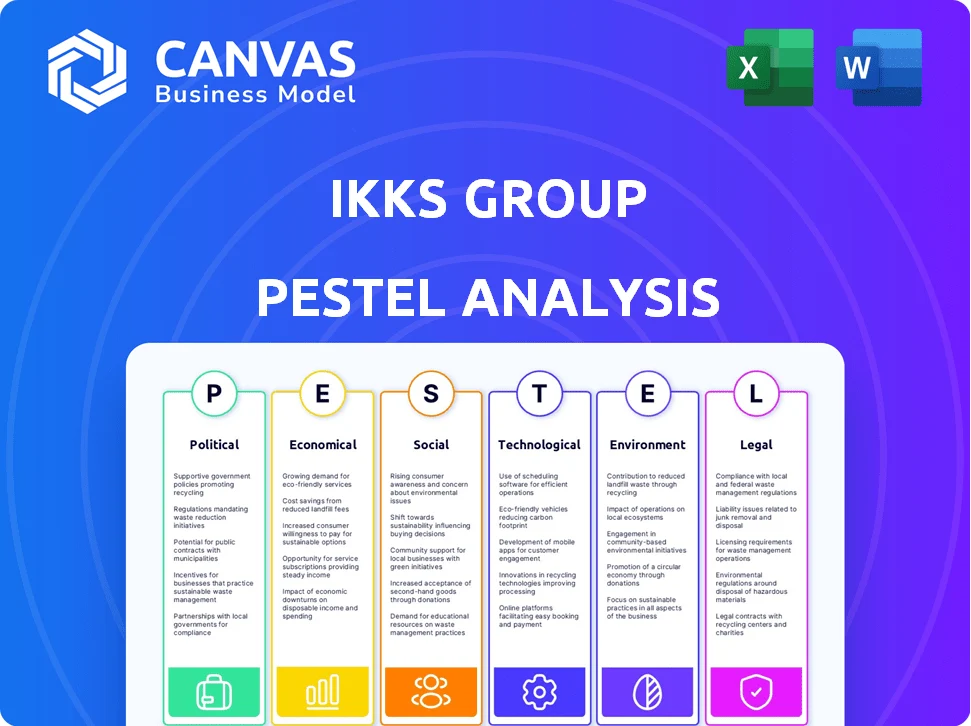
The PESTLE analysis you see is what you’ll get. This document includes a comprehensive IKKS Group analysis.

PESTLE Analysis Template

Your Competitive Advantage Starts with This Report
IKKS Group faces a dynamic landscape. Their strategies are shaped by fashion trends and global economies. Social and legal factors heavily influence the brand’s appeal and market presence. From supply chains to digital shifts, IKKS must adapt.
Our professionally prepared PESTEL Analysis goes beyond theory. Explore how real external trends are impacting IKKS Group's operations and strategy. Perfect for research, pitches, or strategic reviews. Get the full analysis instantly.
Political factors

Geopolitical Instability and Trade Policies
Geopolitical instability, including conflicts and trade disputes, can disrupt supply chains, affecting fashion brands like IKKS. New tariffs and changing trade agreements, especially from major economies, introduce uncertainty. The US-China trade tensions and the war in Ukraine have already caused significant shifts. In 2024, global trade growth is projected at 3.3%, down from 5.0% in 2022, impacting sourcing costs.
Government Regulations on Sustainability
Governments are tightening environmental regulations. The EU's Corporate Sustainability Reporting Directive (CSRD) mandates detailed sustainability disclosures, affecting fashion businesses. The US is also increasing scrutiny on environmental impact, particularly concerning supply chains. For example, in 2024, the EU's textile strategy targets reducing textile waste. These regulations push companies like IKKS Group to improve sustainability.

Political Support for Sustainable Practices
Political backing for sustainability is increasing in fashion. IKKS, as a Fashion Pact signatory, aligns with governmental and industry efforts. The EU's Circular Economy Action Plan, updated in 2024, pressures fashion brands. This involves stricter regulations on waste and resource management. In 2024, the EU's Ecodesign for Sustainable Products Regulation is in development.

Labor Laws and Human Rights
Labor laws and human rights are critical for IKKS Group. The company faces scrutiny regarding its supply chain practices. Compliance with diverse labor standards globally is essential for brand reputation and legal adherence. IKKS must navigate varying regulations to ensure ethical sourcing.
- In 2024, the International Labour Organization (ILO) reported that 27.6 million people were in forced labor globally.
- The fashion industry faces pressure to improve worker welfare.
- IKKS should conduct regular audits of its suppliers to ensure compliance.
Political Stability in Sourcing Countries
Political stability significantly affects IKKS Group's sourcing and manufacturing. Instability can disrupt supply chains, increasing costs and delaying production. Countries with stable governments offer more predictable business environments, essential for long-term planning. For example, a 2024 report indicated a 15% rise in supply chain disruptions due to political instability in key sourcing regions.
- Political risks include trade policy changes and regulatory shifts.
- Political stability directly influences investment decisions.
- Stable regions often see better labor relations.
Political Winds: Shaping the Future of Fashion
Political factors significantly affect IKKS Group through trade policies, sustainability regulations, and labor laws. Geopolitical tensions and trade disputes, like the US-China dynamics, introduce supply chain risks, influencing sourcing costs. Governments' environmental regulations, particularly the EU's CSRD and circular economy initiatives, push for enhanced sustainability in fashion.
| Political Factor | Impact on IKKS Group | 2024/2025 Data |
|---|---|---|
| Trade Policies | Supply chain disruptions, cost increases | 2024: Global trade growth at 3.3%, down from 5.0% in 2022. |
| Environmental Regulations | Increased compliance costs, need for sustainable practices | EU's textile strategy targets waste reduction, 2024. |
| Labor Laws & Human Rights | Ethical sourcing demands, supply chain scrutiny | ILO: 27.6 million people in forced labor globally (2024). |
Economic factors

Consumer Spending and Inflation
Economic uncertainty, inflation, and low confidence hurt fashion spending. Price-conscious consumers choose cheaper options. In 2024, French retail sales fell, impacting brands like IKKS. Inflation in France was 2.3% in March 2024.
Global Economic Growth
Global economic growth directly impacts fashion demand. In 2024, the World Bank projected global growth at 2.6%, a slight increase from 2023. Slowdowns in major economies, like the EU, could challenge IKKS Group's sales and sourcing. Market fluctuations require adaptive strategies.

Currency Fluctuations
Currency fluctuations significantly affect IKKS Group, an international entity. Changes in exchange rates directly influence the cost of materials and production, potentially squeezing profit margins. For example, in 2024, the Eurozone faced volatility against the US dollar, impacting import costs. Therefore, hedging strategies and diversification are critical for managing currency risk effectively. This ensures stable pricing and maintains a competitive edge in various global markets.

Rising Production Costs
Rising production costs pose a significant challenge for IKKS Group. Increased transportation expenses, coupled with rising labor wages in sourcing regions, are inflating manufacturing expenses. Additionally, compliance with stringent sustainability regulations adds to the financial burden. These factors collectively squeeze profit margins, impacting overall financial performance.
- Freight rates have increased by approximately 20% in 2024, according to the World Bank.
- Labor costs in key sourcing countries have risen by 5-10% in the last year (2024).
- Sustainability compliance can increase production costs by 3-7%.
Shift in Value Creation
The fashion industry is experiencing a shift in value creation. Non-luxury segments are poised to drive economic profit. This indicates evolving consumer preferences and new market possibilities. For example, in 2024, the global apparel market reached $1.7 trillion, with fast fashion brands showing significant growth.
- Consumer behavior increasingly favors affordable fashion.
- This trend presents opportunities for IKKS Group to expand in these segments.
- Adapting to changing preferences is key to sustained profitability.
IKKS Faces Economic Hurdles
Economic headwinds like inflation and reduced consumer spending impact IKKS. Slow global growth, projected at 2.6% in 2024 by the World Bank, poses challenges. Rising production and labor costs are a concern.
| Factor | Impact | Data |
|---|---|---|
| Inflation (France) | Reduces spending | 2.3% (March 2024) |
| Freight Rate Increase | Raises Costs | ~20% (2024) |
| Apparel Market (2024) | Overall market size | $1.7T |
Sociological factors

Shifting Consumer Values and Preferences
Consumer values are evolving, with sustainability and ethics gaining importance. A 2024 study shows that 68% of consumers prefer eco-friendly brands. IKKS must show responsible practices to meet these demands. Transparency in sourcing and production is crucial. This shift impacts purchasing decisions significantly.
Rise of Second-Hand and Circular Fashion
The rise of second-hand fashion is notable. A 2024 report showed the global resale market hit $198 billion. Younger consumers drive this shift toward circularity. IKKS Group's launch of a second-hand platform addresses this trend directly, showing a proactive adaptation.

Demand for Inclusivity and Diversity
Consumers increasingly seek inclusivity and diversity in fashion, impacting brand strategies. IKKS Group must adapt product lines and marketing to reflect varied body types, skin tones, and gender expressions. Data from 2024 shows a 20% rise in demand for inclusive sizing. Failure to adapt can result in a loss of market share.

Influence of Social Media and Digital Channels
Social media shapes fashion trends and consumer behavior, especially on platforms like TikTok and Instagram. IKKS Group must actively engage consumers on these channels, adapting swiftly to evolving trends. In 2024, social media ad spending reached $225 billion globally, reflecting its impact. The fashion industry sees about 60% of purchases influenced by digital channels.
- Digital platforms drive fashion trends.
- Brands require active social media engagement.
- Adaptation to rapidly changing trends is crucial.
- Social media ad spending is up globally.
Awareness of Social Standards in Supply Chains
Consumers are increasingly aware of the social impact of their purchases, particularly in the fashion industry. There's growing pressure on brands like IKKS to ensure fair labor practices and transparency in their supply chains. A 2024 study revealed that 70% of consumers are willing to pay more for sustainable and ethically sourced products. This shift influences brand reputation and purchasing decisions. Brands must adapt to these changing social standards.
- 70% of consumers are willing to pay more for sustainable and ethically sourced products (2024).
- Increased consumer demand for supply chain transparency.
- Reputational risks associated with unethical labor practices.
Ethical Choices Drive Fashion Trends in 2024
Consumer preferences now favor ethical brands and eco-friendly practices, influencing purchasing decisions. In 2024, 68% of consumers showed a preference for sustainable brands, impacting companies. Transparency and responsible practices are increasingly important.
The second-hand fashion market is experiencing rapid growth, particularly among younger consumers, reaching $198 billion in 2024. IKKS Group is actively adapting by launching resale platforms. This proactive approach reflects market shifts.
Brands need to adapt to increasing demand for inclusivity and diversity. Data indicates a 20% rise in demand for inclusive sizing in 2024. Adapting product lines to reflect various body types and gender expressions is crucial for sustained market share.
| Trend | Impact on IKKS Group | Data (2024) |
|---|---|---|
| Sustainability | Brand perception and sourcing | 68% prefer eco-friendly brands |
| Second-Hand Fashion | Resale platform strategy | $198B global market size |
| Inclusivity | Product and marketing adaptation | 20% rise in demand |
Original: $10.00
-65%$10.00
$3.50IKKS GROUP PESTLE ANALYSIS TEMPLATE RESEARCH
What is included in the product
Detailed Word Document
Evaluates how macro-environmental factors impact IKKS Group.
Each part features examples and trends.
Customizable Excel Spreadsheet
Allows users to modify and contextualize the IKKS Group PESTLE, optimizing for targeted action.
Preview the Actual Deliverable
IKKS Group PESTLE Analysis
The PESTLE analysis you see is what you’ll get. This document includes a comprehensive IKKS Group analysis.
PESTLE Analysis Template
Your Competitive Advantage Starts with This Report
IKKS Group faces a dynamic landscape. Their strategies are shaped by fashion trends and global economies. Social and legal factors heavily influence the brand’s appeal and market presence. From supply chains to digital shifts, IKKS must adapt.
Our professionally prepared PESTEL Analysis goes beyond theory. Explore how real external trends are impacting IKKS Group's operations and strategy. Perfect for research, pitches, or strategic reviews. Get the full analysis instantly.
Political factors
Geopolitical Instability and Trade Policies
Geopolitical instability, including conflicts and trade disputes, can disrupt supply chains, affecting fashion brands like IKKS. New tariffs and changing trade agreements, especially from major economies, introduce uncertainty. The US-China trade tensions and the war in Ukraine have already caused significant shifts. In 2024, global trade growth is projected at 3.3%, down from 5.0% in 2022, impacting sourcing costs.
Government Regulations on Sustainability
Governments are tightening environmental regulations. The EU's Corporate Sustainability Reporting Directive (CSRD) mandates detailed sustainability disclosures, affecting fashion businesses. The US is also increasing scrutiny on environmental impact, particularly concerning supply chains. For example, in 2024, the EU's textile strategy targets reducing textile waste. These regulations push companies like IKKS Group to improve sustainability.
Political Support for Sustainable Practices
Political backing for sustainability is increasing in fashion. IKKS, as a Fashion Pact signatory, aligns with governmental and industry efforts. The EU's Circular Economy Action Plan, updated in 2024, pressures fashion brands. This involves stricter regulations on waste and resource management. In 2024, the EU's Ecodesign for Sustainable Products Regulation is in development.
Labor Laws and Human Rights
Labor laws and human rights are critical for IKKS Group. The company faces scrutiny regarding its supply chain practices. Compliance with diverse labor standards globally is essential for brand reputation and legal adherence. IKKS must navigate varying regulations to ensure ethical sourcing.
- In 2024, the International Labour Organization (ILO) reported that 27.6 million people were in forced labor globally.
- The fashion industry faces pressure to improve worker welfare.
- IKKS should conduct regular audits of its suppliers to ensure compliance.
Political Stability in Sourcing Countries
Political stability significantly affects IKKS Group's sourcing and manufacturing. Instability can disrupt supply chains, increasing costs and delaying production. Countries with stable governments offer more predictable business environments, essential for long-term planning. For example, a 2024 report indicated a 15% rise in supply chain disruptions due to political instability in key sourcing regions.
- Political risks include trade policy changes and regulatory shifts.
- Political stability directly influences investment decisions.
- Stable regions often see better labor relations.
Political Winds: Shaping the Future of Fashion
Political factors significantly affect IKKS Group through trade policies, sustainability regulations, and labor laws. Geopolitical tensions and trade disputes, like the US-China dynamics, introduce supply chain risks, influencing sourcing costs. Governments' environmental regulations, particularly the EU's CSRD and circular economy initiatives, push for enhanced sustainability in fashion.
| Political Factor | Impact on IKKS Group | 2024/2025 Data |
|---|---|---|
| Trade Policies | Supply chain disruptions, cost increases | 2024: Global trade growth at 3.3%, down from 5.0% in 2022. |
| Environmental Regulations | Increased compliance costs, need for sustainable practices | EU's textile strategy targets waste reduction, 2024. |
| Labor Laws & Human Rights | Ethical sourcing demands, supply chain scrutiny | ILO: 27.6 million people in forced labor globally (2024). |
Economic factors
Consumer Spending and Inflation
Economic uncertainty, inflation, and low confidence hurt fashion spending. Price-conscious consumers choose cheaper options. In 2024, French retail sales fell, impacting brands like IKKS. Inflation in France was 2.3% in March 2024.
Global Economic Growth
Global economic growth directly impacts fashion demand. In 2024, the World Bank projected global growth at 2.6%, a slight increase from 2023. Slowdowns in major economies, like the EU, could challenge IKKS Group's sales and sourcing. Market fluctuations require adaptive strategies.
Currency Fluctuations
Currency fluctuations significantly affect IKKS Group, an international entity. Changes in exchange rates directly influence the cost of materials and production, potentially squeezing profit margins. For example, in 2024, the Eurozone faced volatility against the US dollar, impacting import costs. Therefore, hedging strategies and diversification are critical for managing currency risk effectively. This ensures stable pricing and maintains a competitive edge in various global markets.
Rising Production Costs
Rising production costs pose a significant challenge for IKKS Group. Increased transportation expenses, coupled with rising labor wages in sourcing regions, are inflating manufacturing expenses. Additionally, compliance with stringent sustainability regulations adds to the financial burden. These factors collectively squeeze profit margins, impacting overall financial performance.
- Freight rates have increased by approximately 20% in 2024, according to the World Bank.
- Labor costs in key sourcing countries have risen by 5-10% in the last year (2024).
- Sustainability compliance can increase production costs by 3-7%.
Shift in Value Creation
The fashion industry is experiencing a shift in value creation. Non-luxury segments are poised to drive economic profit. This indicates evolving consumer preferences and new market possibilities. For example, in 2024, the global apparel market reached $1.7 trillion, with fast fashion brands showing significant growth.
- Consumer behavior increasingly favors affordable fashion.
- This trend presents opportunities for IKKS Group to expand in these segments.
- Adapting to changing preferences is key to sustained profitability.
IKKS Faces Economic Hurdles
Economic headwinds like inflation and reduced consumer spending impact IKKS. Slow global growth, projected at 2.6% in 2024 by the World Bank, poses challenges. Rising production and labor costs are a concern.
| Factor | Impact | Data |
|---|---|---|
| Inflation (France) | Reduces spending | 2.3% (March 2024) |
| Freight Rate Increase | Raises Costs | ~20% (2024) |
| Apparel Market (2024) | Overall market size | $1.7T |
Sociological factors
Shifting Consumer Values and Preferences
Consumer values are evolving, with sustainability and ethics gaining importance. A 2024 study shows that 68% of consumers prefer eco-friendly brands. IKKS must show responsible practices to meet these demands. Transparency in sourcing and production is crucial. This shift impacts purchasing decisions significantly.
Rise of Second-Hand and Circular Fashion
The rise of second-hand fashion is notable. A 2024 report showed the global resale market hit $198 billion. Younger consumers drive this shift toward circularity. IKKS Group's launch of a second-hand platform addresses this trend directly, showing a proactive adaptation.
Demand for Inclusivity and Diversity
Consumers increasingly seek inclusivity and diversity in fashion, impacting brand strategies. IKKS Group must adapt product lines and marketing to reflect varied body types, skin tones, and gender expressions. Data from 2024 shows a 20% rise in demand for inclusive sizing. Failure to adapt can result in a loss of market share.
Influence of Social Media and Digital Channels
Social media shapes fashion trends and consumer behavior, especially on platforms like TikTok and Instagram. IKKS Group must actively engage consumers on these channels, adapting swiftly to evolving trends. In 2024, social media ad spending reached $225 billion globally, reflecting its impact. The fashion industry sees about 60% of purchases influenced by digital channels.
- Digital platforms drive fashion trends.
- Brands require active social media engagement.
- Adaptation to rapidly changing trends is crucial.
- Social media ad spending is up globally.
Awareness of Social Standards in Supply Chains
Consumers are increasingly aware of the social impact of their purchases, particularly in the fashion industry. There's growing pressure on brands like IKKS to ensure fair labor practices and transparency in their supply chains. A 2024 study revealed that 70% of consumers are willing to pay more for sustainable and ethically sourced products. This shift influences brand reputation and purchasing decisions. Brands must adapt to these changing social standards.
- 70% of consumers are willing to pay more for sustainable and ethically sourced products (2024).
- Increased consumer demand for supply chain transparency.
- Reputational risks associated with unethical labor practices.
Ethical Choices Drive Fashion Trends in 2024
Consumer preferences now favor ethical brands and eco-friendly practices, influencing purchasing decisions. In 2024, 68% of consumers showed a preference for sustainable brands, impacting companies. Transparency and responsible practices are increasingly important.
The second-hand fashion market is experiencing rapid growth, particularly among younger consumers, reaching $198 billion in 2024. IKKS Group is actively adapting by launching resale platforms. This proactive approach reflects market shifts.
Brands need to adapt to increasing demand for inclusivity and diversity. Data indicates a 20% rise in demand for inclusive sizing in 2024. Adapting product lines to reflect various body types and gender expressions is crucial for sustained market share.
| Trend | Impact on IKKS Group | Data (2024) |
|---|---|---|
| Sustainability | Brand perception and sourcing | 68% prefer eco-friendly brands |
| Second-Hand Fashion | Resale platform strategy | $198B global market size |
| Inclusivity | Product and marketing adaptation | 20% rise in demand |
Product Information
Product Information
Shipping & Returns
Shipping & Returns
Description
What is included in the product
Detailed Word Document
Evaluates how macro-environmental factors impact IKKS Group.
Each part features examples and trends.
Customizable Excel Spreadsheet
Allows users to modify and contextualize the IKKS Group PESTLE, optimizing for targeted action.
Preview the Actual Deliverable
IKKS Group PESTLE Analysis
The PESTLE analysis you see is what you’ll get. This document includes a comprehensive IKKS Group analysis.
PESTLE Analysis Template
Your Competitive Advantage Starts with This Report
IKKS Group faces a dynamic landscape. Their strategies are shaped by fashion trends and global economies. Social and legal factors heavily influence the brand’s appeal and market presence. From supply chains to digital shifts, IKKS must adapt.
Our professionally prepared PESTEL Analysis goes beyond theory. Explore how real external trends are impacting IKKS Group's operations and strategy. Perfect for research, pitches, or strategic reviews. Get the full analysis instantly.
Political factors
Geopolitical Instability and Trade Policies
Geopolitical instability, including conflicts and trade disputes, can disrupt supply chains, affecting fashion brands like IKKS. New tariffs and changing trade agreements, especially from major economies, introduce uncertainty. The US-China trade tensions and the war in Ukraine have already caused significant shifts. In 2024, global trade growth is projected at 3.3%, down from 5.0% in 2022, impacting sourcing costs.
Government Regulations on Sustainability
Governments are tightening environmental regulations. The EU's Corporate Sustainability Reporting Directive (CSRD) mandates detailed sustainability disclosures, affecting fashion businesses. The US is also increasing scrutiny on environmental impact, particularly concerning supply chains. For example, in 2024, the EU's textile strategy targets reducing textile waste. These regulations push companies like IKKS Group to improve sustainability.
Political Support for Sustainable Practices
Political backing for sustainability is increasing in fashion. IKKS, as a Fashion Pact signatory, aligns with governmental and industry efforts. The EU's Circular Economy Action Plan, updated in 2024, pressures fashion brands. This involves stricter regulations on waste and resource management. In 2024, the EU's Ecodesign for Sustainable Products Regulation is in development.
Labor Laws and Human Rights
Labor laws and human rights are critical for IKKS Group. The company faces scrutiny regarding its supply chain practices. Compliance with diverse labor standards globally is essential for brand reputation and legal adherence. IKKS must navigate varying regulations to ensure ethical sourcing.
- In 2024, the International Labour Organization (ILO) reported that 27.6 million people were in forced labor globally.
- The fashion industry faces pressure to improve worker welfare.
- IKKS should conduct regular audits of its suppliers to ensure compliance.
Political Stability in Sourcing Countries
Political stability significantly affects IKKS Group's sourcing and manufacturing. Instability can disrupt supply chains, increasing costs and delaying production. Countries with stable governments offer more predictable business environments, essential for long-term planning. For example, a 2024 report indicated a 15% rise in supply chain disruptions due to political instability in key sourcing regions.
- Political risks include trade policy changes and regulatory shifts.
- Political stability directly influences investment decisions.
- Stable regions often see better labor relations.
Political Winds: Shaping the Future of Fashion
Political factors significantly affect IKKS Group through trade policies, sustainability regulations, and labor laws. Geopolitical tensions and trade disputes, like the US-China dynamics, introduce supply chain risks, influencing sourcing costs. Governments' environmental regulations, particularly the EU's CSRD and circular economy initiatives, push for enhanced sustainability in fashion.
| Political Factor | Impact on IKKS Group | 2024/2025 Data |
|---|---|---|
| Trade Policies | Supply chain disruptions, cost increases | 2024: Global trade growth at 3.3%, down from 5.0% in 2022. |
| Environmental Regulations | Increased compliance costs, need for sustainable practices | EU's textile strategy targets waste reduction, 2024. |
| Labor Laws & Human Rights | Ethical sourcing demands, supply chain scrutiny | ILO: 27.6 million people in forced labor globally (2024). |
Economic factors
Consumer Spending and Inflation
Economic uncertainty, inflation, and low confidence hurt fashion spending. Price-conscious consumers choose cheaper options. In 2024, French retail sales fell, impacting brands like IKKS. Inflation in France was 2.3% in March 2024.
Global Economic Growth
Global economic growth directly impacts fashion demand. In 2024, the World Bank projected global growth at 2.6%, a slight increase from 2023. Slowdowns in major economies, like the EU, could challenge IKKS Group's sales and sourcing. Market fluctuations require adaptive strategies.
Currency Fluctuations
Currency fluctuations significantly affect IKKS Group, an international entity. Changes in exchange rates directly influence the cost of materials and production, potentially squeezing profit margins. For example, in 2024, the Eurozone faced volatility against the US dollar, impacting import costs. Therefore, hedging strategies and diversification are critical for managing currency risk effectively. This ensures stable pricing and maintains a competitive edge in various global markets.
Rising Production Costs
Rising production costs pose a significant challenge for IKKS Group. Increased transportation expenses, coupled with rising labor wages in sourcing regions, are inflating manufacturing expenses. Additionally, compliance with stringent sustainability regulations adds to the financial burden. These factors collectively squeeze profit margins, impacting overall financial performance.
- Freight rates have increased by approximately 20% in 2024, according to the World Bank.
- Labor costs in key sourcing countries have risen by 5-10% in the last year (2024).
- Sustainability compliance can increase production costs by 3-7%.
Shift in Value Creation
The fashion industry is experiencing a shift in value creation. Non-luxury segments are poised to drive economic profit. This indicates evolving consumer preferences and new market possibilities. For example, in 2024, the global apparel market reached $1.7 trillion, with fast fashion brands showing significant growth.
- Consumer behavior increasingly favors affordable fashion.
- This trend presents opportunities for IKKS Group to expand in these segments.
- Adapting to changing preferences is key to sustained profitability.
IKKS Faces Economic Hurdles
Economic headwinds like inflation and reduced consumer spending impact IKKS. Slow global growth, projected at 2.6% in 2024 by the World Bank, poses challenges. Rising production and labor costs are a concern.
| Factor | Impact | Data |
|---|---|---|
| Inflation (France) | Reduces spending | 2.3% (March 2024) |
| Freight Rate Increase | Raises Costs | ~20% (2024) |
| Apparel Market (2024) | Overall market size | $1.7T |
Sociological factors
Shifting Consumer Values and Preferences
Consumer values are evolving, with sustainability and ethics gaining importance. A 2024 study shows that 68% of consumers prefer eco-friendly brands. IKKS must show responsible practices to meet these demands. Transparency in sourcing and production is crucial. This shift impacts purchasing decisions significantly.
Rise of Second-Hand and Circular Fashion
The rise of second-hand fashion is notable. A 2024 report showed the global resale market hit $198 billion. Younger consumers drive this shift toward circularity. IKKS Group's launch of a second-hand platform addresses this trend directly, showing a proactive adaptation.
Demand for Inclusivity and Diversity
Consumers increasingly seek inclusivity and diversity in fashion, impacting brand strategies. IKKS Group must adapt product lines and marketing to reflect varied body types, skin tones, and gender expressions. Data from 2024 shows a 20% rise in demand for inclusive sizing. Failure to adapt can result in a loss of market share.
Influence of Social Media and Digital Channels
Social media shapes fashion trends and consumer behavior, especially on platforms like TikTok and Instagram. IKKS Group must actively engage consumers on these channels, adapting swiftly to evolving trends. In 2024, social media ad spending reached $225 billion globally, reflecting its impact. The fashion industry sees about 60% of purchases influenced by digital channels.
- Digital platforms drive fashion trends.
- Brands require active social media engagement.
- Adaptation to rapidly changing trends is crucial.
- Social media ad spending is up globally.
Awareness of Social Standards in Supply Chains
Consumers are increasingly aware of the social impact of their purchases, particularly in the fashion industry. There's growing pressure on brands like IKKS to ensure fair labor practices and transparency in their supply chains. A 2024 study revealed that 70% of consumers are willing to pay more for sustainable and ethically sourced products. This shift influences brand reputation and purchasing decisions. Brands must adapt to these changing social standards.
- 70% of consumers are willing to pay more for sustainable and ethically sourced products (2024).
- Increased consumer demand for supply chain transparency.
- Reputational risks associated with unethical labor practices.
Ethical Choices Drive Fashion Trends in 2024
Consumer preferences now favor ethical brands and eco-friendly practices, influencing purchasing decisions. In 2024, 68% of consumers showed a preference for sustainable brands, impacting companies. Transparency and responsible practices are increasingly important.
The second-hand fashion market is experiencing rapid growth, particularly among younger consumers, reaching $198 billion in 2024. IKKS Group is actively adapting by launching resale platforms. This proactive approach reflects market shifts.
Brands need to adapt to increasing demand for inclusivity and diversity. Data indicates a 20% rise in demand for inclusive sizing in 2024. Adapting product lines to reflect various body types and gender expressions is crucial for sustained market share.
| Trend | Impact on IKKS Group | Data (2024) |
|---|---|---|
| Sustainability | Brand perception and sourcing | 68% prefer eco-friendly brands |
| Second-Hand Fashion | Resale platform strategy | $198B global market size |
| Inclusivity | Product and marketing adaptation | 20% rise in demand |