HI MARLEY PORTER'S FIVE FORCES TEMPLATE RESEARCH
What is included in the product
 Detailed Word Document
Tailored exclusively for Hi Marley, analyzing its position within its competitive landscape.

 Customizable Excel Spreadsheet
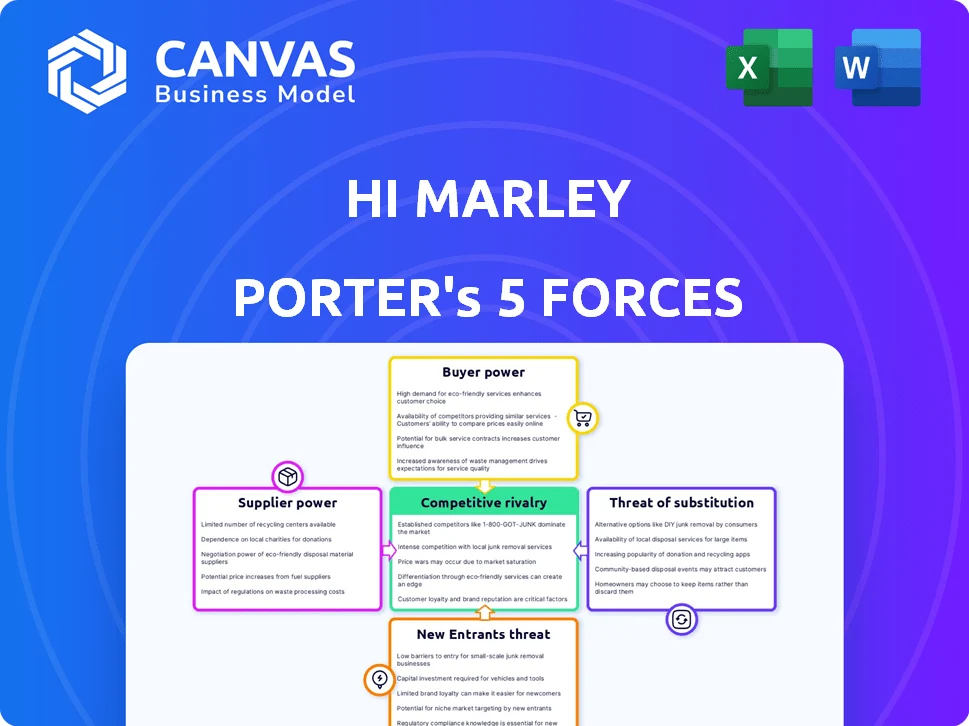
Gain immediate insights with a dynamic visualization of Porter's Five Forces, ready for your next meeting.
What You See Is What You Get
Hi Marley Porter's Five Forces Analysis
This preview presents the complete Porter's Five Forces analysis for Hi Marley. You're viewing the identical document you'll receive instantly upon purchase.

Porter's Five Forces Analysis Template

Go Beyond the Preview—Access the Full Strategic Report
Hi Marley navigates a complex insurance tech landscape. Buyer power is moderate, influenced by insurer demands for solutions. Supplier power, especially from tech providers, poses some challenges. The threat of new entrants remains, with innovation driving competition. Substitute products, such as in-house developed solutions, are a factor. Competitive rivalry is fierce, fueled by industry consolidation and new players.
This brief snapshot only scratches the surface. Unlock the full Porter's Five Forces Analysis to explore Hi Marley’s competitive dynamics, market pressures, and strategic advantages in detail.
Suppliers Bargaining Power

Availability of AI and SMS Technology
Hi Marley's AI and SMS tech relies on broadly available tech, potentially increasing supplier bargaining power. However, specialized insurance AI and secure SMS gateways could limit viable suppliers. The global SMS market reached $22.6 billion in 2024, with AI solutions growing rapidly. This balance impacts Hi Marley's cost and tech choices.
Importance of Data and AI Models
Hi Marley's AI-driven platform relies on its AI models and the data used to train them. Suppliers of specialized AI components or unique insurance datasets could wield significant bargaining power. For example, the AI in the insurance market is expected to reach $4.4 billion by 2024. This makes the suppliers of the best AI models critical.

Switching Costs for Hi Marley
Hi Marley's dependence on specific tech or data sources elevates supplier power due to switch costs. If switching is complex, current suppliers gain leverage. According to 2024 data, software integration projects average $100k-$500k. This high cost strengthens supplier bargaining positions.

Number and Concentration of Suppliers
The bargaining power of suppliers for Hi Marley's AI and SMS functionalities hinges on the number and concentration of these suppliers. If only a few companies offer the specific AI and SMS solutions Hi Marley needs, those suppliers wield significant power. Conversely, a market with numerous, diverse suppliers dilutes their individual power, giving Hi Marley more leverage.
- Market concentration is key; a few dominant players increase supplier power.
- A fragmented market with many options reduces supplier influence.
- Consider the pricing dynamics of AI and SMS services in 2024.
- Assess the switching costs associated with changing suppliers.
Forward Integration Threat of Suppliers
Suppliers, such as technology providers, could become competitors by creating their own insurance communication platforms, posing a forward integration threat to Hi Marley. This would significantly increase their bargaining power. For example, if a major cloud services provider developed a competing platform, Hi Marley's dependence on them would shift. This shift could lead to increased costs or reduced service quality for Hi Marley.
- Forward integration by suppliers can disrupt existing market dynamics.
- Suppliers might leverage their existing customer relationships.
- The threat is heightened if switching costs for customers are low.
- This could lead to a loss of market share for Hi Marley.
AI/SMS Market Dynamics: Supplier Power
Supplier power varies with AI/SMS market concentration. Few dominant suppliers increase their leverage over Hi Marley. Fragmented markets weaken supplier bargaining power. Assess 2024 AI/SMS pricing and switching costs.
| Factor | Impact on Supplier Power | 2024 Data Point |
|---|---|---|
| Market Concentration | High concentration = higher power | Top 3 SMS providers control 60% of market |
| Switching Costs | High costs = higher power | Average integration cost: $100k-$500k |
| Supplier Integration | Forward integration threat | Cloud market: $670.6 billion in 2024 |
Customers Bargaining Power

Concentration of Insurance Companies
The insurance industry is dominated by large, established players like UnitedHealth Group and Anthem, influencing market dynamics. In 2024, these major insurers control a significant market share. If Hi Marley's customers are concentrated among these few, they gain strong bargaining power. This allows them to negotiate favorable terms, impacting Hi Marley's pricing and features.
Switching Costs for Insurance Companies
Switching costs are high for insurance companies implementing new communication platforms, reducing customer bargaining power. Integrating new systems and training staff can be costly, with implementation projects often exceeding budgets. In 2024, the average cost for such projects was $75,000-$250,000. These high switching costs make it less likely that customers will change providers.

Availability of Alternative Solutions
Insurance customers have options beyond Hi Marley. Traditional communication methods like phone, email, and mail remain viable. The presence of these alternatives strengthens customer bargaining power in 2024. For example, 60% of customers still prefer traditional communication methods.

Impact of Communication on Customer Satisfaction and Efficiency
Effective communication boosts customer satisfaction and operational efficiency, vital for insurers. If Hi Marley's platform greatly improves these, it could lessen customer bargaining power due to its high value. Consider that in 2024, 80% of customers cite clear communication as key to satisfaction, and streamlined claims processing can cut costs by up to 30%.
- Customer satisfaction hinges on clear communication.
- Efficient claims processing reduces operational costs.
- Hi Marley's platform could reduce customer bargaining power.
- Insurers can leverage tech for better customer relationships.
Customer Sophistication and Industry Knowledge
Insurance companies, as sophisticated buyers, possess considerable bargaining power. They have specific needs and must comply with regulations, which allows them to evaluate communication technology offerings critically. This industry knowledge enables them to negotiate favorable terms, potentially lowering costs for communication solutions. In 2024, the insurance industry spent approximately $2.5 billion on communication tech.
- Insurance companies' deep understanding of communication tech enhances negotiation skills.
- They can effectively negotiate for better pricing and service terms.
- This power is amplified by regulatory demands and tech-specific needs.
- In 2024, the insurance sector's tech spending reached $2.5B.
Insurance Giants' Grip on the Market
Insurance companies wield significant bargaining power due to their size and industry knowledge. In 2024, the top 10 insurers controlled over 70% of the market. They can negotiate favorable terms, impacting Hi Marley's revenue.
Switching costs also affect customer power; high costs reduce their ability to switch. Implementing new platforms costs between $75,000-$250,000 in 2024.
The availability of alternatives like traditional methods also impacts power dynamics. 60% of customers still use traditional methods.
| Factor | Impact on Bargaining Power | 2024 Data |
|---|---|---|
| Market Concentration | High concentration = higher power | Top 10 insurers: 70%+ market share |
| Switching Costs | High costs = lower power | Platform implementation: $75K-$250K |
| Alternatives | More alternatives = higher power | 60% use traditional methods |
Rivalry Among Competitors

Number and Size of Competitors
The insurance communication platform market features various competitors, including tech giants and insurtech startups. The presence of numerous competitors often intensifies rivalry. For example, companies like Guidewire and Duck Creek Technologies compete with newer firms. The competitive landscape is dynamic, influencing pricing and innovation strategies.
Market Growth Rate
The insurtech market, especially in AI and customer communication, is growing. Rapid market growth can lessen rivalry as demand supports more firms. In 2024, the global insurtech market was valued at $13.5 billion, with an expected CAGR of 30% from 2024 to 2030.

Product Differentiation
Hi Marley's product differentiation centers on AI-driven SMS for insurance. Its unique platform, setting it apart from rivals, influences competitive intensity. In 2024, the insurance tech market saw increased adoption of AI, with investments exceeding $10 billion. This focus on SMS offers distinct advantages.

Switching Costs for Customers
Switching costs significantly impact competitive rivalry in the insurance tech sector. High switching costs, which can include data migration and retraining, can lessen the intensity of competition. For instance, a 2024 study showed that the average cost for an insurance company to migrate to a new platform is $50,000, acting as a deterrent. These costs make it harder for smaller competitors to challenge established platforms like Hi Marley. This dynamic influences how companies compete for customer loyalty and market share.
- Data migration expenses can be a major barrier.
- Training and implementation further increase costs.
- Customer lock-in reduces competitive pressures.
- Long-term contracts also raise switching costs.
Industry Concentration
Competitive rivalry in the insurtech sector is shaped by industry concentration. While numerous insurtech firms exist, the power held by a few large insurance carriers, who are potential customers, significantly influences competition. These insurtech companies battle intensely to secure major clients, impacting market dynamics. For instance, in 2024, the top 10 U.S. insurance companies controlled over 50% of the market share, underscoring the importance of these clients. This concentrated market creates a high-stakes environment for insurtech firms.
- Market Share: The top 10 U.S. insurance companies controlled over 50% of the market share in 2024.
- Customer Concentration: A few large insurance carriers are key customers.
- Intense Competition: Insurtech companies compete fiercely for major clients.
- Market Dynamics: Industry concentration significantly shapes market dynamics.
Insurance Tech: Market Dynamics Unveiled
Competitive rivalry in the insurance tech space is shaped by several factors. The market is competitive, with numerous players vying for market share. High switching costs, like data migration, influence how firms compete. The top 10 U.S. insurance companies held over 50% of the market share in 2024.
| Factor | Impact | Data (2024) |
|---|---|---|
| Market Competition | High rivalry | Numerous competitors |
| Switching Costs | Reduce rivalry | Avg. migration cost: $50K |
| Market Concentration | Intense competition | Top 10 U.S. firms: >50% share |
Original: $10.00
-65%$10.00
$3.50HI MARLEY PORTER'S FIVE FORCES TEMPLATE RESEARCH
What is included in the product
Detailed Word Document
Tailored exclusively for Hi Marley, analyzing its position within its competitive landscape.
Customizable Excel Spreadsheet
Gain immediate insights with a dynamic visualization of Porter's Five Forces, ready for your next meeting.
What You See Is What You Get
Hi Marley Porter's Five Forces Analysis
This preview presents the complete Porter's Five Forces analysis for Hi Marley. You're viewing the identical document you'll receive instantly upon purchase.
Porter's Five Forces Analysis Template
Go Beyond the Preview—Access the Full Strategic Report
Hi Marley navigates a complex insurance tech landscape. Buyer power is moderate, influenced by insurer demands for solutions. Supplier power, especially from tech providers, poses some challenges. The threat of new entrants remains, with innovation driving competition. Substitute products, such as in-house developed solutions, are a factor. Competitive rivalry is fierce, fueled by industry consolidation and new players.
This brief snapshot only scratches the surface. Unlock the full Porter's Five Forces Analysis to explore Hi Marley’s competitive dynamics, market pressures, and strategic advantages in detail.
Suppliers Bargaining Power
Availability of AI and SMS Technology
Hi Marley's AI and SMS tech relies on broadly available tech, potentially increasing supplier bargaining power. However, specialized insurance AI and secure SMS gateways could limit viable suppliers. The global SMS market reached $22.6 billion in 2024, with AI solutions growing rapidly. This balance impacts Hi Marley's cost and tech choices.
Importance of Data and AI Models
Hi Marley's AI-driven platform relies on its AI models and the data used to train them. Suppliers of specialized AI components or unique insurance datasets could wield significant bargaining power. For example, the AI in the insurance market is expected to reach $4.4 billion by 2024. This makes the suppliers of the best AI models critical.
Switching Costs for Hi Marley
Hi Marley's dependence on specific tech or data sources elevates supplier power due to switch costs. If switching is complex, current suppliers gain leverage. According to 2024 data, software integration projects average $100k-$500k. This high cost strengthens supplier bargaining positions.
Number and Concentration of Suppliers
The bargaining power of suppliers for Hi Marley's AI and SMS functionalities hinges on the number and concentration of these suppliers. If only a few companies offer the specific AI and SMS solutions Hi Marley needs, those suppliers wield significant power. Conversely, a market with numerous, diverse suppliers dilutes their individual power, giving Hi Marley more leverage.
- Market concentration is key; a few dominant players increase supplier power.
- A fragmented market with many options reduces supplier influence.
- Consider the pricing dynamics of AI and SMS services in 2024.
- Assess the switching costs associated with changing suppliers.
Forward Integration Threat of Suppliers
Suppliers, such as technology providers, could become competitors by creating their own insurance communication platforms, posing a forward integration threat to Hi Marley. This would significantly increase their bargaining power. For example, if a major cloud services provider developed a competing platform, Hi Marley's dependence on them would shift. This shift could lead to increased costs or reduced service quality for Hi Marley.
- Forward integration by suppliers can disrupt existing market dynamics.
- Suppliers might leverage their existing customer relationships.
- The threat is heightened if switching costs for customers are low.
- This could lead to a loss of market share for Hi Marley.
AI/SMS Market Dynamics: Supplier Power
Supplier power varies with AI/SMS market concentration. Few dominant suppliers increase their leverage over Hi Marley. Fragmented markets weaken supplier bargaining power. Assess 2024 AI/SMS pricing and switching costs.
| Factor | Impact on Supplier Power | 2024 Data Point |
|---|---|---|
| Market Concentration | High concentration = higher power | Top 3 SMS providers control 60% of market |
| Switching Costs | High costs = higher power | Average integration cost: $100k-$500k |
| Supplier Integration | Forward integration threat | Cloud market: $670.6 billion in 2024 |
Customers Bargaining Power
Concentration of Insurance Companies
The insurance industry is dominated by large, established players like UnitedHealth Group and Anthem, influencing market dynamics. In 2024, these major insurers control a significant market share. If Hi Marley's customers are concentrated among these few, they gain strong bargaining power. This allows them to negotiate favorable terms, impacting Hi Marley's pricing and features.
Switching Costs for Insurance Companies
Switching costs are high for insurance companies implementing new communication platforms, reducing customer bargaining power. Integrating new systems and training staff can be costly, with implementation projects often exceeding budgets. In 2024, the average cost for such projects was $75,000-$250,000. These high switching costs make it less likely that customers will change providers.
Availability of Alternative Solutions
Insurance customers have options beyond Hi Marley. Traditional communication methods like phone, email, and mail remain viable. The presence of these alternatives strengthens customer bargaining power in 2024. For example, 60% of customers still prefer traditional communication methods.
Impact of Communication on Customer Satisfaction and Efficiency
Effective communication boosts customer satisfaction and operational efficiency, vital for insurers. If Hi Marley's platform greatly improves these, it could lessen customer bargaining power due to its high value. Consider that in 2024, 80% of customers cite clear communication as key to satisfaction, and streamlined claims processing can cut costs by up to 30%.
- Customer satisfaction hinges on clear communication.
- Efficient claims processing reduces operational costs.
- Hi Marley's platform could reduce customer bargaining power.
- Insurers can leverage tech for better customer relationships.
Customer Sophistication and Industry Knowledge
Insurance companies, as sophisticated buyers, possess considerable bargaining power. They have specific needs and must comply with regulations, which allows them to evaluate communication technology offerings critically. This industry knowledge enables them to negotiate favorable terms, potentially lowering costs for communication solutions. In 2024, the insurance industry spent approximately $2.5 billion on communication tech.
- Insurance companies' deep understanding of communication tech enhances negotiation skills.
- They can effectively negotiate for better pricing and service terms.
- This power is amplified by regulatory demands and tech-specific needs.
- In 2024, the insurance sector's tech spending reached $2.5B.
Insurance Giants' Grip on the Market
Insurance companies wield significant bargaining power due to their size and industry knowledge. In 2024, the top 10 insurers controlled over 70% of the market. They can negotiate favorable terms, impacting Hi Marley's revenue.
Switching costs also affect customer power; high costs reduce their ability to switch. Implementing new platforms costs between $75,000-$250,000 in 2024.
The availability of alternatives like traditional methods also impacts power dynamics. 60% of customers still use traditional methods.
| Factor | Impact on Bargaining Power | 2024 Data |
|---|---|---|
| Market Concentration | High concentration = higher power | Top 10 insurers: 70%+ market share |
| Switching Costs | High costs = lower power | Platform implementation: $75K-$250K |
| Alternatives | More alternatives = higher power | 60% use traditional methods |
Rivalry Among Competitors
Number and Size of Competitors
The insurance communication platform market features various competitors, including tech giants and insurtech startups. The presence of numerous competitors often intensifies rivalry. For example, companies like Guidewire and Duck Creek Technologies compete with newer firms. The competitive landscape is dynamic, influencing pricing and innovation strategies.
Market Growth Rate
The insurtech market, especially in AI and customer communication, is growing. Rapid market growth can lessen rivalry as demand supports more firms. In 2024, the global insurtech market was valued at $13.5 billion, with an expected CAGR of 30% from 2024 to 2030.
Product Differentiation
Hi Marley's product differentiation centers on AI-driven SMS for insurance. Its unique platform, setting it apart from rivals, influences competitive intensity. In 2024, the insurance tech market saw increased adoption of AI, with investments exceeding $10 billion. This focus on SMS offers distinct advantages.
Switching Costs for Customers
Switching costs significantly impact competitive rivalry in the insurance tech sector. High switching costs, which can include data migration and retraining, can lessen the intensity of competition. For instance, a 2024 study showed that the average cost for an insurance company to migrate to a new platform is $50,000, acting as a deterrent. These costs make it harder for smaller competitors to challenge established platforms like Hi Marley. This dynamic influences how companies compete for customer loyalty and market share.
- Data migration expenses can be a major barrier.
- Training and implementation further increase costs.
- Customer lock-in reduces competitive pressures.
- Long-term contracts also raise switching costs.
Industry Concentration
Competitive rivalry in the insurtech sector is shaped by industry concentration. While numerous insurtech firms exist, the power held by a few large insurance carriers, who are potential customers, significantly influences competition. These insurtech companies battle intensely to secure major clients, impacting market dynamics. For instance, in 2024, the top 10 U.S. insurance companies controlled over 50% of the market share, underscoring the importance of these clients. This concentrated market creates a high-stakes environment for insurtech firms.
- Market Share: The top 10 U.S. insurance companies controlled over 50% of the market share in 2024.
- Customer Concentration: A few large insurance carriers are key customers.
- Intense Competition: Insurtech companies compete fiercely for major clients.
- Market Dynamics: Industry concentration significantly shapes market dynamics.
Insurance Tech: Market Dynamics Unveiled
Competitive rivalry in the insurance tech space is shaped by several factors. The market is competitive, with numerous players vying for market share. High switching costs, like data migration, influence how firms compete. The top 10 U.S. insurance companies held over 50% of the market share in 2024.
| Factor | Impact | Data (2024) |
|---|---|---|
| Market Competition | High rivalry | Numerous competitors |
| Switching Costs | Reduce rivalry | Avg. migration cost: $50K |
| Market Concentration | Intense competition | Top 10 U.S. firms: >50% share |
Product Information
Product Information
Shipping & Returns
Shipping & Returns
Description
What is included in the product
Detailed Word Document
Tailored exclusively for Hi Marley, analyzing its position within its competitive landscape.
Customizable Excel Spreadsheet
Gain immediate insights with a dynamic visualization of Porter's Five Forces, ready for your next meeting.
What You See Is What You Get
Hi Marley Porter's Five Forces Analysis
This preview presents the complete Porter's Five Forces analysis for Hi Marley. You're viewing the identical document you'll receive instantly upon purchase.
Porter's Five Forces Analysis Template
Go Beyond the Preview—Access the Full Strategic Report
Hi Marley navigates a complex insurance tech landscape. Buyer power is moderate, influenced by insurer demands for solutions. Supplier power, especially from tech providers, poses some challenges. The threat of new entrants remains, with innovation driving competition. Substitute products, such as in-house developed solutions, are a factor. Competitive rivalry is fierce, fueled by industry consolidation and new players.
This brief snapshot only scratches the surface. Unlock the full Porter's Five Forces Analysis to explore Hi Marley’s competitive dynamics, market pressures, and strategic advantages in detail.
Suppliers Bargaining Power
Availability of AI and SMS Technology
Hi Marley's AI and SMS tech relies on broadly available tech, potentially increasing supplier bargaining power. However, specialized insurance AI and secure SMS gateways could limit viable suppliers. The global SMS market reached $22.6 billion in 2024, with AI solutions growing rapidly. This balance impacts Hi Marley's cost and tech choices.
Importance of Data and AI Models
Hi Marley's AI-driven platform relies on its AI models and the data used to train them. Suppliers of specialized AI components or unique insurance datasets could wield significant bargaining power. For example, the AI in the insurance market is expected to reach $4.4 billion by 2024. This makes the suppliers of the best AI models critical.
Switching Costs for Hi Marley
Hi Marley's dependence on specific tech or data sources elevates supplier power due to switch costs. If switching is complex, current suppliers gain leverage. According to 2024 data, software integration projects average $100k-$500k. This high cost strengthens supplier bargaining positions.
Number and Concentration of Suppliers
The bargaining power of suppliers for Hi Marley's AI and SMS functionalities hinges on the number and concentration of these suppliers. If only a few companies offer the specific AI and SMS solutions Hi Marley needs, those suppliers wield significant power. Conversely, a market with numerous, diverse suppliers dilutes their individual power, giving Hi Marley more leverage.
- Market concentration is key; a few dominant players increase supplier power.
- A fragmented market with many options reduces supplier influence.
- Consider the pricing dynamics of AI and SMS services in 2024.
- Assess the switching costs associated with changing suppliers.
Forward Integration Threat of Suppliers
Suppliers, such as technology providers, could become competitors by creating their own insurance communication platforms, posing a forward integration threat to Hi Marley. This would significantly increase their bargaining power. For example, if a major cloud services provider developed a competing platform, Hi Marley's dependence on them would shift. This shift could lead to increased costs or reduced service quality for Hi Marley.
- Forward integration by suppliers can disrupt existing market dynamics.
- Suppliers might leverage their existing customer relationships.
- The threat is heightened if switching costs for customers are low.
- This could lead to a loss of market share for Hi Marley.
AI/SMS Market Dynamics: Supplier Power
Supplier power varies with AI/SMS market concentration. Few dominant suppliers increase their leverage over Hi Marley. Fragmented markets weaken supplier bargaining power. Assess 2024 AI/SMS pricing and switching costs.
| Factor | Impact on Supplier Power | 2024 Data Point |
|---|---|---|
| Market Concentration | High concentration = higher power | Top 3 SMS providers control 60% of market |
| Switching Costs | High costs = higher power | Average integration cost: $100k-$500k |
| Supplier Integration | Forward integration threat | Cloud market: $670.6 billion in 2024 |
Customers Bargaining Power
Concentration of Insurance Companies
The insurance industry is dominated by large, established players like UnitedHealth Group and Anthem, influencing market dynamics. In 2024, these major insurers control a significant market share. If Hi Marley's customers are concentrated among these few, they gain strong bargaining power. This allows them to negotiate favorable terms, impacting Hi Marley's pricing and features.
Switching Costs for Insurance Companies
Switching costs are high for insurance companies implementing new communication platforms, reducing customer bargaining power. Integrating new systems and training staff can be costly, with implementation projects often exceeding budgets. In 2024, the average cost for such projects was $75,000-$250,000. These high switching costs make it less likely that customers will change providers.
Availability of Alternative Solutions
Insurance customers have options beyond Hi Marley. Traditional communication methods like phone, email, and mail remain viable. The presence of these alternatives strengthens customer bargaining power in 2024. For example, 60% of customers still prefer traditional communication methods.
Impact of Communication on Customer Satisfaction and Efficiency
Effective communication boosts customer satisfaction and operational efficiency, vital for insurers. If Hi Marley's platform greatly improves these, it could lessen customer bargaining power due to its high value. Consider that in 2024, 80% of customers cite clear communication as key to satisfaction, and streamlined claims processing can cut costs by up to 30%.
- Customer satisfaction hinges on clear communication.
- Efficient claims processing reduces operational costs.
- Hi Marley's platform could reduce customer bargaining power.
- Insurers can leverage tech for better customer relationships.
Customer Sophistication and Industry Knowledge
Insurance companies, as sophisticated buyers, possess considerable bargaining power. They have specific needs and must comply with regulations, which allows them to evaluate communication technology offerings critically. This industry knowledge enables them to negotiate favorable terms, potentially lowering costs for communication solutions. In 2024, the insurance industry spent approximately $2.5 billion on communication tech.
- Insurance companies' deep understanding of communication tech enhances negotiation skills.
- They can effectively negotiate for better pricing and service terms.
- This power is amplified by regulatory demands and tech-specific needs.
- In 2024, the insurance sector's tech spending reached $2.5B.
Insurance Giants' Grip on the Market
Insurance companies wield significant bargaining power due to their size and industry knowledge. In 2024, the top 10 insurers controlled over 70% of the market. They can negotiate favorable terms, impacting Hi Marley's revenue.
Switching costs also affect customer power; high costs reduce their ability to switch. Implementing new platforms costs between $75,000-$250,000 in 2024.
The availability of alternatives like traditional methods also impacts power dynamics. 60% of customers still use traditional methods.
| Factor | Impact on Bargaining Power | 2024 Data |
|---|---|---|
| Market Concentration | High concentration = higher power | Top 10 insurers: 70%+ market share |
| Switching Costs | High costs = lower power | Platform implementation: $75K-$250K |
| Alternatives | More alternatives = higher power | 60% use traditional methods |
Rivalry Among Competitors
Number and Size of Competitors
The insurance communication platform market features various competitors, including tech giants and insurtech startups. The presence of numerous competitors often intensifies rivalry. For example, companies like Guidewire and Duck Creek Technologies compete with newer firms. The competitive landscape is dynamic, influencing pricing and innovation strategies.
Market Growth Rate
The insurtech market, especially in AI and customer communication, is growing. Rapid market growth can lessen rivalry as demand supports more firms. In 2024, the global insurtech market was valued at $13.5 billion, with an expected CAGR of 30% from 2024 to 2030.
Product Differentiation
Hi Marley's product differentiation centers on AI-driven SMS for insurance. Its unique platform, setting it apart from rivals, influences competitive intensity. In 2024, the insurance tech market saw increased adoption of AI, with investments exceeding $10 billion. This focus on SMS offers distinct advantages.
Switching Costs for Customers
Switching costs significantly impact competitive rivalry in the insurance tech sector. High switching costs, which can include data migration and retraining, can lessen the intensity of competition. For instance, a 2024 study showed that the average cost for an insurance company to migrate to a new platform is $50,000, acting as a deterrent. These costs make it harder for smaller competitors to challenge established platforms like Hi Marley. This dynamic influences how companies compete for customer loyalty and market share.
- Data migration expenses can be a major barrier.
- Training and implementation further increase costs.
- Customer lock-in reduces competitive pressures.
- Long-term contracts also raise switching costs.
Industry Concentration
Competitive rivalry in the insurtech sector is shaped by industry concentration. While numerous insurtech firms exist, the power held by a few large insurance carriers, who are potential customers, significantly influences competition. These insurtech companies battle intensely to secure major clients, impacting market dynamics. For instance, in 2024, the top 10 U.S. insurance companies controlled over 50% of the market share, underscoring the importance of these clients. This concentrated market creates a high-stakes environment for insurtech firms.
- Market Share: The top 10 U.S. insurance companies controlled over 50% of the market share in 2024.
- Customer Concentration: A few large insurance carriers are key customers.
- Intense Competition: Insurtech companies compete fiercely for major clients.
- Market Dynamics: Industry concentration significantly shapes market dynamics.
Insurance Tech: Market Dynamics Unveiled
Competitive rivalry in the insurance tech space is shaped by several factors. The market is competitive, with numerous players vying for market share. High switching costs, like data migration, influence how firms compete. The top 10 U.S. insurance companies held over 50% of the market share in 2024.
| Factor | Impact | Data (2024) |
|---|---|---|
| Market Competition | High rivalry | Numerous competitors |
| Switching Costs | Reduce rivalry | Avg. migration cost: $50K |
| Market Concentration | Intense competition | Top 10 U.S. firms: >50% share |