
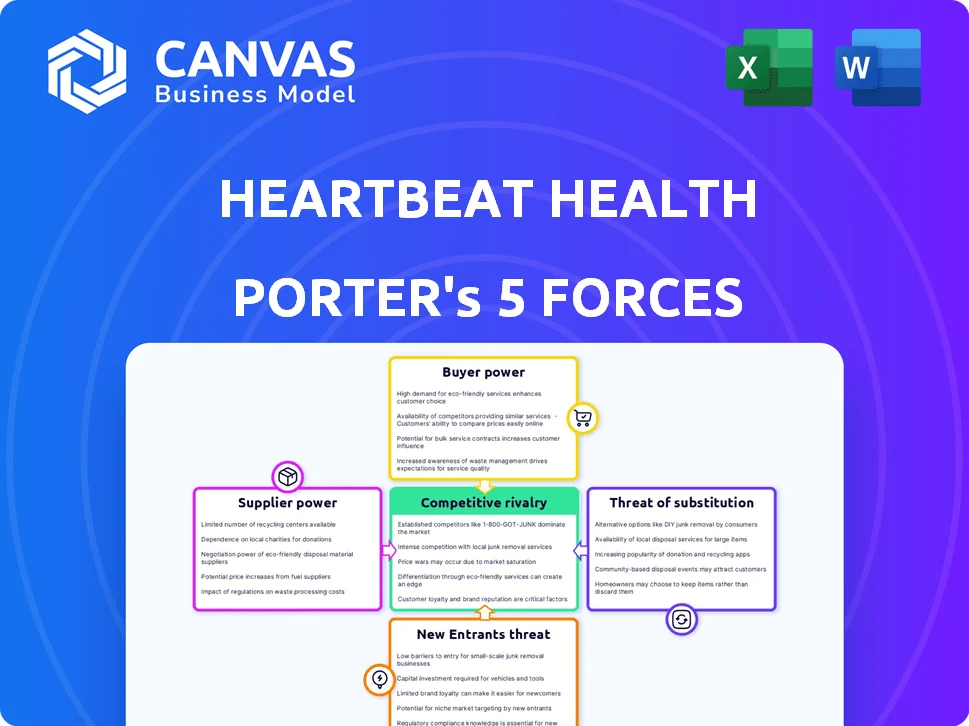
HEARTBEAT HEALTH PORTER'S FIVE FORCES TEMPLATE RESEARCH
What is included in the product
 Detailed Word Document
Tailored exclusively for Heartbeat Health, analyzing its position within its competitive landscape.

 Customizable Excel Spreadsheet
Quickly analyze the competitive landscape with an automated scoring system and color-coded force levels.
Same Document Delivered
Heartbeat Health Porter's Five Forces Analysis
This preview provides the Heartbeat Health Porter's Five Forces analysis in its entirety. The document you see here is the exact, fully formatted report you'll receive immediately upon purchase. There are no hidden elements or edits to come, it's ready to use. It's been professionally researched and crafted for your needs.

Porter's Five Forces Analysis Template

Elevate Your Analysis with the Complete Porter's Five Forces Analysis
Heartbeat Health operates in a dynamic healthcare market, facing pressures from various forces. Buyer power is significant due to insurance negotiations. The threat of new entrants is moderate, with established players holding advantages. Substitute products, like wearable devices, pose a potential threat. Supplier power, particularly for technology providers, is noteworthy. Competitive rivalry is intense, with numerous telehealth competitors.
Ready to move beyond the basics? Get a full strategic breakdown of Heartbeat Health’s market position, competitive intensity, and external threats—all in one powerful analysis.
Suppliers Bargaining Power

Technology Providers
Heartbeat Health depends on tech, including software and maybe hardware for remote monitoring. Supplier power hinges on tech uniqueness and availability. If few offer the needed tech, their bargaining power rises. In 2024, the global health tech market is projected to reach $600 billion, increasing supplier influence.
Healthcare Professionals
Cardiologists and other healthcare professionals are crucial for Heartbeat Health's services. The demand for these specialists, particularly in telehealth, grants them considerable bargaining power. In 2024, the average salary for cardiologists in the U.S. was around $500,000, reflecting their value. This high demand allows them to negotiate favorable terms, impacting Heartbeat Health's operational costs.

Data and Analytics Providers
Heartbeat Health's data-driven approach relies on data analytics and health data suppliers. The bargaining power of these suppliers is significant if their data or analytics are proprietary. In 2024, the market for healthcare analytics is projected to reach $38.7 billion, showing supplier influence.

Telecommunication and Infrastructure Providers
Reliable internet and telecom infrastructure are vital for telehealth. Providers' service costs directly affect Heartbeat Health's expenses. High costs or service disruptions from providers could hinder operations. The industry saw a 2.8% rise in telecom spending in 2024, impacting telehealth services.
- Telecommunication costs are a significant operational expense.
- Infrastructure reliability directly impacts service delivery.
- Rising telecom costs can reduce profit margins.
- Dependence on external providers creates vulnerabilities.
Electronic Health Record (EHR) Systems
EHR vendors hold some bargaining power because telehealth companies often need to integrate with their systems to share patient data. This integration can be complex, and the need for it gives EHR vendors leverage. The EHR market is consolidated, with a few major players controlling a significant share. For instance, Epic and Cerner (now Oracle Health) are dominant, impacting integration choices and costs for telehealth providers.
- Market dominance by Epic and Oracle Health (Cerner) gives them significant control.
- Integration complexities can lead to higher costs and dependencies for telehealth companies.
- EHR vendors can dictate terms, affecting telehealth's operational efficiency.
Supplier Power Dynamics in Healthcare Tech
Heartbeat Health faces supplier power from tech providers, specialists, data analytics, and infrastructure. The leverage of these suppliers hinges on factors like tech uniqueness and data proprietary. In 2024, the healthcare tech market's $600B size highlights this influence.
| Supplier Type | Bargaining Power Factor | 2024 Market Data |
|---|---|---|
| Tech Providers | Uniqueness, Availability | Health tech market: $600B |
| Healthcare Professionals | Demand, Expertise | Cardiologist avg. salary: $500K |
| Data & Analytics | Proprietary Data | Healthcare analytics market: $38.7B |
Customers Bargaining Power

Patients
Patients' bargaining power in telehealth is rising. The telehealth market is expanding, offering more choices. Factors include platform alternatives, service differentiation, and patient price sensitivity. In 2024, telehealth adoption increased, with 20% of Americans using it.
Healthcare Providers and Systems
Hospitals, clinics, and healthcare systems are key telehealth customers. They hold considerable bargaining power due to their size and the potential for substantial contracts. For example, in 2024, the US healthcare expenditure reached $4.8 trillion. This spending level gives these entities significant leverage in negotiations.

Insurance Companies (Payers)
Insurance companies, acting as payers, hold considerable bargaining power in the telehealth market, including for services like those offered by Heartbeat Health. They dictate coverage terms and reimbursement rates, directly affecting telehealth providers' revenue. In 2024, the average telehealth reimbursement rate varied widely depending on the service and payer, with some plans offering rates as low as $50 per visit. This power enables insurers to negotiate favorable terms, impacting profitability. The trend shows ongoing pressure on telehealth reimbursement, influencing the financial health of providers like Heartbeat Health.

Employers
Employers, acting as customers for telehealth services, wield considerable bargaining power. They're often large entities seeking cost-effective healthcare solutions for their employees, influencing provider selection. Employee satisfaction is a key factor, which further empowers employers in negotiations. For instance, in 2024, employer-sponsored health plans covered approximately 157 million Americans, representing a significant market share.
- Cost-consciousness drives provider selection.
- Employee satisfaction influences decisions.
- Large employers have significant leverage.
- Market share is a critical factor.
Government and Regulatory Bodies
Government and regulatory bodies, though not direct customers, wield considerable influence over the telehealth market, including companies like Heartbeat Health, through their policies and regulations. These entities shape the landscape by setting standards for data privacy, interoperability, and the scope of services that can be delivered via telehealth. For example, the Centers for Medicare & Medicaid Services (CMS) expanded telehealth coverage during the COVID-19 pandemic, which had a significant impact on market growth. Changes in reimbursement models, such as those related to virtual care, can also either encourage or hinder telehealth adoption.
- CMS increased telehealth use among Medicare beneficiaries by 63x from 2019 to 2020.
- The telehealth market is projected to reach $175 billion by 2026.
- The FDA regulates medical devices used in telehealth, ensuring safety and efficacy.
- HIPAA compliance is mandatory for telehealth providers, protecting patient data.
Heartbeat Health's Success: Who Holds the Cards?
Patients, hospitals, insurance companies, and employers influence Heartbeat Health's success. Patients' choices and price sensitivity impact telehealth adoption. Large entities like hospitals and insurers have significant bargaining power due to their financial influence. Government regulations also shape the market.
| Customer Type | Bargaining Power Level | Impact on Heartbeat Health |
|---|---|---|
| Patients | Moderate | Influences service adoption and demand. |
| Hospitals/Clinics | High | Large contracts, pricing, and service needs. |
| Insurers | High | Dictates reimbursement rates and coverage. |
Rivalry Among Competitors

Number and Diversity of Competitors
The telehealth market, especially telecardiology, is booming, drawing many companies. In 2024, the U.S. telehealth market was valued at roughly $66.3 billion, reflecting its rapid expansion. This sector's growth has increased the number of competitors in the field.
Rivalry intensifies with both large established firms and agile startups. For instance, major players like Amwell and Teladoc compete with smaller, specialized firms. This diversity fuels competition.
Market Growth Rate
The telehealth market's fast expansion can lessen rivalry initially, offering opportunities for many companies. As the market develops, expect stronger competition for market share. In 2024, the telehealth market is projected to reach $60 billion, with a growth rate of 20% annually. Companies will vie for a piece of this rapidly expanding pie.

Industry Concentration
While the telehealth market is crowded, virtual cardiology could be more concentrated. In 2024, the top 5 telehealth companies held about 60% of the market share. A higher concentration means more intense rivalry.

Differentiation of Services
Heartbeat Health's ability to differentiate its virtual cardiovascular care services significantly impacts competitive rivalry. Offering unique technology, like AI-driven diagnostic tools, can set it apart. Focusing on specialized programs, such as remote patient monitoring for specific heart conditions, also helps. A strong brand reputation and positive patient outcomes can also reduce direct competition. For example, the telehealth market is projected to reach $175 billion by 2026.
- Technological Advantages: AI diagnostics, remote monitoring.
- Specialized Programs: Focus on specific heart conditions.
- Brand Reputation: Positive patient outcomes.
- Market Growth: Telehealth market is projected to reach $175 billion by 2026.
Switching Costs for Customers
Switching costs significantly impact competitive rivalry in telehealth. If patients or healthcare systems can easily switch providers, competition intensifies. This ease of switching forces companies to compete aggressively on price and service. For example, in 2024, the average patient satisfaction score for telehealth services was 4.2 out of 5, indicating a high degree of customer mobility.
- High patient satisfaction means less incentive to switch.
- Low switching costs increase price competition.
- Service quality becomes a key differentiator.
- Market share is more volatile.
Telehealth's $175B Battleground: Who Will Win?
Competitive rivalry in the telehealth market is fierce, driven by rapid growth and numerous players. The U.S. telehealth market was valued at $66.3 billion in 2024, attracting both established firms and startups. Differentiation through technology and specialized services is key.
The market is projected to reach $175 billion by 2026, intensifying the competition for market share. High patient satisfaction, at 4.2 out of 5 in 2024, and low switching costs fuel price and service competition.
| Factor | Impact | Example |
|---|---|---|
| Market Growth | Increases competition | Projected $175B by 2026 |
| Switching Costs | Influence rivalry | Patient satisfaction 4.2/5 |
| Differentiation | Reduces competition | AI diagnostics |
HEARTBEAT HEALTH PORTER'S FIVE FORCES TEMPLATE RESEARCH
What is included in the product
Detailed Word Document
Tailored exclusively for Heartbeat Health, analyzing its position within its competitive landscape.
Customizable Excel Spreadsheet
Quickly analyze the competitive landscape with an automated scoring system and color-coded force levels.
Same Document Delivered
Heartbeat Health Porter's Five Forces Analysis
This preview provides the Heartbeat Health Porter's Five Forces analysis in its entirety. The document you see here is the exact, fully formatted report you'll receive immediately upon purchase. There are no hidden elements or edits to come, it's ready to use. It's been professionally researched and crafted for your needs.
Porter's Five Forces Analysis Template
Elevate Your Analysis with the Complete Porter's Five Forces Analysis
Heartbeat Health operates in a dynamic healthcare market, facing pressures from various forces. Buyer power is significant due to insurance negotiations. The threat of new entrants is moderate, with established players holding advantages. Substitute products, like wearable devices, pose a potential threat. Supplier power, particularly for technology providers, is noteworthy. Competitive rivalry is intense, with numerous telehealth competitors.
Ready to move beyond the basics? Get a full strategic breakdown of Heartbeat Health’s market position, competitive intensity, and external threats—all in one powerful analysis.
Suppliers Bargaining Power
Technology Providers
Heartbeat Health depends on tech, including software and maybe hardware for remote monitoring. Supplier power hinges on tech uniqueness and availability. If few offer the needed tech, their bargaining power rises. In 2024, the global health tech market is projected to reach $600 billion, increasing supplier influence.
Healthcare Professionals
Cardiologists and other healthcare professionals are crucial for Heartbeat Health's services. The demand for these specialists, particularly in telehealth, grants them considerable bargaining power. In 2024, the average salary for cardiologists in the U.S. was around $500,000, reflecting their value. This high demand allows them to negotiate favorable terms, impacting Heartbeat Health's operational costs.
Data and Analytics Providers
Heartbeat Health's data-driven approach relies on data analytics and health data suppliers. The bargaining power of these suppliers is significant if their data or analytics are proprietary. In 2024, the market for healthcare analytics is projected to reach $38.7 billion, showing supplier influence.
Telecommunication and Infrastructure Providers
Reliable internet and telecom infrastructure are vital for telehealth. Providers' service costs directly affect Heartbeat Health's expenses. High costs or service disruptions from providers could hinder operations. The industry saw a 2.8% rise in telecom spending in 2024, impacting telehealth services.
- Telecommunication costs are a significant operational expense.
- Infrastructure reliability directly impacts service delivery.
- Rising telecom costs can reduce profit margins.
- Dependence on external providers creates vulnerabilities.
Electronic Health Record (EHR) Systems
EHR vendors hold some bargaining power because telehealth companies often need to integrate with their systems to share patient data. This integration can be complex, and the need for it gives EHR vendors leverage. The EHR market is consolidated, with a few major players controlling a significant share. For instance, Epic and Cerner (now Oracle Health) are dominant, impacting integration choices and costs for telehealth providers.
- Market dominance by Epic and Oracle Health (Cerner) gives them significant control.
- Integration complexities can lead to higher costs and dependencies for telehealth companies.
- EHR vendors can dictate terms, affecting telehealth's operational efficiency.
Supplier Power Dynamics in Healthcare Tech
Heartbeat Health faces supplier power from tech providers, specialists, data analytics, and infrastructure. The leverage of these suppliers hinges on factors like tech uniqueness and data proprietary. In 2024, the healthcare tech market's $600B size highlights this influence.
| Supplier Type | Bargaining Power Factor | 2024 Market Data |
|---|---|---|
| Tech Providers | Uniqueness, Availability | Health tech market: $600B |
| Healthcare Professionals | Demand, Expertise | Cardiologist avg. salary: $500K |
| Data & Analytics | Proprietary Data | Healthcare analytics market: $38.7B |
Customers Bargaining Power
Patients
Patients' bargaining power in telehealth is rising. The telehealth market is expanding, offering more choices. Factors include platform alternatives, service differentiation, and patient price sensitivity. In 2024, telehealth adoption increased, with 20% of Americans using it.
Healthcare Providers and Systems
Hospitals, clinics, and healthcare systems are key telehealth customers. They hold considerable bargaining power due to their size and the potential for substantial contracts. For example, in 2024, the US healthcare expenditure reached $4.8 trillion. This spending level gives these entities significant leverage in negotiations.
Insurance Companies (Payers)
Insurance companies, acting as payers, hold considerable bargaining power in the telehealth market, including for services like those offered by Heartbeat Health. They dictate coverage terms and reimbursement rates, directly affecting telehealth providers' revenue. In 2024, the average telehealth reimbursement rate varied widely depending on the service and payer, with some plans offering rates as low as $50 per visit. This power enables insurers to negotiate favorable terms, impacting profitability. The trend shows ongoing pressure on telehealth reimbursement, influencing the financial health of providers like Heartbeat Health.
Employers
Employers, acting as customers for telehealth services, wield considerable bargaining power. They're often large entities seeking cost-effective healthcare solutions for their employees, influencing provider selection. Employee satisfaction is a key factor, which further empowers employers in negotiations. For instance, in 2024, employer-sponsored health plans covered approximately 157 million Americans, representing a significant market share.
- Cost-consciousness drives provider selection.
- Employee satisfaction influences decisions.
- Large employers have significant leverage.
- Market share is a critical factor.
Government and Regulatory Bodies
Government and regulatory bodies, though not direct customers, wield considerable influence over the telehealth market, including companies like Heartbeat Health, through their policies and regulations. These entities shape the landscape by setting standards for data privacy, interoperability, and the scope of services that can be delivered via telehealth. For example, the Centers for Medicare & Medicaid Services (CMS) expanded telehealth coverage during the COVID-19 pandemic, which had a significant impact on market growth. Changes in reimbursement models, such as those related to virtual care, can also either encourage or hinder telehealth adoption.
- CMS increased telehealth use among Medicare beneficiaries by 63x from 2019 to 2020.
- The telehealth market is projected to reach $175 billion by 2026.
- The FDA regulates medical devices used in telehealth, ensuring safety and efficacy.
- HIPAA compliance is mandatory for telehealth providers, protecting patient data.
Heartbeat Health's Success: Who Holds the Cards?
Patients, hospitals, insurance companies, and employers influence Heartbeat Health's success. Patients' choices and price sensitivity impact telehealth adoption. Large entities like hospitals and insurers have significant bargaining power due to their financial influence. Government regulations also shape the market.
| Customer Type | Bargaining Power Level | Impact on Heartbeat Health |
|---|---|---|
| Patients | Moderate | Influences service adoption and demand. |
| Hospitals/Clinics | High | Large contracts, pricing, and service needs. |
| Insurers | High | Dictates reimbursement rates and coverage. |
Rivalry Among Competitors
Number and Diversity of Competitors
The telehealth market, especially telecardiology, is booming, drawing many companies. In 2024, the U.S. telehealth market was valued at roughly $66.3 billion, reflecting its rapid expansion. This sector's growth has increased the number of competitors in the field.
Rivalry intensifies with both large established firms and agile startups. For instance, major players like Amwell and Teladoc compete with smaller, specialized firms. This diversity fuels competition.
Market Growth Rate
The telehealth market's fast expansion can lessen rivalry initially, offering opportunities for many companies. As the market develops, expect stronger competition for market share. In 2024, the telehealth market is projected to reach $60 billion, with a growth rate of 20% annually. Companies will vie for a piece of this rapidly expanding pie.
Industry Concentration
While the telehealth market is crowded, virtual cardiology could be more concentrated. In 2024, the top 5 telehealth companies held about 60% of the market share. A higher concentration means more intense rivalry.
Differentiation of Services
Heartbeat Health's ability to differentiate its virtual cardiovascular care services significantly impacts competitive rivalry. Offering unique technology, like AI-driven diagnostic tools, can set it apart. Focusing on specialized programs, such as remote patient monitoring for specific heart conditions, also helps. A strong brand reputation and positive patient outcomes can also reduce direct competition. For example, the telehealth market is projected to reach $175 billion by 2026.
- Technological Advantages: AI diagnostics, remote monitoring.
- Specialized Programs: Focus on specific heart conditions.
- Brand Reputation: Positive patient outcomes.
- Market Growth: Telehealth market is projected to reach $175 billion by 2026.
Switching Costs for Customers
Switching costs significantly impact competitive rivalry in telehealth. If patients or healthcare systems can easily switch providers, competition intensifies. This ease of switching forces companies to compete aggressively on price and service. For example, in 2024, the average patient satisfaction score for telehealth services was 4.2 out of 5, indicating a high degree of customer mobility.
- High patient satisfaction means less incentive to switch.
- Low switching costs increase price competition.
- Service quality becomes a key differentiator.
- Market share is more volatile.
Telehealth's $175B Battleground: Who Will Win?
Competitive rivalry in the telehealth market is fierce, driven by rapid growth and numerous players. The U.S. telehealth market was valued at $66.3 billion in 2024, attracting both established firms and startups. Differentiation through technology and specialized services is key.
The market is projected to reach $175 billion by 2026, intensifying the competition for market share. High patient satisfaction, at 4.2 out of 5 in 2024, and low switching costs fuel price and service competition.
| Factor | Impact | Example |
|---|---|---|
| Market Growth | Increases competition | Projected $175B by 2026 |
| Switching Costs | Influence rivalry | Patient satisfaction 4.2/5 |
| Differentiation | Reduces competition | AI diagnostics |
Product Information
Product Information
Shipping & Returns
Shipping & Returns
Description
What is included in the product
Detailed Word Document
Tailored exclusively for Heartbeat Health, analyzing its position within its competitive landscape.
Customizable Excel Spreadsheet
Quickly analyze the competitive landscape with an automated scoring system and color-coded force levels.
Same Document Delivered
Heartbeat Health Porter's Five Forces Analysis
This preview provides the Heartbeat Health Porter's Five Forces analysis in its entirety. The document you see here is the exact, fully formatted report you'll receive immediately upon purchase. There are no hidden elements or edits to come, it's ready to use. It's been professionally researched and crafted for your needs.
Porter's Five Forces Analysis Template
Elevate Your Analysis with the Complete Porter's Five Forces Analysis
Heartbeat Health operates in a dynamic healthcare market, facing pressures from various forces. Buyer power is significant due to insurance negotiations. The threat of new entrants is moderate, with established players holding advantages. Substitute products, like wearable devices, pose a potential threat. Supplier power, particularly for technology providers, is noteworthy. Competitive rivalry is intense, with numerous telehealth competitors.
Ready to move beyond the basics? Get a full strategic breakdown of Heartbeat Health’s market position, competitive intensity, and external threats—all in one powerful analysis.
Suppliers Bargaining Power
Technology Providers
Heartbeat Health depends on tech, including software and maybe hardware for remote monitoring. Supplier power hinges on tech uniqueness and availability. If few offer the needed tech, their bargaining power rises. In 2024, the global health tech market is projected to reach $600 billion, increasing supplier influence.
Healthcare Professionals
Cardiologists and other healthcare professionals are crucial for Heartbeat Health's services. The demand for these specialists, particularly in telehealth, grants them considerable bargaining power. In 2024, the average salary for cardiologists in the U.S. was around $500,000, reflecting their value. This high demand allows them to negotiate favorable terms, impacting Heartbeat Health's operational costs.
Data and Analytics Providers
Heartbeat Health's data-driven approach relies on data analytics and health data suppliers. The bargaining power of these suppliers is significant if their data or analytics are proprietary. In 2024, the market for healthcare analytics is projected to reach $38.7 billion, showing supplier influence.
Telecommunication and Infrastructure Providers
Reliable internet and telecom infrastructure are vital for telehealth. Providers' service costs directly affect Heartbeat Health's expenses. High costs or service disruptions from providers could hinder operations. The industry saw a 2.8% rise in telecom spending in 2024, impacting telehealth services.
- Telecommunication costs are a significant operational expense.
- Infrastructure reliability directly impacts service delivery.
- Rising telecom costs can reduce profit margins.
- Dependence on external providers creates vulnerabilities.
Electronic Health Record (EHR) Systems
EHR vendors hold some bargaining power because telehealth companies often need to integrate with their systems to share patient data. This integration can be complex, and the need for it gives EHR vendors leverage. The EHR market is consolidated, with a few major players controlling a significant share. For instance, Epic and Cerner (now Oracle Health) are dominant, impacting integration choices and costs for telehealth providers.
- Market dominance by Epic and Oracle Health (Cerner) gives them significant control.
- Integration complexities can lead to higher costs and dependencies for telehealth companies.
- EHR vendors can dictate terms, affecting telehealth's operational efficiency.
Supplier Power Dynamics in Healthcare Tech
Heartbeat Health faces supplier power from tech providers, specialists, data analytics, and infrastructure. The leverage of these suppliers hinges on factors like tech uniqueness and data proprietary. In 2024, the healthcare tech market's $600B size highlights this influence.
| Supplier Type | Bargaining Power Factor | 2024 Market Data |
|---|---|---|
| Tech Providers | Uniqueness, Availability | Health tech market: $600B |
| Healthcare Professionals | Demand, Expertise | Cardiologist avg. salary: $500K |
| Data & Analytics | Proprietary Data | Healthcare analytics market: $38.7B |
Customers Bargaining Power
Patients
Patients' bargaining power in telehealth is rising. The telehealth market is expanding, offering more choices. Factors include platform alternatives, service differentiation, and patient price sensitivity. In 2024, telehealth adoption increased, with 20% of Americans using it.
Healthcare Providers and Systems
Hospitals, clinics, and healthcare systems are key telehealth customers. They hold considerable bargaining power due to their size and the potential for substantial contracts. For example, in 2024, the US healthcare expenditure reached $4.8 trillion. This spending level gives these entities significant leverage in negotiations.
Insurance Companies (Payers)
Insurance companies, acting as payers, hold considerable bargaining power in the telehealth market, including for services like those offered by Heartbeat Health. They dictate coverage terms and reimbursement rates, directly affecting telehealth providers' revenue. In 2024, the average telehealth reimbursement rate varied widely depending on the service and payer, with some plans offering rates as low as $50 per visit. This power enables insurers to negotiate favorable terms, impacting profitability. The trend shows ongoing pressure on telehealth reimbursement, influencing the financial health of providers like Heartbeat Health.
Employers
Employers, acting as customers for telehealth services, wield considerable bargaining power. They're often large entities seeking cost-effective healthcare solutions for their employees, influencing provider selection. Employee satisfaction is a key factor, which further empowers employers in negotiations. For instance, in 2024, employer-sponsored health plans covered approximately 157 million Americans, representing a significant market share.
- Cost-consciousness drives provider selection.
- Employee satisfaction influences decisions.
- Large employers have significant leverage.
- Market share is a critical factor.
Government and Regulatory Bodies
Government and regulatory bodies, though not direct customers, wield considerable influence over the telehealth market, including companies like Heartbeat Health, through their policies and regulations. These entities shape the landscape by setting standards for data privacy, interoperability, and the scope of services that can be delivered via telehealth. For example, the Centers for Medicare & Medicaid Services (CMS) expanded telehealth coverage during the COVID-19 pandemic, which had a significant impact on market growth. Changes in reimbursement models, such as those related to virtual care, can also either encourage or hinder telehealth adoption.
- CMS increased telehealth use among Medicare beneficiaries by 63x from 2019 to 2020.
- The telehealth market is projected to reach $175 billion by 2026.
- The FDA regulates medical devices used in telehealth, ensuring safety and efficacy.
- HIPAA compliance is mandatory for telehealth providers, protecting patient data.
Heartbeat Health's Success: Who Holds the Cards?
Patients, hospitals, insurance companies, and employers influence Heartbeat Health's success. Patients' choices and price sensitivity impact telehealth adoption. Large entities like hospitals and insurers have significant bargaining power due to their financial influence. Government regulations also shape the market.
| Customer Type | Bargaining Power Level | Impact on Heartbeat Health |
|---|---|---|
| Patients | Moderate | Influences service adoption and demand. |
| Hospitals/Clinics | High | Large contracts, pricing, and service needs. |
| Insurers | High | Dictates reimbursement rates and coverage. |
Rivalry Among Competitors
Number and Diversity of Competitors
The telehealth market, especially telecardiology, is booming, drawing many companies. In 2024, the U.S. telehealth market was valued at roughly $66.3 billion, reflecting its rapid expansion. This sector's growth has increased the number of competitors in the field.
Rivalry intensifies with both large established firms and agile startups. For instance, major players like Amwell and Teladoc compete with smaller, specialized firms. This diversity fuels competition.
Market Growth Rate
The telehealth market's fast expansion can lessen rivalry initially, offering opportunities for many companies. As the market develops, expect stronger competition for market share. In 2024, the telehealth market is projected to reach $60 billion, with a growth rate of 20% annually. Companies will vie for a piece of this rapidly expanding pie.
Industry Concentration
While the telehealth market is crowded, virtual cardiology could be more concentrated. In 2024, the top 5 telehealth companies held about 60% of the market share. A higher concentration means more intense rivalry.
Differentiation of Services
Heartbeat Health's ability to differentiate its virtual cardiovascular care services significantly impacts competitive rivalry. Offering unique technology, like AI-driven diagnostic tools, can set it apart. Focusing on specialized programs, such as remote patient monitoring for specific heart conditions, also helps. A strong brand reputation and positive patient outcomes can also reduce direct competition. For example, the telehealth market is projected to reach $175 billion by 2026.
- Technological Advantages: AI diagnostics, remote monitoring.
- Specialized Programs: Focus on specific heart conditions.
- Brand Reputation: Positive patient outcomes.
- Market Growth: Telehealth market is projected to reach $175 billion by 2026.
Switching Costs for Customers
Switching costs significantly impact competitive rivalry in telehealth. If patients or healthcare systems can easily switch providers, competition intensifies. This ease of switching forces companies to compete aggressively on price and service. For example, in 2024, the average patient satisfaction score for telehealth services was 4.2 out of 5, indicating a high degree of customer mobility.
- High patient satisfaction means less incentive to switch.
- Low switching costs increase price competition.
- Service quality becomes a key differentiator.
- Market share is more volatile.
Telehealth's $175B Battleground: Who Will Win?
Competitive rivalry in the telehealth market is fierce, driven by rapid growth and numerous players. The U.S. telehealth market was valued at $66.3 billion in 2024, attracting both established firms and startups. Differentiation through technology and specialized services is key.
The market is projected to reach $175 billion by 2026, intensifying the competition for market share. High patient satisfaction, at 4.2 out of 5 in 2024, and low switching costs fuel price and service competition.
| Factor | Impact | Example |
|---|---|---|
| Market Growth | Increases competition | Projected $175B by 2026 |
| Switching Costs | Influence rivalry | Patient satisfaction 4.2/5 |
| Differentiation | Reduces competition | AI diagnostics |


