
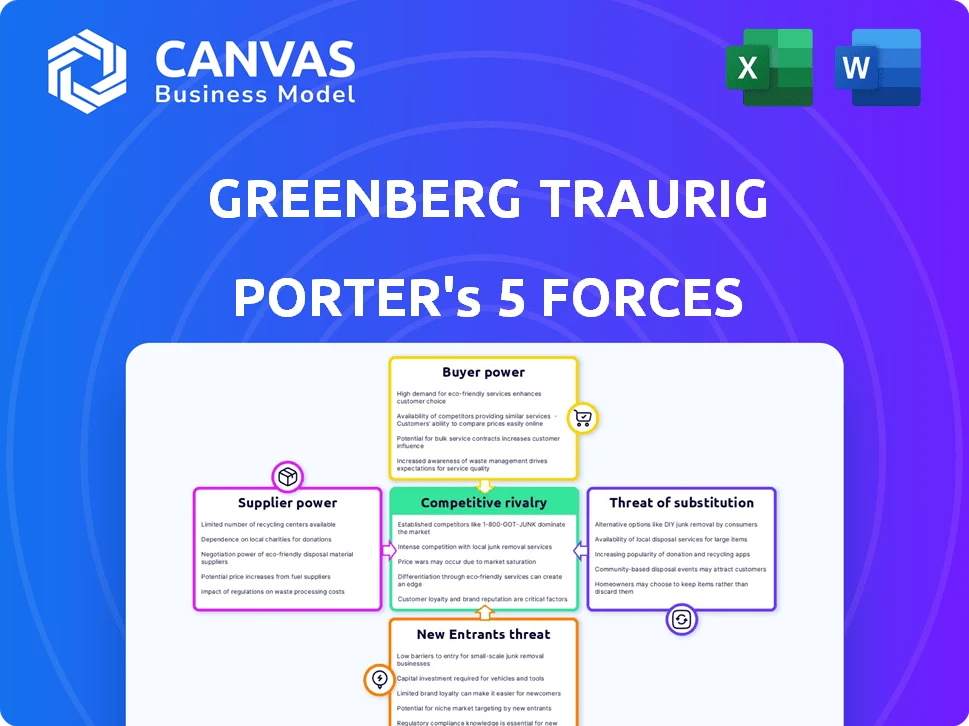
GREENBERG TRAURIG PORTER'S FIVE FORCES TEMPLATE RESEARCH
What is included in the product
 Detailed Word Document
Evaluates control held by suppliers and buyers, and their influence on pricing and profitability.

 Customizable Excel Spreadsheet
Customize pressure levels to identify and address the most pressing competitive forces.
Preview the Actual Deliverable
Greenberg Traurig Porter's Five Forces Analysis
The Greenberg Traurig Porter's Five Forces analysis you're viewing is the complete document you'll receive. This comprehensive analysis, assessing industry competition, threat of new entrants, supplier power, buyer power, and threat of substitutes, is ready for instant download after purchase.

Porter's Five Forces Analysis Template

Go Beyond the Preview—Access the Full Strategic Report
Greenberg Traurig faces complex forces. Buyer power, supplier influence, and competitive rivalry are all at play. The threat of new entrants and substitutes also shape their strategy. Understanding these dynamics is key. This preview is just the beginning. The full analysis provides a complete strategic snapshot with force-by-force ratings, visuals, and business implications tailored to Greenberg Traurig.
Suppliers Bargaining Power

Attorney Talent and Expertise
Attorney talent is a crucial supplier for Greenberg Traurig. High-demand partners, especially those with client relationships, have significant bargaining power. This power influences the firm's costs and competitive standing. In 2024, the top 100 law firms saw average partner compensation exceed $1 million. The ability of these attorneys to seek better compensation elsewhere impacts the firm's financial strategy.
Legal Information and Technology Providers
Legal information and technology suppliers possess considerable bargaining power. Switching costs are high due to platform-specific training and data migration, impacting firms like Greenberg Traurig. The legal tech market, valued at $1.2 billion in 2024, is growing, increasing supplier influence. Access to tools like AI-driven research is vital for competitive advantage. Suppliers can leverage this to dictate pricing and contract terms.

Support Staff and Administrative Services
Greenberg Traurig Porter's bargaining power of support staff is moderate. Demand for experienced staff in competitive markets can increase their salaries. In 2024, average paralegal salaries ranged from $60,000 to $80,000, varying by location and experience. However, the larger talent pool generally limits individual leverage.

Real Estate and Office Services
Greenberg Traurig, as a large global law firm, faces supplier power in real estate and office services. Prime office space costs are high, impacting profitability. The firm's scale and long-term lease commitments offer some bargaining power. However, location and market demand affect negotiation outcomes.
- In 2024, average commercial rent per square foot in major U.S. cities ranged from $40 to $80+ annually.
- Greenberg Traurig operates in over 40 locations globally, increasing their leverage.
- Long-term lease contracts are common, providing stability but potentially limiting flexibility.
External Consultants and Expert Witnesses
Greenberg Traurig often engages external consultants and expert witnesses, particularly in intricate legal matters. These specialists, with their unique skills and reputations, can significantly influence case outcomes. The firm's reliance on these experts affects both the cost and the approach to litigation. The fees charged by these experts can be substantial, reflecting their specialized knowledge and demand.
- Expert witness fees can range from $300 to $1,000+ per hour, depending on specialization and experience.
- The market for expert witnesses is competitive, with demand varying by industry and case type.
- Availability of experts can influence litigation timelines and strategies.
- In 2024, the legal services market is projected to reach $437.3 billion in the U.S.
Supplier Dynamics at a Major Law Firm
Greenberg Traurig faces supplier power from attorneys, especially high-demand partners, impacting costs. Legal tech suppliers also wield significant bargaining power due to high switching costs. Real estate and office services suppliers' influence varies based on location and market. Expert witnesses also command substantial fees.
| Supplier Type | Bargaining Power | Impact on Firm |
|---|---|---|
| Attorneys | High | Influences costs and competitive standing, average partner comp. $1M+ in 2024 |
| Legal Tech | High | Dictates pricing, market valued at $1.2B in 2024 |
| Real Estate | Moderate | Affects profitability, rent $40-$80+/sq ft in 2024 |
| Expert Witnesses | High | Influences case outcomes, fees $300-$1,000+/hour |
Customers Bargaining Power

Large Corporate Clients
Greenberg Traurig caters to large corporate clients with extensive legal needs. These clients can spread their work among various law firms. This competition allows them to negotiate better fee terms. For example, in 2024, alternative fee arrangements accounted for roughly 40% of law firm revenue, reflecting client bargaining power.
Repeat Business and Long-Term Relationships
Clients with repeat business and long-term relationships with Greenberg Traurig can wield greater bargaining power. The firm prioritizes these clients, often providing competitive pricing to retain them. In 2024, repeat clients accounted for a significant portion of the firm's revenue, indicating their influence. Greenberg Traurig's focus is on delivering value to secure continued work.

Sophistication of Legal Needs
Clients needing highly specialized legal services often have less bargaining power. Greenberg Traurig's expertise in complex litigation and corporate law, for example, strengthens its position. In 2024, the firm advised on over $200 billion in global transactions, showcasing its niche capabilities. This expertise reduces client leverage in specialized areas.

Price Sensitivity
Price sensitivity varies among clients, impacting their bargaining power. Some clients value expertise and reputation, while others, such as smaller businesses, are more cost-conscious. This sensitivity increases their ability to negotiate fees, especially in the competitive legal market. For instance, in 2024, the average hourly rate for corporate law firms was around $500, but this varied significantly based on firm size and location.
- Smaller businesses often seek lower rates.
- Competition among law firms intensifies price pressure.
- Market dynamics influence fee negotiations.
- Specialized expertise often commands higher fees.
Availability of In-House Counsel
Large corporations' in-house legal teams influence bargaining power. This setup allows them to handle some legal tasks themselves. Consequently, they rely less on external firms, boosting their negotiation leverage. This internal capability enables better project scoping and fee discussions. For instance, in 2024, companies saved an average of 25% on legal costs by using in-house teams.
- Reduced External Reliance: Companies with strong in-house counsel depend less on external firms.
- Cost Savings: Internal legal teams often lead to lower legal expenses.
- Negotiating Power: Enhanced ability to negotiate fees and project scopes.
- Efficiency: Improved control over legal processes and outcomes.
Negotiating Legal Fees: Client Power Dynamics
Greenberg Traurig's clients, particularly large corporations, possess considerable bargaining power, leveraging competition among law firms to negotiate favorable fee terms. Repeat clients and those with long-term relationships further enhance their influence, often securing competitive pricing. However, clients requiring specialized legal services have less leverage due to the firm's niche expertise.
Price sensitivity varies, with smaller businesses often seeking lower rates and facing intensified competition. In-house legal teams also strengthen client bargaining power, reducing reliance on external firms. In 2024, alternative fee arrangements represented roughly 40% of law firm revenue, reflecting this dynamic.
The firm's ability to retain clients hinges on delivering value and adapting to these pressures. Understanding client dynamics is crucial for Greenberg Traurig's strategic positioning.
| Factor | Impact on Bargaining Power | 2024 Data/Example |
|---|---|---|
| Client Size/Type | Larger clients have more leverage | Alternative fee arrangements accounted for 40% of revenue. |
| Specialization Needs | Less bargaining power if specialized services are needed | Greenberg Traurig advised on over $200B in global transactions. |
| In-House Legal Teams | Increased bargaining power | Companies saved an average of 25% on legal costs. |
Rivalry Among Competitors

Large Global Law Firms
Greenberg Traurig faces intense competition from other large global law firms. These firms vie for major clients and complex legal projects worldwide. The competitive landscape is shaped by firm size, reputation, and service offerings. In 2024, the legal services market was valued at over $800 billion globally, indicating high stakes.
Specialized Boutique Firms
Greenberg Traurig encounters competition from specialized boutique firms. These firms excel in niche legal areas, offering focused expertise and personalized service. The legal services market was valued at $375.7 billion in 2023. Boutique firms can challenge Greenberg Traurig, especially in their specialized domains. However, Greenberg Traurig's breadth helps it compete across diverse legal needs.

Lateral Hires and Talent Acquisition
Competition for top legal talent significantly shapes rivalry in the legal sector. Law firms, like Greenberg Traurig Porter, aggressively pursue experienced attorneys. Lateral hires swiftly boost a firm's expertise and market standing. In 2024, the average salary for a partner at a major law firm was $1.2 million, intensifying the competition.

Pricing and Fee Arrangements
Competition among law firms, including Greenberg Traurig, is significantly influenced by pricing and fee arrangements. Hourly billing remains prevalent, yet clients push for alternatives. Firms compete by offering flexible, value-based pricing. In 2024, the legal services market was valued at approximately $500 billion globally.
- Hourly billing rates can range from $300 to over $1,000 per hour, varying by firm and lawyer experience.
- Alternative fee arrangements, like fixed fees or contingency, are gaining popularity, representing up to 30% of some firms' revenue.
- Value-based pricing, tied to the outcome of a case, is also on the rise, though less common.
- The trend shows a shift towards more predictable and cost-effective legal services.
Reputation and Brand Recognition
Reputation and brand recognition are critical in the legal sector for attracting both clients and top-tier talent. Greenberg Traurig, with its extensive history and consistent high rankings in directories like Chambers and Partners and The Legal 500, benefits from strong brand recognition. This positive perception allows the firm to command premium rates and compete effectively for high-profile cases. In 2024, Greenberg Traurig's revenue was reported to be over $2 billion, showcasing its strong market position.
- Greenberg Traurig's brand recognition helps secure high-value clients and retain top legal talent.
- Consistent high rankings in legal directories positively affect the firm's competitive standing.
- The firm's revenue in 2024 exceeded $2 billion, reflecting its strong market position.
- Strong brand reputation allows the firm to charge premium fees.
Legal Market's Billion-Dollar Battleground
Competitive rivalry in the legal sector is fierce, with firms battling for clients and talent. Pricing strategies and brand recognition are crucial for market positioning. In 2024, the global legal market was valued at over $800 billion, highlighting intense competition.
| Aspect | Details | 2024 Data |
|---|---|---|
| Market Size | Global Legal Services Market | $800+ billion |
| Partner Salaries | Average at Major Firms | $1.2 million |
| Revenue | Greenberg Traurig | Over $2 billion |
Original: $10.00
-65%$10.00
$3.50GREENBERG TRAURIG PORTER'S FIVE FORCES TEMPLATE RESEARCH
What is included in the product
Detailed Word Document
Evaluates control held by suppliers and buyers, and their influence on pricing and profitability.
Customizable Excel Spreadsheet
Customize pressure levels to identify and address the most pressing competitive forces.
Preview the Actual Deliverable
Greenberg Traurig Porter's Five Forces Analysis
The Greenberg Traurig Porter's Five Forces analysis you're viewing is the complete document you'll receive. This comprehensive analysis, assessing industry competition, threat of new entrants, supplier power, buyer power, and threat of substitutes, is ready for instant download after purchase.
Porter's Five Forces Analysis Template
Go Beyond the Preview—Access the Full Strategic Report
Greenberg Traurig faces complex forces. Buyer power, supplier influence, and competitive rivalry are all at play. The threat of new entrants and substitutes also shape their strategy. Understanding these dynamics is key. This preview is just the beginning. The full analysis provides a complete strategic snapshot with force-by-force ratings, visuals, and business implications tailored to Greenberg Traurig.
Suppliers Bargaining Power
Attorney Talent and Expertise
Attorney talent is a crucial supplier for Greenberg Traurig. High-demand partners, especially those with client relationships, have significant bargaining power. This power influences the firm's costs and competitive standing. In 2024, the top 100 law firms saw average partner compensation exceed $1 million. The ability of these attorneys to seek better compensation elsewhere impacts the firm's financial strategy.
Legal Information and Technology Providers
Legal information and technology suppliers possess considerable bargaining power. Switching costs are high due to platform-specific training and data migration, impacting firms like Greenberg Traurig. The legal tech market, valued at $1.2 billion in 2024, is growing, increasing supplier influence. Access to tools like AI-driven research is vital for competitive advantage. Suppliers can leverage this to dictate pricing and contract terms.
Support Staff and Administrative Services
Greenberg Traurig Porter's bargaining power of support staff is moderate. Demand for experienced staff in competitive markets can increase their salaries. In 2024, average paralegal salaries ranged from $60,000 to $80,000, varying by location and experience. However, the larger talent pool generally limits individual leverage.
Real Estate and Office Services
Greenberg Traurig, as a large global law firm, faces supplier power in real estate and office services. Prime office space costs are high, impacting profitability. The firm's scale and long-term lease commitments offer some bargaining power. However, location and market demand affect negotiation outcomes.
- In 2024, average commercial rent per square foot in major U.S. cities ranged from $40 to $80+ annually.
- Greenberg Traurig operates in over 40 locations globally, increasing their leverage.
- Long-term lease contracts are common, providing stability but potentially limiting flexibility.
External Consultants and Expert Witnesses
Greenberg Traurig often engages external consultants and expert witnesses, particularly in intricate legal matters. These specialists, with their unique skills and reputations, can significantly influence case outcomes. The firm's reliance on these experts affects both the cost and the approach to litigation. The fees charged by these experts can be substantial, reflecting their specialized knowledge and demand.
- Expert witness fees can range from $300 to $1,000+ per hour, depending on specialization and experience.
- The market for expert witnesses is competitive, with demand varying by industry and case type.
- Availability of experts can influence litigation timelines and strategies.
- In 2024, the legal services market is projected to reach $437.3 billion in the U.S.
Supplier Dynamics at a Major Law Firm
Greenberg Traurig faces supplier power from attorneys, especially high-demand partners, impacting costs. Legal tech suppliers also wield significant bargaining power due to high switching costs. Real estate and office services suppliers' influence varies based on location and market. Expert witnesses also command substantial fees.
| Supplier Type | Bargaining Power | Impact on Firm |
|---|---|---|
| Attorneys | High | Influences costs and competitive standing, average partner comp. $1M+ in 2024 |
| Legal Tech | High | Dictates pricing, market valued at $1.2B in 2024 |
| Real Estate | Moderate | Affects profitability, rent $40-$80+/sq ft in 2024 |
| Expert Witnesses | High | Influences case outcomes, fees $300-$1,000+/hour |
Customers Bargaining Power
Large Corporate Clients
Greenberg Traurig caters to large corporate clients with extensive legal needs. These clients can spread their work among various law firms. This competition allows them to negotiate better fee terms. For example, in 2024, alternative fee arrangements accounted for roughly 40% of law firm revenue, reflecting client bargaining power.
Repeat Business and Long-Term Relationships
Clients with repeat business and long-term relationships with Greenberg Traurig can wield greater bargaining power. The firm prioritizes these clients, often providing competitive pricing to retain them. In 2024, repeat clients accounted for a significant portion of the firm's revenue, indicating their influence. Greenberg Traurig's focus is on delivering value to secure continued work.
Sophistication of Legal Needs
Clients needing highly specialized legal services often have less bargaining power. Greenberg Traurig's expertise in complex litigation and corporate law, for example, strengthens its position. In 2024, the firm advised on over $200 billion in global transactions, showcasing its niche capabilities. This expertise reduces client leverage in specialized areas.
Price Sensitivity
Price sensitivity varies among clients, impacting their bargaining power. Some clients value expertise and reputation, while others, such as smaller businesses, are more cost-conscious. This sensitivity increases their ability to negotiate fees, especially in the competitive legal market. For instance, in 2024, the average hourly rate for corporate law firms was around $500, but this varied significantly based on firm size and location.
- Smaller businesses often seek lower rates.
- Competition among law firms intensifies price pressure.
- Market dynamics influence fee negotiations.
- Specialized expertise often commands higher fees.
Availability of In-House Counsel
Large corporations' in-house legal teams influence bargaining power. This setup allows them to handle some legal tasks themselves. Consequently, they rely less on external firms, boosting their negotiation leverage. This internal capability enables better project scoping and fee discussions. For instance, in 2024, companies saved an average of 25% on legal costs by using in-house teams.
- Reduced External Reliance: Companies with strong in-house counsel depend less on external firms.
- Cost Savings: Internal legal teams often lead to lower legal expenses.
- Negotiating Power: Enhanced ability to negotiate fees and project scopes.
- Efficiency: Improved control over legal processes and outcomes.
Negotiating Legal Fees: Client Power Dynamics
Greenberg Traurig's clients, particularly large corporations, possess considerable bargaining power, leveraging competition among law firms to negotiate favorable fee terms. Repeat clients and those with long-term relationships further enhance their influence, often securing competitive pricing. However, clients requiring specialized legal services have less leverage due to the firm's niche expertise.
Price sensitivity varies, with smaller businesses often seeking lower rates and facing intensified competition. In-house legal teams also strengthen client bargaining power, reducing reliance on external firms. In 2024, alternative fee arrangements represented roughly 40% of law firm revenue, reflecting this dynamic.
The firm's ability to retain clients hinges on delivering value and adapting to these pressures. Understanding client dynamics is crucial for Greenberg Traurig's strategic positioning.
| Factor | Impact on Bargaining Power | 2024 Data/Example |
|---|---|---|
| Client Size/Type | Larger clients have more leverage | Alternative fee arrangements accounted for 40% of revenue. |
| Specialization Needs | Less bargaining power if specialized services are needed | Greenberg Traurig advised on over $200B in global transactions. |
| In-House Legal Teams | Increased bargaining power | Companies saved an average of 25% on legal costs. |
Rivalry Among Competitors
Large Global Law Firms
Greenberg Traurig faces intense competition from other large global law firms. These firms vie for major clients and complex legal projects worldwide. The competitive landscape is shaped by firm size, reputation, and service offerings. In 2024, the legal services market was valued at over $800 billion globally, indicating high stakes.
Specialized Boutique Firms
Greenberg Traurig encounters competition from specialized boutique firms. These firms excel in niche legal areas, offering focused expertise and personalized service. The legal services market was valued at $375.7 billion in 2023. Boutique firms can challenge Greenberg Traurig, especially in their specialized domains. However, Greenberg Traurig's breadth helps it compete across diverse legal needs.
Lateral Hires and Talent Acquisition
Competition for top legal talent significantly shapes rivalry in the legal sector. Law firms, like Greenberg Traurig Porter, aggressively pursue experienced attorneys. Lateral hires swiftly boost a firm's expertise and market standing. In 2024, the average salary for a partner at a major law firm was $1.2 million, intensifying the competition.
Pricing and Fee Arrangements
Competition among law firms, including Greenberg Traurig, is significantly influenced by pricing and fee arrangements. Hourly billing remains prevalent, yet clients push for alternatives. Firms compete by offering flexible, value-based pricing. In 2024, the legal services market was valued at approximately $500 billion globally.
- Hourly billing rates can range from $300 to over $1,000 per hour, varying by firm and lawyer experience.
- Alternative fee arrangements, like fixed fees or contingency, are gaining popularity, representing up to 30% of some firms' revenue.
- Value-based pricing, tied to the outcome of a case, is also on the rise, though less common.
- The trend shows a shift towards more predictable and cost-effective legal services.
Reputation and Brand Recognition
Reputation and brand recognition are critical in the legal sector for attracting both clients and top-tier talent. Greenberg Traurig, with its extensive history and consistent high rankings in directories like Chambers and Partners and The Legal 500, benefits from strong brand recognition. This positive perception allows the firm to command premium rates and compete effectively for high-profile cases. In 2024, Greenberg Traurig's revenue was reported to be over $2 billion, showcasing its strong market position.
- Greenberg Traurig's brand recognition helps secure high-value clients and retain top legal talent.
- Consistent high rankings in legal directories positively affect the firm's competitive standing.
- The firm's revenue in 2024 exceeded $2 billion, reflecting its strong market position.
- Strong brand reputation allows the firm to charge premium fees.
Legal Market's Billion-Dollar Battleground
Competitive rivalry in the legal sector is fierce, with firms battling for clients and talent. Pricing strategies and brand recognition are crucial for market positioning. In 2024, the global legal market was valued at over $800 billion, highlighting intense competition.
| Aspect | Details | 2024 Data |
|---|---|---|
| Market Size | Global Legal Services Market | $800+ billion |
| Partner Salaries | Average at Major Firms | $1.2 million |
| Revenue | Greenberg Traurig | Over $2 billion |
Product Information
Product Information
Shipping & Returns
Shipping & Returns
Description
What is included in the product
Detailed Word Document
Evaluates control held by suppliers and buyers, and their influence on pricing and profitability.
Customizable Excel Spreadsheet
Customize pressure levels to identify and address the most pressing competitive forces.
Preview the Actual Deliverable
Greenberg Traurig Porter's Five Forces Analysis
The Greenberg Traurig Porter's Five Forces analysis you're viewing is the complete document you'll receive. This comprehensive analysis, assessing industry competition, threat of new entrants, supplier power, buyer power, and threat of substitutes, is ready for instant download after purchase.
Porter's Five Forces Analysis Template
Go Beyond the Preview—Access the Full Strategic Report
Greenberg Traurig faces complex forces. Buyer power, supplier influence, and competitive rivalry are all at play. The threat of new entrants and substitutes also shape their strategy. Understanding these dynamics is key. This preview is just the beginning. The full analysis provides a complete strategic snapshot with force-by-force ratings, visuals, and business implications tailored to Greenberg Traurig.
Suppliers Bargaining Power
Attorney Talent and Expertise
Attorney talent is a crucial supplier for Greenberg Traurig. High-demand partners, especially those with client relationships, have significant bargaining power. This power influences the firm's costs and competitive standing. In 2024, the top 100 law firms saw average partner compensation exceed $1 million. The ability of these attorneys to seek better compensation elsewhere impacts the firm's financial strategy.
Legal Information and Technology Providers
Legal information and technology suppliers possess considerable bargaining power. Switching costs are high due to platform-specific training and data migration, impacting firms like Greenberg Traurig. The legal tech market, valued at $1.2 billion in 2024, is growing, increasing supplier influence. Access to tools like AI-driven research is vital for competitive advantage. Suppliers can leverage this to dictate pricing and contract terms.
Support Staff and Administrative Services
Greenberg Traurig Porter's bargaining power of support staff is moderate. Demand for experienced staff in competitive markets can increase their salaries. In 2024, average paralegal salaries ranged from $60,000 to $80,000, varying by location and experience. However, the larger talent pool generally limits individual leverage.
Real Estate and Office Services
Greenberg Traurig, as a large global law firm, faces supplier power in real estate and office services. Prime office space costs are high, impacting profitability. The firm's scale and long-term lease commitments offer some bargaining power. However, location and market demand affect negotiation outcomes.
- In 2024, average commercial rent per square foot in major U.S. cities ranged from $40 to $80+ annually.
- Greenberg Traurig operates in over 40 locations globally, increasing their leverage.
- Long-term lease contracts are common, providing stability but potentially limiting flexibility.
External Consultants and Expert Witnesses
Greenberg Traurig often engages external consultants and expert witnesses, particularly in intricate legal matters. These specialists, with their unique skills and reputations, can significantly influence case outcomes. The firm's reliance on these experts affects both the cost and the approach to litigation. The fees charged by these experts can be substantial, reflecting their specialized knowledge and demand.
- Expert witness fees can range from $300 to $1,000+ per hour, depending on specialization and experience.
- The market for expert witnesses is competitive, with demand varying by industry and case type.
- Availability of experts can influence litigation timelines and strategies.
- In 2024, the legal services market is projected to reach $437.3 billion in the U.S.
Supplier Dynamics at a Major Law Firm
Greenberg Traurig faces supplier power from attorneys, especially high-demand partners, impacting costs. Legal tech suppliers also wield significant bargaining power due to high switching costs. Real estate and office services suppliers' influence varies based on location and market. Expert witnesses also command substantial fees.
| Supplier Type | Bargaining Power | Impact on Firm |
|---|---|---|
| Attorneys | High | Influences costs and competitive standing, average partner comp. $1M+ in 2024 |
| Legal Tech | High | Dictates pricing, market valued at $1.2B in 2024 |
| Real Estate | Moderate | Affects profitability, rent $40-$80+/sq ft in 2024 |
| Expert Witnesses | High | Influences case outcomes, fees $300-$1,000+/hour |
Customers Bargaining Power
Large Corporate Clients
Greenberg Traurig caters to large corporate clients with extensive legal needs. These clients can spread their work among various law firms. This competition allows them to negotiate better fee terms. For example, in 2024, alternative fee arrangements accounted for roughly 40% of law firm revenue, reflecting client bargaining power.
Repeat Business and Long-Term Relationships
Clients with repeat business and long-term relationships with Greenberg Traurig can wield greater bargaining power. The firm prioritizes these clients, often providing competitive pricing to retain them. In 2024, repeat clients accounted for a significant portion of the firm's revenue, indicating their influence. Greenberg Traurig's focus is on delivering value to secure continued work.
Sophistication of Legal Needs
Clients needing highly specialized legal services often have less bargaining power. Greenberg Traurig's expertise in complex litigation and corporate law, for example, strengthens its position. In 2024, the firm advised on over $200 billion in global transactions, showcasing its niche capabilities. This expertise reduces client leverage in specialized areas.
Price Sensitivity
Price sensitivity varies among clients, impacting their bargaining power. Some clients value expertise and reputation, while others, such as smaller businesses, are more cost-conscious. This sensitivity increases their ability to negotiate fees, especially in the competitive legal market. For instance, in 2024, the average hourly rate for corporate law firms was around $500, but this varied significantly based on firm size and location.
- Smaller businesses often seek lower rates.
- Competition among law firms intensifies price pressure.
- Market dynamics influence fee negotiations.
- Specialized expertise often commands higher fees.
Availability of In-House Counsel
Large corporations' in-house legal teams influence bargaining power. This setup allows them to handle some legal tasks themselves. Consequently, they rely less on external firms, boosting their negotiation leverage. This internal capability enables better project scoping and fee discussions. For instance, in 2024, companies saved an average of 25% on legal costs by using in-house teams.
- Reduced External Reliance: Companies with strong in-house counsel depend less on external firms.
- Cost Savings: Internal legal teams often lead to lower legal expenses.
- Negotiating Power: Enhanced ability to negotiate fees and project scopes.
- Efficiency: Improved control over legal processes and outcomes.
Negotiating Legal Fees: Client Power Dynamics
Greenberg Traurig's clients, particularly large corporations, possess considerable bargaining power, leveraging competition among law firms to negotiate favorable fee terms. Repeat clients and those with long-term relationships further enhance their influence, often securing competitive pricing. However, clients requiring specialized legal services have less leverage due to the firm's niche expertise.
Price sensitivity varies, with smaller businesses often seeking lower rates and facing intensified competition. In-house legal teams also strengthen client bargaining power, reducing reliance on external firms. In 2024, alternative fee arrangements represented roughly 40% of law firm revenue, reflecting this dynamic.
The firm's ability to retain clients hinges on delivering value and adapting to these pressures. Understanding client dynamics is crucial for Greenberg Traurig's strategic positioning.
| Factor | Impact on Bargaining Power | 2024 Data/Example |
|---|---|---|
| Client Size/Type | Larger clients have more leverage | Alternative fee arrangements accounted for 40% of revenue. |
| Specialization Needs | Less bargaining power if specialized services are needed | Greenberg Traurig advised on over $200B in global transactions. |
| In-House Legal Teams | Increased bargaining power | Companies saved an average of 25% on legal costs. |
Rivalry Among Competitors
Large Global Law Firms
Greenberg Traurig faces intense competition from other large global law firms. These firms vie for major clients and complex legal projects worldwide. The competitive landscape is shaped by firm size, reputation, and service offerings. In 2024, the legal services market was valued at over $800 billion globally, indicating high stakes.
Specialized Boutique Firms
Greenberg Traurig encounters competition from specialized boutique firms. These firms excel in niche legal areas, offering focused expertise and personalized service. The legal services market was valued at $375.7 billion in 2023. Boutique firms can challenge Greenberg Traurig, especially in their specialized domains. However, Greenberg Traurig's breadth helps it compete across diverse legal needs.
Lateral Hires and Talent Acquisition
Competition for top legal talent significantly shapes rivalry in the legal sector. Law firms, like Greenberg Traurig Porter, aggressively pursue experienced attorneys. Lateral hires swiftly boost a firm's expertise and market standing. In 2024, the average salary for a partner at a major law firm was $1.2 million, intensifying the competition.
Pricing and Fee Arrangements
Competition among law firms, including Greenberg Traurig, is significantly influenced by pricing and fee arrangements. Hourly billing remains prevalent, yet clients push for alternatives. Firms compete by offering flexible, value-based pricing. In 2024, the legal services market was valued at approximately $500 billion globally.
- Hourly billing rates can range from $300 to over $1,000 per hour, varying by firm and lawyer experience.
- Alternative fee arrangements, like fixed fees or contingency, are gaining popularity, representing up to 30% of some firms' revenue.
- Value-based pricing, tied to the outcome of a case, is also on the rise, though less common.
- The trend shows a shift towards more predictable and cost-effective legal services.
Reputation and Brand Recognition
Reputation and brand recognition are critical in the legal sector for attracting both clients and top-tier talent. Greenberg Traurig, with its extensive history and consistent high rankings in directories like Chambers and Partners and The Legal 500, benefits from strong brand recognition. This positive perception allows the firm to command premium rates and compete effectively for high-profile cases. In 2024, Greenberg Traurig's revenue was reported to be over $2 billion, showcasing its strong market position.
- Greenberg Traurig's brand recognition helps secure high-value clients and retain top legal talent.
- Consistent high rankings in legal directories positively affect the firm's competitive standing.
- The firm's revenue in 2024 exceeded $2 billion, reflecting its strong market position.
- Strong brand reputation allows the firm to charge premium fees.
Legal Market's Billion-Dollar Battleground
Competitive rivalry in the legal sector is fierce, with firms battling for clients and talent. Pricing strategies and brand recognition are crucial for market positioning. In 2024, the global legal market was valued at over $800 billion, highlighting intense competition.
| Aspect | Details | 2024 Data |
|---|---|---|
| Market Size | Global Legal Services Market | $800+ billion |
| Partner Salaries | Average at Major Firms | $1.2 million |
| Revenue | Greenberg Traurig | Over $2 billion |


