
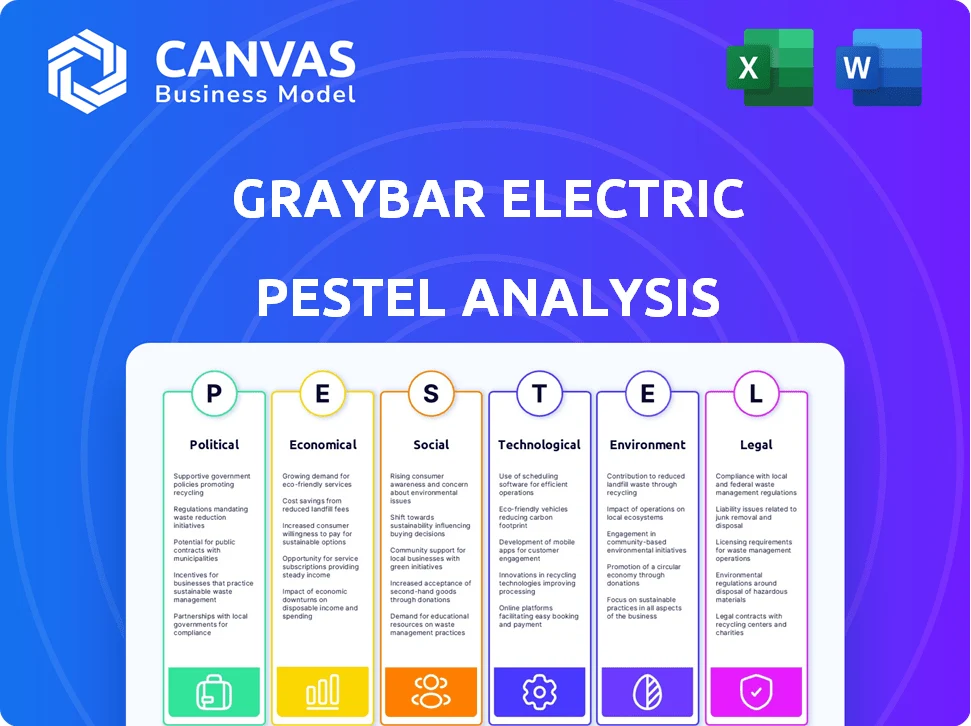
GRAYBAR ELECTRIC PESTLE ANALYSIS TEMPLATE RESEARCH
What is included in the product
 Detailed Word Document
Evaluates macro-environmental forces influencing Graybar Electric via Political, Economic, Social, Technological, Environmental, and Legal lenses.

 Customizable Excel Spreadsheet
Helps support discussions on external risk and market positioning during planning sessions.
Preview Before You Purchase
Graybar Electric PESTLE Analysis
This is the Graybar Electric PESTLE Analysis document. The preview you see here is the same document you'll receive after purchase. It includes a detailed analysis of the political, economic, social, technological, legal, and environmental factors. The content is ready for your use immediately after your order is complete. Everything shown here is part of the finished document.

PESTLE Analysis Template

Your Competitive Advantage Starts with This Report
Navigate Graybar Electric's landscape with our detailed PESTLE Analysis. Discover how external factors influence their strategies and operations. Understand market dynamics, regulatory impacts, and competitive pressures.
Our analysis provides actionable insights for informed decision-making. Identify growth opportunities and anticipate potential challenges in the market. Gain a competitive edge with strategic intelligence.
Download the full PESTLE Analysis for comprehensive, up-to-date market intelligence. Unlock strategic insights and transform your approach to Graybar Electric.
Political factors

Government Infrastructure Spending
Government infrastructure spending significantly impacts Graybar. The U.S. Infrastructure Investment and Jobs Act (IIJA) offers major opportunities. Billions in funds remain for projects needing Graybar's products. The IIJA allocated billions to roads, bridges, and broadband, driving demand. This boosts Graybar's sales and market position through 2026.
Trade Policies and Tariffs
Trade policies and tariffs significantly affect Graybar's operations. Recent shifts in trade, especially with China and North American countries, alter product costs and availability. For example, tariffs on electrical components can increase prices. In 2024, the U.S. imposed tariffs on various imported goods, impacting supply chains. This uncertainty requires careful market planning.

Energy Policy and Regulations
Government policies supporting clean energy significantly impact demand for renewable infrastructure, benefiting companies like Graybar. For instance, the U.S. aims for a carbon pollution-free power sector by 2035. Regulations reducing power plant emissions and promoting renewables create opportunities. The Inflation Reduction Act of 2022 allocated billions towards clean energy initiatives.

Support for Smart City Initiatives
Governments worldwide are heavily investing in smart city projects, boosting demand for smart building tech and integrated systems. These initiatives, fueled by political support and funding, directly benefit companies like Graybar. The global smart city market is projected to reach $2.5 trillion by 2025, presenting huge opportunities. Such projects require advanced electrical and data networking infrastructure, aligning with Graybar's offerings.
- Global smart city market projected to hit $2.5 trillion by 2025.
- Government spending on smart cities is increasing year over year.
Regulatory Environment for Supply Chain
The regulatory landscape significantly impacts Graybar's supply chain. Evolving rules on risk management and transparency, including those related to forced labor and environmental impacts, force adaptation in sourcing and reporting. Compliance increases complexity but also boosts ethical operations. For example, the U.S. Uyghur Forced Labor Prevention Act (UFLPA) has led to increased scrutiny.
- U.S. Customs and Border Protection (CBP) has increased its enforcement actions under UFLPA, resulting in detentions of goods.
- Companies are investing in supply chain mapping and due diligence to comply with these regulations, increasing operational costs by 5-10%.
- Environmental regulations, like the EU's Carbon Border Adjustment Mechanism (CBAM), will affect the cost of imported goods.
Political Winds: Shaping the Electrical Sector
Political factors significantly shape Graybar's landscape.
Infrastructure spending, particularly via the IIJA, fuels growth; the U.S. smart city market's $2.5T value by 2025 presents major opportunities.
Trade policies and evolving regulations, especially concerning tariffs and supply chains, demand strategic adaptation to navigate increasing complexities and costs.
| Political Factor | Impact on Graybar | Data |
|---|---|---|
| Infrastructure Spending | Boosts demand for electrical products and services. | IIJA allocates billions to infrastructure through 2026. |
| Trade Policies & Tariffs | Affects product costs and supply chain stability. | US tariffs on imported goods impacted supply chains in 2024. |
| Clean Energy Initiatives | Drives demand for renewable infrastructure. | U.S. aims for a carbon pollution-free power sector by 2035. |
Economic factors

Construction Industry Health
The construction industry's health is vital for Graybar. It affects sales, especially in commercial, industrial, and residential sectors. Forecasts for 2025 suggest modest growth or stagnation in some areas. However, overall activity remains near record highs in specific segments. Construction spending in the US reached $2.07 trillion in March 2024.
Inflation and Interest Rates
Inflation, influenced by factors like supply chain issues and labor costs, impacts Graybar's material prices and operational expenses. Interest rate hikes, as seen in 2023-2024, can increase borrowing costs, affecting both Graybar's investments and customer projects. For instance, the Federal Reserve's actions significantly influenced construction project financing. High rates might decrease construction starts. These economic dynamics directly shape demand and profitability.

Supply Chain Costs and Disruptions
Graybar faces challenges from fluctuating commodity prices and transportation costs. The Baltic Dry Index, a measure of shipping costs, saw significant volatility in 2024, impacting delivery expenses. Geopolitical events continue to pose risks, potentially disrupting supply chains. In 2024, supply chain disruptions cost businesses globally an estimated $2.4 trillion.

Investment in Data Centers
Investment in data centers is booming worldwide, fueled by cloud computing and AI needs. This creates a significant market for Graybar, given the electrical and data networking demands of these facilities. Rapid growth in this sector means considerable capital expenditure. In 2024, the global data center market was valued at $518.3 billion, with projections to reach $776.9 billion by 2029.
- Data center spending is expected to grow at a CAGR of 8.5% from 2024 to 2029.
- North America leads in data center investments, followed by Europe and Asia-Pacific.
- Graybar can capitalize on providing electrical and networking solutions.
Renewable Energy Investment
Increased investment in renewable energy significantly impacts Graybar Electric, boosting demand for electrical products and services. The global renewable energy market is projected to reach $2 trillion by 2030. Government incentives, such as tax credits, and decarbonization initiatives are major growth drivers. This creates opportunities for Graybar to supply components for solar, wind, and battery storage projects.
- The U.S. solar market is expected to grow by 25% in 2024.
- Wind energy capacity additions are increasing, particularly offshore.
- Battery storage deployments are rising rapidly, enhancing grid stability.
- Graybar can capitalize on these trends by expanding its product offerings.
Economic Forces Shaping Operations
Economic factors heavily influence Graybar Electric's operations, including the state of construction, which can see stagnation in certain areas. Inflation and interest rate hikes impact material costs and investment. Global supply chain disruptions and fluctuations in commodity prices continue to present risks. The data center market is valued at $518.3 billion (2024). Increased investments in renewable energy also offer growth.
| Economic Factor | Impact on Graybar | Data/Statistics (2024-2025) |
|---|---|---|
| Construction | Sales volume | US construction spending: $2.07T (March 2024). |
| Inflation/Interest Rates | Material/Operational Costs, Project Financing | Fed influenced construction project financing. |
| Supply Chain/Commodity Prices | Delivery Expenses | Disruptions cost ~$2.4T (globally in 2024). |
| Data Centers | Market Demand | Global market: $518.3B (2024) to $776.9B (2029). |
| Renewable Energy | Product/Service Demand | Market projected at $2T by 2030, U.S. solar growth (25% in 2024). |
Sociological factors

Workforce Availability and Skills
The availability of skilled labor, like electricians, is vital for Graybar's operations. Recent data from the Bureau of Labor Statistics (BLS) indicates a sustained demand for these professionals. The industry faces challenges, with potential shortages impacting project timelines. Investing in training programs can help to mitigate these risks.
Urbanization and Smart Cities
Urbanization and the rise of smart cities boost demand for advanced electrical infrastructure. This trend creates opportunities for Graybar. Market research indicates that the smart city market is projected to reach $2.5 trillion by 2026. Graybar can capitalize on this growth by providing solutions.

Aging Infrastructure
The aging infrastructure in North America, including power grids and communication networks, drives consistent demand for electrical products and services. Graybar benefits from this as it supplies to utilities and government agencies. The US infrastructure spending in 2024 is estimated at $450 billion, with plans to increase further. This creates a steady market for Graybar's offerings, supporting revenue growth.

Awareness of Sustainability
Societal awareness of sustainability is growing, influencing customer choices and building regulations. This shift boosts demand for energy-efficient products and green building materials, directly impacting Graybar's market. In 2024, the global green building materials market was valued at approximately $369.6 billion, projected to reach $547.6 billion by 2029. This trend aligns with Graybar's offerings, presenting growth opportunities.
- $369.6 billion: 2024 global green building materials market value.
- $547.6 billion: Projected market value by 2029.
- Increasing customer preference for sustainable solutions.
- Growing influence of building codes promoting energy efficiency.
Technological Literacy and Adoption
Technological literacy is rising, influencing customer behavior. Digital tools and platforms are key for purchases and supply chain management, impacting how Graybar interacts with customers. To meet these changes, Graybar has invested in initiatives like Graybar Connect. This shift shows the importance of digital solutions in the industry.
- Graybar's digital sales grew 20% in 2024.
- Over 60% of Graybar's customers now use digital platforms.
- Graybar invested $150 million in digital transformation by 2025.
Graybar Navigates Sustainability and Digital Shifts
Sustainability trends significantly affect Graybar, with rising customer demand for eco-friendly products and regulations driving this change. The green building materials market, valued at $369.6 billion in 2024, is set to hit $547.6 billion by 2029, opening growth opportunities. Simultaneously, Graybar is adapting to increasing digital literacy.
| Factor | Impact on Graybar | Data |
|---|---|---|
| Sustainability | Drives demand for eco-friendly products | Green building market valued at $369.6B (2024), $547.6B (2029) |
| Digitalization | Shapes customer behavior and purchasing patterns | Graybar Connect initiatives, digital sales increased by 20% in 2024 |
| Demographics | Influences labor availability | Demand for electricians steady |
GRAYBAR ELECTRIC PESTLE ANALYSIS TEMPLATE RESEARCH
What is included in the product
Detailed Word Document
Evaluates macro-environmental forces influencing Graybar Electric via Political, Economic, Social, Technological, Environmental, and Legal lenses.
Customizable Excel Spreadsheet
Helps support discussions on external risk and market positioning during planning sessions.
Preview Before You Purchase
Graybar Electric PESTLE Analysis
This is the Graybar Electric PESTLE Analysis document. The preview you see here is the same document you'll receive after purchase. It includes a detailed analysis of the political, economic, social, technological, legal, and environmental factors. The content is ready for your use immediately after your order is complete. Everything shown here is part of the finished document.
PESTLE Analysis Template
Your Competitive Advantage Starts with This Report
Navigate Graybar Electric's landscape with our detailed PESTLE Analysis. Discover how external factors influence their strategies and operations. Understand market dynamics, regulatory impacts, and competitive pressures.
Our analysis provides actionable insights for informed decision-making. Identify growth opportunities and anticipate potential challenges in the market. Gain a competitive edge with strategic intelligence.
Download the full PESTLE Analysis for comprehensive, up-to-date market intelligence. Unlock strategic insights and transform your approach to Graybar Electric.
Political factors
Government Infrastructure Spending
Government infrastructure spending significantly impacts Graybar. The U.S. Infrastructure Investment and Jobs Act (IIJA) offers major opportunities. Billions in funds remain for projects needing Graybar's products. The IIJA allocated billions to roads, bridges, and broadband, driving demand. This boosts Graybar's sales and market position through 2026.
Trade Policies and Tariffs
Trade policies and tariffs significantly affect Graybar's operations. Recent shifts in trade, especially with China and North American countries, alter product costs and availability. For example, tariffs on electrical components can increase prices. In 2024, the U.S. imposed tariffs on various imported goods, impacting supply chains. This uncertainty requires careful market planning.
Energy Policy and Regulations
Government policies supporting clean energy significantly impact demand for renewable infrastructure, benefiting companies like Graybar. For instance, the U.S. aims for a carbon pollution-free power sector by 2035. Regulations reducing power plant emissions and promoting renewables create opportunities. The Inflation Reduction Act of 2022 allocated billions towards clean energy initiatives.
Support for Smart City Initiatives
Governments worldwide are heavily investing in smart city projects, boosting demand for smart building tech and integrated systems. These initiatives, fueled by political support and funding, directly benefit companies like Graybar. The global smart city market is projected to reach $2.5 trillion by 2025, presenting huge opportunities. Such projects require advanced electrical and data networking infrastructure, aligning with Graybar's offerings.
- Global smart city market projected to hit $2.5 trillion by 2025.
- Government spending on smart cities is increasing year over year.
Regulatory Environment for Supply Chain
The regulatory landscape significantly impacts Graybar's supply chain. Evolving rules on risk management and transparency, including those related to forced labor and environmental impacts, force adaptation in sourcing and reporting. Compliance increases complexity but also boosts ethical operations. For example, the U.S. Uyghur Forced Labor Prevention Act (UFLPA) has led to increased scrutiny.
- U.S. Customs and Border Protection (CBP) has increased its enforcement actions under UFLPA, resulting in detentions of goods.
- Companies are investing in supply chain mapping and due diligence to comply with these regulations, increasing operational costs by 5-10%.
- Environmental regulations, like the EU's Carbon Border Adjustment Mechanism (CBAM), will affect the cost of imported goods.
Political Winds: Shaping the Electrical Sector
Political factors significantly shape Graybar's landscape.
Infrastructure spending, particularly via the IIJA, fuels growth; the U.S. smart city market's $2.5T value by 2025 presents major opportunities.
Trade policies and evolving regulations, especially concerning tariffs and supply chains, demand strategic adaptation to navigate increasing complexities and costs.
| Political Factor | Impact on Graybar | Data |
|---|---|---|
| Infrastructure Spending | Boosts demand for electrical products and services. | IIJA allocates billions to infrastructure through 2026. |
| Trade Policies & Tariffs | Affects product costs and supply chain stability. | US tariffs on imported goods impacted supply chains in 2024. |
| Clean Energy Initiatives | Drives demand for renewable infrastructure. | U.S. aims for a carbon pollution-free power sector by 2035. |
Economic factors
Construction Industry Health
The construction industry's health is vital for Graybar. It affects sales, especially in commercial, industrial, and residential sectors. Forecasts for 2025 suggest modest growth or stagnation in some areas. However, overall activity remains near record highs in specific segments. Construction spending in the US reached $2.07 trillion in March 2024.
Inflation and Interest Rates
Inflation, influenced by factors like supply chain issues and labor costs, impacts Graybar's material prices and operational expenses. Interest rate hikes, as seen in 2023-2024, can increase borrowing costs, affecting both Graybar's investments and customer projects. For instance, the Federal Reserve's actions significantly influenced construction project financing. High rates might decrease construction starts. These economic dynamics directly shape demand and profitability.
Supply Chain Costs and Disruptions
Graybar faces challenges from fluctuating commodity prices and transportation costs. The Baltic Dry Index, a measure of shipping costs, saw significant volatility in 2024, impacting delivery expenses. Geopolitical events continue to pose risks, potentially disrupting supply chains. In 2024, supply chain disruptions cost businesses globally an estimated $2.4 trillion.
Investment in Data Centers
Investment in data centers is booming worldwide, fueled by cloud computing and AI needs. This creates a significant market for Graybar, given the electrical and data networking demands of these facilities. Rapid growth in this sector means considerable capital expenditure. In 2024, the global data center market was valued at $518.3 billion, with projections to reach $776.9 billion by 2029.
- Data center spending is expected to grow at a CAGR of 8.5% from 2024 to 2029.
- North America leads in data center investments, followed by Europe and Asia-Pacific.
- Graybar can capitalize on providing electrical and networking solutions.
Renewable Energy Investment
Increased investment in renewable energy significantly impacts Graybar Electric, boosting demand for electrical products and services. The global renewable energy market is projected to reach $2 trillion by 2030. Government incentives, such as tax credits, and decarbonization initiatives are major growth drivers. This creates opportunities for Graybar to supply components for solar, wind, and battery storage projects.
- The U.S. solar market is expected to grow by 25% in 2024.
- Wind energy capacity additions are increasing, particularly offshore.
- Battery storage deployments are rising rapidly, enhancing grid stability.
- Graybar can capitalize on these trends by expanding its product offerings.
Economic Forces Shaping Operations
Economic factors heavily influence Graybar Electric's operations, including the state of construction, which can see stagnation in certain areas. Inflation and interest rate hikes impact material costs and investment. Global supply chain disruptions and fluctuations in commodity prices continue to present risks. The data center market is valued at $518.3 billion (2024). Increased investments in renewable energy also offer growth.
| Economic Factor | Impact on Graybar | Data/Statistics (2024-2025) |
|---|---|---|
| Construction | Sales volume | US construction spending: $2.07T (March 2024). |
| Inflation/Interest Rates | Material/Operational Costs, Project Financing | Fed influenced construction project financing. |
| Supply Chain/Commodity Prices | Delivery Expenses | Disruptions cost ~$2.4T (globally in 2024). |
| Data Centers | Market Demand | Global market: $518.3B (2024) to $776.9B (2029). |
| Renewable Energy | Product/Service Demand | Market projected at $2T by 2030, U.S. solar growth (25% in 2024). |
Sociological factors
Workforce Availability and Skills
The availability of skilled labor, like electricians, is vital for Graybar's operations. Recent data from the Bureau of Labor Statistics (BLS) indicates a sustained demand for these professionals. The industry faces challenges, with potential shortages impacting project timelines. Investing in training programs can help to mitigate these risks.
Urbanization and Smart Cities
Urbanization and the rise of smart cities boost demand for advanced electrical infrastructure. This trend creates opportunities for Graybar. Market research indicates that the smart city market is projected to reach $2.5 trillion by 2026. Graybar can capitalize on this growth by providing solutions.
Aging Infrastructure
The aging infrastructure in North America, including power grids and communication networks, drives consistent demand for electrical products and services. Graybar benefits from this as it supplies to utilities and government agencies. The US infrastructure spending in 2024 is estimated at $450 billion, with plans to increase further. This creates a steady market for Graybar's offerings, supporting revenue growth.
Awareness of Sustainability
Societal awareness of sustainability is growing, influencing customer choices and building regulations. This shift boosts demand for energy-efficient products and green building materials, directly impacting Graybar's market. In 2024, the global green building materials market was valued at approximately $369.6 billion, projected to reach $547.6 billion by 2029. This trend aligns with Graybar's offerings, presenting growth opportunities.
- $369.6 billion: 2024 global green building materials market value.
- $547.6 billion: Projected market value by 2029.
- Increasing customer preference for sustainable solutions.
- Growing influence of building codes promoting energy efficiency.
Technological Literacy and Adoption
Technological literacy is rising, influencing customer behavior. Digital tools and platforms are key for purchases and supply chain management, impacting how Graybar interacts with customers. To meet these changes, Graybar has invested in initiatives like Graybar Connect. This shift shows the importance of digital solutions in the industry.
- Graybar's digital sales grew 20% in 2024.
- Over 60% of Graybar's customers now use digital platforms.
- Graybar invested $150 million in digital transformation by 2025.
Graybar Navigates Sustainability and Digital Shifts
Sustainability trends significantly affect Graybar, with rising customer demand for eco-friendly products and regulations driving this change. The green building materials market, valued at $369.6 billion in 2024, is set to hit $547.6 billion by 2029, opening growth opportunities. Simultaneously, Graybar is adapting to increasing digital literacy.
| Factor | Impact on Graybar | Data |
|---|---|---|
| Sustainability | Drives demand for eco-friendly products | Green building market valued at $369.6B (2024), $547.6B (2029) |
| Digitalization | Shapes customer behavior and purchasing patterns | Graybar Connect initiatives, digital sales increased by 20% in 2024 |
| Demographics | Influences labor availability | Demand for electricians steady |
Product Information
Product Information
Shipping & Returns
Shipping & Returns
Description
What is included in the product
Detailed Word Document
Evaluates macro-environmental forces influencing Graybar Electric via Political, Economic, Social, Technological, Environmental, and Legal lenses.
Customizable Excel Spreadsheet
Helps support discussions on external risk and market positioning during planning sessions.
Preview Before You Purchase
Graybar Electric PESTLE Analysis
This is the Graybar Electric PESTLE Analysis document. The preview you see here is the same document you'll receive after purchase. It includes a detailed analysis of the political, economic, social, technological, legal, and environmental factors. The content is ready for your use immediately after your order is complete. Everything shown here is part of the finished document.
PESTLE Analysis Template
Your Competitive Advantage Starts with This Report
Navigate Graybar Electric's landscape with our detailed PESTLE Analysis. Discover how external factors influence their strategies and operations. Understand market dynamics, regulatory impacts, and competitive pressures.
Our analysis provides actionable insights for informed decision-making. Identify growth opportunities and anticipate potential challenges in the market. Gain a competitive edge with strategic intelligence.
Download the full PESTLE Analysis for comprehensive, up-to-date market intelligence. Unlock strategic insights and transform your approach to Graybar Electric.
Political factors
Government Infrastructure Spending
Government infrastructure spending significantly impacts Graybar. The U.S. Infrastructure Investment and Jobs Act (IIJA) offers major opportunities. Billions in funds remain for projects needing Graybar's products. The IIJA allocated billions to roads, bridges, and broadband, driving demand. This boosts Graybar's sales and market position through 2026.
Trade Policies and Tariffs
Trade policies and tariffs significantly affect Graybar's operations. Recent shifts in trade, especially with China and North American countries, alter product costs and availability. For example, tariffs on electrical components can increase prices. In 2024, the U.S. imposed tariffs on various imported goods, impacting supply chains. This uncertainty requires careful market planning.
Energy Policy and Regulations
Government policies supporting clean energy significantly impact demand for renewable infrastructure, benefiting companies like Graybar. For instance, the U.S. aims for a carbon pollution-free power sector by 2035. Regulations reducing power plant emissions and promoting renewables create opportunities. The Inflation Reduction Act of 2022 allocated billions towards clean energy initiatives.
Support for Smart City Initiatives
Governments worldwide are heavily investing in smart city projects, boosting demand for smart building tech and integrated systems. These initiatives, fueled by political support and funding, directly benefit companies like Graybar. The global smart city market is projected to reach $2.5 trillion by 2025, presenting huge opportunities. Such projects require advanced electrical and data networking infrastructure, aligning with Graybar's offerings.
- Global smart city market projected to hit $2.5 trillion by 2025.
- Government spending on smart cities is increasing year over year.
Regulatory Environment for Supply Chain
The regulatory landscape significantly impacts Graybar's supply chain. Evolving rules on risk management and transparency, including those related to forced labor and environmental impacts, force adaptation in sourcing and reporting. Compliance increases complexity but also boosts ethical operations. For example, the U.S. Uyghur Forced Labor Prevention Act (UFLPA) has led to increased scrutiny.
- U.S. Customs and Border Protection (CBP) has increased its enforcement actions under UFLPA, resulting in detentions of goods.
- Companies are investing in supply chain mapping and due diligence to comply with these regulations, increasing operational costs by 5-10%.
- Environmental regulations, like the EU's Carbon Border Adjustment Mechanism (CBAM), will affect the cost of imported goods.
Political Winds: Shaping the Electrical Sector
Political factors significantly shape Graybar's landscape.
Infrastructure spending, particularly via the IIJA, fuels growth; the U.S. smart city market's $2.5T value by 2025 presents major opportunities.
Trade policies and evolving regulations, especially concerning tariffs and supply chains, demand strategic adaptation to navigate increasing complexities and costs.
| Political Factor | Impact on Graybar | Data |
|---|---|---|
| Infrastructure Spending | Boosts demand for electrical products and services. | IIJA allocates billions to infrastructure through 2026. |
| Trade Policies & Tariffs | Affects product costs and supply chain stability. | US tariffs on imported goods impacted supply chains in 2024. |
| Clean Energy Initiatives | Drives demand for renewable infrastructure. | U.S. aims for a carbon pollution-free power sector by 2035. |
Economic factors
Construction Industry Health
The construction industry's health is vital for Graybar. It affects sales, especially in commercial, industrial, and residential sectors. Forecasts for 2025 suggest modest growth or stagnation in some areas. However, overall activity remains near record highs in specific segments. Construction spending in the US reached $2.07 trillion in March 2024.
Inflation and Interest Rates
Inflation, influenced by factors like supply chain issues and labor costs, impacts Graybar's material prices and operational expenses. Interest rate hikes, as seen in 2023-2024, can increase borrowing costs, affecting both Graybar's investments and customer projects. For instance, the Federal Reserve's actions significantly influenced construction project financing. High rates might decrease construction starts. These economic dynamics directly shape demand and profitability.
Supply Chain Costs and Disruptions
Graybar faces challenges from fluctuating commodity prices and transportation costs. The Baltic Dry Index, a measure of shipping costs, saw significant volatility in 2024, impacting delivery expenses. Geopolitical events continue to pose risks, potentially disrupting supply chains. In 2024, supply chain disruptions cost businesses globally an estimated $2.4 trillion.
Investment in Data Centers
Investment in data centers is booming worldwide, fueled by cloud computing and AI needs. This creates a significant market for Graybar, given the electrical and data networking demands of these facilities. Rapid growth in this sector means considerable capital expenditure. In 2024, the global data center market was valued at $518.3 billion, with projections to reach $776.9 billion by 2029.
- Data center spending is expected to grow at a CAGR of 8.5% from 2024 to 2029.
- North America leads in data center investments, followed by Europe and Asia-Pacific.
- Graybar can capitalize on providing electrical and networking solutions.
Renewable Energy Investment
Increased investment in renewable energy significantly impacts Graybar Electric, boosting demand for electrical products and services. The global renewable energy market is projected to reach $2 trillion by 2030. Government incentives, such as tax credits, and decarbonization initiatives are major growth drivers. This creates opportunities for Graybar to supply components for solar, wind, and battery storage projects.
- The U.S. solar market is expected to grow by 25% in 2024.
- Wind energy capacity additions are increasing, particularly offshore.
- Battery storage deployments are rising rapidly, enhancing grid stability.
- Graybar can capitalize on these trends by expanding its product offerings.
Economic Forces Shaping Operations
Economic factors heavily influence Graybar Electric's operations, including the state of construction, which can see stagnation in certain areas. Inflation and interest rate hikes impact material costs and investment. Global supply chain disruptions and fluctuations in commodity prices continue to present risks. The data center market is valued at $518.3 billion (2024). Increased investments in renewable energy also offer growth.
| Economic Factor | Impact on Graybar | Data/Statistics (2024-2025) |
|---|---|---|
| Construction | Sales volume | US construction spending: $2.07T (March 2024). |
| Inflation/Interest Rates | Material/Operational Costs, Project Financing | Fed influenced construction project financing. |
| Supply Chain/Commodity Prices | Delivery Expenses | Disruptions cost ~$2.4T (globally in 2024). |
| Data Centers | Market Demand | Global market: $518.3B (2024) to $776.9B (2029). |
| Renewable Energy | Product/Service Demand | Market projected at $2T by 2030, U.S. solar growth (25% in 2024). |
Sociological factors
Workforce Availability and Skills
The availability of skilled labor, like electricians, is vital for Graybar's operations. Recent data from the Bureau of Labor Statistics (BLS) indicates a sustained demand for these professionals. The industry faces challenges, with potential shortages impacting project timelines. Investing in training programs can help to mitigate these risks.
Urbanization and Smart Cities
Urbanization and the rise of smart cities boost demand for advanced electrical infrastructure. This trend creates opportunities for Graybar. Market research indicates that the smart city market is projected to reach $2.5 trillion by 2026. Graybar can capitalize on this growth by providing solutions.
Aging Infrastructure
The aging infrastructure in North America, including power grids and communication networks, drives consistent demand for electrical products and services. Graybar benefits from this as it supplies to utilities and government agencies. The US infrastructure spending in 2024 is estimated at $450 billion, with plans to increase further. This creates a steady market for Graybar's offerings, supporting revenue growth.
Awareness of Sustainability
Societal awareness of sustainability is growing, influencing customer choices and building regulations. This shift boosts demand for energy-efficient products and green building materials, directly impacting Graybar's market. In 2024, the global green building materials market was valued at approximately $369.6 billion, projected to reach $547.6 billion by 2029. This trend aligns with Graybar's offerings, presenting growth opportunities.
- $369.6 billion: 2024 global green building materials market value.
- $547.6 billion: Projected market value by 2029.
- Increasing customer preference for sustainable solutions.
- Growing influence of building codes promoting energy efficiency.
Technological Literacy and Adoption
Technological literacy is rising, influencing customer behavior. Digital tools and platforms are key for purchases and supply chain management, impacting how Graybar interacts with customers. To meet these changes, Graybar has invested in initiatives like Graybar Connect. This shift shows the importance of digital solutions in the industry.
- Graybar's digital sales grew 20% in 2024.
- Over 60% of Graybar's customers now use digital platforms.
- Graybar invested $150 million in digital transformation by 2025.
Graybar Navigates Sustainability and Digital Shifts
Sustainability trends significantly affect Graybar, with rising customer demand for eco-friendly products and regulations driving this change. The green building materials market, valued at $369.6 billion in 2024, is set to hit $547.6 billion by 2029, opening growth opportunities. Simultaneously, Graybar is adapting to increasing digital literacy.
| Factor | Impact on Graybar | Data |
|---|---|---|
| Sustainability | Drives demand for eco-friendly products | Green building market valued at $369.6B (2024), $547.6B (2029) |
| Digitalization | Shapes customer behavior and purchasing patterns | Graybar Connect initiatives, digital sales increased by 20% in 2024 |
| Demographics | Influences labor availability | Demand for electricians steady |


