
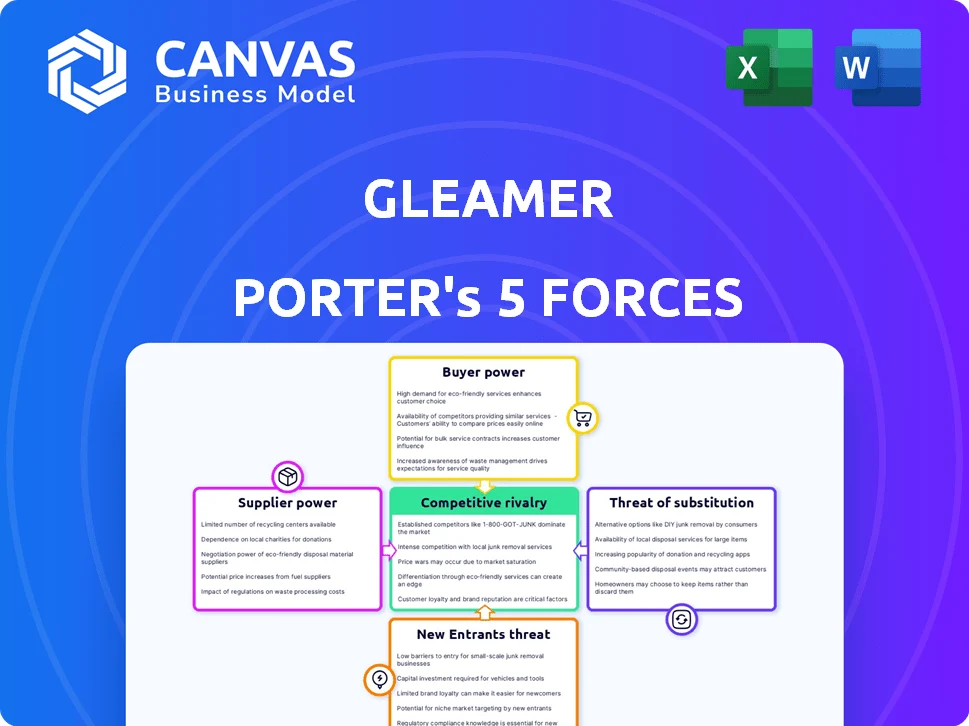
GLEAMER PORTER'S FIVE FORCES TEMPLATE RESEARCH
What is included in the product
 Detailed Word Document
Tailored exclusively for Gleamer, analyzing its position within its competitive landscape.

 Customizable Excel Spreadsheet
Duplicate tabs for different market scenarios, offering versatile strategic analysis.
Full Version Awaits
Gleamer Porter's Five Forces Analysis
This preview showcases the complete Porter's Five Forces analysis. The document displayed here is identical to the one you'll receive immediately after purchasing.

Porter's Five Forces Analysis Template

Don't Miss the Bigger Picture
Gleamer faces moderate rivalry, with established players vying for market share. Buyer power is balanced, yet price sensitivity exists. Suppliers hold limited influence, ensuring stable cost control. The threat of substitutes is moderate, requiring constant innovation. New entrants pose a manageable threat, given existing barriers.
This brief snapshot only scratches the surface. Unlock the full Porter's Five Forces Analysis to explore Gleamer’s competitive dynamics, market pressures, and strategic advantages in detail.
Suppliers Bargaining Power

Access to High-Quality Data
Gleamer and similar AI radiology firms depend on high-quality medical imaging data. Hospitals and research institutions, holding this data, wield considerable bargaining power. Data collection, anonymization, and curation are complex, costing around $100,000 per project in 2024. Regulations like HIPAA and GDPR amplify data providers' leverage.
Availability of AI Development Talent
Gleamer faces supplier power from AI talent. The need for specialized AI experts in medical imaging is high. Limited talent boosts their bargaining power, affecting Gleamer's costs. In 2024, AI engineer salaries rose 15%, impacting operational budgets. This could slow innovation.

Reliance on Hardware and Cloud Infrastructure
Gleamer's AI solutions depend heavily on powerful hardware and cloud services. This includes specialized components like GPUs and cloud computing. Cloud providers can significantly influence costs and terms. In 2024, cloud computing spending reached nearly $670 billion, highlighting the leverage these suppliers possess.

Dependency on Medical Imaging Equipment Manufacturers
Gleamer's success hinges on its ability to work with medical imaging equipment. This includes X-ray, CT, and MRI machines, plus Picture Archiving and Communication Systems (PACS). While not direct suppliers, these manufacturers affect Gleamer’s product development and market reach. The medical imaging market was valued at $27.8 billion in 2023.
- Integration with various equipment types is crucial for Gleamer's software functionality.
- Partnerships with manufacturers can broaden market access and adoption rates.
- Compatibility issues could limit Gleamer's ability to serve diverse healthcare providers.
- The medical imaging market is projected to reach $37.2 billion by 2028.
Intellectual Property and Licensing
Suppliers of key AI components, like specific frameworks or models, wield bargaining power through licensing and IP. Gleamer's dependence on these elements means it must accept their terms and pay fees. For example, in 2024, AI software licensing costs rose by 15% due to increased demand. This affects Gleamer's operational costs and profitability.
- Licensing fees can significantly impact Gleamer's budget.
- Intellectual property rights restrict Gleamer's control over its AI solutions.
- Changes in licensing terms can quickly alter Gleamer's financial projections.
- The availability of alternative AI components influences Gleamer's negotiation leverage.
Supplier Power Dynamics: Costs Surge
Gleamer's suppliers, including data providers and AI talent, hold considerable bargaining power. Data costs, such as anonymization and curation, can reach $100,000 per project. Licensing fees for AI components also impact operational costs.
| Supplier Type | Bargaining Power Source | Impact on Gleamer |
|---|---|---|
| Data Providers | Data exclusivity, regulations | Higher data acquisition costs |
| AI Talent | Specialized skills, limited supply | Increased labor costs (15% rise in 2024) |
| AI Component Suppliers | Licensing, IP control | Rising licensing fees (15% in 2024) |
Customers Bargaining Power

Concentrated Customer Base
Gleamer's key clients include hospitals and radiology centers. Large healthcare systems in certain regions can control a substantial market share. In 2024, the top 10 U.S. hospitals accounted for roughly 20% of healthcare spending. This concentration empowers them in price discussions and contract stipulations.
Switching Costs
Switching costs in healthcare AI, like radiology software, are significant. Implementing new AI software means integrating it with existing systems, training staff, and adjusting workflows, which can be costly. Despite these costs, the potential for better efficiency and diagnostic accuracy from a different vendor gives customers some bargaining power. For instance, in 2024, the average cost of integrating new healthcare IT systems was around $50,000 to $200,000 depending on the scope, indicating the financial impact of switching.

Customer's Access to Multiple Vendors
The AI radiology market sees intensifying competition, with multiple vendors providing similar solutions. This proliferation boosts customer bargaining power. For instance, a 2024 study showed that 65% of hospitals now evaluate at least three AI radiology vendors. This is because customers can readily compare prices and features. The ease of switching vendors further strengthens customer leverage.

Regulatory and Reimbursement Landscape
Gleamer's customer bargaining power is significantly shaped by regulatory and reimbursement landscapes within healthcare. Policies around AI in radiology directly affect adoption rates. For example, in 2024, the Centers for Medicare & Medicaid Services (CMS) updated its reimbursement codes for AI-assisted radiology services. These changes influence how much customers are willing to pay for AI solutions, impacting Gleamer's pricing.
- CMS updates can lead to either increased or decreased adoption of AI solutions.
- Reimbursement rates are crucial for the financial viability of AI implementation.
- Regulatory approvals for AI tools are another factor.
- Pricing strategies must align with reimbursement realities.
Clinical Validation and Performance Requirements
Healthcare providers, as Gleamer's customers, have significant bargaining power, demanding proof of AI's efficacy. They require clinical validation, accuracy, and reliability before adoption. This influences Gleamer's need for rigorous testing and validation processes to meet customer demands. The market reflects this: in 2024, the FDA cleared over 100 AI-based medical devices.
- Clinicians often cite clinical validation as a primary decision factor.
- Accuracy rates, like sensitivity and specificity, are crucial for acceptance.
- Real-world performance data is critical for demonstrating reliability.
- Lack of validation can significantly hinder adoption and sales.
Hospital's Price Power: IT Costs & Vendor Choice
Customers, like hospitals, wield significant power in price discussions. Switching costs, around $50,000-$200,000 in 2024 for new IT systems, provide leverage. Competition among vendors further strengthens customer bargaining capabilities.
| Factor | Impact | Example (2024) |
|---|---|---|
| Market Concentration | High concentration increases bargaining power | Top 10 US hospitals: ~20% healthcare spending |
| Switching Costs | High costs limit power, but tech can change this | IT integration cost: $50,000 - $200,000 |
| Vendor Competition | More vendors boost customer options | 65% hospitals evaluate 3+ vendors |
Rivalry Among Competitors

Number and Diversity of Competitors
The AI in radiology market is booming, drawing many competitors. This includes startups and established firms, increasing the fight for market share. In 2024, the global AI in medical imaging market was valued at $2.2 billion, with projections to reach $12.5 billion by 2030. This rapid growth fuels competition.
Rate of Market Growth
The AI in radiology market is experiencing rapid growth. It is projected to reach $2.8 billion by 2024. This high growth rate intensifies rivalry among companies. Companies are aggressively competing to secure market share.

Product Differentiation
In the realm of competitive rivalry, product differentiation is key. Companies vie on AI algorithm accuracy, breadth, and usability, alongside integration with existing radiology workflows. Specialized AI applications for modalities such as X-ray, CT, and MRI are crucial for differentiation. For instance, in 2024, companies invested heavily in enhancing these AI capabilities, with market spending exceeding $5 billion.

Mergers and Acquisitions
The AI in medical imaging sector is witnessing significant merger and acquisition activity. Companies are consolidating to boost capabilities, market presence, and talent. This trend results in larger, more competitive entities with wider product ranges. For instance, in 2024, acquisitions in healthcare IT reached $29 billion, reflecting the ongoing consolidation. These moves intensify competition by creating stronger players.
- 2024 saw $29B in healthcare IT acquisitions.
- Consolidation strengthens market competitors.
- M&As broaden product portfolios.
Intensity of Marketing and Sales Efforts
Companies in the healthcare technology market significantly invest in marketing, sales, and partnerships to promote their solutions to healthcare institutions. This intensity impacts the level of competition. Strong relationships with decision-makers are crucial. For instance, in 2024, marketing spending in the health tech sector rose by 15%.
- Marketing and sales investments are critical for market penetration.
- Building strong decision-maker relationships is vital.
- Competition is high due to these active efforts.
- Increased marketing spending reflects the rivalry.
AI Radiology: A Competitive Landscape
Competitive rivalry in AI radiology is fierce, fueled by rapid market growth and numerous competitors. Product differentiation through algorithm accuracy and specialized applications is crucial, with over $5B invested in 2024. Mergers and acquisitions are common, with $29B in healthcare IT deals in 2024, creating stronger rivals. Marketing and sales efforts are intensive, with a 15% rise in health tech marketing spend in 2024, intensifying competition.
| Aspect | Details | 2024 Data |
|---|---|---|
| Market Growth | Projected Market Size | $2.8B |
| M&A Activity | Healthcare IT Acquisitions | $29B |
| Marketing Spend | Health Tech Marketing Increase | 15% |
GLEAMER PORTER'S FIVE FORCES TEMPLATE RESEARCH
What is included in the product
Detailed Word Document
Tailored exclusively for Gleamer, analyzing its position within its competitive landscape.
Customizable Excel Spreadsheet
Duplicate tabs for different market scenarios, offering versatile strategic analysis.
Full Version Awaits
Gleamer Porter's Five Forces Analysis
This preview showcases the complete Porter's Five Forces analysis. The document displayed here is identical to the one you'll receive immediately after purchasing.
Porter's Five Forces Analysis Template
Don't Miss the Bigger Picture
Gleamer faces moderate rivalry, with established players vying for market share. Buyer power is balanced, yet price sensitivity exists. Suppliers hold limited influence, ensuring stable cost control. The threat of substitutes is moderate, requiring constant innovation. New entrants pose a manageable threat, given existing barriers.
This brief snapshot only scratches the surface. Unlock the full Porter's Five Forces Analysis to explore Gleamer’s competitive dynamics, market pressures, and strategic advantages in detail.
Suppliers Bargaining Power
Access to High-Quality Data
Gleamer and similar AI radiology firms depend on high-quality medical imaging data. Hospitals and research institutions, holding this data, wield considerable bargaining power. Data collection, anonymization, and curation are complex, costing around $100,000 per project in 2024. Regulations like HIPAA and GDPR amplify data providers' leverage.
Availability of AI Development Talent
Gleamer faces supplier power from AI talent. The need for specialized AI experts in medical imaging is high. Limited talent boosts their bargaining power, affecting Gleamer's costs. In 2024, AI engineer salaries rose 15%, impacting operational budgets. This could slow innovation.
Reliance on Hardware and Cloud Infrastructure
Gleamer's AI solutions depend heavily on powerful hardware and cloud services. This includes specialized components like GPUs and cloud computing. Cloud providers can significantly influence costs and terms. In 2024, cloud computing spending reached nearly $670 billion, highlighting the leverage these suppliers possess.
Dependency on Medical Imaging Equipment Manufacturers
Gleamer's success hinges on its ability to work with medical imaging equipment. This includes X-ray, CT, and MRI machines, plus Picture Archiving and Communication Systems (PACS). While not direct suppliers, these manufacturers affect Gleamer’s product development and market reach. The medical imaging market was valued at $27.8 billion in 2023.
- Integration with various equipment types is crucial for Gleamer's software functionality.
- Partnerships with manufacturers can broaden market access and adoption rates.
- Compatibility issues could limit Gleamer's ability to serve diverse healthcare providers.
- The medical imaging market is projected to reach $37.2 billion by 2028.
Intellectual Property and Licensing
Suppliers of key AI components, like specific frameworks or models, wield bargaining power through licensing and IP. Gleamer's dependence on these elements means it must accept their terms and pay fees. For example, in 2024, AI software licensing costs rose by 15% due to increased demand. This affects Gleamer's operational costs and profitability.
- Licensing fees can significantly impact Gleamer's budget.
- Intellectual property rights restrict Gleamer's control over its AI solutions.
- Changes in licensing terms can quickly alter Gleamer's financial projections.
- The availability of alternative AI components influences Gleamer's negotiation leverage.
Supplier Power Dynamics: Costs Surge
Gleamer's suppliers, including data providers and AI talent, hold considerable bargaining power. Data costs, such as anonymization and curation, can reach $100,000 per project. Licensing fees for AI components also impact operational costs.
| Supplier Type | Bargaining Power Source | Impact on Gleamer |
|---|---|---|
| Data Providers | Data exclusivity, regulations | Higher data acquisition costs |
| AI Talent | Specialized skills, limited supply | Increased labor costs (15% rise in 2024) |
| AI Component Suppliers | Licensing, IP control | Rising licensing fees (15% in 2024) |
Customers Bargaining Power
Concentrated Customer Base
Gleamer's key clients include hospitals and radiology centers. Large healthcare systems in certain regions can control a substantial market share. In 2024, the top 10 U.S. hospitals accounted for roughly 20% of healthcare spending. This concentration empowers them in price discussions and contract stipulations.
Switching Costs
Switching costs in healthcare AI, like radiology software, are significant. Implementing new AI software means integrating it with existing systems, training staff, and adjusting workflows, which can be costly. Despite these costs, the potential for better efficiency and diagnostic accuracy from a different vendor gives customers some bargaining power. For instance, in 2024, the average cost of integrating new healthcare IT systems was around $50,000 to $200,000 depending on the scope, indicating the financial impact of switching.
Customer's Access to Multiple Vendors
The AI radiology market sees intensifying competition, with multiple vendors providing similar solutions. This proliferation boosts customer bargaining power. For instance, a 2024 study showed that 65% of hospitals now evaluate at least three AI radiology vendors. This is because customers can readily compare prices and features. The ease of switching vendors further strengthens customer leverage.
Regulatory and Reimbursement Landscape
Gleamer's customer bargaining power is significantly shaped by regulatory and reimbursement landscapes within healthcare. Policies around AI in radiology directly affect adoption rates. For example, in 2024, the Centers for Medicare & Medicaid Services (CMS) updated its reimbursement codes for AI-assisted radiology services. These changes influence how much customers are willing to pay for AI solutions, impacting Gleamer's pricing.
- CMS updates can lead to either increased or decreased adoption of AI solutions.
- Reimbursement rates are crucial for the financial viability of AI implementation.
- Regulatory approvals for AI tools are another factor.
- Pricing strategies must align with reimbursement realities.
Clinical Validation and Performance Requirements
Healthcare providers, as Gleamer's customers, have significant bargaining power, demanding proof of AI's efficacy. They require clinical validation, accuracy, and reliability before adoption. This influences Gleamer's need for rigorous testing and validation processes to meet customer demands. The market reflects this: in 2024, the FDA cleared over 100 AI-based medical devices.
- Clinicians often cite clinical validation as a primary decision factor.
- Accuracy rates, like sensitivity and specificity, are crucial for acceptance.
- Real-world performance data is critical for demonstrating reliability.
- Lack of validation can significantly hinder adoption and sales.
Hospital's Price Power: IT Costs & Vendor Choice
Customers, like hospitals, wield significant power in price discussions. Switching costs, around $50,000-$200,000 in 2024 for new IT systems, provide leverage. Competition among vendors further strengthens customer bargaining capabilities.
| Factor | Impact | Example (2024) |
|---|---|---|
| Market Concentration | High concentration increases bargaining power | Top 10 US hospitals: ~20% healthcare spending |
| Switching Costs | High costs limit power, but tech can change this | IT integration cost: $50,000 - $200,000 |
| Vendor Competition | More vendors boost customer options | 65% hospitals evaluate 3+ vendors |
Rivalry Among Competitors
Number and Diversity of Competitors
The AI in radiology market is booming, drawing many competitors. This includes startups and established firms, increasing the fight for market share. In 2024, the global AI in medical imaging market was valued at $2.2 billion, with projections to reach $12.5 billion by 2030. This rapid growth fuels competition.
Rate of Market Growth
The AI in radiology market is experiencing rapid growth. It is projected to reach $2.8 billion by 2024. This high growth rate intensifies rivalry among companies. Companies are aggressively competing to secure market share.
Product Differentiation
In the realm of competitive rivalry, product differentiation is key. Companies vie on AI algorithm accuracy, breadth, and usability, alongside integration with existing radiology workflows. Specialized AI applications for modalities such as X-ray, CT, and MRI are crucial for differentiation. For instance, in 2024, companies invested heavily in enhancing these AI capabilities, with market spending exceeding $5 billion.
Mergers and Acquisitions
The AI in medical imaging sector is witnessing significant merger and acquisition activity. Companies are consolidating to boost capabilities, market presence, and talent. This trend results in larger, more competitive entities with wider product ranges. For instance, in 2024, acquisitions in healthcare IT reached $29 billion, reflecting the ongoing consolidation. These moves intensify competition by creating stronger players.
- 2024 saw $29B in healthcare IT acquisitions.
- Consolidation strengthens market competitors.
- M&As broaden product portfolios.
Intensity of Marketing and Sales Efforts
Companies in the healthcare technology market significantly invest in marketing, sales, and partnerships to promote their solutions to healthcare institutions. This intensity impacts the level of competition. Strong relationships with decision-makers are crucial. For instance, in 2024, marketing spending in the health tech sector rose by 15%.
- Marketing and sales investments are critical for market penetration.
- Building strong decision-maker relationships is vital.
- Competition is high due to these active efforts.
- Increased marketing spending reflects the rivalry.
AI Radiology: A Competitive Landscape
Competitive rivalry in AI radiology is fierce, fueled by rapid market growth and numerous competitors. Product differentiation through algorithm accuracy and specialized applications is crucial, with over $5B invested in 2024. Mergers and acquisitions are common, with $29B in healthcare IT deals in 2024, creating stronger rivals. Marketing and sales efforts are intensive, with a 15% rise in health tech marketing spend in 2024, intensifying competition.
| Aspect | Details | 2024 Data |
|---|---|---|
| Market Growth | Projected Market Size | $2.8B |
| M&A Activity | Healthcare IT Acquisitions | $29B |
| Marketing Spend | Health Tech Marketing Increase | 15% |
Product Information
Product Information
Shipping & Returns
Shipping & Returns
Description
What is included in the product
Detailed Word Document
Tailored exclusively for Gleamer, analyzing its position within its competitive landscape.
Customizable Excel Spreadsheet
Duplicate tabs for different market scenarios, offering versatile strategic analysis.
Full Version Awaits
Gleamer Porter's Five Forces Analysis
This preview showcases the complete Porter's Five Forces analysis. The document displayed here is identical to the one you'll receive immediately after purchasing.
Porter's Five Forces Analysis Template
Don't Miss the Bigger Picture
Gleamer faces moderate rivalry, with established players vying for market share. Buyer power is balanced, yet price sensitivity exists. Suppliers hold limited influence, ensuring stable cost control. The threat of substitutes is moderate, requiring constant innovation. New entrants pose a manageable threat, given existing barriers.
This brief snapshot only scratches the surface. Unlock the full Porter's Five Forces Analysis to explore Gleamer’s competitive dynamics, market pressures, and strategic advantages in detail.
Suppliers Bargaining Power
Access to High-Quality Data
Gleamer and similar AI radiology firms depend on high-quality medical imaging data. Hospitals and research institutions, holding this data, wield considerable bargaining power. Data collection, anonymization, and curation are complex, costing around $100,000 per project in 2024. Regulations like HIPAA and GDPR amplify data providers' leverage.
Availability of AI Development Talent
Gleamer faces supplier power from AI talent. The need for specialized AI experts in medical imaging is high. Limited talent boosts their bargaining power, affecting Gleamer's costs. In 2024, AI engineer salaries rose 15%, impacting operational budgets. This could slow innovation.
Reliance on Hardware and Cloud Infrastructure
Gleamer's AI solutions depend heavily on powerful hardware and cloud services. This includes specialized components like GPUs and cloud computing. Cloud providers can significantly influence costs and terms. In 2024, cloud computing spending reached nearly $670 billion, highlighting the leverage these suppliers possess.
Dependency on Medical Imaging Equipment Manufacturers
Gleamer's success hinges on its ability to work with medical imaging equipment. This includes X-ray, CT, and MRI machines, plus Picture Archiving and Communication Systems (PACS). While not direct suppliers, these manufacturers affect Gleamer’s product development and market reach. The medical imaging market was valued at $27.8 billion in 2023.
- Integration with various equipment types is crucial for Gleamer's software functionality.
- Partnerships with manufacturers can broaden market access and adoption rates.
- Compatibility issues could limit Gleamer's ability to serve diverse healthcare providers.
- The medical imaging market is projected to reach $37.2 billion by 2028.
Intellectual Property and Licensing
Suppliers of key AI components, like specific frameworks or models, wield bargaining power through licensing and IP. Gleamer's dependence on these elements means it must accept their terms and pay fees. For example, in 2024, AI software licensing costs rose by 15% due to increased demand. This affects Gleamer's operational costs and profitability.
- Licensing fees can significantly impact Gleamer's budget.
- Intellectual property rights restrict Gleamer's control over its AI solutions.
- Changes in licensing terms can quickly alter Gleamer's financial projections.
- The availability of alternative AI components influences Gleamer's negotiation leverage.
Supplier Power Dynamics: Costs Surge
Gleamer's suppliers, including data providers and AI talent, hold considerable bargaining power. Data costs, such as anonymization and curation, can reach $100,000 per project. Licensing fees for AI components also impact operational costs.
| Supplier Type | Bargaining Power Source | Impact on Gleamer |
|---|---|---|
| Data Providers | Data exclusivity, regulations | Higher data acquisition costs |
| AI Talent | Specialized skills, limited supply | Increased labor costs (15% rise in 2024) |
| AI Component Suppliers | Licensing, IP control | Rising licensing fees (15% in 2024) |
Customers Bargaining Power
Concentrated Customer Base
Gleamer's key clients include hospitals and radiology centers. Large healthcare systems in certain regions can control a substantial market share. In 2024, the top 10 U.S. hospitals accounted for roughly 20% of healthcare spending. This concentration empowers them in price discussions and contract stipulations.
Switching Costs
Switching costs in healthcare AI, like radiology software, are significant. Implementing new AI software means integrating it with existing systems, training staff, and adjusting workflows, which can be costly. Despite these costs, the potential for better efficiency and diagnostic accuracy from a different vendor gives customers some bargaining power. For instance, in 2024, the average cost of integrating new healthcare IT systems was around $50,000 to $200,000 depending on the scope, indicating the financial impact of switching.
Customer's Access to Multiple Vendors
The AI radiology market sees intensifying competition, with multiple vendors providing similar solutions. This proliferation boosts customer bargaining power. For instance, a 2024 study showed that 65% of hospitals now evaluate at least three AI radiology vendors. This is because customers can readily compare prices and features. The ease of switching vendors further strengthens customer leverage.
Regulatory and Reimbursement Landscape
Gleamer's customer bargaining power is significantly shaped by regulatory and reimbursement landscapes within healthcare. Policies around AI in radiology directly affect adoption rates. For example, in 2024, the Centers for Medicare & Medicaid Services (CMS) updated its reimbursement codes for AI-assisted radiology services. These changes influence how much customers are willing to pay for AI solutions, impacting Gleamer's pricing.
- CMS updates can lead to either increased or decreased adoption of AI solutions.
- Reimbursement rates are crucial for the financial viability of AI implementation.
- Regulatory approvals for AI tools are another factor.
- Pricing strategies must align with reimbursement realities.
Clinical Validation and Performance Requirements
Healthcare providers, as Gleamer's customers, have significant bargaining power, demanding proof of AI's efficacy. They require clinical validation, accuracy, and reliability before adoption. This influences Gleamer's need for rigorous testing and validation processes to meet customer demands. The market reflects this: in 2024, the FDA cleared over 100 AI-based medical devices.
- Clinicians often cite clinical validation as a primary decision factor.
- Accuracy rates, like sensitivity and specificity, are crucial for acceptance.
- Real-world performance data is critical for demonstrating reliability.
- Lack of validation can significantly hinder adoption and sales.
Hospital's Price Power: IT Costs & Vendor Choice
Customers, like hospitals, wield significant power in price discussions. Switching costs, around $50,000-$200,000 in 2024 for new IT systems, provide leverage. Competition among vendors further strengthens customer bargaining capabilities.
| Factor | Impact | Example (2024) |
|---|---|---|
| Market Concentration | High concentration increases bargaining power | Top 10 US hospitals: ~20% healthcare spending |
| Switching Costs | High costs limit power, but tech can change this | IT integration cost: $50,000 - $200,000 |
| Vendor Competition | More vendors boost customer options | 65% hospitals evaluate 3+ vendors |
Rivalry Among Competitors
Number and Diversity of Competitors
The AI in radiology market is booming, drawing many competitors. This includes startups and established firms, increasing the fight for market share. In 2024, the global AI in medical imaging market was valued at $2.2 billion, with projections to reach $12.5 billion by 2030. This rapid growth fuels competition.
Rate of Market Growth
The AI in radiology market is experiencing rapid growth. It is projected to reach $2.8 billion by 2024. This high growth rate intensifies rivalry among companies. Companies are aggressively competing to secure market share.
Product Differentiation
In the realm of competitive rivalry, product differentiation is key. Companies vie on AI algorithm accuracy, breadth, and usability, alongside integration with existing radiology workflows. Specialized AI applications for modalities such as X-ray, CT, and MRI are crucial for differentiation. For instance, in 2024, companies invested heavily in enhancing these AI capabilities, with market spending exceeding $5 billion.
Mergers and Acquisitions
The AI in medical imaging sector is witnessing significant merger and acquisition activity. Companies are consolidating to boost capabilities, market presence, and talent. This trend results in larger, more competitive entities with wider product ranges. For instance, in 2024, acquisitions in healthcare IT reached $29 billion, reflecting the ongoing consolidation. These moves intensify competition by creating stronger players.
- 2024 saw $29B in healthcare IT acquisitions.
- Consolidation strengthens market competitors.
- M&As broaden product portfolios.
Intensity of Marketing and Sales Efforts
Companies in the healthcare technology market significantly invest in marketing, sales, and partnerships to promote their solutions to healthcare institutions. This intensity impacts the level of competition. Strong relationships with decision-makers are crucial. For instance, in 2024, marketing spending in the health tech sector rose by 15%.
- Marketing and sales investments are critical for market penetration.
- Building strong decision-maker relationships is vital.
- Competition is high due to these active efforts.
- Increased marketing spending reflects the rivalry.
AI Radiology: A Competitive Landscape
Competitive rivalry in AI radiology is fierce, fueled by rapid market growth and numerous competitors. Product differentiation through algorithm accuracy and specialized applications is crucial, with over $5B invested in 2024. Mergers and acquisitions are common, with $29B in healthcare IT deals in 2024, creating stronger rivals. Marketing and sales efforts are intensive, with a 15% rise in health tech marketing spend in 2024, intensifying competition.
| Aspect | Details | 2024 Data |
|---|---|---|
| Market Growth | Projected Market Size | $2.8B |
| M&A Activity | Healthcare IT Acquisitions | $29B |
| Marketing Spend | Health Tech Marketing Increase | 15% |


