
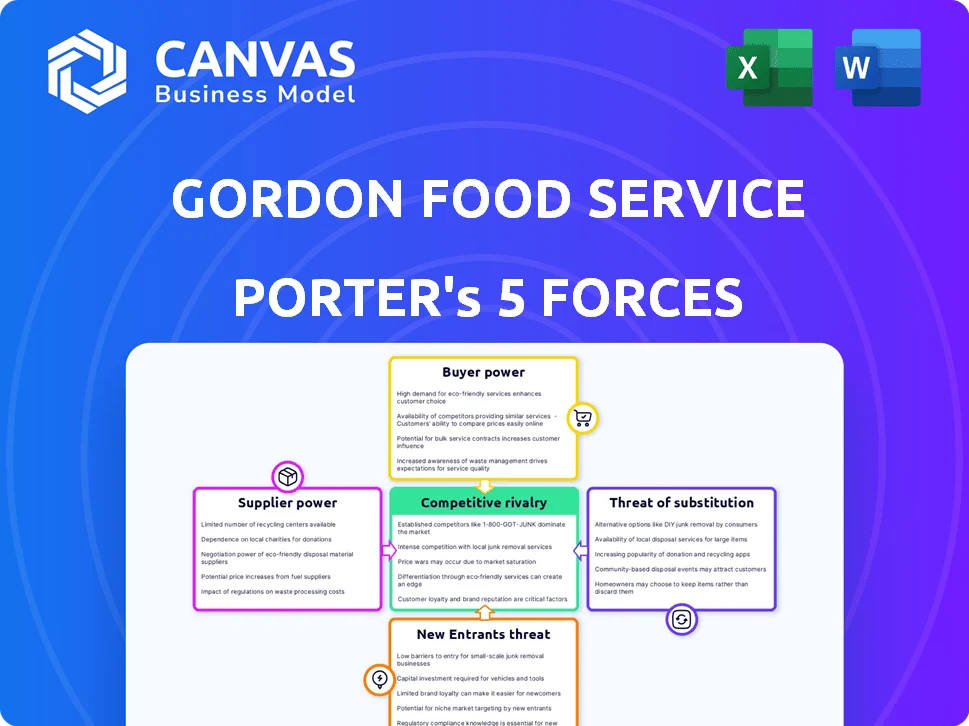
GORDON FOOD SERVICE PORTER'S FIVE FORCES TEMPLATE RESEARCH
What is included in the product
 Detailed Word Document
Evaluates control held by suppliers and buyers, and their influence on pricing and profitability.

 Customizable Excel Spreadsheet
Customize pressure levels based on new data or evolving market trends.
Preview the Actual Deliverable
Gordon Food Service Porter's Five Forces Analysis
This preview details Gordon Food Service's Porter's Five Forces analysis—no hidden content or edits post-purchase.
The full, downloadable document offers the very same detailed strategic analysis you're currently viewing.
You're seeing the complete Porter's Five Forces assessment—your instant, ready-to-use deliverable.
Every aspect of this document, from structure to content, is fully present and exactly as you'll receive it.
There are no changes; the shown analysis is precisely the purchased version.

Porter's Five Forces Analysis Template

Don't Miss the Bigger Picture
Gordon Food Service navigates a complex foodservice landscape, facing challenges from powerful buyers like restaurants and healthcare facilities. Supplier power is moderate, with varied food sources. The threat of new entrants is relatively low, due to established distribution networks. Intense rivalry among broadline distributors shapes competition. Finally, substitute products like meal kits and direct-to-consumer options pose a threat.
This preview is just the starting point. Dive into a complete, consultant-grade breakdown of Gordon Food Service’s industry competitiveness—ready for immediate use.
Suppliers Bargaining Power

Concentrated Supplier Market
Gordon Food Service sources from various food producers. If the supplier market is concentrated, with a few dominant players, their bargaining power increases. In the US food supply chain, large national manufacturers like Tyson Foods and Nestle could have significant leverage. For example, in 2024, Tyson Foods' revenue was over $52 billion, demonstrating its market influence.
Switching Costs for GFS
Switching costs significantly influence supplier power in Gordon Food Service's (GFS) case. High switching costs, such as those from specialized distribution networks, empower suppliers. For instance, GFS's reliance on specific logistics may limit its ability to quickly change suppliers. In 2024, GFS's revenue was approximately $17.9 billion, highlighting the scale impacted by supplier dynamics.

Supplier Dependence on GFS
The bargaining power of suppliers hinges on their dependence on Gordon Food Service (GFS). Suppliers heavily reliant on GFS for revenue face weaker bargaining positions. For instance, if over 50% of a supplier's sales go to GFS, GFS holds considerable power.
Conversely, suppliers with a diversified customer base, such as those selling to multiple distributors or directly to restaurants, wield more influence. This diversification reduces their vulnerability to GFS's demands. In 2024, companies like Sysco, a competitor, showed over $70 billion in revenue, showcasing the scale of competition.

Forward Integration Threat
Forward integration poses a threat if suppliers can distribute directly, increasing their leverage. For Gordon Food Service, this is less likely for smaller food manufacturers but a potential concern with major producers. Large companies might bypass distributors, impacting GFS's role. Consider how Nestle or Tyson Foods might directly serve major restaurant chains.
- Nestle's 2024 revenue was approximately $99.4 billion, indicating the scale of potential forward integration.
- Tyson Foods reported around $52.8 billion in sales in 2024, showing similar capabilities.
- Direct sales could reduce GFS's market share and profit margins.
Availability of Substitute Inputs
The availability of substitute inputs significantly affects the bargaining power of suppliers for Gordon Food Service. If GFS can easily find alternative ingredients, supplier power diminishes. Conversely, if GFS needs unique or specialized ingredients, suppliers gain more leverage. For example, in 2024, the global food ingredients market was valued at approximately $180 billion, providing GFS with diverse sourcing options.
- The more substitutes available, the less power suppliers have.
- Specialized ingredients increase supplier power.
- Market size and competition influence supplier power.
- GFS can negotiate better terms with many suppliers.
GFS Supplier Power: Key Market Dynamics
The bargaining power of suppliers for Gordon Food Service (GFS) is influenced by market concentration and switching costs. High supplier concentration, like that of Tyson Foods with $52.8 billion in 2024 revenue, increases their power. Conversely, GFS's ability to switch suppliers, though impacted by logistics, provides some leverage.
Supplier dependence on GFS affects their influence; those reliant on GFS face weaker bargaining positions. A diversified supplier base, however, reduces vulnerability. Sysco, with over $70 billion in revenue in 2024, represents a competitive alternative for suppliers.
Forward integration by suppliers like Nestle, with $99.4 billion in 2024 revenue, poses a threat, potentially reducing GFS's market share. The availability of substitute inputs, with a $180 billion global food ingredients market in 2024, impacts supplier power, with more substitutes diminishing supplier influence.
| Factor | Impact on Supplier Power | Example (2024) |
|---|---|---|
| Supplier Concentration | Increases Power | Tyson Foods ($52.8B Revenue) |
| Switching Costs | Influences Power | GFS Logistics |
| Supplier Dependence | Weaker Power | High GFS Sales % |
Customers Bargaining Power

Large Volume Customers
Gordon Food Service's customer base includes restaurants, schools, and healthcare facilities. Large-volume customers can negotiate better prices, impacting GFS's profitability. For example, Sysco, a major competitor, reported $76.3 billion in sales in 2023. These large buyers have significant leverage.
Customer Concentration
Customer concentration significantly impacts Gordon Food Service's (GFS) bargaining power. If a few major customers generate most of GFS's revenue, their leverage increases. For example, in 2024, a hypothetical scenario shows that if 20% of GFS's sales come from a single large restaurant chain, that chain can demand better terms.

Low Customer Switching Costs
Customers' ability to switch suppliers significantly affects their bargaining power. Low switching costs empower customers to seek better deals from competitors like US Foods. In 2024, the food distribution market saw intense competition, with companies vying for market share. This pressure necessitates GFS to offer competitive pricing and services to retain customers. If switching is easy, customer loyalty decreases, increasing their influence.

Customer Price Sensitivity
Customers in the foodservice industry, including restaurants and institutions, demonstrate high price sensitivity, driven by their own operational cost pressures. This sensitivity empowers them to negotiate aggressively for lower prices from suppliers like Gordon Food Service. The ability of customers to switch to alternative suppliers further amplifies their bargaining power. In 2024, food costs represented a significant portion of restaurant expenses, with some sources indicating up to 30-35% of total costs. This environment intensifies the need for competitive pricing.
- High food costs in 2024 increased customer price sensitivity.
- Switching to alternative suppliers is a key factor.
- Restaurant expenses in 2024: 30-35%.
Threat of Backward Integration
The bargaining power of customers, especially large ones, poses a challenge to Gordon Food Service (GFS). Major restaurant chains, representing significant purchasing volume, could theoretically integrate backward. This strategic move, though capital-intensive, allows these chains to control their supply chain and potentially negotiate more favorable terms. This potential for backward integration increases customer leverage, influencing GFS's pricing and service offerings.
- The U.S. food service distribution market was valued at approximately $360 billion in 2024.
- Sysco and US Foods are the two largest players, controlling a significant market share.
- A large chain like McDonald's could theoretically establish its own distribution network.
Customer Power: Impacting Food Service Profits
Customer bargaining power affects Gordon Food Service (GFS). Large customers can negotiate better prices, impacting GFS's profitability. The U.S. food service distribution market was valued at approximately $360 billion in 2024. High food costs in 2024 increased customer price sensitivity.
| Aspect | Impact | Example (2024) |
|---|---|---|
| Customer Concentration | Higher concentration increases leverage. | 20% sales from one chain = more power. |
| Switching Costs | Low costs increase customer power. | Easy switching to US Foods. |
| Price Sensitivity | High sensitivity boosts bargaining. | Restaurant food costs: 30-35%. |
Rivalry Among Competitors

Number and Size of Competitors
The food distribution industry is highly competitive, featuring several substantial players. Gordon Food Service faces off against industry giants like Sysco and US Foods. These firms, with their considerable resources, are constantly striving to capture market share. This results in intense rivalry within the sector. In 2024, Sysco's revenue was over $77 billion, demonstrating the scale of competition.
Industry Growth Rate
The foodservice industry's growth rate significantly shapes competitive rivalry. The U.S. foodservice market is projected to grow, yet intense competition is expected. Slower growth often intensifies rivalry as companies fight for market share. The US foodservice market generated $944 billion in sales in 2023.

Product Differentiation
In competitive markets, similar products heighten price-based competition. Gordon Food Service (GFS) can lessen rivalry through unique offerings. GFS could differentiate with tech or specialized products. However, in 2024, the food service industry's high competition, with numerous suppliers, intensifies the need for differentiation.

High Fixed Costs
High fixed costs in food distribution, like those at Gordon Food Service, fuel fierce competition. These costs include warehouses, trucks, and operational infrastructure. During economic slowdowns, companies aggressively cut prices to offset these expenses. This intensity directly impacts profitability and market share.
- Warehousing expenses can represent a substantial portion of operational costs.
- Transportation costs, including fuel and maintenance, significantly influence price competitiveness.
- High fixed costs can lead to price wars, reducing profit margins across the industry.
- Gordon Food Service has many competitors like US Foods and Sysco, all with similar cost structures.
Exit Barriers
High exit barriers significantly influence competitive dynamics. Specialized assets and long-term contracts are common in the foodservice distribution sector. These factors can trap underperforming companies, fostering overcapacity and intensified price wars. Gordon Food Service, like its competitors, faces these challenges.
- Specialized distribution networks require substantial investment.
- Long-term contracts with clients create exit difficulties.
- Industry consolidation is ongoing, reflecting exit pressures.
- Profit margins in the sector are often thin, intensifying competition.
Food Distribution: A Battleground of Billions
Competitive rivalry in food distribution is fierce, driven by giants like Sysco and US Foods, with Sysco's 2024 revenue exceeding $77 billion. Growth rate and fixed costs, such as warehousing and transportation, further intensify competition, impacting profitability. High exit barriers and thin profit margins, typical in the sector, also fuel price wars.
| Factor | Impact | Example (2024) |
|---|---|---|
| Market Players | Intense competition | Sysco's $77B+ revenue |
| Growth Rate | Slower growth intensifies rivalry | US market at $944B (2023) |
| Fixed Costs | Price wars | Warehousing/transportation |
GORDON FOOD SERVICE PORTER'S FIVE FORCES TEMPLATE RESEARCH
What is included in the product
Detailed Word Document
Evaluates control held by suppliers and buyers, and their influence on pricing and profitability.
Customizable Excel Spreadsheet
Customize pressure levels based on new data or evolving market trends.
Preview the Actual Deliverable
Gordon Food Service Porter's Five Forces Analysis
This preview details Gordon Food Service's Porter's Five Forces analysis—no hidden content or edits post-purchase.
The full, downloadable document offers the very same detailed strategic analysis you're currently viewing.
You're seeing the complete Porter's Five Forces assessment—your instant, ready-to-use deliverable.
Every aspect of this document, from structure to content, is fully present and exactly as you'll receive it.
There are no changes; the shown analysis is precisely the purchased version.
Porter's Five Forces Analysis Template
Don't Miss the Bigger Picture
Gordon Food Service navigates a complex foodservice landscape, facing challenges from powerful buyers like restaurants and healthcare facilities. Supplier power is moderate, with varied food sources. The threat of new entrants is relatively low, due to established distribution networks. Intense rivalry among broadline distributors shapes competition. Finally, substitute products like meal kits and direct-to-consumer options pose a threat.
This preview is just the starting point. Dive into a complete, consultant-grade breakdown of Gordon Food Service’s industry competitiveness—ready for immediate use.
Suppliers Bargaining Power
Concentrated Supplier Market
Gordon Food Service sources from various food producers. If the supplier market is concentrated, with a few dominant players, their bargaining power increases. In the US food supply chain, large national manufacturers like Tyson Foods and Nestle could have significant leverage. For example, in 2024, Tyson Foods' revenue was over $52 billion, demonstrating its market influence.
Switching Costs for GFS
Switching costs significantly influence supplier power in Gordon Food Service's (GFS) case. High switching costs, such as those from specialized distribution networks, empower suppliers. For instance, GFS's reliance on specific logistics may limit its ability to quickly change suppliers. In 2024, GFS's revenue was approximately $17.9 billion, highlighting the scale impacted by supplier dynamics.
Supplier Dependence on GFS
The bargaining power of suppliers hinges on their dependence on Gordon Food Service (GFS). Suppliers heavily reliant on GFS for revenue face weaker bargaining positions. For instance, if over 50% of a supplier's sales go to GFS, GFS holds considerable power.
Conversely, suppliers with a diversified customer base, such as those selling to multiple distributors or directly to restaurants, wield more influence. This diversification reduces their vulnerability to GFS's demands. In 2024, companies like Sysco, a competitor, showed over $70 billion in revenue, showcasing the scale of competition.
Forward Integration Threat
Forward integration poses a threat if suppliers can distribute directly, increasing their leverage. For Gordon Food Service, this is less likely for smaller food manufacturers but a potential concern with major producers. Large companies might bypass distributors, impacting GFS's role. Consider how Nestle or Tyson Foods might directly serve major restaurant chains.
- Nestle's 2024 revenue was approximately $99.4 billion, indicating the scale of potential forward integration.
- Tyson Foods reported around $52.8 billion in sales in 2024, showing similar capabilities.
- Direct sales could reduce GFS's market share and profit margins.
Availability of Substitute Inputs
The availability of substitute inputs significantly affects the bargaining power of suppliers for Gordon Food Service. If GFS can easily find alternative ingredients, supplier power diminishes. Conversely, if GFS needs unique or specialized ingredients, suppliers gain more leverage. For example, in 2024, the global food ingredients market was valued at approximately $180 billion, providing GFS with diverse sourcing options.
- The more substitutes available, the less power suppliers have.
- Specialized ingredients increase supplier power.
- Market size and competition influence supplier power.
- GFS can negotiate better terms with many suppliers.
GFS Supplier Power: Key Market Dynamics
The bargaining power of suppliers for Gordon Food Service (GFS) is influenced by market concentration and switching costs. High supplier concentration, like that of Tyson Foods with $52.8 billion in 2024 revenue, increases their power. Conversely, GFS's ability to switch suppliers, though impacted by logistics, provides some leverage.
Supplier dependence on GFS affects their influence; those reliant on GFS face weaker bargaining positions. A diversified supplier base, however, reduces vulnerability. Sysco, with over $70 billion in revenue in 2024, represents a competitive alternative for suppliers.
Forward integration by suppliers like Nestle, with $99.4 billion in 2024 revenue, poses a threat, potentially reducing GFS's market share. The availability of substitute inputs, with a $180 billion global food ingredients market in 2024, impacts supplier power, with more substitutes diminishing supplier influence.
| Factor | Impact on Supplier Power | Example (2024) |
|---|---|---|
| Supplier Concentration | Increases Power | Tyson Foods ($52.8B Revenue) |
| Switching Costs | Influences Power | GFS Logistics |
| Supplier Dependence | Weaker Power | High GFS Sales % |
Customers Bargaining Power
Large Volume Customers
Gordon Food Service's customer base includes restaurants, schools, and healthcare facilities. Large-volume customers can negotiate better prices, impacting GFS's profitability. For example, Sysco, a major competitor, reported $76.3 billion in sales in 2023. These large buyers have significant leverage.
Customer Concentration
Customer concentration significantly impacts Gordon Food Service's (GFS) bargaining power. If a few major customers generate most of GFS's revenue, their leverage increases. For example, in 2024, a hypothetical scenario shows that if 20% of GFS's sales come from a single large restaurant chain, that chain can demand better terms.
Low Customer Switching Costs
Customers' ability to switch suppliers significantly affects their bargaining power. Low switching costs empower customers to seek better deals from competitors like US Foods. In 2024, the food distribution market saw intense competition, with companies vying for market share. This pressure necessitates GFS to offer competitive pricing and services to retain customers. If switching is easy, customer loyalty decreases, increasing their influence.
Customer Price Sensitivity
Customers in the foodservice industry, including restaurants and institutions, demonstrate high price sensitivity, driven by their own operational cost pressures. This sensitivity empowers them to negotiate aggressively for lower prices from suppliers like Gordon Food Service. The ability of customers to switch to alternative suppliers further amplifies their bargaining power. In 2024, food costs represented a significant portion of restaurant expenses, with some sources indicating up to 30-35% of total costs. This environment intensifies the need for competitive pricing.
- High food costs in 2024 increased customer price sensitivity.
- Switching to alternative suppliers is a key factor.
- Restaurant expenses in 2024: 30-35%.
Threat of Backward Integration
The bargaining power of customers, especially large ones, poses a challenge to Gordon Food Service (GFS). Major restaurant chains, representing significant purchasing volume, could theoretically integrate backward. This strategic move, though capital-intensive, allows these chains to control their supply chain and potentially negotiate more favorable terms. This potential for backward integration increases customer leverage, influencing GFS's pricing and service offerings.
- The U.S. food service distribution market was valued at approximately $360 billion in 2024.
- Sysco and US Foods are the two largest players, controlling a significant market share.
- A large chain like McDonald's could theoretically establish its own distribution network.
Customer Power: Impacting Food Service Profits
Customer bargaining power affects Gordon Food Service (GFS). Large customers can negotiate better prices, impacting GFS's profitability. The U.S. food service distribution market was valued at approximately $360 billion in 2024. High food costs in 2024 increased customer price sensitivity.
| Aspect | Impact | Example (2024) |
|---|---|---|
| Customer Concentration | Higher concentration increases leverage. | 20% sales from one chain = more power. |
| Switching Costs | Low costs increase customer power. | Easy switching to US Foods. |
| Price Sensitivity | High sensitivity boosts bargaining. | Restaurant food costs: 30-35%. |
Rivalry Among Competitors
Number and Size of Competitors
The food distribution industry is highly competitive, featuring several substantial players. Gordon Food Service faces off against industry giants like Sysco and US Foods. These firms, with their considerable resources, are constantly striving to capture market share. This results in intense rivalry within the sector. In 2024, Sysco's revenue was over $77 billion, demonstrating the scale of competition.
Industry Growth Rate
The foodservice industry's growth rate significantly shapes competitive rivalry. The U.S. foodservice market is projected to grow, yet intense competition is expected. Slower growth often intensifies rivalry as companies fight for market share. The US foodservice market generated $944 billion in sales in 2023.
Product Differentiation
In competitive markets, similar products heighten price-based competition. Gordon Food Service (GFS) can lessen rivalry through unique offerings. GFS could differentiate with tech or specialized products. However, in 2024, the food service industry's high competition, with numerous suppliers, intensifies the need for differentiation.
High Fixed Costs
High fixed costs in food distribution, like those at Gordon Food Service, fuel fierce competition. These costs include warehouses, trucks, and operational infrastructure. During economic slowdowns, companies aggressively cut prices to offset these expenses. This intensity directly impacts profitability and market share.
- Warehousing expenses can represent a substantial portion of operational costs.
- Transportation costs, including fuel and maintenance, significantly influence price competitiveness.
- High fixed costs can lead to price wars, reducing profit margins across the industry.
- Gordon Food Service has many competitors like US Foods and Sysco, all with similar cost structures.
Exit Barriers
High exit barriers significantly influence competitive dynamics. Specialized assets and long-term contracts are common in the foodservice distribution sector. These factors can trap underperforming companies, fostering overcapacity and intensified price wars. Gordon Food Service, like its competitors, faces these challenges.
- Specialized distribution networks require substantial investment.
- Long-term contracts with clients create exit difficulties.
- Industry consolidation is ongoing, reflecting exit pressures.
- Profit margins in the sector are often thin, intensifying competition.
Food Distribution: A Battleground of Billions
Competitive rivalry in food distribution is fierce, driven by giants like Sysco and US Foods, with Sysco's 2024 revenue exceeding $77 billion. Growth rate and fixed costs, such as warehousing and transportation, further intensify competition, impacting profitability. High exit barriers and thin profit margins, typical in the sector, also fuel price wars.
| Factor | Impact | Example (2024) |
|---|---|---|
| Market Players | Intense competition | Sysco's $77B+ revenue |
| Growth Rate | Slower growth intensifies rivalry | US market at $944B (2023) |
| Fixed Costs | Price wars | Warehousing/transportation |
Product Information
Product Information
Shipping & Returns
Shipping & Returns
Description
What is included in the product
Detailed Word Document
Evaluates control held by suppliers and buyers, and their influence on pricing and profitability.
Customizable Excel Spreadsheet
Customize pressure levels based on new data or evolving market trends.
Preview the Actual Deliverable
Gordon Food Service Porter's Five Forces Analysis
This preview details Gordon Food Service's Porter's Five Forces analysis—no hidden content or edits post-purchase.
The full, downloadable document offers the very same detailed strategic analysis you're currently viewing.
You're seeing the complete Porter's Five Forces assessment—your instant, ready-to-use deliverable.
Every aspect of this document, from structure to content, is fully present and exactly as you'll receive it.
There are no changes; the shown analysis is precisely the purchased version.
Porter's Five Forces Analysis Template
Don't Miss the Bigger Picture
Gordon Food Service navigates a complex foodservice landscape, facing challenges from powerful buyers like restaurants and healthcare facilities. Supplier power is moderate, with varied food sources. The threat of new entrants is relatively low, due to established distribution networks. Intense rivalry among broadline distributors shapes competition. Finally, substitute products like meal kits and direct-to-consumer options pose a threat.
This preview is just the starting point. Dive into a complete, consultant-grade breakdown of Gordon Food Service’s industry competitiveness—ready for immediate use.
Suppliers Bargaining Power
Concentrated Supplier Market
Gordon Food Service sources from various food producers. If the supplier market is concentrated, with a few dominant players, their bargaining power increases. In the US food supply chain, large national manufacturers like Tyson Foods and Nestle could have significant leverage. For example, in 2024, Tyson Foods' revenue was over $52 billion, demonstrating its market influence.
Switching Costs for GFS
Switching costs significantly influence supplier power in Gordon Food Service's (GFS) case. High switching costs, such as those from specialized distribution networks, empower suppliers. For instance, GFS's reliance on specific logistics may limit its ability to quickly change suppliers. In 2024, GFS's revenue was approximately $17.9 billion, highlighting the scale impacted by supplier dynamics.
Supplier Dependence on GFS
The bargaining power of suppliers hinges on their dependence on Gordon Food Service (GFS). Suppliers heavily reliant on GFS for revenue face weaker bargaining positions. For instance, if over 50% of a supplier's sales go to GFS, GFS holds considerable power.
Conversely, suppliers with a diversified customer base, such as those selling to multiple distributors or directly to restaurants, wield more influence. This diversification reduces their vulnerability to GFS's demands. In 2024, companies like Sysco, a competitor, showed over $70 billion in revenue, showcasing the scale of competition.
Forward Integration Threat
Forward integration poses a threat if suppliers can distribute directly, increasing their leverage. For Gordon Food Service, this is less likely for smaller food manufacturers but a potential concern with major producers. Large companies might bypass distributors, impacting GFS's role. Consider how Nestle or Tyson Foods might directly serve major restaurant chains.
- Nestle's 2024 revenue was approximately $99.4 billion, indicating the scale of potential forward integration.
- Tyson Foods reported around $52.8 billion in sales in 2024, showing similar capabilities.
- Direct sales could reduce GFS's market share and profit margins.
Availability of Substitute Inputs
The availability of substitute inputs significantly affects the bargaining power of suppliers for Gordon Food Service. If GFS can easily find alternative ingredients, supplier power diminishes. Conversely, if GFS needs unique or specialized ingredients, suppliers gain more leverage. For example, in 2024, the global food ingredients market was valued at approximately $180 billion, providing GFS with diverse sourcing options.
- The more substitutes available, the less power suppliers have.
- Specialized ingredients increase supplier power.
- Market size and competition influence supplier power.
- GFS can negotiate better terms with many suppliers.
GFS Supplier Power: Key Market Dynamics
The bargaining power of suppliers for Gordon Food Service (GFS) is influenced by market concentration and switching costs. High supplier concentration, like that of Tyson Foods with $52.8 billion in 2024 revenue, increases their power. Conversely, GFS's ability to switch suppliers, though impacted by logistics, provides some leverage.
Supplier dependence on GFS affects their influence; those reliant on GFS face weaker bargaining positions. A diversified supplier base, however, reduces vulnerability. Sysco, with over $70 billion in revenue in 2024, represents a competitive alternative for suppliers.
Forward integration by suppliers like Nestle, with $99.4 billion in 2024 revenue, poses a threat, potentially reducing GFS's market share. The availability of substitute inputs, with a $180 billion global food ingredients market in 2024, impacts supplier power, with more substitutes diminishing supplier influence.
| Factor | Impact on Supplier Power | Example (2024) |
|---|---|---|
| Supplier Concentration | Increases Power | Tyson Foods ($52.8B Revenue) |
| Switching Costs | Influences Power | GFS Logistics |
| Supplier Dependence | Weaker Power | High GFS Sales % |
Customers Bargaining Power
Large Volume Customers
Gordon Food Service's customer base includes restaurants, schools, and healthcare facilities. Large-volume customers can negotiate better prices, impacting GFS's profitability. For example, Sysco, a major competitor, reported $76.3 billion in sales in 2023. These large buyers have significant leverage.
Customer Concentration
Customer concentration significantly impacts Gordon Food Service's (GFS) bargaining power. If a few major customers generate most of GFS's revenue, their leverage increases. For example, in 2024, a hypothetical scenario shows that if 20% of GFS's sales come from a single large restaurant chain, that chain can demand better terms.
Low Customer Switching Costs
Customers' ability to switch suppliers significantly affects their bargaining power. Low switching costs empower customers to seek better deals from competitors like US Foods. In 2024, the food distribution market saw intense competition, with companies vying for market share. This pressure necessitates GFS to offer competitive pricing and services to retain customers. If switching is easy, customer loyalty decreases, increasing their influence.
Customer Price Sensitivity
Customers in the foodservice industry, including restaurants and institutions, demonstrate high price sensitivity, driven by their own operational cost pressures. This sensitivity empowers them to negotiate aggressively for lower prices from suppliers like Gordon Food Service. The ability of customers to switch to alternative suppliers further amplifies their bargaining power. In 2024, food costs represented a significant portion of restaurant expenses, with some sources indicating up to 30-35% of total costs. This environment intensifies the need for competitive pricing.
- High food costs in 2024 increased customer price sensitivity.
- Switching to alternative suppliers is a key factor.
- Restaurant expenses in 2024: 30-35%.
Threat of Backward Integration
The bargaining power of customers, especially large ones, poses a challenge to Gordon Food Service (GFS). Major restaurant chains, representing significant purchasing volume, could theoretically integrate backward. This strategic move, though capital-intensive, allows these chains to control their supply chain and potentially negotiate more favorable terms. This potential for backward integration increases customer leverage, influencing GFS's pricing and service offerings.
- The U.S. food service distribution market was valued at approximately $360 billion in 2024.
- Sysco and US Foods are the two largest players, controlling a significant market share.
- A large chain like McDonald's could theoretically establish its own distribution network.
Customer Power: Impacting Food Service Profits
Customer bargaining power affects Gordon Food Service (GFS). Large customers can negotiate better prices, impacting GFS's profitability. The U.S. food service distribution market was valued at approximately $360 billion in 2024. High food costs in 2024 increased customer price sensitivity.
| Aspect | Impact | Example (2024) |
|---|---|---|
| Customer Concentration | Higher concentration increases leverage. | 20% sales from one chain = more power. |
| Switching Costs | Low costs increase customer power. | Easy switching to US Foods. |
| Price Sensitivity | High sensitivity boosts bargaining. | Restaurant food costs: 30-35%. |
Rivalry Among Competitors
Number and Size of Competitors
The food distribution industry is highly competitive, featuring several substantial players. Gordon Food Service faces off against industry giants like Sysco and US Foods. These firms, with their considerable resources, are constantly striving to capture market share. This results in intense rivalry within the sector. In 2024, Sysco's revenue was over $77 billion, demonstrating the scale of competition.
Industry Growth Rate
The foodservice industry's growth rate significantly shapes competitive rivalry. The U.S. foodservice market is projected to grow, yet intense competition is expected. Slower growth often intensifies rivalry as companies fight for market share. The US foodservice market generated $944 billion in sales in 2023.
Product Differentiation
In competitive markets, similar products heighten price-based competition. Gordon Food Service (GFS) can lessen rivalry through unique offerings. GFS could differentiate with tech or specialized products. However, in 2024, the food service industry's high competition, with numerous suppliers, intensifies the need for differentiation.
High Fixed Costs
High fixed costs in food distribution, like those at Gordon Food Service, fuel fierce competition. These costs include warehouses, trucks, and operational infrastructure. During economic slowdowns, companies aggressively cut prices to offset these expenses. This intensity directly impacts profitability and market share.
- Warehousing expenses can represent a substantial portion of operational costs.
- Transportation costs, including fuel and maintenance, significantly influence price competitiveness.
- High fixed costs can lead to price wars, reducing profit margins across the industry.
- Gordon Food Service has many competitors like US Foods and Sysco, all with similar cost structures.
Exit Barriers
High exit barriers significantly influence competitive dynamics. Specialized assets and long-term contracts are common in the foodservice distribution sector. These factors can trap underperforming companies, fostering overcapacity and intensified price wars. Gordon Food Service, like its competitors, faces these challenges.
- Specialized distribution networks require substantial investment.
- Long-term contracts with clients create exit difficulties.
- Industry consolidation is ongoing, reflecting exit pressures.
- Profit margins in the sector are often thin, intensifying competition.
Food Distribution: A Battleground of Billions
Competitive rivalry in food distribution is fierce, driven by giants like Sysco and US Foods, with Sysco's 2024 revenue exceeding $77 billion. Growth rate and fixed costs, such as warehousing and transportation, further intensify competition, impacting profitability. High exit barriers and thin profit margins, typical in the sector, also fuel price wars.
| Factor | Impact | Example (2024) |
|---|---|---|
| Market Players | Intense competition | Sysco's $77B+ revenue |
| Growth Rate | Slower growth intensifies rivalry | US market at $944B (2023) |
| Fixed Costs | Price wars | Warehousing/transportation |


