
GEOPURA PORTER'S FIVE FORCES TEMPLATE RESEARCH
What is included in the product
 Detailed Word Document
Tailored exclusively for GeoPura, analyzing its position within its competitive landscape.

 Customizable Excel Spreadsheet
A clear, one-sheet summary of all five forces—perfect for quick decision-making.
Preview Before You Purchase
GeoPura Porter's Five Forces Analysis
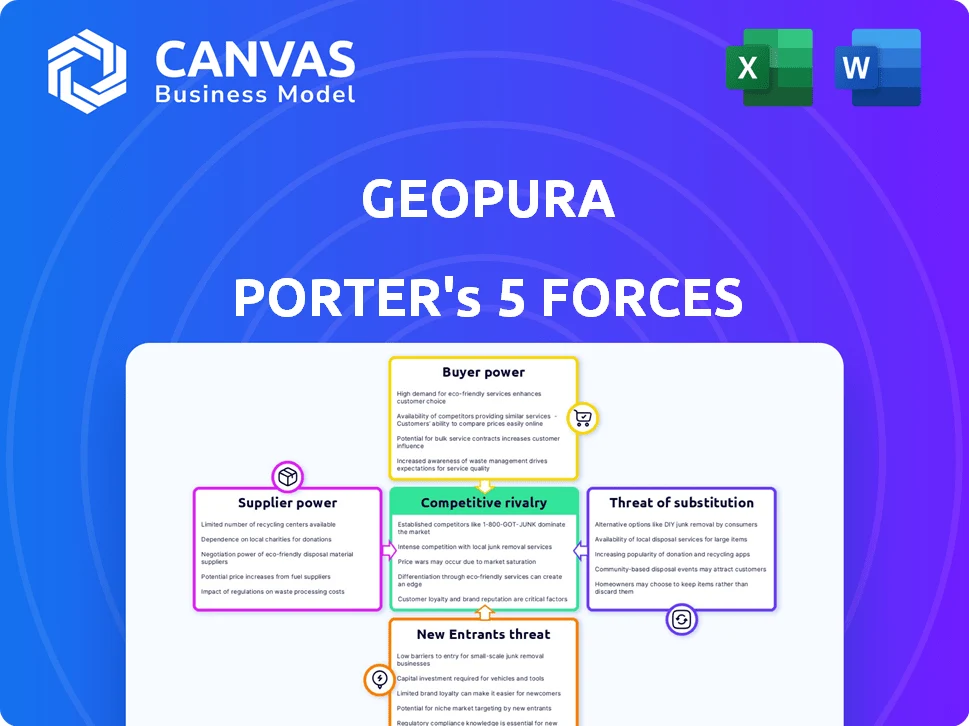
This preview reveals the complete Porter's Five Forces analysis. It's the same professional document you'll receive immediately after purchase, fully formatted and ready.

Porter's Five Forces Analysis Template

Go Beyond the Preview—Access the Full Strategic Report
GeoPura's industry faces moderate rivalry, influenced by renewable energy competition and government regulations. Supplier power is moderate, dependent on component costs and availability. Buyers possess moderate power, as energy choices expand. Threat of new entrants is moderate, with high capital needs. Substitutes, like grid power, pose a moderate threat.
This brief snapshot only scratches the surface. Unlock the full Porter's Five Forces Analysis to explore GeoPura’s competitive dynamics, market pressures, and strategic advantages in detail.
Suppliers Bargaining Power

Availability of Green Hydrogen Production Technology
The bargaining power of suppliers in green hydrogen production hinges on technology availability. Limited electrolyser suppliers, crucial for GeoPura's process, could wield more power. The global electrolyser market, valued at $1.3 billion in 2023, is projected to reach $5.4 billion by 2028, indicating increasing supplier competition, but also consolidation.
Reliance on Key Components and Materials
GeoPura's Hydrogen Power Units (HPUs) depend on key components such as fuel cells and battery storage. The suppliers of these parts, which include companies like Ballard Power Systems (fuel cells) and various battery manufacturers, hold some bargaining power. In 2024, fuel cell prices are still high, impacting HPU costs. Limited suppliers and high demand increase supplier influence.

Access to Renewable Energy Sources
GeoPura's green hydrogen production relies on renewable energy, making access crucial. Suppliers of solar and wind power, like NextEra Energy, could wield bargaining power. NextEra Energy's Q4 2023 revenue was $5.88 billion, showing their market influence. This power affects GeoPura's hydrogen production costs and reliability.

Hydrogen Transportation and Storage Infrastructure
GeoPura's hydrogen operations heavily rely on transportation and storage infrastructure. The suppliers of tube trailers and related services significantly influence GeoPura's costs. The bargaining power of suppliers increases if there are few providers or if these services are expensive. For instance, the cost of hydrogen tube trailers can range from $200,000 to $500,000 each, impacting operational expenses.
- Limited number of suppliers can increase costs.
- High transportation costs can affect profitability.
- Infrastructure availability is crucial for operations.
- Supplier pricing impacts GeoPura's financial planning.
Skilled Labor Availability
The hydrogen energy sector's reliance on skilled labor, such as engineers and technicians, significantly impacts GeoPura Porter's operations. A limited pool of qualified professionals can drive up labor costs, affecting project profitability. This dynamic strengthens the bargaining power of employees and specialized contractors, potentially increasing project expenses. The increasing demand for these skills, as the sector expands, could further intensify this issue.
- The U.S. Bureau of Labor Statistics projects a 6% growth for mechanical engineers from 2022 to 2032.
- In 2024, the average annual salary for a hydrogen engineer in the U.S. is around $100,000-$140,000.
- According to the Department of Energy, the hydrogen sector could create millions of jobs by 2030.
GeoPura's Supplier Dynamics: Costs & Influences
Suppliers' power affects GeoPura's costs and operations. Limited electrolyzer and key component suppliers, like Ballard, impact production costs. Renewable energy and infrastructure suppliers, such as NextEra, also hold significant influence.
| Supplier Type | Impact on GeoPura | 2024 Data Points |
|---|---|---|
| Electrolyzer | Cost, Availability | Market: $1.3B (2023), $5.4B (2028) |
| Fuel Cells/Batteries | HPU Costs | Fuel cell prices: still high in 2024 |
| Renewable Energy | Production Costs | NextEra Q4 2023 Revenue: $5.88B |
| Transportation/Storage | Operational Costs | Tube trailers: $200K-$500K each |
Customers Bargaining Power

Diversity of Customer Base
GeoPura's diverse customer base across construction, events, utilities, and film/TV production enhances its bargaining power. This diversification means no single customer holds excessive sway. For example, in 2024, the events sector contributed approximately 15% to GeoPura's revenue, showing a balanced distribution.
Importance of Reliable, Zero-Emission Power
GeoPura's customers depend on dependable, zero-emission power, especially in critical sectors like construction or events, where conventional options fall short. This need can limit customer bargaining power. In 2024, the demand for zero-emission power solutions grew, with the market projected to reach $3.8 billion.

Availability of Alternative Power Solutions
GeoPura faces customer bargaining power due to alternative power solutions. Customers can opt for grid connections, standard generators, or emerging clean energy tech. For instance, in 2024, solar and wind capacity surged, offering viable alternatives. The availability of these options gives customers leverage in negotiations. This impacts GeoPura's pricing and market share.

Customer Switching Costs
Customer switching costs significantly impact customer bargaining power within GeoPura's market. If switching to GeoPura's hydrogen-based power or a competitor is easy and inexpensive, customer power increases. High switching costs, however, reduce customer power. In 2024, the average cost to switch energy providers in the UK ranged from £50 to £200, highlighting the financial hurdles involved. This directly impacts customer decisions.
- Switching costs are influenced by contract terms and infrastructure requirements.
- Simpler installations and standardized systems reduce switching barriers.
- Competitor pricing and incentives can lower perceived switching costs.
- Regulatory changes can also affect customer switching dynamics.
Customer Awareness and Demand for Green Solutions
Customers are becoming more environmentally conscious, driving demand for sustainable solutions. This heightened awareness empowers customers to choose eco-friendly options like GeoPura's zero-emission products. The increasing preference for green energy strengthens GeoPura's bargaining power, especially against traditional fossil fuel providers.
- In 2024, the global market for green energy solutions is projected to reach $1.5 trillion.
- Consumer demand for sustainable products has increased by 20% in the past year.
- GeoPura's revenue grew by 45% in 2023 due to the rising demand for decarbonization.
GeoPura's Customer Power: Key Factors
GeoPura's customer bargaining power is shaped by several forces. Customer diversification limits the impact of any single client. Alternative power solutions and switching costs affect customer leverage. The rising demand for sustainable energy strengthens GeoPura's position.
| Factor | Impact | 2024 Data |
|---|---|---|
| Customer Diversity | Reduces bargaining power | Events sector: ~15% revenue share |
| Alternative Solutions | Increases bargaining power | Solar/wind capacity surge |
| Switching Costs | Influences bargaining power | UK switching cost: £50-£200 |
| Environmental Awareness | Strengthens GeoPura's power | Green energy market: $1.5T |
Rivalry Among Competitors

Number and Size of Competitors
The hydrogen energy market is becoming more competitive. Established energy companies and startups are both entering the space, increasing rivalry. Competitors range from those offering similar hydrogen solutions to those in alternative clean energy. For example, in 2024, the global hydrogen market was valued at over $130 billion, with many companies vying for a share.
Market Growth Rate
The UK hydrogen energy market is poised for substantial growth, with forecasts estimating its value could reach billions in the coming years. This expansion might initially lessen rivalry as companies focus on capturing new opportunities. For instance, the UK government's Hydrogen Strategy aims to generate 5GW of low-carbon hydrogen production capacity by 2030. This rapid growth phase can allow multiple firms to thrive simultaneously.

Product Differentiation
GeoPura's product differentiation, focusing on an end-to-end hydrogen solution, impacts competitive rivalry. Its unique selling proposition lies in managing production, transport, and deployment. The intensity of rivalry depends on how well GeoPura's technology, service, and cost structure set it apart. For example, in 2024, the hydrogen market's projected value was around $130 billion, with growth expected due to such integrated service models.

Industry Concentration
Competitive rivalry in the portable, off-grid hydrogen power solutions market, like GeoPura's, is shaped by industry concentration. While the hydrogen sector is broad, the number of direct competitors offering similar HPUs impacts rivalry intensity. High concentration, with few players, could lessen competition, while many competitors would increase it. In 2024, the global hydrogen market was valued at approximately $174.3 billion.
- The global hydrogen market is projected to reach $314.2 billion by 2030.
- GeoPura's main competitors include companies like AFC Energy and Powerhouse Energy.
- Market share data for 2024 shows a fragmented landscape, with no single company dominating.
- A study by McKinsey in 2024 showed that the HPU market is still emerging.
Exit Barriers
High exit barriers in the hydrogen energy market, like substantial infrastructure and technology investments, can trap companies, intensifying competition even with low profits. This can be seen in the European Union, where hydrogen projects require massive capital, such as the €1.4 billion HyDeal Ambition project. Such investments make it difficult for firms to leave, increasing rivalry. The hydrogen sector's long-term nature also contributes to high exit costs.
- EU Hydrogen Strategy targets €470 billion investment by 2050.
- HyDeal Ambition project cost: €1.4 billion.
- Large-scale infrastructure needs in hydrogen production and distribution.
- High fixed costs and specialized assets limit exit options.
Hydrogen Market Heats Up: $174.3B in 2024!
Competitive rivalry in the hydrogen energy market is intensifying due to new entrants and the growth in the market size. GeoPura faces competition from companies like AFC Energy and Powerhouse Energy. The global hydrogen market was valued at $174.3 billion in 2024.
| Factor | Details | Data (2024) |
|---|---|---|
| Market Value | Global Hydrogen Market | $174.3 billion |
| Key Competitors | GeoPura's Rivals | AFC Energy, Powerhouse Energy |
| Market Growth | Projected Value by 2030 | $314.2 billion |
Original: $10.00
-65%$10.00
$3.50GEOPURA PORTER'S FIVE FORCES TEMPLATE RESEARCH
What is included in the product
Detailed Word Document
Tailored exclusively for GeoPura, analyzing its position within its competitive landscape.
Customizable Excel Spreadsheet
A clear, one-sheet summary of all five forces—perfect for quick decision-making.
Preview Before You Purchase
GeoPura Porter's Five Forces Analysis
This preview reveals the complete Porter's Five Forces analysis. It's the same professional document you'll receive immediately after purchase, fully formatted and ready.
Porter's Five Forces Analysis Template
Go Beyond the Preview—Access the Full Strategic Report
GeoPura's industry faces moderate rivalry, influenced by renewable energy competition and government regulations. Supplier power is moderate, dependent on component costs and availability. Buyers possess moderate power, as energy choices expand. Threat of new entrants is moderate, with high capital needs. Substitutes, like grid power, pose a moderate threat.
This brief snapshot only scratches the surface. Unlock the full Porter's Five Forces Analysis to explore GeoPura’s competitive dynamics, market pressures, and strategic advantages in detail.
Suppliers Bargaining Power
Availability of Green Hydrogen Production Technology
The bargaining power of suppliers in green hydrogen production hinges on technology availability. Limited electrolyser suppliers, crucial for GeoPura's process, could wield more power. The global electrolyser market, valued at $1.3 billion in 2023, is projected to reach $5.4 billion by 2028, indicating increasing supplier competition, but also consolidation.
Reliance on Key Components and Materials
GeoPura's Hydrogen Power Units (HPUs) depend on key components such as fuel cells and battery storage. The suppliers of these parts, which include companies like Ballard Power Systems (fuel cells) and various battery manufacturers, hold some bargaining power. In 2024, fuel cell prices are still high, impacting HPU costs. Limited suppliers and high demand increase supplier influence.
Access to Renewable Energy Sources
GeoPura's green hydrogen production relies on renewable energy, making access crucial. Suppliers of solar and wind power, like NextEra Energy, could wield bargaining power. NextEra Energy's Q4 2023 revenue was $5.88 billion, showing their market influence. This power affects GeoPura's hydrogen production costs and reliability.
Hydrogen Transportation and Storage Infrastructure
GeoPura's hydrogen operations heavily rely on transportation and storage infrastructure. The suppliers of tube trailers and related services significantly influence GeoPura's costs. The bargaining power of suppliers increases if there are few providers or if these services are expensive. For instance, the cost of hydrogen tube trailers can range from $200,000 to $500,000 each, impacting operational expenses.
- Limited number of suppliers can increase costs.
- High transportation costs can affect profitability.
- Infrastructure availability is crucial for operations.
- Supplier pricing impacts GeoPura's financial planning.
Skilled Labor Availability
The hydrogen energy sector's reliance on skilled labor, such as engineers and technicians, significantly impacts GeoPura Porter's operations. A limited pool of qualified professionals can drive up labor costs, affecting project profitability. This dynamic strengthens the bargaining power of employees and specialized contractors, potentially increasing project expenses. The increasing demand for these skills, as the sector expands, could further intensify this issue.
- The U.S. Bureau of Labor Statistics projects a 6% growth for mechanical engineers from 2022 to 2032.
- In 2024, the average annual salary for a hydrogen engineer in the U.S. is around $100,000-$140,000.
- According to the Department of Energy, the hydrogen sector could create millions of jobs by 2030.
GeoPura's Supplier Dynamics: Costs & Influences
Suppliers' power affects GeoPura's costs and operations. Limited electrolyzer and key component suppliers, like Ballard, impact production costs. Renewable energy and infrastructure suppliers, such as NextEra, also hold significant influence.
| Supplier Type | Impact on GeoPura | 2024 Data Points |
|---|---|---|
| Electrolyzer | Cost, Availability | Market: $1.3B (2023), $5.4B (2028) |
| Fuel Cells/Batteries | HPU Costs | Fuel cell prices: still high in 2024 |
| Renewable Energy | Production Costs | NextEra Q4 2023 Revenue: $5.88B |
| Transportation/Storage | Operational Costs | Tube trailers: $200K-$500K each |
Customers Bargaining Power
Diversity of Customer Base
GeoPura's diverse customer base across construction, events, utilities, and film/TV production enhances its bargaining power. This diversification means no single customer holds excessive sway. For example, in 2024, the events sector contributed approximately 15% to GeoPura's revenue, showing a balanced distribution.
Importance of Reliable, Zero-Emission Power
GeoPura's customers depend on dependable, zero-emission power, especially in critical sectors like construction or events, where conventional options fall short. This need can limit customer bargaining power. In 2024, the demand for zero-emission power solutions grew, with the market projected to reach $3.8 billion.
Availability of Alternative Power Solutions
GeoPura faces customer bargaining power due to alternative power solutions. Customers can opt for grid connections, standard generators, or emerging clean energy tech. For instance, in 2024, solar and wind capacity surged, offering viable alternatives. The availability of these options gives customers leverage in negotiations. This impacts GeoPura's pricing and market share.
Customer Switching Costs
Customer switching costs significantly impact customer bargaining power within GeoPura's market. If switching to GeoPura's hydrogen-based power or a competitor is easy and inexpensive, customer power increases. High switching costs, however, reduce customer power. In 2024, the average cost to switch energy providers in the UK ranged from £50 to £200, highlighting the financial hurdles involved. This directly impacts customer decisions.
- Switching costs are influenced by contract terms and infrastructure requirements.
- Simpler installations and standardized systems reduce switching barriers.
- Competitor pricing and incentives can lower perceived switching costs.
- Regulatory changes can also affect customer switching dynamics.
Customer Awareness and Demand for Green Solutions
Customers are becoming more environmentally conscious, driving demand for sustainable solutions. This heightened awareness empowers customers to choose eco-friendly options like GeoPura's zero-emission products. The increasing preference for green energy strengthens GeoPura's bargaining power, especially against traditional fossil fuel providers.
- In 2024, the global market for green energy solutions is projected to reach $1.5 trillion.
- Consumer demand for sustainable products has increased by 20% in the past year.
- GeoPura's revenue grew by 45% in 2023 due to the rising demand for decarbonization.
GeoPura's Customer Power: Key Factors
GeoPura's customer bargaining power is shaped by several forces. Customer diversification limits the impact of any single client. Alternative power solutions and switching costs affect customer leverage. The rising demand for sustainable energy strengthens GeoPura's position.
| Factor | Impact | 2024 Data |
|---|---|---|
| Customer Diversity | Reduces bargaining power | Events sector: ~15% revenue share |
| Alternative Solutions | Increases bargaining power | Solar/wind capacity surge |
| Switching Costs | Influences bargaining power | UK switching cost: £50-£200 |
| Environmental Awareness | Strengthens GeoPura's power | Green energy market: $1.5T |
Rivalry Among Competitors
Number and Size of Competitors
The hydrogen energy market is becoming more competitive. Established energy companies and startups are both entering the space, increasing rivalry. Competitors range from those offering similar hydrogen solutions to those in alternative clean energy. For example, in 2024, the global hydrogen market was valued at over $130 billion, with many companies vying for a share.
Market Growth Rate
The UK hydrogen energy market is poised for substantial growth, with forecasts estimating its value could reach billions in the coming years. This expansion might initially lessen rivalry as companies focus on capturing new opportunities. For instance, the UK government's Hydrogen Strategy aims to generate 5GW of low-carbon hydrogen production capacity by 2030. This rapid growth phase can allow multiple firms to thrive simultaneously.
Product Differentiation
GeoPura's product differentiation, focusing on an end-to-end hydrogen solution, impacts competitive rivalry. Its unique selling proposition lies in managing production, transport, and deployment. The intensity of rivalry depends on how well GeoPura's technology, service, and cost structure set it apart. For example, in 2024, the hydrogen market's projected value was around $130 billion, with growth expected due to such integrated service models.
Industry Concentration
Competitive rivalry in the portable, off-grid hydrogen power solutions market, like GeoPura's, is shaped by industry concentration. While the hydrogen sector is broad, the number of direct competitors offering similar HPUs impacts rivalry intensity. High concentration, with few players, could lessen competition, while many competitors would increase it. In 2024, the global hydrogen market was valued at approximately $174.3 billion.
- The global hydrogen market is projected to reach $314.2 billion by 2030.
- GeoPura's main competitors include companies like AFC Energy and Powerhouse Energy.
- Market share data for 2024 shows a fragmented landscape, with no single company dominating.
- A study by McKinsey in 2024 showed that the HPU market is still emerging.
Exit Barriers
High exit barriers in the hydrogen energy market, like substantial infrastructure and technology investments, can trap companies, intensifying competition even with low profits. This can be seen in the European Union, where hydrogen projects require massive capital, such as the €1.4 billion HyDeal Ambition project. Such investments make it difficult for firms to leave, increasing rivalry. The hydrogen sector's long-term nature also contributes to high exit costs.
- EU Hydrogen Strategy targets €470 billion investment by 2050.
- HyDeal Ambition project cost: €1.4 billion.
- Large-scale infrastructure needs in hydrogen production and distribution.
- High fixed costs and specialized assets limit exit options.
Hydrogen Market Heats Up: $174.3B in 2024!
Competitive rivalry in the hydrogen energy market is intensifying due to new entrants and the growth in the market size. GeoPura faces competition from companies like AFC Energy and Powerhouse Energy. The global hydrogen market was valued at $174.3 billion in 2024.
| Factor | Details | Data (2024) |
|---|---|---|
| Market Value | Global Hydrogen Market | $174.3 billion |
| Key Competitors | GeoPura's Rivals | AFC Energy, Powerhouse Energy |
| Market Growth | Projected Value by 2030 | $314.2 billion |
Product Information
Product Information
Shipping & Returns
Shipping & Returns
Description
What is included in the product
Detailed Word Document
Tailored exclusively for GeoPura, analyzing its position within its competitive landscape.
Customizable Excel Spreadsheet
A clear, one-sheet summary of all five forces—perfect for quick decision-making.
Preview Before You Purchase
GeoPura Porter's Five Forces Analysis
This preview reveals the complete Porter's Five Forces analysis. It's the same professional document you'll receive immediately after purchase, fully formatted and ready.
Porter's Five Forces Analysis Template
Go Beyond the Preview—Access the Full Strategic Report
GeoPura's industry faces moderate rivalry, influenced by renewable energy competition and government regulations. Supplier power is moderate, dependent on component costs and availability. Buyers possess moderate power, as energy choices expand. Threat of new entrants is moderate, with high capital needs. Substitutes, like grid power, pose a moderate threat.
This brief snapshot only scratches the surface. Unlock the full Porter's Five Forces Analysis to explore GeoPura’s competitive dynamics, market pressures, and strategic advantages in detail.
Suppliers Bargaining Power
Availability of Green Hydrogen Production Technology
The bargaining power of suppliers in green hydrogen production hinges on technology availability. Limited electrolyser suppliers, crucial for GeoPura's process, could wield more power. The global electrolyser market, valued at $1.3 billion in 2023, is projected to reach $5.4 billion by 2028, indicating increasing supplier competition, but also consolidation.
Reliance on Key Components and Materials
GeoPura's Hydrogen Power Units (HPUs) depend on key components such as fuel cells and battery storage. The suppliers of these parts, which include companies like Ballard Power Systems (fuel cells) and various battery manufacturers, hold some bargaining power. In 2024, fuel cell prices are still high, impacting HPU costs. Limited suppliers and high demand increase supplier influence.
Access to Renewable Energy Sources
GeoPura's green hydrogen production relies on renewable energy, making access crucial. Suppliers of solar and wind power, like NextEra Energy, could wield bargaining power. NextEra Energy's Q4 2023 revenue was $5.88 billion, showing their market influence. This power affects GeoPura's hydrogen production costs and reliability.
Hydrogen Transportation and Storage Infrastructure
GeoPura's hydrogen operations heavily rely on transportation and storage infrastructure. The suppliers of tube trailers and related services significantly influence GeoPura's costs. The bargaining power of suppliers increases if there are few providers or if these services are expensive. For instance, the cost of hydrogen tube trailers can range from $200,000 to $500,000 each, impacting operational expenses.
- Limited number of suppliers can increase costs.
- High transportation costs can affect profitability.
- Infrastructure availability is crucial for operations.
- Supplier pricing impacts GeoPura's financial planning.
Skilled Labor Availability
The hydrogen energy sector's reliance on skilled labor, such as engineers and technicians, significantly impacts GeoPura Porter's operations. A limited pool of qualified professionals can drive up labor costs, affecting project profitability. This dynamic strengthens the bargaining power of employees and specialized contractors, potentially increasing project expenses. The increasing demand for these skills, as the sector expands, could further intensify this issue.
- The U.S. Bureau of Labor Statistics projects a 6% growth for mechanical engineers from 2022 to 2032.
- In 2024, the average annual salary for a hydrogen engineer in the U.S. is around $100,000-$140,000.
- According to the Department of Energy, the hydrogen sector could create millions of jobs by 2030.
GeoPura's Supplier Dynamics: Costs & Influences
Suppliers' power affects GeoPura's costs and operations. Limited electrolyzer and key component suppliers, like Ballard, impact production costs. Renewable energy and infrastructure suppliers, such as NextEra, also hold significant influence.
| Supplier Type | Impact on GeoPura | 2024 Data Points |
|---|---|---|
| Electrolyzer | Cost, Availability | Market: $1.3B (2023), $5.4B (2028) |
| Fuel Cells/Batteries | HPU Costs | Fuel cell prices: still high in 2024 |
| Renewable Energy | Production Costs | NextEra Q4 2023 Revenue: $5.88B |
| Transportation/Storage | Operational Costs | Tube trailers: $200K-$500K each |
Customers Bargaining Power
Diversity of Customer Base
GeoPura's diverse customer base across construction, events, utilities, and film/TV production enhances its bargaining power. This diversification means no single customer holds excessive sway. For example, in 2024, the events sector contributed approximately 15% to GeoPura's revenue, showing a balanced distribution.
Importance of Reliable, Zero-Emission Power
GeoPura's customers depend on dependable, zero-emission power, especially in critical sectors like construction or events, where conventional options fall short. This need can limit customer bargaining power. In 2024, the demand for zero-emission power solutions grew, with the market projected to reach $3.8 billion.
Availability of Alternative Power Solutions
GeoPura faces customer bargaining power due to alternative power solutions. Customers can opt for grid connections, standard generators, or emerging clean energy tech. For instance, in 2024, solar and wind capacity surged, offering viable alternatives. The availability of these options gives customers leverage in negotiations. This impacts GeoPura's pricing and market share.
Customer Switching Costs
Customer switching costs significantly impact customer bargaining power within GeoPura's market. If switching to GeoPura's hydrogen-based power or a competitor is easy and inexpensive, customer power increases. High switching costs, however, reduce customer power. In 2024, the average cost to switch energy providers in the UK ranged from £50 to £200, highlighting the financial hurdles involved. This directly impacts customer decisions.
- Switching costs are influenced by contract terms and infrastructure requirements.
- Simpler installations and standardized systems reduce switching barriers.
- Competitor pricing and incentives can lower perceived switching costs.
- Regulatory changes can also affect customer switching dynamics.
Customer Awareness and Demand for Green Solutions
Customers are becoming more environmentally conscious, driving demand for sustainable solutions. This heightened awareness empowers customers to choose eco-friendly options like GeoPura's zero-emission products. The increasing preference for green energy strengthens GeoPura's bargaining power, especially against traditional fossil fuel providers.
- In 2024, the global market for green energy solutions is projected to reach $1.5 trillion.
- Consumer demand for sustainable products has increased by 20% in the past year.
- GeoPura's revenue grew by 45% in 2023 due to the rising demand for decarbonization.
GeoPura's Customer Power: Key Factors
GeoPura's customer bargaining power is shaped by several forces. Customer diversification limits the impact of any single client. Alternative power solutions and switching costs affect customer leverage. The rising demand for sustainable energy strengthens GeoPura's position.
| Factor | Impact | 2024 Data |
|---|---|---|
| Customer Diversity | Reduces bargaining power | Events sector: ~15% revenue share |
| Alternative Solutions | Increases bargaining power | Solar/wind capacity surge |
| Switching Costs | Influences bargaining power | UK switching cost: £50-£200 |
| Environmental Awareness | Strengthens GeoPura's power | Green energy market: $1.5T |
Rivalry Among Competitors
Number and Size of Competitors
The hydrogen energy market is becoming more competitive. Established energy companies and startups are both entering the space, increasing rivalry. Competitors range from those offering similar hydrogen solutions to those in alternative clean energy. For example, in 2024, the global hydrogen market was valued at over $130 billion, with many companies vying for a share.
Market Growth Rate
The UK hydrogen energy market is poised for substantial growth, with forecasts estimating its value could reach billions in the coming years. This expansion might initially lessen rivalry as companies focus on capturing new opportunities. For instance, the UK government's Hydrogen Strategy aims to generate 5GW of low-carbon hydrogen production capacity by 2030. This rapid growth phase can allow multiple firms to thrive simultaneously.
Product Differentiation
GeoPura's product differentiation, focusing on an end-to-end hydrogen solution, impacts competitive rivalry. Its unique selling proposition lies in managing production, transport, and deployment. The intensity of rivalry depends on how well GeoPura's technology, service, and cost structure set it apart. For example, in 2024, the hydrogen market's projected value was around $130 billion, with growth expected due to such integrated service models.
Industry Concentration
Competitive rivalry in the portable, off-grid hydrogen power solutions market, like GeoPura's, is shaped by industry concentration. While the hydrogen sector is broad, the number of direct competitors offering similar HPUs impacts rivalry intensity. High concentration, with few players, could lessen competition, while many competitors would increase it. In 2024, the global hydrogen market was valued at approximately $174.3 billion.
- The global hydrogen market is projected to reach $314.2 billion by 2030.
- GeoPura's main competitors include companies like AFC Energy and Powerhouse Energy.
- Market share data for 2024 shows a fragmented landscape, with no single company dominating.
- A study by McKinsey in 2024 showed that the HPU market is still emerging.
Exit Barriers
High exit barriers in the hydrogen energy market, like substantial infrastructure and technology investments, can trap companies, intensifying competition even with low profits. This can be seen in the European Union, where hydrogen projects require massive capital, such as the €1.4 billion HyDeal Ambition project. Such investments make it difficult for firms to leave, increasing rivalry. The hydrogen sector's long-term nature also contributes to high exit costs.
- EU Hydrogen Strategy targets €470 billion investment by 2050.
- HyDeal Ambition project cost: €1.4 billion.
- Large-scale infrastructure needs in hydrogen production and distribution.
- High fixed costs and specialized assets limit exit options.
Hydrogen Market Heats Up: $174.3B in 2024!
Competitive rivalry in the hydrogen energy market is intensifying due to new entrants and the growth in the market size. GeoPura faces competition from companies like AFC Energy and Powerhouse Energy. The global hydrogen market was valued at $174.3 billion in 2024.
| Factor | Details | Data (2024) |
|---|---|---|
| Market Value | Global Hydrogen Market | $174.3 billion |
| Key Competitors | GeoPura's Rivals | AFC Energy, Powerhouse Energy |
| Market Growth | Projected Value by 2030 | $314.2 billion |


