
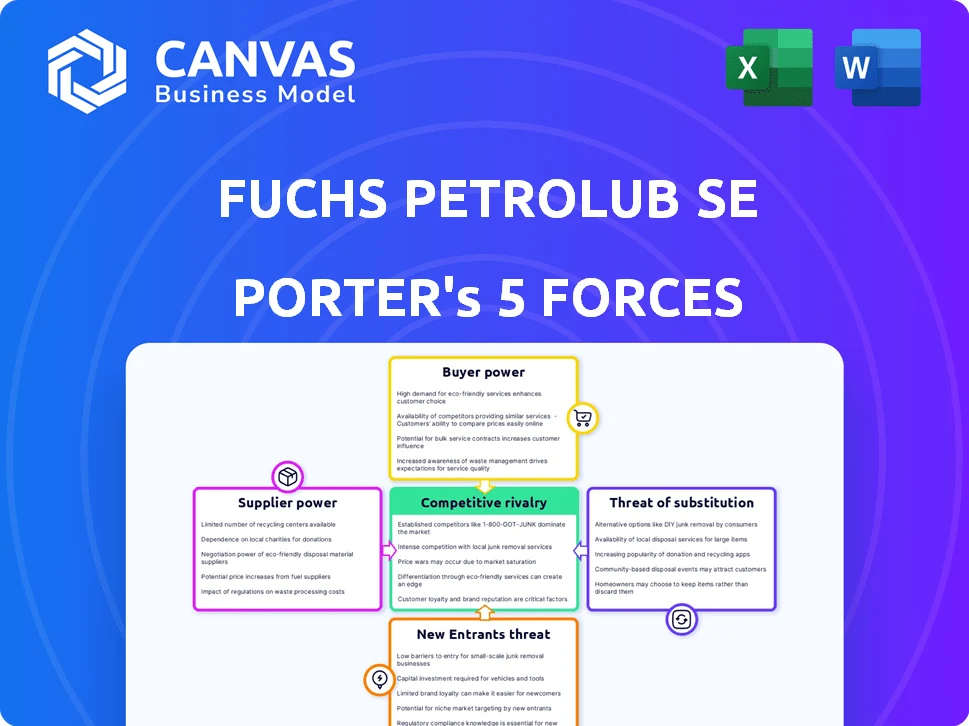
FUCHS PETROLUB SE PORTER'S FIVE FORCES TEMPLATE RESEARCH
What is included in the product
 Detailed Word Document
Analyzes Fuchs Petrolub SE's competitive forces, including rivalry, suppliers, and new entrants.

 Customizable Excel Spreadsheet
Instantly visualize Fuchs Petrolub's competitive landscape with dynamic, color-coded threat levels.
Full Version Awaits
Fuchs Petrolub SE Porter's Five Forces Analysis
The Fuchs Petrolub SE Porter's Five Forces analysis is fully displayed here. This preview shows the exact document you'll receive immediately after purchase—no surprises.

Porter's Five Forces Analysis Template

Don't Miss the Bigger Picture
Fuchs Petrolub SE faces a competitive landscape shaped by key industry forces. Supplier power is moderate, influenced by raw material availability. Buyer power varies across its diverse customer base. Threat of new entrants is limited due to high capital requirements. Substitutes pose a moderate challenge with alternative lubricants available. Competitive rivalry is intense, driven by established players.
This brief snapshot only scratches the surface. Unlock the full Porter's Five Forces Analysis to explore Fuchs Petrolub SE’s competitive dynamics, market pressures, and strategic advantages in detail.
Suppliers Bargaining Power

Supplier Concentration
Supplier concentration significantly affects Fuchs Petrolub's bargaining power. In the lubricant industry, a limited number of base oil and additive suppliers could increase supplier influence. For example, in 2024, base oil prices fluctuated, impacting manufacturers. This dynamic can lead to increased costs for Fuchs.
Switching Costs for Manufacturers
Switching costs significantly influence a manufacturer's supplier power. High switching costs, like those related to specialized lubricant formulations or lengthy testing, empower suppliers. In 2024, Fuchs Petrolub SE's revenue was approximately EUR 3.6 billion. The complexity of these processes can make changing suppliers costly and time-consuming, increasing supplier leverage.

Supplier Dependence on Manufacturer
Supplier dependence on Fuchs Petrolub SE impacts bargaining power. If Fuchs is a major client, suppliers' influence may be limited. In 2024, Fuchs's revenue was approximately €3.6 billion, showcasing its market significance. This financial standing influences supplier relationships, potentially reducing supplier leverage.

Availability of Substitute Inputs
The availability of substitute inputs significantly affects supplier power in Fuchs Petrolub SE's operations. If Fuchs can easily switch to alternative raw materials, suppliers have less control. This reduces their ability to dictate prices or terms. For example, Fuchs might use various base oils or additives.
- In 2024, Fuchs Petrolub SE reported a gross profit margin of approximately 38%, indicating some pricing flexibility despite input costs.
- The company's diversified sourcing strategy, including multiple suppliers for key components, helps mitigate supplier power.
- Fuchs' ability to formulate products with different base oils and additives provides flexibility.
- The lubricant market's competitive landscape, with many suppliers, also limits supplier influence.
Threat of Forward Integration by Suppliers
The threat of forward integration by suppliers significantly impacts Fuchs Petrolub SE's bargaining power. If suppliers, such as those providing raw materials, could produce lubricants themselves, they gain leverage. This potential for suppliers to become direct competitors increases their ability to dictate terms. Fuchs Petrolub SE must then manage relationships carefully to mitigate this risk. For example, in 2023, Fuchs Petrolub SE's cost of materials was a substantial portion of its revenue, highlighting the importance of supplier relationships.
- Potential for suppliers to become direct competitors.
- Increased supplier leverage in negotiations.
- Need for strategic supplier relationship management.
- Impact on cost of materials.
Fuchs Petrolub SE: Supplier Power Dynamics Unveiled
Supplier power for Fuchs Petrolub SE is influenced by concentration, switching costs, and dependence. Fuchs's 2024 revenue was approximately €3.6B, impacting supplier relationships. The firm's gross profit margin in 2024 was around 38%, showing some flexibility.
| Factor | Impact | 2024 Data |
|---|---|---|
| Supplier Concentration | High concentration increases supplier power | Base oil price fluctuations |
| Switching Costs | High costs empower suppliers | Revenue approx. €3.6B |
| Supplier Dependence | Reduced supplier power if Fuchs is a major client | Gross profit margin ~38% |
Customers Bargaining Power

Customer Concentration
Fuchs Petrolub SE's vast customer base, exceeding 100,000, spans diverse sectors. This broad distribution, including automotive and mining, mitigates customer concentration risk. In 2024, no single customer accounted for over 10% of sales. This diversification limits individual customer bargaining power, a positive for Fuchs.
Switching Costs for Customers
Switching costs significantly influence customer bargaining power in the lubricants market. Low switching costs empower customers to seek better deals. This includes technical compatibility, testing, and potential production line disruptions. In 2024, Fuchs Petrolub SE's focus on advanced lubricants aims to increase switching costs, reducing customer power.

Customer Information and Price Sensitivity
Customers with access to detailed lubricant data and pricing comparisons wield greater bargaining power. Price sensitivity is heightened in commoditized lubricant markets, where Fuchs Petrolub competes. In 2024, the global lubricants market was valued at approximately $39 billion, indicating the scale of customer influence. Increased price transparency via online platforms further empowers buyers.

Threat of Backward Integration by Customers
The threat of backward integration by customers significantly impacts Fuchs Petrolub SE. If major customers can produce lubricants themselves, their bargaining power rises, pressuring Fuchs to offer better terms. This scenario reduces Fuchs's profitability and market share. For example, a large automotive manufacturer deciding to produce its own lubricants could drastically affect Fuchs's revenue.
- Backward integration reduces the customer's reliance on external suppliers.
- This increases price sensitivity and negotiation leverage.
- It forces suppliers to offer competitive pricing and services.
- The risk is higher with customers having the resources and technical expertise.
Product Differentiation and Importance to Customer
The degree to which Fuchs Petrolub SE's lubricants are differentiated and their importance to customer operations significantly affect customer power. Specialized lubricants, crucial for specific machinery, reduce customer power due to limited alternatives. Conversely, commodity lubricants face higher customer power due to readily available substitutes. Fuchs Petrolub's ability to innovate and offer unique solutions is key.
- In 2024, Fuchs Petrolub SE reported a revenue of approximately €3.4 billion, indicating the scale of its operations and market presence.
- The company's R&D spending, vital for product differentiation, was around €80 million in 2024.
- Fuchs Petrolub's customer base spans various industries, with the automotive sector being a significant segment.
- The company's global presence, with operations in over 50 countries, impacts its customer relationships.
Customer Power Dynamics at Play
Fuchs Petrolub SE faces varied customer bargaining power. Its extensive customer base and product differentiation, supported by €80 million in R&D in 2024, limit customer influence. However, price transparency and low switching costs in the $39 billion global market (2024 estimate) elevate customer power.
| Factor | Impact | 2024 Data/Observation |
|---|---|---|
| Customer Concentration | Low concentration reduces power. | No single customer over 10% of sales. |
| Switching Costs | Low costs increase power. | Focus on advanced lubricants to raise costs. |
| Price Transparency | High transparency increases power. | Online platforms enhance price comparison. |
Rivalry Among Competitors

Industry Growth Rate
The lubricant market's slow growth rate intensifies competitive rivalry. Slower growth often means companies fight harder for existing market share. This can lead to price wars, impacting profit margins. In 2024, the global lubricant market grew by approximately 2.5%, reflecting this dynamic.
Number and Diversity of Competitors
The lubricant industry features a diverse mix of competitors. Fuchs Petrolub SE, the largest independent, competes with oil majors and smaller firms. This diversity, including players like Shell and Exxon Mobil, intensifies rivalry. In 2024, the global lubricants market was valued at approximately $30 billion, showcasing the competitive landscape.

Brand Identity and Differentiation
In competitive markets, brand identity and differentiation are crucial. Fuchs Petrolub SE's focus on specialized applications and technical expertise sets it apart. This differentiation is key in the lubricants industry, where competitors vie for market share. For example, in 2024, Fuchs Petrolub SE's revenue was approximately EUR 3.7 billion, showcasing its ability to compete effectively.

Exit Barriers
High exit barriers, a key factor in Fuchs Petrolub SE's competitive landscape, stem from substantial investments in specialized production facilities. These barriers, including the need for specific equipment, limit the ability of underperforming companies to leave the market. This can lead to overcapacity, intensifying price competition among lubricant manufacturers. For instance, Fuchs Petrolub SE's 2023 annual report highlights significant capital expenditures in its global production network.
- Capital-intensive production facilities: Require substantial investment.
- Specialized equipment: High costs to adapt or sell.
- Overcapacity risk: Drives price wars.
- Fuchs Petrolub SE's 2023 CAPEX: Reflects its commitment to production.
Industry Concentration
The lubricant market features a mix of large corporations and specialized firms. Fuchs Petrolub competes within this landscape. The industry has a moderate concentration, with major oil companies and independent players. This structure influences competition dynamics, affecting pricing and market share.
- Fuchs Petrolub's 2023 sales were approximately €3.6 billion.
- The top 5 lubricant companies control a significant portion of the global market.
- Independent lubricant companies often compete on specialized products.
- Mergers and acquisitions are common, impacting market concentration.
Lubricant Market: A Price War Arena
Competitive rivalry in the lubricant market is fierce. The slow growth, about 2.5% in 2024, intensifies competition. A diverse mix of competitors, including Fuchs Petrolub SE and oil majors, battles for market share. High exit barriers, like specialized facilities, further fuel price wars.
| Factor | Impact | Example (2024) |
|---|---|---|
| Market Growth | Slow growth increases rivalry | ~2.5% global lubricant market growth |
| Competition | Diverse competitors intensify price wars | Fuchs Petrolub SE vs. Shell, Exxon Mobil |
| Exit Barriers | High barriers increase price competition | Significant CAPEX in production facilities |
FUCHS PETROLUB SE PORTER'S FIVE FORCES TEMPLATE RESEARCH
What is included in the product
Detailed Word Document
Analyzes Fuchs Petrolub SE's competitive forces, including rivalry, suppliers, and new entrants.
Customizable Excel Spreadsheet
Instantly visualize Fuchs Petrolub's competitive landscape with dynamic, color-coded threat levels.
Full Version Awaits
Fuchs Petrolub SE Porter's Five Forces Analysis
The Fuchs Petrolub SE Porter's Five Forces analysis is fully displayed here. This preview shows the exact document you'll receive immediately after purchase—no surprises.
Porter's Five Forces Analysis Template
Don't Miss the Bigger Picture
Fuchs Petrolub SE faces a competitive landscape shaped by key industry forces. Supplier power is moderate, influenced by raw material availability. Buyer power varies across its diverse customer base. Threat of new entrants is limited due to high capital requirements. Substitutes pose a moderate challenge with alternative lubricants available. Competitive rivalry is intense, driven by established players.
This brief snapshot only scratches the surface. Unlock the full Porter's Five Forces Analysis to explore Fuchs Petrolub SE’s competitive dynamics, market pressures, and strategic advantages in detail.
Suppliers Bargaining Power
Supplier Concentration
Supplier concentration significantly affects Fuchs Petrolub's bargaining power. In the lubricant industry, a limited number of base oil and additive suppliers could increase supplier influence. For example, in 2024, base oil prices fluctuated, impacting manufacturers. This dynamic can lead to increased costs for Fuchs.
Switching Costs for Manufacturers
Switching costs significantly influence a manufacturer's supplier power. High switching costs, like those related to specialized lubricant formulations or lengthy testing, empower suppliers. In 2024, Fuchs Petrolub SE's revenue was approximately EUR 3.6 billion. The complexity of these processes can make changing suppliers costly and time-consuming, increasing supplier leverage.
Supplier Dependence on Manufacturer
Supplier dependence on Fuchs Petrolub SE impacts bargaining power. If Fuchs is a major client, suppliers' influence may be limited. In 2024, Fuchs's revenue was approximately €3.6 billion, showcasing its market significance. This financial standing influences supplier relationships, potentially reducing supplier leverage.
Availability of Substitute Inputs
The availability of substitute inputs significantly affects supplier power in Fuchs Petrolub SE's operations. If Fuchs can easily switch to alternative raw materials, suppliers have less control. This reduces their ability to dictate prices or terms. For example, Fuchs might use various base oils or additives.
- In 2024, Fuchs Petrolub SE reported a gross profit margin of approximately 38%, indicating some pricing flexibility despite input costs.
- The company's diversified sourcing strategy, including multiple suppliers for key components, helps mitigate supplier power.
- Fuchs' ability to formulate products with different base oils and additives provides flexibility.
- The lubricant market's competitive landscape, with many suppliers, also limits supplier influence.
Threat of Forward Integration by Suppliers
The threat of forward integration by suppliers significantly impacts Fuchs Petrolub SE's bargaining power. If suppliers, such as those providing raw materials, could produce lubricants themselves, they gain leverage. This potential for suppliers to become direct competitors increases their ability to dictate terms. Fuchs Petrolub SE must then manage relationships carefully to mitigate this risk. For example, in 2023, Fuchs Petrolub SE's cost of materials was a substantial portion of its revenue, highlighting the importance of supplier relationships.
- Potential for suppliers to become direct competitors.
- Increased supplier leverage in negotiations.
- Need for strategic supplier relationship management.
- Impact on cost of materials.
Fuchs Petrolub SE: Supplier Power Dynamics Unveiled
Supplier power for Fuchs Petrolub SE is influenced by concentration, switching costs, and dependence. Fuchs's 2024 revenue was approximately €3.6B, impacting supplier relationships. The firm's gross profit margin in 2024 was around 38%, showing some flexibility.
| Factor | Impact | 2024 Data |
|---|---|---|
| Supplier Concentration | High concentration increases supplier power | Base oil price fluctuations |
| Switching Costs | High costs empower suppliers | Revenue approx. €3.6B |
| Supplier Dependence | Reduced supplier power if Fuchs is a major client | Gross profit margin ~38% |
Customers Bargaining Power
Customer Concentration
Fuchs Petrolub SE's vast customer base, exceeding 100,000, spans diverse sectors. This broad distribution, including automotive and mining, mitigates customer concentration risk. In 2024, no single customer accounted for over 10% of sales. This diversification limits individual customer bargaining power, a positive for Fuchs.
Switching Costs for Customers
Switching costs significantly influence customer bargaining power in the lubricants market. Low switching costs empower customers to seek better deals. This includes technical compatibility, testing, and potential production line disruptions. In 2024, Fuchs Petrolub SE's focus on advanced lubricants aims to increase switching costs, reducing customer power.
Customer Information and Price Sensitivity
Customers with access to detailed lubricant data and pricing comparisons wield greater bargaining power. Price sensitivity is heightened in commoditized lubricant markets, where Fuchs Petrolub competes. In 2024, the global lubricants market was valued at approximately $39 billion, indicating the scale of customer influence. Increased price transparency via online platforms further empowers buyers.
Threat of Backward Integration by Customers
The threat of backward integration by customers significantly impacts Fuchs Petrolub SE. If major customers can produce lubricants themselves, their bargaining power rises, pressuring Fuchs to offer better terms. This scenario reduces Fuchs's profitability and market share. For example, a large automotive manufacturer deciding to produce its own lubricants could drastically affect Fuchs's revenue.
- Backward integration reduces the customer's reliance on external suppliers.
- This increases price sensitivity and negotiation leverage.
- It forces suppliers to offer competitive pricing and services.
- The risk is higher with customers having the resources and technical expertise.
Product Differentiation and Importance to Customer
The degree to which Fuchs Petrolub SE's lubricants are differentiated and their importance to customer operations significantly affect customer power. Specialized lubricants, crucial for specific machinery, reduce customer power due to limited alternatives. Conversely, commodity lubricants face higher customer power due to readily available substitutes. Fuchs Petrolub's ability to innovate and offer unique solutions is key.
- In 2024, Fuchs Petrolub SE reported a revenue of approximately €3.4 billion, indicating the scale of its operations and market presence.
- The company's R&D spending, vital for product differentiation, was around €80 million in 2024.
- Fuchs Petrolub's customer base spans various industries, with the automotive sector being a significant segment.
- The company's global presence, with operations in over 50 countries, impacts its customer relationships.
Customer Power Dynamics at Play
Fuchs Petrolub SE faces varied customer bargaining power. Its extensive customer base and product differentiation, supported by €80 million in R&D in 2024, limit customer influence. However, price transparency and low switching costs in the $39 billion global market (2024 estimate) elevate customer power.
| Factor | Impact | 2024 Data/Observation |
|---|---|---|
| Customer Concentration | Low concentration reduces power. | No single customer over 10% of sales. |
| Switching Costs | Low costs increase power. | Focus on advanced lubricants to raise costs. |
| Price Transparency | High transparency increases power. | Online platforms enhance price comparison. |
Rivalry Among Competitors
Industry Growth Rate
The lubricant market's slow growth rate intensifies competitive rivalry. Slower growth often means companies fight harder for existing market share. This can lead to price wars, impacting profit margins. In 2024, the global lubricant market grew by approximately 2.5%, reflecting this dynamic.
Number and Diversity of Competitors
The lubricant industry features a diverse mix of competitors. Fuchs Petrolub SE, the largest independent, competes with oil majors and smaller firms. This diversity, including players like Shell and Exxon Mobil, intensifies rivalry. In 2024, the global lubricants market was valued at approximately $30 billion, showcasing the competitive landscape.
Brand Identity and Differentiation
In competitive markets, brand identity and differentiation are crucial. Fuchs Petrolub SE's focus on specialized applications and technical expertise sets it apart. This differentiation is key in the lubricants industry, where competitors vie for market share. For example, in 2024, Fuchs Petrolub SE's revenue was approximately EUR 3.7 billion, showcasing its ability to compete effectively.
Exit Barriers
High exit barriers, a key factor in Fuchs Petrolub SE's competitive landscape, stem from substantial investments in specialized production facilities. These barriers, including the need for specific equipment, limit the ability of underperforming companies to leave the market. This can lead to overcapacity, intensifying price competition among lubricant manufacturers. For instance, Fuchs Petrolub SE's 2023 annual report highlights significant capital expenditures in its global production network.
- Capital-intensive production facilities: Require substantial investment.
- Specialized equipment: High costs to adapt or sell.
- Overcapacity risk: Drives price wars.
- Fuchs Petrolub SE's 2023 CAPEX: Reflects its commitment to production.
Industry Concentration
The lubricant market features a mix of large corporations and specialized firms. Fuchs Petrolub competes within this landscape. The industry has a moderate concentration, with major oil companies and independent players. This structure influences competition dynamics, affecting pricing and market share.
- Fuchs Petrolub's 2023 sales were approximately €3.6 billion.
- The top 5 lubricant companies control a significant portion of the global market.
- Independent lubricant companies often compete on specialized products.
- Mergers and acquisitions are common, impacting market concentration.
Lubricant Market: A Price War Arena
Competitive rivalry in the lubricant market is fierce. The slow growth, about 2.5% in 2024, intensifies competition. A diverse mix of competitors, including Fuchs Petrolub SE and oil majors, battles for market share. High exit barriers, like specialized facilities, further fuel price wars.
| Factor | Impact | Example (2024) |
|---|---|---|
| Market Growth | Slow growth increases rivalry | ~2.5% global lubricant market growth |
| Competition | Diverse competitors intensify price wars | Fuchs Petrolub SE vs. Shell, Exxon Mobil |
| Exit Barriers | High barriers increase price competition | Significant CAPEX in production facilities |
Product Information
Product Information
Shipping & Returns
Shipping & Returns
Description
What is included in the product
Detailed Word Document
Analyzes Fuchs Petrolub SE's competitive forces, including rivalry, suppliers, and new entrants.
Customizable Excel Spreadsheet
Instantly visualize Fuchs Petrolub's competitive landscape with dynamic, color-coded threat levels.
Full Version Awaits
Fuchs Petrolub SE Porter's Five Forces Analysis
The Fuchs Petrolub SE Porter's Five Forces analysis is fully displayed here. This preview shows the exact document you'll receive immediately after purchase—no surprises.
Porter's Five Forces Analysis Template
Don't Miss the Bigger Picture
Fuchs Petrolub SE faces a competitive landscape shaped by key industry forces. Supplier power is moderate, influenced by raw material availability. Buyer power varies across its diverse customer base. Threat of new entrants is limited due to high capital requirements. Substitutes pose a moderate challenge with alternative lubricants available. Competitive rivalry is intense, driven by established players.
This brief snapshot only scratches the surface. Unlock the full Porter's Five Forces Analysis to explore Fuchs Petrolub SE’s competitive dynamics, market pressures, and strategic advantages in detail.
Suppliers Bargaining Power
Supplier Concentration
Supplier concentration significantly affects Fuchs Petrolub's bargaining power. In the lubricant industry, a limited number of base oil and additive suppliers could increase supplier influence. For example, in 2024, base oil prices fluctuated, impacting manufacturers. This dynamic can lead to increased costs for Fuchs.
Switching Costs for Manufacturers
Switching costs significantly influence a manufacturer's supplier power. High switching costs, like those related to specialized lubricant formulations or lengthy testing, empower suppliers. In 2024, Fuchs Petrolub SE's revenue was approximately EUR 3.6 billion. The complexity of these processes can make changing suppliers costly and time-consuming, increasing supplier leverage.
Supplier Dependence on Manufacturer
Supplier dependence on Fuchs Petrolub SE impacts bargaining power. If Fuchs is a major client, suppliers' influence may be limited. In 2024, Fuchs's revenue was approximately €3.6 billion, showcasing its market significance. This financial standing influences supplier relationships, potentially reducing supplier leverage.
Availability of Substitute Inputs
The availability of substitute inputs significantly affects supplier power in Fuchs Petrolub SE's operations. If Fuchs can easily switch to alternative raw materials, suppliers have less control. This reduces their ability to dictate prices or terms. For example, Fuchs might use various base oils or additives.
- In 2024, Fuchs Petrolub SE reported a gross profit margin of approximately 38%, indicating some pricing flexibility despite input costs.
- The company's diversified sourcing strategy, including multiple suppliers for key components, helps mitigate supplier power.
- Fuchs' ability to formulate products with different base oils and additives provides flexibility.
- The lubricant market's competitive landscape, with many suppliers, also limits supplier influence.
Threat of Forward Integration by Suppliers
The threat of forward integration by suppliers significantly impacts Fuchs Petrolub SE's bargaining power. If suppliers, such as those providing raw materials, could produce lubricants themselves, they gain leverage. This potential for suppliers to become direct competitors increases their ability to dictate terms. Fuchs Petrolub SE must then manage relationships carefully to mitigate this risk. For example, in 2023, Fuchs Petrolub SE's cost of materials was a substantial portion of its revenue, highlighting the importance of supplier relationships.
- Potential for suppliers to become direct competitors.
- Increased supplier leverage in negotiations.
- Need for strategic supplier relationship management.
- Impact on cost of materials.
Fuchs Petrolub SE: Supplier Power Dynamics Unveiled
Supplier power for Fuchs Petrolub SE is influenced by concentration, switching costs, and dependence. Fuchs's 2024 revenue was approximately €3.6B, impacting supplier relationships. The firm's gross profit margin in 2024 was around 38%, showing some flexibility.
| Factor | Impact | 2024 Data |
|---|---|---|
| Supplier Concentration | High concentration increases supplier power | Base oil price fluctuations |
| Switching Costs | High costs empower suppliers | Revenue approx. €3.6B |
| Supplier Dependence | Reduced supplier power if Fuchs is a major client | Gross profit margin ~38% |
Customers Bargaining Power
Customer Concentration
Fuchs Petrolub SE's vast customer base, exceeding 100,000, spans diverse sectors. This broad distribution, including automotive and mining, mitigates customer concentration risk. In 2024, no single customer accounted for over 10% of sales. This diversification limits individual customer bargaining power, a positive for Fuchs.
Switching Costs for Customers
Switching costs significantly influence customer bargaining power in the lubricants market. Low switching costs empower customers to seek better deals. This includes technical compatibility, testing, and potential production line disruptions. In 2024, Fuchs Petrolub SE's focus on advanced lubricants aims to increase switching costs, reducing customer power.
Customer Information and Price Sensitivity
Customers with access to detailed lubricant data and pricing comparisons wield greater bargaining power. Price sensitivity is heightened in commoditized lubricant markets, where Fuchs Petrolub competes. In 2024, the global lubricants market was valued at approximately $39 billion, indicating the scale of customer influence. Increased price transparency via online platforms further empowers buyers.
Threat of Backward Integration by Customers
The threat of backward integration by customers significantly impacts Fuchs Petrolub SE. If major customers can produce lubricants themselves, their bargaining power rises, pressuring Fuchs to offer better terms. This scenario reduces Fuchs's profitability and market share. For example, a large automotive manufacturer deciding to produce its own lubricants could drastically affect Fuchs's revenue.
- Backward integration reduces the customer's reliance on external suppliers.
- This increases price sensitivity and negotiation leverage.
- It forces suppliers to offer competitive pricing and services.
- The risk is higher with customers having the resources and technical expertise.
Product Differentiation and Importance to Customer
The degree to which Fuchs Petrolub SE's lubricants are differentiated and their importance to customer operations significantly affect customer power. Specialized lubricants, crucial for specific machinery, reduce customer power due to limited alternatives. Conversely, commodity lubricants face higher customer power due to readily available substitutes. Fuchs Petrolub's ability to innovate and offer unique solutions is key.
- In 2024, Fuchs Petrolub SE reported a revenue of approximately €3.4 billion, indicating the scale of its operations and market presence.
- The company's R&D spending, vital for product differentiation, was around €80 million in 2024.
- Fuchs Petrolub's customer base spans various industries, with the automotive sector being a significant segment.
- The company's global presence, with operations in over 50 countries, impacts its customer relationships.
Customer Power Dynamics at Play
Fuchs Petrolub SE faces varied customer bargaining power. Its extensive customer base and product differentiation, supported by €80 million in R&D in 2024, limit customer influence. However, price transparency and low switching costs in the $39 billion global market (2024 estimate) elevate customer power.
| Factor | Impact | 2024 Data/Observation |
|---|---|---|
| Customer Concentration | Low concentration reduces power. | No single customer over 10% of sales. |
| Switching Costs | Low costs increase power. | Focus on advanced lubricants to raise costs. |
| Price Transparency | High transparency increases power. | Online platforms enhance price comparison. |
Rivalry Among Competitors
Industry Growth Rate
The lubricant market's slow growth rate intensifies competitive rivalry. Slower growth often means companies fight harder for existing market share. This can lead to price wars, impacting profit margins. In 2024, the global lubricant market grew by approximately 2.5%, reflecting this dynamic.
Number and Diversity of Competitors
The lubricant industry features a diverse mix of competitors. Fuchs Petrolub SE, the largest independent, competes with oil majors and smaller firms. This diversity, including players like Shell and Exxon Mobil, intensifies rivalry. In 2024, the global lubricants market was valued at approximately $30 billion, showcasing the competitive landscape.
Brand Identity and Differentiation
In competitive markets, brand identity and differentiation are crucial. Fuchs Petrolub SE's focus on specialized applications and technical expertise sets it apart. This differentiation is key in the lubricants industry, where competitors vie for market share. For example, in 2024, Fuchs Petrolub SE's revenue was approximately EUR 3.7 billion, showcasing its ability to compete effectively.
Exit Barriers
High exit barriers, a key factor in Fuchs Petrolub SE's competitive landscape, stem from substantial investments in specialized production facilities. These barriers, including the need for specific equipment, limit the ability of underperforming companies to leave the market. This can lead to overcapacity, intensifying price competition among lubricant manufacturers. For instance, Fuchs Petrolub SE's 2023 annual report highlights significant capital expenditures in its global production network.
- Capital-intensive production facilities: Require substantial investment.
- Specialized equipment: High costs to adapt or sell.
- Overcapacity risk: Drives price wars.
- Fuchs Petrolub SE's 2023 CAPEX: Reflects its commitment to production.
Industry Concentration
The lubricant market features a mix of large corporations and specialized firms. Fuchs Petrolub competes within this landscape. The industry has a moderate concentration, with major oil companies and independent players. This structure influences competition dynamics, affecting pricing and market share.
- Fuchs Petrolub's 2023 sales were approximately €3.6 billion.
- The top 5 lubricant companies control a significant portion of the global market.
- Independent lubricant companies often compete on specialized products.
- Mergers and acquisitions are common, impacting market concentration.
Lubricant Market: A Price War Arena
Competitive rivalry in the lubricant market is fierce. The slow growth, about 2.5% in 2024, intensifies competition. A diverse mix of competitors, including Fuchs Petrolub SE and oil majors, battles for market share. High exit barriers, like specialized facilities, further fuel price wars.
| Factor | Impact | Example (2024) |
|---|---|---|
| Market Growth | Slow growth increases rivalry | ~2.5% global lubricant market growth |
| Competition | Diverse competitors intensify price wars | Fuchs Petrolub SE vs. Shell, Exxon Mobil |
| Exit Barriers | High barriers increase price competition | Significant CAPEX in production facilities |


