
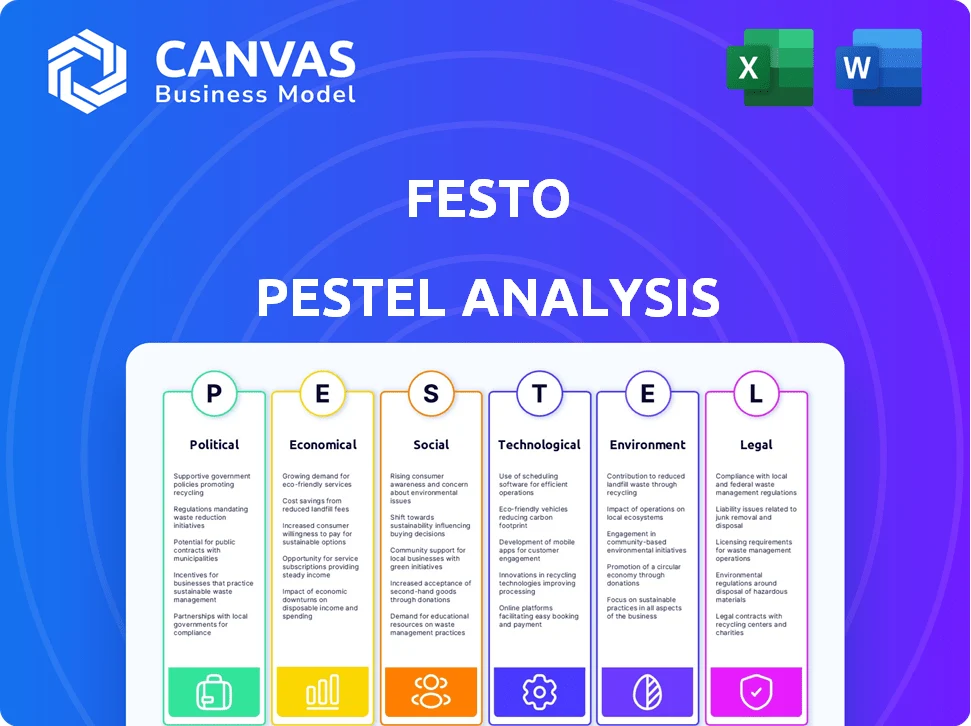
FESTO PESTLE ANALYSIS TEMPLATE RESEARCH
What is included in the product
 Detailed Word Document
Investigates Festo via external factors: Political, Economic, Social, Technological, Environmental, and Legal.

 Customizable Excel Spreadsheet
Provides a concise version that can be dropped into PowerPoints or used in group planning sessions.
Full Version Awaits
Festo PESTLE Analysis
The Festo PESTLE analysis you see here is the full document. It is professionally formatted. Upon purchase, you'll get this same analysis file instantly. There are no changes.

PESTLE Analysis Template

Make Smarter Strategic Decisions with a Complete PESTEL View
Uncover the external factors shaping Festo's future with our PESTLE Analysis. This analysis delivers essential insights into political, economic, social, technological, legal, and environmental forces. Understand the risks and opportunities Festo faces in a rapidly changing global landscape. Make informed decisions and develop effective strategies.
For deeper understanding, download the full PESTLE Analysis today and unlock expert-level market intelligence!
Political factors

Government Policy and Stability
Government policies and regulations are crucial for Festo. Shifts in trade policies or industry-specific rules, like those affecting automation or sectors such as semiconductors, can greatly influence the company. For instance, in 2024, the EU's focus on green energy and automation could lead to incentives favoring Festo's products. Policy stability is key; unpredictable changes can disrupt operations, as seen with Brexit's impact on supply chains.
International Relations and Trade Agreements
Festo, with its presence in 176 countries, is significantly impacted by international relations and trade agreements. Geopolitical instability and shifts in trade policies can disrupt supply chains and market access. For instance, the ongoing Russia-Ukraine conflict has led to supply chain disruptions, increasing costs. In 2024, global trade growth is projected to be around 3%, which impacts Festo's international operations.

Political Risk and Instability in Key Markets
Political risk and instability significantly affect Festo's operations. Uncertainty has curbed investments in machine engineering. Political disruptions, particularly in Asia and Europe, pose challenges. For example, the European Commission predicts a 1.3% GDP growth for the EU in 2024, influencing Festo's sales. These factors necessitate careful market assessment.

Government Investment in Education and Skills Development
Government investment in education and skills development directly impacts Festo's Didactic division, which provides training solutions. Support for technical education, especially in digitalization and AI, helps bridge the skills gap in automation. The U.S. government, for example, allocated $1.9 billion in 2024 for workforce development programs. These programs aim to train workers in high-demand fields like automation, which is crucial for Festo.
- U.S. government allocated $1.9B in 2024 for workforce development.
- Focus on areas like digitalization and AI.
- Addresses skills gap in the automation sector.
Regulatory Environment for Industrial Automation
The regulatory environment for industrial automation is essential for Festo, covering safety and product conformity standards. Compliance is critical in all operational markets. For instance, the EU's Machinery Directive 2006/42/EC mandates safety standards. Failure to comply can lead to significant penalties and market access issues. Regulatory changes, such as those related to cybersecurity in industrial systems, also impact Festo.
- EU Machinery Directive 2006/42/EC: Mandatory safety standards.
- Cybersecurity regulations for industrial systems: Increasingly important.
Festo's 2024 Outlook: Trade, Rules, and Growth
Government policies impact Festo; trade rules, especially in automation, matter. EU focuses on green energy, possibly favoring Festo in 2024. Global trade growth is projected at 3% affecting its global operations. Regulatory compliance like EU's Machinery Directive 2006/42/EC is crucial.
| Political Factor | Impact on Festo | Example/Data (2024) |
|---|---|---|
| Trade Policies | Affects supply chains, market access | Global trade growth projected at 3%. |
| Regulations | Impacts product compliance, safety | EU Machinery Directive 2006/42/EC. |
| Government Investment | Influences skills and training. | U.S. allocated $1.9B for workforce development. |
Economic factors

Global Economic Conditions
Global economic conditions are crucial for Festo. Sales and investments are sensitive to economic shifts. Uncertainty and slow growth can curb customer spending on automation. The IMF projects global growth at 3.2% in 2024, rising to 3.3% in 2025. This influences Festo's strategic planning.
Inflation and Interest Rates
Inflation and interest rates significantly impact Festo's operations. Rising inflation increases the cost of raw materials and production, potentially squeezing profit margins. Higher interest rates can make borrowing more expensive, affecting Festo's investments and customer demand for its products. In 2024, the Eurozone's inflation rate was around 2.4%, while the ECB's key interest rate was 4.5%. These factors influence both Festo's financial planning and customer purchasing decisions.

Industry-Specific Economic Cycles
Festo's diverse customer base means it's exposed to various industry-specific economic cycles. The automotive sector, a key market, saw a 9.1% global sales increase in 2024. Electronics, like semiconductors, are also crucial, with the chip market projected to reach $600 billion by the end of 2024. Fluctuations in these sectors directly impact Festo's sales and profitability.

Exchange Rates
Exchange rate volatility presents a significant risk for Festo, a global entity. Currency fluctuations directly influence the translation of international sales revenue, impacting reported financial performance. For example, a strong Euro can make Festo's products more expensive in international markets, potentially reducing sales volumes. Conversely, a weaker Euro could boost competitiveness but decrease the value of foreign earnings when converted.
- EUR/USD exchange rate in early May 2024 was approximately 1.07-1.08.
- Festo's financial reports will reflect these currency impacts, especially in regions like Asia.
- Hedging strategies are crucial to mitigate these risks, protecting profit margins.
Investment in Research and Development
Festo's unwavering commitment to research and development (R&D) is a key economic indicator. This consistent investment, even during economic downturns, signals a focus on long-term growth and innovation. In 2024, Festo allocated a substantial portion of its budget to R&D, aiming to stay ahead. This strategy is reflected in its drive for advanced automation solutions.
- Festo's R&D spending in 2024 reached €350 million.
- This investment supports the development of cutting-edge products.
- Focus on areas like AI-driven automation.
- Festo's revenue from new products in 2024 increased by 15%.
Economic Trends Impacting Festo's Strategy
Economic forecasts shape Festo’s outlook; the IMF projects 3.2% global growth in 2024, increasing to 3.3% in 2025. Inflation and interest rates, such as the Eurozone's 2.4% inflation rate in 2024, affect costs. Currency fluctuations, for instance, a EUR/USD rate of approximately 1.07-1.08 in May 2024, present risks.
| Economic Factor | Impact on Festo | 2024/2025 Data Points |
|---|---|---|
| Global Growth | Influences sales & investment | IMF: 3.2% (2024), 3.3% (2025) |
| Inflation | Increases production costs | Eurozone: 2.4% (2024) |
| Exchange Rates | Affects international revenue | EUR/USD: 1.07-1.08 (early May 2024) |
Sociological factors

Workforce Skills and Education
The automation sector heavily relies on a skilled workforce. A shortage of skilled workers, influenced by demographic shifts, necessitates companies like Festo to focus on training and development. Festo's Didactic division plays a key role in addressing these skill gaps. In 2024, the global automation market faced a 5% skills shortage.
Customer Needs and Expectations
Evolving customer needs and expectations significantly shape the demand for advanced automation solutions. Customers now prioritize seamless connectivity and integrated technologies for enhanced efficiency. Sustainability is also a key factor, with 70% of consumers considering a brand's environmental impact. Festo's innovative solutions must align with these shifts to remain competitive in 2024/2025.

Aging Population and Workforce Well-being
An aging population results in a shrinking workforce, increasing the demand for automation to sustain output. Festo's automation solutions can reduce physical demands on workers, enhancing their well-being. In 2024, the global elderly population (65+) reached 771 million, projected to hit 1 billion by 2030. This demographic shift boosts the need for ergonomic and automated workplace solutions.

Societal Attitudes towards Automation and AI
Societal attitudes significantly shape automation and AI adoption, directly impacting companies like Festo. Festo's emphasis on digitalization and AI reflects this growing trend. Public acceptance and trust in these technologies are crucial for their successful integration across sectors. Concerns about job displacement and ethical implications can hinder widespread adoption. Understanding and addressing these societal views is key for Festo's strategic planning.
- A 2024 survey indicated that 45% of the public are concerned about AI's impact on jobs.
- The global AI market is projected to reach $1.8 trillion by 2030.
- Festo's revenue in 2024 was approximately €3.36 billion.
Corporate Social Responsibility
Festo's commitment to corporate social responsibility (CSR) is crucial, reflecting societal expectations. Their dedication to sustainable development is a key factor for stakeholders. Corporate citizenship programs highlight this commitment, impacting brand perception. This focus aligns with broader societal trends toward ethical business practices. Festo's initiatives resonate with consumers and employees.
- Festo's CSR efforts include initiatives in education, environmental protection, and social projects.
- In 2024, global CSR spending is projected to reach $21.2 billion, underscoring the importance of these initiatives.
- Companies with strong CSR performance often see improved employee engagement and customer loyalty.
- Festo's commitment helps build trust and positive relationships with stakeholders.
AI's Job Impact: 45% Worry, $1.8T Market
Societal views influence AI and automation acceptance, critical for companies like Festo. A 2024 survey showed 45% worried about AI's impact on jobs. Public trust in technology shapes market success. Festo's strategies must consider these perceptions.
| Aspect | Details | Data |
|---|---|---|
| Public Opinion on AI | Concerns over job displacement | 45% in 2024 |
| AI Market Forecast | Projected global market value | $1.8T by 2030 |
| Festo's Revenue (2024) | Approximate annual revenue | €3.36B |
Original: $10.00
-65%$10.00
$3.50FESTO PESTLE ANALYSIS TEMPLATE RESEARCH
What is included in the product
Detailed Word Document
Investigates Festo via external factors: Political, Economic, Social, Technological, Environmental, and Legal.
Customizable Excel Spreadsheet
Provides a concise version that can be dropped into PowerPoints or used in group planning sessions.
Full Version Awaits
Festo PESTLE Analysis
The Festo PESTLE analysis you see here is the full document. It is professionally formatted. Upon purchase, you'll get this same analysis file instantly. There are no changes.
PESTLE Analysis Template
Make Smarter Strategic Decisions with a Complete PESTEL View
Uncover the external factors shaping Festo's future with our PESTLE Analysis. This analysis delivers essential insights into political, economic, social, technological, legal, and environmental forces. Understand the risks and opportunities Festo faces in a rapidly changing global landscape. Make informed decisions and develop effective strategies.
For deeper understanding, download the full PESTLE Analysis today and unlock expert-level market intelligence!
Political factors
Government Policy and Stability
Government policies and regulations are crucial for Festo. Shifts in trade policies or industry-specific rules, like those affecting automation or sectors such as semiconductors, can greatly influence the company. For instance, in 2024, the EU's focus on green energy and automation could lead to incentives favoring Festo's products. Policy stability is key; unpredictable changes can disrupt operations, as seen with Brexit's impact on supply chains.
International Relations and Trade Agreements
Festo, with its presence in 176 countries, is significantly impacted by international relations and trade agreements. Geopolitical instability and shifts in trade policies can disrupt supply chains and market access. For instance, the ongoing Russia-Ukraine conflict has led to supply chain disruptions, increasing costs. In 2024, global trade growth is projected to be around 3%, which impacts Festo's international operations.
Political Risk and Instability in Key Markets
Political risk and instability significantly affect Festo's operations. Uncertainty has curbed investments in machine engineering. Political disruptions, particularly in Asia and Europe, pose challenges. For example, the European Commission predicts a 1.3% GDP growth for the EU in 2024, influencing Festo's sales. These factors necessitate careful market assessment.
Government Investment in Education and Skills Development
Government investment in education and skills development directly impacts Festo's Didactic division, which provides training solutions. Support for technical education, especially in digitalization and AI, helps bridge the skills gap in automation. The U.S. government, for example, allocated $1.9 billion in 2024 for workforce development programs. These programs aim to train workers in high-demand fields like automation, which is crucial for Festo.
- U.S. government allocated $1.9B in 2024 for workforce development.
- Focus on areas like digitalization and AI.
- Addresses skills gap in the automation sector.
Regulatory Environment for Industrial Automation
The regulatory environment for industrial automation is essential for Festo, covering safety and product conformity standards. Compliance is critical in all operational markets. For instance, the EU's Machinery Directive 2006/42/EC mandates safety standards. Failure to comply can lead to significant penalties and market access issues. Regulatory changes, such as those related to cybersecurity in industrial systems, also impact Festo.
- EU Machinery Directive 2006/42/EC: Mandatory safety standards.
- Cybersecurity regulations for industrial systems: Increasingly important.
Festo's 2024 Outlook: Trade, Rules, and Growth
Government policies impact Festo; trade rules, especially in automation, matter. EU focuses on green energy, possibly favoring Festo in 2024. Global trade growth is projected at 3% affecting its global operations. Regulatory compliance like EU's Machinery Directive 2006/42/EC is crucial.
| Political Factor | Impact on Festo | Example/Data (2024) |
|---|---|---|
| Trade Policies | Affects supply chains, market access | Global trade growth projected at 3%. |
| Regulations | Impacts product compliance, safety | EU Machinery Directive 2006/42/EC. |
| Government Investment | Influences skills and training. | U.S. allocated $1.9B for workforce development. |
Economic factors
Global Economic Conditions
Global economic conditions are crucial for Festo. Sales and investments are sensitive to economic shifts. Uncertainty and slow growth can curb customer spending on automation. The IMF projects global growth at 3.2% in 2024, rising to 3.3% in 2025. This influences Festo's strategic planning.
Inflation and Interest Rates
Inflation and interest rates significantly impact Festo's operations. Rising inflation increases the cost of raw materials and production, potentially squeezing profit margins. Higher interest rates can make borrowing more expensive, affecting Festo's investments and customer demand for its products. In 2024, the Eurozone's inflation rate was around 2.4%, while the ECB's key interest rate was 4.5%. These factors influence both Festo's financial planning and customer purchasing decisions.
Industry-Specific Economic Cycles
Festo's diverse customer base means it's exposed to various industry-specific economic cycles. The automotive sector, a key market, saw a 9.1% global sales increase in 2024. Electronics, like semiconductors, are also crucial, with the chip market projected to reach $600 billion by the end of 2024. Fluctuations in these sectors directly impact Festo's sales and profitability.
Exchange Rates
Exchange rate volatility presents a significant risk for Festo, a global entity. Currency fluctuations directly influence the translation of international sales revenue, impacting reported financial performance. For example, a strong Euro can make Festo's products more expensive in international markets, potentially reducing sales volumes. Conversely, a weaker Euro could boost competitiveness but decrease the value of foreign earnings when converted.
- EUR/USD exchange rate in early May 2024 was approximately 1.07-1.08.
- Festo's financial reports will reflect these currency impacts, especially in regions like Asia.
- Hedging strategies are crucial to mitigate these risks, protecting profit margins.
Investment in Research and Development
Festo's unwavering commitment to research and development (R&D) is a key economic indicator. This consistent investment, even during economic downturns, signals a focus on long-term growth and innovation. In 2024, Festo allocated a substantial portion of its budget to R&D, aiming to stay ahead. This strategy is reflected in its drive for advanced automation solutions.
- Festo's R&D spending in 2024 reached €350 million.
- This investment supports the development of cutting-edge products.
- Focus on areas like AI-driven automation.
- Festo's revenue from new products in 2024 increased by 15%.
Economic Trends Impacting Festo's Strategy
Economic forecasts shape Festo’s outlook; the IMF projects 3.2% global growth in 2024, increasing to 3.3% in 2025. Inflation and interest rates, such as the Eurozone's 2.4% inflation rate in 2024, affect costs. Currency fluctuations, for instance, a EUR/USD rate of approximately 1.07-1.08 in May 2024, present risks.
| Economic Factor | Impact on Festo | 2024/2025 Data Points |
|---|---|---|
| Global Growth | Influences sales & investment | IMF: 3.2% (2024), 3.3% (2025) |
| Inflation | Increases production costs | Eurozone: 2.4% (2024) |
| Exchange Rates | Affects international revenue | EUR/USD: 1.07-1.08 (early May 2024) |
Sociological factors
Workforce Skills and Education
The automation sector heavily relies on a skilled workforce. A shortage of skilled workers, influenced by demographic shifts, necessitates companies like Festo to focus on training and development. Festo's Didactic division plays a key role in addressing these skill gaps. In 2024, the global automation market faced a 5% skills shortage.
Customer Needs and Expectations
Evolving customer needs and expectations significantly shape the demand for advanced automation solutions. Customers now prioritize seamless connectivity and integrated technologies for enhanced efficiency. Sustainability is also a key factor, with 70% of consumers considering a brand's environmental impact. Festo's innovative solutions must align with these shifts to remain competitive in 2024/2025.
Aging Population and Workforce Well-being
An aging population results in a shrinking workforce, increasing the demand for automation to sustain output. Festo's automation solutions can reduce physical demands on workers, enhancing their well-being. In 2024, the global elderly population (65+) reached 771 million, projected to hit 1 billion by 2030. This demographic shift boosts the need for ergonomic and automated workplace solutions.
Societal Attitudes towards Automation and AI
Societal attitudes significantly shape automation and AI adoption, directly impacting companies like Festo. Festo's emphasis on digitalization and AI reflects this growing trend. Public acceptance and trust in these technologies are crucial for their successful integration across sectors. Concerns about job displacement and ethical implications can hinder widespread adoption. Understanding and addressing these societal views is key for Festo's strategic planning.
- A 2024 survey indicated that 45% of the public are concerned about AI's impact on jobs.
- The global AI market is projected to reach $1.8 trillion by 2030.
- Festo's revenue in 2024 was approximately €3.36 billion.
Corporate Social Responsibility
Festo's commitment to corporate social responsibility (CSR) is crucial, reflecting societal expectations. Their dedication to sustainable development is a key factor for stakeholders. Corporate citizenship programs highlight this commitment, impacting brand perception. This focus aligns with broader societal trends toward ethical business practices. Festo's initiatives resonate with consumers and employees.
- Festo's CSR efforts include initiatives in education, environmental protection, and social projects.
- In 2024, global CSR spending is projected to reach $21.2 billion, underscoring the importance of these initiatives.
- Companies with strong CSR performance often see improved employee engagement and customer loyalty.
- Festo's commitment helps build trust and positive relationships with stakeholders.
AI's Job Impact: 45% Worry, $1.8T Market
Societal views influence AI and automation acceptance, critical for companies like Festo. A 2024 survey showed 45% worried about AI's impact on jobs. Public trust in technology shapes market success. Festo's strategies must consider these perceptions.
| Aspect | Details | Data |
|---|---|---|
| Public Opinion on AI | Concerns over job displacement | 45% in 2024 |
| AI Market Forecast | Projected global market value | $1.8T by 2030 |
| Festo's Revenue (2024) | Approximate annual revenue | €3.36B |
Product Information
Product Information
Shipping & Returns
Shipping & Returns
Description
What is included in the product
Detailed Word Document
Investigates Festo via external factors: Political, Economic, Social, Technological, Environmental, and Legal.
Customizable Excel Spreadsheet
Provides a concise version that can be dropped into PowerPoints or used in group planning sessions.
Full Version Awaits
Festo PESTLE Analysis
The Festo PESTLE analysis you see here is the full document. It is professionally formatted. Upon purchase, you'll get this same analysis file instantly. There are no changes.
PESTLE Analysis Template
Make Smarter Strategic Decisions with a Complete PESTEL View
Uncover the external factors shaping Festo's future with our PESTLE Analysis. This analysis delivers essential insights into political, economic, social, technological, legal, and environmental forces. Understand the risks and opportunities Festo faces in a rapidly changing global landscape. Make informed decisions and develop effective strategies.
For deeper understanding, download the full PESTLE Analysis today and unlock expert-level market intelligence!
Political factors
Government Policy and Stability
Government policies and regulations are crucial for Festo. Shifts in trade policies or industry-specific rules, like those affecting automation or sectors such as semiconductors, can greatly influence the company. For instance, in 2024, the EU's focus on green energy and automation could lead to incentives favoring Festo's products. Policy stability is key; unpredictable changes can disrupt operations, as seen with Brexit's impact on supply chains.
International Relations and Trade Agreements
Festo, with its presence in 176 countries, is significantly impacted by international relations and trade agreements. Geopolitical instability and shifts in trade policies can disrupt supply chains and market access. For instance, the ongoing Russia-Ukraine conflict has led to supply chain disruptions, increasing costs. In 2024, global trade growth is projected to be around 3%, which impacts Festo's international operations.
Political Risk and Instability in Key Markets
Political risk and instability significantly affect Festo's operations. Uncertainty has curbed investments in machine engineering. Political disruptions, particularly in Asia and Europe, pose challenges. For example, the European Commission predicts a 1.3% GDP growth for the EU in 2024, influencing Festo's sales. These factors necessitate careful market assessment.
Government Investment in Education and Skills Development
Government investment in education and skills development directly impacts Festo's Didactic division, which provides training solutions. Support for technical education, especially in digitalization and AI, helps bridge the skills gap in automation. The U.S. government, for example, allocated $1.9 billion in 2024 for workforce development programs. These programs aim to train workers in high-demand fields like automation, which is crucial for Festo.
- U.S. government allocated $1.9B in 2024 for workforce development.
- Focus on areas like digitalization and AI.
- Addresses skills gap in the automation sector.
Regulatory Environment for Industrial Automation
The regulatory environment for industrial automation is essential for Festo, covering safety and product conformity standards. Compliance is critical in all operational markets. For instance, the EU's Machinery Directive 2006/42/EC mandates safety standards. Failure to comply can lead to significant penalties and market access issues. Regulatory changes, such as those related to cybersecurity in industrial systems, also impact Festo.
- EU Machinery Directive 2006/42/EC: Mandatory safety standards.
- Cybersecurity regulations for industrial systems: Increasingly important.
Festo's 2024 Outlook: Trade, Rules, and Growth
Government policies impact Festo; trade rules, especially in automation, matter. EU focuses on green energy, possibly favoring Festo in 2024. Global trade growth is projected at 3% affecting its global operations. Regulatory compliance like EU's Machinery Directive 2006/42/EC is crucial.
| Political Factor | Impact on Festo | Example/Data (2024) |
|---|---|---|
| Trade Policies | Affects supply chains, market access | Global trade growth projected at 3%. |
| Regulations | Impacts product compliance, safety | EU Machinery Directive 2006/42/EC. |
| Government Investment | Influences skills and training. | U.S. allocated $1.9B for workforce development. |
Economic factors
Global Economic Conditions
Global economic conditions are crucial for Festo. Sales and investments are sensitive to economic shifts. Uncertainty and slow growth can curb customer spending on automation. The IMF projects global growth at 3.2% in 2024, rising to 3.3% in 2025. This influences Festo's strategic planning.
Inflation and Interest Rates
Inflation and interest rates significantly impact Festo's operations. Rising inflation increases the cost of raw materials and production, potentially squeezing profit margins. Higher interest rates can make borrowing more expensive, affecting Festo's investments and customer demand for its products. In 2024, the Eurozone's inflation rate was around 2.4%, while the ECB's key interest rate was 4.5%. These factors influence both Festo's financial planning and customer purchasing decisions.
Industry-Specific Economic Cycles
Festo's diverse customer base means it's exposed to various industry-specific economic cycles. The automotive sector, a key market, saw a 9.1% global sales increase in 2024. Electronics, like semiconductors, are also crucial, with the chip market projected to reach $600 billion by the end of 2024. Fluctuations in these sectors directly impact Festo's sales and profitability.
Exchange Rates
Exchange rate volatility presents a significant risk for Festo, a global entity. Currency fluctuations directly influence the translation of international sales revenue, impacting reported financial performance. For example, a strong Euro can make Festo's products more expensive in international markets, potentially reducing sales volumes. Conversely, a weaker Euro could boost competitiveness but decrease the value of foreign earnings when converted.
- EUR/USD exchange rate in early May 2024 was approximately 1.07-1.08.
- Festo's financial reports will reflect these currency impacts, especially in regions like Asia.
- Hedging strategies are crucial to mitigate these risks, protecting profit margins.
Investment in Research and Development
Festo's unwavering commitment to research and development (R&D) is a key economic indicator. This consistent investment, even during economic downturns, signals a focus on long-term growth and innovation. In 2024, Festo allocated a substantial portion of its budget to R&D, aiming to stay ahead. This strategy is reflected in its drive for advanced automation solutions.
- Festo's R&D spending in 2024 reached €350 million.
- This investment supports the development of cutting-edge products.
- Focus on areas like AI-driven automation.
- Festo's revenue from new products in 2024 increased by 15%.
Economic Trends Impacting Festo's Strategy
Economic forecasts shape Festo’s outlook; the IMF projects 3.2% global growth in 2024, increasing to 3.3% in 2025. Inflation and interest rates, such as the Eurozone's 2.4% inflation rate in 2024, affect costs. Currency fluctuations, for instance, a EUR/USD rate of approximately 1.07-1.08 in May 2024, present risks.
| Economic Factor | Impact on Festo | 2024/2025 Data Points |
|---|---|---|
| Global Growth | Influences sales & investment | IMF: 3.2% (2024), 3.3% (2025) |
| Inflation | Increases production costs | Eurozone: 2.4% (2024) |
| Exchange Rates | Affects international revenue | EUR/USD: 1.07-1.08 (early May 2024) |
Sociological factors
Workforce Skills and Education
The automation sector heavily relies on a skilled workforce. A shortage of skilled workers, influenced by demographic shifts, necessitates companies like Festo to focus on training and development. Festo's Didactic division plays a key role in addressing these skill gaps. In 2024, the global automation market faced a 5% skills shortage.
Customer Needs and Expectations
Evolving customer needs and expectations significantly shape the demand for advanced automation solutions. Customers now prioritize seamless connectivity and integrated technologies for enhanced efficiency. Sustainability is also a key factor, with 70% of consumers considering a brand's environmental impact. Festo's innovative solutions must align with these shifts to remain competitive in 2024/2025.
Aging Population and Workforce Well-being
An aging population results in a shrinking workforce, increasing the demand for automation to sustain output. Festo's automation solutions can reduce physical demands on workers, enhancing their well-being. In 2024, the global elderly population (65+) reached 771 million, projected to hit 1 billion by 2030. This demographic shift boosts the need for ergonomic and automated workplace solutions.
Societal Attitudes towards Automation and AI
Societal attitudes significantly shape automation and AI adoption, directly impacting companies like Festo. Festo's emphasis on digitalization and AI reflects this growing trend. Public acceptance and trust in these technologies are crucial for their successful integration across sectors. Concerns about job displacement and ethical implications can hinder widespread adoption. Understanding and addressing these societal views is key for Festo's strategic planning.
- A 2024 survey indicated that 45% of the public are concerned about AI's impact on jobs.
- The global AI market is projected to reach $1.8 trillion by 2030.
- Festo's revenue in 2024 was approximately €3.36 billion.
Corporate Social Responsibility
Festo's commitment to corporate social responsibility (CSR) is crucial, reflecting societal expectations. Their dedication to sustainable development is a key factor for stakeholders. Corporate citizenship programs highlight this commitment, impacting brand perception. This focus aligns with broader societal trends toward ethical business practices. Festo's initiatives resonate with consumers and employees.
- Festo's CSR efforts include initiatives in education, environmental protection, and social projects.
- In 2024, global CSR spending is projected to reach $21.2 billion, underscoring the importance of these initiatives.
- Companies with strong CSR performance often see improved employee engagement and customer loyalty.
- Festo's commitment helps build trust and positive relationships with stakeholders.
AI's Job Impact: 45% Worry, $1.8T Market
Societal views influence AI and automation acceptance, critical for companies like Festo. A 2024 survey showed 45% worried about AI's impact on jobs. Public trust in technology shapes market success. Festo's strategies must consider these perceptions.
| Aspect | Details | Data |
|---|---|---|
| Public Opinion on AI | Concerns over job displacement | 45% in 2024 |
| AI Market Forecast | Projected global market value | $1.8T by 2030 |
| Festo's Revenue (2024) | Approximate annual revenue | €3.36B |


