
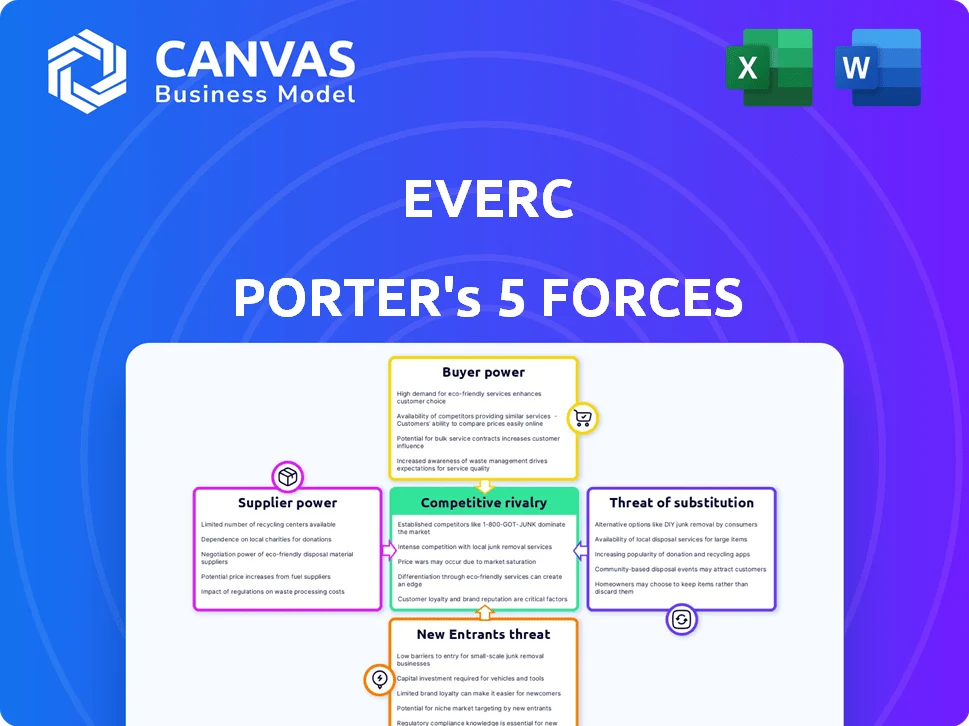
EVERC PORTER'S FIVE FORCES TEMPLATE RESEARCH
What is included in the product
 Detailed Word Document
Analyzes competition, buyer power, and threats to reveal EverC's competitive landscape.

 Customizable Excel Spreadsheet
Instantly identify threats and opportunities with this dynamic, data-driven analysis.
Same Document Delivered
EverC Porter's Five Forces Analysis
This preview presents the full EverC Porter's Five Forces analysis you'll receive. The document you see now is identical to the one you'll download immediately after purchasing. It's a complete, ready-to-use analysis. No alterations are needed. Expect the same quality and format.

Porter's Five Forces Analysis Template

Elevate Your Analysis with the Complete Porter's Five Forces Analysis
EverC faces a complex competitive landscape. The threat of new entrants is moderate, fueled by technological advancements. Bargaining power of suppliers appears manageable. Buyer power is also moderate, influenced by market fragmentation. The threat of substitutes poses a limited challenge currently. Rivalry among existing competitors is intense, particularly due to rapid technological changes.
The full analysis reveals the strength and intensity of each market force affecting EverC, complete with visuals and summaries for fast, clear interpretation.
Suppliers Bargaining Power

Data and Technology Providers
EverC's dependence on data and tech, like AI, gives suppliers leverage. Specialized AI providers, for instance, might command high prices. In 2024, the AI market hit $196.63 billion. This could drive up EverC's costs if these resources are essential and not easily substituted.
Talent Acquisition
EverC's success hinges on securing top cybersecurity and AI talent. The demand for skilled data scientists and AI experts is high, influencing labor costs. A limited talent pool boosts employee bargaining power. In 2024, the average salary for AI specialists rose by 7%, impacting operational expenses.

Infrastructure Providers
EverC relies on cloud infrastructure for its SaaS solutions. Cloud providers like AWS, Microsoft Azure, and Google Cloud Platform could influence EverC through pricing or service terms. In 2024, the global cloud computing market is estimated at $670.6 billion. EverC can mitigate supplier power by using multiple providers or securing long-term deals.

Third-Party Service Providers
EverC relies on third-party service providers for specialized tasks, such as in-depth investigations or niche data analysis. This dependence can shift bargaining power towards these providers, especially those with unique expertise or hard-to-find data. For example, the market for specialized fraud detection tools is expected to reach $10 billion by 2024, indicating significant provider power. This situation necessitates careful vendor management to maintain competitive costs and service quality.
- Market size for fraud detection tools: $10B (2024 estimate).
- Need for specialized data analysis.
- Importance of vendor management.
- Potential for price negotiation challenges.
Regulatory Information Sources
EverC must stay current with financial regulations. Suppliers of regulatory information, while important, likely hold less power than tech or data providers. The regulatory environment is dynamic, requiring constant updates. Compliance costs for financial services were about $39.3 billion in 2023.
- Regulatory changes impact EverC's services.
- Information providers offer critical updates.
- Compliance is a significant expense.
- Supplier power is moderate in this area.
EverC's Supplier Hurdles: AI, Talent, and Cloud Costs
EverC faces supplier power challenges in tech, talent, and cloud services. AI providers' leverage is notable in a $196.63B market (2024). The increasing cost of skilled AI specialists and cloud computing further affects EverC.
| Supplier Type | Impact on EverC | 2024 Data Point |
|---|---|---|
| AI Providers | High costs, essential resources | $196.63B AI market |
| AI Specialists | Rising labor costs | 7% salary increase |
| Cloud Providers | Pricing & service terms | $670.6B cloud market |
Customers Bargaining Power

Large Financial Institutions and Marketplaces
EverC's main clients, such as large banks and online marketplaces, possess substantial bargaining power. These entities, handling high transaction volumes, can demand better terms. In 2024, the top 10 global banks managed trillions in assets, emphasizing their leverage. This allows them to negotiate favorable pricing and tailored services.
Industry Consolidation
Consolidation in financial services and e-commerce, where EverC operates, means fewer, larger clients. This boosts customer bargaining power. In 2024, the top 10 e-commerce companies accounted for over 60% of online sales. Losing a big client significantly impacts EverC.

Availability of Alternatives
Customers can choose alternatives like in-house development, competitors, or manual methods for financial crime solutions. Switching costs are key; the easier it is to switch, the more power customers have. In 2024, the global financial crime detection and prevention market was valued at $28.8 billion, reflecting the availability of various solution providers. This competition limits EverC's pricing power.

Regulatory Mandates
Regulatory mandates significantly influence customer power. Customers, driven by specific compliance needs, can dictate the features and functionalities of EverC's services. If EverC's solutions don't fully align with these requirements, customers have leverage. For example, in 2024, financial institutions faced over $10 billion in regulatory fines, highlighting the importance of precise compliance solutions.
- Compliance demands shape service features.
- Customers have leverage if solutions fall short.
- Regulatory fines underscore the importance of precise solutions.
Integration Requirements
EverC's customers' bargaining power is significant due to integration needs. The ease and cost of integrating EverC's solutions into existing systems directly impact customer choices. Complex, expensive integrations give customers leverage to negotiate terms, favoring user-friendly, efficient providers. This is crucial, as 70% of businesses in 2024 prioritize seamless software integration.
- Integration challenges can increase project costs by up to 30%.
- Businesses report an average of 3.5 software integration issues annually.
- Companies with poor integration face a 20% decrease in operational efficiency.
- Easy integration can reduce customer onboarding time by 40%.
Bargaining Power Dynamics in the Financial Sector
EverC's clients, like major banks, wield significant bargaining power. High transaction volumes let them demand better terms; the top 10 banks managed trillions in 2024. Consolidation in e-commerce boosts this power, with top 10 firms handling over 60% of sales.
| Factor | Impact | 2024 Data |
|---|---|---|
| Client Size | Large clients have more power | Top banks: trillions in assets |
| Market Concentration | Fewer, larger clients | Top e-commerce: 60%+ sales |
| Switching Costs | Low costs increase power | Financial crime market: $28.8B |
Rivalry Among Competitors

Number and Diversity of Competitors
The financial crime prevention and cyber intelligence market sees intense competition. Numerous firms, including cybersecurity and regtech companies, vie for market share. For example, in 2024, the cybersecurity market was valued at over $200 billion, indicating a crowded field. This diversity intensifies rivalry, pushing companies to innovate and differentiate.
Technological Innovation
Technological innovation fuels intense rivalry. In 2024, AI spending rose, impacting market dynamics. Companies must swiftly adopt new tech for an edge. Firms investing heavily in R&D, like Alphabet, show this trend. This drives competition in speed.

Market Growth Rate
The market for EverC's services benefits from a growing online transaction volume and escalating financial crime. A fast-growing market often eases competitive pressure, offering more opportunities for various players. In 2024, the global cybersecurity market, which includes EverC's services, is projected to reach $202.8 billion, growing to $279.5 billion by 2028. This expansion can lessen the intensity of rivalry.

Switching Costs for Customers
Switching costs are crucial in the competitive landscape. Customers face substantial costs when switching fraud detection systems. This can include data migration, retraining staff, and potential service disruptions. High switching costs can make it harder for competitors to attract clients. For example, the average cost to switch from a legacy fraud detection system is $50,000.
- Data migration complexities and expenses.
- Staff retraining on new platforms.
- Potential for service interruption during the transition.
- Contractual obligations and penalties.
Differentiation of Offerings
Competitive rivalry in payment risk management is intense. Companies differentiate through accuracy, speed, and data comprehensiveness. EverC uses AI and focuses on e-commerce risks. The market is estimated at billions, showing strong competition.
- Market size expected to reach $23.7 billion by 2024.
- EverC's AI platform offers a competitive advantage.
- Focus on e-commerce risks provides specialization.
- Integration capabilities are crucial for differentiation.
Financial Crime Market: Fierce Competition
Competitive rivalry in the financial crime and cyber intelligence market is high. The market, valued at over $200 billion in 2024, sees intense competition among cybersecurity and regtech firms. Innovation, particularly in AI, drives this rivalry, with companies like Alphabet investing heavily in R&D.
| Factor | Impact | Data |
|---|---|---|
| Market Size | High Competition | Cybersecurity market $202.8B in 2024 |
| Switching Costs | Reduce Rivalry | Avg. switch cost: $50,000 |
| Innovation | Intensifies Rivalry | AI spending increased in 2024 |
EVERC PORTER'S FIVE FORCES TEMPLATE RESEARCH
What is included in the product
Detailed Word Document
Analyzes competition, buyer power, and threats to reveal EverC's competitive landscape.
Customizable Excel Spreadsheet
Instantly identify threats and opportunities with this dynamic, data-driven analysis.
Same Document Delivered
EverC Porter's Five Forces Analysis
This preview presents the full EverC Porter's Five Forces analysis you'll receive. The document you see now is identical to the one you'll download immediately after purchasing. It's a complete, ready-to-use analysis. No alterations are needed. Expect the same quality and format.
Porter's Five Forces Analysis Template
Elevate Your Analysis with the Complete Porter's Five Forces Analysis
EverC faces a complex competitive landscape. The threat of new entrants is moderate, fueled by technological advancements. Bargaining power of suppliers appears manageable. Buyer power is also moderate, influenced by market fragmentation. The threat of substitutes poses a limited challenge currently. Rivalry among existing competitors is intense, particularly due to rapid technological changes.
The full analysis reveals the strength and intensity of each market force affecting EverC, complete with visuals and summaries for fast, clear interpretation.
Suppliers Bargaining Power
Data and Technology Providers
EverC's dependence on data and tech, like AI, gives suppliers leverage. Specialized AI providers, for instance, might command high prices. In 2024, the AI market hit $196.63 billion. This could drive up EverC's costs if these resources are essential and not easily substituted.
Talent Acquisition
EverC's success hinges on securing top cybersecurity and AI talent. The demand for skilled data scientists and AI experts is high, influencing labor costs. A limited talent pool boosts employee bargaining power. In 2024, the average salary for AI specialists rose by 7%, impacting operational expenses.
Infrastructure Providers
EverC relies on cloud infrastructure for its SaaS solutions. Cloud providers like AWS, Microsoft Azure, and Google Cloud Platform could influence EverC through pricing or service terms. In 2024, the global cloud computing market is estimated at $670.6 billion. EverC can mitigate supplier power by using multiple providers or securing long-term deals.
Third-Party Service Providers
EverC relies on third-party service providers for specialized tasks, such as in-depth investigations or niche data analysis. This dependence can shift bargaining power towards these providers, especially those with unique expertise or hard-to-find data. For example, the market for specialized fraud detection tools is expected to reach $10 billion by 2024, indicating significant provider power. This situation necessitates careful vendor management to maintain competitive costs and service quality.
- Market size for fraud detection tools: $10B (2024 estimate).
- Need for specialized data analysis.
- Importance of vendor management.
- Potential for price negotiation challenges.
Regulatory Information Sources
EverC must stay current with financial regulations. Suppliers of regulatory information, while important, likely hold less power than tech or data providers. The regulatory environment is dynamic, requiring constant updates. Compliance costs for financial services were about $39.3 billion in 2023.
- Regulatory changes impact EverC's services.
- Information providers offer critical updates.
- Compliance is a significant expense.
- Supplier power is moderate in this area.
EverC's Supplier Hurdles: AI, Talent, and Cloud Costs
EverC faces supplier power challenges in tech, talent, and cloud services. AI providers' leverage is notable in a $196.63B market (2024). The increasing cost of skilled AI specialists and cloud computing further affects EverC.
| Supplier Type | Impact on EverC | 2024 Data Point |
|---|---|---|
| AI Providers | High costs, essential resources | $196.63B AI market |
| AI Specialists | Rising labor costs | 7% salary increase |
| Cloud Providers | Pricing & service terms | $670.6B cloud market |
Customers Bargaining Power
Large Financial Institutions and Marketplaces
EverC's main clients, such as large banks and online marketplaces, possess substantial bargaining power. These entities, handling high transaction volumes, can demand better terms. In 2024, the top 10 global banks managed trillions in assets, emphasizing their leverage. This allows them to negotiate favorable pricing and tailored services.
Industry Consolidation
Consolidation in financial services and e-commerce, where EverC operates, means fewer, larger clients. This boosts customer bargaining power. In 2024, the top 10 e-commerce companies accounted for over 60% of online sales. Losing a big client significantly impacts EverC.
Availability of Alternatives
Customers can choose alternatives like in-house development, competitors, or manual methods for financial crime solutions. Switching costs are key; the easier it is to switch, the more power customers have. In 2024, the global financial crime detection and prevention market was valued at $28.8 billion, reflecting the availability of various solution providers. This competition limits EverC's pricing power.
Regulatory Mandates
Regulatory mandates significantly influence customer power. Customers, driven by specific compliance needs, can dictate the features and functionalities of EverC's services. If EverC's solutions don't fully align with these requirements, customers have leverage. For example, in 2024, financial institutions faced over $10 billion in regulatory fines, highlighting the importance of precise compliance solutions.
- Compliance demands shape service features.
- Customers have leverage if solutions fall short.
- Regulatory fines underscore the importance of precise solutions.
Integration Requirements
EverC's customers' bargaining power is significant due to integration needs. The ease and cost of integrating EverC's solutions into existing systems directly impact customer choices. Complex, expensive integrations give customers leverage to negotiate terms, favoring user-friendly, efficient providers. This is crucial, as 70% of businesses in 2024 prioritize seamless software integration.
- Integration challenges can increase project costs by up to 30%.
- Businesses report an average of 3.5 software integration issues annually.
- Companies with poor integration face a 20% decrease in operational efficiency.
- Easy integration can reduce customer onboarding time by 40%.
Bargaining Power Dynamics in the Financial Sector
EverC's clients, like major banks, wield significant bargaining power. High transaction volumes let them demand better terms; the top 10 banks managed trillions in 2024. Consolidation in e-commerce boosts this power, with top 10 firms handling over 60% of sales.
| Factor | Impact | 2024 Data |
|---|---|---|
| Client Size | Large clients have more power | Top banks: trillions in assets |
| Market Concentration | Fewer, larger clients | Top e-commerce: 60%+ sales |
| Switching Costs | Low costs increase power | Financial crime market: $28.8B |
Rivalry Among Competitors
Number and Diversity of Competitors
The financial crime prevention and cyber intelligence market sees intense competition. Numerous firms, including cybersecurity and regtech companies, vie for market share. For example, in 2024, the cybersecurity market was valued at over $200 billion, indicating a crowded field. This diversity intensifies rivalry, pushing companies to innovate and differentiate.
Technological Innovation
Technological innovation fuels intense rivalry. In 2024, AI spending rose, impacting market dynamics. Companies must swiftly adopt new tech for an edge. Firms investing heavily in R&D, like Alphabet, show this trend. This drives competition in speed.
Market Growth Rate
The market for EverC's services benefits from a growing online transaction volume and escalating financial crime. A fast-growing market often eases competitive pressure, offering more opportunities for various players. In 2024, the global cybersecurity market, which includes EverC's services, is projected to reach $202.8 billion, growing to $279.5 billion by 2028. This expansion can lessen the intensity of rivalry.
Switching Costs for Customers
Switching costs are crucial in the competitive landscape. Customers face substantial costs when switching fraud detection systems. This can include data migration, retraining staff, and potential service disruptions. High switching costs can make it harder for competitors to attract clients. For example, the average cost to switch from a legacy fraud detection system is $50,000.
- Data migration complexities and expenses.
- Staff retraining on new platforms.
- Potential for service interruption during the transition.
- Contractual obligations and penalties.
Differentiation of Offerings
Competitive rivalry in payment risk management is intense. Companies differentiate through accuracy, speed, and data comprehensiveness. EverC uses AI and focuses on e-commerce risks. The market is estimated at billions, showing strong competition.
- Market size expected to reach $23.7 billion by 2024.
- EverC's AI platform offers a competitive advantage.
- Focus on e-commerce risks provides specialization.
- Integration capabilities are crucial for differentiation.
Financial Crime Market: Fierce Competition
Competitive rivalry in the financial crime and cyber intelligence market is high. The market, valued at over $200 billion in 2024, sees intense competition among cybersecurity and regtech firms. Innovation, particularly in AI, drives this rivalry, with companies like Alphabet investing heavily in R&D.
| Factor | Impact | Data |
|---|---|---|
| Market Size | High Competition | Cybersecurity market $202.8B in 2024 |
| Switching Costs | Reduce Rivalry | Avg. switch cost: $50,000 |
| Innovation | Intensifies Rivalry | AI spending increased in 2024 |
Product Information
Product Information
Shipping & Returns
Shipping & Returns
Description
What is included in the product
Detailed Word Document
Analyzes competition, buyer power, and threats to reveal EverC's competitive landscape.
Customizable Excel Spreadsheet
Instantly identify threats and opportunities with this dynamic, data-driven analysis.
Same Document Delivered
EverC Porter's Five Forces Analysis
This preview presents the full EverC Porter's Five Forces analysis you'll receive. The document you see now is identical to the one you'll download immediately after purchasing. It's a complete, ready-to-use analysis. No alterations are needed. Expect the same quality and format.
Porter's Five Forces Analysis Template
Elevate Your Analysis with the Complete Porter's Five Forces Analysis
EverC faces a complex competitive landscape. The threat of new entrants is moderate, fueled by technological advancements. Bargaining power of suppliers appears manageable. Buyer power is also moderate, influenced by market fragmentation. The threat of substitutes poses a limited challenge currently. Rivalry among existing competitors is intense, particularly due to rapid technological changes.
The full analysis reveals the strength and intensity of each market force affecting EverC, complete with visuals and summaries for fast, clear interpretation.
Suppliers Bargaining Power
Data and Technology Providers
EverC's dependence on data and tech, like AI, gives suppliers leverage. Specialized AI providers, for instance, might command high prices. In 2024, the AI market hit $196.63 billion. This could drive up EverC's costs if these resources are essential and not easily substituted.
Talent Acquisition
EverC's success hinges on securing top cybersecurity and AI talent. The demand for skilled data scientists and AI experts is high, influencing labor costs. A limited talent pool boosts employee bargaining power. In 2024, the average salary for AI specialists rose by 7%, impacting operational expenses.
Infrastructure Providers
EverC relies on cloud infrastructure for its SaaS solutions. Cloud providers like AWS, Microsoft Azure, and Google Cloud Platform could influence EverC through pricing or service terms. In 2024, the global cloud computing market is estimated at $670.6 billion. EverC can mitigate supplier power by using multiple providers or securing long-term deals.
Third-Party Service Providers
EverC relies on third-party service providers for specialized tasks, such as in-depth investigations or niche data analysis. This dependence can shift bargaining power towards these providers, especially those with unique expertise or hard-to-find data. For example, the market for specialized fraud detection tools is expected to reach $10 billion by 2024, indicating significant provider power. This situation necessitates careful vendor management to maintain competitive costs and service quality.
- Market size for fraud detection tools: $10B (2024 estimate).
- Need for specialized data analysis.
- Importance of vendor management.
- Potential for price negotiation challenges.
Regulatory Information Sources
EverC must stay current with financial regulations. Suppliers of regulatory information, while important, likely hold less power than tech or data providers. The regulatory environment is dynamic, requiring constant updates. Compliance costs for financial services were about $39.3 billion in 2023.
- Regulatory changes impact EverC's services.
- Information providers offer critical updates.
- Compliance is a significant expense.
- Supplier power is moderate in this area.
EverC's Supplier Hurdles: AI, Talent, and Cloud Costs
EverC faces supplier power challenges in tech, talent, and cloud services. AI providers' leverage is notable in a $196.63B market (2024). The increasing cost of skilled AI specialists and cloud computing further affects EverC.
| Supplier Type | Impact on EverC | 2024 Data Point |
|---|---|---|
| AI Providers | High costs, essential resources | $196.63B AI market |
| AI Specialists | Rising labor costs | 7% salary increase |
| Cloud Providers | Pricing & service terms | $670.6B cloud market |
Customers Bargaining Power
Large Financial Institutions and Marketplaces
EverC's main clients, such as large banks and online marketplaces, possess substantial bargaining power. These entities, handling high transaction volumes, can demand better terms. In 2024, the top 10 global banks managed trillions in assets, emphasizing their leverage. This allows them to negotiate favorable pricing and tailored services.
Industry Consolidation
Consolidation in financial services and e-commerce, where EverC operates, means fewer, larger clients. This boosts customer bargaining power. In 2024, the top 10 e-commerce companies accounted for over 60% of online sales. Losing a big client significantly impacts EverC.
Availability of Alternatives
Customers can choose alternatives like in-house development, competitors, or manual methods for financial crime solutions. Switching costs are key; the easier it is to switch, the more power customers have. In 2024, the global financial crime detection and prevention market was valued at $28.8 billion, reflecting the availability of various solution providers. This competition limits EverC's pricing power.
Regulatory Mandates
Regulatory mandates significantly influence customer power. Customers, driven by specific compliance needs, can dictate the features and functionalities of EverC's services. If EverC's solutions don't fully align with these requirements, customers have leverage. For example, in 2024, financial institutions faced over $10 billion in regulatory fines, highlighting the importance of precise compliance solutions.
- Compliance demands shape service features.
- Customers have leverage if solutions fall short.
- Regulatory fines underscore the importance of precise solutions.
Integration Requirements
EverC's customers' bargaining power is significant due to integration needs. The ease and cost of integrating EverC's solutions into existing systems directly impact customer choices. Complex, expensive integrations give customers leverage to negotiate terms, favoring user-friendly, efficient providers. This is crucial, as 70% of businesses in 2024 prioritize seamless software integration.
- Integration challenges can increase project costs by up to 30%.
- Businesses report an average of 3.5 software integration issues annually.
- Companies with poor integration face a 20% decrease in operational efficiency.
- Easy integration can reduce customer onboarding time by 40%.
Bargaining Power Dynamics in the Financial Sector
EverC's clients, like major banks, wield significant bargaining power. High transaction volumes let them demand better terms; the top 10 banks managed trillions in 2024. Consolidation in e-commerce boosts this power, with top 10 firms handling over 60% of sales.
| Factor | Impact | 2024 Data |
|---|---|---|
| Client Size | Large clients have more power | Top banks: trillions in assets |
| Market Concentration | Fewer, larger clients | Top e-commerce: 60%+ sales |
| Switching Costs | Low costs increase power | Financial crime market: $28.8B |
Rivalry Among Competitors
Number and Diversity of Competitors
The financial crime prevention and cyber intelligence market sees intense competition. Numerous firms, including cybersecurity and regtech companies, vie for market share. For example, in 2024, the cybersecurity market was valued at over $200 billion, indicating a crowded field. This diversity intensifies rivalry, pushing companies to innovate and differentiate.
Technological Innovation
Technological innovation fuels intense rivalry. In 2024, AI spending rose, impacting market dynamics. Companies must swiftly adopt new tech for an edge. Firms investing heavily in R&D, like Alphabet, show this trend. This drives competition in speed.
Market Growth Rate
The market for EverC's services benefits from a growing online transaction volume and escalating financial crime. A fast-growing market often eases competitive pressure, offering more opportunities for various players. In 2024, the global cybersecurity market, which includes EverC's services, is projected to reach $202.8 billion, growing to $279.5 billion by 2028. This expansion can lessen the intensity of rivalry.
Switching Costs for Customers
Switching costs are crucial in the competitive landscape. Customers face substantial costs when switching fraud detection systems. This can include data migration, retraining staff, and potential service disruptions. High switching costs can make it harder for competitors to attract clients. For example, the average cost to switch from a legacy fraud detection system is $50,000.
- Data migration complexities and expenses.
- Staff retraining on new platforms.
- Potential for service interruption during the transition.
- Contractual obligations and penalties.
Differentiation of Offerings
Competitive rivalry in payment risk management is intense. Companies differentiate through accuracy, speed, and data comprehensiveness. EverC uses AI and focuses on e-commerce risks. The market is estimated at billions, showing strong competition.
- Market size expected to reach $23.7 billion by 2024.
- EverC's AI platform offers a competitive advantage.
- Focus on e-commerce risks provides specialization.
- Integration capabilities are crucial for differentiation.
Financial Crime Market: Fierce Competition
Competitive rivalry in the financial crime and cyber intelligence market is high. The market, valued at over $200 billion in 2024, sees intense competition among cybersecurity and regtech firms. Innovation, particularly in AI, drives this rivalry, with companies like Alphabet investing heavily in R&D.
| Factor | Impact | Data |
|---|---|---|
| Market Size | High Competition | Cybersecurity market $202.8B in 2024 |
| Switching Costs | Reduce Rivalry | Avg. switch cost: $50,000 |
| Innovation | Intensifies Rivalry | AI spending increased in 2024 |


