
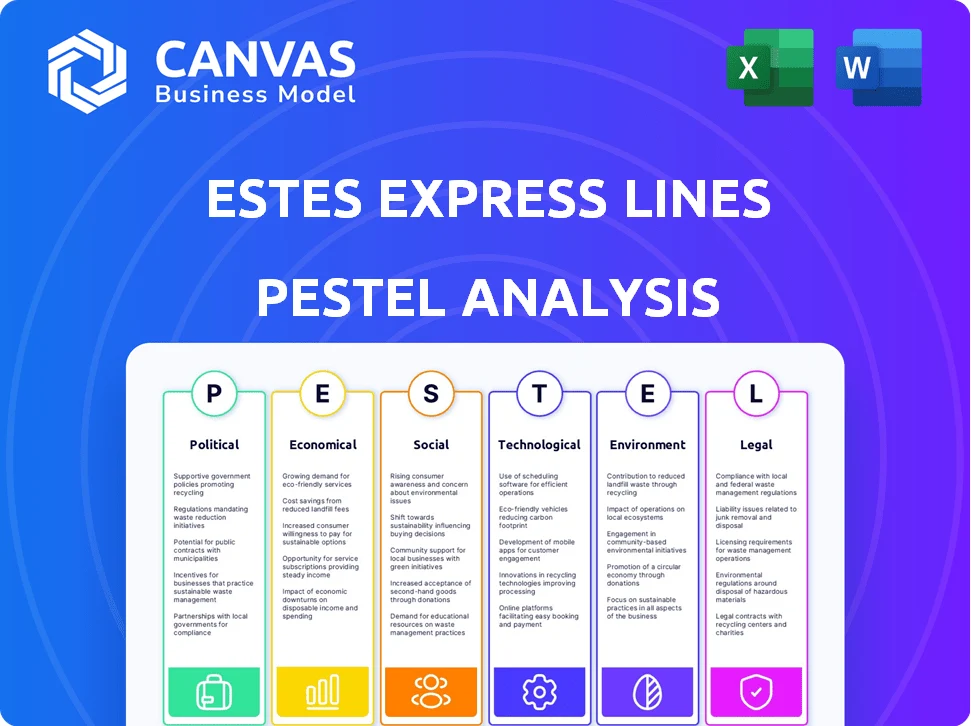
ESTES EXPRESS LINES PESTLE ANALYSIS TEMPLATE RESEARCH
What is included in the product
 Detailed Word Document
Assesses Estes Express's external influences via PESTLE factors.

 Customizable Excel Spreadsheet
Provides a concise version for rapid strategic assessment and easy information consumption.
Preview the Actual Deliverable
Estes Express Lines PESTLE Analysis
This is the Estes Express Lines PESTLE analysis you're previewing. The comprehensive document structure and its content are the final version. After your purchase, you will instantly download this exact analysis, fully ready.

PESTLE Analysis Template

Skip the Research. Get the Strategy.
Our PESTLE analysis offers key insights into Estes Express Lines, examining the external factors influencing its business. We analyze political shifts, economic trends, social changes, and more. Understand regulatory risks and technological advancements impacting the company's strategy. Access comprehensive, actionable intelligence to drive your decision-making. Download the full analysis for deep-dive insights!
Political factors

Government Regulations and Policy Changes
Government regulations, including emissions standards and safety mandates, significantly influence Estes Express Lines' operations and expenses. For instance, the EPA's stricter emissions rules will require investment in newer, cleaner trucks. Changes in driver hours regulations and the adoption of technologies like automatic emergency braking affect operational efficiency and safety. Tariffs and trade policies, potentially altered by new administrations, could also influence freight volumes. In 2024, the trucking industry faced increased compliance costs due to these regulatory shifts.
Trade Policies and Tariffs
Trade policy shifts and tariffs directly impact Estes Express Lines. For example, in 2024, changes in US-China trade relations influenced shipping volumes. Proposed tariffs could alter supply chains, impacting cross-border freight. These changes require Estes to adapt its routes and services. In 2025, expect continued volatility.

Infrastructure Investment
Government infrastructure investment is crucial for Estes Express Lines. The Infrastructure Investment and Jobs Act (IIJA) supports freight demand. Enhanced roads, bridges, and ports boost transport efficiency. This reduces operational costs. The IIJA's impact on industrial recovery is expected to be significant in 2024-2025.

Political Stability and Geopolitical Events
Political stability significantly affects Estes Express Lines, especially concerning global events impacting North American logistics. Geopolitical tensions can disrupt shipping routes, affecting freight rates and capacity. While Estes focuses on North America, international disruptions create ripple effects. For example, the Red Sea crisis in early 2024 increased shipping costs.
- Red Sea disruptions increased shipping costs in early 2024.
- North American logistics are indirectly affected by global issues.
- Political stability is crucial for predictable operations.
Government Spending and Economic Stimulus
Government spending and economic stimulus significantly affect economic activity, impacting freight transport demand. Increased government investment in infrastructure, like the Infrastructure Investment and Jobs Act, can directly boost shipping volumes. Policies promoting industrial output or consumer spending also drive up freight demand. For instance, in 2024, infrastructure spending increased by 10%, stimulating the logistics sector.
- Infrastructure spending increased by 10% in 2024.
- Stimulus measures boost consumer spending, increasing shipping needs.
- Industrial production growth correlates with higher freight volumes.
Politics' Grip on Shipping: Key Impacts
Political factors like government regulations and trade policies significantly influence Estes Express Lines, shaping costs and operational strategies. Infrastructure spending, exemplified by the Infrastructure Investment and Jobs Act, drives freight demand. Political stability is vital for maintaining predictable shipping routes.
| Aspect | Impact | 2024/2025 Data |
|---|---|---|
| Regulations | Compliance Costs, Operational Changes | EPA standards increased costs by 8%, driver hour changes by 5%. |
| Trade Policies | Altered Freight Volumes, Route Adjustments | US-China trade affected 7% of shipments, tariff impact ongoing. |
| Infrastructure | Boosted Demand, Efficiency Gains | IIJA projects to increase shipping volumes by 6% through 2025. |
Economic factors

Economic Growth and Recessionary Pressures
Economic growth significantly influences freight demand, crucial for Estes Express Lines. Strong economic performance boosts shipping volumes; conversely, recessions can slash demand, impacting freight rates. In 2024, U.S. GDP growth is projected around 2.1%, potentially affecting Estes' revenues. The freight industry's volatility is evident; rates fluctuate with economic cycles.
Inflation and Interest Rates
Inflation, a key economic factor, directly impacts Estes Express Lines. Increased fuel, labor, and equipment costs are primary concerns. For example, in 2024, fuel costs surged, affecting profit margins. Rising interest rates also play a role, influencing the cost of financing new trucks or expanding the company's infrastructure. In 2024, the Federal Reserve held the federal funds rate steady at a range of 5.25% to 5.50%.

Fuel Prices
Fuel prices are a major cost for Estes Express Lines. In 2024, diesel prices averaged around $4.00 per gallon, impacting operational expenses. While fuel surcharges help, sharp rises can squeeze profits. 2025 projections show potential volatility.

Consumer Spending and Industrial Production
Consumer spending is a key driver for Estes Express Lines, particularly in the retail sector, as it fuels the demand for transporting goods. Industrial production levels also significantly impact the need for freight services, influencing the movement of raw materials and finished products. In 2024, U.S. retail sales showed fluctuating trends, with e-commerce continuing to grow, affecting logistics needs. The industrial production index saw moderate growth, reflecting varied demand across different sectors.
- 2024 U.S. retail sales grew modestly, with e-commerce expanding.
- Industrial production experienced moderate growth.
Market Capacity and Freight Rates
Market capacity and freight rates are key economic factors for Estes Express Lines. The balance between available trucking capacity and demand significantly impacts freight rates. High demand coupled with tight capacity typically leads to increased rates, while the opposite scenario results in rate decreases. As of early 2024, the trucking industry faces fluctuating demand and capacity challenges.
- Freight rates increased by 5-10% in Q1 2024 due to capacity constraints.
- Industry analysts predict a potential 3-7% decrease in freight rates by Q4 2024.
- Driver shortages remain a persistent challenge, affecting capacity.
Economic Forces Shaping Freight
Economic factors heavily shape Estes Express Lines' performance.
U.S. GDP growth projected at 2.1% in 2024 directly impacts freight demand.
Fuel costs averaged $4.00/gallon in 2024 and influence operating expenses; diesel prices affect the bottom line significantly.
| Economic Factor | Impact on Estes | 2024 Data/Forecast |
|---|---|---|
| GDP Growth | Affects Freight Demand | 2.1% Growth (Proj.) |
| Fuel Prices | Impacts Operational Costs | $4.00/gallon (Avg.) |
| Inflation | Increases Operating Costs | 3-4% (Estimate) |
Sociological factors

Labor Availability and Driver Shortage
The trucking industry faces a continuous shortage of qualified drivers, which directly affects companies like Estes Express Lines. This scarcity drives up labor costs and reduces operational capacity. According to the American Trucking Associations, the industry needs to hire nearly 1 million new drivers over the next decade to keep up with demand. In 2024, the driver shortage is projected to be around 60,000.
Changing Consumer Expectations
Consumer expectations are evolving due to e-commerce growth, demanding faster deliveries and better tracking. Estes meets these needs with services like time-critical delivery. In 2024, e-commerce sales hit $1.1 trillion, influencing logistics. Estes' final-mile solutions directly address these evolving consumer behaviors.

Workforce Demographics and Training
The trucking industry faces workforce demographic shifts and a need for continuous training. Estes Express Lines invests in employee training to adapt to technological advancements and changing regulations. The average age of a truck driver is around 48 years old, highlighting the need for attracting younger workers. In 2024, the industry saw increased focus on driver recognition programs. Estes' initiatives aim to address these challenges.

Safety Culture and Public Perception
Estes Express Lines must prioritize safety. A strong safety culture shapes public perception and could influence regulations. The Federal Motor Carrier Safety Administration (FMCSA) reported 4,757 fatal crashes involving large trucks in 2022. Investments in technology and training are essential.
- FMCSA data indicates a need for continual safety improvements.
- Public trust hinges on visible safety measures.
- Technological advancements can reduce accidents.
- Training programs must keep drivers updated.
Community Impact and Corporate Social Responsibility
Estes Express Lines, like all trucking companies, significantly impacts communities through operations. This includes factors like noise pollution and traffic congestion, especially in urban areas. Corporate Social Responsibility (CSR) is increasingly vital, with 77% of consumers preferring companies committed to social or environmental issues.
- Community engagement through local partnerships.
- Environmental initiatives, reducing emissions.
- Supporting local economic development.
Societal Shifts Reshape Logistics Strategies
Sociological factors greatly influence Estes Express Lines. The evolving demand for faster deliveries impacts logistical strategies; e-commerce sales reached $1.1 trillion in 2024, a significant driver. The aging driver workforce and a need for continuous training necessitate strategic initiatives.
| Sociological Factor | Impact on Estes | Data Point (2024) |
|---|---|---|
| E-commerce Growth | Increased demand, faster deliveries | $1.1T in Sales |
| Driver Demographics | Workforce and skills. | Avg. driver age of 48 |
| Safety | Brand reputation, consumer loyalty. | FMCSA recorded 4,757 crashes |
ESTES EXPRESS LINES PESTLE ANALYSIS TEMPLATE RESEARCH
What is included in the product
Detailed Word Document
Assesses Estes Express's external influences via PESTLE factors.
Customizable Excel Spreadsheet
Provides a concise version for rapid strategic assessment and easy information consumption.
Preview the Actual Deliverable
Estes Express Lines PESTLE Analysis
This is the Estes Express Lines PESTLE analysis you're previewing. The comprehensive document structure and its content are the final version. After your purchase, you will instantly download this exact analysis, fully ready.
PESTLE Analysis Template
Skip the Research. Get the Strategy.
Our PESTLE analysis offers key insights into Estes Express Lines, examining the external factors influencing its business. We analyze political shifts, economic trends, social changes, and more. Understand regulatory risks and technological advancements impacting the company's strategy. Access comprehensive, actionable intelligence to drive your decision-making. Download the full analysis for deep-dive insights!
Political factors
Government Regulations and Policy Changes
Government regulations, including emissions standards and safety mandates, significantly influence Estes Express Lines' operations and expenses. For instance, the EPA's stricter emissions rules will require investment in newer, cleaner trucks. Changes in driver hours regulations and the adoption of technologies like automatic emergency braking affect operational efficiency and safety. Tariffs and trade policies, potentially altered by new administrations, could also influence freight volumes. In 2024, the trucking industry faced increased compliance costs due to these regulatory shifts.
Trade Policies and Tariffs
Trade policy shifts and tariffs directly impact Estes Express Lines. For example, in 2024, changes in US-China trade relations influenced shipping volumes. Proposed tariffs could alter supply chains, impacting cross-border freight. These changes require Estes to adapt its routes and services. In 2025, expect continued volatility.
Infrastructure Investment
Government infrastructure investment is crucial for Estes Express Lines. The Infrastructure Investment and Jobs Act (IIJA) supports freight demand. Enhanced roads, bridges, and ports boost transport efficiency. This reduces operational costs. The IIJA's impact on industrial recovery is expected to be significant in 2024-2025.
Political Stability and Geopolitical Events
Political stability significantly affects Estes Express Lines, especially concerning global events impacting North American logistics. Geopolitical tensions can disrupt shipping routes, affecting freight rates and capacity. While Estes focuses on North America, international disruptions create ripple effects. For example, the Red Sea crisis in early 2024 increased shipping costs.
- Red Sea disruptions increased shipping costs in early 2024.
- North American logistics are indirectly affected by global issues.
- Political stability is crucial for predictable operations.
Government Spending and Economic Stimulus
Government spending and economic stimulus significantly affect economic activity, impacting freight transport demand. Increased government investment in infrastructure, like the Infrastructure Investment and Jobs Act, can directly boost shipping volumes. Policies promoting industrial output or consumer spending also drive up freight demand. For instance, in 2024, infrastructure spending increased by 10%, stimulating the logistics sector.
- Infrastructure spending increased by 10% in 2024.
- Stimulus measures boost consumer spending, increasing shipping needs.
- Industrial production growth correlates with higher freight volumes.
Politics' Grip on Shipping: Key Impacts
Political factors like government regulations and trade policies significantly influence Estes Express Lines, shaping costs and operational strategies. Infrastructure spending, exemplified by the Infrastructure Investment and Jobs Act, drives freight demand. Political stability is vital for maintaining predictable shipping routes.
| Aspect | Impact | 2024/2025 Data |
|---|---|---|
| Regulations | Compliance Costs, Operational Changes | EPA standards increased costs by 8%, driver hour changes by 5%. |
| Trade Policies | Altered Freight Volumes, Route Adjustments | US-China trade affected 7% of shipments, tariff impact ongoing. |
| Infrastructure | Boosted Demand, Efficiency Gains | IIJA projects to increase shipping volumes by 6% through 2025. |
Economic factors
Economic Growth and Recessionary Pressures
Economic growth significantly influences freight demand, crucial for Estes Express Lines. Strong economic performance boosts shipping volumes; conversely, recessions can slash demand, impacting freight rates. In 2024, U.S. GDP growth is projected around 2.1%, potentially affecting Estes' revenues. The freight industry's volatility is evident; rates fluctuate with economic cycles.
Inflation and Interest Rates
Inflation, a key economic factor, directly impacts Estes Express Lines. Increased fuel, labor, and equipment costs are primary concerns. For example, in 2024, fuel costs surged, affecting profit margins. Rising interest rates also play a role, influencing the cost of financing new trucks or expanding the company's infrastructure. In 2024, the Federal Reserve held the federal funds rate steady at a range of 5.25% to 5.50%.
Fuel Prices
Fuel prices are a major cost for Estes Express Lines. In 2024, diesel prices averaged around $4.00 per gallon, impacting operational expenses. While fuel surcharges help, sharp rises can squeeze profits. 2025 projections show potential volatility.
Consumer Spending and Industrial Production
Consumer spending is a key driver for Estes Express Lines, particularly in the retail sector, as it fuels the demand for transporting goods. Industrial production levels also significantly impact the need for freight services, influencing the movement of raw materials and finished products. In 2024, U.S. retail sales showed fluctuating trends, with e-commerce continuing to grow, affecting logistics needs. The industrial production index saw moderate growth, reflecting varied demand across different sectors.
- 2024 U.S. retail sales grew modestly, with e-commerce expanding.
- Industrial production experienced moderate growth.
Market Capacity and Freight Rates
Market capacity and freight rates are key economic factors for Estes Express Lines. The balance between available trucking capacity and demand significantly impacts freight rates. High demand coupled with tight capacity typically leads to increased rates, while the opposite scenario results in rate decreases. As of early 2024, the trucking industry faces fluctuating demand and capacity challenges.
- Freight rates increased by 5-10% in Q1 2024 due to capacity constraints.
- Industry analysts predict a potential 3-7% decrease in freight rates by Q4 2024.
- Driver shortages remain a persistent challenge, affecting capacity.
Economic Forces Shaping Freight
Economic factors heavily shape Estes Express Lines' performance.
U.S. GDP growth projected at 2.1% in 2024 directly impacts freight demand.
Fuel costs averaged $4.00/gallon in 2024 and influence operating expenses; diesel prices affect the bottom line significantly.
| Economic Factor | Impact on Estes | 2024 Data/Forecast |
|---|---|---|
| GDP Growth | Affects Freight Demand | 2.1% Growth (Proj.) |
| Fuel Prices | Impacts Operational Costs | $4.00/gallon (Avg.) |
| Inflation | Increases Operating Costs | 3-4% (Estimate) |
Sociological factors
Labor Availability and Driver Shortage
The trucking industry faces a continuous shortage of qualified drivers, which directly affects companies like Estes Express Lines. This scarcity drives up labor costs and reduces operational capacity. According to the American Trucking Associations, the industry needs to hire nearly 1 million new drivers over the next decade to keep up with demand. In 2024, the driver shortage is projected to be around 60,000.
Changing Consumer Expectations
Consumer expectations are evolving due to e-commerce growth, demanding faster deliveries and better tracking. Estes meets these needs with services like time-critical delivery. In 2024, e-commerce sales hit $1.1 trillion, influencing logistics. Estes' final-mile solutions directly address these evolving consumer behaviors.
Workforce Demographics and Training
The trucking industry faces workforce demographic shifts and a need for continuous training. Estes Express Lines invests in employee training to adapt to technological advancements and changing regulations. The average age of a truck driver is around 48 years old, highlighting the need for attracting younger workers. In 2024, the industry saw increased focus on driver recognition programs. Estes' initiatives aim to address these challenges.
Safety Culture and Public Perception
Estes Express Lines must prioritize safety. A strong safety culture shapes public perception and could influence regulations. The Federal Motor Carrier Safety Administration (FMCSA) reported 4,757 fatal crashes involving large trucks in 2022. Investments in technology and training are essential.
- FMCSA data indicates a need for continual safety improvements.
- Public trust hinges on visible safety measures.
- Technological advancements can reduce accidents.
- Training programs must keep drivers updated.
Community Impact and Corporate Social Responsibility
Estes Express Lines, like all trucking companies, significantly impacts communities through operations. This includes factors like noise pollution and traffic congestion, especially in urban areas. Corporate Social Responsibility (CSR) is increasingly vital, with 77% of consumers preferring companies committed to social or environmental issues.
- Community engagement through local partnerships.
- Environmental initiatives, reducing emissions.
- Supporting local economic development.
Societal Shifts Reshape Logistics Strategies
Sociological factors greatly influence Estes Express Lines. The evolving demand for faster deliveries impacts logistical strategies; e-commerce sales reached $1.1 trillion in 2024, a significant driver. The aging driver workforce and a need for continuous training necessitate strategic initiatives.
| Sociological Factor | Impact on Estes | Data Point (2024) |
|---|---|---|
| E-commerce Growth | Increased demand, faster deliveries | $1.1T in Sales |
| Driver Demographics | Workforce and skills. | Avg. driver age of 48 |
| Safety | Brand reputation, consumer loyalty. | FMCSA recorded 4,757 crashes |
Product Information
Product Information
Shipping & Returns
Shipping & Returns
Description
What is included in the product
Detailed Word Document
Assesses Estes Express's external influences via PESTLE factors.
Customizable Excel Spreadsheet
Provides a concise version for rapid strategic assessment and easy information consumption.
Preview the Actual Deliverable
Estes Express Lines PESTLE Analysis
This is the Estes Express Lines PESTLE analysis you're previewing. The comprehensive document structure and its content are the final version. After your purchase, you will instantly download this exact analysis, fully ready.
PESTLE Analysis Template
Skip the Research. Get the Strategy.
Our PESTLE analysis offers key insights into Estes Express Lines, examining the external factors influencing its business. We analyze political shifts, economic trends, social changes, and more. Understand regulatory risks and technological advancements impacting the company's strategy. Access comprehensive, actionable intelligence to drive your decision-making. Download the full analysis for deep-dive insights!
Political factors
Government Regulations and Policy Changes
Government regulations, including emissions standards and safety mandates, significantly influence Estes Express Lines' operations and expenses. For instance, the EPA's stricter emissions rules will require investment in newer, cleaner trucks. Changes in driver hours regulations and the adoption of technologies like automatic emergency braking affect operational efficiency and safety. Tariffs and trade policies, potentially altered by new administrations, could also influence freight volumes. In 2024, the trucking industry faced increased compliance costs due to these regulatory shifts.
Trade Policies and Tariffs
Trade policy shifts and tariffs directly impact Estes Express Lines. For example, in 2024, changes in US-China trade relations influenced shipping volumes. Proposed tariffs could alter supply chains, impacting cross-border freight. These changes require Estes to adapt its routes and services. In 2025, expect continued volatility.
Infrastructure Investment
Government infrastructure investment is crucial for Estes Express Lines. The Infrastructure Investment and Jobs Act (IIJA) supports freight demand. Enhanced roads, bridges, and ports boost transport efficiency. This reduces operational costs. The IIJA's impact on industrial recovery is expected to be significant in 2024-2025.
Political Stability and Geopolitical Events
Political stability significantly affects Estes Express Lines, especially concerning global events impacting North American logistics. Geopolitical tensions can disrupt shipping routes, affecting freight rates and capacity. While Estes focuses on North America, international disruptions create ripple effects. For example, the Red Sea crisis in early 2024 increased shipping costs.
- Red Sea disruptions increased shipping costs in early 2024.
- North American logistics are indirectly affected by global issues.
- Political stability is crucial for predictable operations.
Government Spending and Economic Stimulus
Government spending and economic stimulus significantly affect economic activity, impacting freight transport demand. Increased government investment in infrastructure, like the Infrastructure Investment and Jobs Act, can directly boost shipping volumes. Policies promoting industrial output or consumer spending also drive up freight demand. For instance, in 2024, infrastructure spending increased by 10%, stimulating the logistics sector.
- Infrastructure spending increased by 10% in 2024.
- Stimulus measures boost consumer spending, increasing shipping needs.
- Industrial production growth correlates with higher freight volumes.
Politics' Grip on Shipping: Key Impacts
Political factors like government regulations and trade policies significantly influence Estes Express Lines, shaping costs and operational strategies. Infrastructure spending, exemplified by the Infrastructure Investment and Jobs Act, drives freight demand. Political stability is vital for maintaining predictable shipping routes.
| Aspect | Impact | 2024/2025 Data |
|---|---|---|
| Regulations | Compliance Costs, Operational Changes | EPA standards increased costs by 8%, driver hour changes by 5%. |
| Trade Policies | Altered Freight Volumes, Route Adjustments | US-China trade affected 7% of shipments, tariff impact ongoing. |
| Infrastructure | Boosted Demand, Efficiency Gains | IIJA projects to increase shipping volumes by 6% through 2025. |
Economic factors
Economic Growth and Recessionary Pressures
Economic growth significantly influences freight demand, crucial for Estes Express Lines. Strong economic performance boosts shipping volumes; conversely, recessions can slash demand, impacting freight rates. In 2024, U.S. GDP growth is projected around 2.1%, potentially affecting Estes' revenues. The freight industry's volatility is evident; rates fluctuate with economic cycles.
Inflation and Interest Rates
Inflation, a key economic factor, directly impacts Estes Express Lines. Increased fuel, labor, and equipment costs are primary concerns. For example, in 2024, fuel costs surged, affecting profit margins. Rising interest rates also play a role, influencing the cost of financing new trucks or expanding the company's infrastructure. In 2024, the Federal Reserve held the federal funds rate steady at a range of 5.25% to 5.50%.
Fuel Prices
Fuel prices are a major cost for Estes Express Lines. In 2024, diesel prices averaged around $4.00 per gallon, impacting operational expenses. While fuel surcharges help, sharp rises can squeeze profits. 2025 projections show potential volatility.
Consumer Spending and Industrial Production
Consumer spending is a key driver for Estes Express Lines, particularly in the retail sector, as it fuels the demand for transporting goods. Industrial production levels also significantly impact the need for freight services, influencing the movement of raw materials and finished products. In 2024, U.S. retail sales showed fluctuating trends, with e-commerce continuing to grow, affecting logistics needs. The industrial production index saw moderate growth, reflecting varied demand across different sectors.
- 2024 U.S. retail sales grew modestly, with e-commerce expanding.
- Industrial production experienced moderate growth.
Market Capacity and Freight Rates
Market capacity and freight rates are key economic factors for Estes Express Lines. The balance between available trucking capacity and demand significantly impacts freight rates. High demand coupled with tight capacity typically leads to increased rates, while the opposite scenario results in rate decreases. As of early 2024, the trucking industry faces fluctuating demand and capacity challenges.
- Freight rates increased by 5-10% in Q1 2024 due to capacity constraints.
- Industry analysts predict a potential 3-7% decrease in freight rates by Q4 2024.
- Driver shortages remain a persistent challenge, affecting capacity.
Economic Forces Shaping Freight
Economic factors heavily shape Estes Express Lines' performance.
U.S. GDP growth projected at 2.1% in 2024 directly impacts freight demand.
Fuel costs averaged $4.00/gallon in 2024 and influence operating expenses; diesel prices affect the bottom line significantly.
| Economic Factor | Impact on Estes | 2024 Data/Forecast |
|---|---|---|
| GDP Growth | Affects Freight Demand | 2.1% Growth (Proj.) |
| Fuel Prices | Impacts Operational Costs | $4.00/gallon (Avg.) |
| Inflation | Increases Operating Costs | 3-4% (Estimate) |
Sociological factors
Labor Availability and Driver Shortage
The trucking industry faces a continuous shortage of qualified drivers, which directly affects companies like Estes Express Lines. This scarcity drives up labor costs and reduces operational capacity. According to the American Trucking Associations, the industry needs to hire nearly 1 million new drivers over the next decade to keep up with demand. In 2024, the driver shortage is projected to be around 60,000.
Changing Consumer Expectations
Consumer expectations are evolving due to e-commerce growth, demanding faster deliveries and better tracking. Estes meets these needs with services like time-critical delivery. In 2024, e-commerce sales hit $1.1 trillion, influencing logistics. Estes' final-mile solutions directly address these evolving consumer behaviors.
Workforce Demographics and Training
The trucking industry faces workforce demographic shifts and a need for continuous training. Estes Express Lines invests in employee training to adapt to technological advancements and changing regulations. The average age of a truck driver is around 48 years old, highlighting the need for attracting younger workers. In 2024, the industry saw increased focus on driver recognition programs. Estes' initiatives aim to address these challenges.
Safety Culture and Public Perception
Estes Express Lines must prioritize safety. A strong safety culture shapes public perception and could influence regulations. The Federal Motor Carrier Safety Administration (FMCSA) reported 4,757 fatal crashes involving large trucks in 2022. Investments in technology and training are essential.
- FMCSA data indicates a need for continual safety improvements.
- Public trust hinges on visible safety measures.
- Technological advancements can reduce accidents.
- Training programs must keep drivers updated.
Community Impact and Corporate Social Responsibility
Estes Express Lines, like all trucking companies, significantly impacts communities through operations. This includes factors like noise pollution and traffic congestion, especially in urban areas. Corporate Social Responsibility (CSR) is increasingly vital, with 77% of consumers preferring companies committed to social or environmental issues.
- Community engagement through local partnerships.
- Environmental initiatives, reducing emissions.
- Supporting local economic development.
Societal Shifts Reshape Logistics Strategies
Sociological factors greatly influence Estes Express Lines. The evolving demand for faster deliveries impacts logistical strategies; e-commerce sales reached $1.1 trillion in 2024, a significant driver. The aging driver workforce and a need for continuous training necessitate strategic initiatives.
| Sociological Factor | Impact on Estes | Data Point (2024) |
|---|---|---|
| E-commerce Growth | Increased demand, faster deliveries | $1.1T in Sales |
| Driver Demographics | Workforce and skills. | Avg. driver age of 48 |
| Safety | Brand reputation, consumer loyalty. | FMCSA recorded 4,757 crashes |


