ENVISION HEALTHCARE PESTLE ANALYSIS TEMPLATE RESEARCH
What is included in the product
 Detailed Word Document
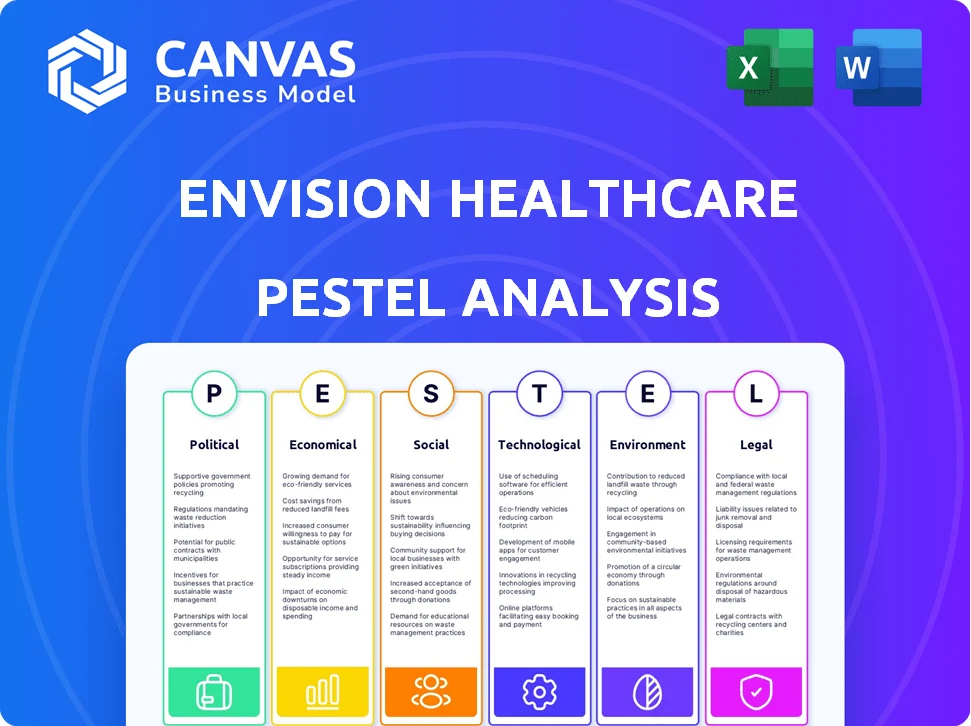
Examines external forces impacting Envision across Politics, Economy, Society, Technology, Environment, and Law.

 Customizable Excel Spreadsheet
Helps support discussions on external risk and market positioning during planning sessions.
Preview the Actual Deliverable
Envision Healthcare PESTLE Analysis
What you’re previewing here is the actual file—fully formatted and professionally structured. This is a complete Envision Healthcare PESTLE analysis, ready to inform your decisions. You'll gain valuable insights immediately after purchase. There are no revisions necessary!

PESTLE Analysis Template

Your Shortcut to Market Insight Starts Here
Uncover crucial external factors shaping Envision Healthcare. This PESTLE Analysis provides a deep dive into political, economic, social, technological, legal, and environmental influences. Learn how industry trends impact their operations and strategic direction. Perfect for informed decision-making in a dynamic market. Enhance your strategic planning and competitive analysis by downloading the full PESTLE analysis now!
Political factors

Government Healthcare Policies and Reform
Government healthcare policies, like the Affordable Care Act and No Surprises Act, reshape healthcare economics. The No Surprises Act, protecting patients from surprise bills, altered Envision's revenue. In 2024, anticipate continued policy adjustments influencing reimbursement and operational strategies. The Centers for Medicare & Medicaid Services (CMS) proposed rule changes in late 2024.
Regulatory Compliance and Scrutiny
Envision Healthcare navigates a complex regulatory landscape, subject to federal and state laws like HIPAA. It has faced scrutiny over billing, and compliance with regulations is crucial for its operations. Recent legal challenges highlight the ongoing need for rigorous adherence to healthcare laws. In 2024, healthcare companies faced increased regulatory enforcement, with fines exceeding billions of dollars. This includes cases of fraudulent billing.

Political Advocacy and Lobbying
Healthcare companies, like Envision Healthcare, actively engage in political advocacy and lobbying. They aim to shape policies affecting their business, including reimbursement rates. Envision has a PAC. In 2024, healthcare lobbying spending totaled over $700 million.

Government Reimbursement Rates
Government reimbursement rates are crucial for Envision Healthcare, as a large portion of its revenue comes from government programs. Fluctuations in Medicare and Medicaid payments directly affect the company's profitability. For instance, in 2024, changes in Medicare Advantage reimbursement rates have been a key concern. These adjustments can significantly impact Envision's financial results.
- In 2024, Medicare Advantage payments are under scrutiny.
- Medicaid reimbursement rates vary by state.
- Changes in rates can impact service profitability.
- Envision closely monitors regulatory updates.
State-Level Regulations and Corporate Practice of Medicine
State-level regulations on the corporate practice of medicine significantly impact healthcare companies like Envision Healthcare. These regulations vary widely, affecting how Envision can structure its relationships with physicians and medical groups across different states. Legal challenges to these arrangements can introduce operational and financial risks. For example, a 2024 study showed that approximately 30% of states have strict laws against the corporate practice of medicine.
- Regulatory Differences: State-specific laws on corporate practice of medicine.
- Legal Risks: Lawsuits against corporate structures in healthcare.
- Operational Challenges: Adapting to varied state requirements.
Healthcare Dynamics: Policy, Regulations, and Financials
Envision Healthcare faces constant shifts in healthcare policy and faces intense regulations, including laws like the Affordable Care Act, that directly influence its financials. Ongoing regulatory adjustments are impacting its operational strategies. The CMS updates, with changes in reimbursement rates and healthcare compliance enforcement, affect profitability.
| Aspect | Details | Impact for Envision |
|---|---|---|
| Policy Shifts | ACA, No Surprises Act, CMS Proposed rules | Altered revenue and operations. |
| Regulations | HIPAA, Billing scrutiny, fraud cases. | Increased compliance costs. |
| Lobbying | Over $700 million spent in 2024 | Influences healthcare policies. |
Economic factors

Healthcare Spending and Economic Conditions
Overall economic conditions significantly impact healthcare spending. For example, the U.S. inflation rate was 3.2% in February 2024, influencing healthcare costs. High unemployment, like the 3.9% rate in February 2024, can reduce patient access to care. Rising labor costs are a challenge, with healthcare wages up 4.2% year-over-year in early 2024, affecting Envision's operating expenses.
Reimbursement Rates and Payer Mix
Negotiating reimbursement rates with payers is a key economic factor for Envision. Disputes with insurers, like UnitedHealthcare, have previously hit revenue hard. In 2023, Envision faced challenges with reimbursement rates, impacting profitability. The payer mix, with a higher proportion of government versus commercial payers, affects revenue.

Healthcare Staffing Costs and Shortages
Envision Healthcare, like others, grapples with rising healthcare staffing costs. Clinician shortages drive up labor expenses, squeezing profitability. The U.S. is projected to face a shortage of 37,800 to 124,000 physicians by 2034. Labor costs account for a significant portion of healthcare spending. These increases can negatively impact the company's financial performance.

Ambulatory Surgery Center Market Trends
Envision Healthcare's ASC management is influenced by economic trends. Demand for cost-effective outpatient procedures is rising. Technological advancements in ASCs also play a key role. The ASC market is projected to reach $87.8 billion by 2024, growing to $105.7 billion by 2028.
- Market growth: The ASC market is experiencing significant expansion.
- Cost-effectiveness: ASCs offer more affordable care compared to hospitals.
- Technological advancements: New technologies are improving ASC capabilities.
Debt Levels and Financial Restructuring
Envision Healthcare's recent financial challenges, including a Chapter 11 bankruptcy filing in 2023, highlight the impact of high debt levels. The company's ability to restructure debt and secure new financing is key to its operational viability. Economic conditions, such as interest rate fluctuations, directly affect Envision's debt servicing costs and access to capital markets. Managing debt and financial restructuring are crucial for its long-term success. In 2024, healthcare debt restructuring is projected to continue.
- Chapter 11 bankruptcy filing in 2023 due to debt.
- Interest rate fluctuations impact debt servicing costs.
- Healthcare debt restructuring is projected to continue in 2024.
Economic Forces Shaping Healthcare's Future
Economic factors are vital for Envision Healthcare's performance. Inflation, at 3.2% in February 2024, influences costs. Reimbursement rates, especially with major payers, directly impact revenue. Debt management and restructuring remain key given the 2023 bankruptcy.
| Economic Factor | Impact on Envision | Data Point (2024) |
|---|---|---|
| Inflation | Increases operational costs | 3.2% (February) |
| Reimbursement Rates | Affects revenue and profitability | Negotiations with payers ongoing |
| Debt & Restructuring | Influences financial stability | Healthcare debt restructuring projected in 2024 |
Sociological factors

Changing Demographics and Healthcare Needs
The U.S. population is aging; by 2030, those 65+ will be 21% of the population. Chronic diseases like diabetes and heart disease are increasing, impacting healthcare demand. This demographic shift drives the need for emergency and specialized medical services. The healthcare sector's value is projected to reach $7.2 trillion by 2025.
Patient Expectations and Consumerism
Patient expectations are shifting, with consumers demanding better healthcare experiences. This consumer-driven approach influences service delivery and patient engagement strategies. In 2024, patient satisfaction scores significantly impact healthcare provider ratings. Around 75% of patients now research providers online before choosing one. Envision needs to adapt to meet these evolving demands.

Health Equity and Social Determinants of Health
The healthcare sector increasingly emphasizes health equity, recognizing SDOH's influence on outcomes. Envision Healthcare addresses SDOH, aiming to improve access and quality. For instance, in 2024, initiatives focused on underserved communities saw a 15% rise in patient satisfaction. This shift reflects a commitment to equitable care.

Healthcare Workforce and Labor Relations
The social context of the healthcare workforce significantly impacts Envision Healthcare. Clinician well-being, labor union representation, and staffing models directly affect Envision's operations and provider relationships. The healthcare industry faces challenges like burnout and shortages, potentially increasing operational costs. Unionization efforts and evolving staffing models require strategic adaptation.
- 2024: Healthcare worker shortages continue, with projected needs in various specialties.
- 2024: Labor union activities and negotiations are increasing in the healthcare sector.
- 2024: Focus on clinician well-being and mental health programs is expanding.
Public Perception and Trust
Public opinion significantly shapes patient decisions and regulatory actions towards healthcare providers like Envision Healthcare. Negative publicity, stemming from past billing controversies, can erode trust and affect the company's reputation. In 2024, approximately 68% of Americans expressed concerns about healthcare costs, potentially amplifying scrutiny. Public perception directly impacts market share and the ability to secure favorable contracts.
- 2024: 68% of Americans concerned about healthcare costs.
- Negative billing practices erode public trust.
- Public perception influences patient choice.
- Regulatory scrutiny can increase due to negative publicity.
Healthcare's Societal Shifts: Key Factors and Impacts
Sociological factors include aging populations driving healthcare demand. Changing patient expectations and a focus on health equity reshape service delivery. Workforce dynamics, clinician well-being, and public opinion significantly impact healthcare providers.
| Factor | Impact | Data |
|---|---|---|
| Aging Population | Increased demand for emergency services | By 2030, 21% of U.S. population aged 65+ |
| Patient Expectations | Influences service delivery and engagement | 75% of patients research providers online (2024) |
| Health Equity | Improved access, quality for underserved | 15% rise in patient satisfaction (2024, specific initiatives) |
Original: $10.00
-65%$10.00
$3.50ENVISION HEALTHCARE PESTLE ANALYSIS TEMPLATE RESEARCH
What is included in the product
Detailed Word Document
Examines external forces impacting Envision across Politics, Economy, Society, Technology, Environment, and Law.
Customizable Excel Spreadsheet
Helps support discussions on external risk and market positioning during planning sessions.
Preview the Actual Deliverable
Envision Healthcare PESTLE Analysis
What you’re previewing here is the actual file—fully formatted and professionally structured. This is a complete Envision Healthcare PESTLE analysis, ready to inform your decisions. You'll gain valuable insights immediately after purchase. There are no revisions necessary!
PESTLE Analysis Template
Your Shortcut to Market Insight Starts Here
Uncover crucial external factors shaping Envision Healthcare. This PESTLE Analysis provides a deep dive into political, economic, social, technological, legal, and environmental influences. Learn how industry trends impact their operations and strategic direction. Perfect for informed decision-making in a dynamic market. Enhance your strategic planning and competitive analysis by downloading the full PESTLE analysis now!
Political factors
Government Healthcare Policies and Reform
Government healthcare policies, like the Affordable Care Act and No Surprises Act, reshape healthcare economics. The No Surprises Act, protecting patients from surprise bills, altered Envision's revenue. In 2024, anticipate continued policy adjustments influencing reimbursement and operational strategies. The Centers for Medicare & Medicaid Services (CMS) proposed rule changes in late 2024.
Regulatory Compliance and Scrutiny
Envision Healthcare navigates a complex regulatory landscape, subject to federal and state laws like HIPAA. It has faced scrutiny over billing, and compliance with regulations is crucial for its operations. Recent legal challenges highlight the ongoing need for rigorous adherence to healthcare laws. In 2024, healthcare companies faced increased regulatory enforcement, with fines exceeding billions of dollars. This includes cases of fraudulent billing.
Political Advocacy and Lobbying
Healthcare companies, like Envision Healthcare, actively engage in political advocacy and lobbying. They aim to shape policies affecting their business, including reimbursement rates. Envision has a PAC. In 2024, healthcare lobbying spending totaled over $700 million.
Government Reimbursement Rates
Government reimbursement rates are crucial for Envision Healthcare, as a large portion of its revenue comes from government programs. Fluctuations in Medicare and Medicaid payments directly affect the company's profitability. For instance, in 2024, changes in Medicare Advantage reimbursement rates have been a key concern. These adjustments can significantly impact Envision's financial results.
- In 2024, Medicare Advantage payments are under scrutiny.
- Medicaid reimbursement rates vary by state.
- Changes in rates can impact service profitability.
- Envision closely monitors regulatory updates.
State-Level Regulations and Corporate Practice of Medicine
State-level regulations on the corporate practice of medicine significantly impact healthcare companies like Envision Healthcare. These regulations vary widely, affecting how Envision can structure its relationships with physicians and medical groups across different states. Legal challenges to these arrangements can introduce operational and financial risks. For example, a 2024 study showed that approximately 30% of states have strict laws against the corporate practice of medicine.
- Regulatory Differences: State-specific laws on corporate practice of medicine.
- Legal Risks: Lawsuits against corporate structures in healthcare.
- Operational Challenges: Adapting to varied state requirements.
Healthcare Dynamics: Policy, Regulations, and Financials
Envision Healthcare faces constant shifts in healthcare policy and faces intense regulations, including laws like the Affordable Care Act, that directly influence its financials. Ongoing regulatory adjustments are impacting its operational strategies. The CMS updates, with changes in reimbursement rates and healthcare compliance enforcement, affect profitability.
| Aspect | Details | Impact for Envision |
|---|---|---|
| Policy Shifts | ACA, No Surprises Act, CMS Proposed rules | Altered revenue and operations. |
| Regulations | HIPAA, Billing scrutiny, fraud cases. | Increased compliance costs. |
| Lobbying | Over $700 million spent in 2024 | Influences healthcare policies. |
Economic factors
Healthcare Spending and Economic Conditions
Overall economic conditions significantly impact healthcare spending. For example, the U.S. inflation rate was 3.2% in February 2024, influencing healthcare costs. High unemployment, like the 3.9% rate in February 2024, can reduce patient access to care. Rising labor costs are a challenge, with healthcare wages up 4.2% year-over-year in early 2024, affecting Envision's operating expenses.
Reimbursement Rates and Payer Mix
Negotiating reimbursement rates with payers is a key economic factor for Envision. Disputes with insurers, like UnitedHealthcare, have previously hit revenue hard. In 2023, Envision faced challenges with reimbursement rates, impacting profitability. The payer mix, with a higher proportion of government versus commercial payers, affects revenue.
Healthcare Staffing Costs and Shortages
Envision Healthcare, like others, grapples with rising healthcare staffing costs. Clinician shortages drive up labor expenses, squeezing profitability. The U.S. is projected to face a shortage of 37,800 to 124,000 physicians by 2034. Labor costs account for a significant portion of healthcare spending. These increases can negatively impact the company's financial performance.
Ambulatory Surgery Center Market Trends
Envision Healthcare's ASC management is influenced by economic trends. Demand for cost-effective outpatient procedures is rising. Technological advancements in ASCs also play a key role. The ASC market is projected to reach $87.8 billion by 2024, growing to $105.7 billion by 2028.
- Market growth: The ASC market is experiencing significant expansion.
- Cost-effectiveness: ASCs offer more affordable care compared to hospitals.
- Technological advancements: New technologies are improving ASC capabilities.
Debt Levels and Financial Restructuring
Envision Healthcare's recent financial challenges, including a Chapter 11 bankruptcy filing in 2023, highlight the impact of high debt levels. The company's ability to restructure debt and secure new financing is key to its operational viability. Economic conditions, such as interest rate fluctuations, directly affect Envision's debt servicing costs and access to capital markets. Managing debt and financial restructuring are crucial for its long-term success. In 2024, healthcare debt restructuring is projected to continue.
- Chapter 11 bankruptcy filing in 2023 due to debt.
- Interest rate fluctuations impact debt servicing costs.
- Healthcare debt restructuring is projected to continue in 2024.
Economic Forces Shaping Healthcare's Future
Economic factors are vital for Envision Healthcare's performance. Inflation, at 3.2% in February 2024, influences costs. Reimbursement rates, especially with major payers, directly impact revenue. Debt management and restructuring remain key given the 2023 bankruptcy.
| Economic Factor | Impact on Envision | Data Point (2024) |
|---|---|---|
| Inflation | Increases operational costs | 3.2% (February) |
| Reimbursement Rates | Affects revenue and profitability | Negotiations with payers ongoing |
| Debt & Restructuring | Influences financial stability | Healthcare debt restructuring projected in 2024 |
Sociological factors
Changing Demographics and Healthcare Needs
The U.S. population is aging; by 2030, those 65+ will be 21% of the population. Chronic diseases like diabetes and heart disease are increasing, impacting healthcare demand. This demographic shift drives the need for emergency and specialized medical services. The healthcare sector's value is projected to reach $7.2 trillion by 2025.
Patient Expectations and Consumerism
Patient expectations are shifting, with consumers demanding better healthcare experiences. This consumer-driven approach influences service delivery and patient engagement strategies. In 2024, patient satisfaction scores significantly impact healthcare provider ratings. Around 75% of patients now research providers online before choosing one. Envision needs to adapt to meet these evolving demands.
Health Equity and Social Determinants of Health
The healthcare sector increasingly emphasizes health equity, recognizing SDOH's influence on outcomes. Envision Healthcare addresses SDOH, aiming to improve access and quality. For instance, in 2024, initiatives focused on underserved communities saw a 15% rise in patient satisfaction. This shift reflects a commitment to equitable care.
Healthcare Workforce and Labor Relations
The social context of the healthcare workforce significantly impacts Envision Healthcare. Clinician well-being, labor union representation, and staffing models directly affect Envision's operations and provider relationships. The healthcare industry faces challenges like burnout and shortages, potentially increasing operational costs. Unionization efforts and evolving staffing models require strategic adaptation.
- 2024: Healthcare worker shortages continue, with projected needs in various specialties.
- 2024: Labor union activities and negotiations are increasing in the healthcare sector.
- 2024: Focus on clinician well-being and mental health programs is expanding.
Public Perception and Trust
Public opinion significantly shapes patient decisions and regulatory actions towards healthcare providers like Envision Healthcare. Negative publicity, stemming from past billing controversies, can erode trust and affect the company's reputation. In 2024, approximately 68% of Americans expressed concerns about healthcare costs, potentially amplifying scrutiny. Public perception directly impacts market share and the ability to secure favorable contracts.
- 2024: 68% of Americans concerned about healthcare costs.
- Negative billing practices erode public trust.
- Public perception influences patient choice.
- Regulatory scrutiny can increase due to negative publicity.
Healthcare's Societal Shifts: Key Factors and Impacts
Sociological factors include aging populations driving healthcare demand. Changing patient expectations and a focus on health equity reshape service delivery. Workforce dynamics, clinician well-being, and public opinion significantly impact healthcare providers.
| Factor | Impact | Data |
|---|---|---|
| Aging Population | Increased demand for emergency services | By 2030, 21% of U.S. population aged 65+ |
| Patient Expectations | Influences service delivery and engagement | 75% of patients research providers online (2024) |
| Health Equity | Improved access, quality for underserved | 15% rise in patient satisfaction (2024, specific initiatives) |
Product Information
Product Information
Shipping & Returns
Shipping & Returns
Description
What is included in the product
Detailed Word Document
Examines external forces impacting Envision across Politics, Economy, Society, Technology, Environment, and Law.
Customizable Excel Spreadsheet
Helps support discussions on external risk and market positioning during planning sessions.
Preview the Actual Deliverable
Envision Healthcare PESTLE Analysis
What you’re previewing here is the actual file—fully formatted and professionally structured. This is a complete Envision Healthcare PESTLE analysis, ready to inform your decisions. You'll gain valuable insights immediately after purchase. There are no revisions necessary!
PESTLE Analysis Template
Your Shortcut to Market Insight Starts Here
Uncover crucial external factors shaping Envision Healthcare. This PESTLE Analysis provides a deep dive into political, economic, social, technological, legal, and environmental influences. Learn how industry trends impact their operations and strategic direction. Perfect for informed decision-making in a dynamic market. Enhance your strategic planning and competitive analysis by downloading the full PESTLE analysis now!
Political factors
Government Healthcare Policies and Reform
Government healthcare policies, like the Affordable Care Act and No Surprises Act, reshape healthcare economics. The No Surprises Act, protecting patients from surprise bills, altered Envision's revenue. In 2024, anticipate continued policy adjustments influencing reimbursement and operational strategies. The Centers for Medicare & Medicaid Services (CMS) proposed rule changes in late 2024.
Regulatory Compliance and Scrutiny
Envision Healthcare navigates a complex regulatory landscape, subject to federal and state laws like HIPAA. It has faced scrutiny over billing, and compliance with regulations is crucial for its operations. Recent legal challenges highlight the ongoing need for rigorous adherence to healthcare laws. In 2024, healthcare companies faced increased regulatory enforcement, with fines exceeding billions of dollars. This includes cases of fraudulent billing.
Political Advocacy and Lobbying
Healthcare companies, like Envision Healthcare, actively engage in political advocacy and lobbying. They aim to shape policies affecting their business, including reimbursement rates. Envision has a PAC. In 2024, healthcare lobbying spending totaled over $700 million.
Government Reimbursement Rates
Government reimbursement rates are crucial for Envision Healthcare, as a large portion of its revenue comes from government programs. Fluctuations in Medicare and Medicaid payments directly affect the company's profitability. For instance, in 2024, changes in Medicare Advantage reimbursement rates have been a key concern. These adjustments can significantly impact Envision's financial results.
- In 2024, Medicare Advantage payments are under scrutiny.
- Medicaid reimbursement rates vary by state.
- Changes in rates can impact service profitability.
- Envision closely monitors regulatory updates.
State-Level Regulations and Corporate Practice of Medicine
State-level regulations on the corporate practice of medicine significantly impact healthcare companies like Envision Healthcare. These regulations vary widely, affecting how Envision can structure its relationships with physicians and medical groups across different states. Legal challenges to these arrangements can introduce operational and financial risks. For example, a 2024 study showed that approximately 30% of states have strict laws against the corporate practice of medicine.
- Regulatory Differences: State-specific laws on corporate practice of medicine.
- Legal Risks: Lawsuits against corporate structures in healthcare.
- Operational Challenges: Adapting to varied state requirements.
Healthcare Dynamics: Policy, Regulations, and Financials
Envision Healthcare faces constant shifts in healthcare policy and faces intense regulations, including laws like the Affordable Care Act, that directly influence its financials. Ongoing regulatory adjustments are impacting its operational strategies. The CMS updates, with changes in reimbursement rates and healthcare compliance enforcement, affect profitability.
| Aspect | Details | Impact for Envision |
|---|---|---|
| Policy Shifts | ACA, No Surprises Act, CMS Proposed rules | Altered revenue and operations. |
| Regulations | HIPAA, Billing scrutiny, fraud cases. | Increased compliance costs. |
| Lobbying | Over $700 million spent in 2024 | Influences healthcare policies. |
Economic factors
Healthcare Spending and Economic Conditions
Overall economic conditions significantly impact healthcare spending. For example, the U.S. inflation rate was 3.2% in February 2024, influencing healthcare costs. High unemployment, like the 3.9% rate in February 2024, can reduce patient access to care. Rising labor costs are a challenge, with healthcare wages up 4.2% year-over-year in early 2024, affecting Envision's operating expenses.
Reimbursement Rates and Payer Mix
Negotiating reimbursement rates with payers is a key economic factor for Envision. Disputes with insurers, like UnitedHealthcare, have previously hit revenue hard. In 2023, Envision faced challenges with reimbursement rates, impacting profitability. The payer mix, with a higher proportion of government versus commercial payers, affects revenue.
Healthcare Staffing Costs and Shortages
Envision Healthcare, like others, grapples with rising healthcare staffing costs. Clinician shortages drive up labor expenses, squeezing profitability. The U.S. is projected to face a shortage of 37,800 to 124,000 physicians by 2034. Labor costs account for a significant portion of healthcare spending. These increases can negatively impact the company's financial performance.
Ambulatory Surgery Center Market Trends
Envision Healthcare's ASC management is influenced by economic trends. Demand for cost-effective outpatient procedures is rising. Technological advancements in ASCs also play a key role. The ASC market is projected to reach $87.8 billion by 2024, growing to $105.7 billion by 2028.
- Market growth: The ASC market is experiencing significant expansion.
- Cost-effectiveness: ASCs offer more affordable care compared to hospitals.
- Technological advancements: New technologies are improving ASC capabilities.
Debt Levels and Financial Restructuring
Envision Healthcare's recent financial challenges, including a Chapter 11 bankruptcy filing in 2023, highlight the impact of high debt levels. The company's ability to restructure debt and secure new financing is key to its operational viability. Economic conditions, such as interest rate fluctuations, directly affect Envision's debt servicing costs and access to capital markets. Managing debt and financial restructuring are crucial for its long-term success. In 2024, healthcare debt restructuring is projected to continue.
- Chapter 11 bankruptcy filing in 2023 due to debt.
- Interest rate fluctuations impact debt servicing costs.
- Healthcare debt restructuring is projected to continue in 2024.
Economic Forces Shaping Healthcare's Future
Economic factors are vital for Envision Healthcare's performance. Inflation, at 3.2% in February 2024, influences costs. Reimbursement rates, especially with major payers, directly impact revenue. Debt management and restructuring remain key given the 2023 bankruptcy.
| Economic Factor | Impact on Envision | Data Point (2024) |
|---|---|---|
| Inflation | Increases operational costs | 3.2% (February) |
| Reimbursement Rates | Affects revenue and profitability | Negotiations with payers ongoing |
| Debt & Restructuring | Influences financial stability | Healthcare debt restructuring projected in 2024 |
Sociological factors
Changing Demographics and Healthcare Needs
The U.S. population is aging; by 2030, those 65+ will be 21% of the population. Chronic diseases like diabetes and heart disease are increasing, impacting healthcare demand. This demographic shift drives the need for emergency and specialized medical services. The healthcare sector's value is projected to reach $7.2 trillion by 2025.
Patient Expectations and Consumerism
Patient expectations are shifting, with consumers demanding better healthcare experiences. This consumer-driven approach influences service delivery and patient engagement strategies. In 2024, patient satisfaction scores significantly impact healthcare provider ratings. Around 75% of patients now research providers online before choosing one. Envision needs to adapt to meet these evolving demands.
Health Equity and Social Determinants of Health
The healthcare sector increasingly emphasizes health equity, recognizing SDOH's influence on outcomes. Envision Healthcare addresses SDOH, aiming to improve access and quality. For instance, in 2024, initiatives focused on underserved communities saw a 15% rise in patient satisfaction. This shift reflects a commitment to equitable care.
Healthcare Workforce and Labor Relations
The social context of the healthcare workforce significantly impacts Envision Healthcare. Clinician well-being, labor union representation, and staffing models directly affect Envision's operations and provider relationships. The healthcare industry faces challenges like burnout and shortages, potentially increasing operational costs. Unionization efforts and evolving staffing models require strategic adaptation.
- 2024: Healthcare worker shortages continue, with projected needs in various specialties.
- 2024: Labor union activities and negotiations are increasing in the healthcare sector.
- 2024: Focus on clinician well-being and mental health programs is expanding.
Public Perception and Trust
Public opinion significantly shapes patient decisions and regulatory actions towards healthcare providers like Envision Healthcare. Negative publicity, stemming from past billing controversies, can erode trust and affect the company's reputation. In 2024, approximately 68% of Americans expressed concerns about healthcare costs, potentially amplifying scrutiny. Public perception directly impacts market share and the ability to secure favorable contracts.
- 2024: 68% of Americans concerned about healthcare costs.
- Negative billing practices erode public trust.
- Public perception influences patient choice.
- Regulatory scrutiny can increase due to negative publicity.
Healthcare's Societal Shifts: Key Factors and Impacts
Sociological factors include aging populations driving healthcare demand. Changing patient expectations and a focus on health equity reshape service delivery. Workforce dynamics, clinician well-being, and public opinion significantly impact healthcare providers.
| Factor | Impact | Data |
|---|---|---|
| Aging Population | Increased demand for emergency services | By 2030, 21% of U.S. population aged 65+ |
| Patient Expectations | Influences service delivery and engagement | 75% of patients research providers online (2024) |
| Health Equity | Improved access, quality for underserved | 15% rise in patient satisfaction (2024, specific initiatives) |