
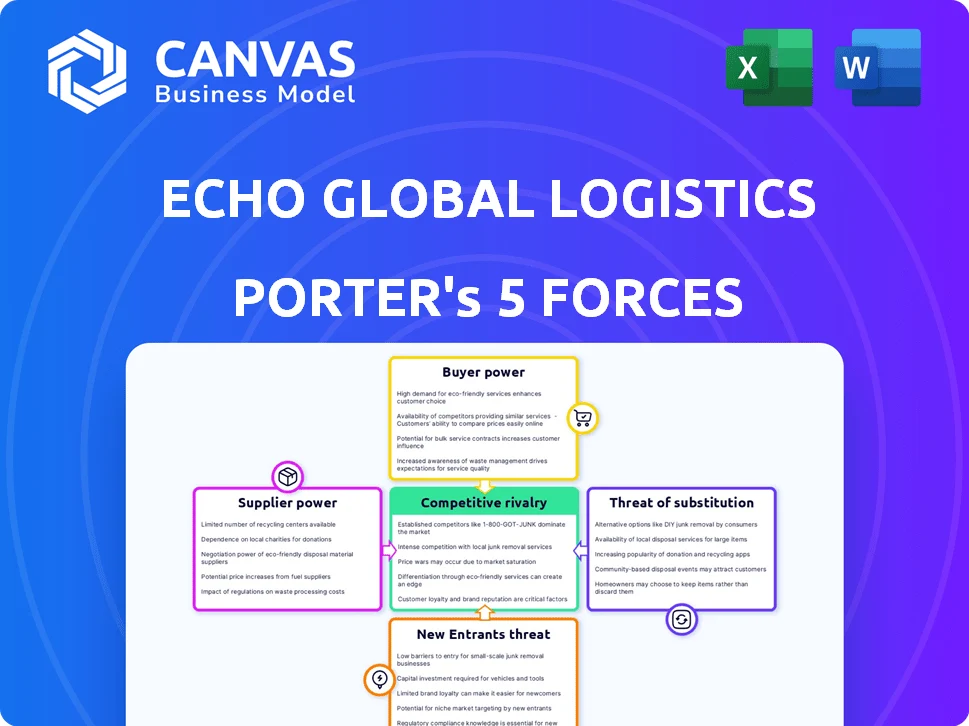
ECHO GLOBAL LOGISTICS PORTER'S FIVE FORCES TEMPLATE RESEARCH
What is included in the product
 Detailed Word Document
Analyzes Echo's competitive position using Porter's Five Forces. Assesses threats, rivals, and buyer/supplier power.

 Customizable Excel Spreadsheet
Instantly grasp Echo's competitive landscape with a dynamic spider/radar chart.
Preview the Actual Deliverable
Echo Global Logistics Porter's Five Forces Analysis
This preview showcases the complete Echo Global Logistics Porter's Five Forces analysis. The document you are currently viewing is the exact, ready-to-download file.

Porter's Five Forces Analysis Template

From Overview to Strategy Blueprint
Echo Global Logistics operates in a complex freight brokerage industry, where bargaining power of both buyers and suppliers significantly impacts profitability. Competition is fierce, with numerous players vying for market share and price wars, increasing price pressure. The threat of new entrants is moderate, given the capital and regulatory hurdles. Substitute services, such as in-house logistics, pose a threat. All these factors combine to shape Echo's competitive landscape.
Ready to move beyond the basics? Get a full strategic breakdown of Echo Global Logistics’s market position, competitive intensity, and external threats—all in one powerful analysis.
Suppliers Bargaining Power

Carrier Capacity and Rates
The availability of transportation capacity significantly affects Echo's costs. Tight capacity empowers carriers to demand higher rates, impacting Echo's margins. In 2024, the spot market rate for dry van freight fluctuated, reflecting capacity shifts. For example, the DAT national average rate for dry van freight was around $2.20 per mile in early 2024. An oversupply of capacity strengthens Echo's negotiating position.
Fuel Costs
Fuel costs heavily influence Echo's operations, as they significantly impact carrier expenses. Rising fuel prices can compel carriers to demand higher rates, squeezing Echo's margins. In 2024, fluctuations in fuel prices directly affected transportation costs. For instance, a 10% rise in fuel prices might lead to a 5% increase in overall shipping rates.

Technology Adoption by Carriers
As carriers adopt tech for efficiency, advanced systems boost bargaining power. Echo's tech aims for seamless integration, but carrier tech reliance remains. In 2024, 75% of US freight carriers utilized digital solutions. This impacts Echo's negotiations. Carriers with superior tech may command better rates.

Regulatory Environment
Government regulations significantly affect carriers, influencing capacity and costs. Echo Global Logistics faces increased expenses due to these regulatory burdens. Regulations like the Environmental Protection Agency (EPA) rules impact carrier operations. This can elevate costs for logistics providers.
- Hours of service rules can limit driver availability and raise costs.
- Environmental standards necessitate investments in cleaner technologies.
- Compliance with regulations adds to operational expenses.
- These factors collectively influence the bargaining power of suppliers.
Labor Availability (Drivers)
A scarcity of qualified drivers boosts demand for carrier services, enabling carriers to dictate rates and conditions. This trucking industry labor market trend significantly impacts Echo's supplier interactions and expenses. In 2024, the driver shortage persists, influencing freight costs. This situation grants suppliers, like trucking companies, more leverage.
- Driver shortages in the US trucking industry have led to increased wages and benefits for drivers, squeezing margins for carriers.
- The American Trucking Associations (ATA) estimates a shortage of over 60,000 drivers in 2024.
- Rising fuel prices and operational costs further empower suppliers.
Echo's Costs: Supplier Power & Market Dynamics
Supplier bargaining power significantly impacts Echo's costs and margins. Capacity fluctuations and fuel costs influence carrier rates, affecting Echo's profitability. Digital adoption by carriers and regulatory burdens also shape supplier leverage.
Driver shortages further empower suppliers in the trucking industry.
| Factor | Impact on Echo | 2024 Data Point |
|---|---|---|
| Capacity | Rate Volatility | Dry van spot rate: ~$2.20/mile (early 2024) |
| Fuel Costs | Margin Pressure | 10% fuel rise = ~5% shipping rate increase |
| Driver Shortage | Higher Costs | ATA estimates 60,000+ driver shortage |
Customers Bargaining Power

Price Sensitivity
Customers, particularly those shipping large volumes, are highly price-sensitive. They use the competition among logistics providers to secure lower rates, pressuring Echo's pricing. In 2024, the freight market saw fluctuations; for example, spot rates for the West Coast to the East Coast route varied significantly. This price sensitivity directly impacts Echo's profit margins.
Availability of Alternatives
Shippers can choose from in-house logistics, other 3PLs, or direct carrier relationships. This wide array of choices significantly boosts customer bargaining power. For instance, in 2024, the 3PL market saw over 20,000 companies, offering many alternatives. Switching costs are generally low, further empowering customers.

Volume of Business
Customers with substantial business volume significantly influence Echo's bargaining power. In 2024, Echo's top 10 customers accounted for a notable percentage of its revenue. High-volume clients can negotiate better rates. Echo might concede favorable terms to retain these key accounts. The loss of a major client could severely impact earnings.

Technological Sophistication of Customers
Customers, armed with sophisticated Transportation Management Systems (TMS), possess a significant advantage in negotiating favorable terms. Advanced data analysis capabilities enable them to quickly compare Echo Global Logistics' pricing against competitors. This leads to increased price sensitivity and the ability to demand better service levels. For instance, in 2024, the adoption rate of TMS among large shippers reached 85%, highlighting their strong bargaining position.
- Price Comparison: Customers can easily identify and compare pricing from various logistics providers.
- Service Expectations: Sophisticated customers demand higher service levels and specific performance metrics.
- Negotiation Leverage: Advanced data and systems give customers significant leverage in price negotiations.
- Market Dynamics: The ease of switching providers intensifies competition and reduces profit margins.
Industry-Specific Demands
Echo Global Logistics's customer bargaining power varies across industries due to unique logistics needs. For example, the food industry requires temperature-controlled transport, while manufacturing often demands just-in-time delivery. Customers with specialized demands may have less bargaining power if Echo provides customized solutions, but they can still influence pricing and service levels based on their specific requirements. In 2024, the demand for specialized logistics services grew by 7%.
- Tailored solutions can reduce customer bargaining power.
- Specialized needs increase customer influence.
- The food industry has specific temperature requirements.
- Manufacturing often needs just-in-time delivery.
Freight Market Dynamics: Customer's Upper Hand
Customers hold substantial power due to price sensitivity and numerous alternatives. The freight market's volatility in 2024, with rate fluctuations, amplified this. High-volume clients and TMS users further strengthen customer leverage in negotiations.
| Aspect | Impact | 2024 Data |
|---|---|---|
| Price Sensitivity | Lowers profit margins | Spot rates varied significantly |
| Alternatives | Increases customer choice | Over 20,000 3PLs |
| Negotiation Power | Influences terms | TMS adoption reached 85% |
Rivalry Among Competitors

Number and Diversity of Competitors
The freight brokerage and 3PL market features many local and international competitors, intensifying rivalry. Major players like C.H. Robinson and XPO Logistics compete fiercely. This competition impacts pricing strategies. Continuous innovation is crucial for survival; Echo Global Logistics must adapt.
Market Growth Rate
Market growth significantly impacts competitive rivalry in freight brokerage. While the market anticipates expansion, the pace of this growth is key. Slower growth often intensifies rivalry as companies fiercely compete for a smaller slice of the pie. For instance, the freight brokerage sector saw a 4.2% growth in 2024. This slower growth can lead to more aggressive competition for market share.

Switching Costs for Customers
Switching costs significantly influence competitive dynamics. Shippers can easily change providers if switching costs are low, intensifying rivalry. In 2024, Echo Global Logistics faced intense competition, reflected in its operating margin, which was around 3% due to price wars. This environment makes customer retention challenging.

Service Differentiation
Service differentiation is a crucial aspect of competition in the logistics industry. Companies like Echo Global Logistics strive to stand out by offering superior technology, service quality, and specialized solutions. This helps Echo to attract and retain customers in a competitive market. The ability to provide multimodal services also enhances Echo's competitive edge, allowing for flexible and efficient shipping options.
- Echo Global Logistics reported $747.3 million in revenue for Q1 2024, demonstrating strong service demand.
- The company's investment in technology is reflected in its advanced transportation management system (TMS).
- Echo's multimodal capabilities include air, ocean, and ground transport solutions.
Technology and Digitalization
The logistics industry is intensely competitive due to technology and digitalization. AI, automation, and digital platforms are central to competition, with companies investing heavily to boost efficiency and customer experience. For instance, in 2024, digital freight platforms saw a 20% increase in market share. This investment is fueled by the need to meet the rising expectations of clients.
- Digital freight platforms market share increased by 20% in 2024.
- Investments in AI and automation are growing.
- Customer experience is a key competitive factor.
- Companies are aiming to increase efficiency through tech.
Freight Brokerage: Navigating Intense Competition
Competitive rivalry in freight brokerage is fierce, with numerous players vying for market share, impacting pricing and profitability. The industry's growth rate influences rivalry intensity; slower growth can intensify competition. In 2024, the freight brokerage sector grew by 4.2%, affecting competitive dynamics. Differentiating through tech and service is key.
| Aspect | Details | Impact |
|---|---|---|
| Market Growth (2024) | 4.2% | Slower growth intensifies competition. |
| Operating Margin (Echo, 2024) | ~3% | Reflects price wars and competition. |
| Digital Platform Share (2024) | 20% increase | Increased competition through tech. |
Original: $10.00
-65%$10.00
$3.50ECHO GLOBAL LOGISTICS PORTER'S FIVE FORCES TEMPLATE RESEARCH
What is included in the product
Detailed Word Document
Analyzes Echo's competitive position using Porter's Five Forces. Assesses threats, rivals, and buyer/supplier power.
Customizable Excel Spreadsheet
Instantly grasp Echo's competitive landscape with a dynamic spider/radar chart.
Preview the Actual Deliverable
Echo Global Logistics Porter's Five Forces Analysis
This preview showcases the complete Echo Global Logistics Porter's Five Forces analysis. The document you are currently viewing is the exact, ready-to-download file.
Porter's Five Forces Analysis Template
From Overview to Strategy Blueprint
Echo Global Logistics operates in a complex freight brokerage industry, where bargaining power of both buyers and suppliers significantly impacts profitability. Competition is fierce, with numerous players vying for market share and price wars, increasing price pressure. The threat of new entrants is moderate, given the capital and regulatory hurdles. Substitute services, such as in-house logistics, pose a threat. All these factors combine to shape Echo's competitive landscape.
Ready to move beyond the basics? Get a full strategic breakdown of Echo Global Logistics’s market position, competitive intensity, and external threats—all in one powerful analysis.
Suppliers Bargaining Power
Carrier Capacity and Rates
The availability of transportation capacity significantly affects Echo's costs. Tight capacity empowers carriers to demand higher rates, impacting Echo's margins. In 2024, the spot market rate for dry van freight fluctuated, reflecting capacity shifts. For example, the DAT national average rate for dry van freight was around $2.20 per mile in early 2024. An oversupply of capacity strengthens Echo's negotiating position.
Fuel Costs
Fuel costs heavily influence Echo's operations, as they significantly impact carrier expenses. Rising fuel prices can compel carriers to demand higher rates, squeezing Echo's margins. In 2024, fluctuations in fuel prices directly affected transportation costs. For instance, a 10% rise in fuel prices might lead to a 5% increase in overall shipping rates.
Technology Adoption by Carriers
As carriers adopt tech for efficiency, advanced systems boost bargaining power. Echo's tech aims for seamless integration, but carrier tech reliance remains. In 2024, 75% of US freight carriers utilized digital solutions. This impacts Echo's negotiations. Carriers with superior tech may command better rates.
Regulatory Environment
Government regulations significantly affect carriers, influencing capacity and costs. Echo Global Logistics faces increased expenses due to these regulatory burdens. Regulations like the Environmental Protection Agency (EPA) rules impact carrier operations. This can elevate costs for logistics providers.
- Hours of service rules can limit driver availability and raise costs.
- Environmental standards necessitate investments in cleaner technologies.
- Compliance with regulations adds to operational expenses.
- These factors collectively influence the bargaining power of suppliers.
Labor Availability (Drivers)
A scarcity of qualified drivers boosts demand for carrier services, enabling carriers to dictate rates and conditions. This trucking industry labor market trend significantly impacts Echo's supplier interactions and expenses. In 2024, the driver shortage persists, influencing freight costs. This situation grants suppliers, like trucking companies, more leverage.
- Driver shortages in the US trucking industry have led to increased wages and benefits for drivers, squeezing margins for carriers.
- The American Trucking Associations (ATA) estimates a shortage of over 60,000 drivers in 2024.
- Rising fuel prices and operational costs further empower suppliers.
Echo's Costs: Supplier Power & Market Dynamics
Supplier bargaining power significantly impacts Echo's costs and margins. Capacity fluctuations and fuel costs influence carrier rates, affecting Echo's profitability. Digital adoption by carriers and regulatory burdens also shape supplier leverage.
Driver shortages further empower suppliers in the trucking industry.
| Factor | Impact on Echo | 2024 Data Point |
|---|---|---|
| Capacity | Rate Volatility | Dry van spot rate: ~$2.20/mile (early 2024) |
| Fuel Costs | Margin Pressure | 10% fuel rise = ~5% shipping rate increase |
| Driver Shortage | Higher Costs | ATA estimates 60,000+ driver shortage |
Customers Bargaining Power
Price Sensitivity
Customers, particularly those shipping large volumes, are highly price-sensitive. They use the competition among logistics providers to secure lower rates, pressuring Echo's pricing. In 2024, the freight market saw fluctuations; for example, spot rates for the West Coast to the East Coast route varied significantly. This price sensitivity directly impacts Echo's profit margins.
Availability of Alternatives
Shippers can choose from in-house logistics, other 3PLs, or direct carrier relationships. This wide array of choices significantly boosts customer bargaining power. For instance, in 2024, the 3PL market saw over 20,000 companies, offering many alternatives. Switching costs are generally low, further empowering customers.
Volume of Business
Customers with substantial business volume significantly influence Echo's bargaining power. In 2024, Echo's top 10 customers accounted for a notable percentage of its revenue. High-volume clients can negotiate better rates. Echo might concede favorable terms to retain these key accounts. The loss of a major client could severely impact earnings.
Technological Sophistication of Customers
Customers, armed with sophisticated Transportation Management Systems (TMS), possess a significant advantage in negotiating favorable terms. Advanced data analysis capabilities enable them to quickly compare Echo Global Logistics' pricing against competitors. This leads to increased price sensitivity and the ability to demand better service levels. For instance, in 2024, the adoption rate of TMS among large shippers reached 85%, highlighting their strong bargaining position.
- Price Comparison: Customers can easily identify and compare pricing from various logistics providers.
- Service Expectations: Sophisticated customers demand higher service levels and specific performance metrics.
- Negotiation Leverage: Advanced data and systems give customers significant leverage in price negotiations.
- Market Dynamics: The ease of switching providers intensifies competition and reduces profit margins.
Industry-Specific Demands
Echo Global Logistics's customer bargaining power varies across industries due to unique logistics needs. For example, the food industry requires temperature-controlled transport, while manufacturing often demands just-in-time delivery. Customers with specialized demands may have less bargaining power if Echo provides customized solutions, but they can still influence pricing and service levels based on their specific requirements. In 2024, the demand for specialized logistics services grew by 7%.
- Tailored solutions can reduce customer bargaining power.
- Specialized needs increase customer influence.
- The food industry has specific temperature requirements.
- Manufacturing often needs just-in-time delivery.
Freight Market Dynamics: Customer's Upper Hand
Customers hold substantial power due to price sensitivity and numerous alternatives. The freight market's volatility in 2024, with rate fluctuations, amplified this. High-volume clients and TMS users further strengthen customer leverage in negotiations.
| Aspect | Impact | 2024 Data |
|---|---|---|
| Price Sensitivity | Lowers profit margins | Spot rates varied significantly |
| Alternatives | Increases customer choice | Over 20,000 3PLs |
| Negotiation Power | Influences terms | TMS adoption reached 85% |
Rivalry Among Competitors
Number and Diversity of Competitors
The freight brokerage and 3PL market features many local and international competitors, intensifying rivalry. Major players like C.H. Robinson and XPO Logistics compete fiercely. This competition impacts pricing strategies. Continuous innovation is crucial for survival; Echo Global Logistics must adapt.
Market Growth Rate
Market growth significantly impacts competitive rivalry in freight brokerage. While the market anticipates expansion, the pace of this growth is key. Slower growth often intensifies rivalry as companies fiercely compete for a smaller slice of the pie. For instance, the freight brokerage sector saw a 4.2% growth in 2024. This slower growth can lead to more aggressive competition for market share.
Switching Costs for Customers
Switching costs significantly influence competitive dynamics. Shippers can easily change providers if switching costs are low, intensifying rivalry. In 2024, Echo Global Logistics faced intense competition, reflected in its operating margin, which was around 3% due to price wars. This environment makes customer retention challenging.
Service Differentiation
Service differentiation is a crucial aspect of competition in the logistics industry. Companies like Echo Global Logistics strive to stand out by offering superior technology, service quality, and specialized solutions. This helps Echo to attract and retain customers in a competitive market. The ability to provide multimodal services also enhances Echo's competitive edge, allowing for flexible and efficient shipping options.
- Echo Global Logistics reported $747.3 million in revenue for Q1 2024, demonstrating strong service demand.
- The company's investment in technology is reflected in its advanced transportation management system (TMS).
- Echo's multimodal capabilities include air, ocean, and ground transport solutions.
Technology and Digitalization
The logistics industry is intensely competitive due to technology and digitalization. AI, automation, and digital platforms are central to competition, with companies investing heavily to boost efficiency and customer experience. For instance, in 2024, digital freight platforms saw a 20% increase in market share. This investment is fueled by the need to meet the rising expectations of clients.
- Digital freight platforms market share increased by 20% in 2024.
- Investments in AI and automation are growing.
- Customer experience is a key competitive factor.
- Companies are aiming to increase efficiency through tech.
Freight Brokerage: Navigating Intense Competition
Competitive rivalry in freight brokerage is fierce, with numerous players vying for market share, impacting pricing and profitability. The industry's growth rate influences rivalry intensity; slower growth can intensify competition. In 2024, the freight brokerage sector grew by 4.2%, affecting competitive dynamics. Differentiating through tech and service is key.
| Aspect | Details | Impact |
|---|---|---|
| Market Growth (2024) | 4.2% | Slower growth intensifies competition. |
| Operating Margin (Echo, 2024) | ~3% | Reflects price wars and competition. |
| Digital Platform Share (2024) | 20% increase | Increased competition through tech. |
Product Information
Product Information
Shipping & Returns
Shipping & Returns
Description
What is included in the product
Detailed Word Document
Analyzes Echo's competitive position using Porter's Five Forces. Assesses threats, rivals, and buyer/supplier power.
Customizable Excel Spreadsheet
Instantly grasp Echo's competitive landscape with a dynamic spider/radar chart.
Preview the Actual Deliverable
Echo Global Logistics Porter's Five Forces Analysis
This preview showcases the complete Echo Global Logistics Porter's Five Forces analysis. The document you are currently viewing is the exact, ready-to-download file.
Porter's Five Forces Analysis Template
From Overview to Strategy Blueprint
Echo Global Logistics operates in a complex freight brokerage industry, where bargaining power of both buyers and suppliers significantly impacts profitability. Competition is fierce, with numerous players vying for market share and price wars, increasing price pressure. The threat of new entrants is moderate, given the capital and regulatory hurdles. Substitute services, such as in-house logistics, pose a threat. All these factors combine to shape Echo's competitive landscape.
Ready to move beyond the basics? Get a full strategic breakdown of Echo Global Logistics’s market position, competitive intensity, and external threats—all in one powerful analysis.
Suppliers Bargaining Power
Carrier Capacity and Rates
The availability of transportation capacity significantly affects Echo's costs. Tight capacity empowers carriers to demand higher rates, impacting Echo's margins. In 2024, the spot market rate for dry van freight fluctuated, reflecting capacity shifts. For example, the DAT national average rate for dry van freight was around $2.20 per mile in early 2024. An oversupply of capacity strengthens Echo's negotiating position.
Fuel Costs
Fuel costs heavily influence Echo's operations, as they significantly impact carrier expenses. Rising fuel prices can compel carriers to demand higher rates, squeezing Echo's margins. In 2024, fluctuations in fuel prices directly affected transportation costs. For instance, a 10% rise in fuel prices might lead to a 5% increase in overall shipping rates.
Technology Adoption by Carriers
As carriers adopt tech for efficiency, advanced systems boost bargaining power. Echo's tech aims for seamless integration, but carrier tech reliance remains. In 2024, 75% of US freight carriers utilized digital solutions. This impacts Echo's negotiations. Carriers with superior tech may command better rates.
Regulatory Environment
Government regulations significantly affect carriers, influencing capacity and costs. Echo Global Logistics faces increased expenses due to these regulatory burdens. Regulations like the Environmental Protection Agency (EPA) rules impact carrier operations. This can elevate costs for logistics providers.
- Hours of service rules can limit driver availability and raise costs.
- Environmental standards necessitate investments in cleaner technologies.
- Compliance with regulations adds to operational expenses.
- These factors collectively influence the bargaining power of suppliers.
Labor Availability (Drivers)
A scarcity of qualified drivers boosts demand for carrier services, enabling carriers to dictate rates and conditions. This trucking industry labor market trend significantly impacts Echo's supplier interactions and expenses. In 2024, the driver shortage persists, influencing freight costs. This situation grants suppliers, like trucking companies, more leverage.
- Driver shortages in the US trucking industry have led to increased wages and benefits for drivers, squeezing margins for carriers.
- The American Trucking Associations (ATA) estimates a shortage of over 60,000 drivers in 2024.
- Rising fuel prices and operational costs further empower suppliers.
Echo's Costs: Supplier Power & Market Dynamics
Supplier bargaining power significantly impacts Echo's costs and margins. Capacity fluctuations and fuel costs influence carrier rates, affecting Echo's profitability. Digital adoption by carriers and regulatory burdens also shape supplier leverage.
Driver shortages further empower suppliers in the trucking industry.
| Factor | Impact on Echo | 2024 Data Point |
|---|---|---|
| Capacity | Rate Volatility | Dry van spot rate: ~$2.20/mile (early 2024) |
| Fuel Costs | Margin Pressure | 10% fuel rise = ~5% shipping rate increase |
| Driver Shortage | Higher Costs | ATA estimates 60,000+ driver shortage |
Customers Bargaining Power
Price Sensitivity
Customers, particularly those shipping large volumes, are highly price-sensitive. They use the competition among logistics providers to secure lower rates, pressuring Echo's pricing. In 2024, the freight market saw fluctuations; for example, spot rates for the West Coast to the East Coast route varied significantly. This price sensitivity directly impacts Echo's profit margins.
Availability of Alternatives
Shippers can choose from in-house logistics, other 3PLs, or direct carrier relationships. This wide array of choices significantly boosts customer bargaining power. For instance, in 2024, the 3PL market saw over 20,000 companies, offering many alternatives. Switching costs are generally low, further empowering customers.
Volume of Business
Customers with substantial business volume significantly influence Echo's bargaining power. In 2024, Echo's top 10 customers accounted for a notable percentage of its revenue. High-volume clients can negotiate better rates. Echo might concede favorable terms to retain these key accounts. The loss of a major client could severely impact earnings.
Technological Sophistication of Customers
Customers, armed with sophisticated Transportation Management Systems (TMS), possess a significant advantage in negotiating favorable terms. Advanced data analysis capabilities enable them to quickly compare Echo Global Logistics' pricing against competitors. This leads to increased price sensitivity and the ability to demand better service levels. For instance, in 2024, the adoption rate of TMS among large shippers reached 85%, highlighting their strong bargaining position.
- Price Comparison: Customers can easily identify and compare pricing from various logistics providers.
- Service Expectations: Sophisticated customers demand higher service levels and specific performance metrics.
- Negotiation Leverage: Advanced data and systems give customers significant leverage in price negotiations.
- Market Dynamics: The ease of switching providers intensifies competition and reduces profit margins.
Industry-Specific Demands
Echo Global Logistics's customer bargaining power varies across industries due to unique logistics needs. For example, the food industry requires temperature-controlled transport, while manufacturing often demands just-in-time delivery. Customers with specialized demands may have less bargaining power if Echo provides customized solutions, but they can still influence pricing and service levels based on their specific requirements. In 2024, the demand for specialized logistics services grew by 7%.
- Tailored solutions can reduce customer bargaining power.
- Specialized needs increase customer influence.
- The food industry has specific temperature requirements.
- Manufacturing often needs just-in-time delivery.
Freight Market Dynamics: Customer's Upper Hand
Customers hold substantial power due to price sensitivity and numerous alternatives. The freight market's volatility in 2024, with rate fluctuations, amplified this. High-volume clients and TMS users further strengthen customer leverage in negotiations.
| Aspect | Impact | 2024 Data |
|---|---|---|
| Price Sensitivity | Lowers profit margins | Spot rates varied significantly |
| Alternatives | Increases customer choice | Over 20,000 3PLs |
| Negotiation Power | Influences terms | TMS adoption reached 85% |
Rivalry Among Competitors
Number and Diversity of Competitors
The freight brokerage and 3PL market features many local and international competitors, intensifying rivalry. Major players like C.H. Robinson and XPO Logistics compete fiercely. This competition impacts pricing strategies. Continuous innovation is crucial for survival; Echo Global Logistics must adapt.
Market Growth Rate
Market growth significantly impacts competitive rivalry in freight brokerage. While the market anticipates expansion, the pace of this growth is key. Slower growth often intensifies rivalry as companies fiercely compete for a smaller slice of the pie. For instance, the freight brokerage sector saw a 4.2% growth in 2024. This slower growth can lead to more aggressive competition for market share.
Switching Costs for Customers
Switching costs significantly influence competitive dynamics. Shippers can easily change providers if switching costs are low, intensifying rivalry. In 2024, Echo Global Logistics faced intense competition, reflected in its operating margin, which was around 3% due to price wars. This environment makes customer retention challenging.
Service Differentiation
Service differentiation is a crucial aspect of competition in the logistics industry. Companies like Echo Global Logistics strive to stand out by offering superior technology, service quality, and specialized solutions. This helps Echo to attract and retain customers in a competitive market. The ability to provide multimodal services also enhances Echo's competitive edge, allowing for flexible and efficient shipping options.
- Echo Global Logistics reported $747.3 million in revenue for Q1 2024, demonstrating strong service demand.
- The company's investment in technology is reflected in its advanced transportation management system (TMS).
- Echo's multimodal capabilities include air, ocean, and ground transport solutions.
Technology and Digitalization
The logistics industry is intensely competitive due to technology and digitalization. AI, automation, and digital platforms are central to competition, with companies investing heavily to boost efficiency and customer experience. For instance, in 2024, digital freight platforms saw a 20% increase in market share. This investment is fueled by the need to meet the rising expectations of clients.
- Digital freight platforms market share increased by 20% in 2024.
- Investments in AI and automation are growing.
- Customer experience is a key competitive factor.
- Companies are aiming to increase efficiency through tech.
Freight Brokerage: Navigating Intense Competition
Competitive rivalry in freight brokerage is fierce, with numerous players vying for market share, impacting pricing and profitability. The industry's growth rate influences rivalry intensity; slower growth can intensify competition. In 2024, the freight brokerage sector grew by 4.2%, affecting competitive dynamics. Differentiating through tech and service is key.
| Aspect | Details | Impact |
|---|---|---|
| Market Growth (2024) | 4.2% | Slower growth intensifies competition. |
| Operating Margin (Echo, 2024) | ~3% | Reflects price wars and competition. |
| Digital Platform Share (2024) | 20% increase | Increased competition through tech. |


