EASYJET SWOT ANALYSIS TEMPLATE RESEARCH

Your Strategic Toolkit Starts Here
EasyJet's lean cost structure and strong brand across Europe position it well for post-pandemic demand recovery, but margin pressure from fuel volatility, capacity competition, and regulatory shifts present clear risks; operational resilience and ancillary revenue growth are key near-term levers. Want the full story behind the company's strengths, risks, and growth drivers? Purchase the complete SWOT analysis to gain access to a professionally written, fully editable report designed to support planning, pitches, and research.
Strengths

Primary slot dominance at 20 major European airports
EasyJet holds primary slot dominance at 20 major European airports-over 50% market share at London Gatwick in 2025-locking in high-yield business and leisure traffic and raising rival entry costs.
EasyJet holidays contributing over 25 percent of group profit
EasyJet holidays now contributes over 25% of EasyJet Group pre-tax profit in FY2025, shifting the firm from a pure seat-seller to a full travel provider and lifting group margin by ~130 basis points year-on-year.
By bundling existing flight seats, the holidays arm yields high-margin revenue with minimal capex; FY2025 holidays gross margin ~38% versus 12% on ticket-only sales.
Customer uptake rose double digits in 2025-holiday bookings +22% YoY-driven by demand for bundled protection and flexible options, improving repeat-booking rates and ancillary revenue per pax.

Robust investment-grade balance sheet with 1.2 billion dollars in liquidity
Maintaining an investment-grade rating lets EasyJet raise debt at lower rates-2025 average borrowing cost ~4.1% vs ~8% for weaker carriers-preserving the $1.2 billion liquidity buffer to fund fleet renewals (A320neo orders) and absorb shocks without equity dilution; it also enables large fuel and FX hedges covering ~60% of next 12 months' exposure, stabilizing unit costs.

Fleet modernization with 190 plus Airbus A320neo family aircraft on order
EasyJet's fleet shift-190+ Airbus A320neo family on order-cuts fuel burn and CO2 by ~15% per seat and trims noise footprint ~50%, preserving slots at noise‑sensitive EU hubs and lowering cost per available seat mile (CASM).
Strong brand loyalty with 75 percent repeat customer rate
Data shows 75% repeat customers-three of four passengers-demonstrating strong brand resonance across the UK and continental Europe and supporting EasyJet's 2025 passenger base of about 108 million flown in FY2025.
This retention cuts customer acquisition costs versus new low-cost entrants and helped yield a 2025 ancillary revenue of £1.9 billion, reflecting loyalty-driven upsell.
The brand trades off price and service, seen in a 2025 Net Promoter Score near +28, positioning EasyJet above ultra-low-cost rivals on perceived reliability.
- 75% repeat rate
- ~108m passengers FY2025
- £1.9bn ancillary revenue 2025
- NPS ≈ +28 in 2025
EasyJet 2025: Gatwick slot dominance, high-margin Holidays, £1.9bn ancillaries
EasyJet's 2025 strengths: slot dominance (50%+ at Gatwick) secures high-yield traffic; Holidays now 25%+ of pre-tax profit with ~38% gross margin, boosting group margin ~130 bps; 108m passengers and 75% repeat rate fuel £1.9bn ancillary revenue and NPS ≈+28; investment-grade debt keeps avg borrowing ~4.1% and $1.2bn liquidity.
| Metric | 2025 |
|---|---|
| Passengers | 108m |
| Repeat rate | 75% |
| Ancillary rev | £1.9bn |
| Holidays margin | ~38% |
| Group profit share (Holidays) | 25%+ |
| Avg borrowing cost | ~4.1% |
| Liquidity | $1.2bn |
| NPS | +28 |
What is included in the product
 Detailed Word Document
Analyzes EasyJet's competitive position by outlining internal strengths and weaknesses alongside external opportunities and threats shaping its low-cost airline strategy.

 Customizable Excel Spreadsheet
Delivers a concise EasyJet SWOT snapshot for rapid strategic alignment and stakeholder-ready presentations.
Weaknesses

Heavy 95 percent revenue concentration in European short-haul markets
EasyJet's revenue is roughly 95% intra-European short‑haul, leaving the carrier heavily exposed to UK/EU economic swings; in FY2025 passenger numbers were 67.4 million and unit revenue fell 4.2% year-over-year, highlighting sensitivity to regional demand.
Without long‑haul operations, EasyJet cannot offset weak UK or EU consumer spending as global carriers do, concentrating risk in one market cluster.
Geopolitical tensions (e.g., 2024 Channel delays) and Eurozone inflation spikes-CPI reaching 5.1% in 2024-directly pressure fares and costs, squeezing margins and capex plans.
Significant summer seasonality with 70 percent of profits earned in Q4
EasyJet faces marked seasonal volatility: about 70% of 2025 pre-tax profits were earned in Q4, forcing summer revenue to subsidize heavy winter losses and stressing cash flow.
That imbalance forces costly scaling of crews and maintenance in low-demand months; winter load factors (Nov-Feb) fell to ~68% in 2025, below break-even levels.
EasyJet Holidays cushions revenue-contributing roughly £350m in 2025-but the core airline still struggles to reach consistent profitability outside peak summer and Q4.

Exposure to rising EU ETS carbon costs exceeding 150 million dollars annually
Rising EU ETS costs now exceed $150m annually for EasyJet, driven by tighter 2025 caps and the phase-out of free allowances, squeezing margins as short-haul flights incur higher per-passenger charges than long-haul peers.
If EasyJet absorbs the $150m+ hit, 2025 EBIT could fall several percentage points; passing costs to passengers risks a 2-4% drop in demand per fare studies on price elasticity for leisure short-haul routes.
The net effect: higher unit costs without easy offsetting yield, forcing fleet, network, or ancillary-price moves to protect profitability.

Operational vulnerability to French air traffic control strikes
EasyJet's network routes heavily transit French airspace, so repeated French ATC strikes cause thousands of cancellations-e.g., 2025 first-half disruptions forced ~3,400 cancellations and triggered ~£22m EU261 payouts.
These events are treated as extraordinary but still drove a volatile £30-50m hit to quarterly EBIT in 2024-25, creating recurring, unpredictable pressure on margins.
- ~3,400 cancellations (H1 2025)
- £22m EU261 cash payouts (H1 2025)
- £30-50m quarterly EBIT volatility (2024-25)
Labor cost inflation trending at 6 percent above historical averages
EasyJet faces labor cost inflation about 6% above historical averages, driven by tight pilot and cabin crew markets in Europe that forced wage settlements up to 8-12% in 2024-25 to avoid strikes.
These structural pay rises are hard to reverse, lifting 2025 personnel expense to roughly £1.9bn (up ~10% YoY) and pressuring unit cost and margins.
As a service-heavy airline with limited automation for crew roles, labor remains the primary headwind to margin expansion.
- 2025 personnel costs ~£1.9bn (+10% YoY)
- Wage settlements 8-12% (2024-25)
- Labor inflation ~6% above long-term average
- Limited automation → persistent margin pressure
EasyJet FY25 risks: EU short‑haul exposure, falling unit revenue, rising costs
EasyJet's FY2025 weakness: 95% short‑haul EU focus (67.4m pax), unit revenue down 4.2%, seasonal profit skew (70% in Q4), winter LF ~68%, personnel costs £1.9bn (+10%), EU ETS >$150m, H1 2025 ~3,400 cancellations → £22m EU261; these concentrate cost and demand risks.
| Metric | FY2025 |
|---|---|
| Passengers | 67.4m |
| Unit rev YoY | -4.2% |
| Personnel costs | £1.9bn |
| EU ETS | >$150m |
| Winter LF | ~68% |
| H1 cancellations | ~3,400 |
| EU261 payouts H1 | £22m |
Preview the Actual Deliverable
EasyJet SWOT Analysis
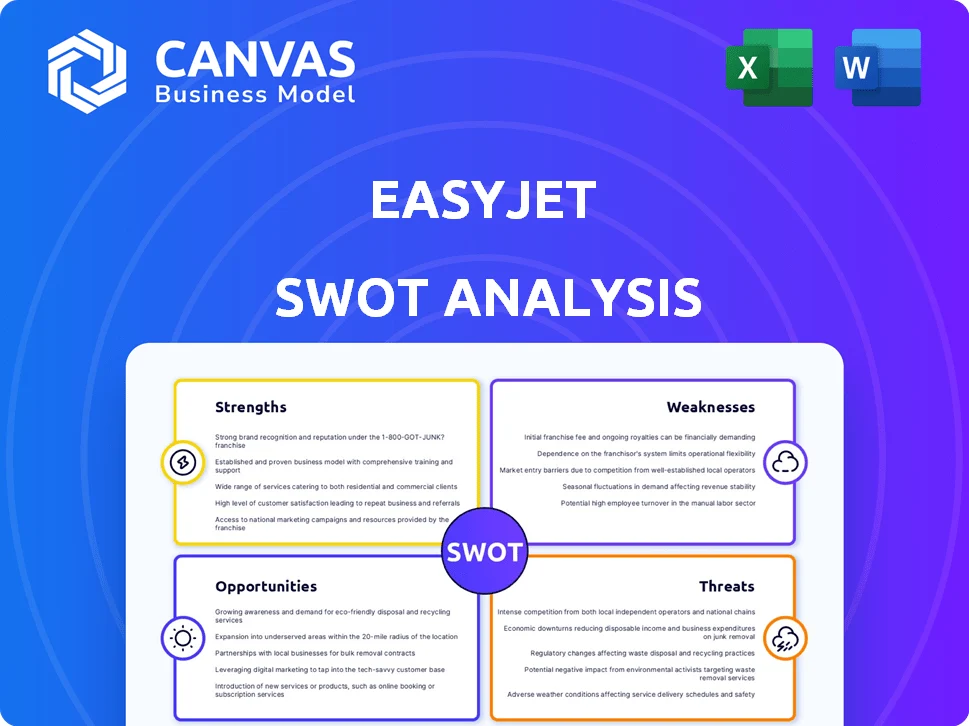
This is the actual SWOT analysis document you'll receive upon purchase-no surprises, just professional quality; the preview below is taken directly from the full report you'll get, and buying unlocks the complete, editable version with detailed strengths, weaknesses, opportunities, and threats.

Original: $10.00
-65%$10.00
$3.50EASYJET SWOT ANALYSIS TEMPLATE RESEARCH
Your Strategic Toolkit Starts Here
EasyJet's lean cost structure and strong brand across Europe position it well for post-pandemic demand recovery, but margin pressure from fuel volatility, capacity competition, and regulatory shifts present clear risks; operational resilience and ancillary revenue growth are key near-term levers. Want the full story behind the company's strengths, risks, and growth drivers? Purchase the complete SWOT analysis to gain access to a professionally written, fully editable report designed to support planning, pitches, and research.
Strengths
Primary slot dominance at 20 major European airports
EasyJet holds primary slot dominance at 20 major European airports-over 50% market share at London Gatwick in 2025-locking in high-yield business and leisure traffic and raising rival entry costs.
EasyJet holidays contributing over 25 percent of group profit
EasyJet holidays now contributes over 25% of EasyJet Group pre-tax profit in FY2025, shifting the firm from a pure seat-seller to a full travel provider and lifting group margin by ~130 basis points year-on-year.
By bundling existing flight seats, the holidays arm yields high-margin revenue with minimal capex; FY2025 holidays gross margin ~38% versus 12% on ticket-only sales.
Customer uptake rose double digits in 2025-holiday bookings +22% YoY-driven by demand for bundled protection and flexible options, improving repeat-booking rates and ancillary revenue per pax.
Robust investment-grade balance sheet with 1.2 billion dollars in liquidity
Maintaining an investment-grade rating lets EasyJet raise debt at lower rates-2025 average borrowing cost ~4.1% vs ~8% for weaker carriers-preserving the $1.2 billion liquidity buffer to fund fleet renewals (A320neo orders) and absorb shocks without equity dilution; it also enables large fuel and FX hedges covering ~60% of next 12 months' exposure, stabilizing unit costs.
Fleet modernization with 190 plus Airbus A320neo family aircraft on order
EasyJet's fleet shift-190+ Airbus A320neo family on order-cuts fuel burn and CO2 by ~15% per seat and trims noise footprint ~50%, preserving slots at noise‑sensitive EU hubs and lowering cost per available seat mile (CASM).
Strong brand loyalty with 75 percent repeat customer rate
Data shows 75% repeat customers-three of four passengers-demonstrating strong brand resonance across the UK and continental Europe and supporting EasyJet's 2025 passenger base of about 108 million flown in FY2025.
This retention cuts customer acquisition costs versus new low-cost entrants and helped yield a 2025 ancillary revenue of £1.9 billion, reflecting loyalty-driven upsell.
The brand trades off price and service, seen in a 2025 Net Promoter Score near +28, positioning EasyJet above ultra-low-cost rivals on perceived reliability.
- 75% repeat rate
- ~108m passengers FY2025
- £1.9bn ancillary revenue 2025
- NPS ≈ +28 in 2025
EasyJet 2025: Gatwick slot dominance, high-margin Holidays, £1.9bn ancillaries
EasyJet's 2025 strengths: slot dominance (50%+ at Gatwick) secures high-yield traffic; Holidays now 25%+ of pre-tax profit with ~38% gross margin, boosting group margin ~130 bps; 108m passengers and 75% repeat rate fuel £1.9bn ancillary revenue and NPS ≈+28; investment-grade debt keeps avg borrowing ~4.1% and $1.2bn liquidity.
| Metric | 2025 |
|---|---|
| Passengers | 108m |
| Repeat rate | 75% |
| Ancillary rev | £1.9bn |
| Holidays margin | ~38% |
| Group profit share (Holidays) | 25%+ |
| Avg borrowing cost | ~4.1% |
| Liquidity | $1.2bn |
| NPS | +28 |
What is included in the product
Detailed Word Document
Analyzes EasyJet's competitive position by outlining internal strengths and weaknesses alongside external opportunities and threats shaping its low-cost airline strategy.
Customizable Excel Spreadsheet
Delivers a concise EasyJet SWOT snapshot for rapid strategic alignment and stakeholder-ready presentations.
Weaknesses
Heavy 95 percent revenue concentration in European short-haul markets
EasyJet's revenue is roughly 95% intra-European short‑haul, leaving the carrier heavily exposed to UK/EU economic swings; in FY2025 passenger numbers were 67.4 million and unit revenue fell 4.2% year-over-year, highlighting sensitivity to regional demand.
Without long‑haul operations, EasyJet cannot offset weak UK or EU consumer spending as global carriers do, concentrating risk in one market cluster.
Geopolitical tensions (e.g., 2024 Channel delays) and Eurozone inflation spikes-CPI reaching 5.1% in 2024-directly pressure fares and costs, squeezing margins and capex plans.
Significant summer seasonality with 70 percent of profits earned in Q4
EasyJet faces marked seasonal volatility: about 70% of 2025 pre-tax profits were earned in Q4, forcing summer revenue to subsidize heavy winter losses and stressing cash flow.
That imbalance forces costly scaling of crews and maintenance in low-demand months; winter load factors (Nov-Feb) fell to ~68% in 2025, below break-even levels.
EasyJet Holidays cushions revenue-contributing roughly £350m in 2025-but the core airline still struggles to reach consistent profitability outside peak summer and Q4.
Exposure to rising EU ETS carbon costs exceeding 150 million dollars annually
Rising EU ETS costs now exceed $150m annually for EasyJet, driven by tighter 2025 caps and the phase-out of free allowances, squeezing margins as short-haul flights incur higher per-passenger charges than long-haul peers.
If EasyJet absorbs the $150m+ hit, 2025 EBIT could fall several percentage points; passing costs to passengers risks a 2-4% drop in demand per fare studies on price elasticity for leisure short-haul routes.
The net effect: higher unit costs without easy offsetting yield, forcing fleet, network, or ancillary-price moves to protect profitability.
Operational vulnerability to French air traffic control strikes
EasyJet's network routes heavily transit French airspace, so repeated French ATC strikes cause thousands of cancellations-e.g., 2025 first-half disruptions forced ~3,400 cancellations and triggered ~£22m EU261 payouts.
These events are treated as extraordinary but still drove a volatile £30-50m hit to quarterly EBIT in 2024-25, creating recurring, unpredictable pressure on margins.
- ~3,400 cancellations (H1 2025)
- £22m EU261 cash payouts (H1 2025)
- £30-50m quarterly EBIT volatility (2024-25)
Labor cost inflation trending at 6 percent above historical averages
EasyJet faces labor cost inflation about 6% above historical averages, driven by tight pilot and cabin crew markets in Europe that forced wage settlements up to 8-12% in 2024-25 to avoid strikes.
These structural pay rises are hard to reverse, lifting 2025 personnel expense to roughly £1.9bn (up ~10% YoY) and pressuring unit cost and margins.
As a service-heavy airline with limited automation for crew roles, labor remains the primary headwind to margin expansion.
- 2025 personnel costs ~£1.9bn (+10% YoY)
- Wage settlements 8-12% (2024-25)
- Labor inflation ~6% above long-term average
- Limited automation → persistent margin pressure
EasyJet FY25 risks: EU short‑haul exposure, falling unit revenue, rising costs
EasyJet's FY2025 weakness: 95% short‑haul EU focus (67.4m pax), unit revenue down 4.2%, seasonal profit skew (70% in Q4), winter LF ~68%, personnel costs £1.9bn (+10%), EU ETS >$150m, H1 2025 ~3,400 cancellations → £22m EU261; these concentrate cost and demand risks.
| Metric | FY2025 |
|---|---|
| Passengers | 67.4m |
| Unit rev YoY | -4.2% |
| Personnel costs | £1.9bn |
| EU ETS | >$150m |
| Winter LF | ~68% |
| H1 cancellations | ~3,400 |
| EU261 payouts H1 | £22m |
Preview the Actual Deliverable
EasyJet SWOT Analysis
This is the actual SWOT analysis document you'll receive upon purchase-no surprises, just professional quality; the preview below is taken directly from the full report you'll get, and buying unlocks the complete, editable version with detailed strengths, weaknesses, opportunities, and threats.
Product Information
Product Information
Shipping & Returns
Shipping & Returns
Description
Your Strategic Toolkit Starts Here
EasyJet's lean cost structure and strong brand across Europe position it well for post-pandemic demand recovery, but margin pressure from fuel volatility, capacity competition, and regulatory shifts present clear risks; operational resilience and ancillary revenue growth are key near-term levers. Want the full story behind the company's strengths, risks, and growth drivers? Purchase the complete SWOT analysis to gain access to a professionally written, fully editable report designed to support planning, pitches, and research.
Strengths
Primary slot dominance at 20 major European airports
EasyJet holds primary slot dominance at 20 major European airports-over 50% market share at London Gatwick in 2025-locking in high-yield business and leisure traffic and raising rival entry costs.
EasyJet holidays contributing over 25 percent of group profit
EasyJet holidays now contributes over 25% of EasyJet Group pre-tax profit in FY2025, shifting the firm from a pure seat-seller to a full travel provider and lifting group margin by ~130 basis points year-on-year.
By bundling existing flight seats, the holidays arm yields high-margin revenue with minimal capex; FY2025 holidays gross margin ~38% versus 12% on ticket-only sales.
Customer uptake rose double digits in 2025-holiday bookings +22% YoY-driven by demand for bundled protection and flexible options, improving repeat-booking rates and ancillary revenue per pax.
Robust investment-grade balance sheet with 1.2 billion dollars in liquidity
Maintaining an investment-grade rating lets EasyJet raise debt at lower rates-2025 average borrowing cost ~4.1% vs ~8% for weaker carriers-preserving the $1.2 billion liquidity buffer to fund fleet renewals (A320neo orders) and absorb shocks without equity dilution; it also enables large fuel and FX hedges covering ~60% of next 12 months' exposure, stabilizing unit costs.
Fleet modernization with 190 plus Airbus A320neo family aircraft on order
EasyJet's fleet shift-190+ Airbus A320neo family on order-cuts fuel burn and CO2 by ~15% per seat and trims noise footprint ~50%, preserving slots at noise‑sensitive EU hubs and lowering cost per available seat mile (CASM).
Strong brand loyalty with 75 percent repeat customer rate
Data shows 75% repeat customers-three of four passengers-demonstrating strong brand resonance across the UK and continental Europe and supporting EasyJet's 2025 passenger base of about 108 million flown in FY2025.
This retention cuts customer acquisition costs versus new low-cost entrants and helped yield a 2025 ancillary revenue of £1.9 billion, reflecting loyalty-driven upsell.
The brand trades off price and service, seen in a 2025 Net Promoter Score near +28, positioning EasyJet above ultra-low-cost rivals on perceived reliability.
- 75% repeat rate
- ~108m passengers FY2025
- £1.9bn ancillary revenue 2025
- NPS ≈ +28 in 2025
EasyJet 2025: Gatwick slot dominance, high-margin Holidays, £1.9bn ancillaries
EasyJet's 2025 strengths: slot dominance (50%+ at Gatwick) secures high-yield traffic; Holidays now 25%+ of pre-tax profit with ~38% gross margin, boosting group margin ~130 bps; 108m passengers and 75% repeat rate fuel £1.9bn ancillary revenue and NPS ≈+28; investment-grade debt keeps avg borrowing ~4.1% and $1.2bn liquidity.
| Metric | 2025 |
|---|---|
| Passengers | 108m |
| Repeat rate | 75% |
| Ancillary rev | £1.9bn |
| Holidays margin | ~38% |
| Group profit share (Holidays) | 25%+ |
| Avg borrowing cost | ~4.1% |
| Liquidity | $1.2bn |
| NPS | +28 |
What is included in the product
Detailed Word Document
Analyzes EasyJet's competitive position by outlining internal strengths and weaknesses alongside external opportunities and threats shaping its low-cost airline strategy.
Customizable Excel Spreadsheet
Delivers a concise EasyJet SWOT snapshot for rapid strategic alignment and stakeholder-ready presentations.
Weaknesses
Heavy 95 percent revenue concentration in European short-haul markets
EasyJet's revenue is roughly 95% intra-European short‑haul, leaving the carrier heavily exposed to UK/EU economic swings; in FY2025 passenger numbers were 67.4 million and unit revenue fell 4.2% year-over-year, highlighting sensitivity to regional demand.
Without long‑haul operations, EasyJet cannot offset weak UK or EU consumer spending as global carriers do, concentrating risk in one market cluster.
Geopolitical tensions (e.g., 2024 Channel delays) and Eurozone inflation spikes-CPI reaching 5.1% in 2024-directly pressure fares and costs, squeezing margins and capex plans.
Significant summer seasonality with 70 percent of profits earned in Q4
EasyJet faces marked seasonal volatility: about 70% of 2025 pre-tax profits were earned in Q4, forcing summer revenue to subsidize heavy winter losses and stressing cash flow.
That imbalance forces costly scaling of crews and maintenance in low-demand months; winter load factors (Nov-Feb) fell to ~68% in 2025, below break-even levels.
EasyJet Holidays cushions revenue-contributing roughly £350m in 2025-but the core airline still struggles to reach consistent profitability outside peak summer and Q4.
Exposure to rising EU ETS carbon costs exceeding 150 million dollars annually
Rising EU ETS costs now exceed $150m annually for EasyJet, driven by tighter 2025 caps and the phase-out of free allowances, squeezing margins as short-haul flights incur higher per-passenger charges than long-haul peers.
If EasyJet absorbs the $150m+ hit, 2025 EBIT could fall several percentage points; passing costs to passengers risks a 2-4% drop in demand per fare studies on price elasticity for leisure short-haul routes.
The net effect: higher unit costs without easy offsetting yield, forcing fleet, network, or ancillary-price moves to protect profitability.
Operational vulnerability to French air traffic control strikes
EasyJet's network routes heavily transit French airspace, so repeated French ATC strikes cause thousands of cancellations-e.g., 2025 first-half disruptions forced ~3,400 cancellations and triggered ~£22m EU261 payouts.
These events are treated as extraordinary but still drove a volatile £30-50m hit to quarterly EBIT in 2024-25, creating recurring, unpredictable pressure on margins.
- ~3,400 cancellations (H1 2025)
- £22m EU261 cash payouts (H1 2025)
- £30-50m quarterly EBIT volatility (2024-25)
Labor cost inflation trending at 6 percent above historical averages
EasyJet faces labor cost inflation about 6% above historical averages, driven by tight pilot and cabin crew markets in Europe that forced wage settlements up to 8-12% in 2024-25 to avoid strikes.
These structural pay rises are hard to reverse, lifting 2025 personnel expense to roughly £1.9bn (up ~10% YoY) and pressuring unit cost and margins.
As a service-heavy airline with limited automation for crew roles, labor remains the primary headwind to margin expansion.
- 2025 personnel costs ~£1.9bn (+10% YoY)
- Wage settlements 8-12% (2024-25)
- Labor inflation ~6% above long-term average
- Limited automation → persistent margin pressure
EasyJet FY25 risks: EU short‑haul exposure, falling unit revenue, rising costs
EasyJet's FY2025 weakness: 95% short‑haul EU focus (67.4m pax), unit revenue down 4.2%, seasonal profit skew (70% in Q4), winter LF ~68%, personnel costs £1.9bn (+10%), EU ETS >$150m, H1 2025 ~3,400 cancellations → £22m EU261; these concentrate cost and demand risks.
| Metric | FY2025 |
|---|---|
| Passengers | 67.4m |
| Unit rev YoY | -4.2% |
| Personnel costs | £1.9bn |
| EU ETS | >$150m |
| Winter LF | ~68% |
| H1 cancellations | ~3,400 |
| EU261 payouts H1 | £22m |
Preview the Actual Deliverable
EasyJet SWOT Analysis
This is the actual SWOT analysis document you'll receive upon purchase-no surprises, just professional quality; the preview below is taken directly from the full report you'll get, and buying unlocks the complete, editable version with detailed strengths, weaknesses, opportunities, and threats.