
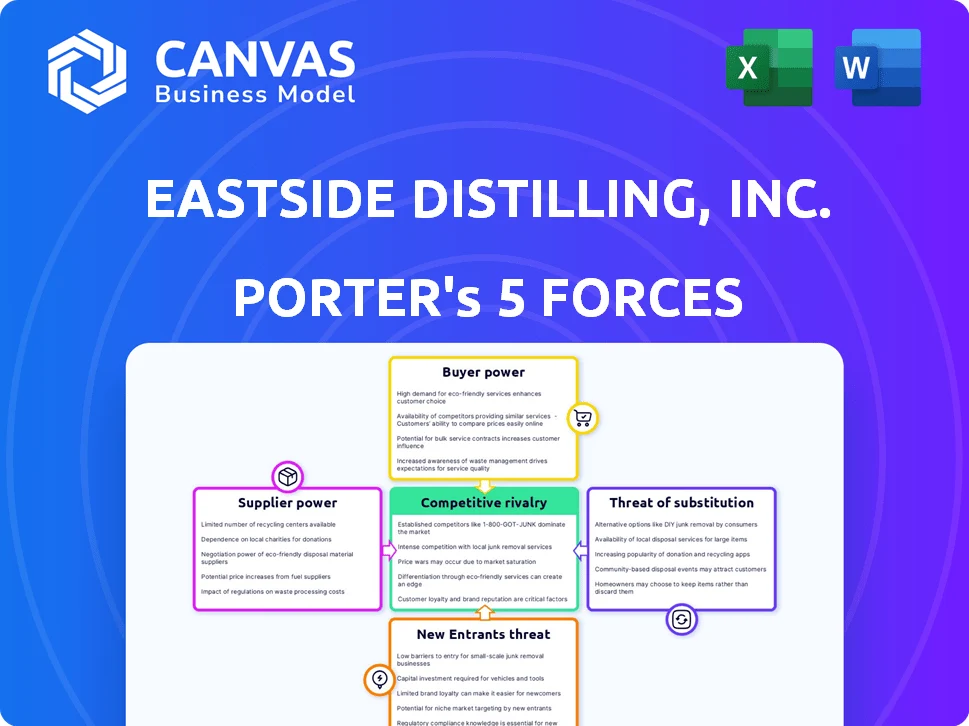
EASTSIDE DISTILLING, INC. PORTER'S FIVE FORCES TEMPLATE RESEARCH
What is included in the product
 Detailed Word Document
Analyzes Eastside Distilling, Inc.'s position, exploring competitive forces, pricing, and market entry.

 Customizable Excel Spreadsheet
Customize pressure levels based on new data or evolving market trends.
Full Version Awaits
Eastside Distilling, Inc. Porter's Five Forces Analysis
This preview details the Eastside Distilling, Inc. Porter's Five Forces analysis—it's the same thorough document you'll receive immediately after purchasing. The analysis covers competitive rivalry, supplier power, buyer power, threat of substitutes, and threat of new entrants. Each force is meticulously examined, providing valuable insights for strategic decision-making. This complete analysis offers a ready-to-use assessment of Eastside Distilling's competitive landscape.

Porter's Five Forces Analysis Template

Go Beyond the Preview—Access the Full Strategic Report
Eastside Distilling, Inc. operates in a competitive spirits market. The threat of new entrants is moderate, given established brands & distribution challenges. Buyer power is concentrated through retailers, impacting pricing. Supplier power, particularly for quality ingredients, can affect costs. Substitutes like beer & wine pose a continuous threat. Rivalry among existing competitors is intense.
This brief snapshot only scratches the surface. Unlock the full Porter's Five Forces Analysis to explore Eastside Distilling, Inc.’s competitive dynamics, market pressures, and strategic advantages in detail.
Suppliers Bargaining Power

Limited Number of Craft Spirits Ingredient Suppliers
The craft spirits industry depends on specialized suppliers. These suppliers provide vital ingredients like grains and botanicals. In 2024, a concentrated supplier market exists. This concentration grants suppliers bargaining power, affecting pricing. Eastside Distilling faces these supplier dynamics.
Price Volatility for Raw Materials
Fluctuations in raw material costs, like wheat and rye, directly affect Eastside Distilling's production expenses. The bargaining power of suppliers rises with agricultural commodity price volatility, potentially leading to higher costs. In 2024, wheat prices saw a 10% increase due to supply chain disruptions. This forces distillers to adapt pricing strategies.

Agricultural Sourcing Regions
Eastside Distilling relies on specific agricultural regions for its ingredients, increasing supplier bargaining power. Limited alternative sourcing options enhance this leverage. For example, in 2024, agricultural commodity prices saw fluctuations. Supply chain disruptions, as experienced by many companies, further empower suppliers.

Supplier Concentration
Eastside Distilling faces supplier concentration risks, particularly for ingredients and packaging. Limited supplier options can weaken Eastside's negotiating power. This potentially increases costs, impacting profitability. For example, ingredient costs account for a significant portion of overall expenses.
- In 2024, ingredient costs for similar distilleries averaged 35-40% of revenue.
- Packaging materials, a concentrated market, also present cost risks.
- Eastside's profitability is sensitive to these input costs.
Importance of Quality and Consistency
Maintaining the quality and consistency of craft spirits is paramount for Eastside Distilling. The company depends on its suppliers for high-quality ingredients like grains and botanicals. If few suppliers can meet these strict quality standards, their power grows. Switching to cheaper options could hurt Eastside's products and its brand. In 2024, Eastside Distilling's focus on premium ingredients highlights this dependency.
- Eastside Distilling's 2024 revenue was $1.5 million, impacted by supply chain costs.
- Ingredient quality directly affects product shelf life and consumer satisfaction.
- Limited supplier options increase the risk of supply disruptions.
- High-quality ingredients support Eastside's premium pricing strategy.
Supplier Power: A Threat to Distilling Profits
Eastside Distilling faces significant supplier bargaining power, particularly due to ingredient costs. In 2024, ingredient costs for similar distilleries averaged 35-40% of revenue. Limited supplier options for key ingredients like grains and botanicals further increase this risk.
Supply chain disruptions and agricultural commodity price volatility, like a 10% wheat price increase in 2024, amplify supplier power. This impacts Eastside's production expenses and profitability. High-quality ingredient dependency supports its premium pricing.
Concentration in the packaging materials market also poses cost risks. Eastside Distilling's 2024 revenue was $1.5 million, and ingredient quality directly affects product shelf life. Supplier power can lead to supply disruptions.
| Factor | Impact | Data (2024) |
|---|---|---|
| Ingredient Costs | High | 35-40% of revenue |
| Wheat Price Increase | Cost Pressure | 10% |
| Eastside Revenue | Sensitivity | $1.5 million |
Customers Bargaining Power

Price Sensitivity in the Premium Spirits Market
Even in the premium spirits market, like the one Eastside Distilling operates in, customers show price sensitivity. A notable example is the shift observed in 2024 where some consumers chose slightly cheaper alternatives due to economic pressures, impacting sales volumes. When prices go up substantially, consumers might switch to rival brands.
Availability of Substitute Products
Customers of Eastside Distilling have numerous choices, including craft and mass-market spirits, beer, wine, and RTDs. This extensive availability of substitutes significantly boosts customer bargaining power. For example, in 2024, the RTD market alone saw substantial growth, with sales reaching billions of dollars, giving consumers more alternatives. This allows customers to readily switch if Eastside's offerings are not appealing, impacting pricing and sales strategies.

Influence of Distribution Channels
Eastside Distilling's distribution spans retail, wholesale, and direct-to-consumer channels. Large retailers and wholesalers wield considerable bargaining power. For example, in 2023, about 60% of Eastside's sales went through these channels. Their volume and consumer access give them leverage.

Brand Loyalty vs. Exploration
Customer bargaining power in craft spirits is influenced by brand loyalty and the trend of exploration. While some consumers stick to familiar brands, many seek unique experiences. This shift reduces the influence of established brands, giving customers more choice. The market's dynamic nature empowers consumers to switch producers.
- In 2024, craft spirits sales grew, yet competition intensified.
- Consumer exploration is fueled by social media and tasting events.
- Eastside Distilling must focus on innovation and brand visibility.
- Price sensitivity and variety seeking impact purchasing decisions.
Access to Information and Reviews
Customers wield significant power thanks to readily available information online. They can easily compare Eastside Distilling's products with competitors, checking prices and reading reviews. This access enables informed choices, pushing the company to maintain quality and competitive pricing in 2024. Social media and dedicated spirits websites amplify this effect.
- Online reviews significantly influence purchasing decisions, with 80% of consumers consulting them before buying.
- Price comparison websites are used by over 60% of online shoppers to find the best deals.
- The spirits market in the U.S. reached approximately $37.9 billion in revenue in 2023.
Market Dynamics: Navigating Price, Reviews, and Retailer Influence
Customer bargaining power is high due to price sensitivity and market alternatives. In 2024, consumers sought cheaper options, affecting sales. Retailers and wholesalers, handling about 60% of sales in 2023, hold significant leverage.
Brand loyalty competes with the trend of consumer exploration and online reviews. Online reviews influence purchasing decisions, with about 80% of consumers consulting them before buying. This forces Eastside to maintain quality and competitive pricing.
The U.S. spirits market reached approximately $37.9 billion in revenue in 2023. This dynamic market requires Eastside to focus on innovation and brand visibility to retain consumers. Price comparison websites are used by over 60% of online shoppers.
| Aspect | Impact | Data |
|---|---|---|
| Price Sensitivity | Switch to cheaper alternatives | 2024 sales impacted |
| Retailer Power | Significant bargaining power | ~60% sales through channels (2023) |
| Online Influence | Informed choices, price comparisons | 80% use reviews; 60% use comparison sites |
Rivalry Among Competitors

Intense Competition in the Craft Spirits Market
The craft spirits market is fiercely competitive, featuring numerous players. Eastside Distilling faces rivals from local distilleries to global beverage giants. In 2024, the spirits market saw over $35 billion in sales. Competition drives innovation and pricing pressures. This impacts Eastside Distilling's market share.
Numerous Competitors
Eastside Distilling operates within a highly competitive alcoholic beverage market. As of April 2024, the company faced 508 active competitors, intensifying rivalry. This large number of competitors limits Eastside's market share potential. The competitive landscape demands constant innovation and effective marketing.

Differentiation through Quality and Innovation
Eastside Distilling combats rivalry by emphasizing premium quality and innovation in its craft spirits. Successful differentiation reduces direct competition's intensity. In 2024, the craft spirits market was valued at approximately $3.4 billion. Eastside's digital can printing is a key differentiator.

Marketing and Distribution Capabilities
Competitive rivalry in the spirits industry is significantly shaped by marketing and distribution prowess. Eastside Distilling, a smaller entity, faces hurdles due to the substantial marketing budgets and expansive distribution networks of larger competitors. These established players can leverage their resources to secure prime shelf space and build brand recognition, creating a formidable barrier. For example, in 2024, Diageo's marketing spend was over $3 billion. This financial advantage allows them to dominate market visibility and consumer reach.
- Marketing spend: Diageo's 2024 marketing budget exceeded $3 billion.
- Distribution networks: Larger firms possess established, extensive distribution channels.
- Market share: Smaller companies struggle to compete for shelf space.
- Brand recognition: Extensive marketing builds brand awareness.
Market Position and Niche Focus
Eastside Distilling's market position centers on craft spirits and co-packing. This niche focus offers a competitive edge within specific segments. However, the beverage alcohol market is highly competitive. The industry faces intense rivalry due to a multitude of brands. This includes both established giants and emerging craft producers.
- Co-packing services revenue grew 17% in 2023.
- The craft spirits market is projected to reach $42.5 billion by 2028.
- Eastside Distilling's sales were $16.7 million in 2023.
Spirits Market: Competition & Opportunities
The spirits market is highly competitive, with numerous rivals. Larger firms, like Diageo, have extensive marketing budgets, exceeding $3 billion in 2024, and distribution networks, impacting smaller companies. Eastside Distilling focuses on craft spirits and co-packing to differentiate itself.
| Aspect | Impact | Data (2024) |
|---|---|---|
| Rivalry Intensity | High | Over 500 competitors |
| Marketing Spend | Significant Barrier | Diageo's budget > $3B |
| Market Focus | Niche Advantage | Craft spirits valued at $3.4B |
Original: $10.00
-65%$10.00
$3.50EASTSIDE DISTILLING, INC. PORTER'S FIVE FORCES TEMPLATE RESEARCH
What is included in the product
Detailed Word Document
Analyzes Eastside Distilling, Inc.'s position, exploring competitive forces, pricing, and market entry.
Customizable Excel Spreadsheet
Customize pressure levels based on new data or evolving market trends.
Full Version Awaits
Eastside Distilling, Inc. Porter's Five Forces Analysis
This preview details the Eastside Distilling, Inc. Porter's Five Forces analysis—it's the same thorough document you'll receive immediately after purchasing. The analysis covers competitive rivalry, supplier power, buyer power, threat of substitutes, and threat of new entrants. Each force is meticulously examined, providing valuable insights for strategic decision-making. This complete analysis offers a ready-to-use assessment of Eastside Distilling's competitive landscape.
Porter's Five Forces Analysis Template
Go Beyond the Preview—Access the Full Strategic Report
Eastside Distilling, Inc. operates in a competitive spirits market. The threat of new entrants is moderate, given established brands & distribution challenges. Buyer power is concentrated through retailers, impacting pricing. Supplier power, particularly for quality ingredients, can affect costs. Substitutes like beer & wine pose a continuous threat. Rivalry among existing competitors is intense.
This brief snapshot only scratches the surface. Unlock the full Porter's Five Forces Analysis to explore Eastside Distilling, Inc.’s competitive dynamics, market pressures, and strategic advantages in detail.
Suppliers Bargaining Power
Limited Number of Craft Spirits Ingredient Suppliers
The craft spirits industry depends on specialized suppliers. These suppliers provide vital ingredients like grains and botanicals. In 2024, a concentrated supplier market exists. This concentration grants suppliers bargaining power, affecting pricing. Eastside Distilling faces these supplier dynamics.
Price Volatility for Raw Materials
Fluctuations in raw material costs, like wheat and rye, directly affect Eastside Distilling's production expenses. The bargaining power of suppliers rises with agricultural commodity price volatility, potentially leading to higher costs. In 2024, wheat prices saw a 10% increase due to supply chain disruptions. This forces distillers to adapt pricing strategies.
Agricultural Sourcing Regions
Eastside Distilling relies on specific agricultural regions for its ingredients, increasing supplier bargaining power. Limited alternative sourcing options enhance this leverage. For example, in 2024, agricultural commodity prices saw fluctuations. Supply chain disruptions, as experienced by many companies, further empower suppliers.
Supplier Concentration
Eastside Distilling faces supplier concentration risks, particularly for ingredients and packaging. Limited supplier options can weaken Eastside's negotiating power. This potentially increases costs, impacting profitability. For example, ingredient costs account for a significant portion of overall expenses.
- In 2024, ingredient costs for similar distilleries averaged 35-40% of revenue.
- Packaging materials, a concentrated market, also present cost risks.
- Eastside's profitability is sensitive to these input costs.
Importance of Quality and Consistency
Maintaining the quality and consistency of craft spirits is paramount for Eastside Distilling. The company depends on its suppliers for high-quality ingredients like grains and botanicals. If few suppliers can meet these strict quality standards, their power grows. Switching to cheaper options could hurt Eastside's products and its brand. In 2024, Eastside Distilling's focus on premium ingredients highlights this dependency.
- Eastside Distilling's 2024 revenue was $1.5 million, impacted by supply chain costs.
- Ingredient quality directly affects product shelf life and consumer satisfaction.
- Limited supplier options increase the risk of supply disruptions.
- High-quality ingredients support Eastside's premium pricing strategy.
Supplier Power: A Threat to Distilling Profits
Eastside Distilling faces significant supplier bargaining power, particularly due to ingredient costs. In 2024, ingredient costs for similar distilleries averaged 35-40% of revenue. Limited supplier options for key ingredients like grains and botanicals further increase this risk.
Supply chain disruptions and agricultural commodity price volatility, like a 10% wheat price increase in 2024, amplify supplier power. This impacts Eastside's production expenses and profitability. High-quality ingredient dependency supports its premium pricing.
Concentration in the packaging materials market also poses cost risks. Eastside Distilling's 2024 revenue was $1.5 million, and ingredient quality directly affects product shelf life. Supplier power can lead to supply disruptions.
| Factor | Impact | Data (2024) |
|---|---|---|
| Ingredient Costs | High | 35-40% of revenue |
| Wheat Price Increase | Cost Pressure | 10% |
| Eastside Revenue | Sensitivity | $1.5 million |
Customers Bargaining Power
Price Sensitivity in the Premium Spirits Market
Even in the premium spirits market, like the one Eastside Distilling operates in, customers show price sensitivity. A notable example is the shift observed in 2024 where some consumers chose slightly cheaper alternatives due to economic pressures, impacting sales volumes. When prices go up substantially, consumers might switch to rival brands.
Availability of Substitute Products
Customers of Eastside Distilling have numerous choices, including craft and mass-market spirits, beer, wine, and RTDs. This extensive availability of substitutes significantly boosts customer bargaining power. For example, in 2024, the RTD market alone saw substantial growth, with sales reaching billions of dollars, giving consumers more alternatives. This allows customers to readily switch if Eastside's offerings are not appealing, impacting pricing and sales strategies.
Influence of Distribution Channels
Eastside Distilling's distribution spans retail, wholesale, and direct-to-consumer channels. Large retailers and wholesalers wield considerable bargaining power. For example, in 2023, about 60% of Eastside's sales went through these channels. Their volume and consumer access give them leverage.
Brand Loyalty vs. Exploration
Customer bargaining power in craft spirits is influenced by brand loyalty and the trend of exploration. While some consumers stick to familiar brands, many seek unique experiences. This shift reduces the influence of established brands, giving customers more choice. The market's dynamic nature empowers consumers to switch producers.
- In 2024, craft spirits sales grew, yet competition intensified.
- Consumer exploration is fueled by social media and tasting events.
- Eastside Distilling must focus on innovation and brand visibility.
- Price sensitivity and variety seeking impact purchasing decisions.
Access to Information and Reviews
Customers wield significant power thanks to readily available information online. They can easily compare Eastside Distilling's products with competitors, checking prices and reading reviews. This access enables informed choices, pushing the company to maintain quality and competitive pricing in 2024. Social media and dedicated spirits websites amplify this effect.
- Online reviews significantly influence purchasing decisions, with 80% of consumers consulting them before buying.
- Price comparison websites are used by over 60% of online shoppers to find the best deals.
- The spirits market in the U.S. reached approximately $37.9 billion in revenue in 2023.
Market Dynamics: Navigating Price, Reviews, and Retailer Influence
Customer bargaining power is high due to price sensitivity and market alternatives. In 2024, consumers sought cheaper options, affecting sales. Retailers and wholesalers, handling about 60% of sales in 2023, hold significant leverage.
Brand loyalty competes with the trend of consumer exploration and online reviews. Online reviews influence purchasing decisions, with about 80% of consumers consulting them before buying. This forces Eastside to maintain quality and competitive pricing.
The U.S. spirits market reached approximately $37.9 billion in revenue in 2023. This dynamic market requires Eastside to focus on innovation and brand visibility to retain consumers. Price comparison websites are used by over 60% of online shoppers.
| Aspect | Impact | Data |
|---|---|---|
| Price Sensitivity | Switch to cheaper alternatives | 2024 sales impacted |
| Retailer Power | Significant bargaining power | ~60% sales through channels (2023) |
| Online Influence | Informed choices, price comparisons | 80% use reviews; 60% use comparison sites |
Rivalry Among Competitors
Intense Competition in the Craft Spirits Market
The craft spirits market is fiercely competitive, featuring numerous players. Eastside Distilling faces rivals from local distilleries to global beverage giants. In 2024, the spirits market saw over $35 billion in sales. Competition drives innovation and pricing pressures. This impacts Eastside Distilling's market share.
Numerous Competitors
Eastside Distilling operates within a highly competitive alcoholic beverage market. As of April 2024, the company faced 508 active competitors, intensifying rivalry. This large number of competitors limits Eastside's market share potential. The competitive landscape demands constant innovation and effective marketing.
Differentiation through Quality and Innovation
Eastside Distilling combats rivalry by emphasizing premium quality and innovation in its craft spirits. Successful differentiation reduces direct competition's intensity. In 2024, the craft spirits market was valued at approximately $3.4 billion. Eastside's digital can printing is a key differentiator.
Marketing and Distribution Capabilities
Competitive rivalry in the spirits industry is significantly shaped by marketing and distribution prowess. Eastside Distilling, a smaller entity, faces hurdles due to the substantial marketing budgets and expansive distribution networks of larger competitors. These established players can leverage their resources to secure prime shelf space and build brand recognition, creating a formidable barrier. For example, in 2024, Diageo's marketing spend was over $3 billion. This financial advantage allows them to dominate market visibility and consumer reach.
- Marketing spend: Diageo's 2024 marketing budget exceeded $3 billion.
- Distribution networks: Larger firms possess established, extensive distribution channels.
- Market share: Smaller companies struggle to compete for shelf space.
- Brand recognition: Extensive marketing builds brand awareness.
Market Position and Niche Focus
Eastside Distilling's market position centers on craft spirits and co-packing. This niche focus offers a competitive edge within specific segments. However, the beverage alcohol market is highly competitive. The industry faces intense rivalry due to a multitude of brands. This includes both established giants and emerging craft producers.
- Co-packing services revenue grew 17% in 2023.
- The craft spirits market is projected to reach $42.5 billion by 2028.
- Eastside Distilling's sales were $16.7 million in 2023.
Spirits Market: Competition & Opportunities
The spirits market is highly competitive, with numerous rivals. Larger firms, like Diageo, have extensive marketing budgets, exceeding $3 billion in 2024, and distribution networks, impacting smaller companies. Eastside Distilling focuses on craft spirits and co-packing to differentiate itself.
| Aspect | Impact | Data (2024) |
|---|---|---|
| Rivalry Intensity | High | Over 500 competitors |
| Marketing Spend | Significant Barrier | Diageo's budget > $3B |
| Market Focus | Niche Advantage | Craft spirits valued at $3.4B |
Product Information
Product Information
Shipping & Returns
Shipping & Returns
Description
What is included in the product
Detailed Word Document
Analyzes Eastside Distilling, Inc.'s position, exploring competitive forces, pricing, and market entry.
Customizable Excel Spreadsheet
Customize pressure levels based on new data or evolving market trends.
Full Version Awaits
Eastside Distilling, Inc. Porter's Five Forces Analysis
This preview details the Eastside Distilling, Inc. Porter's Five Forces analysis—it's the same thorough document you'll receive immediately after purchasing. The analysis covers competitive rivalry, supplier power, buyer power, threat of substitutes, and threat of new entrants. Each force is meticulously examined, providing valuable insights for strategic decision-making. This complete analysis offers a ready-to-use assessment of Eastside Distilling's competitive landscape.
Porter's Five Forces Analysis Template
Go Beyond the Preview—Access the Full Strategic Report
Eastside Distilling, Inc. operates in a competitive spirits market. The threat of new entrants is moderate, given established brands & distribution challenges. Buyer power is concentrated through retailers, impacting pricing. Supplier power, particularly for quality ingredients, can affect costs. Substitutes like beer & wine pose a continuous threat. Rivalry among existing competitors is intense.
This brief snapshot only scratches the surface. Unlock the full Porter's Five Forces Analysis to explore Eastside Distilling, Inc.’s competitive dynamics, market pressures, and strategic advantages in detail.
Suppliers Bargaining Power
Limited Number of Craft Spirits Ingredient Suppliers
The craft spirits industry depends on specialized suppliers. These suppliers provide vital ingredients like grains and botanicals. In 2024, a concentrated supplier market exists. This concentration grants suppliers bargaining power, affecting pricing. Eastside Distilling faces these supplier dynamics.
Price Volatility for Raw Materials
Fluctuations in raw material costs, like wheat and rye, directly affect Eastside Distilling's production expenses. The bargaining power of suppliers rises with agricultural commodity price volatility, potentially leading to higher costs. In 2024, wheat prices saw a 10% increase due to supply chain disruptions. This forces distillers to adapt pricing strategies.
Agricultural Sourcing Regions
Eastside Distilling relies on specific agricultural regions for its ingredients, increasing supplier bargaining power. Limited alternative sourcing options enhance this leverage. For example, in 2024, agricultural commodity prices saw fluctuations. Supply chain disruptions, as experienced by many companies, further empower suppliers.
Supplier Concentration
Eastside Distilling faces supplier concentration risks, particularly for ingredients and packaging. Limited supplier options can weaken Eastside's negotiating power. This potentially increases costs, impacting profitability. For example, ingredient costs account for a significant portion of overall expenses.
- In 2024, ingredient costs for similar distilleries averaged 35-40% of revenue.
- Packaging materials, a concentrated market, also present cost risks.
- Eastside's profitability is sensitive to these input costs.
Importance of Quality and Consistency
Maintaining the quality and consistency of craft spirits is paramount for Eastside Distilling. The company depends on its suppliers for high-quality ingredients like grains and botanicals. If few suppliers can meet these strict quality standards, their power grows. Switching to cheaper options could hurt Eastside's products and its brand. In 2024, Eastside Distilling's focus on premium ingredients highlights this dependency.
- Eastside Distilling's 2024 revenue was $1.5 million, impacted by supply chain costs.
- Ingredient quality directly affects product shelf life and consumer satisfaction.
- Limited supplier options increase the risk of supply disruptions.
- High-quality ingredients support Eastside's premium pricing strategy.
Supplier Power: A Threat to Distilling Profits
Eastside Distilling faces significant supplier bargaining power, particularly due to ingredient costs. In 2024, ingredient costs for similar distilleries averaged 35-40% of revenue. Limited supplier options for key ingredients like grains and botanicals further increase this risk.
Supply chain disruptions and agricultural commodity price volatility, like a 10% wheat price increase in 2024, amplify supplier power. This impacts Eastside's production expenses and profitability. High-quality ingredient dependency supports its premium pricing.
Concentration in the packaging materials market also poses cost risks. Eastside Distilling's 2024 revenue was $1.5 million, and ingredient quality directly affects product shelf life. Supplier power can lead to supply disruptions.
| Factor | Impact | Data (2024) |
|---|---|---|
| Ingredient Costs | High | 35-40% of revenue |
| Wheat Price Increase | Cost Pressure | 10% |
| Eastside Revenue | Sensitivity | $1.5 million |
Customers Bargaining Power
Price Sensitivity in the Premium Spirits Market
Even in the premium spirits market, like the one Eastside Distilling operates in, customers show price sensitivity. A notable example is the shift observed in 2024 where some consumers chose slightly cheaper alternatives due to economic pressures, impacting sales volumes. When prices go up substantially, consumers might switch to rival brands.
Availability of Substitute Products
Customers of Eastside Distilling have numerous choices, including craft and mass-market spirits, beer, wine, and RTDs. This extensive availability of substitutes significantly boosts customer bargaining power. For example, in 2024, the RTD market alone saw substantial growth, with sales reaching billions of dollars, giving consumers more alternatives. This allows customers to readily switch if Eastside's offerings are not appealing, impacting pricing and sales strategies.
Influence of Distribution Channels
Eastside Distilling's distribution spans retail, wholesale, and direct-to-consumer channels. Large retailers and wholesalers wield considerable bargaining power. For example, in 2023, about 60% of Eastside's sales went through these channels. Their volume and consumer access give them leverage.
Brand Loyalty vs. Exploration
Customer bargaining power in craft spirits is influenced by brand loyalty and the trend of exploration. While some consumers stick to familiar brands, many seek unique experiences. This shift reduces the influence of established brands, giving customers more choice. The market's dynamic nature empowers consumers to switch producers.
- In 2024, craft spirits sales grew, yet competition intensified.
- Consumer exploration is fueled by social media and tasting events.
- Eastside Distilling must focus on innovation and brand visibility.
- Price sensitivity and variety seeking impact purchasing decisions.
Access to Information and Reviews
Customers wield significant power thanks to readily available information online. They can easily compare Eastside Distilling's products with competitors, checking prices and reading reviews. This access enables informed choices, pushing the company to maintain quality and competitive pricing in 2024. Social media and dedicated spirits websites amplify this effect.
- Online reviews significantly influence purchasing decisions, with 80% of consumers consulting them before buying.
- Price comparison websites are used by over 60% of online shoppers to find the best deals.
- The spirits market in the U.S. reached approximately $37.9 billion in revenue in 2023.
Market Dynamics: Navigating Price, Reviews, and Retailer Influence
Customer bargaining power is high due to price sensitivity and market alternatives. In 2024, consumers sought cheaper options, affecting sales. Retailers and wholesalers, handling about 60% of sales in 2023, hold significant leverage.
Brand loyalty competes with the trend of consumer exploration and online reviews. Online reviews influence purchasing decisions, with about 80% of consumers consulting them before buying. This forces Eastside to maintain quality and competitive pricing.
The U.S. spirits market reached approximately $37.9 billion in revenue in 2023. This dynamic market requires Eastside to focus on innovation and brand visibility to retain consumers. Price comparison websites are used by over 60% of online shoppers.
| Aspect | Impact | Data |
|---|---|---|
| Price Sensitivity | Switch to cheaper alternatives | 2024 sales impacted |
| Retailer Power | Significant bargaining power | ~60% sales through channels (2023) |
| Online Influence | Informed choices, price comparisons | 80% use reviews; 60% use comparison sites |
Rivalry Among Competitors
Intense Competition in the Craft Spirits Market
The craft spirits market is fiercely competitive, featuring numerous players. Eastside Distilling faces rivals from local distilleries to global beverage giants. In 2024, the spirits market saw over $35 billion in sales. Competition drives innovation and pricing pressures. This impacts Eastside Distilling's market share.
Numerous Competitors
Eastside Distilling operates within a highly competitive alcoholic beverage market. As of April 2024, the company faced 508 active competitors, intensifying rivalry. This large number of competitors limits Eastside's market share potential. The competitive landscape demands constant innovation and effective marketing.
Differentiation through Quality and Innovation
Eastside Distilling combats rivalry by emphasizing premium quality and innovation in its craft spirits. Successful differentiation reduces direct competition's intensity. In 2024, the craft spirits market was valued at approximately $3.4 billion. Eastside's digital can printing is a key differentiator.
Marketing and Distribution Capabilities
Competitive rivalry in the spirits industry is significantly shaped by marketing and distribution prowess. Eastside Distilling, a smaller entity, faces hurdles due to the substantial marketing budgets and expansive distribution networks of larger competitors. These established players can leverage their resources to secure prime shelf space and build brand recognition, creating a formidable barrier. For example, in 2024, Diageo's marketing spend was over $3 billion. This financial advantage allows them to dominate market visibility and consumer reach.
- Marketing spend: Diageo's 2024 marketing budget exceeded $3 billion.
- Distribution networks: Larger firms possess established, extensive distribution channels.
- Market share: Smaller companies struggle to compete for shelf space.
- Brand recognition: Extensive marketing builds brand awareness.
Market Position and Niche Focus
Eastside Distilling's market position centers on craft spirits and co-packing. This niche focus offers a competitive edge within specific segments. However, the beverage alcohol market is highly competitive. The industry faces intense rivalry due to a multitude of brands. This includes both established giants and emerging craft producers.
- Co-packing services revenue grew 17% in 2023.
- The craft spirits market is projected to reach $42.5 billion by 2028.
- Eastside Distilling's sales were $16.7 million in 2023.
Spirits Market: Competition & Opportunities
The spirits market is highly competitive, with numerous rivals. Larger firms, like Diageo, have extensive marketing budgets, exceeding $3 billion in 2024, and distribution networks, impacting smaller companies. Eastside Distilling focuses on craft spirits and co-packing to differentiate itself.
| Aspect | Impact | Data (2024) |
|---|---|---|
| Rivalry Intensity | High | Over 500 competitors |
| Marketing Spend | Significant Barrier | Diageo's budget > $3B |
| Market Focus | Niche Advantage | Craft spirits valued at $3.4B |


