DYTE PORTER'S FIVE FORCES TEMPLATE RESEARCH
What is included in the product
 Detailed Word Document
Tailored exclusively for dyte, analyzing its position within its competitive landscape.

 Customizable Excel Spreadsheet
Instantly grasp strategic pressure with a powerful radar chart to visualize competitive dynamics.
Preview the Actual Deliverable
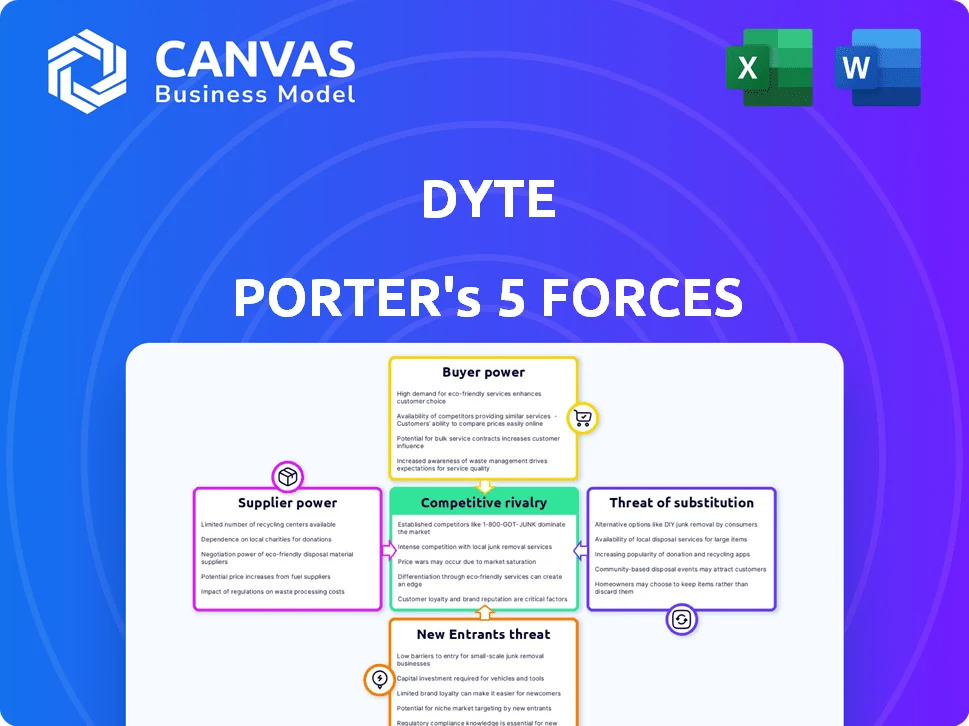
dyte Porter's Five Forces Analysis
This Porter's Five Forces analysis preview is the complete document. It's the same professionally crafted analysis you'll instantly receive post-purchase.

Porter's Five Forces Analysis Template

Go Beyond the Preview—Access the Full Strategic Report
Analyzing dyte through Porter's Five Forces reveals its industry's competitive landscape. The analysis assesses rivalry, supplier & buyer power, new entrants, and substitutes. This framework identifies market threats and opportunities. Understanding these forces is key for strategic planning & investment decisions. This snapshot is just the beginning. Unlock the full Porter's Five Forces Analysis to explore dyte’s competitive dynamics, market pressures, and strategic advantages in detail.
Suppliers Bargaining Power

Key Technology Providers
Dyte's reliance on key tech providers, like AWS, grants these suppliers some bargaining power. In 2024, AWS's revenue reached approximately $90 billion, showing its substantial market influence. This concentration means Dyte must negotiate effectively. Failure could lead to higher costs or service disruptions.
Availability of Alternatives
The availability of alternatives significantly impacts supplier power. If several cloud hosting or video processing options exist, supplier power decreases. For example, in 2024, the cloud computing market saw diverse providers, reducing individual supplier influence. This competition helps keep prices and service terms favorable for businesses.

Uniqueness of Supplier Offerings
If a supplier offers unique, essential tech like specific codecs or streaming protocols crucial for Dyte, their bargaining power increases. This is particularly true if these offerings have no readily available alternatives. For example, in 2024, companies with proprietary video compression tech could command higher prices. This advantage is amplified by their ability to control critical aspects of Dyte's service delivery.

Cost of Switching Suppliers
The cost of switching suppliers is a crucial factor in assessing supplier power for Dyte. If Dyte faces high switching costs, such as significant investment in new equipment or extensive retraining, existing suppliers gain more leverage. These costs can include financial expenses, time investments, and the risk of operational disruptions. This scenario allows suppliers to potentially increase prices or dictate terms.
- High Switching Costs: Increased supplier power.
- Low Switching Costs: Reduced supplier power.
- Examples: Software integration, specialized components.
- Impact: Affects Dyte's profitability and strategic flexibility.
Supplier Concentration
Supplier concentration significantly impacts a company's operational landscape. When key components or services are controlled by a few powerful suppliers, they wield considerable influence. This can lead to increased costs and reduced flexibility for buyers. For example, in 2024, the semiconductor industry, dominated by a handful of major players like TSMC and Intel, demonstrated this power.
These suppliers can dictate terms, pricing, and supply availability. Conversely, if suppliers are numerous and fragmented, buyers have more leverage. This dynamic shapes negotiation outcomes and profitability. This power balance is a crucial element of Porter's Five Forces.
- Semiconductor market concentration creates supplier power.
- Fragmented supplier markets reduce supplier power.
- Supplier power impacts costs and flexibility.
- Negotiation outcomes and profitability are affected.
Supplier Power Dynamics: Costs and Flexibility
Dyte's supplier power hinges on factors like AWS's $90B revenue in 2024, and the availability of alternatives. Unique tech from suppliers, such as proprietary codecs, boosts their leverage. High switching costs also strengthen supplier power. These elements affect Dyte's costs and operational flexibility.
| Factor | Impact on Dyte | 2024 Example |
|---|---|---|
| Supplier Concentration | Increased Costs, Reduced Flexibility | Semiconductor industry dominated by few (TSMC, Intel) |
| Switching Costs | Higher Prices, Dictated Terms | Significant investment in new equipment or retraining |
| Alternative Availability | Reduced Supplier Power | Cloud computing market with diverse providers |
Customers Bargaining Power

Availability of Alternatives
Dyte's customers, mainly developers & businesses, have many choices for video/audio integration. They can build their own systems or use competitors' SDKs/APIs. This wide availability of alternatives significantly boosts customer bargaining power. The global video conferencing market, estimated at $14.6 billion in 2023, shows these choices are plentiful. Competition is fierce.
Switching Costs for Customers
Switching costs significantly influence customer bargaining power. If switching from Dyte to a competitor is easy, customers have more power. Conversely, high switching costs, like complex integrations, reduce customer power. In 2024, the video SDK market saw efforts to simplify integration. However, vendor lock-in can still impact customer decisions. Easy integration and low switching costs empower customers.

Price Sensitivity
Customers' price sensitivity significantly impacts bargaining power. In competitive markets, customers actively compare pricing models. For example, in 2024, the average SaaS churn rate rose to 12%, indicating customers' willingness to switch for better deals.

Customer Concentration
Customer concentration significantly impacts bargaining power. If Dyte relies heavily on a few major clients, these customers gain considerable leverage. They can demand lower prices, customized features, or other favorable terms, squeezing Dyte's profitability. This scenario weakens Dyte's market position.
- Concentration Ratio: A high concentration ratio (e.g., top 3 customers account for >50% of revenue) indicates strong customer power.
- Switching Costs: Low switching costs for customers amplify their bargaining power.
- Customer Profitability: If Dyte's services are crucial for customer profitability, power shifts to Dyte.
- 2024 Data: Analyze Dyte's client base to assess concentration and its impact on pricing.
Customer's Ability to Build In-House
Some customers, particularly those with substantial resources, might opt to develop their own video infrastructure. This in-house capability strengthens their bargaining position when dealing with providers like Dyte. The ability to self-provide creates a credible threat of switching, enabling these customers to negotiate more favorable terms. For instance, companies like Amazon and Netflix have heavily invested in their own video platforms. This control allows them to dictate features and pricing. In 2024, the trend of large tech companies building in-house solutions continues.
- Building in-house reduces dependency on external providers.
- Negotiating power increases due to the alternative of self-service.
- Companies with existing tech infrastructure have an advantage.
- This trend is more prevalent among larger enterprises.
Customer Power in a $15.8B Market
Dyte's customers, primarily developers and businesses, hold significant bargaining power due to the availability of alternative video/audio integration solutions and the competitive market landscape. In 2024, the video conferencing market reached $15.8 billion, offering numerous choices. Easy switching and price sensitivity further amplify customer influence on pricing and features.
| Factor | Impact | 2024 Data/Insight |
|---|---|---|
| Alternatives | High customer power | Market size: $15.8B |
| Switching Costs | Low costs increase power | SaaS churn rate: 12% |
| Price Sensitivity | High sensitivity | Competitive pricing models |
Rivalry Among Competitors

Number and Strength of Competitors
The video infrastructure-as-a-service sector is highly competitive, featuring many firms with comparable SDKs and APIs. Established companies and agile startups drive strong rivalry. In 2024, the market size is estimated at $5.2 billion, with a CAGR of 20%. This competition pressures pricing and innovation.
Market Growth Rate
The video streaming and communication market is expanding, with a projected global market size of $1.06 trillion by 2027. Despite this growth, the competition is fierce. Companies like Netflix and Disney+ aggressively compete for subscribers, indicating a high level of rivalry. This competition includes pricing wars and content acquisitions.

Product Differentiation
Product differentiation is key for Dyte. Offering unique features, user-friendliness, and excellent service separates it from rivals. In 2024, companies like Dyte are focusing on developer experience, with over 70% of developers prioritizing ease of integration. Competitive pricing models, as seen in the video conferencing market, also play a huge role.

Switching Costs for Customers
Switching costs significantly influence competitive rivalry. Lower switching costs make it simpler for customers to switch providers, intensifying competition. Dyte and its rivals, focusing on easy integration, may lower these costs. This can lead to increased price wars and aggressive marketing strategies. The goal is to retain customers by providing superior value and service to counteract the ease of switching.
- Churn rates in the SaaS industry average around 10-15% annually, reflecting the ease with which customers can switch.
- Companies with high switching costs often have higher customer retention rates, sometimes exceeding 90%.
- Easy integration features can reduce implementation time and costs, thus lowering switching barriers.
Exit Barriers
High exit barriers intensify competition. When leaving is tough, firms fight harder to survive. This can lead to price wars and reduced profits. For example, the airline industry, with its expensive assets, often sees intense rivalry even during downturns. The cost of shutting down a factory or laying off employees can be substantial, making it harder for companies to exit the market.
- Airline industry exit costs are extremely high, with significant asset write-downs.
- Pharmaceuticals: Regulatory hurdles and sunk costs make exiting difficult.
- Oil and Gas: Decommissioning costs and environmental liabilities are substantial.
- Steel industry: High capital investments and labor agreements increase exit barriers.
Video Infrastructure: A $5.2B Battleground
Competitive rivalry in the video infrastructure-as-a-service sector is intense, driven by numerous firms with similar offerings, such as comparable SDKs and APIs. The market, valued at $5.2 billion in 2024, fuels this rivalry. Product differentiation, like developer-friendly features, is crucial for companies like Dyte.
| Factor | Impact | Example |
|---|---|---|
| Market Growth | Intensifies competition | Video streaming market projected to $1.06T by 2027 |
| Switching Costs | Lower costs increase rivalry | SaaS churn rates averaging 10-15% annually |
| Exit Barriers | High barriers intensify competition | Airline industry's high asset costs |
DYTE PORTER'S FIVE FORCES TEMPLATE RESEARCH
What is included in the product
Detailed Word Document
Tailored exclusively for dyte, analyzing its position within its competitive landscape.
Customizable Excel Spreadsheet
Instantly grasp strategic pressure with a powerful radar chart to visualize competitive dynamics.
Preview the Actual Deliverable
dyte Porter's Five Forces Analysis
This Porter's Five Forces analysis preview is the complete document. It's the same professionally crafted analysis you'll instantly receive post-purchase.
Porter's Five Forces Analysis Template
Go Beyond the Preview—Access the Full Strategic Report
Analyzing dyte through Porter's Five Forces reveals its industry's competitive landscape. The analysis assesses rivalry, supplier & buyer power, new entrants, and substitutes. This framework identifies market threats and opportunities. Understanding these forces is key for strategic planning & investment decisions. This snapshot is just the beginning. Unlock the full Porter's Five Forces Analysis to explore dyte’s competitive dynamics, market pressures, and strategic advantages in detail.
Suppliers Bargaining Power
Key Technology Providers
Dyte's reliance on key tech providers, like AWS, grants these suppliers some bargaining power. In 2024, AWS's revenue reached approximately $90 billion, showing its substantial market influence. This concentration means Dyte must negotiate effectively. Failure could lead to higher costs or service disruptions.
Availability of Alternatives
The availability of alternatives significantly impacts supplier power. If several cloud hosting or video processing options exist, supplier power decreases. For example, in 2024, the cloud computing market saw diverse providers, reducing individual supplier influence. This competition helps keep prices and service terms favorable for businesses.
Uniqueness of Supplier Offerings
If a supplier offers unique, essential tech like specific codecs or streaming protocols crucial for Dyte, their bargaining power increases. This is particularly true if these offerings have no readily available alternatives. For example, in 2024, companies with proprietary video compression tech could command higher prices. This advantage is amplified by their ability to control critical aspects of Dyte's service delivery.
Cost of Switching Suppliers
The cost of switching suppliers is a crucial factor in assessing supplier power for Dyte. If Dyte faces high switching costs, such as significant investment in new equipment or extensive retraining, existing suppliers gain more leverage. These costs can include financial expenses, time investments, and the risk of operational disruptions. This scenario allows suppliers to potentially increase prices or dictate terms.
- High Switching Costs: Increased supplier power.
- Low Switching Costs: Reduced supplier power.
- Examples: Software integration, specialized components.
- Impact: Affects Dyte's profitability and strategic flexibility.
Supplier Concentration
Supplier concentration significantly impacts a company's operational landscape. When key components or services are controlled by a few powerful suppliers, they wield considerable influence. This can lead to increased costs and reduced flexibility for buyers. For example, in 2024, the semiconductor industry, dominated by a handful of major players like TSMC and Intel, demonstrated this power.
These suppliers can dictate terms, pricing, and supply availability. Conversely, if suppliers are numerous and fragmented, buyers have more leverage. This dynamic shapes negotiation outcomes and profitability. This power balance is a crucial element of Porter's Five Forces.
- Semiconductor market concentration creates supplier power.
- Fragmented supplier markets reduce supplier power.
- Supplier power impacts costs and flexibility.
- Negotiation outcomes and profitability are affected.
Supplier Power Dynamics: Costs and Flexibility
Dyte's supplier power hinges on factors like AWS's $90B revenue in 2024, and the availability of alternatives. Unique tech from suppliers, such as proprietary codecs, boosts their leverage. High switching costs also strengthen supplier power. These elements affect Dyte's costs and operational flexibility.
| Factor | Impact on Dyte | 2024 Example |
|---|---|---|
| Supplier Concentration | Increased Costs, Reduced Flexibility | Semiconductor industry dominated by few (TSMC, Intel) |
| Switching Costs | Higher Prices, Dictated Terms | Significant investment in new equipment or retraining |
| Alternative Availability | Reduced Supplier Power | Cloud computing market with diverse providers |
Customers Bargaining Power
Availability of Alternatives
Dyte's customers, mainly developers & businesses, have many choices for video/audio integration. They can build their own systems or use competitors' SDKs/APIs. This wide availability of alternatives significantly boosts customer bargaining power. The global video conferencing market, estimated at $14.6 billion in 2023, shows these choices are plentiful. Competition is fierce.
Switching Costs for Customers
Switching costs significantly influence customer bargaining power. If switching from Dyte to a competitor is easy, customers have more power. Conversely, high switching costs, like complex integrations, reduce customer power. In 2024, the video SDK market saw efforts to simplify integration. However, vendor lock-in can still impact customer decisions. Easy integration and low switching costs empower customers.
Price Sensitivity
Customers' price sensitivity significantly impacts bargaining power. In competitive markets, customers actively compare pricing models. For example, in 2024, the average SaaS churn rate rose to 12%, indicating customers' willingness to switch for better deals.
Customer Concentration
Customer concentration significantly impacts bargaining power. If Dyte relies heavily on a few major clients, these customers gain considerable leverage. They can demand lower prices, customized features, or other favorable terms, squeezing Dyte's profitability. This scenario weakens Dyte's market position.
- Concentration Ratio: A high concentration ratio (e.g., top 3 customers account for >50% of revenue) indicates strong customer power.
- Switching Costs: Low switching costs for customers amplify their bargaining power.
- Customer Profitability: If Dyte's services are crucial for customer profitability, power shifts to Dyte.
- 2024 Data: Analyze Dyte's client base to assess concentration and its impact on pricing.
Customer's Ability to Build In-House
Some customers, particularly those with substantial resources, might opt to develop their own video infrastructure. This in-house capability strengthens their bargaining position when dealing with providers like Dyte. The ability to self-provide creates a credible threat of switching, enabling these customers to negotiate more favorable terms. For instance, companies like Amazon and Netflix have heavily invested in their own video platforms. This control allows them to dictate features and pricing. In 2024, the trend of large tech companies building in-house solutions continues.
- Building in-house reduces dependency on external providers.
- Negotiating power increases due to the alternative of self-service.
- Companies with existing tech infrastructure have an advantage.
- This trend is more prevalent among larger enterprises.
Customer Power in a $15.8B Market
Dyte's customers, primarily developers and businesses, hold significant bargaining power due to the availability of alternative video/audio integration solutions and the competitive market landscape. In 2024, the video conferencing market reached $15.8 billion, offering numerous choices. Easy switching and price sensitivity further amplify customer influence on pricing and features.
| Factor | Impact | 2024 Data/Insight |
|---|---|---|
| Alternatives | High customer power | Market size: $15.8B |
| Switching Costs | Low costs increase power | SaaS churn rate: 12% |
| Price Sensitivity | High sensitivity | Competitive pricing models |
Rivalry Among Competitors
Number and Strength of Competitors
The video infrastructure-as-a-service sector is highly competitive, featuring many firms with comparable SDKs and APIs. Established companies and agile startups drive strong rivalry. In 2024, the market size is estimated at $5.2 billion, with a CAGR of 20%. This competition pressures pricing and innovation.
Market Growth Rate
The video streaming and communication market is expanding, with a projected global market size of $1.06 trillion by 2027. Despite this growth, the competition is fierce. Companies like Netflix and Disney+ aggressively compete for subscribers, indicating a high level of rivalry. This competition includes pricing wars and content acquisitions.
Product Differentiation
Product differentiation is key for Dyte. Offering unique features, user-friendliness, and excellent service separates it from rivals. In 2024, companies like Dyte are focusing on developer experience, with over 70% of developers prioritizing ease of integration. Competitive pricing models, as seen in the video conferencing market, also play a huge role.
Switching Costs for Customers
Switching costs significantly influence competitive rivalry. Lower switching costs make it simpler for customers to switch providers, intensifying competition. Dyte and its rivals, focusing on easy integration, may lower these costs. This can lead to increased price wars and aggressive marketing strategies. The goal is to retain customers by providing superior value and service to counteract the ease of switching.
- Churn rates in the SaaS industry average around 10-15% annually, reflecting the ease with which customers can switch.
- Companies with high switching costs often have higher customer retention rates, sometimes exceeding 90%.
- Easy integration features can reduce implementation time and costs, thus lowering switching barriers.
Exit Barriers
High exit barriers intensify competition. When leaving is tough, firms fight harder to survive. This can lead to price wars and reduced profits. For example, the airline industry, with its expensive assets, often sees intense rivalry even during downturns. The cost of shutting down a factory or laying off employees can be substantial, making it harder for companies to exit the market.
- Airline industry exit costs are extremely high, with significant asset write-downs.
- Pharmaceuticals: Regulatory hurdles and sunk costs make exiting difficult.
- Oil and Gas: Decommissioning costs and environmental liabilities are substantial.
- Steel industry: High capital investments and labor agreements increase exit barriers.
Video Infrastructure: A $5.2B Battleground
Competitive rivalry in the video infrastructure-as-a-service sector is intense, driven by numerous firms with similar offerings, such as comparable SDKs and APIs. The market, valued at $5.2 billion in 2024, fuels this rivalry. Product differentiation, like developer-friendly features, is crucial for companies like Dyte.
| Factor | Impact | Example |
|---|---|---|
| Market Growth | Intensifies competition | Video streaming market projected to $1.06T by 2027 |
| Switching Costs | Lower costs increase rivalry | SaaS churn rates averaging 10-15% annually |
| Exit Barriers | High barriers intensify competition | Airline industry's high asset costs |
Product Information
Product Information
Shipping & Returns
Shipping & Returns
Description
What is included in the product
Detailed Word Document
Tailored exclusively for dyte, analyzing its position within its competitive landscape.
Customizable Excel Spreadsheet
Instantly grasp strategic pressure with a powerful radar chart to visualize competitive dynamics.
Preview the Actual Deliverable
dyte Porter's Five Forces Analysis
This Porter's Five Forces analysis preview is the complete document. It's the same professionally crafted analysis you'll instantly receive post-purchase.
Porter's Five Forces Analysis Template
Go Beyond the Preview—Access the Full Strategic Report
Analyzing dyte through Porter's Five Forces reveals its industry's competitive landscape. The analysis assesses rivalry, supplier & buyer power, new entrants, and substitutes. This framework identifies market threats and opportunities. Understanding these forces is key for strategic planning & investment decisions. This snapshot is just the beginning. Unlock the full Porter's Five Forces Analysis to explore dyte’s competitive dynamics, market pressures, and strategic advantages in detail.
Suppliers Bargaining Power
Key Technology Providers
Dyte's reliance on key tech providers, like AWS, grants these suppliers some bargaining power. In 2024, AWS's revenue reached approximately $90 billion, showing its substantial market influence. This concentration means Dyte must negotiate effectively. Failure could lead to higher costs or service disruptions.
Availability of Alternatives
The availability of alternatives significantly impacts supplier power. If several cloud hosting or video processing options exist, supplier power decreases. For example, in 2024, the cloud computing market saw diverse providers, reducing individual supplier influence. This competition helps keep prices and service terms favorable for businesses.
Uniqueness of Supplier Offerings
If a supplier offers unique, essential tech like specific codecs or streaming protocols crucial for Dyte, their bargaining power increases. This is particularly true if these offerings have no readily available alternatives. For example, in 2024, companies with proprietary video compression tech could command higher prices. This advantage is amplified by their ability to control critical aspects of Dyte's service delivery.
Cost of Switching Suppliers
The cost of switching suppliers is a crucial factor in assessing supplier power for Dyte. If Dyte faces high switching costs, such as significant investment in new equipment or extensive retraining, existing suppliers gain more leverage. These costs can include financial expenses, time investments, and the risk of operational disruptions. This scenario allows suppliers to potentially increase prices or dictate terms.
- High Switching Costs: Increased supplier power.
- Low Switching Costs: Reduced supplier power.
- Examples: Software integration, specialized components.
- Impact: Affects Dyte's profitability and strategic flexibility.
Supplier Concentration
Supplier concentration significantly impacts a company's operational landscape. When key components or services are controlled by a few powerful suppliers, they wield considerable influence. This can lead to increased costs and reduced flexibility for buyers. For example, in 2024, the semiconductor industry, dominated by a handful of major players like TSMC and Intel, demonstrated this power.
These suppliers can dictate terms, pricing, and supply availability. Conversely, if suppliers are numerous and fragmented, buyers have more leverage. This dynamic shapes negotiation outcomes and profitability. This power balance is a crucial element of Porter's Five Forces.
- Semiconductor market concentration creates supplier power.
- Fragmented supplier markets reduce supplier power.
- Supplier power impacts costs and flexibility.
- Negotiation outcomes and profitability are affected.
Supplier Power Dynamics: Costs and Flexibility
Dyte's supplier power hinges on factors like AWS's $90B revenue in 2024, and the availability of alternatives. Unique tech from suppliers, such as proprietary codecs, boosts their leverage. High switching costs also strengthen supplier power. These elements affect Dyte's costs and operational flexibility.
| Factor | Impact on Dyte | 2024 Example |
|---|---|---|
| Supplier Concentration | Increased Costs, Reduced Flexibility | Semiconductor industry dominated by few (TSMC, Intel) |
| Switching Costs | Higher Prices, Dictated Terms | Significant investment in new equipment or retraining |
| Alternative Availability | Reduced Supplier Power | Cloud computing market with diverse providers |
Customers Bargaining Power
Availability of Alternatives
Dyte's customers, mainly developers & businesses, have many choices for video/audio integration. They can build their own systems or use competitors' SDKs/APIs. This wide availability of alternatives significantly boosts customer bargaining power. The global video conferencing market, estimated at $14.6 billion in 2023, shows these choices are plentiful. Competition is fierce.
Switching Costs for Customers
Switching costs significantly influence customer bargaining power. If switching from Dyte to a competitor is easy, customers have more power. Conversely, high switching costs, like complex integrations, reduce customer power. In 2024, the video SDK market saw efforts to simplify integration. However, vendor lock-in can still impact customer decisions. Easy integration and low switching costs empower customers.
Price Sensitivity
Customers' price sensitivity significantly impacts bargaining power. In competitive markets, customers actively compare pricing models. For example, in 2024, the average SaaS churn rate rose to 12%, indicating customers' willingness to switch for better deals.
Customer Concentration
Customer concentration significantly impacts bargaining power. If Dyte relies heavily on a few major clients, these customers gain considerable leverage. They can demand lower prices, customized features, or other favorable terms, squeezing Dyte's profitability. This scenario weakens Dyte's market position.
- Concentration Ratio: A high concentration ratio (e.g., top 3 customers account for >50% of revenue) indicates strong customer power.
- Switching Costs: Low switching costs for customers amplify their bargaining power.
- Customer Profitability: If Dyte's services are crucial for customer profitability, power shifts to Dyte.
- 2024 Data: Analyze Dyte's client base to assess concentration and its impact on pricing.
Customer's Ability to Build In-House
Some customers, particularly those with substantial resources, might opt to develop their own video infrastructure. This in-house capability strengthens their bargaining position when dealing with providers like Dyte. The ability to self-provide creates a credible threat of switching, enabling these customers to negotiate more favorable terms. For instance, companies like Amazon and Netflix have heavily invested in their own video platforms. This control allows them to dictate features and pricing. In 2024, the trend of large tech companies building in-house solutions continues.
- Building in-house reduces dependency on external providers.
- Negotiating power increases due to the alternative of self-service.
- Companies with existing tech infrastructure have an advantage.
- This trend is more prevalent among larger enterprises.
Customer Power in a $15.8B Market
Dyte's customers, primarily developers and businesses, hold significant bargaining power due to the availability of alternative video/audio integration solutions and the competitive market landscape. In 2024, the video conferencing market reached $15.8 billion, offering numerous choices. Easy switching and price sensitivity further amplify customer influence on pricing and features.
| Factor | Impact | 2024 Data/Insight |
|---|---|---|
| Alternatives | High customer power | Market size: $15.8B |
| Switching Costs | Low costs increase power | SaaS churn rate: 12% |
| Price Sensitivity | High sensitivity | Competitive pricing models |
Rivalry Among Competitors
Number and Strength of Competitors
The video infrastructure-as-a-service sector is highly competitive, featuring many firms with comparable SDKs and APIs. Established companies and agile startups drive strong rivalry. In 2024, the market size is estimated at $5.2 billion, with a CAGR of 20%. This competition pressures pricing and innovation.
Market Growth Rate
The video streaming and communication market is expanding, with a projected global market size of $1.06 trillion by 2027. Despite this growth, the competition is fierce. Companies like Netflix and Disney+ aggressively compete for subscribers, indicating a high level of rivalry. This competition includes pricing wars and content acquisitions.
Product Differentiation
Product differentiation is key for Dyte. Offering unique features, user-friendliness, and excellent service separates it from rivals. In 2024, companies like Dyte are focusing on developer experience, with over 70% of developers prioritizing ease of integration. Competitive pricing models, as seen in the video conferencing market, also play a huge role.
Switching Costs for Customers
Switching costs significantly influence competitive rivalry. Lower switching costs make it simpler for customers to switch providers, intensifying competition. Dyte and its rivals, focusing on easy integration, may lower these costs. This can lead to increased price wars and aggressive marketing strategies. The goal is to retain customers by providing superior value and service to counteract the ease of switching.
- Churn rates in the SaaS industry average around 10-15% annually, reflecting the ease with which customers can switch.
- Companies with high switching costs often have higher customer retention rates, sometimes exceeding 90%.
- Easy integration features can reduce implementation time and costs, thus lowering switching barriers.
Exit Barriers
High exit barriers intensify competition. When leaving is tough, firms fight harder to survive. This can lead to price wars and reduced profits. For example, the airline industry, with its expensive assets, often sees intense rivalry even during downturns. The cost of shutting down a factory or laying off employees can be substantial, making it harder for companies to exit the market.
- Airline industry exit costs are extremely high, with significant asset write-downs.
- Pharmaceuticals: Regulatory hurdles and sunk costs make exiting difficult.
- Oil and Gas: Decommissioning costs and environmental liabilities are substantial.
- Steel industry: High capital investments and labor agreements increase exit barriers.
Video Infrastructure: A $5.2B Battleground
Competitive rivalry in the video infrastructure-as-a-service sector is intense, driven by numerous firms with similar offerings, such as comparable SDKs and APIs. The market, valued at $5.2 billion in 2024, fuels this rivalry. Product differentiation, like developer-friendly features, is crucial for companies like Dyte.
| Factor | Impact | Example |
|---|---|---|
| Market Growth | Intensifies competition | Video streaming market projected to $1.06T by 2027 |
| Switching Costs | Lower costs increase rivalry | SaaS churn rates averaging 10-15% annually |
| Exit Barriers | High barriers intensify competition | Airline industry's high asset costs |