DSV MILJØ A/S PESTLE ANALYSIS TEMPLATE RESEARCH
What is included in the product
 Detailed Word Document
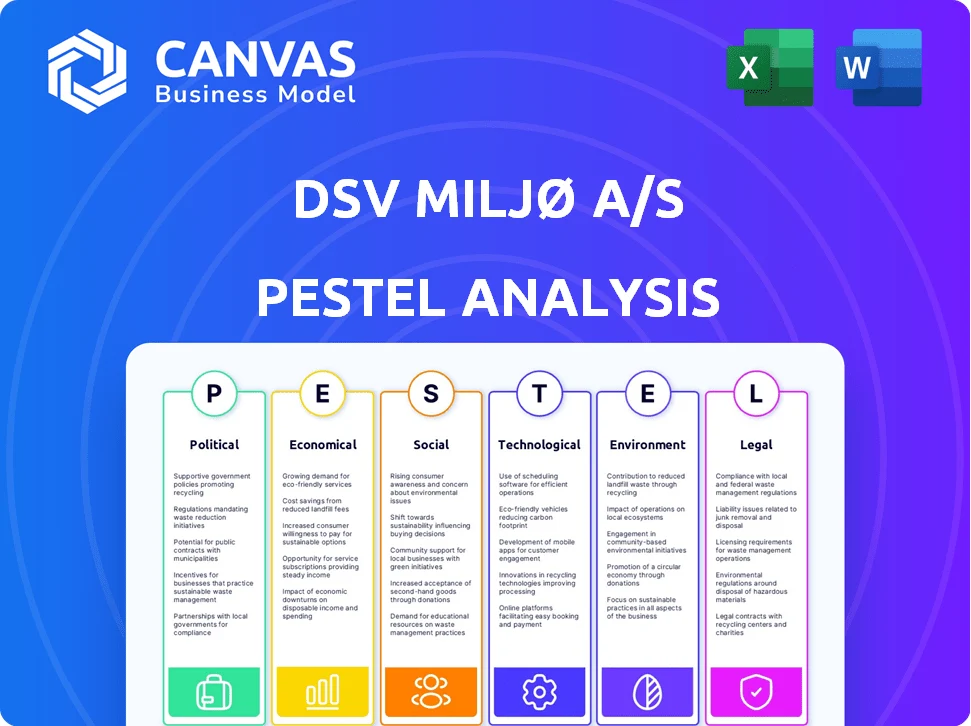
DSV Miljø A/S's PESTLE analyzes external macro-environmental forces across six categories.

 Customizable Excel Spreadsheet
Provides a concise version that can be dropped into PowerPoints or used in group planning sessions.
Same Document Delivered
DSV Miljø A/S PESTLE Analysis
The PESTLE analysis preview is the complete, final document. This is the exact document, fully structured & ready. You’ll receive the same file after payment, containing all the insights. There are no hidden content or additional formatting required.

PESTLE Analysis Template

Plan Smarter. Present Sharper. Compete Stronger.
Explore the dynamic environment surrounding DSV Miljø A/S with our expert PESTLE analysis. Uncover how political, economic, social, technological, legal, and environmental factors impact its operations. Understand market shifts, anticipate challenges, and capitalize on opportunities. Download the full analysis to empower your strategic decisions.
Political factors

Government Regulations and Policies
Government regulations heavily influence DSV Miljø A/S in Denmark and Sweden. Waste management policies dictate collection, treatment, and recycling practices. The Danish government's EPR schemes impact operational costs. In 2024, Denmark's waste recycling rate was approximately 40%, a target influenced by these policies.
Circular Economy Initiatives
The political landscape emphasizes circular economy in Denmark and the EU, affecting DSV Miljø A/S. Denmark aims for a 70% waste recycling rate by 2030, and the EU has similar goals. This drives investment in recycling tech. In 2024, the EU's circular economy action plan continues to evolve, shaping waste management regulations.

Political Stability
Political stability is vital for DSV Miljø A/S's operations, ensuring predictable policies. Geopolitical events may indirectly affect the company's services. For 2024, Denmark's political environment remained stable, aiding business. This stability facilitated consistent policy implementation and business environment predictability. In 2025, DSV's strategic plans will likely factor in the stability of key operational regions.

Public Procurement Policies
Public procurement policies significantly impact DSV Miljø A/S, especially regarding government and municipal tenders for waste management. Recent trends prioritize sustainability and efficiency in these tenders. For instance, in 2024, the EU's Green Public Procurement criteria influenced waste management contracts across member states. This necessitates DSV Miljø A/S to adapt its services to meet stringent environmental standards to remain competitive.
- EU's Green Public Procurement criteria.
- Emphasis on sustainability in tenders.
- Impact on DSV Miljø A/S's services.
- Competition within waste management sector.
International Agreements and EU Directives
DSV Miljø A/S must comply with EU directives. These directives, like the Packaging and Packaging Waste Directive, are key. In 2024, the EU's circular economy action plan continues to shape regulations. The EU aims to halve waste by 2030. This impacts DSV's operations significantly.
- EU waste recycling targets are increasing.
- DSV must adapt to stricter environmental rules.
- New directives affect waste management practices.
- Compliance costs are likely to rise.
Politics and Regulations: Shaping Waste Management
Government regulations and political initiatives significantly shape DSV Miljø A/S. Denmark's 2024 recycling rate was about 40%, influenced by policies, with a 2030 target of 70%. EU directives, like the Packaging Directive, affect the company's operations. The political stability in Denmark aids in predictable policy implementation.
| Political Factor | Impact on DSV Miljø A/S | Data (2024/2025) |
|---|---|---|
| Government Regulations | Directly influences waste management practices. | Danish waste recycling rate ~40% (2024). |
| EU Circular Economy Goals | Drives investment and operational adjustments. | EU aims to halve waste by 2030. |
| Political Stability | Ensures policy predictability. | Denmark's stable political environment. |
Economic factors

Economic Growth and Stability
Denmark, Sweden, and Norway's economic health directly impacts DSV Miljø A/S. Strong economies boost waste generation, increasing service demand. In 2024, Denmark's GDP growth was around 1.8%, while Sweden and Norway saw 0.7% and 1.5% respectively. Economic instability reduces demand, affecting DSV Miljø's revenue.
Activity in the Construction Industry
DSV Miljø A/S heavily relies on the construction sector for its environmental solutions. Increased construction activity fuels demand for its services and raw materials. In 2024, construction spending in Europe is projected to grow by about 2%, impacting DSV Miljø. This growth is influenced by infrastructure projects and housing.

Energy Prices
Energy prices are crucial for DSV Miljø A/S, affecting transport and treatment costs. In 2024, fuel prices showed volatility, impacting operational expenses. Electricity costs also play a role in waste processing. Rising energy prices can squeeze profit margins.

Inflation and Interest Rates
Inflation poses a risk to DSV Miljø A/S by potentially escalating operational expenses, such as fuel and labor costs. Interest rate fluctuations directly impact the company’s borrowing costs and investment strategies. These economic factors are crucial for DSV Miljø A/S. In the EU, inflation in March 2024 was at 2.4%, impacting business costs.
- Inflation in the Eurozone decreased to 2.4% in March 2024.
- The European Central Bank (ECB) held interest rates steady in April 2024.
Customer Investment Levels
Economic downturns often lead customers to cut back on non-essential services, potentially affecting waste management. This can directly impact DSV Miljø A/S's revenue streams. During economic slowdowns, companies may delay or reduce spending, including waste disposal. This can result in lower demand for their services, affecting profitability.
- Consumer Confidence Index in Denmark decreased to 87.2 in May 2024.
- Danish GDP growth slowed to 1.1% in Q1 2024.
- DSV's Q1 2024 revenue decreased by 5.7% to DKK 41.7 billion.
Economic Trends Shaping Business Performance
Economic factors such as GDP growth, inflation, and interest rates greatly influence DSV Miljø A/S.
Reduced consumer confidence and slower GDP growth can negatively affect revenue, as seen with a 5.7% revenue decrease in Q1 2024.
Fuel and energy price volatility alongside fluctuations in inflation like the EU's March 2024 rate of 2.4%, impact operational costs and borrowing expenses.
| Factor | Data Point | Impact |
|---|---|---|
| GDP Growth (Denmark, Q1 2024) | 1.1% | Slower demand |
| Inflation (EU, March 2024) | 2.4% | Increased costs |
| Consumer Confidence (Denmark, May 2024) | 87.2 | Reduced spending |
Sociological factors

Public Awareness and Environmental Concerns
Public awareness of environmental issues is increasing, boosting demand for sustainable waste solutions. In 2024, global climate change concerns grew, with waste management solutions becoming more crucial. DSV Miljø A/S benefits from this societal shift. Public support for eco-friendly practices strengthens the market.
Consumer Behavior and Waste Sorting Habits
Household waste sorting habits and consumer behavior are crucial for DSV Miljø. In 2024, EU household waste generation was about 500 kg per person, with recycling rates varying greatly. Consumer attitudes towards recycling affect waste volumes and composition. Changes in behavior influence operational needs and investment in recycling infrastructure.

Community Acceptance of Facilities
Community acceptance significantly impacts DSV Miljø A/S. Public perception of waste facilities directly influences project approvals and operational permits. In 2024, NIMBY (Not In My Backyard) sentiments delayed numerous waste projects across Europe. For example, in Denmark, stricter environmental regulations, as of late 2024, require more transparent community engagement. This affects DSV Miljø's expansion plans.

Workforce Availability and Skills
The success of DSV Miljø A/S hinges on having a capable workforce for waste management. Factors such as labor market trends and education levels impact both workforce availability and wage expenses. A well-trained staff is crucial for efficient operations, including collection, sorting, and treatment processes.
- In 2024, the waste management sector in Denmark employed approximately 10,000 people.
- The average salary in waste management in Denmark was about 45,000 DKK per month in late 2024.
- Government initiatives in 2025 may influence vocational training programs in environmental services.
Attitude Towards Recycling and Reuse
Societal attitudes greatly influence recycling and reuse programs, directly impacting DSV Miljø A/S. Positive public perception fosters demand for recycled goods, supporting the company's circular economy model. Recent surveys show increasing environmental awareness, with 70% of Europeans actively recycling in 2024. This trend boosts DSV's business prospects.
- 70% of Europeans actively recycle (2024).
- Growing demand for sustainable products.
- Positive attitudes support circular economy.
Green Growth: Recycling Trends & Impact
Rising environmental awareness fuels demand for DSV Miljø's services. Consumer recycling habits and waste generation impact operational needs. Public acceptance and workforce availability are critical. A well-trained staff supports efficient operations. 70% of Europeans recycle in 2024, enhancing prospects.
| Factor | Impact on DSV Miljø A/S | Data (2024/2025) |
|---|---|---|
| Public Awareness | Increased demand for sustainable solutions | 70% of Europeans actively recycle (2024), with growth. |
| Consumer Behavior | Influences waste volumes and composition | EU household waste ~500 kg/person (2024). |
| Community Acceptance | Impacts project approvals | NIMBY sentiments delay projects. |
Original: $10.00
-65%$10.00
$3.50DSV MILJØ A/S PESTLE ANALYSIS TEMPLATE RESEARCH
What is included in the product
Detailed Word Document
DSV Miljø A/S's PESTLE analyzes external macro-environmental forces across six categories.
Customizable Excel Spreadsheet
Provides a concise version that can be dropped into PowerPoints or used in group planning sessions.
Same Document Delivered
DSV Miljø A/S PESTLE Analysis
The PESTLE analysis preview is the complete, final document. This is the exact document, fully structured & ready. You’ll receive the same file after payment, containing all the insights. There are no hidden content or additional formatting required.
PESTLE Analysis Template
Plan Smarter. Present Sharper. Compete Stronger.
Explore the dynamic environment surrounding DSV Miljø A/S with our expert PESTLE analysis. Uncover how political, economic, social, technological, legal, and environmental factors impact its operations. Understand market shifts, anticipate challenges, and capitalize on opportunities. Download the full analysis to empower your strategic decisions.
Political factors
Government Regulations and Policies
Government regulations heavily influence DSV Miljø A/S in Denmark and Sweden. Waste management policies dictate collection, treatment, and recycling practices. The Danish government's EPR schemes impact operational costs. In 2024, Denmark's waste recycling rate was approximately 40%, a target influenced by these policies.
Circular Economy Initiatives
The political landscape emphasizes circular economy in Denmark and the EU, affecting DSV Miljø A/S. Denmark aims for a 70% waste recycling rate by 2030, and the EU has similar goals. This drives investment in recycling tech. In 2024, the EU's circular economy action plan continues to evolve, shaping waste management regulations.
Political Stability
Political stability is vital for DSV Miljø A/S's operations, ensuring predictable policies. Geopolitical events may indirectly affect the company's services. For 2024, Denmark's political environment remained stable, aiding business. This stability facilitated consistent policy implementation and business environment predictability. In 2025, DSV's strategic plans will likely factor in the stability of key operational regions.
Public Procurement Policies
Public procurement policies significantly impact DSV Miljø A/S, especially regarding government and municipal tenders for waste management. Recent trends prioritize sustainability and efficiency in these tenders. For instance, in 2024, the EU's Green Public Procurement criteria influenced waste management contracts across member states. This necessitates DSV Miljø A/S to adapt its services to meet stringent environmental standards to remain competitive.
- EU's Green Public Procurement criteria.
- Emphasis on sustainability in tenders.
- Impact on DSV Miljø A/S's services.
- Competition within waste management sector.
International Agreements and EU Directives
DSV Miljø A/S must comply with EU directives. These directives, like the Packaging and Packaging Waste Directive, are key. In 2024, the EU's circular economy action plan continues to shape regulations. The EU aims to halve waste by 2030. This impacts DSV's operations significantly.
- EU waste recycling targets are increasing.
- DSV must adapt to stricter environmental rules.
- New directives affect waste management practices.
- Compliance costs are likely to rise.
Politics and Regulations: Shaping Waste Management
Government regulations and political initiatives significantly shape DSV Miljø A/S. Denmark's 2024 recycling rate was about 40%, influenced by policies, with a 2030 target of 70%. EU directives, like the Packaging Directive, affect the company's operations. The political stability in Denmark aids in predictable policy implementation.
| Political Factor | Impact on DSV Miljø A/S | Data (2024/2025) |
|---|---|---|
| Government Regulations | Directly influences waste management practices. | Danish waste recycling rate ~40% (2024). |
| EU Circular Economy Goals | Drives investment and operational adjustments. | EU aims to halve waste by 2030. |
| Political Stability | Ensures policy predictability. | Denmark's stable political environment. |
Economic factors
Economic Growth and Stability
Denmark, Sweden, and Norway's economic health directly impacts DSV Miljø A/S. Strong economies boost waste generation, increasing service demand. In 2024, Denmark's GDP growth was around 1.8%, while Sweden and Norway saw 0.7% and 1.5% respectively. Economic instability reduces demand, affecting DSV Miljø's revenue.
Activity in the Construction Industry
DSV Miljø A/S heavily relies on the construction sector for its environmental solutions. Increased construction activity fuels demand for its services and raw materials. In 2024, construction spending in Europe is projected to grow by about 2%, impacting DSV Miljø. This growth is influenced by infrastructure projects and housing.
Energy Prices
Energy prices are crucial for DSV Miljø A/S, affecting transport and treatment costs. In 2024, fuel prices showed volatility, impacting operational expenses. Electricity costs also play a role in waste processing. Rising energy prices can squeeze profit margins.
Inflation and Interest Rates
Inflation poses a risk to DSV Miljø A/S by potentially escalating operational expenses, such as fuel and labor costs. Interest rate fluctuations directly impact the company’s borrowing costs and investment strategies. These economic factors are crucial for DSV Miljø A/S. In the EU, inflation in March 2024 was at 2.4%, impacting business costs.
- Inflation in the Eurozone decreased to 2.4% in March 2024.
- The European Central Bank (ECB) held interest rates steady in April 2024.
Customer Investment Levels
Economic downturns often lead customers to cut back on non-essential services, potentially affecting waste management. This can directly impact DSV Miljø A/S's revenue streams. During economic slowdowns, companies may delay or reduce spending, including waste disposal. This can result in lower demand for their services, affecting profitability.
- Consumer Confidence Index in Denmark decreased to 87.2 in May 2024.
- Danish GDP growth slowed to 1.1% in Q1 2024.
- DSV's Q1 2024 revenue decreased by 5.7% to DKK 41.7 billion.
Economic Trends Shaping Business Performance
Economic factors such as GDP growth, inflation, and interest rates greatly influence DSV Miljø A/S.
Reduced consumer confidence and slower GDP growth can negatively affect revenue, as seen with a 5.7% revenue decrease in Q1 2024.
Fuel and energy price volatility alongside fluctuations in inflation like the EU's March 2024 rate of 2.4%, impact operational costs and borrowing expenses.
| Factor | Data Point | Impact |
|---|---|---|
| GDP Growth (Denmark, Q1 2024) | 1.1% | Slower demand |
| Inflation (EU, March 2024) | 2.4% | Increased costs |
| Consumer Confidence (Denmark, May 2024) | 87.2 | Reduced spending |
Sociological factors
Public Awareness and Environmental Concerns
Public awareness of environmental issues is increasing, boosting demand for sustainable waste solutions. In 2024, global climate change concerns grew, with waste management solutions becoming more crucial. DSV Miljø A/S benefits from this societal shift. Public support for eco-friendly practices strengthens the market.
Consumer Behavior and Waste Sorting Habits
Household waste sorting habits and consumer behavior are crucial for DSV Miljø. In 2024, EU household waste generation was about 500 kg per person, with recycling rates varying greatly. Consumer attitudes towards recycling affect waste volumes and composition. Changes in behavior influence operational needs and investment in recycling infrastructure.
Community Acceptance of Facilities
Community acceptance significantly impacts DSV Miljø A/S. Public perception of waste facilities directly influences project approvals and operational permits. In 2024, NIMBY (Not In My Backyard) sentiments delayed numerous waste projects across Europe. For example, in Denmark, stricter environmental regulations, as of late 2024, require more transparent community engagement. This affects DSV Miljø's expansion plans.
Workforce Availability and Skills
The success of DSV Miljø A/S hinges on having a capable workforce for waste management. Factors such as labor market trends and education levels impact both workforce availability and wage expenses. A well-trained staff is crucial for efficient operations, including collection, sorting, and treatment processes.
- In 2024, the waste management sector in Denmark employed approximately 10,000 people.
- The average salary in waste management in Denmark was about 45,000 DKK per month in late 2024.
- Government initiatives in 2025 may influence vocational training programs in environmental services.
Attitude Towards Recycling and Reuse
Societal attitudes greatly influence recycling and reuse programs, directly impacting DSV Miljø A/S. Positive public perception fosters demand for recycled goods, supporting the company's circular economy model. Recent surveys show increasing environmental awareness, with 70% of Europeans actively recycling in 2024. This trend boosts DSV's business prospects.
- 70% of Europeans actively recycle (2024).
- Growing demand for sustainable products.
- Positive attitudes support circular economy.
Green Growth: Recycling Trends & Impact
Rising environmental awareness fuels demand for DSV Miljø's services. Consumer recycling habits and waste generation impact operational needs. Public acceptance and workforce availability are critical. A well-trained staff supports efficient operations. 70% of Europeans recycle in 2024, enhancing prospects.
| Factor | Impact on DSV Miljø A/S | Data (2024/2025) |
|---|---|---|
| Public Awareness | Increased demand for sustainable solutions | 70% of Europeans actively recycle (2024), with growth. |
| Consumer Behavior | Influences waste volumes and composition | EU household waste ~500 kg/person (2024). |
| Community Acceptance | Impacts project approvals | NIMBY sentiments delay projects. |
Product Information
Product Information
Shipping & Returns
Shipping & Returns
Description
What is included in the product
Detailed Word Document
DSV Miljø A/S's PESTLE analyzes external macro-environmental forces across six categories.
Customizable Excel Spreadsheet
Provides a concise version that can be dropped into PowerPoints or used in group planning sessions.
Same Document Delivered
DSV Miljø A/S PESTLE Analysis
The PESTLE analysis preview is the complete, final document. This is the exact document, fully structured & ready. You’ll receive the same file after payment, containing all the insights. There are no hidden content or additional formatting required.
PESTLE Analysis Template
Plan Smarter. Present Sharper. Compete Stronger.
Explore the dynamic environment surrounding DSV Miljø A/S with our expert PESTLE analysis. Uncover how political, economic, social, technological, legal, and environmental factors impact its operations. Understand market shifts, anticipate challenges, and capitalize on opportunities. Download the full analysis to empower your strategic decisions.
Political factors
Government Regulations and Policies
Government regulations heavily influence DSV Miljø A/S in Denmark and Sweden. Waste management policies dictate collection, treatment, and recycling practices. The Danish government's EPR schemes impact operational costs. In 2024, Denmark's waste recycling rate was approximately 40%, a target influenced by these policies.
Circular Economy Initiatives
The political landscape emphasizes circular economy in Denmark and the EU, affecting DSV Miljø A/S. Denmark aims for a 70% waste recycling rate by 2030, and the EU has similar goals. This drives investment in recycling tech. In 2024, the EU's circular economy action plan continues to evolve, shaping waste management regulations.
Political Stability
Political stability is vital for DSV Miljø A/S's operations, ensuring predictable policies. Geopolitical events may indirectly affect the company's services. For 2024, Denmark's political environment remained stable, aiding business. This stability facilitated consistent policy implementation and business environment predictability. In 2025, DSV's strategic plans will likely factor in the stability of key operational regions.
Public Procurement Policies
Public procurement policies significantly impact DSV Miljø A/S, especially regarding government and municipal tenders for waste management. Recent trends prioritize sustainability and efficiency in these tenders. For instance, in 2024, the EU's Green Public Procurement criteria influenced waste management contracts across member states. This necessitates DSV Miljø A/S to adapt its services to meet stringent environmental standards to remain competitive.
- EU's Green Public Procurement criteria.
- Emphasis on sustainability in tenders.
- Impact on DSV Miljø A/S's services.
- Competition within waste management sector.
International Agreements and EU Directives
DSV Miljø A/S must comply with EU directives. These directives, like the Packaging and Packaging Waste Directive, are key. In 2024, the EU's circular economy action plan continues to shape regulations. The EU aims to halve waste by 2030. This impacts DSV's operations significantly.
- EU waste recycling targets are increasing.
- DSV must adapt to stricter environmental rules.
- New directives affect waste management practices.
- Compliance costs are likely to rise.
Politics and Regulations: Shaping Waste Management
Government regulations and political initiatives significantly shape DSV Miljø A/S. Denmark's 2024 recycling rate was about 40%, influenced by policies, with a 2030 target of 70%. EU directives, like the Packaging Directive, affect the company's operations. The political stability in Denmark aids in predictable policy implementation.
| Political Factor | Impact on DSV Miljø A/S | Data (2024/2025) |
|---|---|---|
| Government Regulations | Directly influences waste management practices. | Danish waste recycling rate ~40% (2024). |
| EU Circular Economy Goals | Drives investment and operational adjustments. | EU aims to halve waste by 2030. |
| Political Stability | Ensures policy predictability. | Denmark's stable political environment. |
Economic factors
Economic Growth and Stability
Denmark, Sweden, and Norway's economic health directly impacts DSV Miljø A/S. Strong economies boost waste generation, increasing service demand. In 2024, Denmark's GDP growth was around 1.8%, while Sweden and Norway saw 0.7% and 1.5% respectively. Economic instability reduces demand, affecting DSV Miljø's revenue.
Activity in the Construction Industry
DSV Miljø A/S heavily relies on the construction sector for its environmental solutions. Increased construction activity fuels demand for its services and raw materials. In 2024, construction spending in Europe is projected to grow by about 2%, impacting DSV Miljø. This growth is influenced by infrastructure projects and housing.
Energy Prices
Energy prices are crucial for DSV Miljø A/S, affecting transport and treatment costs. In 2024, fuel prices showed volatility, impacting operational expenses. Electricity costs also play a role in waste processing. Rising energy prices can squeeze profit margins.
Inflation and Interest Rates
Inflation poses a risk to DSV Miljø A/S by potentially escalating operational expenses, such as fuel and labor costs. Interest rate fluctuations directly impact the company’s borrowing costs and investment strategies. These economic factors are crucial for DSV Miljø A/S. In the EU, inflation in March 2024 was at 2.4%, impacting business costs.
- Inflation in the Eurozone decreased to 2.4% in March 2024.
- The European Central Bank (ECB) held interest rates steady in April 2024.
Customer Investment Levels
Economic downturns often lead customers to cut back on non-essential services, potentially affecting waste management. This can directly impact DSV Miljø A/S's revenue streams. During economic slowdowns, companies may delay or reduce spending, including waste disposal. This can result in lower demand for their services, affecting profitability.
- Consumer Confidence Index in Denmark decreased to 87.2 in May 2024.
- Danish GDP growth slowed to 1.1% in Q1 2024.
- DSV's Q1 2024 revenue decreased by 5.7% to DKK 41.7 billion.
Economic Trends Shaping Business Performance
Economic factors such as GDP growth, inflation, and interest rates greatly influence DSV Miljø A/S.
Reduced consumer confidence and slower GDP growth can negatively affect revenue, as seen with a 5.7% revenue decrease in Q1 2024.
Fuel and energy price volatility alongside fluctuations in inflation like the EU's March 2024 rate of 2.4%, impact operational costs and borrowing expenses.
| Factor | Data Point | Impact |
|---|---|---|
| GDP Growth (Denmark, Q1 2024) | 1.1% | Slower demand |
| Inflation (EU, March 2024) | 2.4% | Increased costs |
| Consumer Confidence (Denmark, May 2024) | 87.2 | Reduced spending |
Sociological factors
Public Awareness and Environmental Concerns
Public awareness of environmental issues is increasing, boosting demand for sustainable waste solutions. In 2024, global climate change concerns grew, with waste management solutions becoming more crucial. DSV Miljø A/S benefits from this societal shift. Public support for eco-friendly practices strengthens the market.
Consumer Behavior and Waste Sorting Habits
Household waste sorting habits and consumer behavior are crucial for DSV Miljø. In 2024, EU household waste generation was about 500 kg per person, with recycling rates varying greatly. Consumer attitudes towards recycling affect waste volumes and composition. Changes in behavior influence operational needs and investment in recycling infrastructure.
Community Acceptance of Facilities
Community acceptance significantly impacts DSV Miljø A/S. Public perception of waste facilities directly influences project approvals and operational permits. In 2024, NIMBY (Not In My Backyard) sentiments delayed numerous waste projects across Europe. For example, in Denmark, stricter environmental regulations, as of late 2024, require more transparent community engagement. This affects DSV Miljø's expansion plans.
Workforce Availability and Skills
The success of DSV Miljø A/S hinges on having a capable workforce for waste management. Factors such as labor market trends and education levels impact both workforce availability and wage expenses. A well-trained staff is crucial for efficient operations, including collection, sorting, and treatment processes.
- In 2024, the waste management sector in Denmark employed approximately 10,000 people.
- The average salary in waste management in Denmark was about 45,000 DKK per month in late 2024.
- Government initiatives in 2025 may influence vocational training programs in environmental services.
Attitude Towards Recycling and Reuse
Societal attitudes greatly influence recycling and reuse programs, directly impacting DSV Miljø A/S. Positive public perception fosters demand for recycled goods, supporting the company's circular economy model. Recent surveys show increasing environmental awareness, with 70% of Europeans actively recycling in 2024. This trend boosts DSV's business prospects.
- 70% of Europeans actively recycle (2024).
- Growing demand for sustainable products.
- Positive attitudes support circular economy.
Green Growth: Recycling Trends & Impact
Rising environmental awareness fuels demand for DSV Miljø's services. Consumer recycling habits and waste generation impact operational needs. Public acceptance and workforce availability are critical. A well-trained staff supports efficient operations. 70% of Europeans recycle in 2024, enhancing prospects.
| Factor | Impact on DSV Miljø A/S | Data (2024/2025) |
|---|---|---|
| Public Awareness | Increased demand for sustainable solutions | 70% of Europeans actively recycle (2024), with growth. |
| Consumer Behavior | Influences waste volumes and composition | EU household waste ~500 kg/person (2024). |
| Community Acceptance | Impacts project approvals | NIMBY sentiments delay projects. |